Abstract
The demands placed on the environment to supply raw-materials for future construction require changing the current paradigm away from carbon intensive materials. Replacing steel and concrete with wood as a construction material has been one suggestion to help make this transition because of the avoided carbon emissions from wood construction. However, this emphasis on wood construction comes at a time when the forests across North America are increasingly vulnerable to the impacts of climate change. Consequently, the timber industry’s ability to use wood killed in climate-related disturbances has become increasingly important both economically and environmentally. Beginning with the example of the mountain pine beetle, this paper discusses the challenges and opportunities of using salvaged wood as a construction material. It demonstrates how the use of salvaged wood in construction can result in up to 24.8% more avoided carbon emissions than the use of normal wood. Using three examples of newly constructed wood buildings in Europe, the value of these avoided emissions is estimated as a percentage of the building cost and per cubic meterof wood used in construction. Results indicate that depending on the price of carbon, the values used to estimate avoided emissions from wood substitution, and the assumptions regarding the alternative uses for salvaged wood, that the value of avoided emissions from using salvaged wood could be as high as 2.3% of the building cost. If this value was made accessible to developers, it could be used as a financial incentive to increase the demand for wood products and encourage greater utilization of salvageable wood as a green building material.
List of Acronyms
(BKP) Beetle Killed Pine (CLT) Cross Laminated Timber (GHG) Green House Gas1
(HWP) Harvested Wood Products
(IPCC) International Panel on Climate Change (LCA) Life-Cycle Assessment
(MPB) Mountain Pine Beetle
1 This study assumes that CO
Table of Contents
1.
Introduction………3
2.
The Mountain Pine Beetle and Climate Change……….5
3.
Challenges and Opportunities Using and Marketing BKP……….……...13
4.
Salvaged Wood as a Green Building Material……….19
5.
Valuing the Avoided Emissions of Salvaged Wood…….………....30
6.
Conclusion………...35
7.
Acknowledgements………..37
8.
References………38
1. Introduction
Wood in the Era of Climate Change
The built environment is currently estimated to account for 30% of the annual Green-House Gas (GHG) emissions by the United States (“Material Matter”). Increasingly, concerns over these emissions and their role in climate change has encouraged architects and engineers to consider using building materials that produce fewer life-cycle emissions. The use of wood as a construction material has been identified as one way to help address these concerns and mitigate carbon emissions in future development (IPCC 2007). Although wood has many advantageous characteristics as a building material, the world’s forests (especially those in the boreal regions) are increasingly threatened by the direct and indirect effects of climate change, such as increased vulnerability to insects, fungi, changed precipitation patterns, habitat loss, etc. (Volney 2000, Malmsheimer 2008). As a result, the timber industry is challenged to develop resilient strategies to cope with the consequences of climate change while also supplying the timber needed to build sustainably. One strategy suggested to address both of these challenges is to develop more efficient ways to use salvageable dead timber in the construction of new mass-timber buildings. 2
Today, millions of cubic meters of usable dead timber are not harvested because of low values for salvaged timber products across the United States and Canada (Prestemon 2013). This has both economic consequences for the timber industry and environmental implications on climate change feedback processes that release carbon into the atmosphere (USDA 2011, Kurz 2008). This paper attempts to understand how the value of the avoided GHG emissions in wood construction might be used to address the current lack of demand for salvaged wood products. It argues that one way to encourage the use of salvageable timber is to value the avoided carbon
emissions when wood and salvaged wood are used as construction materials. With the appropriate financial mechanisms available for developers to realize these savings, this value could be used as an incentive to help the timber industry address losses from climate change while encouraging markets for salvaged wood as a green construction material.
Research Roadmap
This paper begins with a case-study of the Mountain Pine Beetle (MPB) epidemics that, in the past decade, have left millions of cubic meters of salvageable lodgepole and ponderosa pine timber across the Western United States and Canada. The lessons learned following these epidemics are helpful in understanding: (1) The dynamic relationship between climate change and forest vulnerability, (2) the challenges and limitations faced by the timber industry in efficiently using salvaged timber, and (3) industry recommendations and new opportunities to use salvaged wood in mass-timber construction.
Building off the lessons learned from the MPB case study, this paper will move on to discuss the environmental benefits of using wood as a construction material. To help quantify these, a basic model for calculating the avoided carbon emissions of wood and salvaged wood is constructed and applied to estimate the avoided emissions of three newly constructed mass-timber buildings. Finally, this paper will compare and value the avoided emissions for normal and salvaged wood using California’s market for carbon emissions and the U.S. Government’s Social Cost of Carbon. Using the results of FPInnovations3 2008 U.S. market analysis for mass-timber construction, the values of the avoided emissions will be estimated at the national level to demonstrate the “big picture” savings that could be realized through wood construction.
3 FPInnovations is one of the world’s largest, private, non-profit research centers working in forest research. It is
2. The Mountain Pine Beetle Epidemics and Climate Change
2.1 The Mountain Pine Beetle
Bark Beetles and the Timber Industry: A Background
Bark beetles (Family Curculionidae) have played an important ecological role in
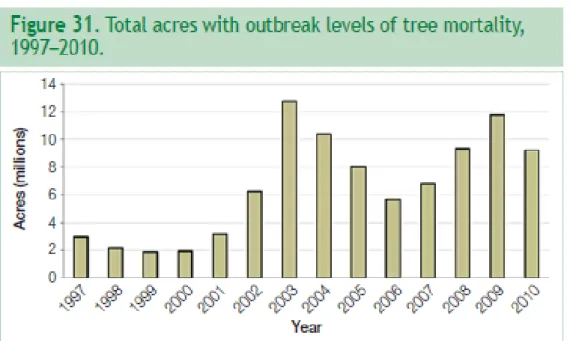
regulating natural cycles of growth and succession in many ecosystems across the United States and Canada for thousands of years (Gibson 2009). In North America alone there are over 500 species, only a few of which are associated with host tree mortality (USDA 2011). Only within the last century (with the development of forestry management and the scaling of the forest products industry in North America) has the timescale in which these epidemics occur been the focus of significant management and mitigation efforts (Nikiforuk 2011). However, in the last two decades tree mortality from the beetles has increased at unprecedented rates and impacted much larger geographic regions of North America then the normal outbreak patterns over the past century (Natural Resources Canada 2012, USDA 2011). (Appendix Figure 1)
Although forest managers have had some success in preventing outbreaks using
were at risk of reaching at least 25% mortality by the year 2021 (USDA 2006). 4 (Appendix
Tables 1-2)
Of the many species of native bark beetles in North America, the Mountain Pine Beetle (MPB) (Dendroctinus pondersa) is known as one of the most destructive in terms of the volume of timber killed and the geographical area impacted.5 The MPB is known to target twelve different species of pine, including several economically important commercial species such lodgepole (Pinus contorta) and pondersa pine (Pinus ponderosa). The range of the MPB extends from Northern Baja, Mexico northward through the western United States to Central British Columbia (Gibson 2009).6
For such a destructive insect, the MPB beetle is actually quite small—roughly the size of a grain of rice. The beetles attack trees through a collective pheromone-driven effort in which hundreds of beetles work to penetrate the bark of a host tree in order to access and feed off of the nutrient-rich phloem (Hicke 2008, Gibson 2009). Forest stands with larger trees eight inches or greater in diameter and older than 80 years are generally preferred by the beetles because these older trees grow slower and are unable to produce the quantity of resin necessary to defend against the invading beetles (Hicke 2008). Once inside a tree, the female beetles will carve vertical galleries that are used as nurseries for the larvae of future generations throughout the tree’s phloem. (Appendix Image 1) Occasionally, the tunnels carved by the beetles will score the valuable sapwood of the trees, but the damage is usually superficial, allowing for high lumber recovery rates at the mill (Gibson 2009). The tunneling of the beetles, in combination
4 US EPA “Forestry Facts and Figures” estimates 751.2 million acres of forested land in the United States. 5 The large volumes of timber killed by the MPB are the reason why this study specifically focuses on MPB killed
timber, the potential to use timber killed by other bark beetles and insects also exists.
with the growth of symbiotic fungi they carry, effectively girdle the tree, resulting in tree mortality in as little as one to two months (Byrne 2005). (Appendix Image 2)
Blue Stain Timber
One of the biggest barriers to fully utilizing timber recently killed by the mountain pine beetle is the color of the wood after the tree is attacked (Lewis 2006). The MPB has a symbiotic relationship with different blue-stain fungi including Ophiostoma clavigerum, and O. monitum,
that is essential for providing nutrients to the developing beetle larvae inside the tree (Byrne 2005). Once the MPBs successfully break through the trees defenses, the spores of these fungi are carried by the beetles into the tree were the hyphae of the fungi spread throughout the tree’s vasculature, staining the wood a grayish-blue color (Byrne 2005, Gibson 2009). This blue stain is a distinctive characteristic of pine killed by the MPB and it affects the coloration of any salvaged wood through the value chain of Beetle Killed Pine (BKP) products. (Appendix Image 3) Importantly, the blue-stain fungus does not damage the structural integrity of the wood beyond the natural decay and drying process that would take place after the tree mortality. However, the stain does have impacts on the marketability and potential uses for the salvaged timber, ultimately limiting the types of products that can be made from the wood (Byrne, 2005, Lewis 2006).
2.2 North America Salvage Potential for Beetle Killed Pine
Understanding the Extent of the Epidemics
ecological disturbances ever recorded, damaging approximately 50% of British Columbia’s commercial pine forest and killing an estimated 675 million cubic meters of pine (Maness 2012, Hicke 2008, Environment Canada, and Natural Resources Canada). As the world’s largest exporter of softwood7 timber products, the economic consequences of the MPB epidemics have cost the industry hundreds of millions of dollars in potential revenue (Natural Resources
Canada).
Despite the fact that the most severe MPB epidemics have occurred across British Columbia, the western United States has also suffered devastating loses of lodgepole and ponderosa pine. Since the early 1980’s the cumulative effects of these epidemics are estimated to have impacted more than 20.3 million acres of forested land across twelve western states (Hick 2008, Prestemon 2013). Studies have estimated that as much as 550 million cubic meters of timber are potentially available for salvage across this outbreak area, with the highest amounts of salvageable timber found in Montana, Colorado, Wyoming, Utah, and Idaho. Collectively these five states account for nearly 75% of all dead salvageable timber west of the Mississippi River (Prestemon 2013). Given current forest conditions across these states, millions of acres remain at high risk for future outbreaks (USDA 2006, Hicke 2008).
2.3 Factors Influencing the MPB Epidemic Severity
Climate Change and the MPB
A growing body of research on the MPB has linked the severity of the recent MPB epidemics to climate change. Both the direct effects of higher temperatures and the indirect effects of drought have been cited as triggers for the recent MPB epidemics (Bentz 2010, Hicke
2008, Gibson 2009, USDA 2011). Like many other destructive insects, the entire lifecycle of a bark beetles life is affected by temperature (USDA 2011). Historically, MPB populations have been controlled by the presence of cold winter temperatures that occur naturally in the
mountainous western U.S. and British Columbia that would routinely drop below -40 ᴼC (USDA 2011, Natural Resources Canada). These low temperatures kill beetle larva that would otherwise mature to seek out other pine host in late spring and summer. However, because average
temperatures in western states have increased by 1-2 ᴼC over the last two decades, more beetles are surviving to reproductive maturity (Bentz 2010, Hicke 2008). Evidence also suggests that warmer temperatures will expand the natural range of the MPB northward and to higher elevation forests (Bentz 2010, Volney 2000). This poses increasing risks to pine forests in northern latitudes across western and central Canada and threatens higher elevation forests across the beetle’s current range in North America.
Indirect effects of climate change that alter precipitation patterns are also predicted to increase the vulnerability of pine forests to insects like the MPB. In particular, the prevalence of drought has played a major role in the severity of the MPB epidemics across western North America. When trees become stressed for water, they are weakened in their ability to secrete the resinous compounds necessary to defend against attacking beetles (USDA 2011).
More ecologically complex and species-specific interactions between the MPB and warming temperatures are only beginning to be researched and understood. For example, a 2009 study conducted by MPB expert Diana Six at the University of Montana at Missoula, found that MPB larvae thrive at higher temperatures because this encourages the growth of a more
fungi provides, MPB beetle larvae have been shown to grow faster and are more likely to survive to adulthood (Nikifork 2013).
Impacts of Management on Pine Forest Vulnerability
Although changes in climate are often regarded as the trigger for large scale MPB
epidemics across North America, underfunded and misguided forest management practices have also played a large role increasing the vulnerability of pine forests to bark beetle epidemics. For example, policies supporting wildfire suppression have been one contributing factor to the severity of recent MPB epidemics across western states such as Colorado and Wyoming (USDA 2011). The absence of fire in naturally fire-regulated ecosystems has led to dense stand
conditions that stress trees to compete for limited nutrients and water resources. Historically, these crowded pine forests are where tree mortality from the MPB has been the highest. Even to this day, millions of acres of forest remain vulnerable for this reason to future epidemics. (Hicke 2008, Pfeifer 2010, USDA 2011).
The declining health of the United States and Canadian timber industries has also played a significant role in contributing to the severity of the MPB epidemics. Since the 1980’s, steep declines within the US timber industry have reduced the funding for practices such as thinning that help reduce the vulnerability of trees to insect epidemics. This has been especially true across federally managed timberlands, which are estimated to have about 85% of all MPB
2.4 The Mountain Pine Beetle and Forest Carbon Feedback
The relationship between climate change and the MPB epidemics becomes increasingly complicated when carbon-feedback cycles from large mortality events are considered. Although forested ecosystems represent a tremendous global carbon sink8, the ratio of carbon stored in biomass to the carbon released into the atmosphere varies based upon the productivity of the forest studied (Kurz 2008). On average one acre of pine forest holds approximately 170 tons of carbon (Nikiforuk 2013). Consequently, widespread tree mortality following MPB epidemics impacts the ability of forests to absorb and store carbon following outbreaks. Research conducted on stands of beetle killed pine (BKP) in Idaho has confirms this, finding that after mortality events occur, carbon stocks in the stands measured were reduced between 31-83% (Pfeifer 2010).9 Across British Columbia alone, the decomposition associated with the epidemics in the past decade is expected to release approximately 270 Mt of carbon by 2020—an amount equal to approximately 40% of Canada’s annual GHG emissions (Kurz 2008, Environment Canada 2012). Over time, natural ecological cycles will eventually replace the carbon stocks in these forests (assuming reforestation occurs). However, there is concern that the carbon released in the short and mid-term10 following MPB epidemics could lead to an overestimation in the ability of forests across the Northern Hemisphere to sequester CO2 (Kurz 2008, Pfeifer 2010).
The carbon emissions from these mortality events following MPB outbreaks have also been identified as a positive feedback to regional climate processes (Malmsheimer 2008).
Besides the obvious case of increased CO2 emissions from tree decomposition, additional factors
such as a decrease in summertime evapotranspiration and increases in ground temperatures have
8 Globally, this carbon sink is estimated at 1.6 trillion metric tons of carbon dioxide (IPCC 2007).
9In this study the highest pine mortality rate in the plots studied was 52%.
3. Challenges and Opportunities Utilizing and Marketing Beetle Killed Pine
3.1 Challenges Associated with Salvaging Beetle Killed Pine
The severity and scale of the MPB epidemics over the last decade has posed significant challenges for the forest products industry that have prevented BKP from being used efficiently as a resource. Fundamentally, the most significant challenge for the industry has been a lack of demand for both wood and salvaged wood products. This lack of demand translates into low values for timber, especially salvaged timber which typically sells between $25 and $40 less per 1000 board feet than normal wood.11 Because the decision to salvage timber is regarded as an economic one, much of the timber that could be used in long-lived wood products is left to decompose. However, leaving the fundamental issue of creating demand to be discussed later in this paper, salvaged wood is associated with certain challenges that must be overcome before the industry can efficiently utilize it as a construction material. This section addresses these
challenges as they relate to the harvesting, processing, and marketing of BKP timber.
The Decline of the Forest Products Industry
Two common responses to the bark beetle epidemics have been to increase the allowable harvest permits for living pine, and to salvage BKP when it proves to be economically
advantageous. (Kurz 2008, Nikiforuk 2011, USDA 2011).12 However, due to the declines in the North American timber industry, a lack of milling capacity within the industry has limited the amount of wood that can ultimately be processed in many areas. For example, in the US Forest Service Region 2 (encompassing states such as Wyoming and Colorado), the timber industry saw
11 Correspondence with Neiman Enterprises Inc. estimated that the stumpage value for salvaged timber killed by the
MBP was typically $25-40 less per 1000 board feet (mbf) than normal wood (Stevens 2014).
12 Decisions to increase harvest above permitted levels have been controversial. Environmental have voiced
a decline of 63% since 1986 (USDA 2011).13 This region has also been one of the hardest hit by the recent bark beetle outbreaks in the U.S. More recently, a slow recovery from the 2008-2009 recession and housing market crash has impaired the industry’s ability to actively manage forests (reducing the chances of MBP outbreaks) and assist in salvage logging operations following epidemics (Natural Resources Canada, USDA 2011). In locations where tree mortality has been highest (e.g. Colorado), the U.S. Forest Service has increasingly looked towards private
companies to develop new technologies that can increase the efficiency of BKP utilization (USDA 2011).
The Canadian timber industry has also faced similar challenges in the last decade because of downturns in the global economy that have reduced the demand for exported wood products, primarily to markets in the United States (Natural Resources Canada). A 2012 review by the Canadian Forest Service concluded that these cyclical downturns, in combination with the collapse of newsprint and paper demand, have forced many Canadian mills to close. These factors, in addition to the impact on the wood fiber supply from the MBP epidemics across western Canada, are cited as the primary reasons behind the industry’s recent decline (Natural Resources Canada).
High Costs to Harvest Beetle Killed Pine
The high cost of accessing BKP limits the volumes of wood that can be harvested. Because BKP outbreaks often occur in remote area or in protected forests, large volumes of BKP are not salvaged because of high harvesting and transportation costs. In 2011, the “Forest
Service Response” to the MPB outbreak across Colorado and Wyoming found that only 25% of the timber in these outbreaks was economically salvageable due to the lack of road access, slope,
and transportation distances (USDA 2011). Despite this relatively small percentage of accessible BKP, the total volume of wood killed in these epidemics is so large that even this fraction still represents an enormous amount of usable timber. Studies looking at the salvage potential across the western U.S. have found that nearly 7% of all timber volume is estimated to be both dead and salvageable. This is easily in the hundreds of millions of cubic meters range (Prestemon 2013). However, until the price for this dead timber increases to justify harvesting it, the percentage of dead wood that is salvaged will remain small because of the cost barrier to accessing this wood.
Wood Deterioration with Time after Death
Perhaps the single greatest challenge to BKP utilization is harvesting it while it is still economically valuable.14 This involves a careful cost benefit analysis by forest managers. After the trees are killed, the amount of recoverable timber decrease with time. The rate of this
decrease depends upon environmental factors such as moisture, oxygen, and temperature. These factors not only impact the deterioration of wood, but also the value of the products that can ultimately be made from it (Byrne 2005). As the time after death increases, so does the chance that other fungi and insects have damaged the wood. These damages make processing the wood more expensive, and decrease the final value of the wood (Byrne 2005, Lewis 2006).
Consequently, the “shelf-life” of BKP is longer for some products than others. For BKP to still be useable in solid wood products (dimensional lumber, studs and veneers), it usually needs to be salvaged within three years after it has been killed (Bryne 2005).15 Beyond this point, the salvaged blue stain timber is known to check16 as the wood dries out naturally. These checks
14 The rush to harvest leads to rapid increase of supply, depressing prices, and the sense of urgency has in many
cases been an excuse to employ unsustainable forestry practices such as clear cutting
can reduce the strength, quality, and ultimately the value of the wood. Other studies have contested this 3 year “shelf-life” showing that substantial lumber recovery from standing dead timber exists beyond this point, especially in cold and dry environments (Lewis 2006). Other studies conducted by Forestry Innovation Investment Ltd. in Canada have found that even after being harvested five years after death BKP had a lumber recovery factor17 of 87.5% that of normal wood (Barrett 2007).
Difficulties Processing BKP in Solid Wood Products
The physical condition of salvaged BKP has implications on how efficiently it is processed. With timber that has been dead for a long time, the heavy machinery used in harvesting, skidding, loading, hauling, decking, and feeding mills can accidently break or
damage the timber. At the mill, debarking equipment jams more easily with dead timber because the bark sloughs off in large chunks. Sawing dead timber increases energy and processing costs because the dead timber is drier and denser than normal wood and the saw blades dull more quickly. Kiln drying18 dead wood also proves problematic, because the wood already has a low moisture content when it arrives at the mill. Collectively, these considerations highlight the difficulties faced by mills in processing BKP (Byrne 2005).
Marketing the Blue Stain
The blue stain associated with MPB also has a negative impact on the value of salvaged BKP. One explanation is that the presence of blue stain in the timber lowers the grade of wood to “2 Common”—the lowest grade for softwood timber.19 Consequently, the wood obtains a low
17 The lumber recovery factor is a measure of lumber yield per quantity of log volume. Generally this is expressed
in 1000 board feet (mbf) per cubic meter.
market price (Lewis 2006). Researchers have found little evidence that the presence of blue stain has any significant negative structural implications on the wood, beyond those that would
naturally occur as a result of natural deterioration. Regardless, the blue-grey color of the stained wood is perceived as unattractive or of lower quality by buyers (Byrne 2005, Lewis 2006). The negative perception is especially strong in important export markets for the Canadian timber industry, like China and Japan. Without markets to drive the demand for BKP timber, the net value of BKP products for the timber industry is very low, if not in many cases negative (Byrne 2005).
3.2 Timber Industry Recommendations for Increasing the Use of Salvaged BKP
Industry Suggestions for Increasing Utilization
The inefficiencies and costs associated with salvaging BKP have led to discussions about how the wood can be used, particularly in value-added products that justify its inefficiencies and increased processing costs (Byrne 2005). Recommendations for utilizing BKP focus on
encouraging its use in applications where the appearance of the wood does not matter. This would include dimensional lumber products and wall studs because these products, unlike other “appearance grade” products, are not intended to be visible. Consequently, the aesthetics of the blue-grey stain should not play as large of a role in the marketability and grade of the salvaged timber (Lewis 2006). Other researchers have suggested using government policies and
incentives to increase demand for BKP by growing the timber industry as a whole (Prestemon 2013).
The case of the mountain pine beetle provides one example of the difficulties associated with utilizing salvaged timber following major forest disturbances. As described in the previous sections, changes in climate and poor forest management are the primary factors affecting the severity of these epidemics. Across western North America the volumes of potentially
salvageable wood are quite large, and have the potential to be used in wood products that are not appearance grade—assuming the trees are salvaged within several years after being killed. When this timber is not utilized, research suggests that the carbon released from decomposition may actually contribute to climate feedback processes, helping to create the conditions necessary for the MBP to thrive. This, along with the presence of vulnerable forest conditions and
predictions for warmer temperatures, suggests the high likelihood that future MBP epidemics will continue to impact the North American timber industry.
Finally, despite the current availability of this timber, salvaging BKP is associated with several challenges that discourage the timber industry from fully using this resource.
4. Salvaged Timber as a Green Building Material
4.1 Carbon Benefits of Wood and Salvaged Wood in Construction
The first two chapters of this paper describe the extent and severity of the Mountain Pine Beetle (MPB) epidemics in the United States and Canada, as well as the challenges that these mass mortality events have had on the timber industry’s ability to utilize Beetle Killed Pine (BKP). However, the potential environmental benefits associated with using salvaged wood as a construction material make a compelling case to find ways to utilize this resource as a green building material.
Carbon Sequestration in Wood Products
The natural ability of trees to convert atmospheric carbon into woody biomass gives wood an environmental advantage over many other building materials because wood fiber is a carbon sink.20This carbon sink, when aggregated across all harvested wood products in use (and those buried in landfills), sequesters a large volume of carbon that over time is oxidized back into the atmosphere as CO2.21 When incorporated into longer-lived products such as wood
buildings, wood can sequester carbon for the lifetime of the building, frequently exceeding 100 years (McFarlane 2012). A typical North American wood-framed house sequesters on average 28 tons of CO2, an amount roughly equivalent to 12,500 liters of gasoline or seven years of
driving a mid-sized car (Green 2012). Considering that 90% of the US housing stock is wood-framed (115 million units), the amount of carbon stored in residential buildings alone equates to the amount stored in over 100 billion liters of gasoline, or approximately 230 million tons of CO2
20 About half of the mass of dry wood in long-lived wooden structures is comprised of carbon.
21 A study conducted by the USDA estimate that carbon contained within wood products in the US equals about
(Bowyer 2010, Green 2012).22 This is equal to about 4% of all GHG emissions produced by the United States in 2012 (US EPA 2012). As a result, increasing the amount wood used in
buildings, especially those that have not traditionally been constructed using wood (e.g. multi-unit residential/commercial buildings), can be viewed as one response strategy for mitigating GHG emissions (Green 2012).
Avoided Carbon Emissions from Using Wood in Construction
The lower embodied energy of wood when compared to other common building materials gives it another environmental benefit as a construction material. A large body of life-cycle assessment (LCA) data has been published indicating that wood products used in construction are normally much less carbon intensive to produce than alternative materials such as steel and concrete (Ritter 2011). Consequently, when wood is used over other functionally equivalent materials emissions are “avoided” that would have otherwise been released into the atmosphere (Sathre 2010)23. Because of the large amount of energy (often fossil fuel energy) needed to produce materials like steel and concrete, the carbon avoided from the use of wood product substitution is often greater than the amount of carbon sequestered in the wood (Buchanan 1999). Quantifying these avoided emissions becomes more difficult than quantifying sequestration because the emission values differ based upon the materials that could have been used instead of wood. To develop a standard way of estimating this value, researchers have used meta-analyses from dozens of studies to estimate that for every ton of dried wood used in place of non-wood products, approximately 3.9 tons of CO2 emissions were avoided (Sathre 2010).24
22 US EPA GHG calculations and references.
23 This is also known as wood product substitution, or referred to as material substitution.
24 This applies to functionally equivalent materials that would be reasonable alternatives to wood construction
Avoided Carbon Emissions from Salvaged Wood Products
The use of salvaged wood in construction has an additional benefit related to avoided carbon emissions. Unlike living trees that absorb carbon, dead salvageable wood becomes a net producer of carbon as it decomposes. Using salvaged timber in construction is one way to postpone these emissions until the end of a building’s lifetime, potentially hundreds of years in the future (Bowyer 2010). This paper assumes that there is no opportunity cost for using
salvaged wood in construction, meaning that there is no alternative use for this dead wood. It is either used, or it decomposes naturally—a situation similar to many seen following the MPB epidemics. Therefore, any volume of salvaged timber that is used in construction is credited with avoiding 100% of the emissions that would have been released had that volume
decomposed naturally.25 This is different than regular wood which has an opportunity cost. Had the same volume of regular wood not been used in building construction it would have still been harvested. Of this harvested wood, approximately 60% would have been used in other carbon sequestering wood products while the remaining 40% of the wood would be turned into fuel (charcoal, fuel wood, etc.), releasing carbon emissions back into the atmosphere. Consequently, only this 40% of the carbon sequestered in normal wood products would actually count as “avoided emissions” from wood construction (IPCC 2007).
Finally, the use of salvaged timber allows for the wood supply to increase using
proportionally fewer living trees. This allows living timber to remain in forested ecosystems to continue absorbing CO2 from the atmosphere. Although this benefit is beyond the scope of this
paper, it is notable that this substitution could shift more carbon from the atmosphere into wood fiber by keeping green trees growing and using timber that would otherwise decompose.
Calculating the Avoided Emissions from Wood and Salvaged Wood in Construction
The ability for both normal and salvaged wood to be used in construction to sequester carbon and avoid emissions through material substitution gives wood two climate-conscious advantages as a building material. However, for the timber industry to capitalize on these benefits they must first be looked at quantitatively and then captured on a market. To do this, it is helpful to think of the carbon emissions avoided when large buildings use wood as a primary construction material over other traditional materials, primarily steel and concrete. This paper uses the findings studies such as Sathre 2010, Puettman 2013, and Lewis 2006, to inform a basic model for calculating the gross and net avoided emissions for wood construction. The different variables used include:
(Cs) Carbon sequestered in wood
(α) Alternative wood use factor26
(Ms) Carbon avoided from material substitution
(Ep) Emissions produced in cradle-to-gate timber production processes27
(β) Efficiency coefficient used to show the increase in Ep from processing salvaged wood.28
Calculation for Gross Avoided Emissions for using wood and salvaged wood in construction over traditional material construction:
Regular Wood = Cs*α + Ms
Salvaged Wood = Cs + Ms
Calculation for Net Avoided Emissions for using wood and salvaged wood in construction over traditional material construction:
Regular Wood = Cs*α+ Ms – Ep
Salvaged Wood = Cs + Ms – (β*Ep)
26 Globally this is estimated that about 60% of harvested timber is used in products that sequester carbon, and that
40% is used as fuel. For the purposes of this calculation α =0.4. This represents the carbon emissions from the alternative use of this wood as a fuel. In salvaged timber α =1.0 with the assumption that 100% of the carbon would be released into the atmosphere (IPCC 2007).
27 Cradle-to-gate is the assessment of a products partial life-cycle. In this case it refers to all the processes
specifically related to creating cross laminated timber (e.g. harvesting, transporting, milling, and manufacturing).
This model suggests that the net emissions avoided for salvaged wood are balanced between the increase in carbon sequestration (Cs) (from having the alternative wood use factor
[α] equal to 1), and the increase in the emissions produced (Ep) in the cradle-gate-timber
production. This is because even though the use of salvaged wood is associated with more avoided emissions than regular wood, it is often more carbon intensive to harvest, transport, and mill (for reasons discussed in Section 3). Consequently, as the Efficiency Coefficient (β)
increases above 1, the avoided emissions of using salvaged wood decrease until they equal, or fall below the avoided emissions of regular wood. Finally, although the avoided emissions of both normal and salvaged wood will remain proportional to each other when described using the equations in this section, the actual volume of carbon sequestered at the individual building level must first be significant enough to encourage the use of salvaged timber as a construction
material. This means examining wood’s ability to be used in large construction projects.
4.2 Cross Laminated Timber: An Opportunity for Salvaged Timber
Cross Laminated Timber and Salvaged Timber
of the most promising of these technologies for North American markets is Cross Laminated Timber (CLT), an engineered glue-laminated wood product that uses dimensional lumber as its main input material (Crespell 2010).
CLT is made by taking individual softwood panels and assembling them in layers that are stacked so that each consecutive layer lies perpendicular to the layer beneath it. 29(Appendix
Image 4) Through this process, large volumes of wood get incorporated into the finished product
which is prefabricated and transported to the construction site in large pieces. One of the unique qualities of CLT is that it can use both regular and salvaged timber in the layers of this paneling (Crespell 2010). Because of this structural application, the timber used does not have to be of appearance grade quality. This would qualify salvaged blue-stain timber to be used in the construction of future CLT buildings.
Avoiding Carbon Emissions Using CLT Buildings
Most of the examples of newly constructed CLT buildings are found in Europe, where the technology was first developed in the late 1990’s. For the purposes of understanding the carbon avoided by the construction of these wood buildings three examples will be discussed in this paper. These include: (1) Murry Grove Apartments in the UK, (2) Limnologen Apartments in Sweden, and (3) Norwich Open Academy also in the UK. (Appendix Images 5-7) These respective buildings used 950 m3, 4800 m3, and 3600 m3 of CLT in their construction (Crespell 2010). In order to estimate the net avoided carbon emissions from each building, the volume and mass of the wood used in these buildings was multiplied by different conversion factors taken
29 Stacking in this way gives the wood increased stability and rigidity. The layers are generally 3-7 boards thick, but
from literature sources. An example of these calculations is demonstrated below using the equations described previously in this section.
Example calculation of net avoided emissions from Murry Grove Apartments:
Regular Wood = Cs*α+ Ms – Ep
Cs = (950 m3 *1192 kg CO2/m3)/1000 = 1132.4 Tons CO2
α = 0.4
Ms = [(950m3*650 kg/m3)/1000]*3.9 = 2408 Tons CO2
Ep = (218.67 kg CO2*950m3)/1000 = 208Tons CO2
Net Avoided Emissions = (1132.4*0.4) + (2408) – (208) = 2653 Tons CO2
Salvaged Wood = Cs + Ms – (β*Ep)
Cs = (950m3*1192 kg CO2/m3)/1000 = 1132.4 Tons CO2
α = 1.0
Ms = [(950m3*650 kg CO2/m3)/1000]*3.9 = 2408 Tons CO2
β = 1.1
Ep = (218.67 kg CO2*950m3)/1000 =208 Tons CO2
Net Avoided Emissions = (1132.4*1.0) + (2408) – (1.1*208) = 3312 Tons CO2
Table 1 summarizes the results of the net avoided emissions for each of the three buildings selected. Because CLT sequesters between 1.2-1.5 tons of carbon dioxide per meter cubed (depending on wood density), the carbon sequestration (Cs) for these buildings was
estimated by multiplying the CLT volume by a conservative value of 1.192 (Crespell 2010, Green 2012). This value was then multiplied by the alternate wood use factor (α) of 0.4 for the normal wood scenario to equal the emissions that would have been released had this wood not been used in construction (Cs*α). In Table 2, this is represented using only Cs because α=1.0 for
In Tables 1 and 2, the avoided emissions from material substitution (Emissions Ms) were
then calculated using the results of the meta-analysis of greenhouse gas displacement factors for wood material substitution by (Sathre 2010). These avoided emissions corresponded to
approximately 3.9 tons CO2 per ton of dry wood used (Sathre 2010). When added together these
two terms Emissions (Cs) and Emissions (Ms) equaled the gross emissions avoided, or “Gross
Avoided.”
Table 1:Net carbon emissions (Tons) avoided using regular wood as the principle construction material.30
Although the gross emissions avoided convey the potential carbon savings achieved through the construction of these mass-timber structures, they fail to account for the emissions produced in the upstream processes to make the wood usable. For emissions produced from processing normal wood into CLT, this has been estimated to be 218.67 kg CO2/m3 (Puettmann
2013). However, in the case of salvaged wood, inefficiencies in production often result in greater carbon emissions. To account for these inefficiencies, an efficiency coefficient (β) of 1.1
(assuming a 10% increase in emissions per m3) is used.31 As both Tables 1 and 2 indicate, the emissions from processing are small in comparison to the gross emissions avoided,
approximately 7.2% for normal wood and 6.5% for salvaged wood. These small percentages attest to the low embodied energy of wood and its value as a green building material.
30 Reference Appendix Section I for list of table assumptions.
31 Although it might be less efficient to process salvaged wood, it would take an efficiency coefficient of 4.3 in order
Table 2: Net carbon emissions (Tons) avoided using salvaged wood as the principle construction material.
Finally, the net avoided emissions were calculated by subtracting the processing emissions from the gross avoided emission for all buildings in both normal wood and salvaged wood scenarios. Table 3shows a side by side comparison of these results from which two important observations can be made. The first is that the amount of carbon avoided by mass-timber construction has the potential to be large (>10,000 tons).32 This is large enough to be
valued on the individual project level and, assuming the right policies and incentives, could be associated with even larger benefits at the societal level. The second observation is that using salvaged wood has the potential to avoided approximately 25% more emissions than regular wood under the stated assumptions. This increase is entirely dependent on the alternative use factor α.
Table 3: Percent change in avoided emissions (Tons) between normal and salvaged wood.
The North American Market Potential for CLT and Mass-Timber Structures
Most of the buildings constructed using mass-timber exist in Europe. However, a large market potential has been identified across North America by one of the leading forest research groups, FPInnovations. Reports from this group estimate that at a 5% market penetration level
32 As a reference the average timber framed house in the US holds 28 tons CO
for low and mid-rise construction,33 1.2 million cubic meters of wood would be needed as a construction material. At a 15% market penetration level, the amount of wood required would increases to 3.6 million cubic meters (Crespell 2010). Using the same equations to estimate the net carbon emissions avoided as those used in the examples above, these aggregate avoided emissions are equal to 3.4 million and 10.1 million tons CO2 for the 5% and 15% market
penetration scenarios (Table 4).
Table 4. Emissions Avoided (Tons) using FPInnovations’ market projection scenarios for mass-timber CLT structures in the United States.
If the construction of these mass-timber structures could be fulfilled using 100% salvaged timber, then the net emissions avoided could increase by roughly 25%. Although this represents purely a hypothetical scenario, even if only a fraction of salvaged wood was used (presumably to be mixed with normal wood), the potential to avoid millions of tons of emissions would exist.
With urban population on the rise, using wood in high-rise construction (10+ stories) has become a topic of great interest for prominent architects in Canada and the United States. In 2012, designs by Vancouver based firm mpb architecture+design demonstrated how wood could be used as the primary construction material for buildings up to 30 stories tall (Green 2012).
(Appendix Image 8) These findings were echoed in a 2013 study by U.S. firm Skidmore,
Owings and Merrill LLP which found that wood could be used as the main structural material in buildings up to 42 stories tall (“Timber Tower”). Although the construction of mass-timber
33 Low and mid-rise construction includes building from 1-10 stories in height. This estimate applies to multi-unit
5. Valuing Avoided Emissions in Wood Construction
5.1 The Value of Carbon Storage and Material Displacement of CLT
The use of wood in long-lived construction projects has the ability to avoid GHG emissions and create markets for timber damaged in climate-related disturbances such as the MPB epidemics. However, shifting the current construction paradigm to favor more resilient and environmentally beneficial methods requires more than simply quantifying the avoided emissions of building with wood and salvaged wood. Market strategies and financial incentives must be used to encourage architects and developers to consider wood construction in the future. Ideally, these mechanisms would find ways to add value to wood products by attributing the value of their avoided carbon emissions to them.
Background to carbon markets and price of carbon
Valuing and trading carbon emissions has been one approach for countries to meet their GHG reduction goals as outlined in the Kyoto Protocol. California’s carbon cap and trade program is one example depicting how carbon can be successfully made into a valuable commodity with prices trading between $11-16 dollars per ton CO2 in 2013 (Carroll 2013).34
Additional examples of valuing carbon are based on models that use discount rates to estimate the future cost of GHG emissions to society. Currently, the U.S. government estimates that this “Social Cost of Carbon” equals $35 per ton CO2 eq.35 This value is larger than the California
market value because its represents a “just” value for carbon that takes into account the harm posed to future generations from current releases of GHGs (“Technical Update”).
34 A price of $15 per ton CO
2 has been assumed for the calculations in this study.
35 This $35 per ton price assumes a discount rate of 3.5%. Assuming different discount rates will change this value
The avoided emissions of wood construction have the potential to be valued in carbon markets similar to California’s, or ideally, through the government’s Social Cost of Carbon. However, valuing wood in this way is controversial because carbon sequestered in wood construction will eventually be released back into the atmosphere. Although the emissions avoided through material substation (Ms) can be credited as completely avoided, the avoided
emissions from carbon sequestered (Cs*α) for both normal and salvaged wood fall to zero after
the lifetime of the building. Consequently, the decision to value (Cs*α) means recognizing the
immediate importance of sequestering carbon now as a way to postpone GHG emissions for years to come (MacFarlane 2012).
Avoided Emission Values for Mass-Timber Structures
Using the three examples of mass-timber construction discussed in Section 4, the
estimated value of the net carbon avoided through normal wood and salvaged wood construction is given in Tables 5 and 6. These tables show the cost savings that could potentially be achieved by developers at the project level assuming a CO2 price of $15 per Ton and $35 per Ton. For
normal wood, the value of the avoided emissions is in the range of 0.38% to 0.80% of the building’s cost at the California market price, and between 0.89% and 1.86% when valued using the Social Cost of Carbon. For salvaged wood, these percentages increase to a range of 0.47% to 0.99% for the California price and between 1.11% and 2.32% for the Social Cost of Carbon.
Table 6: Potential value of avoided carbon using salvaged wood in existing buildings.
These potential savings can also be expressed for each cubic meter of wood and salvaged wood used in construction. Assuming the price a $15 per ton price for carbon, the avoided emissions value from 1 cubic meterof CLT would equal $42.36 At the higher price of the Social Cost of Carbon, the potential value of the avoided emissions is estimated is $98 per cubic meter. As Table 7 indicates, this represents between 6-14% of the purchase price per cubic meterof CLT. When salvaged wood is considered this value increases to between 7-17% of the price for CLT (Table 8) (Crespell 2010).
Table 7: Values of avoided emission from regular wood per m3 in mass-timber construction.
Table 8: Values of avoided emissions from salvaged wood per m3 in mass-timber construction.
Value of the US National Market Potential
The aggregate value of avoided carbon emissions from mass-timber construction frames these economic benefits in a different light. Using the market analysis of FPInnovations, Table 9 shows that at a 5% market penetration scenario this value range $50-117 million dollars. At the 15% market penetration level these values are estimated to be in the range of $151-352 million dollars, assuming the emissions value is between $15 and $35 dollars.
Table 9: Value of net avoided emissions at 5% and 15% market potential in low and mid-rise construction using normal wood.
For reasons discussed in Section 3, the assumptions made in this paper about the values of (α) and (β), the value proposition for using salvaged timber over normal wood is
approximately 25% greater. Table 10 shows the results of this 25% increase in avoided emissions by using salvaged wood instead of normal wood.
Table 10: Value of net avoided emissions at 5% and 15% market potential in low and mid-rise construction using salvaged wood.
5.2 Discussion, Limitations, and Questions about Valuing Avoided Carbon
GHG emissions, the value of this avoided carbon has the potential to become significant, especially when using salvaged wood, at the individual project level. As the tables above indicate, this significance is highly dependent upon three variables including: (1) the price of carbon, (2) the values used to estimate carbon emissions avoided through material substation (Ms), and (3) the alternative wood use factor (α). Varying the assumptions for any of these
factors will produce different results. However, the increase in energy required to process
salvaged wood (β) plays a much smaller role in determining the value of avoided emissions. This is because the emissions produced in processing wood make up only a small percentage of the gross emissions avoided when wood products are used over traditional building materials.
6. Conclusion
By 2050 it is estimated that the number of people living in the world’s cities will double from 3.5 billion to 7 billion people (“Timber Research Tower”). This transition will require the construction of millions of new buildings to accommodate the growing needs of these expanding urban populations. The demands placed on the environment to supply the raw materials for this construction will also require changing the current construction paradigm away from carbon intensive materials such as steel and concrete. Using salvaged wood from the mountain pine beetle epidemics as a case study, this paper has discussed the challenges and opportunities facing the timber industry to use wood killed from climate related disturbances as a “resilient” green building material when used in mass-timber construction.
Presently, millions of cubic meters of potentially salvageable wood exist across the western United States and Canada that have the potential to be used in wood construction
products such as cross laminated timber. However, historic declines of the management capacity of the timber industry and a general lack of demand for salvaged wood products have prevented this wood from being utilized. This represents an economic problem for the timber industry and, in the case of the large-scale mortality events, has the potential to contribute to the environmental problem of climate change by effectively turning forests into net emitters of CO2. With warmer
temperatures and climate changes already increasing the vulnerability of forests to insects and other climate related disturbances, developing ways to market and add value to future salvaged timber products is a timely and climate appropriate response.
carbon sequestered in wood-fiber. These increases in the amount of avoided emissions from salvaged wood translate into potentially larger values if captured in carbon markets. At a carbon price between $15-35 dollars per ton, the value of the emissions avoided in one cubic meter of wood (as CLT) is equal to 6-14% the price of the wood. Assuming that salvaged timber is used, the value of the emissions avoided is increased to 7-17% of the price of wood. At the individual project level, the value of these avoided emissions from salvaged wood has the potential to be in the range of 1-2% of the total value of the project—potentially in the range of hundreds of thousands of dollars. Nationally, when considering different market penetration scenarios (5%) and (15%) for these mass-timber buildings the values of avoided emissions from both wood and salvaged wood construction are in the range of tens to hundreds of millions of dollars.
7. Acknowledgments
8. References
Barrett, J.D., Lam, F. (2007). Stud Mill Lumber Grade and Value Yields from Green Spruce-Pine-Fir and Grey-Stage Dry Mountain Pine Beetle Attacked Logs. Forestry Innovation Investment Ltd. 26 Mar. Retrieved from: http://www.for.gov.bc.ca/hfd/library/
documents/bib106712Report.pdf
Bentz, B.J., et al. (2010). Climate Change and Bark Beetles of the Western United States and Canada: Direct and indirect effects. BioScience. Sept 2010 60(8):602-613.
Bowyer J., et al. (2010). Recognition of Carbon Storage in Harvested Wood Products: A Post-Copenhagen Update. Dovetail Partners Inc. 25 Feb 2010.
Buchanan, A.H., Levine, S.B. (1999). Wood-based building materials and atmospheric carbon emissions. Environmental Science and Policy 2. 427-437.
Byrne, A., Cameron, S., and Peter, B. (2005) Current knowledge of characteristics and utilization of post-mount pine beetle wood in solid wood products. Working Paper. Natural
Resources Canada. Canadian Forest Service.
CABE, Commission for Architecture and the Built Environment. (2011). Murry Grove. UK National Archives. Jan. Retrieved from: http://webarchive.nationalarchives.gov.uk/ 20110118095356/http://www.cabe.org.uk/case-studies/murray-grove/design
Carroll, R. (2013). “Analysis: Strong Start for Carbon Market but challenges loom.” Rutgers Online. 20 Dec. 2013. Available at: http://www.reuters.com/article/2013/12/20/us-california-carbon-market-analysis-idUSBRE9BJ17U20131220
Crespell, P., Gagnon, S. (2010). Cross Laminated Timber: a Primer. FPInnovations. Retrieved from: http://www.fpinnovations.ca/media/publications/Documents/clt-primer.pdf Environment Canada. (2013). National Inventory Report 1990-2011: Greenhouse Gas Sources
and Sinks in Canada. Retrieved from: http://www.ec.gc.ca/Publications/A07ADAA2-E349-481A-860F9E2064F34822%5CNationalInventoryReportGreenhouseGasSources AndSinksInCanada19902011.pdf.
Fountain H. (2013). “Towers of Steel, Look Again.” NY Times Online 23 Sept 2013. Retrieved from: http://www.nytimes.com/2013/12/02/science/earth/in-new-jersey-pines-trouble-arrives-on-six-legs.html?pagewanted=1&_r=0&hp
Gibson, K., Kegley, S., Bentz, B. (2009). Forest Insect and Disease Leaflet 2. U.S. Department of Agriculture. Revised May 2009. Retrieved from:
http://www.beatthebeetles.com/landowner-guidance/PDF/forest-insect-disease-leaflet-1900-mpb.pdf
Hicke, J.A., Jenkins J.C. (2008). Mapping lodgepole pine stand structure susceptibility to mountain pine beetle attack across the western United States. Forest Ecology and Management. 225: 1536-1547.
IPCC (2007) Forth Assessment Report: Climate Change 2007. Wood Supply, Production, and consumption of Forest Products. Referenced from:
http://www.ipcc.ch/publications_and_data/ar4/wg2/en/ch4s4-4-5.html Jeffree, M. (2010). Timber and Sustainable Building. KLH_UK. Retrieved from:
http://www.klhuk.com/media/8491/032010tsb_feature_%27more%20than%20an%20aca demic%20exercise%27.pdf
Karacabeyli, E., Desjardins, R. (2011). Cross Laminated Timber (CLT) in the Context of Wood Biuilding Systems. FPInnovations. Feb. Retrieved from: http://wecbc.smallboxcms.com /database/rte/files/CLT-Context%20of%20Wood%20Building%20Systems.pdf
Kurz W.A. et al. (2008). Mountain pine beetle and forest carbon feedback to climate change.
Nature. 24 Apr 452: 987-990.
Lewis, K.J., Hartley, I.D. (2006). Rate of deterioration, degrade, and fall of trees killed by the mountain pine beetle. BC Journal of Ecosystems and Management. 7(2): 11-19.
Malmsheimer, R.W. et al. (2008). Forest Management Solutions for Mitigating Climate Change in the United States. Journal of Forestry. Apr/May 115-172.
Maness, H., Kushner, P.J., and Fung, I. (2012). Summertime climate response to mountain pine beetle disturbance in British Columbia. Nature Geoscience. Jan 6: 65-70.
Materials Matter. (2013). Measuring the environmental footprint of wood, concrete and steel is a big factor in designing sustainable buildings. reThink Wood. Aug. Retrieved from: http://continuingeducation.construction.com/article.php?L=221&C=754
McFarlane et al. (2012). Harvested Wood Products: Determination of Half Lives for Wood Products in Use. University of British Columbia, Vancouver and BC Ministry of Forests, Lands and Natural Resource Operations. Poster Presentation.
Natural Resources Canada. (2012) The State of Canada’s Forests Annual Report: 2012.
Canadian Forest Service. Retrieved from: http://cfs.nrcan.gc.ca/pubwarehouse /pdfs/34055.pdf.
Natural Resources Canada. “Economic Impacts.” Canadian Government. Retrieved from: http://www.nrcan.gc.ca/forests/insects-diseases/13387.
Nikiforuk, A. (2011). Empire of the Beetle: How Human Folly and a Tiny Bug Are Killing North America’s Great Forests. Greystone Books. Vancouver, BC.
Prestemon, J.P. et al. (2013). “An Economic Assessment of Mountain Pine Beetle Timber Salvage in the West. Western Journal for Applied Forestry.”28: 143-153.
Puettmann, M., Oneil, E., Johnson, L. (2013) Cradle to Gate Life-Cycle Assessment of Glue-Laminated Timbers Production from the Southeast. Jan. Retrieved from:
http://www.corrim.org/pubs/reports/2013/phase1_updates/SE%20Glulam%20LCA%20re port%201_7_13%20final.pdf
Ritter, M.A., Skog, K., and Bergman R. (2011). Science Supporting the Economic and Environmental Benefits of Using Wood Products in Green Building Construction: Executive Summary. USDA Forest Service. Retrieved from:
http://www.fs.fed.us/news/2011/ releases/09 /green-building-report.pdf
Sathre, R., O’Connor, J. (2010). Meta-analysis of greenhouse gas displacement factors of wood product substitution. Environmental Science and Policy. 13: 104-114
Stevens, M. (2014). Sales Manager, Neiman Enterprises. Personal Communication. Email. Feb. Technical update on the social cost of carbon for regulatory impact analysis under executive
order 12866. (2013). US Government Interagency Working Group on the Social Cost of Carbon. May. Retrieved from: http://www.whitehouse.gov
/sites/default/files/omb/inforeg/ social_cost_of_carbon_for_ria_2013_update.pdf Timber Research Tower Final Report. (2013). Skidmore, Owings and Merrill LLP Timber. 6
May 2013 Retrieved from: https://www.som.com/sites/default/files/20130506_SOM-Timber-Tower-Final-Report_2.pdf
US EPA. (2012). Inventory of US Greenhouse gas emissions and sinks: 1990-2012. Executive Summery: Available at: http://www.epa.gov/climatechange/Downloads/ghgemissions /US-GHG-Inventory-2014-Chapter-Executive-Summary.pdf
US EPA. “Forestry Facts and Figures.” United States Government. Retrieved from: http://www.epa.gov/agriculture/forestry.html.
USDA. (2006). Mapping Risks from Forest Insects and Disease. Aug 2007. Retrieved from: http://www.fs.fed.us/foresthealth/technology/pdfs/FHTET2007-06_RiskMap.pdf USDA. (2011). Review of the Forest Service Response: The Bark beetle Outbreak in Northern
Colorado and Southern Wyoming. Rocky Mountain Region and Rocky Mountain Research Station. Sept.
USDOE. (2008). Energy Efficiency and Renewable Energy: Efficiency trends in Residential and Commercial Buildings. Oct. Available at: http://apps1.eere.energy.gov/buildings
/publications /pdfs/corporate/bt_stateindustry.pdf
9. Appendix
I. Assumptions for Tables 1-10 in Text.
1. Wood density is 650kg/m3 for engineered wood products. This translates into 1192 kg CO
2/m3 (IPCC 2006).
2. Carbon from Wood substitution is 3.9 tons CO2 eq. emission reduction per ton dry wood used (Sathre 2010). 3. Cradle to gate production of 1m3 CLT produces 218.67 kg CO
2 eq. (Puettmann, 2013).
4. Alternative Use (α) = 0.4 (IPCC 2007) 5. Energy Coefficient (β) = 1.1
6. Social Cost of Carbon equals $35.00/ton (“Technical Update”). 7. California Market Price for CO2 equals $15.00/ton (Carroll 2013).
II. Sensitivity Analysis Results
D. Results from the assumed scenario using salvaged wood
E. Results from “worst case scenario” using salvaged wood
Note: The worst case scenario is associated with a 65% reduction in the carbon admissions
IV. List of reference Tables, Charts, and Figures
Table 2. Acres at risk (>25% mortality) of bark beetle damage 2006-2021 (USDA 2006).
Image 1: Mountain Pine Beetle carving galleries through tree phloem (Gibson 2009)
Image 5: Computer generated model of Murry Grove Apartments (Crespell 2010).
Image 7: Nordwich Academy during construction (Crespell 2010).
Image 8: Theoretical 30 story mass-timber (CLT) building proposed by the Vancouver based