The Effects of Competition among Fertility Centers on
Outcomes in In Vitro Fertilization
By Anne Steiner
A Master's paper submitted to the faculty of The University of North Carolina at Chapel Hill
In partial fulfillment of the requirements for The degree of Master of Public Health in
The Public Health Leadership Program.
Chapel Hill
2003
,---i
Ill ~..----Abstract
Context To successfully compete for future patients, fertility specialists strive to achieve high pregnancy rates. If the specialist transfers multiple embryos during an in vitro fertilization (IVF) procedure to obtain high pregnancy rates, the percentage of high order multiples (HOM) may inadvertently rise.
~--Objective To measure the effect of competition among fertility centers on outcomes in in vitro fertilization.
Design and Setting Retrospective cohort of 408 fertility clinics registered with the Society for Assisted Reproduction as providing IVF services in 2000.
Competition is defined as number of clinics in a statistical area. Demand for services is based on the population of reproductive aged women.
Subjects 381 fertility clinics reporting clinical outcomes
Main outcome measures: The clinic high order multiple gestation rate (percentage of pregnancies that were high order multiples) and age adjusted pregnancy rate
of competition resulted in fewer high order multiples than intermediate
competition (RR 0.56, 95% confidence interval 0.36,0.89) or low levels of
competition (RR 0.57, 95% confidence interval 0.35, 0.94). Age adjusted
pregnancy rates did not differ by level of competition.
Conclusions Based on this data, the risk of high order multiple gestation
decreases with increasing competition between clinics; however, pregnancy rates
Acknowledgements:
Katherine E. Hartmann, MD, PhD: Second reader, provided editing and advice on methodology
Vijaya K. Hogan, PhD: Advisor, provided extensive editing
Bob Konrad, PhD: Consultant, provided advice on defining a geographical area
L
Problem Statement
In the year 2000, 180.5 out of 100, 000 live births were triplets or other
high order multiple births. Although this number is down from its peak of 193.5
in 1998, it is still significantly higher than the 1980 rate of371 These multi-fetal
pregnancies are associated with adverse fetal implications such as prematurity,
and maternal complications such as pre-eclampsia and uterine atony with
hemorrhage. In addition, there are large health care costs associated with the
multi-fetal pregnancy and its related complications2 Preventing high order
~---multiple pregnancies can reduce costs and decrease both maternal and infant
mortality.
The use of assisted reproductive technology (ART) services, such as
intrauterine insemination, ovarian hyperstimulation, and in vitro fertilization
(IVF) is associated with an increased risk of multi-fetal pregnancy2 In 1998,
11% ofiVF pregnancies were high order multiples (HOM), three or more
gestaiions3 In fact, ART accounts for 43% of the total number of HOM births in
the United States4•5
The association between HOM and IVF is especially concerning
considering the large demand for infertility services. Approximately 1.2 million
women received care for infertility in 19956 Many of these women sought ART
services. By 1998, 27,300 (0.7%) of the 3.9 million births in the United States
Background Previous Literature
Several researchers have hypothesized and studied risk factors for high order multiple pregnancies (See Attachment A). Different areas of research have included access to care, physician practice styles, system level interventions, patient demographics and medical history, and patient attitt1des. Few researchers have stt1died the effects of access to care on the rate of high order multiples. Jain et a!. found that mandated insurance coverage for IVF lead to a decline in the percentage ofHOM7 However, other researchers failed to find such an association8
The medical history of a patient may also contribute to the risk ofHOM. Some authors have found that increasing number of previous attempts at IVF resulted in a lower risk of multiple gestation9'10 However, Basil eta! did not
observe this association in a retrospective study.11 Studies researching the effects of age have been even more inconsistent, with some studies finding that age decreases the risk ofmultiples,9•12•13 and others showing that age has no
association. 11•14 In fact, Senoz et a! found a nonsignificant trend of increasing risk
with age.15 These differences may more reflect physician practice styles than a medical risk factor. Physicians transfer more embryos in older women than younger women, however the difference in the numbers transferred varies by physician.
Embryologic factors are a more frequently studied subject. Multiple articles have shown a significant association between number of embryos
101
L
I
!recommendations on the number of embryos to transfer, two or three, to
maximize pregnancy rates and minimize the mLI!tiple risk. On the other hand, two studies have clearly shown that blastocyst transfer can lead to lower multi-fetal pregnancies16'17 One study showed that increased embryo quality led to a higher
risk of multiples, but this study has not been confirmed.11 Finally this same study showed that the total number of embryos generated was not associated with HOM risk. Clearly the evidence on risk factors for high order multiples is not
conclusive.
Hock et al used a survey to assess the role of physician practice patterns on multi-fetal pregnancies.18 He found that providers varied in their choice of ART, IVF or superovulation, by region in the United States. In addition, he found that almost all physicians used informed consent for reproductive procedures. The majority of physicians discussed selective reduction (98.3%) and the complications associated with multiple gestation. Physicians most commonly cited maternal morbidity, preterm labor, fetal neurologic sequelae, and fetal death as the complications of multiple gestation pregnancies. These discussions may influence patient knowledge and attitudes towards HOM.
Goldfarb eta! assessed patient's attitudes towards multiple pregnancies by interviewing couples currently undergoing ART.19 He found that patients
preferred triplets to no pregnancy in 88%-98% of cases, and 56-78% preferred quadmplets to no pregnancy. Interestingly, attitudes toward HOM varied by choice of ART procedure.
y---1
~
L
~-To reduce the adverse consequences of HOM, the American Society for
Reproductive Medicine published guidelines in 1999 on the appropriate number
of embryos to transfer. These guidelines stress the use of informed consent and
provide guidance on the number of embryos to transfer based on age, prognosis,
and donor status20 The subsequent decline in HOM would imply that these
guidelines have been successful. The rate ofiVF pregnancies that are high order
multi-fetal gestations dropped from 11% in 1998 to 7. 7% in 2000.21 Engman et a!
found that legislation limiting the number of embryos transferred to three, failed
4---to significantly reduce the risk of mnltiple birth in England9
Current Research Needs
In 1992, the Fertility Clinic Success Rate and Certification Act (P.L.
102-493) called for the reporting and publicizing of the pregnancy rates from all
fertility clinics. These success rates are obtained and validated by the individual
clinics and published on the World Wide Web by the Centers for Disease Control
and Prevention (CDC), with consultation from the American Society for
Reproductive Medicine, Society for Assisted Reproductive Technology, and
RESOLVE: The National Infertility Association.21 These published success rates
appear to influence a patient's choice of a fertility clinic more than the price of the
IVF therapy, distance of the clinic from home, opinion of friends about the clinic,
or recommendation of a general practitioner or gynecologist.22 Thus, a high
pregnancy success rate is important for both economic reasons and the reputation
of the clinic. The goal of achieving pregnancy with each in vitro fertilization
Does competition for success amongst fertility clinics indirectly result in
increased rates of high order multiples? Experts in the field of reproductive
endocrinology have proposed anecdotally that competition between fertility
clinics has induced physicians to transfer multiple embryos in order to improve
23 24 25 A . . I I . . h I . . I
success rates. · · n empmca ana ys1s to examme t e ro e compel!twn p ays
in increasing the number of high order multiples is needed. This requires a
-;---methodologically sound means of measuring competition.
Methodological Considerations in Measuring Competition
A measurement of competition between fertility clinics has yet to be
established. Therefore, a way of measuring competition for each clinic must be
L
generated. In a review on measuring competition in health care by Baker in 2001,the author stresses the need to consider 5 conceptual issues when studying
competition: 1) a definition of the product under study, 2) a measure of
competition, 3) a definition of the market, 4) identification of forces that modify
market dynamics, and 5) the role of health maintenance organizations. 26
Research previously cited on quantifying the degree of competition, uses a
variety of measures for market competition. The number of firms/hospitals (N) in
a market area can be counted and used as a measure of competition in that market
area. Robinson and Luft counted the number of hospitals within 15 miles of each
other, and used the number, N, as the measure of competition27 Gift et a! and
Dranove et a!. considered all hospitals within the same metropolitan area as the
number,
N?
8·29 Although this method is commonly used and easily implemented,The Herfindahl-Hirschman Index (HHl), another measure of competition, is calculated by taking the sum of squared firn1 market shares in an area [(percent market share for clinic A)2+(percent market share for clinic B)2+ ·· .]28 Market
shares for hospitals are usually assigned based on hospital discharges. HHI considers both the relative size and distribution of the firms in a market. As the number of firms increases or the share of the market becomes more evenly
distributed, HHI approaches zero, thereby representing high levels of competition. The Federal Trade Commission uses the HHI measurement for anti-trust
monitoring.
Another way to define competition is to quantify the extent to which two hospitals/firms' markets overlap. The market of a hospital is defined by the zip codes of those patients discharged from the hospitaL Zwanzinger and Melnick used a ZIP code-based HHI to measure competition in multiple studies.30·31 Sohn
also used zip codes to define and compare overlap between hospital markets in
the Los Angeles area using a method defined as the relational approach32
L
How do the various methods of measuring competition compare?Bernstein and Gauthier point out that there is no consensus agreement on the perfect method of measuring competition33 Many previous analyses of competition have been undertaken for a wide variety of reasons by academic researchers, policymakers, competitors, and payers. Their definitions of
local market conditions, such as patient allegiance to certain hospitals or provider groups, restrictions on HMO referrals, or perceived competition by the firrn management33 Sohn found that the various measurements of competition varied significantly in the geographic area she studied with only 50% concordance between any two methods. She asserts that theN method or radial approach overestimates the level of competition in urban markets and underestimates it in rural areas32 However, Garnick et a!. found that all methods produced
bl f . . ~
compara e measurements o competJtwn.
Many geographic areas have been used to define health care markets. Robinson and Luft drew a fixed radius, 15 miles, around each firrn to define an area. Unfortunately a mile radius in Boston, MA may not be similar to a 15-mile radius in Greensboro, NC. Fisher and Wennberg35 used the Dartmouth Atlas ofHealthcare, which defines 306 hospital referral regions based on patient travel patterns. Brasure et al used Health Service Areas (HSA)36 to analyze competitive behavior among physicians. 37 Health service areas are defined using 1988
Medicare data on short hospital stays. There are four alternative definitions of HSAs, two of which base the definition of a HSA on metropolitan statistical
areas. 36
Metropolitan statistical areas (MSA) have a large population nucleus with surrounding communities that share a high degree of economic and social
the components ofMSAs. In MSAs with populations greater than one million the area can be divided up into Primary Metropolitan Statistical Areas (PMSAs) only if the counties in the PMSAs are highly economically and socially integrated38
Other researchers have used metropolitan statistical areas to define a health market. Deaton and Lubotsky compared mortality rates between MSAs39 Anderson et a!. used MSAs to compare community wide access to medical care40 Hendryx et a! compared social capital and access to medical care among 22 MSAs41
Thus a number of factors need to be considered when measuring competition in health care markets. Previous studies offer a variety of
measurements of competition and geographically defined market areas. Because competition among fertility centers has yet to be defined or quantified, previously applied methods of measuring competition must be adopted.
Methods Study Question
This study analyzes the effect of competition among fertility centers on outcomes in in vitro fertilization, specifically high order multiples and pregnancy rates. We hypothesize that competition between clinics results in higher rates of HOM and higher pregnancy success rates. (H0=competition has no effect on
Data Source
The total number of high order multiple pregnancies occurring from fresh embryos with non-donor eggs is currently available from the 2000 Assisted Reproductive Technology Success Rates accessible from the world wide web.21 These success rates are published and placed on the World Wide Web by the Centers for Disease Control and Prevention.21 All clinics that provide artificial reproductive services are required by law to submit their pregnancy rates to the Society for Assisted Reproductive Technologies (SART). The clinic directors then verify the data. SART maintains a list of all ART clinics and their reported success rates and releases that data to the CDC. From 1995-1999 the CDC conducted on-site validation visits, where they randomly selected records from 1321 cycles in 29 clinics. The discrepancy rate was found to be less than five percent. Starting with the 2000 report, the CDC did not conduct random validation visits. Instead, SART conducted a clinic-specific self-validation process. Two hundred and ten of the 377 clinics contacted (63%) completed the self-validation worksheets and a total of2098 ART cycles were validated. Discrepancy rates were calculated and found again to be low. The weighted discrepancy rate for number of fetal hearts on ultrasound was 3 .3 %. 21 In 1999 the
4?
reported rate was 3%.
-Only HOM pregnancies occurring from fresh non-donor eggs were studied. HOM pregnancies occurring from frozen embryos or donor eggs are not reported by the CDC. Twin pregnancies, although reported by the CDC, are not included as high order multiples. The percentage oflive births with multiple
~-infants underestimates the number of pregnancies with multiple fetuses. Patients may choose to selectively reduce multi-fetal pregnancies, thus decreasing the number of multi- fetal pregnancies delivered.
Population
The unit of analysis for this study is the clinic. All fertility clinics listed by the Society for Assisted Reproductive Technology as providing IVF services in 2000 in the United States, including Puerto Rico, are included. On the list were 408 clinics. All 408 were included in the calculation of competition. Twenty-five of the 408 clinics (6%) failed to submit and validate their clinic data, and
therefore were not included in the analysis. In addition, clinics that provide the majority of their care to military families were excluded from the analysis. These two clinics were Wilford Hall Medical Center and The ART Institute of
Washington, Inc. at Walter Reed Army Medical Center. This left 381 clinics in the final analysis.
Independent and Dependent Variables
summed across all patients started at a clinic. Total pregnancies, total number of HOM pregnancies, and clinic HOM rate were calculated from this data and used for analysis. In addition, an age adjusted pregnancy rate was calculated for each clinic using the national age distribution to adjust for the differing age structure among clinics.
Competition
Competition was the main independent factor studied. It was defined as the number of clinics providing IVF services in the delineated market area. For this paper we have chosen to use metropolitan statistical areas (1990 standards) as the geographic market. The addresses for reporting and non-reporting clinics were downloaded from the CDC website. Using the zip codes for each clinic, the county and its designated MSA and, if applicable, its PMSA were obtained. The area of competition was defined as the PM SA. If the clinic was not located in a PMSA, the MSA was defined as the area of competition. If a MSA was not available, the county was defined as the area of competition.
The number of clinics in each area of competition was calculated and then categorized. Areas with I to 2 clinics were defined as displaying low levels of competition, 3 to 7 clinics as intermediate competition, and greater than 7, high competition. This level of competition was then assigned to each clinic within that area.
Covariates Demand
Demand is defined as the universe of all potential users of IVF services.
:l--!
L
fertility center. Although centers in these areas compete for patients, the demand
for services may be greater, thus mitigating the competitive pressure.
Demand for services was based on the female population between the ages
of25 and 44 in each area of competition. 98.3% of all women seeking in vitro
fertilization in 2000 were in this age range.43 The population of these women in
each area of competition (MSA, PMSA, or county) was obtained using the 2000
census.44 Demand was categorized, where clinics in areas with a population less
than 130,000 females were assigned a low score and clinics in areas with a
population with greater than 600,000 females was assigned a high score. Clinics
L
in areas with numbers between these two were assigned an intermediate score.
Cutoffs for high and low levels of demand and competition were based on the
twenty-fifth and seventy-fifth percentiles.
Insurance
The final independent variable delineated whether insurance covered IVF
services in the clinic's location. Clinics were categorized in three groups: full
insurance coverage mandated, partial insurance coverage mandated, or no
insurance coverage mandated.
Statistical Analysis
Statistical analysis was performed using STAT A 7.0 statistical software
(College Station, TX). First, the mean HOM and pregnancy rate for each level of
competition stratified by level of demand was calculated. HOM rate was not
normally distributed. We transformed HOM by taking the square root.
distributed outcomes, two way ANOV A was used to test equality of the means between levels of competition and demand. P-values less than 0.05 were considered significant.
Next, an analytic model was constructed to study the effect of competition on HOM within each level of demand. Eight combinations of competition and demand were coded using indicator variables, with low competition in an area of low demand as the referent indicator. Indicators for areas with high competition and low demand and areas with low demand and high competition were not included in the model because of zero observations in these groups. Also
insurance coverage was coded using two indicator variables with no mandated !
L
insurance as the referent indicator. We constructed the following model: HOM rate= a +{J;X;+IJZj+residual
rx= intercept, {J;=additional risk of HOM associated with X; level of demand and competition, i=l,2,3 .. 7 (e.g. X1=1 if observation in a area with low competition
and intermediate demand and X1=0 otherwise), IJ= additional risk of HOM
associated with Zj type of insurance coverage mandated, j=l,2 (e.g. Z1=1 if partial
coverage for IVF mandated, 0 otherwise)
variance45 Using negative binomial regression with the number of HOM in a
clinic as the dependent variable and number of pregnancies in each clinic as the
exposure, combinations of competition and demand as the independent variables,
and insurance status as the covariate, relative risks were calculated.
A second regression model was constructed to evaluate the association
between competition and pregnancy rate using the same model in the HOM
analysis. However linear and log linear regression were used to calculate adjusted
relative risks and adjusted risk differences.
Only the average number of embryos transferred for women 38-40 was
normally distributed. For this reason, only this age group was selected to study
the effect of competition on the number of embryos transferred. Categorical
variables for competition, demand, and insurance and a continuous variable for
embryos transferred were created. A third model was constructed.
a= intercept, ~1=percent change in embryos transferred per increase in one level
of competition (X), ~2= percent change in embryos transferred per increase in one
level of demand (Z1), ~3=percent change in embryos transferred with a change
insurance mandate (Z2)
Linear regression was used to obtain the percent change in embryos transferred
per increase in one level of demand.
Results
The number of clinics in each area of competition ranged from 1 to 22.
The population base of reproductive age women in the market areas ranged from
~-l
2,677 to I ,557,904. One hundred three clinics (25%) were located in areas with fewer than 130,000 female residents between the ages of25 and 44, 101 (25%) in areas with greater than 600,000, and 204 with numbers in between. The
percentage of HOM for individual clinics ranged from 0 to 50% (mean, 8.36). As demand for services increased, the number of clinics in the area
increased. In areas with less than 130,000 women, the number of clinics averaged 1.65 (Standard deviation, 0.801). In areas with greater than 130,000 women but less than 600,000 there were 4.59 (standard deviation, 2.16). In areas with greater than 600,000 women, the number of clinics averaged 15.65 (standard deviation 5.62).
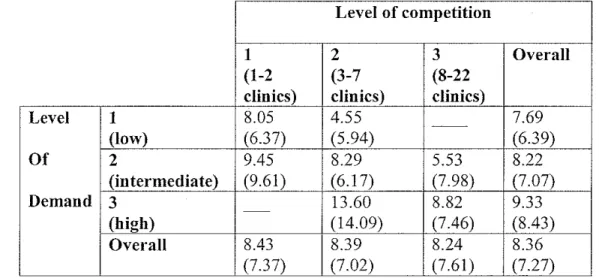
Mean clinic HOM rate declined as the level of competition increased (two-way ANOV A p=0.006). Mean percentage for low level of competition was 8.43%, intermediate 8.39%, and high 8.24%. Level of demand increased as the proportion of HOM declined (two-way ANOV A p=0.002). Mean percentage for low level of demand was 7.69%, intermediate 8.22%, and high 9.33%.
Table I. Mean HOM rate among fertility clinics by level of competition and demand (standard deviation), 2000
Level of competition
1 2 3 Overall
(1-2 (3-7 (8-22
clinics) clinics) clinics)
Level 1 8.05 4.55 ~- 7.69
(low) (6.37) (5.94) (6.39)
Of 2 9.45 8.29 5.53 8.22
(intermediate) (9.61) (6.17) (7.98) (7.07)
Demand 3 - 13.60 8.82 9.33
(high) (14.09) (7.46) (8.43)
Overall 8.43 8.39 8.24 8.36
(7.37) (7.02) (7.61) (7.27)
r-After adjusting for level of demand and insurance coverage, clinics with higher levels of competition were significantly more likely to have a lower HOM percentage compared clinics with low levels of competition or clinics with intermediate levels of competition in areas of intermediate demand.
Table 2. Measures of Association between HOM and competition among fertility clinics stratified by level of demand, 2000
Level of Level of Relative Risk Relative Risk* Demand Competition (95% Confidence (95% Confidence
Interval) Interval)
Low Intermediate 0.71 (0.39, 1.29) 0.69 (0.38, 1.25) competition versus
low competition
Intermediate Intermediate 1.02 (0.80, 1.31) 1.02 (0.80, 1.29) competition versus
low competition
High competition 0.59 (0.36, 0.97) 0.57 (0.35, 0.94) versus low
competition High competition
versus intermediate 0.58 (0.37,0.91) 0.56 (0.36, 0.89) competition
High High competition 1.03 (0.68, 1.56) 1.09 (0.718, 1.65) versus intermediate
competition *Adjusted for msnrance status
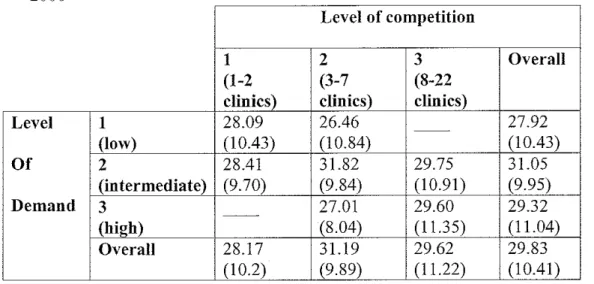
The age adjusted pregnancy rate did not differ significantly between the levels of demand way ANOV A, p=0.481) or levels of competition (Two-way ANOV A, p=0.872). No statistically significant adjusted measures of association were found between levels of competition within a level of demand.
status the effect of competition was even smaller and failed to be significant (RD 0.07%, 95% CI -0.095,0.239).
Table 3. Age adjusted pregnancy rate for fertility clinics (standard deviation), ?000
-Level of competition
1 2 3 Overall
(1-2 (3-7 (8-22
clinics) clinics) clinics)
Level 1 28.09 26.46 - - 27.92
(low) (10.43) (10.84) (10.43)
Of 2 28.41 31.82 29.75 31.05
(intermediate) (9.70) (9.84) (10.91) (9.95)
Demand 3 - - 27.01 29.60 29.32
(high) (8.04) (11.35) (11.04)
Overall 28.17 31.19 29.62 29.83
(1 0.2) (9.89) (11.22) (10.41)
Discussion
The results of this study suggest that competition is associated with a lower risk of high order multiples. These findings contradict the previously hypothesized relationship between competition and HOM that an increase in competition would lead to greater HOM. However, no other studies have attempted to empirically quantify the effects of competition on HOM.
To accept our conclusion, one must agree that the methodology of this study is valid. Specifically, one must assume that this measure of competition accurately depicts the degree to which competition actually is perceived and occurs among fertility centers.
However, a number of clinics do not report their outcomes. A measure of competition could not be assigned for every market area with a non-reporting clinic, which would generate a large amount of missing data. Any imputation of their market share without further information on these clinics would add bias.
There is some concern that a measure of competition snch as HHI that incorporates market share would more accurately describe competition among fertility centers. Previous research has shown that large hospitals generate more competition than small hospitals but that the size of the hospital does not affect the amount of competition received.32 This would imply that adjusting for market share in the measure of competition may be important. However, Baker
L
points out that the number of firms in a geographic area and HHI are typically
t
I
"'
correlated, suggesting that both measures of competition would likely produce
r
similar results26
In addition, it is very important to use a valid geographic area for small area analysis. Unfortunately no gold standards exist, and researchers are limited by the available data. Defining a geographic area by drawing a set radius around a clinic fails to accommodate for differences in urban and rural regions.
MSAs, which are defined by economic and social integration, are more appropriate choice for the geographical unit for this study.
Our use of metropolitan statistical areas may be a poor substitute for the actual market for in vitro fertilization services. Without information from clinics about their patient base, we are unable to verify the appropriateness ofMSAs as a substitute. Research on the utilization of ART services would be improved by studies that look into catchement areas for individual IVF clinics.
Also, the use ofMSA population to define demand may underestimate the actual demand. Eighty percent of the population in the United States lives in Metropolitan Services Areas46 However, women in metropolitan statistical areas without a fertility clinic (over 50%) and women not living in a MSA also seek fertility services. Future research may wish to elucidate the migration pattern for these regions.
Although the majority of clinics are probably independent, some may be
managed by one parent institution. It is unlikely that these clinics would compete,
.
J
but would rather share patients and health care providers. We could not account for affiliated clinics in this analysis. However, we hypothesize that the number of these associations are relatively few.
study the use of homologous and donor embryos in women over forty47 Reynolds eta! challenged this use of aggregate level data to study patient level outcomes. 8 Since our unit of analysis is the clinic and not the patient, we feel that aggregate level data are appropriate and valid.
There is limited outcome information on those clinics not reporting their data. However, this is a small subset of the clinics. Of the 25 clinics that did not report in 2000, II clinics did not report in 1999, 6 reported in 1999 tmder the same name or in the same location, and 8 clinics were new to the list. The median HOM percentage for those clinics that did report in 1999 but not in 2000 was 14.9%. The total number of cycles initiated per clinic reporting in 1999 ranged from 18-231.
Establishing why certain clinics do not submit their data may improve the validity. Non-reporting clinics appear to be concentrated in areas of! ow
competition, which may bias the results. If they perform few ART procedures, other clinics in the area may not see them as competition. If they have higher HOM rates, as implied by the few clinics that did report in 1999, the difference between areas with low versus high competition may be greater. However, more information would be necessary to validate this hypothesis.
Currently, insuraBce companies do not cover IVF in the majority of states.
change their practice patterns to obtain contracts with HMOs. HMOs may use similar standards such as quality, success rates, and price to monitor clinics.
The strengths of this study are in its measurement of competition and in the measurement of the outcomes. In addition, it adjusts for insurance coverage, which has previously been shown to influence not only competition but also HOM rates. Finally, it attempts to delineate the factors, such as number of embryos transferred that may be the intermediaries between competition and HOM.
I theorized that competition between fertility centers would result in greater numbers of high order multiples. The results of this analysis do not
L
support this hypothesis. However, the implication that competition improves quality of care is not unique in healthcare. Kessler and McClelen found that high competitiveness resulted in lower mortality and complication rates after heart attacks48 An analysis by Sari in 2002 showed that increasing a hospital's market share, and subsequent decline in competition, resulted in a decline in qualit/9
may seek other means to increase pregnancy rates such as blastocyst transfers and more selective choice of candidates for TVF.
Other authors have attempted to delineate the risk factors for HOM. Reducing the number of embryos transferred and using blastocysts have been shown to be potentially useful. However, this study tries to identify another means to intervene. Before encouraging further competition among clinics by sponsoring additional IVF clinic openings, we would suggest more research on physician's attitudes and practices in areas ofhigh competition. However,
r--competition should no longer be viewed as the culprit in NF.
Most people recognize the negative impact that high order multiples can cause. It is imperative that we identify and quantify the factors that may
System Level Attachment A:
SART oversight and A Model for the Influence of Local
reporting Competition on Multiple Pregnancy
Guidelines Rates among Patients with Infertility
Provider Factors Patient Education
Patient Beliefs
Media coverage
Access to Care Cost of the procedure Knowledge of Success
Perceived urgency
Type of clinic
rates Cultural Beliefs
Available Reproductive
Level of training
Past experience with IVF
-
Willingness to participateEndocrinologist __,.
Membership in SART ~
Available information
Distance to IVF Center
Local Competition
on!VF
in selective reduction
Likelihood of success
Financial incentives
Abilitv to uav Perception of personal and
/
+
.
-Selective Reductwn
+
Oocytes retrieved Embryo's !Tansferred
I
...
Multiple Pregnancy rateStimulation Protocol
IVF versus COH
J
.
~
L_
/
Medical History
VF= In vitro fertilization Type oflnfertility
Embryo factors :oH~ Controlled ovarian Previous Infertility treatments
Quality
hyperstimulation Age
Stage of Development
!OM~ High order multiples Co morbid diagnosis
References:
1
:Vlartin JA, Hamilton BE, Ventura SJ, lvJenacker F, Park i\'Iiv'L Births: F.lnal data for 2000. National vital statistics reports 2002: 50(5). Hyattsville, lVIary!and.: National Center for Health Statistics.
2
Callahan TL, Hall JE, Ellner SL, Christiansen CL. Greene MF, Crowley WF. The economic impact of multiple-gestation pregnancies and the contribution of assisted-reproduction teclmiques to their incidence. New England Journal of Medicine 1994; 331: 244-249.
3
Centers for Disease Control and Prevention, American Society for Reproductive Medicine, Society for Assisted Reproductive Techuology, RESOLVE (2000). 1998 assisted reproductive technology success rates, Centers for Disease Control and Prevention, Atlanta.
http://www.cdc.gov/nccdphp/drh/art.htm
4
Elster N, and the Institute for Science Law, and Techuology Working Group on Reproductive Techuology. Less is more: the risks of multiple births. Fertility & Sterility 2000; 74(4): 617-623.
5
Center for Disease Control and Prevention. Contribution of assisted reproductive technology and ovulation-inducing drugs to triplet and higher-order multiple births- United States, 1980-1997. MMWR 2000; 49(24):535-8.
6
Abma J, Chandra A, Mosher W, Peterson L, Piccinino L. Fertility, family planning, and women's health: New data from the 1995 National Survey of Family Growth. National Center for Health Statistics. Vital Health Stat 23(19).
1997.
7
Jain T, Harlow BL, Hornstein MD. Insurance coverage and outcomes in IVF. New England Journal ofMedicine 2002; 347(9): 661-6.
8
Reynolds MA, Schieve LA, Peterson HB. Insurance coverage and outcomes in in vitro
fertilization (letter). New England Journal of Medicine 2003; 348(1 0):958-9.
9
Engman L, Maconochie N, Seang CT, Bekir J. Trends in the incidence of births and multiple births and the factors that detennine the probability of multiple births after IVF treatment. Human Reproduction 200!; 16(12):2598-605.
10
Templeton A, Monis JK. Reducing the risk of multiple births by transfer of2 embryos after in vitro fertilization. 1998; 339:573-577.
11
Bassil S, Wyns C, Toussaint-Demylle D, Abdelnour W, Donnez J. Predictive factors for multiple pregnancy in in vitro fertilization. The Journal of Reproductive Medicine !997; 42(12):
761-6.
12
Reynolds MA, Schieve LA, Jeng G, Peterson HB, Wilcox LS. Risk of multiple birth associated with in vitro fertilization using donor eggs. American Journal of Epidemiology 200 I;
154(11):1043-50.
13
Schieve LA, Peterson HB, Meikle SF, Jeng G, Dane! I, Burnett NM, Wilcox LS. Live birth rates and multiple-birth risk using in vitro fertilization. JAMA !999; 282(19):1832-8.
14
Elsner CW, Tucker MJ, Sweitzer CL, Brockman WDW, Morton PC, Wright G, Toledo AA. Multiple pregnancy rate and embryo number transfened during in vitro fertilization. American
s--,
L
15
Senoz S, Ben-cherit A, Casper RF. Clinical Assisted Reproduction: An IVF fallacy: multiple pregnancy risk is 10\ver for older \VOmen. Journal of Assisted Reproduction and Genetics 1997; 14(4) 192-8.
16 Frattarelli JL, Leondires MP, McKeeby JL, Miller BT, Segars JH. Blastocyst transfer decreases
multiple pregnancy rates in in vitro fertilization cycles: a randomized controlled trial. FertiUty &
Sterility 2003; 79(1):228-30.
17
Toledo AA, Wright G, Jones AE, Smith SS, Johnson-Ward J, Brackman vVW, Ng F, Wininger JD. Blastocyst transfer: a useful tool for reduction of high-order multiple gestations in a human assisted reproduction program. American Journal of Obstetrics and Gynecology 2000; 183(2): 377-9.
18
Hock DL, Seifer DB, Kontopoul9s E, Ananth CV. Practice patterns among board-certified reproductive endocrinologists regarding high-order multiple gestations: A United States national survey. Obstetrics & Gynecology 2002; 99:763-70.
19
Goldfarb J, Kinzer DJ, Boyle M, Kurit D. Attitudes of in vitro fetiilization and intrauterine insemination couples toward multiple gestation pregnancy and multi- fetal pregnancy reduction.
Fertility & Sterility 1996; 65(4): 815-820.
20
American Society for Reproductive Medicine. Guidelines on number of embryos transferred, a practice committee report, November 1999. (Accessed June 9, 2003, at
http://v..-\Y\v.asrm.org/P.'lcdia/Practice/NoEmbryosTransferred.pdf).
21
Centers for Disease Control and Prevention, American Society for Reproductive Medicine, Society for Assisted Reproductive Technology, RESOLVE (2002). 2000 assisted reproductive
technology success rates, Centers for Disease Control and Prevention, Atlanta.
httpJ\vvvvv.cdc.gov/nccdvhp/drh/art.htrn
22
Lass A, Brinsden P. How do patients choose· private in vitro fertilization treatment? A customer survey in a tertiary fertility center in the UK. Fertility and Sterility 2001; 75(5):
893-897.
23 Faber.K. IVF in the US: multiple gestation, economic competition, and the necessity of excess.
Human Reproduction 1997; 12 (8)1614-6.
?A-Fritz MA. Addressing the dramatic rise in multiple pregnancies. Hospital Practice 2000; 35( 4):
124. (Accessed June!, 2003 at http://www.hosppract.com/issues/2000/04/fritz.htm).
25
Jones HW Jr, Schnorr JA. Multiple pregnancies: a call for action. Fertility & Sterility 2001;
75(1): 11-13.
"Baker LC. Measuring competition in health care markets. /-lealth Services Research 2001; 36(1 Pt 2): 233-51.
27
Robinson J, Luft H. Competition, regulations, and hospital Costs, 1982 to 1986. Journal of the
American Medical Association 1988; 260(18): 2676-2681.
28
Gift TL, Arnauld R, DeBrock L. Is healthy competition healthy? New evidence of the impact of hospital competition. lnquily 2002; 39:45-55.
29
+-b
'
30
Melnick G, Zwanziger J, Bamezai A, Pattison R. The effects of market structure and bargaining Position on hospital prices. Journal of Health Economics 1992; 11(3): 217-233.
31
Zwanziger J, Melnick G. The effects of hospital competition and the Medicare PPS Program on hospital cost behavior in California. Journal of Health Economics 1988; 7(4): 301-320.
32
Sohn MW. A relational approach to measuring competition among hospitals. Health Services Research 2002; 37(2): 457-82.
33
Bemstien, AB, Gauthier AK. Defining competition in markets: Why and how? Health Services Research 1998; 33:1421-38.
34
Garnick DW, Luft HS, Robinson JC, Tetreault J. Appropriate measures of hospital market areas. Health Services Research 1987; 22:69-89.
35
Fisher ES, Wennberg JE. Heath care quality, geographic variations, and the challenge of supply-sensitive care. Perspectives in Biology & Medicine 2003; 46(1): 69-79.
36
Makuc D, Haglund B, Ingram D, Kleinman J, and Feldman J. Health service areas for the United States. DHHS Publication No. (PHS) 92-1286. Series 2: No. 112. Hyattsviiie, MD: US Department of Health and Human Services, Public Health Service, Centers for Disease Control, National Center for Health Statistics, 1991.
37
Erasure M, Sterns SC, Norton EC, Ricketts T 3rd. Competitive behavior in local physician markets. Medical Care Research & Review 1999; 56(4): 395-414, 1999.
38
US Census Bureau. About metropolitan areas. (Accessed May 25, 2003, at b-lt2.d::;v·H·-·w-.censstls.gnv/population/ww\v/estimates/abo_t~.tm~!!:idlLmD.
39
Deaton A, Lubotsky D. Mortality, inequality, and race in American cities and states. Social Science and Medicine 2003; 56(6): 1139-53.
40
Andersen RM, YuH, Wyn R, Davidson PL, BrownER, Teleki S. Access to medical care for low income persons: how do communities make a difference? Afedical Care Research & Review
2002; 59(4): 384-411.
"' Hendryx MS, Ahern MM, Lovrich NP, McCurdy AH. Access to health care and community social capital. Health services Research 2002; 37(1): 87-103.
42
Centers for Disease Control and Prevention, American Society for Reproductive 1\IIedicine, Society for Assisted Reproductive Technology, RESOLVE (2001). 1999 assisted reproductive technology success rates, Centers for Disease Control and Prevention, Atlanta.
hLtn: // W\YW .cdc. gov..'nccdphp/drh/art htm
43
2000 Assisted reproductive technology success rates. (Accessed March 11, 2003, at bJllt ii www .cdc. gov/nccdgl_mi drhi art.htm)
44
Census summary file l (SFJ) 100% data; http:/if3ctifindcr.ccnsus.i!DV.
-IS Rodriguez G. Lecture notes. Appendix C; Modeling over-dispersed count data. (Accessed on
June 15, 2003 at http://data.princeton.edu/wws509/notes/c4addendum.pdf)
+IS. Feigenbaum. Choice of fresh homologous or fresh donor embryo transfer is determined primarily by availability of insurance-mandated in vitro fertilization (IVF) coverage in university versus private practice. Fertility & Sterility 2001; 76(3 Suppl. 1): S86.
-+s Kessler DP, McClellan MB. Is hospital competition socially wasteful? Quarterly Journal of
Economics 2000; 115(2): 577-615.
49
SariN. Do competition and managed care improve quality? Health Economics 2002; 11(7):
571-84.