Rachel S. Novotny. Selecting Sources: How Adult Public Library Users Find Leisure Books. A Master’s Paper for the M.S. in L.S degree. March 2011. 60 pages. Advisor: Deborah Barreau
With technological advancements and different approaches to marketing books, such as on social networking websites and book trailers on television, there are now more sources for adult library patrons to use for the purpose of finding leisure reading materials. How people search for information and what sources they use to do so can be a way to tailor services to a particular population. Readers’ advisory in public libraries plays a role in how readers may come into contact with books. This study examines the different sources and methods being used currently by surveying adult public library patrons at a Wake County Public Library in North Carolina featuring active and passive readers’ advisory services.
Headings:
by
Rachel S. Novotny
A Master’s paper submitted to the faculty of the School of Information and Library Science of the University of North Carolina at Chapel Hill
in partial fulfillment of the requirements for the degree of Master of Science in
Library Science.
Chapel Hill, North Carolina March 2011
Approved by
Table of Contents
Introduction... 3
Literature Review ... 5
Methodology... 20
Results... 25
Discussion and Conclusions ... 40
References... 44
Appendix A: Print Questionnaire ... 47
Table of Tables and Figures
Table 1: Age Range ... 25
Figure 1: General Use ... 27
Table 2: “Other” General Use Sources and Methods ... 27
Figure 2: General Use – Very Frequently... 29
Figure 3: General Use – Frequently... 30
Figure 4: General Use – Somewhat Frequently... 31
Figure 5: General Use – Infrequently ... 32
Figure 6: General Use - Rare ... 33
Figure 7: Sources Used in the Critical Incident Example... 35
Table 3: Critical Incident “Other” ... 35
Figure 8: Fiction Genres ... 36
Table 4: “Other” Fiction Genres... 37
Figure 9: Non-fiction Genres... 38
Table 5: “Other” Non-fiction Genres... 38
Introduction
Public library readers’ advisory services use a variety of techniques to help readers find materials of potential interest. Although readers’ advisory has held different missions in the past, currently, a primary objective of the service is providing readers with reading materials they might enjoy. To do this, librarians involved in readers’
advisory need to learn about the community they serve (Gregory, 1968). With technology playing a larger role as an information source due to accessibility and convenience, it is harder for librarians to determine what sources their users are consulting (Savolainen, 2008).Source consultation is important so librarians can assess how their users are finding leisure reading materials, not only to learn more about their community but also to see if their patrons use the library as a source.
Crowley (2005) defines readers’ advisory in its current state as “...an organized program promoting both fiction and non-fiction discretionary reading for the dual purposes of satisfying reader needs and advancing a culture’s goal of a literate
displays, reading lists, and books that face outward on shelves to help browsers (Outlaw, 2005).
In terms of services featured in the public library, Shearer (1998) discusses in some cases how it can be more difficult to handle readers’ advisory transactions than reference transactions. Readers’ advisory transactions lack preparedness on two levels. The first addresses history. In the past, public libraries have concentrated more on reference services and therefore have more known tools and resources across the profession. Second, readers’ advisory is not seen as a core need in many library science programs, which instead focus students’ attention on courses for reference, collection development, and other areas (p. 114).
In the conclusion of her paper, Moyer (2005) brings attention to the fact that not many studies have been conducted since tools such as NoveList, a database used in readers’ advisory, and Amazon.com have come into existence (p. 229).
Literature Review Readers’ Advisory
Although it is uncertain exactly when readers’ advisory began, Crowley (2005) states it has been a service in public libraries in the United States for over a century (p. 37-8). At the inception of readers’ advisory, some librarians were opposed to the idea of providing a service to the community that allowed for library users to have librarians select books for users, rather than having the users select their own books (p. 37). “For much of the history of modern reading...readers advisory has been seen as an educational function grounded in using both non-fiction and fiction to assist readers” (p.38).
However, Crowley found that since the 1980s fiction has become more associated with readers’ advisory, when previously non-fiction was heavily recommended (p.38).
Crowley distinguishes readers’ advisory as having four distinct periods in its history: the inception and development of readers’ advisory (roughly from 1870s to 1920), readers’ advisory used for non-fiction purposes (1920-1940), dormancy of readers’ advisory (1940-1984), and readers’ advisory as is known today (1984-Present) (p. 38).
the “Reading with a Purpose” program during that decade. The program provided pamphlets to library users with suggestions for fiction and non-fiction reading at
participating libraries. Although the program was eventually discontinued in the 1930s, it provided more exposure for readers’ advisory services in public libraries (Crowley, 2005, p. 39).
Ross (1991) notes that during the 1930s-1980s, librarians used readers’ advisory services as a way to “promote self-disciplined, educational reading on socially significant topics” to patrons (p. 504). Therefore, non-fiction materials were recommended more frequently than fiction materials. Fiction was viewed as undermining the educational goals set forth by libraries, and in some cases, an addiction that could lead to a weak mind. To dissuade readers from popular materials, some libraries had rules that would allow only two books to be checked out at a time, and at least one of the books was required to be non-fiction (Ross, 1991). Due to these readers’ advisory practices, the service became dormant after the Second World War (Crowley, 2005; Ross, 1991). Many public libraries’ readers’ advisory services were discontinued, while a few libraries maintained their practice (Crowley, 2005, p. 39). And Ross (1991) observed that during this period, many people began to view readers’ advisory services as “quaintly old-fashioned” (p. 503).
Crowley (2005) names 1984 as the beginning of the revival of readers’ advisory because it was the year the Adult Reading Round Table (ARRT) was founded (p. 39). ARRT’s website states its purpose is “Developing Readers Advisory skills and promoting reading for pleasure through public libraries...” (Rolling Meadows Library, 2010).
ARRT’s role in reviving the service (Crowley, 2005, p. 41). Trott (2008) adds that two publications, Genreflection edited by Betty Rosenberg and Readers’ Advisory Service in the Public Library by Joyce Saricks and Nancy Brown, also added to the revival. Ross (1991) views the revival as a distinction between two types of readers’ advising. Before the revival, the first type of readers’ advisor was prevalent. This readers’ advisor knew what books to recommend to a reader because the advisor had previously decided what books readers should be reading for betterment. The second type of readers’ advisor, more common today, gauges what the reader likes through a series of questions, making suggestions based on the reader’s answers (p. 504-5). To advance past the mindset of the first type of readers’ advisor, Ross (1991) suggests a few important points found in readers’ advisory research: reading improves literacy; readers bond with certain books, finding meaning; and books can make a difference in people’s lives (p. 505-6).
Moyer (2005) reports that several studies show readers’ advisors are not
conducting in-depth interviews with readers or using as many resources to find books for readers (Moyer, 2005, p. 226-7). This can be problematic when more than half, if not two-thirds, of library users come to the library for leisure reading materials (Ross, 1991, p. 506). Ross’s (1991) research echoes Moyer’s sentiments, with the concern that
readers’ advisors are not doing enough to connect readers to the books that will make an impact on their lives (p. 508).
Readers and Their Motivations
reading for pleasure. The interviewers received very passionate responses regarding the question: “What is the importance of reading to you?” (p. 507). Many interviewees equated reading with one of their favorite activities and had positive associations. One interviewee commented on how reading for pleasure while growing up allowed her to gain self-confidence (p. 507).
Several of the interviewees commented upon the importance of timing when selecting a book to read. Some days they might want to read a serious book; other days they might prefer something humorous. One reader commented: “I think books have different values depending on the state of your life you’re at when you read them” (Ross, 1991, p. 508). Ross discovered that one of the primary reasons for reading for pleasure was an escape from reality (p. 504).
Ross (1999) later examined more closely how readers chose a book for pleasure and what books made large impacts on readers’ lives. Ross conducted open-ended
interviews with 194 deliberately chosen adults who were avid readers, that is, people who read roughly a book or more a week. Interviews explored readers’ reading lives from childhood to present looking at factors such as: how a reader chooses or rejects a book, how a certain book has made an impact, and factors promoting or discouraging reading during childhood.
Ross (1999) found five themes that became apparent from interviews: the reader’s mood plays a large part in book selection; books recommended to readers by
informed decisions regarding book choices (Ross, 1999). Through research, what reading means to fiction readers and how they select items are becoming clearer, but readers’ advisory research has a long way to go (Moyer, 2005, p. 229).
Source Selection
A study done by Connaway, Radford, Dickey, Williams, and Confer (2008) provides information about how and why two distinct groups, Baby Boomers (the largest generation in the U.S. population, born between 1946-1964) and Millennials (the
generation that has been exposed to a different way of processing information, born between 1979-2000), found and used information. Connaway et al. found that Millennials were more likely to use Google as one of their primary sources for quick searches. Also, they found that each group wanted different things from their library. Millennials wanted unlimited access to the library with social spaces, older Millennials wanted easy and quick access to the library with no hassles (e.g., drive-up book drops), and Baby Boomers wanted the library to appear more like a bookstore with added signage. All of these results fit with the information the researchers had gathered about characteristics of these groups (Connaway et al., 2008). These findings point to the importance of the
organization of a public library for users.
Savolainen (2008) found that past studies regarding everyday life information seeking have shown the importance of accessibility. People would frequently turn to friends, family, and co-workers, or professionals for specific information needs
(Savolainen, 2008).
Savolainen (2008) interviewed 18 environmental activists about the criteria they use to evaluate sources of information in the context of everyday life information seeking. Participants were asked to think about a critical incident that occurred in everyday life information seeking and map themselves and the sources they used on a piece of paper in order of source consultation. Savolainen found that 28 different sources were consulted, which were then divided into five categories: human sources (e.g., family, friends), printed media (e.g., magazines, newspapers), networked sources (e.g., Internet, email), organizational sources (e.g., public libraries, health centers), and other sources (i.e., miscellaneous). Sources were ranked by zones, with zone 1 being the most important, zone 2 as sources of secondary importance, and zone 3 representing sources of marginal importance. Findings showed that human sources and networked sources were the most frequently consulted. Additionally, accessibility and availability of information were important when selecting sources (Savolainen, 2008).
selected for the club. The researchers looked at a sample of 45 Oprah Book Club selections and found that the majority of the books ended up on USA Today’s 150 Bestsellers list shortly after being announced (Butler et al., 2005).
Radio is another medium an individual can access in the quest for a book suggestion. National Public Radio (NPR) frequently hosts authors to discuss their latest book. NPR also invites librarian Nancy Pearl to discuss the latest books she has read and suggestions she might have for some listeners (National Public Radio, 2011).
Print and online reviews, although reported usually by individuals unknown to the reader can influence selection. Many newspapers across the United States feature book review sections. Additionally, magazines such as Time and People also have sections devoted to book reviews. Publications such as the American Library Association’s Booklist are primarily dedicated to book reviews. A portion of a study by Berger,
Sorenson, and Rasmussen (2010) about negative publicity looked at The New York Times Book Review and how positive and negative reviews affected book sales. Their findings revealed that a book with a positive review, regardless of new or known author,
reader as a rating of one star. Chevalier and Mayzlin noted that an individual was more likely to look at the text of the review rather than just an aspect, such as the number of stars given to a review.
Other online resources include book review emails, going to author and publisher websites, and social networking websites. Social networking sites are starting to present more opportunities to readers. Abbe (2011) reports that not only are readers able to discover books through friends online, but more frequently authors are using social networking sites to promote their work. For example, a Facebook.com user can become friends with an author or “like” their page, enabling updates from the author to appear on their personal homepage. Common online venues authors use are Facebook, Twitter, and LinkedIn (Abbe, 2011). Individuals can access information by chance on these sites. PBS (Public Broadcasting Service) recently asked on Facebook “What book are you reading right now that you’d recommend to others? Why?” More than 1,000 people responded (PBS, 2011).
Facebook has an application for a user to keep track of the books he or she has read, but there are also other social networking sites with the sole purpose of connecting readers and dealing with books. Stover (2009) discusses the positive and negative aspects of several different “Library 2.0” sites and finds three emerge: GoodReads, LibraryThing, and Shelfari (p. 234). These sites can provide relationships if the user wishes and/or the ability to search for leisure books which he or she can add to a “to be read” list.
know what they want. LibraryThing (the social networking website) allows readers to create tags for items. Rolla (2009) discusses how libraries use LibraryThing as an added feature to their catalog. Tagging (tags are words or phrases used to describe an item, ex. historical fiction) provided by a reading community offers different ways of classifying an item, which may be more accessible to the user because the information is not solely created by librarians, who may classify the information differently. Many times these tags are in tagging clouds. Tagging clouds are a visual of the tags assigned to an item, not only showing the tags but also placing emphasis on tags more commonly assigned. Rolla found that although LibraryThing tags help to create access, they cannot replace the Library of Congress Subject Headings. However, having both in a catalog can improve the likelihood of access (Rolla, 2009).
BookSelection
Moyer’s (2005) literature review looks at the research on readers’ advisory services in other countries in contrast to those in the United States (p. 220). Moyer reviews Yu and O’Brien’s (as cited in Yu & O’Brien, 1996, p. 160) definition of browsing as “a method of book selection, [which] involves looking around, with the reader hoping to encounter desired books by serendipity. Browsing is used as the major method by more than half of readers when they choose books” (p. 222). Moyer states:
Browsing is an especially important area especially in light of all the electronic resources now available to readers. As recommender systems such as NoveList and Amazon become better known and prevalent in public libraries, it is vital that researchers and librarians understand how patrons are and are not using these types of resources in fiction selection in addition to or instead of browsing. (p. 223).
features a certain kind of character, a book they wish to reread, or a new book by author they do not usually read. Many readers have a difficult time finding new books to read in a library setting because they do not know how to look for what they want; browsing can be difficult if libraries are not configured to facilitate browsing (Ross, 1991; Moyer, 2005). Ross found it can be easier for readers to stick with an author and read everything he or she has written before venturing out to find something new. “Some readers report a feeling akin to panic when they have read all the author’s books” (p. 515). Browsing is usually a last resort when readers have exhausted authors or books with which they are familiar (Ross, 1991).
Ross (1991) found positive and negative reactions to libraries as a place to obtain leisure reading materials. Positive reactions included readers recalling an influential librarian, the ability of the library to allow for a reader to move outside his or her comfort zone as libraries present so many options for little to no cost, and the freedom to choose. Ross found that readers did not like the possibility of being judged; that collections can seem too expansive and intimidating; and “…users do not find libraries as good as bookstores in helping them find books they want to read. Many participants said they went to the bookstore first to find out about some authors and then borrowed the books from the library” (Hemmeter, 2006, p. 511). From the negative aspects readers voiced about libraries, some readers can see libraries as an overwhelming and vast range of materials with little to no help from librarians in selection (Ross, 1991).
theories that when a bookstore - a private market - offered great services and materials for low prices, the usage of public market services - the library - would decrease (p. 595). Hemmeter used data from the National Household Education Survey taken in 1996. This phone survey included 55,000 households, which aimed to be inclusive of the national population. Hemmeter addresses two issues with this survey. The survey excludes households without phones and members of a household might not be able to accurately describe other household members’ library usage habits. The study took into account variables such as age, sex, and highest education level, while asking participants to describe library usage in the past month (or in some cases, year) for certain purposes (e.g., did you visit for a program; for audio-visual materials).
The results of the study found that having audio-visual (A/V) material increases the chance of people using the library, while books did not cause an increase. This information points to popular and recreational materials being a priority for library users. Additionally, Hemmeter found that people who lived closer were more likely to use libraries. Children in a household increased the likelihood of library usage. Finally, when more bookstores were available to middle income households, there was significantly less usage of libraries (Hemmeter, 2006).
Hemmeter discusses how libraries and bookstores may compliment one another in that a book from one location may lead someone to a book in the other location (p. 598). In this way a bookstore could be the source leading a library user to a certain leisure book depending on if the user saw a display that interested him or her. However, the
Hemmeter commented that areas in both establishments, which are very similar, such as leisure reading sections, may be the most vulnerable when the other
establishment is in close proximity. Hemmeter also states: “The importance of A/V material relative to books suggests that the use of the library as a popular materials center may prove to be a large source of future activity and expansion” (p. 613). This could address increased usage of the collections in terms of leisure purposes rather than informational and/or educational use. Additionally, the information from this study provides a bit of background about who might be the most likely users of libraries. Alternatively, the data used were collected 14 years ago and may not reflect the current usage of libraries and bookstores, and do not account for library/bookstore usage in an economic recession.
Browsing tends to work better for bookstores and small libraries; therefore, libraries with bigger collections need to promote their readers’ advisory services. Libraries might adopt some of the market bookstores’ techniques, such as displays, to introduce different books to readers (Ross, 1991).
Erdelez (1999) states: “While information seeking and browsing involve ‘process-oriented’ information acquisition, information encountering is an ‘event’ or ‘incident’ of information acquisition that occurs at a specific moment in time. Information
recall the incident (Erdelez, 1999). Erdelez suggests four elements that provide useful information when looking at an information encounter: who is the information user, what is the environment in which the encounter occurred, what are characteristics of the information encountered, and what are the characteristics of the information needs that the information encounter addresses (p. 26). Information encountering yielding a positive experience may reinforce similar information seeking patterns (Erdelez, 1999).
Foster and Ford (2003) conducted a study examining the role serendipitous discovery of information plays in academic research by interviewing 45 researchers from differing academic backgrounds. They reviewed serendipitous information that had either enhanced the researcher’s existing problem or redirected the researcher’s problem. They discovered during interviews that a third component frequently occurred: serendipitous information could also introduce the researcher to an entirely new problem.
Foster and Ford found that serendipity was experienced among all of their participants in information finding, and could reinforce research or be unrelated information that interested them. Participants noted that they were more likely to encounter information serendipitously if they were open to information around them (Foster & Ford, 2003).
of library and information science than in. Although serendipity is becoming more prevalent in information studies literature, there is a lack of consensus on what
serendipity means. McBirnie conducted interviews with 10 participants. She asked them to identify what serendipity meant to them. Interviewees associated serendipity with discovery, chance, and process, and as something that was positive. Serendipity was also viewed by participants as being both passive and active, with passive meaning happening to and active meaning happening by (p. 607).
McBirnie also found that when the participants encountered serendipitous information online, they spoke mostly of search engines, social networking sites, and email. Because these online components are so vast, it can be easier to find unexpected information. Whereas, one participant remarked that it was harder to use the library catalog and/or databases to come across information serendipitously because they were well organized (p. 609).
Methodology
The purpose of this study was to gain knowledge about the methods and sources consulted by adult public library patrons, and to examine the role the public library plays in terms of methods and sources. Survey research gathers data from respondents to look at their opinions, attitudes, behaviors, preferences, and beliefs (Czaja, 2005, p. 1; Rea & Parker, 2005, p. 3; Wildemuth, 2009, p. 256). In this case, the researcher was interested in the preferences and behaviors in regards to the sources and methods used in selecting leisure books.
The research was conducted at West Regional Library, a public library located in Cary, North Carolina. West Regional Library is one of 20 libraries in the Wake County Public Library system. West Regional was chosen because of the active (readers’
advisory interviews) and passive (reading lists, book displays, etc.) readers’ advisory services it offers to patrons. Additionally, this library is one of the larger regional branches in the system and is fairly busy according to door counts and circulation statistics.
Both the print and electronic forms of the questionnaire were used to increase response rate. A print questionnaire allowed patrons who did not have Internet access at home to fill out the questionnaire, as well as patrons who may not wish to type in a URL or fill out the questionnaire later. The print questionnaire featured a link to the online questionnaire. The online questionnaire may also have allowed respondents more time to complete the questionnaire.
The questionnaire was pretested and pilot tested before distribution in order to reduce the risk of response errors. Testing was only used as a reference for necessary changes to the questionnaire. Data from these questionnaires were not collected for the study. Pilot testing was done only on the print questionnaire because it provided space for written comments. Additionally, pilot testing was used to evaluate the validity of the questionnaire; both formats contained the same content.
The print questionnaires were distributed within a three-week period in February 2011. The longest check out period for a book was three weeks, unless renewed. This window allowed for a more diverse group of the population to be reached. The researcher varied distribution times across the three weeks to cover nearly all hours the library was open. The online questionnaire was active for four weeks total and a survey return box was still accessible for individuals just receiving print questionnaires in hold books or returning the questionnaire.
Print and online questionnaires were identical except for small differences in instructions. The print questionnaire asked respondents to return finished questionnaires to the designated survey return box, whereas respondents using the online questionnaire did not need this option.
The online questionnaire was created and maintained using the software Qualtrics. To afford the same freedom to the online questionnaire that the print form received, none of the questions on either form were mandatory and respondents were able to skip questions they did not wish to answer. The online questionnaire featured return and continue options on each page except for the first and last pages. The consent form fact sheet was included at the beginning of the online questionnaire and if the individual agreed to the terms of the survey, he or she was asked to click the continuation button. There was one question per page. A progress bar was displayed to show where
were captured briefly to prevent submission of duplicate data from the same respondent. The researcher deleted IP addresses before data were analyzed.
The questionnaire was comprised of six open- and close-ended questions. There was no way of knowing if individuals under the age of 18 received a folded questionnaire in a book they reserved from the adult collection. However, the first question asked about the respondent’s age and provided an option (<18) for individuals under the age of 18. Print questionnaires with the “<18” option marked were to be removed and no data from these questionnaires recorded. When this option was selected online, the individuals would be routed out of the survey. No data were to be recorded. The instructions also specified adult library users as being “ages 18 years or older.”
The second question asked respondents to check all of the options that applied in regards to the methods/sources they use in general to find leisure books for leisure
reading. For each option, a numerical scale was provided featuring numbers ranging from 1-5 with descriptive statements attached to measure frequency (Colton & Covert, 2007, p. 155). When a respondent checked an option he or she was asked to fill out the frequency with which they used a method or were influenced by a source. The options were created based on common tools and searching strategies found in the literature and resources in West Regional Library.
The third and fourth questions asked information about a leisure book the
respondent would be more likely to remember and provide accurate information (Wildemuth, 2009, p. 235-6). The fourth question asked respondents to select all the methods and sources (from the same list as the second question) that led them to the leisure book listed in the third question. This question was asked to determine what methods and sources the respondent used in that critical incident, leading him or her to a particular book.
The final two questions asked the respondents to select the fiction genres (question five) and non-fiction genres (question six) they read most frequently. These questions were asked to see if there were any connections between genres read and types of sources and methods used. Questions two, four, five, and six featured an “other” option, which allowed for the respondent to write in their own answers.
Results
Of the questionnaires distributed, the researcher received 75 responses via the print and Web-based forms. All data were used, regardless of questionnaire
completeness. Age
The only demographic piece of information individuals were asked to provide was to identify the age range in which their age was represented. This information was used to detect if any of the respondents were under the age of 18. None of the
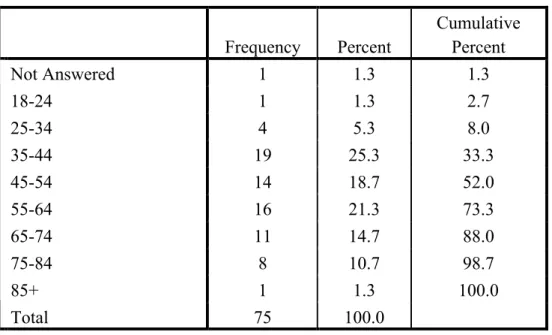
respondents selected this option, therefore all data were counted. Respondents were of varying ages, with most ranging from 35-64 years of age (65.3%). Table 1 shows a break down of the age groups.
Frequency Percent
Cumulative Percent
Not Answered 1 1.3 1.3
18-24 1 1.3 2.7
25-34 4 5.3 8.0
35-44 19 25.3 33.3
45-54 14 18.7 52.0
55-64 16 21.3 73.3
65-74 11 14.7 88.0
75-84 8 10.7 98.7
85+ 1 1.3 100.0
Total 75 100.0
General Use of Sources and Methods
The second question asked respondents to select the sources and methods they have used to find leisure books. These methods and sources were identified in the literature, in addition to being active and passive readers’ advisory aspects of the public library in which the survey took place. Respondents were allowed to provide an
additional source or method by selecting “other.” This option allowed for text to be entered. The "other" tables reflect respondents' written answers and have not been altered by the researcher. Of the respondents who chose this option, not all filled out the source or method to be added.
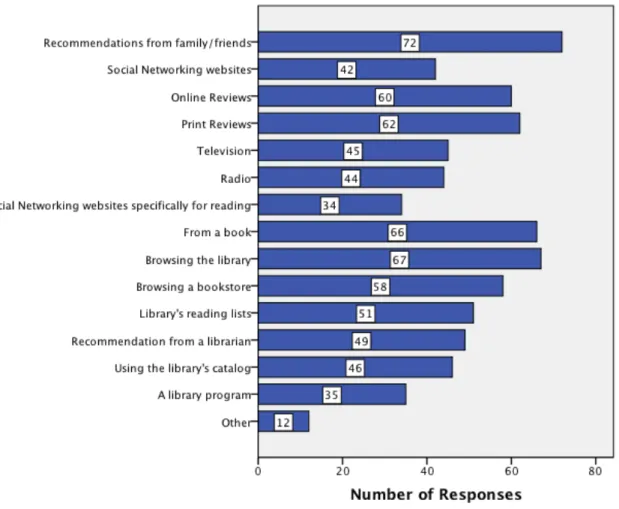
Figure 1 shows the sources and methods respondents have used to find a leisure book at any point in their lives. Of the 15 options, 12 were used by at least half of the respondents once or more frequently. “Recommendations from family/friends” had the highest response rate (96%), followed by “browsing the library” (89.3%), “from a book” (88%), “print reviews” (82.7%), “online reviews” (80%), “browsing a bookstore”
Frequency Percent Valid Percent
Cumulative Percent
66 88.0 88.0 88.0
Author’s website online
1 1.3 1.3 89.3
Book Club 5 6.7 6.7 96.0
Book Club selection 1 1.3 1.3 97.3
Book Clubs 1 1.3 1.3 98.7
Carolina Preserve 1 1.3 1.3 100.0
Valid
Total 75 100.0 100.0
Figure 1: General Use
Table 2 expands on the “other” option. Not all respondents wrote in an answer for “other” and therefore their information was not included in the 88%. Several respondents included book clubs in some form. While this option may have been classified by some as “a library program,” it is unclear if the respondents who chose “other” were in book clubs at the library or somewhere else.
Frequencies of General Use
In addition to the selection of sources and methods used, the respondents were asked to categorize how frequently they used these services. The frequency scale had five indicators: very frequently, frequently, somewhat frequently, infrequently, and rare. Respondents were provided with the information regarding what these indicators represented. “Very frequently” was distinguished as a few times a week to every day. “Frequently” was several times a month. “Somewhat frequently” was equated to once a month. “Infrequently” was identified as a few times a year. And “rare” equaled once in the respondent’s history.
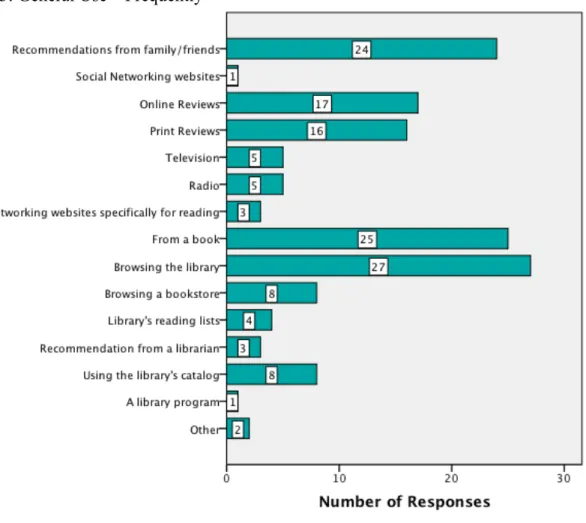
“using the library’s catalog” (10.9%), “online reviews” (8.3%), “social networking sites for reading” (8.8%), and social networking sites in general (4.8%). Three options, “other” (8.3%), “a library program” (2.9%), and “television” (2.2%) received one response in this category.
Figure 3 presents the breakdown of the sources consulted frequently – several times a month. “Browsing the library” received the most responses, making up 40.3% of the responses in that option. “From a book” received the next highest number of
responses (37.9%), followed by “recommendations from family/friends” (33.3%), “online reviews” (28.3%), “print reviews” (25.8%), “using the library’s catalog” (17.4%),
“browsing a bookstore” (13.8%), “radio” (11.4%), “television” (11.1%), “library’s reading lists” (7.8%), “social networking websites specifically for reading” (8.8%), “recommendation from a librarian” (6.1%), “other” (16.7%), “a library program” (2.9%), and “social networking websites” (2.4%).
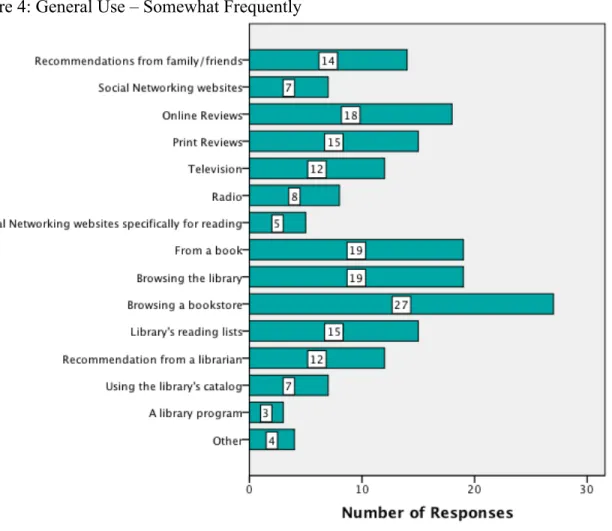
Figure 4 shows the responses for somewhat frequent, once a month, use of the sources and methods listed. Twenty-seven respondents chose the “browsing a bookstore” option as a method they do once a month to find a leisure book (46.6%). This was
from family/friends” (19.4%), “television” (26.7%), “recommendation from a librarian” (24.5%), “radio” (18.2%), “social networking websites” (16.7%), “using the library’s catalog” (15.2%), “social networking websites specifically for reading” (14.7%), “other” (33.3%), and “a library program” (8.6%).
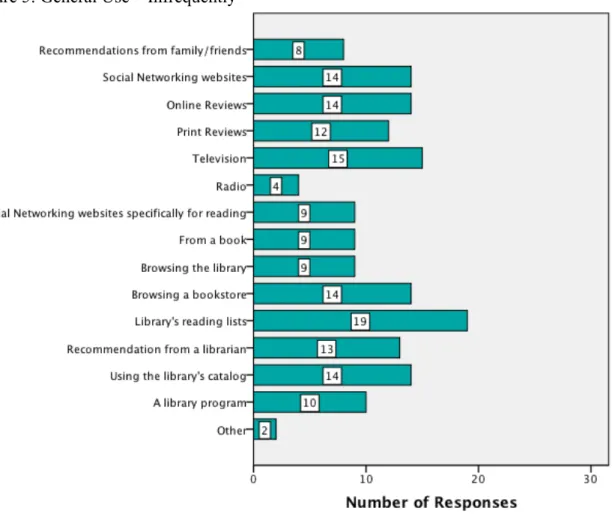
Figure 5 displays the number of responses indicating that sources/methods were used a few times a year. The option “library’s reading lists” was the most popular
program” (28.6%), “social networking websites specifically for reading” (26.5%), “from a book” (13.6%), “browsing the library” (13.4%), “recommendations from
family/friends” (11.1%), “radio” (9.1%), and “other” (16.7%).
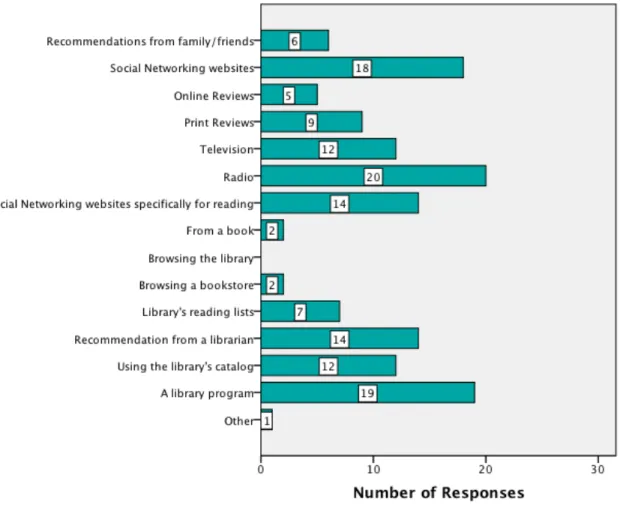
Figure 6 displays the results of the sources and methods that have reportedly been used once by the respondents. Radio received the most responses with twenty (45.5%), then “a library program” (54.3%), followed by “social networking websites” (42.9%), “social networking websites specifically for reading” (41.2%), “recommendation from a librarian” (28.6%), “television” (26.7%), “using the library’s catalog” (26.1%), “print reviews” (14.5%), “library’s reading lists” (13.7%), “recommendations from
family/friends” (8.3%), “online reviews” (8.3%), “browsing a bookstore” (3.4%), “from a book” (3%), and “other” (8.3%). Of the respondents who selected “browsing the library” as a method for finding leisure books, none indicated that they had only done this once.
(3%). One frequency response was not present for “a library program” (2.9%). Two frequency responses were unaccounted for with “other” (16.7%). Options “social networking websites,” “print reviews,” “television,” “social networking websites specifically for reading,” “browsing a bookstore,” “library’s reading lists,”
“recommendation from a librarian,” and “using the library’s catalog” had all frequency responses accounted for in connection with the general sources and methods used. Critical Incident Sources and Methods
The third question asked respondents to think of a book they had recently checked out (within the past two months from the time they filled out the questionnaire) or were currently checking out. Respondents provided a variety of titles and authors. The critical incident was used as a framework to get the respondents to think about the specific sources and methods used for obtaining that particular leisure book.
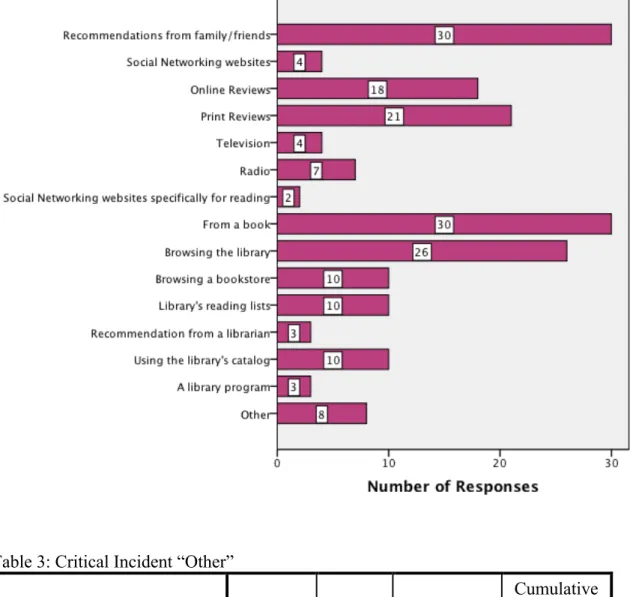
Figure 7 provides the results of the sources and methods used in the critical incident. “Recommendations from family/friends” (40% of the respondents chose this option) and “from a book” (40%) were tied. “Browsing the library” (34.7%) followed, along with “print reviews” (28%), “online reviews” (24%), “browsing a bookstore” (13.3%), “library’s reading lists” (13.3%), “using the library’s catalog” (13.3%), “other” (10.7%), “radio” (9.3%), “social networking websites” (5.3%), “television” (5.3%), “recommendation from a librarian” (4%), “a library program (4%), and “social
Frequency Percent Valid Percent
Cumulative Percent
68 90.7 90.7 90.7
Book Club 1 1.3 1.3 92.0
Book Club selection 1 1.3 1.3 93.3
ebooks/Kindle reviews 1 1.3 1.3 94.7
Previously
read/favorite author
4 5.3 5.3 100.0
Valid
Total 75 100.0 100.0
Figure 7: Sources Used in the Critical Incident Example
Specific Genres
Data were gathered about fiction and non-fiction genres most commonly read by the respondents. This was done to see if there were certain ties to the sources and
methods used based on the genres read by individuals. Respondents were allowed to write in additional fiction and non-fiction genres that may not have been provided on the questionnaire.
The respondents’ most commonly read fiction genres are displayed in Figure 8. “Mystery/thriller” was the most commonly selected category with 46 of the 75
recently released), a tie between “action/adventure” and “romance” (both 34.7%), “classics” (29.3%), “inspirational” (21.3%), “fantasy” (16%), “science fiction” (12%), “other” (10.7%), “horror” (5.3%), and “western” (2.7%). Table 4 is a display of the additional information respondents provided regarding the fiction genres they most commonly read. All but one respondent expanded on the “other” fiction genre they read.
Frequency Percent Valid Percent
Cumulative Percent
68 90.7 90.7 90.7
Biography & History 1 1.3 1.3 92.0
Chick Lit-Beach Reads
1 1.3 1.3 93.3
Historical 1 1.3 1.3 94.7
IT related 1 1.3 1.3 96.0
Literary 1 1.3 1.3 97.3
Travel 1 1.3 1.3 98.7
Women’s 1 1.3 1.3 100.0
Valid
Total 75 100.0 100.0
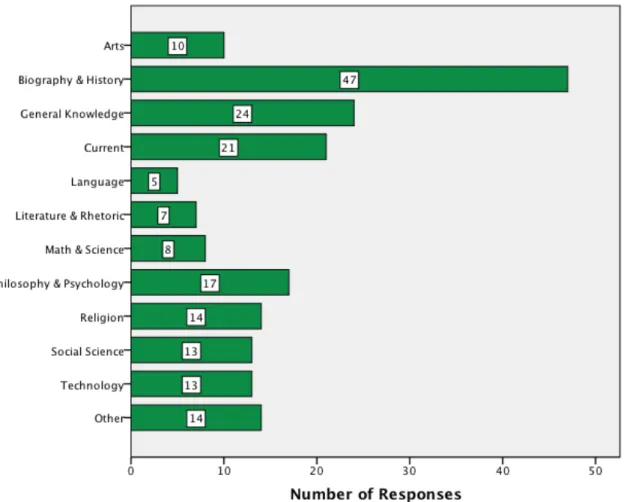
Figure 9 shows the responses to non-fiction genres most commonly read. “Biography & history” was the option chosen most frequently (62.7%), followed by “general knowledge” (32%), “current” (28%), “philosophy & psychology” (22.7%), a tie between “religion” and “other” (both at 18.7%), a tie between “social science” and “technology” (both at 17.3%), “arts” (13.3%), “math & science” (10.7%), “literature & rhetoric” (9.3%), and “language” (6.7%). Of the 14 respondents who chose “other,” 12 provided further information, which is shown in Table 5.
Frequency Percent Valid Percent
Cumulative Percent
63 84.0 84.0 84.0
Business 1 1.3 1.3 85.3
Cookbooks 2 2.7 2.7 88.0
Cookbooks & Travel
2 2.7 2.7 90.7
Health 1 1.3 1.3 92.0
Health/Travel 1 1.3 1.3 93.3
History 1 1.3 1.3 94.7
Medical 1 1.3 1.3 96.0
Self-Help 2 2.7 2.7 98.7
Travel 1 1.3 1.3 100.0
Valid
Total 75 100.0 100.0
Figure 9: Non-fiction Genres
Discussion and Conclusions
When looking at the results of both the general sources and methods used and the sources and methods used in the critical incident, three sources and methods keep
emerging as most commonly chosen. Data concerning the general usage and critical incident point to recommendations from family and friends as being the most commonly chosen source this particular population consulted when looking for a leisure book. The second and third options were “browsing the library” and “from a book.”
While just looking at the data from general usage may not indicate the frequency of its use, looking at the frequency charts upholds these findings. Because the data collection spanned a month, the researcher chose to look at the frequency of methods and sources consulted monthly to daily (“somewhat frequently” to “very frequently”). With these frequencies, respondents in this study chose “browsing the library” the most, closely followed by “recommendations by family/friends” and “from a book.”
As Moyer (2005) noted, over half of readers browse when searching for books. This statistic was reflected in this study. This information points to the importance of how public libraries are configured. Many of the respondents in this study reported that they frequently browse in both bookstores and libraries as a method to locate a leisure book they might enjoy. Spaces that do not lend themselves to browsing may cause readers to have difficulty accessing certain materials.
provide an added social aspect. The relationship between individuals may be
strengthened. In some cases the recommender is using information he or she knows about a reader to make a suggestion, letting the reader know the recommender knows their likes and dislikes. Also, if both parties have read the book, they are able to create a dialog regarding thoughts on the material.
As Ross (1991, 1999) discussed, readers form attachments to authors and
characters. It can be difficult for readers to find a new author. Using books as sources for finding additional leisure books was a common occurrence among this particular
population. Many books provide blurbs on the covers or jackets of books, which readers might use to branch out. Others provide excerpts of books by the same author, or
occasionally a different author.
The library’s role in sources and methods readers use varied by the source and method. The study found the library as a physical space in which readers could browse to be very important. In the frame of monthly to daily usage, the next most used aspect of this public library was reading lists, which can be found online, in the library, or tailored to a particular reader’s tastes. Recommendations from a librarian followed closely behind along with the library’s catalog, which provides readers with tags from LibraryThing. These tags can take a reader in a new direction. Reading lists were used on a monthly to daily basis by one in three respondents, while consulting a librarian and using the catalog were used by roughly one in four respondents on a monthly to daily basis. Library
Social networking websites, reading-based or otherwise did not seem to be as largely used as some of the other sources and methods. However, online reviews were cited more often. This may be because individuals, in the case of social networking websites, are not logging in with the intent of finding something to read. This intent can also apply to television and radio, as the individuals listening/viewing may not be intentionally using these sources as a way to find a leisure book. Lower usage of social networking websites related to reading might be attributed to not being as well-known since they have launched within the last several years and have a more specific following. Results of this survey indicate that passive readers’ advisory services should not be overlooked.
Suggestions for Further Study
To gain even more information, researchers may want to allow respondents to provide information on the specific source and methods they use, instead of providing categories to select. This would work better on an individual public library level as a way to provide librarians with information specific to their library user community.
Since this study took place within a library, the respondents involved were predisposed to using the library. Further information might be found about sources and methods adult readers use by surveying individuals in bookstores and public libraries. Another option would be to study a larger population by looking across multiple public libraries.
References
Abbe, E. (2011). The buzz on social media. Writer, 124(3), 34-55.
Berger, J., Sorenson, A. T., & Rasmussen, S. J. (2010). Positive effects of negative publicity: When negative reviews increase sales. Marketing Science, 29(5), 815-827.
Butler, R. J., Cowen, B. W., & Nilsson, S. (2005). From obscurity to bestseller: Examining the impact of Oprah’s book club selections. Publishing Research Quarterly, 20(4), 23-34.
Chevalier, J. A. & Mayzlin, D. (2006). The effect of word-of-mouth on sales: Online book reviews. Journal of Marketing Research, 43(Aug.), 345-354.
Colton, D., & Covert, R. W. (2007). Designing and constructing instruments for social research and evaluation. San Francisco, CA: Jossey-Bass Publishing.
Connaway, L. S., Radford, M. L., Dickey, T. J., Williams, J., & Confer, P. (2008). Sense-making and synchronicity: Information seeking behaviors of Millennials and Baby Boomers. Libri, 58(2), 123-135.
Crowley, B. (2005). Rediscovering the history of readers advisory service. Public Libraries, 44(1), 35-41.
Erdelez, S. (1999). Information encountering: It’s more than just bumping into information. Bulletin of the American Society for Information Science, 1999(Feb./Mar.), 25-29.
Flanagan, J. C. (1954). The critical incident technique. Psychological Bulletin, 51(4), 327-358.
Foster, A., & Ford, N. (2003). Serendipity and information seeking: An empirical study. Journal of Documentation, 59(3), 321-340.
Gregory, R. W. (1968). The search for information about community needs. Library Trends, 17(1), 14-21.
Hemmeter, J. A. (2006). Household use of public libraries and large bookstores. Library & Information Science Research, 28(4), 595-616.
Hollands, N. (2006). Improving the model for interactive readers’ advisory service. Reference & User Services Quarterly, 45(3), 205-212.
McBirnie, A. (2008). Seeking serendipity: The paradox of control. Aslib Proceedings, 60(6), 600-618.
Moyer, J. E. (2005). Adult fiction reading: A literature review of readers’ advisory services, adult fiction librarianship, and fiction readers. Reference & User Services Quarterly, 44(3), 220-231.
National Public Radio. (2011, Feb. 15). Books. Retrieved from http://www.npr.org/sections/books/
Outlaw, K. A. (2005). Self-service readers advisory. Public Libraries, 44(1), 9-11. PBS. (2011, Mar. 6). In Facebook. Retrieved from
Rea, L. M., & Parker, R. A. (2005). Designing and conducting survey research: A comprehensive guide (3rd ed.). San Francisco, CA: Jossey-Bass Publishing. Rolla, P.J. (2009). User tags versus subject headings: Can user-supplied data improve
subject access to library collections? LRTS, 53(3), 174-184.
Rolling Meadows Library. (2010, Oct. 12). Adult Reading Round Table. Retrieved from http://www.arrtreads.org/
Ross, C. S. (1991). Readers’ advisory service: New directions. RQ, 30(4), 503-519. Ross, C. S. (1999) Finding without seeking: The information encounter in the context of
reading for pleasure. Information Processing & Management, 35, 783-799. Savolainen, R. (2008). Source preferences in the context of seeking problem-specific
information. Information Processing and Management, 44, 274-293.
Shearer, K. (1998). Readers’ advisory services: New attention to a core business of the public library. North Carolina Libraries, 56(3), 114-116.
Stover, K. M. (2009). Stalking the wild appeal factor: Readers’ advisory and social networking sites. Reference & User Services Quarterly, 48(3), 243-246.
Trott, B. (2008). Building on a firm foundation: Readers’ advisory over the next twenty-five years. Reference & User Services Quarterly, 48(2), 132-135.
Wildemuth, B. M. (2009). Applications of social research methods to questions in information and library science. Westport, CT: Libraries Unlimited. Yu, L. & O’Brien, A. (1996). Domain of adult fiction librarianship. Advances in
Appendix A: Print Questionnaire University of North Carolina‐Chapel Hill
Information about a Research Study
___________________________________________________________
IRB Study # INLS 11‐0194 Consent Form Version Date: 02‐03‐05
important to help us understand how adult public library patrons are finding leisure books and how this may play a role in this library. What are the possible risks or discomforts involved from being in this study? We do not think you will experience any discomfort or risk from the survey. However, there may be uncommon or previously unknown risks. Please report any problems to the researcher at the email address provided above. How will your privacy be protected? No identifying information will be obtained from you. This survey is completely anonymous. Will you receive anything for being in this study? No incentives will be given for information, but your information is very important to us. Will it cost you anything to be in this study? It will cost you nothing to be in this study besides 5‐10 minutes of your time. What if you have questions about this study? You have the right to ask, and have answered, any questions you may have about this research. If you have questions, or concerns, you should contact the principle
Adult Patron Leisure Reading Survey This questionnaire asks adult library users (ages 18 years and older) to fill out information on one book they are checking out/have recently checked out (in the past two months) for leisure reading. This questionnaire should take about 5‐10 minutes to complete. There are no right or wrong answers. Please return to the designated box when finished. Or to fill out online go to http://tinyurl.com/4mhyenf. Thank you!
Q1 Please select the range your age falls into:
<18 18‐24 25‐34 35‐44 45‐54 55‐64 65‐74 75‐84
85+
Q2 Check all of the options you use or are influenced by in selecting a leisure reading book. For those you check, please indicate frequency.
Check all that apply
Rare = Once; Infrequently = a few times a year; Somewhat Frequently = once a month; Frequently = several times a month; Very Frequently = a few times a week to every day I have used/been influenced by:
Rare Infrequently Somewhat Frequently Frequently Very Frequently
Recommendations
from family/friends
I have used/been influenced by:
Rare Infrequently Somewhat
Frequently Frequently Very Frequently Print Reviews (print newspapers, magazines) Television (Oprah, The Daily Show, Lost, commercials)
Radio (NPR)
Social Networking websites specifically for reading (goodreads.com, librarything.com, shelfari.com) From a book (excerpts, rereading, favorite author, series book) Browsing the library (displays, end caps, face‐ outs) Browsing a bookstore (displays, end caps, face‐outs) Library's reading
lists (online/print)
Recommendation
from a librarian.
Using the library's
catalog
A library program
Other:
________________
Q3 For the following TWO questions, please select one book you have recently checked out (within the past two months)/are checking out from the library for leisure reading. Title_________________________________________________________________ Author_______________________________________________________________ Q4 Check all of the options you used or were influenced by in selecting the book you listed previously. Check all that apply I have used/been influenced by: Recommendations from family/friends
Social Networking websites (facebook.com,
twitter.com, myspace.com) Online Reviews (online newspapers,
additional book reviews) Print Reviews (print newspapers,
magazines)
Television (Oprah, The Daily Show, Lost,
commercials)
Radio (NPR)
Social Networking websites specifically for reading (goodreads.com, librarything.com, shelfari.com)
From a book (excerpts, rereading, favorite
author, series book) Browsing the library (displays, end caps,
face‐outs)
Browsing a bookstore (displays, end caps,
face‐outs)
Q5 Which fiction genres do you read most often? Select all that apply.
Action‐Adventure Classics
Current Fantasy Horror Inspirational Mystery & Thriller Romance
Science Fiction Western
Other ____________________
Q6 Which non‐fiction genres do you read most often? Select all that apply.
Arts
Biography & History General Knowledge Current
Language
Literature & Rhetoric Math & Science
Philosophy & Psychology Religion
Social Science Technology
Adult Patron Leisure Reading Survey This questionnaire asks adult library users (ages 18 years and older) to fill out information on one book they are checking out/have recently checked out (in the past two months) for leisure reading. This questionnaire should take about 5‐10 minutes to complete. There are no right or wrong answers. Thank you! Q1 Please select the range your age falls into: <18
18‐24 25‐34 35‐44 45‐54 55‐64 65‐74 75‐84
85+
Q2 Check all of the options you use or are influenced by in selecting a leisure reading book. For those you check, please indicate frequency.
Check all that apply
Rare = Once; Infrequently = a few times a year; Somewhat Frequently = once a month; Frequently = several times a month; Very Frequently = a few times a week to every day I have used/been influenced by:
Rare Infrequently Somewhat Frequently Frequently Very Frequently
Recommendations
from family/friends
Television (Oprah, The Daily Show, Lost, commercials)
Radio (NPR)
Social Networking websites specifically for reading (goodreads.com, librarything.com, shelfari.com) From a book (excerpts, rereading, favorite author, series book) Browsing the library (displays, end caps, face‐ outs) Browsing a bookstore (displays, end caps, face‐outs) Library's reading
lists (online/print)
Recommendation
from a librarian.
Using the library's
catalog
A library program
Other:
________________
Q3 For the following TWO questions, please select one book you have recently checked out (within the past two months)/are checking out from the library for leisure reading. Title_________________________________________________________________ Author_______________________________________________________________ Q4 Check all of the options you used or were influenced by in selecting the book you listed previously. Check all that apply I have used/been influenced by: Recommendations from family/friends
Social Networking websites (facebook.com,
twitter.com, myspace.com) Online Reviews (online newspapers,
additional book reviews) Print Reviews (print newspapers,
magazines)
Television (Oprah, The Daily Show, Lost,
commercials)
Radio (NPR)
Social Networking websites specifically for reading (goodreads.com, librarything.com, shelfari.com)
From a book (excerpts, rereading, favorite
author, series book) Browsing the library (displays, end caps,
face‐outs)
Browsing a bookstore (displays, end caps,
face‐outs)
Q5 Which fiction genres do you read most often? Select all that apply.
Action‐Adventure Classics
Current Fantasy Horror Inspirational Mystery & Thriller Romance
Science Fiction Western
Other ____________________
Q6 Which non‐fiction genres do you read most often? Select all that apply. Arts
Biography & History General Knowledge Current
Language
Literature & Rhetoric Math & Science
Philosophy & Psychology Religion
Social Science Technology
Other ____________________
By clicking on the continuation button you will be submitting your answers.