Assessing the Need for Improved Methods of Anemia Detection in Antiretroviral Therapy Programs in Developing Countries and Considerations for Future
Research
By Erin M. Sinnners
July 14, 2006
A Master's paper submitted to the faculty of the University of North Carolina at Chapel Hill in partial fulfilhnent of the requirements for the degree of Master of Public Health in
the School of Public Health, Public Health Leadership Program.
Assessing the Need for Improved Methods of Anemia Detection in Antiretroviral Therapy Programs in Developing Countries and Considerations for Future
Research
By
Erin M. Simmers July 14, 2006
A Master's paper submitted to the faculty of the University of North Carolina at Chapel Hill in partial fulfillment ofthe requirements for the degree of Master of Public Health in
the School of Public Health, Public Health Leadership Program.
Assessing the Need for Improved Methods of Anemia Detection in Antiretroviral Therapy Programs in Developing Countries and Considerations for Future
Research
By Erin M. Simmers
July 14, 2006
A Master's paper submitted to the faculty of the University of North Carolina at Chapel Hill in partial fulfilhnent ofthe requirements for the degree of Master of Public Health in
the School of Public Health, Public Health Leadership Program.
Assessing the Need for Improved Methods of Anemia Detection in Antiretroviral Therapy Programs in Developing Countries and Considerations for Future
Research
By Erin M. Simmers
July 14, 2006
A Master's paper submitted to the faculty of the University of North Carolina at Chapel Hill in partial fulfilhnent of the requirements for the degree of Master of Public Health in
the School of Public Health, Public Health Leadership Program.
Assessing the Need for Improved Methods of Anemia Detection in Antiretroviral Therapy Programs in Developing Countries and Considerations for Future
Research
By
Erin M. Simmers June 20,2006
A Master's paper submitted to the faculty of the University of North Carolina at Chapel Hill in partial fulfillment of the requirements for the degree of Master of Public Health in
the School of Public Health, Public Health Leadership Program.
Approved by:
Content Reader:
Abstract
The high prevalence and rapid spread of human immunodeficiency virus (HIV) across sub-Saharan Africa is a public health problem of unprecedented scale. Acquired lmmtmodeficiency Syndrome (AIDS) related morbidity and mortality predominantly affects young adults in the prime of their working and reproductive years. As a result, the HIV I AIDS pandemic in sub-Saharan Africa has had a detrimental impact on societal and family structures as well as economic growth and development. In order to counter these effects, an initiative introduced in 2003 by the World Health Organization sought to make highly active antiretroviral therapy (HAART) available to poor populations living in underdeveloped countries.
Patients must remain on HAART for life if the treatment is to be effective. One of the problems faced with implementing antiretroviral therapy (ART) in resource-limited settings is that care is often based on hematologic parameters, necessitating a reliable and modem laboratory infrastructure. The WHO has determined that a lack oflaboratory infrastructure should not preclude the implementation of ART programs and, in the absence of such infrastructure, has made available alternate methodologies on which to base care.
Anemia is a common condition found in HIV positive individuals, and certain antiretroviral drugs may cause or exacerbate this condition. Use of a low-tech
Hemoglobin Color Scale to estimate anemia is suggested in areas, such as developing cotmtries in Africa, where automated hematology equipment is unavailable. However, few studies have been done to assess the appropriateness of its use in antiretroviral programs. For this reason, further research should be undertaken to assess the
performance ofthe Hemoglobin Color Scale. Given the uncertainty of the effectiveness of the Hemoglobin Color Scale, alternative diagnostic methods should also be
investigated.
This paper reviews what it known about the performance of the Hemoglobin Color Scale. The primary benefits of this method of anemia detection include low cost and low infrastructure requirements. The main limitation to this method is that few studies have been published to assess its accuracy and no studies have been published to directly assess the impact that use has on clinical care. Diagnostic tests may perform differently depending on the patient population and prevalence of the disease of interest. These factors should be taken into account when assessing the performance of a
diagnostic test. For this reason, studies that evaluate the Hemoglobin Color Scale should provide information not only about test performance, but also about background
parameters and clinical interventions.
This paper provides suggestions for future study into low-tech methods of anemia diagnosis and describes how some of these considerations may be addressed.
Additionally, preliminary evidence is presented that supports the study of a centrifuged hematocrit as an alternative method of anemia diagnosis. An example is given of prospective study design that could be carried out in an antiretroviral therapy program in Lusaka, Zambia to assess the performance of both the hemoglobin color scale and a manual hematocrit in a clinical setting.
The Spread ofHIV in Sub-Saharan Africa
One of the largest public health threats facing the world today is the worldwide spread of the human immunodeficiency virus (HIV). Between 1990 and 2003 the prevalence ofHIV on a global scale has been steadily increasing (figure 1). This is a direct reflection of the spread of the virus in sub-Saharan Africa, which shows a similar trend, albeit on a much larger scale (figure 2). As shown in figures I and 2, the average percentage of the adult population with HIV in sub-Saharan Africa was almost ten times higher than the average worldwide. As of 2005, an estimated 40 million people
worldwide are infected with HIV, with approximately five million new infections in 2005 alone (UN AIDS 2005). No region has been hit harder than sub-Saharan Africa, where it is estimated that approximately 26 million people are currently living with HIV and 3.2 million were newly infected in 2005 (UN AIDS 2005).
Figure 1: The number of people living with H!VandA1DSworldwide and percentage of the adult population with HIV between 1990 and 2003.
The Impact ofHIV on Economic, Societal, and Health Systems
The high prevalence of HIV is detrimentally affecting economic structures in sub-Saharan Africa. Worldwide, the impact of HIV on adult mortality has been greatest in individuals in their twenties and thirties (Heuveline 2004). This age group predominates in the workforce of Southern Africa where labor-intensive agriculture is the largest industry (USAID 2002). As a result AIDS deaths lead directly to a decrease in the number of workers and thus, productivity. The high prevalence ofHIV among those in the workforce can have a severe impact in the ability of an organization or company to function efficiently and, on a large scale, can impact the economy of a country as a whole. Productivity is affected by not only workers who fall sick or die, but by workers who must take time off to care for sick family members or to attend a funeral. Illness and absenteeism affect all sectors of employment. Some companies estimate that AIDS-related costs could reduce productivity and profits by as much as 8% annually (USAID 2002).
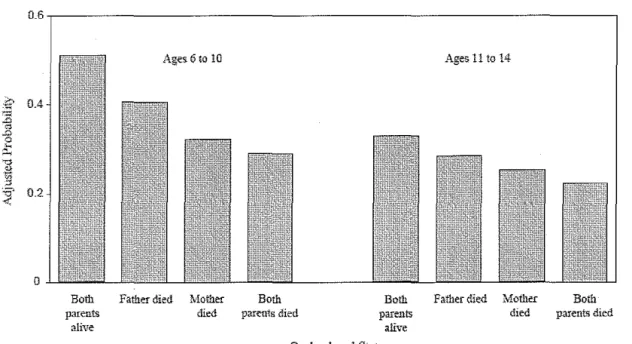
The impact that HIV/AIDS has had on societal and family structures contributes to the severity of this public health emergency. Many of the infected are yotmg adults in the prime of their reproductive years and those who die of the disease often leave young children behind. At the end of2003, 15 million children under the age of fifteen had been orphaned worldwide with 12 fillion of those children living in sub-Saharan Africa (Andrews 2006). It is projected that by 2010, 18 million children under the age of eighteen will be orphaned in Africa (Andrews 2006). Furthermore, even if the
Children are often categorized as single orphans, having one parent who is deceased, or double orphans, having two deceased parents. Throughout the 1990's the number of double orphans in sub-Saharan Africa has been steadily increasing. Figure 3 displays the number of estimated double orphans in five African countries in the years 1995 and 2000. These double-orphans will often reside with another relative, such as a grandmother, but it is uncertain whether child fostering within the extended family will be able to meet the needs of increasing numbers of orphans in the future (Heuveline 2004).
Figure 3: Estimates of the number of double orphans between 1995 and 2000 in five African countries
200.000
t80.1)!)0 0 2000 estimates
160.0()0
•
1 '195 estimales"'
,::: 140.000 cz--a
'"'
120.1)!)00
Q
--"'
:::! 100.000
8
....
0 80.000~
;:;
60JJOO 5Q
40.000
20.000
()
Niger Ghana Zimbflbwe Kenya Tanzania
Source: Bicego eta!. 2003
income-earning individuals supporting an increased number of dependants. One study conducted in East Africa has shown that school emollment rates among orphans are significantly lower than those of non-orphans; Single orphans have lower emollment rates than non-orphans and double orphans have lower emollment rates than single orphans, as demonstrated by figure 4 (Bicego 2003). East African double orphans between the ages of 6 and 10 are only half as likely to be at their appropriate education level as non-orphans. Between ages 11 and 14 double-orphans are only two-thirds as likely as non-orphans to be at the appropriate education level. If this trend continues, it will be a great challenge for African societies to absorb such a high number of under-educated children.
Figure 4: Probability of being at the proper education level by age group and orphan status
0~6,---,
Ages. 6 to 10
Both Father died Mother Both
parents
alive
died parents died
Ages 11 to 14
Bolli Father died Mother Both
parents alive
died parents died Oxphanhood Status
The toll that the pandemic has taken on health systems in sub-Saharan Africa has . been devastating. As HIV I AIDS prevalence rises, so does the number of opportunistic infections requiring medical attention. In many countries in sub-Saharan Africa, AIDS patients occupy over half of the hospital beds (US AID 2002). Because so many of the infected are poor, this burden largely falls on public hospitals and clinics. In South Africa, the total admissions in medical wards and the total number of hospital beds remained stable between 1995 and 2000. However, the HIVIAIDS-related admissions in all categories increased by a factor of seven and, currently, 46% of patients admitted to South African hospitals are HIV positive (Marchal 2005).
The increase in HIV I AIDS is particularly burdensome for the public health workforce. HIV positive patients are often admitted to clinics and hospitals with advanced illness. With limited treatment options this leads to an increase in inpatient deaths, which is illustrated by the higher case fatality rate among HIV infected patients. A 1992 study in the Uganda demonstrated a mortality rate of5.5% among HIV-negative patients as compared to a mortality rate of 17.4 among HIV infected patients (Colvin 200 I). This is a contributing factor to decreased staff morale and burnout (Marchal 2005).
Furthermore, a significant number of health care workers are HIV positive themselves. It is estimated that 16% of the health care workforce in South Africa is HIV positive (Benetar 2004). In low income countries low-cost HIV services are often accessible only through govermnent clinics. This leaves public-sector health care
tmdergo treatment because to do so would require that they disclose their status to a co-worker (Uebel2004). For this reason, HIV programs for clinical staff must be developed that assure anonymity and confidentiality. The loss of health care workers due to HIV-related illness or death has dire implications in a region that is currently facing a health workforce shortage. Figures released by the Minister of Health show 31,000 vacant nursing posts in South Africa alone in 2003 (Uebel2004).
Availability of Treatment Options
In developed countries, highly active antiretroviral therapy (HAART) has been available for years. Pharmaceutical companies have brought to market a wide array of antiretroviral medications designed to arrest the virus at different parts of the replication cycle. With proper triple-drug antiretroviral therapy, the life of an HIV -positive
individual may be prolonged indefinitely. Unfortunately, this type of treatment is not readily available in the regions of the world where it is most needed.
Sub-Saharan Africa provides the most striking example. Despite having the highest burden ofHIV worldwide, very few people who are HIV positive have access to triple-drug therapy. In these developing countries concerns regarding cost of
middle-income countries as compared to those living in wealthy industrialized countries (UNAIDS 2004).
In 2003, the World Health Organization (WHO) called for lmprecedented action to ensure that by the end of 2005 at least 3 million people in need of ART will have access to it (World Health Organization 2003). The "3 by 5" initiative was supported by international organizations and has led to an influx of resources into HIV treatment in developing countries. As an example, in 2003 George Bush announced the President's Emergency Plan for AIDS Relief (PEPF AR). This program dedicated $15 billion over five years to HIV/AIDS prevention and treatment program in fifteen COlmtries. Of the $15 billion, fifty-five percent will be spent on implementing antiretroviral therapy programs in developing countries (Office of the US Global AIDS Coordinator 2004). Ultimately, the 3 by 5 goal was not met, and only 1 million people were on therapy by June 2005 (WHO 2005). While significant progress has been made, the unmet need for ART is still extremely high in sub-Saharan Africa where only 11% of the 4.7 million people who needed therapy were under treatment by June of2005 (WHO 2005).
Description of Problem: The Limited Availability of Laboratory Testing
There are many challenges to be overcome when introducing life-long disease management and therapy into resource-limited areas. Initially, the costs of the
medications themselves were seen as the prohibitive aspect oflarge-scale treatment programs. In 2000, the cost of medications to treat one person with a first-line
The introduction of first -line generic regimens and differential pricing by pharmaceutical companies resulted in a decrease in cost. Furthermore, the Clinton Foundation worked with drug manufacturers in India and South Africa and negotiated further price reductions for poor countries (UN AIDS 2004). Today the cost of medications to treat one person with a first-line antiretroviral regimen may be as low as $132 USD under the pricing structure negotiated by the Clinton Foundation (Clinton HIV I AIDS Initiative 2005). Due to the dramatic reduction in price, the cost of antiretroviral medications is no longer the barrier to treatment that it once was.
Even with a high level of funding, one of the most pressing problems is
maintaining the laboratory infrastructure necessary to properly treat patients. There are a number of clinical laboratory tests that are used through the duration of antiretroviral therapy. During the course of infection, CD4+ T-lymphocytes are attacked and steadily depleted by the human immunodeficiency virus. For this reason, a CD4 count is a good indicator of disease progression and is used to diagnose AIDS in asymptomatic
At a minimum, the capacity should exist to run a CD4 count, a CBC and a basic blood chemistry panel. Accurate measures of these parameters can only be reliably obtained using expensive automated equipment that requires climate-controlled facilities, uninterrupted electricity and a reliable supply of reagents that often require a cold chain for transport and storage. While reduced reagent prices have been negotiated, most of the infrastructure problems with reagent transport and storage have yet to be solved.
Furthermore, maintaining frmctional machinery is difficult in countries that lack the capacity to service broken equipment (Nkengasong 2005). Many developing countries are also experiencing a shortage of skilled laboratory technicians who are able to properly operate laboratory equipment (Archibald 2001).
Despite these problems, it is generally felt that a lack of laboratory infrastructure should not preclude the implementation of ART in resource-poor settings. Four
approaches may be considered for improving patient care with minimal laboratory resources. These include less frequent monitoring, reduced reliance on
member countries and diagnostic manufacturers to scale up laboratory infrastructure at the country level (WHO 2003). Improved laboratory technologies are being developed that are better suited for use in developing countries, but the introduction of automated equipment at the level of district and community clinics is still a long way off. For this reason, there is an immediate need for alternative diagnostic measures to ensure that patients receive the best care possible in rural and resource-limited clinics.
The Need to Monitor Hemoglobin Values of Patients on Antiretroviral Therapy
One operational definition of anemia is a hemoglobin or hematocrit value that is lower than two standard deviations below the mean (Aird 2003). The normal range for hemoglobin and hematocrit varies according to factors such as age, sex, ethnicity,
geographic location and altitude. Decreased hemoglobin leads to a reduced ability of the blood to carry oxygen and a variety of symptoms may result from this condition.
Moderate anemias may be asymptomatic or mildly symptomatic with patients describing such conditions as headache, fatigue and lethargy while severe anemia may present with such symptoms as increased heart rate and hypotension (Bell2002).
demonstrated that anemia is independently associated with decreased survival in HIV positive women (Berhane 2004).
As HIV replicates in the body, it undergoes frequent random mutations. As a result, resistance to a single antiviral drug can develop rapidly (Champoux 2004). For this reason, combination therapy is advised. It has been found that triple-drug therapy demonstrates potent and sustained antiviral activity while monotherapy and dual therapy does not (DHHS 2006). There are currently over twenty FDA approved antiviral
medications. When selecting a drug regimen in any setting factors such as potency and side-effects must be considered, but when selecting medications for use in developing countries the decision will be based heavily on availability and cost (WHO 2003).
The WHO recommends four first-line ARV combination regimens to be used in developing countries. Each regimen contains two nucleoside reverse transcriptase inhibitors (NRTis) and one non-nucleoside reverse transcriptase inhibitor (NNRTI). The regimens will typically utilize stavudine (d4T) or zidovudine (AZT), lamivudine (3TC), and either nevirapine (NVP) or efavirenz (EFV) to form the combinations listed in table
I.
Table 1: First-line ARV Regimens in Adults and Adolescents and Characteristics That Can Influence Choice
ARVRegimen Major Potential Toxicities Laboratory Monitoring Requirements
d4T/3TC/NVP d4T-related neuropathy, No
pancreatitis and lipoatrophy NVP-related hepatotoxicity and severe rash
AZT/3TC/NVP AZT -related GI intolerance, Yes anemia, and neutropenia
NVP-related hepatotoxicity and severe rash
EFV -related CNS toxicity and potential for
teratogenicity
AZT/3TC/EFV ZDV -related GI intolerance, Yes anemia, and neutropenia
EFV-related CNS toxicity and potential for
teratogenicity
Source: WHO Treatment Gmdelmes 2003
Two of these regimens utilize the drug zidovudine (AZT) as a component. As listed in Table 1, one of the possible side effects of AZT is severe and potentially life-threatening anemia. AZT was the first antiretroviral drug with a proven benefit when used to treat HIV/AIDS. One of the earliest clinical trials was ended early due to a significant improvement and increased mortality in the group receiving AZT. However, this group also experienced decreased hemoglobin levels with 21% of participants requiring multiple red-cell transfusions while only 4% in the placebo arm required transfusions (Richman 1987). Additional studies showed that lower-doses of AZT were effective and less toxic (Marks and Gulick 2005) but could not eliminate the risk of anemia completely. AZT manufacturers warn that significant anemia has occurred with AZT therapy and strongly recommend frequent blood counts in those patients receiving the drug (GlaxoSmithKline 2006).
As patients with HIV infection progress in their disease status, they are more likely to develop AZT-related anemia (Street 2002). One study conducted in South Africa found that 7% of individuals placed on AZT experienced a grade 3 or 4
hemoglobin value between 6.5 g/dL and 7.9 g/dL. Grade 4 anemia is considered life threatening and is defmed as a hemoglobin value less than 6.5 (Kirshner 2004). A patient who develops grade three or four anemia risks dying from the condition if it left
undetected and untreated. For this reason, it is recommended that AZT be prescribed only in instances where the hemoglobin levels may be closely monitored. Often, the anemia can be reversed if detected early. If this occurs it is recommended that AZT treatment be stopped and another drug substituted (WHO 2003). Accurate hemoglobin monitoring is critical to ensure successful.outcomes of patients treated with AZT.
If the capacity to monitor hemoglobin is not in place, one option may be to use only those regimens that do not include AZT. However, it is unlikely that this could be possible in all instances. The most commonly used alternative medication is stavudine (d4T), which may also cause serious side effects. d4T does not affect hemoglobin levels but has been demonstrated to cause peripheral neuropathy or pancreatitis that is severe enough to require termination of use. For patients in developing countries who cannot tolerate d4T, the only available and affordable alternative is often AZT. For this reason nearly all large-scale ARV treatment programs will have a percentage of their patients on an AZT -containing regimen by necessity and thus, will require the capacity to monitor hemoglobin levels.
Of additional concern are programs that utilize short-course antiretroviral therapy for prevention of mother to child transmission (PMTCT). The standard of care in many developing countries is to treat women in labor with a single dose of nevirapine. Recent concerns about nevirapine resistance (Palmer 2006) have led to a movement to
currently being researched. Pregnant HIV positive women are at increased risk for anemia (Dairo 2005) and the use of AZT without adequate hemoglobin monitoring could compound their risk of developing severe anemia.
Methods for Monitoring Anemia in IDV Patients
It can be difficult to reliably measure hemoglobin values in areas with limited resources. The only methods of hemoglobin measurement that have been proven to be consistently accurate are those that use automated equipment. In order to obtain a hemoglobin value using automated equipment, blood is drawn from the patient into a tube treated with an anti-coagulant. The blood is then fed into the machine that performs the analysis and reports the hemoglobin value. This type of equipment has been in widespread use in developed countries for years but, as previously mentioned, it is unlikely that many district and community clinics in developing countries will have the necessary infrastructure and resources to reliably operate such equipment. It may also be difficult for poor clinics to keep the needles and blood collection tubes required for specimen collection in stock. For these reasons it is not yet feasible to implement automated laboratory equipment in every clinical site in a developing country and low-tech alternative methods of measuring or estimating hemoglobin are necessary.
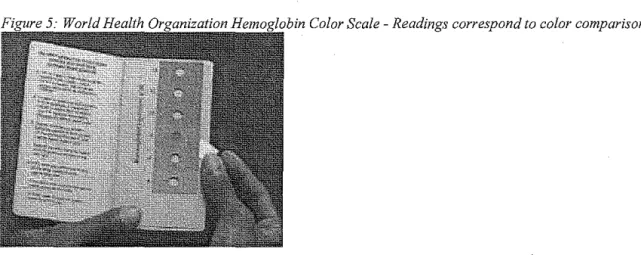
anemia that requires very minimal equipment. A finger stick is done and a drop of blood is placed on absorptive paper. The color of the blood is then visually compared to a set of six color squares each of which corresponds to a hemoglobin value starting at 4 g/dl and increasing at 2 g/dl increments to a maximum of 14 g/dl. The hemoglobin estimate is recorded based on the best color match (WHO 2003).
The Hemoglobin Color Scale represents an ideal public health intervention for resource-limited settings. Unlike automated equipment, the color card requires no electricity or reagents to operate. Due to the fact that it is made of sturdy paper, it can be stored indefinitely at any temperature and does not require refrigeration. As an added benefit, only a small drop of blood is required. This blood can be collected by doing a finger stick on the patient rather than drawing blood from a vein. A finger stick requires only a sharp lancet to break the skin which is far less expensive than the equipment required to collect enough venous blood for an automated hemoglobin measurement. Furthermore, the cost of the color cards is extremely low and training required for use is minimal. Due to the minimal cost and ease of operation, the Hemoglobin Color Scale could easily be implemented into health programs at the community level. District and community health centers could store and use the cards regardless of available
However, the benefits of using this method must be evaluated relative to its accuracy as a diagnostic test.
It is important to recognize that despite the cost and logistical benefits, the Hemoglobin color scale would only be successful if it provided a clinically reliable estimate of hemoglobin. Development of the WHO Hemoglobin color scale (HbCS) began in 1995 and it was made available commercially in 2001. Despite the fact that it has been in widespread use for five years, little research has been done to determine how useful the HbCS is as a tool for detecting anemia in areas where there is little or no laboratory capacity (WHO 2004). To date, very few studies have been published on the efficacy and/or effectiveness of the HbCS. Most of these studies sought to determine sensitivity (the probability that anemia will be detected using the HbCS among patients who are anemic) and specificity (the probability that anemia will not be detected using the HbCS among patients who are not anemic). None of the studies assessed the impact of using the HbCS on clinical outcomes such as appropriate disease management or improvement in patient condition (WHO 2004).
populations. It was found that laboratory based (efficacy) studies often yielded higher sensitivities and specificities than clinic based (effectiveness) studies.
Studies designed to determine the accuracy of the HbCS often focused on use of the color scale to determine if a patient was anemic but most did not assess the ability of the color scale to properly detect the severity of anemia. These studies often used a cutoff of II g/dl or 12 g/dl to define anemia. In many clinical settings, the degree of anemia is relatively unimportant. For example, a pregnant woman would be given the same treatment (iron supplements) regardless of whether her hemoglobin was 10 g/dl or 8 g/dl. In the circumstances in which color-card use is indicated, it is less important to obtain a precise measurement of hemoglobin than to establish what clinical action is required (Lewis eta!. 1998).
However, when using hemoglobin to determine clinical care with regard to antiretroviral therapy, the degree of anemia is precisely the measure used to determine the course of action. Using the example of the government ART program in Lusaka,
There are other concerns that should be addressed when assessing the suitability of use of the HbCS in antiretroviral programs including variability between persons conducting the test. One study evaluated interobserver variability when using the HbCS. When readings were taken by two separate people on 334 blood samples it was found that 81% of the readings were in agreement to within ±2 g/dl and that 19% of the
readings varied by more than 2 g/dl (van den Broek 1999). If a drop in hemoglobin of2 g/dl is the criteria for terminating AZT, this result implies that 19% of patients could potentially have their drug regimens changed or maintained based on errors from interobserver variability alone.
This type of error can have potentially serious consequences. If a patient were incorrectly identified as having a drug-induced anemia then the AZT component of the drug regimen would likely be change to d4T. This could become problematic if the patient were tolerating AZT well but then experienced side effects from the d4T. In this case other drug alternatives must be sought out which may be more expensive, less convenient or less effective. A more severe scenario could result if a patient who experienced a drug-induced anemia was misdiagnosed due to observer variability. An
improper test could lead a clinician to falsely believe that the patient was tolerating AZT when, in reality, continuation of AZT could pose a serious threat to the health of the patient. For reasons such as this it is in the best interest of both clinician and patient to ensure an accurate test for anemia.
determine the severity of anemia. Finally, there is the possibility of poor consistency among users. In conclusion, the available evidence suggests that the Hemoglobin Color Scale may not perform accurately enough to be used as a primary component of an antiretroviral therapy program.
Purpose of this Analysis
A review of the existing data and literature clearly indicates that automated methods of hemoglobin measurement are proven to be the most accurate, but are also the most difficult to implement in resource-limited settings. There is much available
evidence to suggest that the Hemoglobin Color Scale provides a far more convenient and less expensive method for hemoglobin estimation, yet the accuracy and validity of this method remains in question. A good diagnostic test for anemia is still needed to ensure that patients in developing countries are protected from possible anemia-related side effects while also assuring that they receive an optimal drug regimen for treatment of HIV. For this reason, further investigation into available options is needed.
Color Scale, yet less resource-intensive than automated hematology equipment. Supporting evidence for one such alternative, a manual hematocrit measurement, is presented here.
While a hemoglobin value measures the amount of hemoglobin present in the blood (measured in grams per deciliter), a hematocrit value measures the proportion of whole blood that is occupied by red blood cells and is expressed as a percentage. In areas where automated hematology equipment cannot be maintained, it is possible that a
hematocrit level could be a better indicator of anemia than a hemoglobin estimate derived using the hemoglobin color scale. There are some potential advantages to using a
hematocrit over the HbCS in a clinical setting. The first is that the testing method provides a numerical value without relying on subjective observations. With the
Figure 6: Manual hematocrit scale- The capillary tube is positioned with the bottom of the column of blood at the "0 "percent line and the top of the plasma at the "I 00" percent line. The height of the red cell column indicates the percent cell volume (source: Reidinger 1998)
""
CRITOCA.PS.,.I>t
.• ... ~!leiO·Iiernatoclit Capillary Tub<! ReaderPermits-R:t;~adingooH-'•aCk&d Cell
V\?lum~- Dir~ctly 'in-P11!t(ii~;N3ge Fer tn Vitro DiagnostiC _US/#
Figure 7: Representation of a capillary tube after it has been spun. The red layer corresponds to the red blood cells and the gray layer
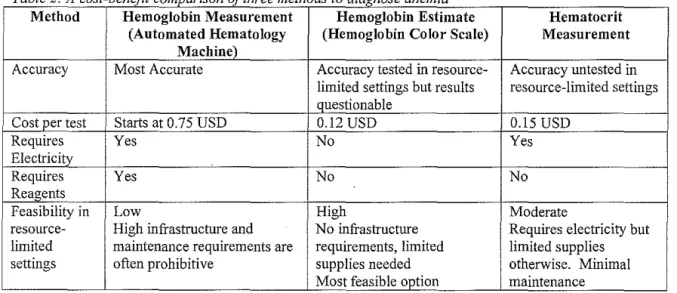
One immediate drawback is that the hematocrit method would require more resources than the Hemoglobin Color Scale. Electricity or battery power is needed to operate the centrifuge and small capillary tubes would be required for blood collection. This may be problematic in rural areas, but many urban clinics have sufficient electricity to nm a centrifuge. Even with these requirements, this technology is far less expensive and easier to maintain than automated hematology machines. The HbCS costs
approximately $0.12 per test (WHO 2004). After purchase of the centrifuge, the hematocrit cost per test would be approximately $0.15. In comparison, the cost per test using an automated hemoglobin analyzer starts at approximately $0.75 (WHO 2004). In areas where installation and maintenance of automated hematology equipment is not feasible, it may be a relatively simple matter to install and maintain a small centrifuge for hematocrit determination. A summary of the costs and benefits of the three methods of anemia determination can be found in table 2. The limited information available on low-tech anemia diagnostics highlights the need for future research on both existing and alternative methods.
Table 2: A cost-benefit comparison of three methods to diagnose anemia
Method Hemoglobin Measurement Hemoglobin Estimate Hematocrit
(Automated Hematology (Hemoglobin Color Scale) Measurement
Machine)
Accuracy Most Accurate Accuracy tested in resource- Accuracy untested in
limited settings but results resource-limited settings
questionable
Cost per test Statts at 0.75 USD 0.12 USD 0.15 USD
Requires Yes No Yes
Electricity
Requires Yes No No
Reaoents
Feasibility in Low Higb Moderate
resource- Higb infrastructure and No infrastructure Requires electricity but
limited maintenance requirements are requirements, limited limited supplies
Preliminary Evidence for Further Hematocrit Studies
In order to provide supporting evidence for further study into alternative methods of anemia diagnosis, a representative antiretroviral program in sub-Saharan Africa will be examined. The government program in Lusaka, Zambia provides an example of a
location where the issues surrolmding large-scale antiretroviral therapy are currently being studied. Zambia is located in the central part of southern Africa and has been one of the colmtries hardest hit by HIV/AIDS. The country has a total population of
approximately eleven million and between thirteen and twenty percent of all adults are infected with HIV (WHO n.d). In 2004 the Zambian government decided that
antiretroviral medications would be provided free-of-charge in the public sector (WHO Summary Country Profile 2005). With over 10,000 patients currently on antiretroviral therapy (Stringer n.d. ), the program in Lusaka provides a good setting to conduct research regarding provision ofHIV care in developing countries.
clinical outcomes. For the purposes of this paper, complete blood count (CBC) results from 7332 patients were used with the permission of Dr. Jeffrey Stringer, CIDRZ Director and Dr. Stewart Reid, CIDRZ Medical Director. The University of Zambia Research Ethics Committee and the Institutional Review Board at the University of Alabama at Birmingham have approved use of this data for research purposes. Presented in this paper is a secondary analysis of existing data that has been stripped of all unique identifiers and thus is exempt from IRB review according to the University of North Carolina Institutional Review Board (Office of Human Research Ethics 2006). This data is referenced because it has been recently derived from a large study in a developing country and may be reviewed to support the need for further studies into anemia detection methods.
The CBC results include hemoglobin and hematocrit values and were obtained using a Sysmex XT2000i analyzer (Sysmex Corporation, Japan). The XT 2000i is an FDA approved hematology analyzer that uses a sodium Iaury! sulfate (SLS) reagent to measure hemoglobin. The gold standard for hemoglobin measurement uses cyanide reagents, which can pose a hazard in use and disposal. The SLS method of hemoglobin measurement provides an accurate measure of hemoglobin without the use of toxic reagents. For the purposes of this paper, hemoglobin values obtained from the XT 2000i will serve as the reference standard. Hematocrit values from the XT 2000i are
determined directly by measuring red cell volume in relation to sample volume. When a CBC is run both hemoglobin and hematocrit are measured simultaneously and may then be compared.
The technology necessary for obtaining manual hematocrit values could be implemented in resource-limited settings. However, no studies have been done
determine whether this would be a reliable method on which to base care in developing countries. As previously mentioned, an ideal method of anemia detection would perform better than the Hemoglobin Color Scale, but require fewer resources than automated hematology equipment.
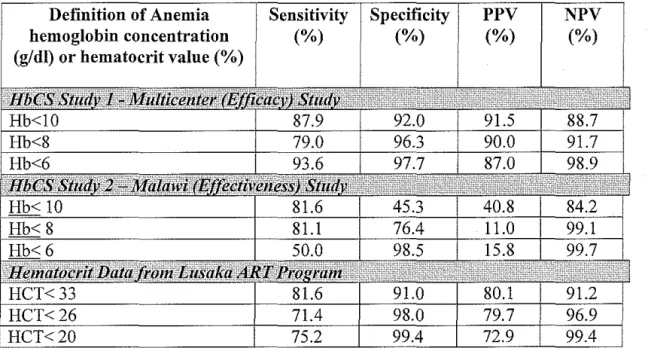
In order to approximate Hemoglobin Color Scale performance, data was selected from two studies for comparison. Study I is an efficacy study conducted on laboratory specimens in four laboratories (Lewis eta! 1998). The laboratories were located in the UK, South Africa, Thailand and Switzerland and the study was designed to assess the ability of laboratory workers to obtain accurate results from the HbCS under direct supervision. The patient population and laboratory workers were not representative of those that would be found in developing countries. This study was selected because of the high level of training and supervision and provides information on how well the HbCS can perform under ideal circumstances. Study 2 is an effectiveness study conducted in Malawi (van den Broek 1999). The purpose of this study was to evaluate HbCS performance in a "real-life" setting where the tests were done by lmsupervised district health care workers in an antenatal clinic. This study provided a patient population and clinical setting that best approximated conditions in the government clinics in Lusaka.
Raw data was presented in study I, but not study 2, so results from study I were recalculated to be comparable to the data from study 2. For example, in study I raw data was presented and broken down into the following hemoglobin categories: less than 4 g/dl, 4 to <6, 6 to <8, 8 to< 10, 10 to< 12, and 12 <14. In study 2 the raw data was not presented but calculated values for Sensitivity, Specificity, Positive Predictive Value and Negative Predictive Value were presented according to the following hemoglobin
Predictive Value (the percentage of people who test positive for anemia and actually are anemic), and Negative Predictive Value (the percentage of people who test negative for anemia and are actually not anemic). These values are presented in Table 3. Also presented in Table 3 is data calculated from the hemoglobin and hematocrit values collected in the Lusaka antiretroviral therapy program. The hematocrit values are expressed in different units than hemoglobin values (a percentage rather than g/dl) and this difference is reflected in the table.
Table 3: Comparison of Anemia Detection Methods in Three Settings- Sensitivity, specificity, positive and negative predictive values (P PV,NPV) and likelihood ratio (LR) for diagnosing anemia at different cut off points of hemoglobin concentration
Definition of Anemia hemoglobin concentration (g/dl) or hematocrit value (%)
Sensitivity
(%)
Specificity
(%)
PPV (%)
NPV (%)
laboratory conditions while Study 2 is an effectiveness study carried out in an unsupervised setting which more closely approximates the setting in which the scale would actually be used. In study 1 and study 2, sensitivity of the HbCS was comparable in the Hb<l 0 and Hb<8 subsets, but specificity was greatly reduced in study 2 indicating an increased number of false positives. At hemoglobin levels below 6 g/dl, the HbCS had a significantly decreased sensitivity in study 2, correctly identifying only 50% of patients with a hemoglobin level below 6 g/dl. The performance of the HbCS was also poor with regard to the reported Positive Predictive Value in Study 2. This indicated that there was a low probability that individuals who tested positive for anemia actually were anemic.
The data from the hematocrit values demonstrates a relatively high level of specificity without a large decrease in sensitivity when compared to the data in study 2. The positive predictive values for the hematocrit method are far higher than those of Study 2 and are comparable with those reported in Study 1.
A good diagnostic test would have high percentage values for sensitivity, specificity, PPV and NPV and a test that performed perfectly would have a value of 1.0 for all four parameters. A test that does not perform well in all areas may still be of value depending on the clinical situation. In some instances, high sensitivity may be far more important than high specificity. A good example is the diagnosis and treatment of anemia in an antenatal clinic. Obviously high sensitivity is preferable, as it is important that women who are anemic receive iron supplements. However, a high level of
anemic is unlikely to be harmful. In this specific situation a test for anemia with high sensitivity but low specificity would be valuable.
When administering antiretroviral therapy, the misdiagnosis of anemia carries higher risk. It is important to exercise caution when changing a patient's drug regimen. Unnecessarily switching a patient off of AZT carries some risks such as the chance that the patient will react adversely to the substitute medication and may increase the risk that the patient will develop a drug resistant viral strain. For these reasons, a high level of specificity is desirable to prevent unnecessary drug regimen changes.
A high level of sensitivity is preferred in this situation because individuals with lower hemoglobin at the time that AZT is initiated are at higher risk of developing severe and possible life-threatening anemia (Fielding et al. 2005). If a person is incorrectly diagnosed as anemic initially, they will be started on a regimen that does not contain AZT. The alternate medication (normally d4T) is equally effective and the patient's outcome should not be adversely affected unless a side effect is experienced as a result of the D4T component of the regimen. However, if a person who is anemic is incorrectly diagnosed as having normal hemoglobin levels and started on AZT, a severe adverse event is more likely.
There are several limitations to the existing data. To date, no studies have been done to assess the accuracy of the HbCS in a Zambian HIV positive population.
clinics in developing countries. Manual hematocrit readings may vary significantly due to the difference in measurement methods and the increased potential for human-error.
While it is not possible to determine the best method for anemia diagnosis based on existing data, the preliminary findings do support the need for further studies as the data on the hematocrit comparison indicates that hematocrit might be a more accurate predictor of anemia in clinical settings. These findings also provide some guidance as to what information is needed for these studies. As previously mentioned, future studies should take into account not only sensitivity and specificity, but also the ability of a test to diagnose severity of anemia and interobserver variability.
Considerations for Future Studies
The need for further research on the role of the HbCS in ART programs has been well documented (WHO 2004). The evidence presented in this paper lays the
groundwork for a prospective cohort study to assess the performance of the Hemoglobin Color Scale and a manual hematocrit as a predictor of anemia. The considerations that must be addressed in future studies are presented here and the Lusaka antiretroviral therapy program is used as an example.
conducting the HbCS and hematocrit readings are blinded to patient condition and the value obtained by the reference standard.
Outline of a Potential Study Design
One example of an appropriate site to carry out this study is Kalingalinga clinic in Lusaka. This clinic provides an ideal setting because it houses an ART clinic, a district laboratory as well as the central laboratory for the ART program. Figure 8 illustrates the relevant duties of health care workers in each facility. The personnel in each facility carry out specific tasks that do not overlap. This is important because the three facilities are a part of the same clinic and blood samples could be analyzed using the reference method as well as the experimental method within similar time frames. Furthermore, the personnel in each facility do not interact and would not have any knowledge of other examination or test results. This would help to ensure that anemia diagnostic methods are evaluated accurately and that results reflect test performance and not technician bias.
Figure 8: Diagram of tasks carried out in each of three clinic facilities and the ability to carry out a study with appropriate blinding
/
Blinded
/
Kalingalinga Clinic
Staffed by district nurses, physicians and clinical officers
Patients are examined by clinicians with
access to chart containing previous
hemoglobin values
Blood is drawn for laboratory testing
Kalingalinga Central Laboratory
Laboratory technicians employed by CIDRZ run tests specific to ART
Blinded
Kalingalinga District Laboratory District laboratory technicians run
Patients would be included in the study upon enrollment in the ART program, and would be randomized to receive either a manual hematocrit or a hemoglobin estimate using the HbCS. Both tests will be run in the district laboratory and the possibility exists that they may be run by the same technician. Because the outcome of one test may affect the technician's interpretation of the other, no patient will have both experimental tests done. To maintain appropriate blinding, each patient will have only one test or the other. Blood would be taken from a venous sample collected in an EDTA tube for the
experimental test as well as the reference test. The district laboratory personnel at Kalingalinga would perform the hematocrit or HbCS estimate before delivering the specimen to the reference laboratory for a complete hematology panel. The personnel at the district laboratory are not involved in clinical care and do not work in the reference laboratory. Therefore they would be blinded to the clinical presentation of the patients, any prior hematology values recorded in the patient chart, as well as the measured
Figure 9: Diagram of proposed study design
District Lab Central Lab
HbCS Reference
-
Hemoglobin/
AHIV Patient Blood Drawn Randomization
Enters
-
-
to HbCS orc1
Treatment Hematocrit
Program Group
~
Manual Reference
Hematocrit
-
HemoglobinB
c2
Comparisons of interested will be based on the reference standard in each group. Group A will be
compared to C1 and group B will be compared to C2 to determine the differences between the experimental
diagnostic methods.
Both experimental methods of anemia detection, the HbCS and the manual hematocrit, are subject to variations due to operator error. Studies should seek to determine the extent of both inter and intra-operator variability. Operator training methods should also be reported in detail to determine if variability is a reflection of the inherent properties of the test or operator training and supervision.
when reporting data. Information on patient indicators such as age, sex and pregnancy status should also be collected as these characteristics can affect baseline hemoglobin levels and anemia prevalence. The clinical setting and medical interventions being performed should be clearly stated, especially with regard to the risks and benefits of improper and proper anemia diagnosis.
Data should also be collected in such a way that the impact of the test on clinical care can be assessed. For example, if conducting the study through the Lusaka ART program, anemia would be defined as Hb value less than 10.0 g/dl. This cutoff has been chosen because previous studies have shown that AZT-induced anemia is more likely to occur in patients with a hemoglobin value of less than 10.5 g/dl (Fielding 2005) and patients with baseline Hb levels below this value are started on antiretroviral regimens that do not include AZT. Data should be analyzed to determine the number of true positives, false positives, true negatives and false negatives so that sensitivity, specificity, PPV and NPV can be reported. This will provide information on test performance, but more importantly it would assess whether reliance on the experimental test method would have resulted in appropriate clinical care. For example, a high sensitivity would indicate that a high percentage of patients with anemia would have been given the correct initial reg1men.
Finally, it is important to keep in mind that both experimental methods are unproven with regard to their impact on clinical care. For ethical reasons, studies should be designed in such a way that actual clinical care is based on the reference hemoglobin values and not the experimental values, especially in settings where an incorrect
studies, as it would still be possible to determine the number of patients who would have
received improper care had the reference value not been available.
While this paper attempts to address some of the concerns involved in further research, there are some issues that are not addressed here. Aspects of future studies not considered in this paper include cost and funding of this type of work, and the timing and duration of such a study. However, this design can be used to form the basis for a
funding or feasibility study proposal.
Conclusion
The HIV I AIDS pandemic is a serious threat to public health, economic development and stable societal structures in sub-Saharan Africa. Life-long
Antiretroviral therapy can prolong the lives of HIV positive individuals indefinitely. For this reason, efforts are underway to make antiretroviral therapy available on a large scale in the areas of sub-Saharan Africa that are the hardest hit. These areas tend to be poor making provision of resource-intensive interventions extremely challenging.
In order to implement large-scale ART, reliable laboratory infrastructure should be in place. However, in facilities without continuous electricity, adequate storage areas for reagents or easily accessible locations for maintenance personnel, operation of high-tech laboratory equipment may not be possible. For this reason, the World Health Organization has recommended alternative diagnostics that do not rely as heavily on strong laboratory infrastructure (WHO 2004).
for use in clinical care is extremely lacking. For this reason, we propose a study with two objectives. The first is to determine whether the hemoglobin color scale is an appropriate diagnostic in an antiretroviral therapy program. The second objective is to examine a manual hematocrit as a possible option and determine whether it performs better than the HbCS in a clinical setting. Preliminary data taken from the Lusaka government
antiretroviral therapy program suggests that hematocrit may be a better predictor of anemia and supports the need for further study.
Appendix I -Abbreviations AIDS
ART
ARV
AZT
CDC CIDRZ d4T HAART HbCSHIV
MTCT NNRTI NRTI PMTCT US AIDVCT
WHOAcquired Immunodeficiency Syndrome Antiretroviral Therapy
Antiretroviral Zidovudine
Centers for Disease Control and Prevention Center for Infectious Disease Research in Zambia Stavudine
Highly Active Antiretroviral Therapy Hemoglobin Color Scale
Human Immunodeficiency Virus Mother to Child Transmission
Non-nucleoside Reverse Transcriptase Inhibitor Nucleoside Reverse Transcriptase Inhibitor Prevention of Mother to Child Transmission
United States Agency for International Development Voluntary Counseling and Testing
References
Aina 0, Dadik J, Charurat M, Amangaman P, Gurumdi S, MangE, Guyit R, Lar N, Datong P, Daniyam C, Kanki P, Abimiku A. Reference Values of CD4 T Lymphocytes in Human Immunodeficiency Virus-Negative Adult Nigerians. Clinical and Diagnostic
Laboratory Immunology. 2005;12(4):525-530
Aird W. Anemia. In: Furie B, Cassileth P, Atkins M, Mayer R, eds. Clinical Hematology
and Oncology. Philadelphia, Pennsylvania: Churchill Livingstone; 2003:232-240
Andrews G, Skinner D, Zuma K. Epidemiology of health and vulnerability among children orphaned and made vulnerable by HIV I AIDS in sub-Saharan Africa. AIDS Care 2006; 18(3):269-276
Archibald L, Reller B. Clinical Microbiology in Developing Countries. Emerging
Infectious Diseases. 2001;7(2):302-305
Bell A. Anemias: RBC Morphology and Approach to Diagnosis. In: Rodak B. ed.
Hematology Clinical Principles and Applications. 2nd Ed. Philadelphia, Pennsylvania:
W.B. Satmders Company; 2002:199-210
Benatar S. Health Care Reform and the Crisis ofHIV and AIDS in South Africa. The
New England Journal of Medicine 2004;351(1):81-92
Berhane K, Karim R, Cohen M, Masri-Lavine L, Young M, Anastos K, Augenbraun M, Watts DH, Levine A. Impact of Highly Active Antiretroviral Therapy on Anemia and Relationship Between Anemia and Survival in a Large Cohort of HIV-Infected Women.
Journal of Acquired Immune Deficiency Syndromes. 2004;37(2):1245-1252
Bicego G, Rutstein S, Johnson K. Dimensions of the emerging orphan crisis in sub-Saharan Africa. Social Science and Medicine. 2003;56:1235-1247
Champoux J, Drew WL. Retroviruses, Human Immunodeficiency Virus, and Acquired Immunodeficiency Syndrome. In: Ryan K, Ray CG, eds. Sherris Medical Microbiology:
An Introduction to Infectious Diseases. 4th Ed. New York, NY: McGraw-Hill;
2004:601-616
Clark K, Hippe! T. Routine Testing in Hematology. In:Rodak B. ed. Hematology Clinical
Principles and Applications. 2nd Ed. Philadelphia, Pennsylvania: W.B. Saunders
Company; 2002:199-210
Comparison ofhaemoglobinometry by WHO Haemoglobin Colour Scale and copper sulphate against haemoglobincyanide reference method. Clinical and Laboratory
Haemotology 2004;26:253-258
Colvin M, Dawood S, Kleinschmidt I, Mullick S, Lallo U. Prevalence ofHIV and HIV-related diseases in the adult medical wards of a tertiary hospital in Durban, South Africa.
International Journal ofSTD and AIDS 2001;12:386-389
Critchley J, Bates I. Haemoglobin colour scale for anaemia diagnosis where there is no laboratory: a systematic review. International Journal of Epidemiology 2005;34: 1425-1434
Dairo MD, Lawoyin TO, Onadeko MO, Asekun-Olarinmoye EO, Adeniji AO. HIV as an additional risk factor for anaemia in pregnancy: evidence from primary care level in Ibadan, Southwestern Nigeria. African Journal of Medicine and Medical Sciences 2005;34(3):275-279
DHHS Panel on Antiretroviral Guidelines for Adults and Adolescents. Guidelines for the
Use of Antiretroviral Agents in HIV-1-Infected Adults and Adolescents. May 4, 2006
Drechsler H, Powderly W. Switching Effective Antiretroviral Therapy: A Review. Clin
Infect Dis 2002;35(10):1219-30
Fielding K, Charalambous S, Pemba L, eta!. Haemoglobin adverse events and changes
in haemoglobin amongst adults on zidovudine-containing antiretroviral therapy in South Africa. Poster presented at International Aids Society Conference. Rio de Janeiro, Brazil.
July 2005
Florence E, Dreezen C, Schrooten W, Van Esbroeck M, Kestens L, Fransen K, De Roo A, Colebunders R. The role of non-viral load surrogate markers in HIV -positive patient monitoring during antiviral treatment. International Journal ofSTD and AIDS 2004; 15:538-542
GlaxoSmithKline. Retrovir® [prescribing information]. Research Triangle Park, NC: GlaxoSmithKline; 2006
Heuveline P. Impact of the HIV epidemic on population and household structure: the dynamics and evidence to date. AIDS 2004; 18(suppl2):S45-S53
KirshnerJ, Hatch M, Hennessey D, Fridman M, Tannous R. Anemia in Stage II and III Breast Cancer Patients Treated With Adjuvant Doxorubicin and Cyclophosphamide Chemotherapy. The Oncologist 2004 ;9:25-34
Lara AM, Mundy C, Kandulu J, Chisuwo L, Bates I. Evaluation and costs of different haemoglobin methods for use in district hospitals in Malawi. Journal of Clinical
Lewis SM, Stott GJ, Wynn KJ. An inexpensive and reliable new haemoglobin colour scale for assessing anaemia. Journal of Clinical Pathology 1998;51:21-24
Marchal B, De Brouware V, Kegels G. HIV/AIDS and the health workforce crisis: What are the next steps? Tropical Medicine and International Health 2005;10(4):300-304
Marks K, Gulick R. Progress in HIV Treatment. In: Butera S. ed. HIV Chemotherapy- A Critical Review. Norfolk, United Kingdom: Caister Academic Press; 2005:1-3
Nkengasong J, Weidle P. Implementing Antiretroviral Thearapy in Developing
Countries: Logistic Issues and Lessons Learned. In: Butera S. ed. HIV Chemotherapy- A Critical Review. Norfolk, United Kingdom: Caister Academic Press; 2005:137-158
Office of Human Research Ethics. Institutional Review Board. Instructions for
Determination Whether Research or Similar Activities Require IRB Approval. Version 7;
March 7 2006. Online
http://ohre. unc.edu/forms/initial/not_ human_ subjects _research_ determination.doc Office of the United States Global AIDS Coordinator. The President's Emergency Plan for AIDS Relief US. Five-Year Global HIVIAIDS Strategy 2004
PalmerS, Boltz V, Martinson N, Maldarelli F, Gray G, Mcintyre J, Mellors J, Morris L, Coffin J. Persistence of nevirapine-resistant HIV -1 in women after single-dose nevirapine therapy for prevention of maternal-to-fetal HIV-1 transmission. Proceedings of the National Academy of Sciences 2006; 1 03(18):7094-7099
Reidinger T, Rodak B. Quantitative Laboratory Evaluation of Erythrocytes. In: Stiene-Martin A, Lotspeich-Steininger C, Koepke J. eds. Clinical Hematology-Principles, Procedures, Correlations. Philadelphia, Pennsylvania: Lippincott-Raven
Publishers;l998:111-113
Street A, Milliken S. Haematological manifestations ofHIV infection. In: Crowe S, Hoy J, Mills J, eds. Management of the HIV-Infected Patient. London, United Kingdom:
Martin Dunitz Ltd; 2002:281-283
Stringer JSA, Zulu I, Levy J, Stringer E, Mwango A, Chi B, Mtonga V, Reid S, Cantrell R, Bulterys M, Saag M, Mar link R, Mwinga A, Ellerbrock T, Sinkala M. Rapid Scale-Up of Antiretroviral Therapy at Primary Care Sites in Lusaka, Zambia: Feasibility and Early Outcomes
Uebel K, Friedland G, Pawinsky R, Holst H. HAART for hospital health care workers-an innovative progrworkers-annne. South Africworkers-an Journal of Medicine 2004;94(6):423-427 UNAIDS. 2004 Report on the global AIDS epidemic. UNAIDS/04/16E.
Geneva:UNAIDS 2004
UNAIDS. AIDS epidemic update. UNAIDS/05.19E. Geneva:UNAIDS, 2005 USAID. How Does HIVIAIDS Affect African Businesses? Washington DC:USAID USAID Report to Congress. USAID 's Expanded Response to HIVIAIDS. June 2002 Van den Broek NR, Ntonya C, Mhango E, White SA. Diagnosing anaemia in pregnancy in rural clinics: assessing the potential of the Haemoglobin Colour Scale. Bulletin of the
World Health Organization 1999;77(1):15-21
World Health Organization. Country information website-Zambia. Online http:/ /who.int/countries/zmb/en/ (no date) Accessed 23 May 2006
World Health Organization. Summary country profile for HIVI AIDS treatment scale-up. Geneva: World Health Organization, June 2005
World Health Organization. Haemoglobin Color Scale: operational research agenda and
study design, WHO/EHT/04.15. Geneva: World Health Organization, 2004
World Health Organization. Prevention of HIV in infants and young children; Review of
evidence and WHO's activities. WHO.HIV/2002.08. Geneva: World Health
Organization, 2002
World Health Organization. Progress on Global Access to HIV Antiretroviral Therapy,
An update on "3 by 5". Geneva: World Health Organization, 2005
World Health Organization. Scaling up Antiretroviral Therapy in Resource-Limited
Settings: Treatment Guidelines for A Public Health Approach 2003 Revision. Geneva: