Paul B C Wolff. Web 2.0 and the Educator’s Dilemma: Interacting with Students in an Online Social Network. A Master’s Paper for the M.S. in I.S degree. November, 2010. 36 pages. Advisor: Gary Marchionini
This study examines the interaction between educators and their students within the Online Social Network (OSN), Facebook. Twenty one educators at the secondary and post-secondary level were interviewed regarding their use of privacy settings within the website, their level of interaction with students, and a variety of other topics surrounding their use of Facebook. The study discusses the differing methods and practices employed regarding teacher-student interaction by the interview participants. Relevant literature pertaining to OSN use is also discussed. Ultimately, a model is proposed for educators to interact with their students through the Facebook interface while protecting both their privacy and the privacy of their students.
Headings:
Computer Communications.
Software -- Learner Management Systems.
Internet -- Security Measures
by Paul B C Wolff
A Master’s paper submitted to the faculty of the School of Information and Library Science of the University of North Carolina at Chapel Hill
in partial fulfillment of the requirements for the degree of Master of Science in
Information Science.
Chapel Hill, North Carolina
November 2010
Approved by
_______________________________________
Table of Contents
Introduction ... 2
Background and Literature Review ... 4
1.1 Online Social Networks ... 4
1.2 Learner Management Systems ... 6
1.3 OSN and LMS Overlap ... 7
1.4 Student and Faculty Interaction on Facebook ... 7
1.5 Summary ... 9
Research Goals... 9
Methodology ... 11
Results ... 13
1.6 Demographics and Requirements... 13
1.7 Friending Practices ... 14
1.8 Privacy ... 17
1.9 Facebook as a Communication Tool ... 21
1.10 Facebook as a Tool for Education ... 22
Conclusion ... 23
Bibliography ... 27
Appendix ... 28
1.11 Interview Questions: ... 29
1.12 Consent Form ... 31
Introduction
In recent years Online Social Networks (OSNs) have increased both in terms of
prevalence and popularity. Every day, people of all ages create accounts on sites like
Myspace and Facebook to interact with friends or reconnect with old acquaintances.
Amongst those people signing up for accounts are both educators and students and the
interaction between these two groups within an OSN is a subject of some controversy.
From an educator’s perspective, issues with this interaction surround privacy. Educators
are often uncomfortable with giving students access to personal information and with
opening a window into their private lives. From a student’s perspective, similar issues
arise. Students often dislike the feeling that an educator is watching them both inside and
outside the classroom. Compounding these problems are concerns regarding the
appropriateness of such interaction. Many in the public view OSNs from a purely
recreational standpoint and view teacher-student interaction in such an environment as
both out of place and improper.
This research explores the application and incorporation of OSNs in the field of
education. Specifically, how faculty members utilize OSNs both from a social standpoint
and in interacting with coworkers and students. The perceived problems and issues
regarding teacher-student interaction in an OSN environment, along with the potential
explored. In addition, this paper looks at how new teachers, who have OSN profiles prior
to teaching, change their behavior after becoming a teacher or professor. Participants in
this research were faculty at both the K-12 and the university level. Ultimately, this
paper presents an alternate model of OSN use that provides teachers with a means to
communicate and collaborate both with one another and with students.
Much of the research involving OSNs focuses on user behavior on and off the networks
and the role that OSNs play in the lives of OSN users. Valentine et al., for example,
looked at the user identity within an OSN and the tendency for the barrier between the
virtual and the real to break down (Valentine et al., 2002). In another study, Ellison et al.
determined that online relationships support and compliment offline relationships rather
than replacing them (Ellison et al., 2007). boyd has also done several studies looking at
user identity and the concept of a virtual self within various OSNs (boyd, 2008). Hewitt
et al. looked into student perception of faculty members when those faculty members
participate in OSNs (the research focused on Facebook) and the inherent identity issues
that arose from that participation (Hewitt et al., 2006). Other studies have examined
Learning Management Systems (LMSs) like Blackboard or Sakai and the interaction
between students and teachers within these environments (many of these studies have
focused on distance learning). Rather than looking at OSNs from the perspective of all
users of the system and rather than looking at LMSs that are used solely for educational
purposes, this research focuses on the teacher perspective within the OSN Facebook
Pursuant to this goal, interviews were conducted with eleven K-12 teachers and ten
university instructors. Interviewees were asked a series of questions pertaining to their
use of the OSN Facebook. Participant responses to these questions were compared and a
discussion of the responses (along with any perceived trends within the response group)
is included later in the study. Although the number of interview participants is relatively
small, this research is intended to contribute to a more general discussion about
teacher-student interaction online and ways that educators can best utilize tools that teacher-students are
already actively engaged in using.
Background and Literature Review
1.1
Online Social Networks
The term Web 2.0 has become a part of the vernacular over the past five years. This
umbrella term refers to a growing trend on the Web – the increase in web technologies
that are interactive, collaborative, and that are designed with the end-user in mind.
Important components of Web 2.0 technology include the idea that the user of a website
is actively engaged rather than passively viewing content and that the user is connected
through a collaborative community. A variety of technologies fall under the umbrella of
Web 2.0 including blogging, micro-blogging, meta-blogging, and video-sharing. One of
the most prominent Web 2.0 technologies is the Online Social Network (OSN). OSNs
are typically websites where users can create accounts and update profile information
about themselves. Users can then interact with one another through the OSN, viewing
other profiles and commenting on a variety of information (photos, status updates, posts,
etc.). Dana boyd defines the three main features of an OSN as profiles, friends lists, and
various OSN platforms that have developed during the Web 2.0 boom. Though the
various OSNs have differed in terms of the mechanics of interaction and the aesthetic
presentation of information, the underlying structures are similar. A user creates a
profile, is able to view and interact with other profiles through some commenting
structure, and is able to save profiles to view later through a friends list.
Facebook, the OSN that is the primary focus of this research, is currently the most
pervasively used OSN in the United States. According to the Facebook website, there are
currently over 500 million active users. True to the OSN model described by boyd,
Facebook focuses on a user-created profile, the accumulation of friends through a friends
list, and commenting on a variety of friends’ objects. These objects include photos,
videos, status updates, wall posts, and virtually anything the user posts and shares on the
site (Engstrom, 2005). Facebook is somewhat rigid in the presentation of this
information in that there is no room for altering the presentation - instead, users can
modify content on the site. Facebook has also allowed for a significant amount of
integration with other systems. RSS feeds, for example, can be set up to automatically
post information to a Facebook user’s wall, developers can create interactive games and
allow Facebook users to interact with one another through the site, and Facebook users
can link their status updates to other sites like Twitter. This level of interconnectivity
between Web 2.0 technologies allows users to constantly communicate with one another
through both synchronous and asynchronous methods of communication and is one of the
1.2
Learner Management Systems
Interaction between educators and students in an online medium is often accomplished
through the use of a Learner Management System (LMS). These systems, like Sakai,
Moodle, and Blackboard, typically exhibit certain characteristics. In an article comparing
Blackboard and Moodle, Bos et al. claimed that LMS software should on some level
enhance instruction, provide technical assistance, and provide a forum for interaction
with both peers and instructor (Bos et al., 2005). The article goes on to describe other
characteristics of an LMS. These characteristics, although not required, include the
presence of: assessment tools (online quiz and test features), learning tools (thesaurus,
glossary, online books, etc.), and instant feedback on test results (Bos et al., 2005). An
LMS represents a targeted type of OSN – namely, an OSN that is designed to facilitate
learning in an educational environment. Here, the targeted audience is students and the
LMS is used to communicate about a course or to complete work for a course. While the
LMS model may not be pervasive at the secondary education level in the United States,
many post-secondary institutions have implemented these systems (and some use
multiple LMS systems concurrently)(Ganjalizadeh et al., 2006).
Where the LMS model breaks down is the fact that students are being asked to learn a
new system that they will only use for school work. These systems, while functional,
seem to be designed with the function in mind, rather than the end user. Students
growing up in the Web 2.0 era are accustomed to sites designed with the end user in
mind. In addition, with the increasingly interconnected nature of Web 2.0 technologies,
students are used to being able to log into a central location, like Facebook, and have it
LMS and participate in discussions, for example, has the potential to result in very low
participation levels.
1.3
OSN and LMS Overlap
Given that an LMS is a targeted OSN, it stands to reason that the two systems would
offer overlapping functionality on some levels. Where this becomes most striking is
when both systems are looked at as a means for users to communicate with one another.
Some form of messaging and/or method of sending emails (either within the system or
through an external email client) are typically present in both systems. In addition, a
means of holding publicly viewable discussions is a common feature of both systems. In
the case of an LMS, this tends to be seen through discussion forums where users that
have access to a course’s forum can view one another’s comments and post responses or
start new threads of discussion (Bos et al., 2007). In an OSN environment, and
particularly in the case of Facebook, these public discussions manifest themselves in the
form of wall posts. Here, users that have permission to view the wall of a person, event,
or group, can hold discussions by posting comments and can start new discussion threads.
This communication tends to be asynchronous. From an educator’s perspective, this
allows users time to think about their comments and plan out their discussion posts more
than would be the case in an in-person discussion (DeNeui et al., 2006).
1.4
Student and Faculty Interaction on Facebook
In a 2006 study titled “Crossing Boundaries: Identity Management and Student/Faculty
Relationships on the Facebook,” researchers attempted to determine whether there is a
correlation between faculty participation on Facebook and student perception of faculty
faculty on Facebook. The study found that student-faculty interaction on Facebook had
no effect on how students rate professors. For the most part, students tended to view
Facebook as an extension of their private lives and viewed this as separate from their
professional interaction with educators outside of Facebook. At the same time, privacy
and identity were major concerns for students and one third of students in the study felt
that faculty should not be on Facebook. Some students felt that faculty presence on
Facebook would amount to “monitoring” and that Facebook should be a recreational site.
Others felt that faculty presence on Facebook took away from the professional nature of
student-faculty interaction (Hewitt et al., 2006).
Admittedly, this study took place in 2006, at a time when Facebook was undergoing a
fundamental change. Prior to 2006, access to Facebook was available to targeted groups
that primarily focused on college students. In September of 2006, Facebook became
open to anyone over the age of 13 which fundamentally changed the Facebook user base.
As students have seen their parents, younger siblings, employers, etc. join Facebook over
the past four years, it is likely that perceptions of who should and shouldn’t be allowed
on Facebook might have changed if a follow up study were conducted today. In addition,
the privacy features offered by Facebook have become far more granular, allowing users
to specify who is able to view narrow subsets of the content they post on the site. In fact,
in response to privacy concerns, Facebook’s privacy settings received an overhaul in
2010, affording users many more options to protect the information they would like to
1.5
Summary
Due to the increased access to Facebook and the widespread use of the site, the
communication resource Facebook represents to educators as a means to reach out to
students should not be ignored. While OSNs like Facebook may not replace LMSs, the
supplemental value they could provide by linking to other Web 2.0 technologies and
serving as an informal discussion medium for course content holds a great deal of
potential. That said, certain aspects of the LMS model should probably remain
autonomous to the LMS such as assessment and grading. Since many students already
use Facebook to communicate, the site represents an untapped resource for
communication that should be explored as a potential tool for education. Through the use
of groups and granular privacy settings, it is possible to create learning environments that
are essentially microcosms within Facebook where students could hold discussions that
would integrate seamlessly into their typical Facebook use. Prior to exploring this idea,
however, it would be beneficial to determine current levels of teacher and student
interaction within Facebook.
Research Goals
The purpose of this study is to determine the various methods educators employ with
respect to privacy when interacting with students within the context of the OSN,
Facebook. Based on the findings of the research and the prevalence of the various
methods, a recommended approach is discussed for educators who want to use Facebook
This research is intended to explore the application and incorporation of OSNs in the
field of education. Specifically, the research focuses on how faculty members utilize
Facebook both from a social standpoint and in interacting with coworkers and students.
In addition, the extent to which new teachers, who have Facebook profiles prior to
teaching, change their behavior after becoming a teacher or professor will also be
examined. By including faculty at both the secondary and post-secondary level, this
study takes a broad view of OSN use by educators and can help determine if there are
major differences in OSN use by the two groups. Many in the public perceive OSNs
purely from a recreational standpoint. In addition, many view teacher-student interaction
in an OSN environment to be inappropriate. This study explores this notion, along with
the potential for positive interaction between teacher and student in these environments.
Ultimately, this research concludes with the presentation of an alternate model of OSN
use that provides teachers with a means to communicate and collaborate both with one
another and with students.
Currently, there is a disconnect between the use of OSNs (which are used frequently and
pervasively by students), and the use of LMSs (which students are forced to use for
certain courses). By examining the current use of OSNs by educators, this study
develops a recommended best practice for educators so that they can make the best use of
a system that is already being used by many of their students. In this way, two primary
groups stand to benefit from this research. The first group, educators, stand to benefit by
students, stand to benefit by increasing their access to communicate with their instructors
through methods they already use frequently.
Methodology
This study took approximately two months to complete, including the proposal approval
process (including the IRB approval), interviews, analysis of research, and compiling of
research. The study involved a qualitative analysis of interviews with twenty-one
participants. A convenience sampling strategy was used. Participants were identified
based on the primary researcher’s knowledge of their background as an educator and
their use of online social networks. Participants were contacted in person, where possible
and by either phone or email when face-to-face contact was not an option. At the time of
contact, participants were read a script (see Appendix 1.13) and shown a fact sheet (see
Appendix 1.12) with information about the study. Participants then signed a consent
form, agreeing to be part of the study after reading the fact sheet (Appendix 1.12).
When conducting interviews, participants were allowed to choose a location in which
they felt most comfortable for the purpose of the interview. Interviews were
semi-structured in that there were certain questions that were always covered, while participant
responses dictated the subsequent questions that were asked and the overall direction of
the interview. Interview questions focused on the educator’s use of Facebook, the level
of interaction the educator has with his or her students and faculty peers, the use of
built-in privacy settbuilt-ings, and any other precautionary measures the educator used to protect his
or her privacy while using the site (please refer to Appendix 1.11 for specific interview
questions were initially designed with his usage of Facebook and student interaction in
mind. Issues and concerns that the primary investigator encountered as an educator and
that he witnessed peers encountering were a primary focus of the interview questions.
The interview questions were vetted through the IRB approval process and through an
initial pilot with two instructors (one secondary and one post-secondary). Participants
were only contacted on three occasions: in order to schedule the interview, in order to
conduct the interview, and in order to allow the participant to view the finished product.
All interview data was collected and compiled by the principal investigator of the study.
Each interview took between 15 and 45 minutes.
The data collected was in the form of interview transcripts. The audio of interviews was
recorded, where possible, and was transcribed after the fact by the principal investigator.
After transcribing the interview, the audio of each interview was deleted. The transcripts
of each interview were compared and significant findings are discussed in the results and
conclusion section of this paper. Based on participant responses, trends of online social
network use by educators were used to help extrapolate a recommended best practice for
educators for online social network use. Because the purpose of this research is to
examine what methods are currently employed by educators in online social networks
and to offer recommended practices when engaging students in online social networks, a
small sample size was sufficient. By interviewing a small number of secondary
instructors and a small number of post-secondary instructors, several examples of how
educators currently use online social networks and several examples of how educators
point for further research and is intended to launch a discussion about instructor-student
interaction in an online social network. That said, the research participants were not
random and, instead, were known to the primary researcher as having participated in an
online social network in some capacity. Again, because the research is intended to
launch a discussion and serve as a starting point for further research, the sample size and
type were deemed sufficient.
In order to protect the anonymity of the participants, no identifiable data was collected
outside of signed consent forms. Due to the small sample size, only the audio recording
of the interview and the transcript of the interview were collected, without any
identifying information (other than a randomly assigned numeric identifier). All data
relevant to the study and its participants was stored in a password protected file. The file
was also encrypted and stored on a password protected computer up to the time of
deletion. Any hard copies of interview transcripts were stored in a locked file cabinet in
a locked office within a locked building. After transcripts were transcribed into a digital
format, the original copies were shredded.
Results
1.6
Demographics and Requirements
Twenty-one interviews were conducted with secondary and post-secondary instructors
over a one month period. No effort was made to discriminate on the basis of age, gender,
race, or ethnicity. In order to participate in the study, participants had to have (or have
secondary or post-secondary level. All participants were known to the primary
investigator ahead of time and were known to be both Facebook users and educators.
1.7
Friending Practices
When asked about their friending practices regarding students, all educators at both the
secondary and post-secondary level had established some form of rule set for themselves.
Some educators set up privacy settings to safeguard against students sending them friend
requests, which represents one conscious policy used if a student were to send them a
friend request. As a result, educators fell into four distinct categories regarding the
rule-sets they established for friending students. In the first category, educators were
comfortable accepting a student’s friend requests while they were currently that student’s
instructor. These educators made no distinction between students that they grew to know
personally and students with whom they had less interaction. In short, they accepted any
and all friend requests of students whether or not they were currently teaching the
student. Educators in the second category were willing to accept student friend requests
only after they were no longer the student’s instructor. In some cases, this meant that the
educator required a student to graduate before accepting a friend request and in others,
the student simply needed to no longer be enrolled in a course with the instructor. In the
third category, educators made the decision to never accept friend requests from students.
In some cases, the educators took steps to hide their profile information, which will be
discussed later, in some cases the educator ignored any and all friend requests, and in
other cases, the educator contacted the student to explain their reasoning for not accepting
friend requests. In the final category, an educator was willing to accept student friend
personal relationship with the educator, either through participation in extra-curricular
activities that the educator participated in or through knowing the educator outside of the
educational environment.
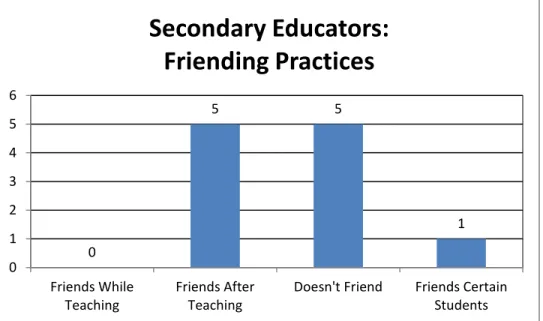
At the secondary level, no educators interviewed were willing to accept student friend
requests while they were currently the student’s instructor, five were willing to accept
friend requests when the person in question was no longer a student, five never accepted
friend requests from students and one educator accepted friend requests on a case-by-case
basis (see Figure 1.a). Secondary educators tended to be very cognizant of separating
their personal life from their professional life. In all cases, secondary instructors viewed
Facebook as an extension of their personal life.
Figure 1.a – Friending Practices of Secondary Educators.
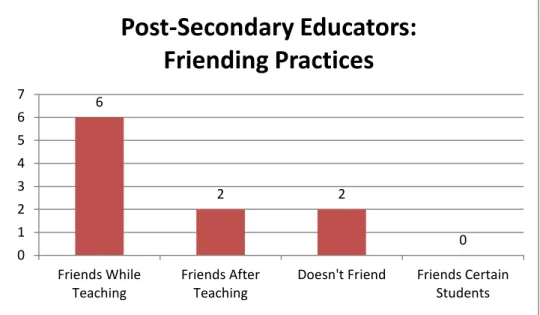
At the post-secondary level, six educators interviewed were willing to accept student
friend requests while they were currently the student’s instructor, two were willing to
accept friend requests when the person in question was no longer a student, two never 0
5 5
1
0 1 2 3 4 5 6
Friends While Teaching
Friends After Teaching
Doesn't Friend Friends Certain Students
Secondary Educators:
accepted friend requests from students and no one accepted friend requests on a
case-by-case basis (see Figure 1.b). Although post-secondary educators were cognizant of a
separation between private and professional life, they tended to be more willing to view
Facebook as a communication tool to reach their students and many felt that Facebook
wasn’t distinctly part of their private or professional life. Instead, they saw Facebook as
blurring the line between the two portions of their life.
Figure 1.b – Friending Practices of Post-Secondary Educators.
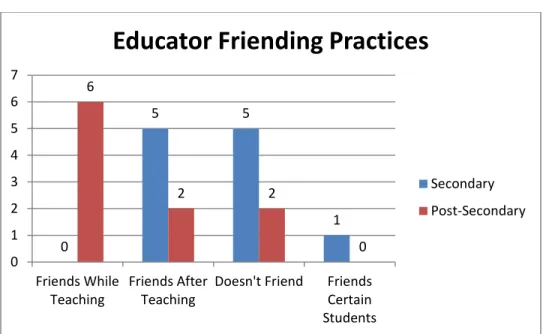
When viewed together, educators tended to be willing to accept friend requests at some
point although post-secondary instructors were the only people willing to accept friend
requests while the person in question was still a student (see figure 1.c). Educators who
chose not to accept friend requests from students at any point in time tended to be
secondary instructors, but all seven of the instructors in this category made reference to
concerns about students having access to personal information and the desire to maintain
a professional distance from their students. 6
2 2
0 0
1 2 3 4 5 6 7
Friends While Teaching
Friends After Teaching
Doesn't Friend Friends Certain Students
Post-Secondary Educators:
Figure 1.c – Educator Friending Practices.
1.8
Privacy
Educators at both the secondary and post-secondary level expressed privacy concerns
with regard to interacting with their students on Facebook. For those who had Facebook
accounts prior to becoming an instructor, this tended to involve changing their usage of
Facebook in some way with regards to privacy. For those who created Facebook
accounts after becoming an educator, this involved setting up privacy settings and
making decisions about what information they wanted to be visible from the outset.
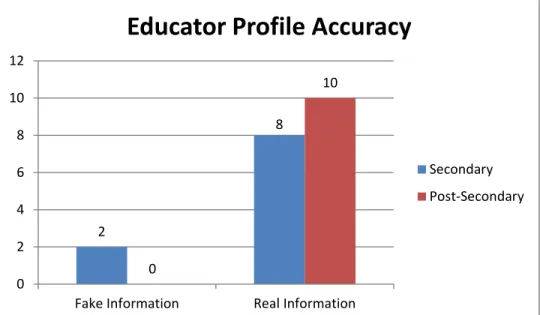
Some participants used false information on their profile (a fake picture and name) in
addition to increasing privacy settings, while one participant chose to delete their profile
all together during the first year of teaching. While falsifying personal information is a
violation of the Facebook terms of service, the two educators who employed this practice
did not indicate if they were cognizant of this fact. Presumably, the privacy benefits of
limiting their personal information displayed, outweighed the potential risk of violating
the terms of service. For the most part, participants in the study tended to use their actual 0
5 5
1 6
2 2
0 0 1 2 3 4 5 6 7 Friends While Teaching Friends After Teaching
Doesn't Friend Friends Certain Students
Educator Friending Practices
Secondary
information (although some chose to only share limited information), and opted to
increase their privacy settings, rather than delete their account (see Figure 1.d).
Figure 1.d – Educator Profile Accuracy – Note: one secondary instructor chose to delete his Facebook profile during the first year of teaching and his information was not included in this graph.
Of those educators who did incorporate privacy settings, they tended to fall into three
categories. In the first category, profile information is extremely restricted. In this
category, educators aren’t searchable in Facebook and their information is only visible to
users that have already been accepted as friends (in this case, both secondary instructors
who used fake information also used the most rigid privacy restrictions). In the second
category, an educator’s profile was searchable in Facebook, but only to users who were
accepted as friends of the educator’s accepted friends. In this category, the educator may
have made some items visible to all (this tended to be information such as name, email
address, education, etc.), but for the most part their profile was restricted. In the final
category, educators left their profile relatively open (either entirely so or with very little 2
8
0
10
0 2 4 6 8 10 12
Fake Information Real Information
Educator Profile Accuracy
Secondary
restricted, such as certain photo albums) and an educator’s profile was searchable by
anyone using Facebook.
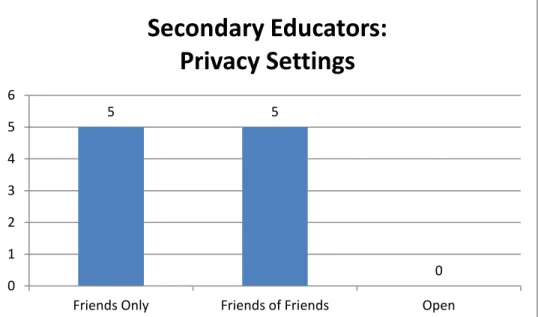
At the secondary level, five educators used the most restrictive privacy settings, five used
moderately restrictive privacy settings, and no educators left their profile open to
everyone (see Figure 1.e). All ten educators expressed privacy concerns and all ten, at
the very least, restricted access to view photos. In addition, several of the educators
mentioned deleting photos after becoming an educator and limiting the information they
posted on their profile. In both cases, participants expressed concern that the built-in
privacy settings might fail and, as a result, were attempting to take every precaution
available.
Figure 1.e – Secondary Educator Privacy Settings – Note: one secondary instructor chose to delete his Facebook profile during the first year of teaching and his information was not included in this graph.
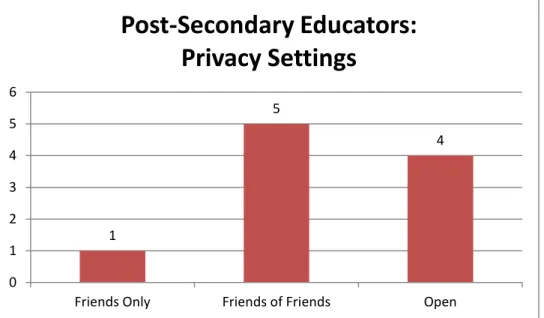
At the post-secondary level, one educator used the most restrictive privacy settings, five
used moderately restrictive privacy settings, and four educators left their profile open to
5 5
0 0
1 2 3 4 5 6
Friends Only Friends of Friends Open
everyone (see Figure 1.f). While most of the participants expressed concern about
privacy, three of the four who left their profile open chose to ensure their privacy by
restricting what information was posted, rather than setting up privacy settings. They
opted to limit photos posted of them to those that they felt were appropriate for students
and coworkers to see. In short, they took an approach to Facebook privacy that involved
not posting any information to Facebook that they felt they needed to hide.
Figure 1.f – Post-Secondary Educator Privacy Settings.
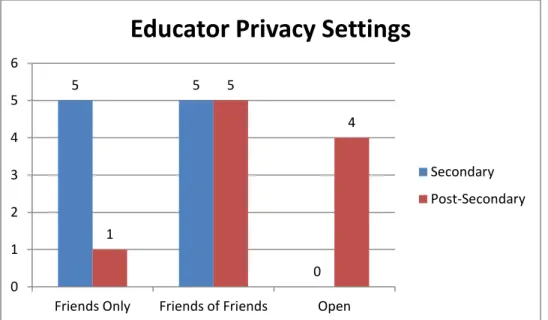
When viewed together, educators tended to employ some type of privacy setting and all
educators were certainly cognizant of privacy concerns (see Figure 1.g). Half of those
interviewed opted for a semi-restricted approach, allowing certain information to be
visible to anyone while restricting information they felt was personal. Roughly one third
of the participants used the most restrictive privacy settings available to ensure their
privacy and even the majority of those who left their profile information open employed
the precautionary privacy measure of omission. That said, secondary instructors seemed 1
5
4
0 1 2 3 4 5 6
Friends Only Friends of Friends Open
to be more concerned about privacy than their post-secondary counterparts, at least
within the limited scope of this study.
Figure 1.g – Educator Privacy Settings.
1.9
Facebook as a Communication Tool
When asked about their use of Facebook as a communication tool, either in a private or
professional capacity, educator responses varied. For the purpose of this study, the
degree of use of communication tools within Facebook was determined by the frequency
of use of any of the following: wall posts, status updates, messaging, chatting,
commenting, or creating events. This was a subjective response indicated by the
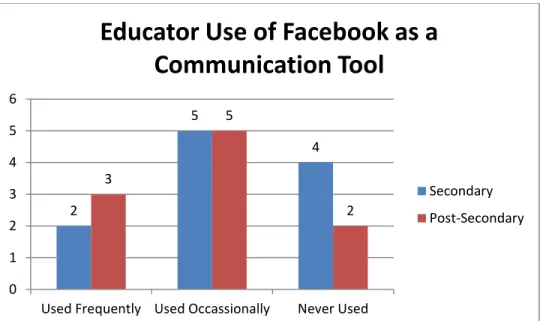
participant as to their frequency of the use of any of those tools. Both secondary and
post-secondary instructors tended to use the communication tools within Facebook
occasionally and several participants stated that their primary use of Facebook was to
view photos of friends and family. Five educators stated that they used one or more of
the communication tools listed above frequently, ten indicated that they occasionally used
5 5
0 1
5
4
0 1 2 3 4 5 6
Friends Only Friends of Friends Open
Educator Privacy Settings
Secondary
one or more of the communication tools and six educators stated that they never used any
of the communication tools available within Facebook (see Figure 1.h).
Figure 1.h – Educator Use of Facebook as a Communication Tool.
1.10
Facebook as a Tool for Education
Of those educators interviewed, only three instructors had ever used Facebook in an
educational capacity. Of these, two had been enrolled in a course that used Facebook as a
communication tool for the course. In both cases, a private group within Facebook was
set up and used as the discussion board for the course and students were allowed to send
messages to the professor. The third instructor had conducted a course in which he used
Facebook as the primary communication device for the course. Again, a group was
created and wall posts within that group served as the discussion board for the course. In
addition, Facebook chat and messaging were used to conduct office hours where students
could be guaranteed that the instructor would be online during preset time periods.
Although the responses were subjective, all three instructors felt that the discussions were
more involved through Facebook than through other online discussion formats they had 2
5
4
3
5
2
0 1 2 3 4 5 6
Used Frequently Used Occassionally Never Used
Educator Use of Facebook as a
Communication Tool
Secondary
used in the past. When questioned further about this, the success of Facebook as a
discussion tool was attributed to the following: the news feed notification system when
new posts were added, the fact that students already used Facebook and were used to the
interface, and the fact that profile images next to posts made the discussion more
enjoyable. In addition, one educator mentioned that the discussion taking place on
Facebook made it feel less formal and less restrictive.
Conclusion
This study was limited in scope and the interview pool was small. That said, the purpose
of this study was not to produce conclusive evidence of educator Facebook practices.
Rather, this study was intended to serve as an initial litmus test of teacher-student
interaction on Facebook and to begin a discussion regarding the use of Facebook for
educational purposes. As has been previously stated, the extensive use of Facebook as a
communication tool by the student population, along with Facebook’s integration with
other Web 2.0 technologies (blogging, rss feeds, twitter, etc.), makes this an appealing
resource for those educators seeking another medium through which to reach students.
After interviewing twenty one educators at both the secondary and post-secondary level,
there are certainly issues to consider when looking at Facebook as an educational tool.
Most notably, issues of both privacy and professionalism were at the forefront of
educator concerns. From a privacy standpoint, educators were concerned about allowing
access to certain aspects of their information within Facebook. Many of the educators
within Facebook, while others implemented the built in privacy settings within Facebook
(to varying degrees of restrictiveness). Still other educators protected their privacy by
omitting information and only sharing what they were comfortable being viewed by the
public. Closely related to this issue, the concept of a separation between personal life and
professional life came up repeatedly throughout the interviews. Many educators viewed
Facebook as operating purely within the realm of private life, while others viewed
Facebook as increasingly bridging the gap between private and professional life. In
either case, the need to present oneself in a professional manner within Facebook seemed
to be a concern for multiple interview participants. A shift in the perception of how
Facebook could be used would need to occur, along with buy-in on the part of both
educators and students in order to make use of Facebook as a communication tool within
the field of education.
Issues of privacy and professionalism within Facebook can also be addressed by using
certain built-in features of the Facebook privacy settings. To begin with, Facebook
privacy settings have become increasingly granular and those settings, when combined
with the use of friend lists, can create some fairly sophisticated layers of privacy. An
educator, for example, could create a friend list entitled “student.” At any point an
educator adds a student as a friend, the educator could then add the student to the friend
list “student.” Within the Facebook privacy settings, the friend list “student” can be set
up to view or not view each grouping of information that the educator has shared through
Facebook. This means that an educator could prevent any person that was part of the
These granular privacy settings can be used in conjunction with the broader privacy
settings. An educator could set up his photos to only be viewable to his friends, with the
exception of those who are grouped into specific friend lists. Similarly, an educator can
make certain content viewable only to those users within a friend list. An educator could,
for example, create a photo album of family photos and set up privacy settings so that
only those friends within the friend list “family” could view the photos. These privacy
settings, when used in combination with the creation of groups, allows for even greater
customization. While the educator has made all of his information private from anyone
within the friend list “student,” he could simultaneously create a group titled “Class 101”
and only allow members of the group to view the content within the group. Here the
users within the friend list “student” would be able to see no profile content (photos, wall
posts, notifications, status updates, etc.) made by the instructor, but they would be able to
see everything within the group “Class 101.” In this way, an educator could effectively
protect his privacy while creating a subsection of Facebook through which he could
interact with his students. When this functionality is leveraged against the ability to
interface with other Web 2.0 technologies, an educator’s options become even more
nuanced. Here, an educator could link his blog’s rss feed to the group “Class 101” and
students could leave comments within the group interface within Facebook that only
group members would be able to see. One significant advantage of interacting with
students through Facebook, is that educators could capitalize on a communication system
that many students already use frequently. Asking students to use a Facebook group as a
discussion forum would interface seamlessly with the students’ typical Facebook usage.
each student’s newsfeed (automatically alerting them if, for example, another student had
a response to something they’d said in a discussion or if a new discussion topic was
added). Making use of this untapped resource could be an effective way of reaching out
to students in an informal manner who might not participate in a discussion otherwise.
The practical application of these ideas may not be suitable for all educators. It was clear
through interviews that many of the secondary educators, in particular, were concerned
about the legal implications of interacting with students through Facebook. In those
cases, a more structured and formal approach that was approved through the proper
channels might be more fitting. Many educators might also be apprehensive about
managing privacy settings at such a granular level (forgetting to restrict access to a
specific friend list or add a student to a friend list could result in information being
viewable that the educator would prefer remained private). It should also be noted that
educators will need to learn Facebook management skills in much the same way that they
currently learn LMS management skills. That said, the possible benefits of reaching
students may outweigh these privacy concerns for other educators. In either case, the
possibility of utilizing Facebook as an educational tool is worthy of further discussion
Bibliography
Bos, B., Munoz, K., and Duzer J. (2005). “Blackboard vs Moodle: A Comparison of Satisfaction with Online Teaching and Learning Tools.” Humboldt State
University, February 15, 2005. http://www.humboldt.edu/~jdv1/moodle/all.htm
boyd, danah. (2007). “Social Network Sites: Public, Private, or What?” Knowledge Tree 13, May 2007.
boyd, danah. (2008) "Why Youth (Heart) Social Network Sites: The Role of
Networked Publics in Teenage Social Life." In D. Buckingham (Ed.), Youth,
Identity and Digital Media, 119-142, Cambridge, MA: MIT Press.
Brown-Syed, C., Adkins, D., and Tsai, H. (2005). “LIS Student Learning Styles and Web-based instruction methods.” Journal of Library & Information Services in
Distance Learning, Vol. 2(1) 2005.
Chen, W., Looi, C. (2007). “Incorporating online discussion in face to face classroom learning: A new blended learning approach.” Australasian Journal of Educational
Technology, 2007, 23(3), 307-326.
Ellison, N. B., Steinfield, C., & Lampe, C. (2007). “The benefits of Facebook "friends:" Social capital and college students' use of online social network sites.” Journal of
Computer- Mediated Communication, 12(4), article 1.
http://jcmc.indiana.edu/vol12/issue4/ellison.html
Engstrom, J. (2005). “Why some social network services work and others don’t – Or: the case for object-centric sociality.”
http://www.zengestrom.com/blog/2005/04/why_some_social.html
Hewitt, A. and Forte, A. (2006) “Crossing Boundaries: Identity Management and Student/Faculty Relationships on the Facebook.” Proceedings of CSCW 2006.
Jovanović, J., Gašević, D., Knight, C., & Richards, G. (2007). “Ontologies for Effective Use of Context in e-Learning Settings.” Educational Technology & Society, 10 (3), 47-59.
Kosba, E., Dimitrova, V., and Boyle, R. (2007). “Adaptive feedback generation to support teachers in web-based distance education.” User Modeling and
User-Adapted Interaction, Volume 17, Number 4, September, 2007.
Kumar, R., Novak, J., and Tomkins, A. (2006). “Structure and evolution of online social networks.” Proceedings of KDD 2006, pages 611–617.
Millen, D. and Patterson, J. (2002) “Stimulating Social Engagement in a Community Network.” Proceedings of CSCW 2002.
Valentine, G and Holloway, S. (2002) “Cyberkids? Exploring Children’s Identities and Social Networks in On-line and Off-line Worlds.” Annals of the Association of
AmericanGeographers, 92(2), 2002.
Appendix
1.11
Interview Questions:
For the purpose of this interview, the primary questions are numbered and follow-up questions are indented below each question. Some follow-up questions may not be needed.
1. Do you have a Facebook account?
a. Did you used to have a Facebook account? b. When did you start using Facebook? c. When did you stop using Facebook?
2. If you no longer have a Facebook profile, what made you delete your account?
a. If the interviewee no longer has a profile, continue to ask questions based
on their past usage of Facebook.
3. Did you have a Facebook account prior to becoming an instructor?
a. If so, did your Facebook usage change after becoming an instructor? 4. Describe your typical Facebook usage?
a. Do you use Facebook: to keep in touch with friends, to interact with peers and/or coworkers, to interact with students, as a communication tool, to create events, as a classroom tool?
b. Do you make use of any or all of the communication tools available through Facebook (i.e. status updates, wall posts, comments, messaging, creating events, creating groups, etc.)?
c. Has your Facebook usage changed over time? How so?
5. Has a student ever sent you a friend request or message through Facebook? a. If so, did you accept the friend request/respond to the message? b. If not, do you take steps to keep your profile hidden from students? 6. What privacy settings do you use on your Facebook account?
a. Is your information visible to anyone, only to friends, to friends of friends, etc.?
b. Is certain information visible while other information is hidden?
c. Do you use your actual information or do you use fictional information on your account to hide it from students?
d. Do you refrain from entering certain information on Facebook to keep it private?
f. Do you organize your friends into groups and apply different privacy settings to different groups?
7. Do you have more than one Facebook profile?
a. If so, do you use the different profiles for different purposes (i.e. a professional profile, a personal profile, a profile only for students, etc.)? 8. Do you have rules you impose on yourself with regards to interacting with your
students on Facebook?
a. Do you interact with students on Facebook?
b. Do you only interact with certain students (i.e. students you’ve spent significant time with, students who performed particularly well, etc.)? c. Do you only interact with students after they meet certain criteria (i.e.
students who have graduated, students who are no longer enrolled in your class, etc.)?
d. Do you accept students as friends on Facebook?
e. Do you only accept students as friends but don’t interact with them through other Facebook communication tools (i.e. wall posts, comments, messaging, etc.)?
9. Are you concerned about interacting with students through Facebook? a. If so, what specific concerns do you have?
10. Have you ever used Facebook in an instructional capacity?
a. Have you ever communicated about a course or subject matter you were teaching through Facebook?
b. Have you ever answered student questions through Facebook? c. Have you ever used Facebook as a discussion board for a course? d. Have you ever sent out information about a course through Facebook? e. Have you ever created a group within Facebook for a course and restricted
access to the group to members of the class?
11.Additional questions may come up or the interview may shift in focus based on the
1.12
Consent Form
University of North Carolina-Chapel Hill Information about a Research Study
________________________________________________________________________
IRB Study # 10-1715 Consent Form Version Date: 09-27-10
Title of Study: Web 2.0 and the Educator’s Dilemma: Interacting with Students in an
Online Social Network
Principal Investigator: Paul Wolff
UNC-Chapel Hill Department: School of Information and Library Science
Faculty Advisor: Gary Marchionini
Study Contact telephone number: 919-225-4835
Study Contact email: [email protected]
Faculty Advisor Contact telephone number: 919-966-3611
Faculty Advisor Contact email: [email protected]
_________________________________________________________________
What are some general things you should know about research studies?
You are being asked to take part in a research study. To join the study is voluntary. You may refuse to join, or you may withdraw your consent to be in the study, for any reason, without penalty.
Research studies are designed to obtain new knowledge. This new information may help people in the future. You may not receive any direct benefit from being in the research study. There also may be risks to being in research studies.
Details about this study are discussed below. It is important that you understand this information so that you can make an informed choice about being in this research study. You will be given a copy of this consent form. You should ask the researchers named above, or staff members who may assist them, any questions you have about this study at any time.
What is the purpose of this study?
The purpose of this study is to determine the various methods educators employ with respect to privacy when interacting with students as well as fellow professionals within the context of the online social network, Facebook. Based on the findings of the research and the prevalence of the various methods, a recommended approach will be discussed for educators who want to use Facebook but are concerned about privacy issues. We also hope that this study will prompt more research into this area.
How many people will take part in this study?
If you decide to be in this study, you will be one of approximately 20 people in this research study.
How long will your part in this study last?
What will happen if you take part in the study
I will ask you questions about your use of the online social network, Facebook, any privacy settings you employ there and any interaction you have with your students through Facebook. I will take notes about what you say. You do not have to answer any questions that you do not wish to answer, for any reason.
What are the possible benefits from being in this study?
Research is designed to benefit society by gaining new knowledge. I hope that your participation will help to develop a recommended best practice for educators who wish to use Facebook to reach their students. It is possible that you will not benefit directly from this research.
What are the possible risks or discomforts involved from being in this study?
We do not think you will experience any discomfort or risk from the interview and several steps will be taken to make sure that your privacy is protected.
How will your privacy be protected?
I will not be collecting any personal information about you and will only be taking notes from the interview. The only information about you that will be used in the presentation of this research to others is whether you are a secondary or post-secondary instructor, so no one here in your community, or elsewhere, will know what you said.
Will you receive anything for being in this study?
You will not be compensated for your information, but your information is very important to us.
Will it cost you anything to be in this study?
There are no costs for being in the study unless you had to drive to the interview location.
What if you have questions about this study?
You have the right to ask, and have answered, any questions you may have about this research. If you have questions, or concerns, you should contact me or my advisor at the phone numbers and email addresses listed at the beginning of this form.
What if you have questions about your rights as a research participant?
All research on human volunteers is reviewed by a committee that works to protect your rights and welfare. If you have questions or concerns about your rights as a research subject you may contact, anonymously if you wish, the Institutional Review Board at 919-966-3113 or by email to [email protected].
Thank you for helping me with this study.
- - -
Title of Study: Web 2.0 and the Educator’s Dilemma: Interacting with Students in an
Online Social Network
Participant’s Agreement:
I have read the information provided above. I have asked all the questions I have at this time. I voluntarily agree to participate in this research study.
I grant permission to the principal investigator to record the interview with the understanding that the digital audio recording will be deleted upon transcription of the interview.
_________________________________________________ _________________
Signature of Research Participant Date
1.13
Script for recruiting volunteers:
Hi, my name is Paul Wolff and I am currently a graduate student at the School of
Information and Library Science at the University of North Carolina at Chapel Hill. I am conducting research about educators and their use of Facebook. Specifically, I am looking at the privacy settings and methods that educators employ on the site when interacting with their students. Based on the findings of the research, a recommended approach will be discussed for educators who want to use Facebook but are concerned about privacy issues. We also hope that this study will prompt more research into this area.
As part of this research, I would like to conduct a 30 minute interview with you. I will also provide you with a fact sheet with more information about the study. Just so you know, no personal information will be collected about you outside of your signature of consent to participate in the study and your responses to the interview questions will not be linked to you in any way. If you are interested in participating, I’d like to schedule an interview time and place that is convenient and comfortable for you. In order to protect your privacy, I’d like to recommend that the interview be in a private location. I would be happy to come to your office or home if that is convenient or we can find a different location.
If the recruit agrees to participate:
Thank you for being willing to participate in this research. I will see you at
(date/time/location) for the scheduled interview. Please let me know if you have any questions or concerns in the mean time.
If the recruit does not want to participate:
Thank you for taking the time to hear about my research. If you change your mind about participating at any point, please let me know.