1 Pregnancy and HIV/STD among Adolescents:
A Literature Review of Technology-Based Preventive Strategies
by Mirna Rauda
A paper presented to the faculty of The University of North Carolina at Chapel Hill in partial fulfillment of the requirements for the
degree of Master of Science in Public Health in the Department of Maternal and Child Health.
Chapel Hill, N.C. July 25 2012
Approved by:
Advisor
2 Abstract
3 Table of Contents
Introduction………4
Background………6
Sexual Risk Behaviors………...6
Risk Indicators………...7
Methods………...9
Review of the Literature………...……….9
Discussion……….17
Recommendations………17
Conclusion………18
4 Introduction
Pregnancy and sexually transmitted diseases (STDs) among adolescents is a public health concern with physical, social, and economic ramifications. Sexual risky behaviors, such as not using contraceptives or having multiple sexual partners, increases an adolescent’s chances of becoming pregnant and contracting HIV or other STDs.1
Although there has been an increase in condom use and hormonal contraceptive methods1
among this population, a large number continue to engage in other risky sexual
behaviors.2 To reach the adolescent population, distribution channels that are frequently
visited by teens needs to be adopted. Such channels include social media, which is increasingly popular among adolescents. This review will look at the limited research on technology-based strategies, in particular the use of social media, to reduce sexual risky behaviors that lead to unintended pregnancies and HIV/STDs.
The United States has made progress toward reducing the adolescent pregnancy rate; however, regions within the US suffer from rates comparable to that of developing countries. From 1990 to 2010, the teen birth rate in the US dropped from 59.9 to 34.3 per 1,000 females aged 15-19.2 While these rates are far higher than that of other
industrialized nations, what is concerning is that countries with fewer resources such as Belarus and Cambodia have lower rates than some US states.3 From 2000-2010, the birth
rate for females ages 15-19 were 51, 22, 46, 51, and 52 for Barbados, Belarus, Bhutan, Botswana, and Cambodia.3
5 If some US states have teen birth rates comparable to certain developing
countries, how do they fare with industrialized regions? In 2009, the United Kingdom had a teen birth rate of 25, Australia 16.5, and Portugal 15.3.5 Compared to these
countries, Mississippi and Texas have more than double the rate of the country with the highest teen birth rate in Western Europe—United Kingdom.5
With these vast disparities and nearly double the teen birth rates of other developed countries, the US is in need of innovative prevention methods to reach the adolescent population.
In 2009, the US diagnosis of HIV infection was 17.4 per 100,000 population.6
Other states, such as Georgia, have a HIV infection rate as high as 33 per 100,000 population; almost double the national rate.6
Adolescents and young adults have the highest rates of STDs of any age group; in 2008, approximately 18 percent of new HIV diagnoses occurred among youth aged 13-24.7 Furthermore, it is estimated that almost
half of all incidences of STDs occurred in young adults, aged 15-24, while this age group only represents 25 percent of sexually experienced population.8 Compared to the general
population, young people ages 15-24 have four times the rate of chlamydia and gonorrhea.9
As a result of the existing high rates of STD among this population, infections continue to rise; during 2009-2010, chlamydia infection rose 2.8 percent for adolescents aged 15-19.8 The gonorrhea prevalence for the same age group increased 1.4 percent
during the same time period.8
Although adolescent females aged 15-19 had higher prevalence of gonorrhea, they had a smaller increase in prevalence (0.9%) than male adolescents aged 15-19 (2.1%).8 Regional and racial disparities exist with the Southeast
6 women having disproportionately higher prevalence of STDs than white males and females.10
Adolescent high risky sexual behavior is a pressing social and public health issue. Teens who engage in unprotected sex are at increased risk for HIV/STDs and pregnancy.2
Research shows that teens’ future prospects diminish when they become pregnant and give birth.11 Teenage moms are less likely to complete school and more likely to become
single parents.11 Furthermore, the children of teens also face poorer health and
developmental outcomes. Children of teen moms are less likely to live in supportive and stimulating environments, and are at increased risk of having poorer health and worse cognitive and educational outcomes.11
Background
Sexual Risk Behaviors
Risky sexual behavior increases the risk of unintended pregnancy, HIV, and STDs. By the time adolescents graduate high school nearly two-thirds have engaged in sexual intercourse.7 Most alarming is that approximately 40 percent of sexually active
teens did not use a condom during their last sexual encounter,7 12.9 percent did not use
any method to prevent pregnancy during the last sexual encounter,12 13.8 percent of
students had sexual intercourse with four or more persons during their life,13 and one in
five reported being under the influence of alcohol or other drugs before the last time they had sexual intercourse.13 Males (25.9%) were more likely than females (17.1%) to have
7 Disparities exist between prevalence of sexual intercourse and race and
ethnicity.13 In 2009, the prevalence of African American students who ever had sex was
65.2 percent, 49.1 percent for Hispanics, and 42 percent for white students. 13 Male
students tended to have significantly higher prevalence of sexual intercourse, with the exception of white females (44.7%) who had higher prevalence than white males.13
Out of all the groups, African American males (72.1%) and African American females (58.3%) had the highest prevalence of sexual intercourse. Hispanic males had a prevalence of 52.8 percent and white males 39.6 percent.13
Prevalence of sexual intercourse increases with age; 12th graders have the highest prevalence (62.3%) compared to 10th (40.9%) and 9th graders (31.6%).13
The increase of sexual activity with age has implications for program prevention efforts; to prevent risky sexual behavior it is necessary to intervene at an early age before the onset of sexual activity. Therefore, preventive programs should occur even before the commencement of high school whenever possible. Number of sexual partners is a growing concern for adolescents who engage in sexual intercourse. Nationwide, 13.8 percent of students had sex with four or more persons during their life.13 Young males report higher number of
partners with whom they had sexual intercourse than females.13 African Americans
(28.6%) are especially more likely to have four or more partners than Hispanics (14.2%) and whites (10.5%).13 The higher prevalence of risky sexual behavior among African
American youth demands special attention to this population. Risk Indicators
8 outcomes.11, 14 Interventions that target risk indicators are more like to influence
behaviors11, 14 as they actively target the factors that contribute to teen pregnancy and
HIV/STD outcomes. A review of over 250 research studies focused on risk and protective factors of teen pregnancy and HIV/STD identified over 100 factors that affect one or more sexual behaviors.11
However, it is important to note than no one factor leads to teen pregnancy or HIV/STD, but the accumulation of risk factors is what affects sexual behaviors.14
Clusters of risk factors can be broken down in the following categories: individual, family, community, peers, and partners.11, 14 Factors on the individual level
include biological factors, ethnicity, attachment and success in school, religiosity, emotional distress, for example.11, 14 Family factors are those that revolve around
structure and economic advantage of teenager’s families, family dynamics, and family attitudes about sexual health.11, 14 Community factors typically involve income level,
crime rate, neighborhood violence, and drug availability.11, 14 Peer and partner factors
include support of contraceptive use, non-normative behavior, among others.11
Because there are a myriad of factors associated with teen pregnancy and
HIV/STD, prevention efforts should focus on those factors that are amenable to change.14
Factors such as community violence, substance abuse, mental disorders, are impossible or extremely difficult to change, and thus, greater focus should be paid to factors more easily influenced such as sexual beliefs, skills and behaviors, attitudes, and values.14
Due to the high rates of pregnancy and HIV/STD among the adolescent
9 With the emerging use of media among adolescents, more attention is needed at
examining the effectiveness of technology-based delivery of prevention services toward this population.
Methods
This review will look at the published literature on emerging strategies using technology to prevent pregnancy and HIV/STDs among adolescents. Articles included in the literature review were selected based on the following criteria: 1) studies published in English from 2000-2012, 2) studies focusing on adolescent sexual or reproductive health, and 3) articles reporting on technology-based strategies. The following keywords were used alone or in combination to find articles: teens, adolescents, youth, pregnancy prevention, STD prevention, HIV prevention, sexual health, reproductive health, sex education, contraceptive, technology, social media, social marketing, internet, SMS, text messaging, computer, campaign, mobile, and internet. Included studies were retrieved from PubMed, PsycInfo, and UNC Chapel Hill Article+ database. In addition, studies were also selected from the reference sections of retrieved articles.
Literature Review
10 adolescents, it is a method that is worth investing due to its popularity and capability to reach a wide number of diverse adolescents.
Many interventions aimed at educating adolescents about pregnancy and HIV/STDs have been primarily school-based. With the rapidly growing use of
technology to communicate, more research is needed in how to incorporate social media (e.g. social networking sites and mobile texting) into sexual and reproductive health education. Adolescents in the United States spend six to seven hours per day engaging with some form of media, such as television, music, movies, internet, smart cell phones, or magazines.15 New media, such as smart cell phones, has increased dramatically among
adolescents. Lenhart16 reports that 75 percent of adolescents own a mobile phone and 88 percent of those adolescents use the text messaging feature. Adolescents use the internet for a wide range of functions including seeking health information. Approximately one-third of adolescents report using the internet to find health information, especially topics that they identified as difficult to talk about, such as HIV and other STDs 17, 18 and they
are more likely to seek information for themselves than any other age group.18
This type of media can serve as channels for sex education; young people use digital media to explore social, sexual, and romantic relationships.19 Its popularity can partially be
attributed to the perceived anonymity,19, 20, 21 availability,19, 20 presumed safety, 19 and ability
to communicate with peers.19
Several studies have evaluated the use of computerized interventions as
preventive measures to pregnancy and HIV/STDs and the results are promising.22-25 One
study examined the effectiveness of computer-assisted instruction (CAI) based
11 behaviors.22 The intervention used stories, role models, and demonstrations to provide
information about HIV prevention.22 The program was tested with an older population— 152 college students—however, the results showed significantly higher HIV knowledge and intention to practice safe sex with current partners than those who participated in the lecture group.22
Similarly, a computer-based intervention designed to change perceived threat, efficacy, attitudes and knowledge regarding pregnancy, HIV, and STD among rural adolescents had positive results.23 A large sample of 887 ninth-graders were
surveyed and those who participated in the computer-based curriculum outperformed other students on knowledge, condom self-efficacy, attitudes toward having sex, and perceived susceptibility to HIV.23
Another sexuality education computerized program titled ProjectLight (“Living in Good Health Together”) showed modest improvements in sexual activity and number of sexual partners among 133 high-risk adolescents ages 14-18 than those who did the face-to-face version.24 A meta-analysis of computer
technology-based HIV prevention programs aimed at increasing condom used showed that computer-based HIV prevention interventions had similar efficacy than traditional face-to-face interventions.26
A study by Howard, Davis, and Mitchell 25 integrated computer-based
intervention with the internet to increase condom use among teens. This study randomly assigned teens to treatment group and comparison condition.25 Teens who attended
treatment group viewed a PowerPoint presentation with links to teen-friendly health websites. 25 When teens returned to follow-up appointments 3-6 months later, those who
12 condoms were not going to be used (71% vs. 38%).25 Results indicate that an interactive
directed learning approach that allows teens the opportunity to explore educational material online might be effective at increasing condom use. Although computer based curriculums might not be effective for all populations, it is a viable alternative due to the low cost in delivery and flexible dissemination channels,26
as well as its ability to be multi-component.
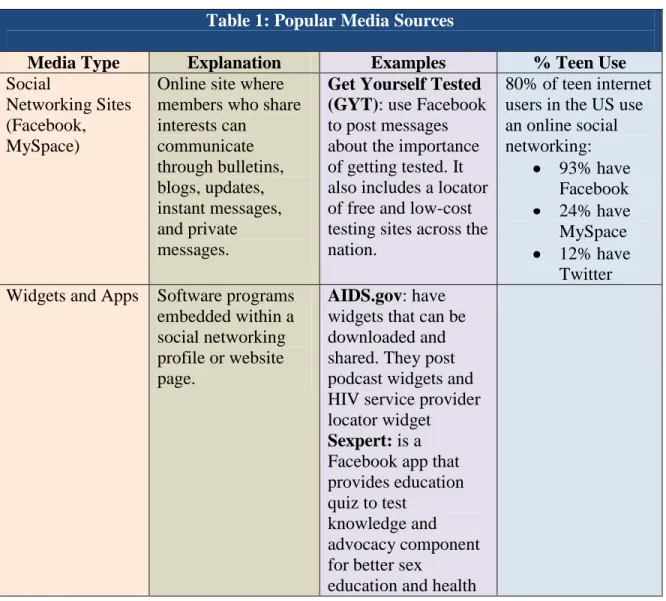
Many organizations have capitalized on the growing use of new media among adolescents by using various sources of media to disseminate sexual and reproductive health messages to teens (Table 1).27, 28
Table 1: Popular Media Sources
Media Type Explanation Examples % Teen Use
Social
Networking Sites (Facebook, MySpace)
Online site where members who share interests can communicate through bulletins, blogs, updates, instant messages, and private messages.
Get Yourself Tested (GYT): use Facebook to post messages about the importance of getting tested. It also includes a locator of free and low-cost testing sites across the nation.
80% of teen internet users in the US use an online social networking: 93% have Facebook 24% have MySpace 12% have Twitter Widgets and Apps Software programs
embedded within a social networking profile or website page.
AIDS.gov: have widgets that can be downloaded and shared. They post podcast widgets and HIV service provider locator widget Sexpert: is a Facebook app that provides education quiz to test
knowledge and advocacy component for better sex
13 services.
Video Sharing (YouTube, MySpaceTV)
Users can upload and stream videos. Videos can be tagged, rated, bookmarked and commented on.
Teensource.org: is a website containing sexual health information via text and YouTube videos.
27% of teens record and upload videos online (this does not include those who just stream videos).
Podcast Internet-based audio and/or video files available for download.
Midwest Teen Sex Show: created by comedians to offer entertaining sex information. Online Games Games delivered via
the internet. Can be used to promote healthy behaviors.
RePlay: Finding Zoe: an online video game that promotes violent free healthy relationships.
81% of teen internet users play games online. SMS Text Messaging Written communication via mobile phone. SexINFO: text messaging service provides facts about sexual health and relationships, as well as referrals to clinical services.
Bedsider: sends text messages for
appointment and contraceptive reminders.
75% of teens own a cell phone (23% own a smart phone) and 87% of these teens use text messaging at least occasionally.
Ecards Electronic greeting cards used for event invitation and to send messages.
InSpot: peer-to-peer, web-based, STD partner notification system that uses ecards to disclose STD diagnosis to a partner(s) and
encourage them to get tested.
The use of text messaging has had some success at reaching adolescents with sexual health information aimed at reducing risky sexual behaviors.29, 30
14 Health developed a sexual health text messaging services for youth titled SexInfo.29 The
goal of this project was to deliver information to adolescents in a culturally competent and accessible way.29 Adolescents were able to text a five-digit number and receive
information such as: 1) “what 2 do if ur condom broke,” 2) “2 find out about STDs,” and 3) “if u think ur pregnant.” 29
Preliminary data showed that during the first 25 weeks of its implementation, there were 4,500 callers that used these services and 2,500 of the calls led to referrals and requests for additional information.29 In another similar program, a
sample of 1,771 Australian youth who participated in a text messaging intervention to promote sexual and reproductive health, participants indicated that the text messages they received increased their knowledge and STD testing.30
Participants responded well to the text messages and indicated that they found them entertaining and informative, and many reported showing the messages to others.30 Delivering services via text messaging or
other methods such as the internet allows adolescents accessibility to sexual and reproductive health education without risking embarrassment and a breach in confidentiality. Research shows that adolescents want sexual health to be easily accessible, trustworthy, confidential, comfortable, and nonthreatening.20Many
adolescents voice availability of sexual health information immediately and without time restriction as a benefit to using the internet or other media sources. 20 , 21
Wide media campaigns have also been shown to be successful in affecting behavioral changes both in developed and developing countries.31-33
15 Latin America, Asia, and a multiple country intervention.31 Results from the review
support the effectiveness of mass media at increasing knowledge of HIV transmission, improved condom use, increased interpersonal communication, and increased awareness of health care providers.31 One of the campaigns saw a significant improvement in
condom knowledge as a prevention method for HIV transmission (60% pre-intervention versus 85% post-intervention).31 All of the studies that reported on self-efficacy in
condom used showed a significant improvement between intervention (75%) and
comparison group (58%).31 A media campaign in Turkey to increase condom use among
young sexually active individuals in order to prevent unwanted pregnancy had encouraging results.32
A media campaign using the internet, social networking sites, e-newsletters, viral marketing, and banners and bloggers was undertaken to promote Fiesta, a brand of condoms.32 After a period of 18 months, Fiesta sold 4.3 million condoms (8%
attributed to online sales) in comparison to 2.6 million sold by Kiss, a less expensive condom that did not receive a marketing campaign.32 Although data on condom usage
was not recorded, sales is a good indicator that sexually active youth are taking preventative measures.
In the United States, the “It’s Your Sex Life” or “ThinkMTV” media campaign co-sponsored by MTV and the Kaiser Family Foundation 33 used television programming,
public service announcement, and a website to reach youth about pregnancy and HIV/STD prevention. Results from a 2003 survey showed that target viewers were significantly influenced by this media campaign.33 Adolescents who had seen the
16 wait to have sex (66%), more inclined to talk with their partner about safe sex (49%), and planned to get tested for HIV or other STDs (65%).33
Although data reporting on the effectiveness of media and social marketing to improve teen pregnancy and HIV/STD outcomes is limited, social marketing has had success in changing other risky behaviors and increasing adherence to medication. Increased adherence to medication has been documented for HIV positive patients who receive mobile phone messages.34 In a study conducted in Kenya, HIV positive patients
were randomized to receive text messages or standard care. 34 Those who received weekly
reminder of antiretroviral therapy were more likely to comply than those who did not receive the mobile messages. 34
Effective media campaigns such as truth have had wide behavioral changes by promoting healthy lifestyles as socially desirable.35 It is estimated
that the campaign is responsible for reducing 300,000 youth smokers. 35 Although at the
individual level, media campaign effects are marginal, at the population level they can be wide. 35 Likewise, pregnancy prevention media campaigns can employ strategies used by
truth to change behaviors. Counter-glamorizing teen sexual activity by displaying “cool”
teens or “social models” that are delaying sexual activity 35 or practicing safe sex might
resonate with teens. Messages of self-control and independence, which were successful components of truth, can be adapted to pregnancy prevention.35
17 via channels that are widely used by adolescents. These efforts increase adolescent’s awareness and mobilize them to be proactive in pregnancy and HIV/STD prevention.
Discussion
Due to the novelty of technology-based interventions, especially those involving social media and marketing, availability of research on its effectiveness is limited. From the available research, few have conducted rigorous evaluations using experimental or quasi-experimental designs. Furthermore, data collected has relied on participant self-reporting which is subject to bias. Many of the evaluations report on short-term outcomes such as changes in beliefs or intent to use contraceptives. However, there is a lack of evidence that these interventions lead to long-term behavioral outcomes, such as a reduction in teen pregnancy and lower prevalence of HIV/STDs. Nonetheless, using technology as a means to reach the adolescent population is an alternative strategy that has the potential to reach a wide number of adolescents, personalize the message so that it resonates with the target population, and use a wide variety of distribution channels frequently visited by youth. Future research on this topic should focus on examining long-term outcomes and cost-effectiveness of technology-based interventions and the use of mass media campaigns.
Recommendations
18 served. In particular, African American youth are at increased risk for engaging in risky sexual behavior that can lead to unintended pregnancy and HIV/STDs.13 If prevention
efforts are to be successful they need to 1) be preventive, meaning they need to target youth at an early age before the initiation of sexual activity and 2) use distribution channels that are popular among adolescents. Future work should focus on developing innovative ways to communicate with adolescents with messages that resonate with this population. Social media is particularly popular among youth; however, randomized controlled trials need to be conducted in order to assess the effectiveness of the intervention to change behaviors and increase access to care.
Conclusions
High rates of teen pregnancy and prevalence of HIV/STDs among adolescents is a growing concern. Despite various efforts to prevent these outcomes, little research has been done in examining the effectiveness of technology-based interventions. Using media is a logical approach to distributing information as 95 percent of adolescents report using the internet, one-third use the internet to look for health information, 80 percent own a social networking site, 75 percent own a mobile phone and 87 percent use the text messaging service.27 Media-delivered interventions by public health practitioners has the
potential to appeal to adolescents because it offers them presumed confidentiality and accessibility to educational resources. Evaluated programs using media to make
19 References
1. Darroch JE, Singh S. Why is teenage pregnancy declining? The roles of
abstinence, sexual activity, and contraceptive use. Occasional Report. New York, NY: The Alan Guttmacher Institute (AGI); 1999;1:1-23.
2. Hamilton BE, Martin JA, Ventura SJ. Births: preliminary data for 2010. National Vital Statistic Reports. Hyattsville, MD: National Center for Health Statistics; 2011: 60(2).
3. United Nation. Adolescent birth rate [Internet] [updated 2012 April 1; cited 2012 May 16]. Available from:
http://data.un.org/Data.aspx?q=adolescent+birth&d=SOWC&f=inID%3a215 4. Hamilton BE, Ventura SJ. Birth rates for U.S. teenagers reach historic lows for all
age and ethnic groups. NCHS Data Brief. Hyattsville, MD: National Center for Health Statistics; 2012:89.
5. The National Campaign to Prevent Teen and Unintended Pregnancy. Teen birth rates: how does the United States Compare? [Internet] 2012 March [cited 2012 May 21]. Available from:
http://www.thenationalcampaign.org/resources/pdf/FastFacts_InternationalCompa risons.pdf
6. Center for Disease Control and Prevention [CDC]. Diagnoses of HIV infection and AIDS in the United States and dependent areas. HIV Surveillance Report. Atlanta, GA: Statistics and Surveillance Reports; 2009:21.
7. Center for Disease Control and Prevention. Bringing high-quality HIV and STD prevention to youth in schools [Internet]. 2010 October 1 [cited 2012 May 21]. Available from:
http://www.cdc.gov/healthyyouth/about/pdf/hivstd_prevention.pdf
8. Center for Disease Control and Prevention. STD in adolescents and young adults [Internet]. [updated 2011 November 17; cited 2012 May 22]. Available from: http://www.cdc.gov/std/stats10/adol.htm.
9. Center for Disease Control and Prevention. Sexually transmitted diseases (STDs) [Internet]. [updated 2011 February 2; cited 2012 May 22]. Available from: http://www.cdc.gov/std/health-disparities/age.htm.
20 11.Kirby D. Emerging answers: research findings on programs to reduce teen
pregnancy and sexually transmitted diseases. Washington, DC: The National Campaign to Prevent Teen Pregnancy; 2001.
12.Centers for Disease Control and Prevention. 2011 Youth risk behavior survey [Internet]. [cited 2012 June 6]. Available from:
http://www.cdc.gov/HealthyYouth/yrbs/index.htm.
13.Eaton et al. Youth risk behavior surveillance—United States, 2009. Surveillance Summaries. MMWR 2010;59: (SS-5):1-148.
14.Kirby D, Lepore G, Ryan J. Sexual risk and protective factors: factors affecting teen sexual behavior, pregnancy, childbearing, and sexually transmitted disease. Washington, DC: The National Campaign to Prevent Teen Pregnancy; 2007. 15.Roberts D, Foehr U, Rideout V. Generation M: media in the lives of 8-18
year-olds. Menlo Park, CA: Kaiser Family Foundation; 2010.
16.Lenhart A, Ling R, Campbell S, Purcell R. Teens and mobile phones [Internet]. 2010 April 20 [cited 2012 May 24]. Pew Internet and American Life Project. Available from: http://pewinternet.org/Reports/2010/Teens-and-Mobile-Phones/Summary-of-findings.aspx
17.Lenhart A, Madden M, Hitlin P. Teens and technology [Internet]. 2005 April 27 [cited 2012 May 27]. Pew Internet and American Life Project. Available from: http://www.pewinternet.org/Reports/2005/Teens-and-Technology/01-Summary-of-Findings.aspx
18.Ybarra ML, Suman M. Reasons, assessments, and actions taken: sex and age difference in uses of Internet health information. Health Educ Res.
2008;23(3):512-521.
19.Brown JD, Keller S, Stern S. Sex, sexuality, sexting, and sexed: adolescents and the media. Prev Res. 2009;16(4):12-16.
20.Benson M, Moreno M, Selkie EM. Adolescents’ views regarding use of social networking websites and text messaging for adolescent sexual health education. Am J of Health Educ. 2011;42(4).
21.Berglas N, Ralph L, Schwartz S, Brinids C. Use of web-based outreach strategies to reach teens: findings from the TeenSMART outreach evaluation. San
21 22.Evans AE, Edmundson-Drane EW, Harris KK. Computer-assisted instruction: an
effective instructional methods for HIV prevention education? J Adolescent Health. 2000;26;244-251
23.Roberto A, Zimmerman R, Carlyle K, Abner E, Cupp P, Hansen G. The effects of a computer-based pregnancy, STD, and HIV prevention intervention: a nine school trial. Health Commun. 2007;21(2):115-124.
24.Lightfoot M, Comulada WS, Stover G. Computerized HIV preventive intervention for adolescents: indications of efficacy. Am J Public Health. 2007;97(6):1,027-1,031.
25.Howard MN, Davis JA, Mitchell ME. Improving low income teen health
behaviors with internet-linked clinic interventions. Sex Res Soc Policy. 2011;8(1):50-57.
26.Noar S, Black H, Pierce L. Efficacy of computer technology-based HIV prevention interventions: a meta-analysis. AIDS. 2009;23(1):107–115.
27.Brenner J. Teens [Internet]. 2012 April 27 [cited 2012 June 13]. Pew Internet and American Life Project. Available from:
http://pewinternet.org/Commentary/2012/April/Pew-Internet-Teens.aspx
28.Levine D. Using technology, new media, and mobile for sexual and reproductive health. Sex Res Soc Policy. 2011;8(1):1826.
29.Levine D, McCright J, Dobkin L, Woodruff A, Klausner J. Sexinfo: a sexual health text messaging service for San Francisco youth. Am J Public Health. 2008;98:393-395.
30.Gold J, Lim M, Hocking J. Determining the impact of text messaging for sexual health promotion to young people. Sexually Transmitted Diseases.
2011;38(2);247-252
31.Bertrand JT, Anhang R. Preventing HIV/AIDS in young people: A systematic review of the evidence from developing countries. World Health Organ Tech Rep Ser. 2006;938:205-241.
32.Christopher PH. Using internet and social media to promote condom use in Turkey. Reproductive Health Matters. 2011;19(37):157-165.
22
34.Lester RT, Ritvo P, Mills E, Kariri A, Karanja S, Chung M, Jack W. Effects of a mobile phone short message service on antiretroviral treatment adherence in Kenya (WelTel Kenya1): a randomised trial. Lancet. 2010;376:1838-1845.