Original Article
Dyslipidemia and metabolic syndrome in patients
with lichen planus: A case-control study
Introduction
Lichen planus (LP) is an inflammatory,
papulosquamous disorder that may affect the
Vidya Kuntoji, Chandramohan Kudligi, Pradeep Vittal Bhagwat, Manasa D.R*, Amita Sharma**, Veena Andanappanavar***, Dinesh Prasad Asati¶, Elangkathiravan Dhayaneethi, KaivalyamDepartment of Dermatology and Venereology, Karnataka Institute of Medical Sciences, Hubli, Karnataka
*Department of Biochemistry, Karnataka Institute of Medical Sciences, Hubli
** Department of Dermatology Venereology and Leprosy, Burdwan Medical College and Hospital, West Bengal University of Health Sciences
***Department of Dermatology Venereology and Leprosy, Bangalore Medical College and Research Institute
¶Department of Dermatology and Venereology, All India Institute of Medical Sciences, Bhopal, India
Abstract
Objectives 1) To study the lipid levels in patients with lichen planus and controls, to find the association of lichen planus with dyslipidemia and to find the association of lichen planus with metabolic syndrome.Methods This was a case-control study involving a total of 100 patients, consecutively visiting the Outpatient Dermatology Department at Karnataka Institute of Medical Sciences Hubli, Karnataka. Men and women with age more than 18 years (50 cases with Lichen planus and 50 controls without lichen planus and had other skin diseases mainly nevi, seborrheic keratosis, verruca vulgaris). Results We found significantly higher levels of triglycerides (153.03 vs 107.91 p value 0.008), total cholesterol (158.49 vs 143.47 p value 0.018), VLDL (30.61 vs 22.75 p value0.021) and significantly lower levels of HDL (38.86 vs 45.78 p value<0.001). Both TG/HDL ratio (4.26 vs 3.19) and LDL/HDL ratio (2.45 vs 1.78) were significantly higher with a p value of <0.0001. ATP-III criteria for metabolic syndrome were met by 6% of the patients with LP versus 2% of the controls (p value=0.617), suggesting no association between metabolic syndrome and lichen planus. The prevalence of dyslipidemia in patients with LP was 38% for cases and 6% for controls (p value< 0.001). A multivariate logistic regression model demonstrated that LP was associated with dyslipidemia, even after controlling for confounders, including age, gender, BMI and FBS levels (OR=11.53 95%, CI=2.80-47.55, p value<0.001).
Conclusion The results obtained in our study support the association of dyslipidemia in lichen planus which was seen even after controlling the confounding factors. The study also highlights the importance of routine screening of dyslipidemia since early intervention may reduce the risk and complications of cardiovascular disease later in life. However, there was no association seen between lichen planus and metabolic syndrome. Further studies are required to establish this finding.
Key words
Address for correspondence
Dr. Chandramohan Kudligi, Assistant Professor, Department of Dermatology and Venereology Karnataka Institute of Medical Sciences, Hubli, Karnataka.
Email: [email protected]
skin, mucous membranes, hair and nails. The
name ‘lichen planus’ has been derived from the
Greek word ‘leichen’ (tree moss) and the Latin
word ‘planus’ (flat). The overall prevalence is
believed to be somewhat around 1% of general
population.
1The classical presentation of LP is
characterized
by
plane-topped,
purplish,
polygonal pruritic papules or plaques (6 Ps)
distributed mainly on the flexor surfaces of
extremities, particularly the wrists and ankles.
The involvement of oral cavity, genitals, nails
and scalp is not uncommon. Rarely, there is
laryngeal,
esophageal
and
conjunctival
involvement.
2,3The exact etiopathogenesis of LP is poorly
understood. Current concepts consider it to be a
T cell-mediated inflammatory condition. Few of
the associated factors and disease conditions
implicated in LP include genetic polymorphism
of different HLA markers, dental materials like
silver amalgam, infections mainly hepatitis C
virus, drugs, autoimmune diseases such as
primary biliary cirrhosis, ulcerative colitis,
myasthenia gravis and thymoma, stress and
anxiety, and physical factors like radiation
therapy.
4Cardiovascular risk factors have been assessed
in some skin diseases such as androgenetic
alopecia
5-7and psoriasis.
8-10Although lipid
abnormalities have been studied in LP,
case-control studies pertaining to the components of
metabolic syndrome in LP are limited. The
objective of this prospective case-control study
was to study the lipid levels along with the
components in the Adult treatment Plan
(ATP)-III metabolic syndrome criteria and also to find
out whether association between LP and
metabolic syndrome exists.
Methods
This was a case-control study involving a total
of 100 patients, consecutively visiting the
Outpatient
Dermatology
Department
at
Karnataka Institute of Medical Sciences Hubli,
Karnataka. Men and women with age more than
18 years (50 cases with LP and 50 controls
having skin diseases other than LP, mainly nevi,
seborrheic keratosis, verruca vulgaris willing to
give informed consent were included in the
study. Patients receiving treatment for lichen
planus like systemic corticosteroids, retinoic
acid, methotrexate and patients with lichenoid
drug eruptions were excluded from the study.
Diagnosis of LP was based mainly on clinical
findings. Biopsy was taken only from willing
patients to confirm the clinical diagnosis.
Clinical
parameters
and
lipid
levels
measurement
The
weight,
height
and
abdominal
Prevalence of metabolic syndrome (MS) was
calculated according to ATP-III criteria.
11MS
was defined by the presence of 3 of the
following criteria: 1) Waist circumference > 102
cm or 40 inches (male), >88 cm or 35 inches
(female); 2) Triglycerides ≥ 150 mg/dl; 3)
Reduced HDL <40 mg/dl in males and <50
mg/dl in females; 4) Blood pressure ≥130/≥85
mmHg; and 5) Fasting plasma glucose ≥ 110
mg/dl).
The presence of dyslipidemia was defined if one
of the following parameters were present: 1)
Triglycerides >150 mg/dL; 2) Total cholesterol
>200 mg/dL; 3) LDL-C>130 mg/dL; or 4) the
patient received treatment for dyslipidemia.
Statistical Analysis
The statistical analyses were performed with the
PASW Version 19. Continuous data were
summarized as mean and standard deviation and
categorical data was summarized as proportion.
Independent sample student t test was used to
compare mean values of quantitative variables.
Qualitative variables were analyzed with
chi-squared test and Fischer exact test. Binary
logistic regression was used to measure the
association between LP and dyslipidemia in a
multivariate analysis. P <0.05 was considered
significant in all analyses.
Results
A total of 100 patients were studied, 50 with LP
and 50 controls. Except for one patient with oral
lichen planus, all other patients presented with
cutaneous LP.
In our study group, 28 cases were males and 22
cases were females. Age of the patients ranged
from 19 years to 78 years. The mean age was
41.71 years for men with LP and 40.64 years for
women with lichen planus. Mean time since the
onset of LP was 7.73 months for men and 7.25
months for women. There were no significant
differences between the two groups with respect
to personal habits, hypothyroidism, personal or
family history of cardiovascular disease.
Moreover, no significant differences were found
in antihypertensive, cholesterol lowering or
hypoglycemic drugs intake between patients
with LP and controls, respectively. We found
significantly higher levels of triglycerides
(153.03 mg/dl vs. 107.91 mg/dl, P value =
0.008), total cholesterol (158.49 mg/dl vs.
143.47 mg/dl, P value = 0.018), VLDL (30.61
mg/dl vs. 22.75 mg/dl, P value = 0.021) and
significantly lower levels of HDL (38.86 mg/dl
vs. 45.78 mg/dl, P value <0.001), [
Table 1
].
Both TG/HDL ratio (4.26 vs 3.19) and
LDL/HDL ratio (2.45 vs 1.78) were significantly
higher with a P value <0.0001. ATP-III criteria
for metabolic syndrome were met by 6% of the
patients with LP versus 2% of the controls (P
value = 0.617)
.
The components of the criteria which were
statistically significant were higher levels of
triglycerides (P value = 0.008) and lower levels
of HDL (P value <0.001). The prevalence of
dyslipidemia in patients with LP was 38% for
cases and 6% for controls (P value < 0.001). A
multivariate
logistic
regression
model
demonstrated that LP was associated with
dyslipidemia,
even
after
controlling
for
confounders, including age, gender, BMI and
FBS levels (OR=11.53, 95% CI=2.80-47.55, p
value<0.001),
(Table 2)
.
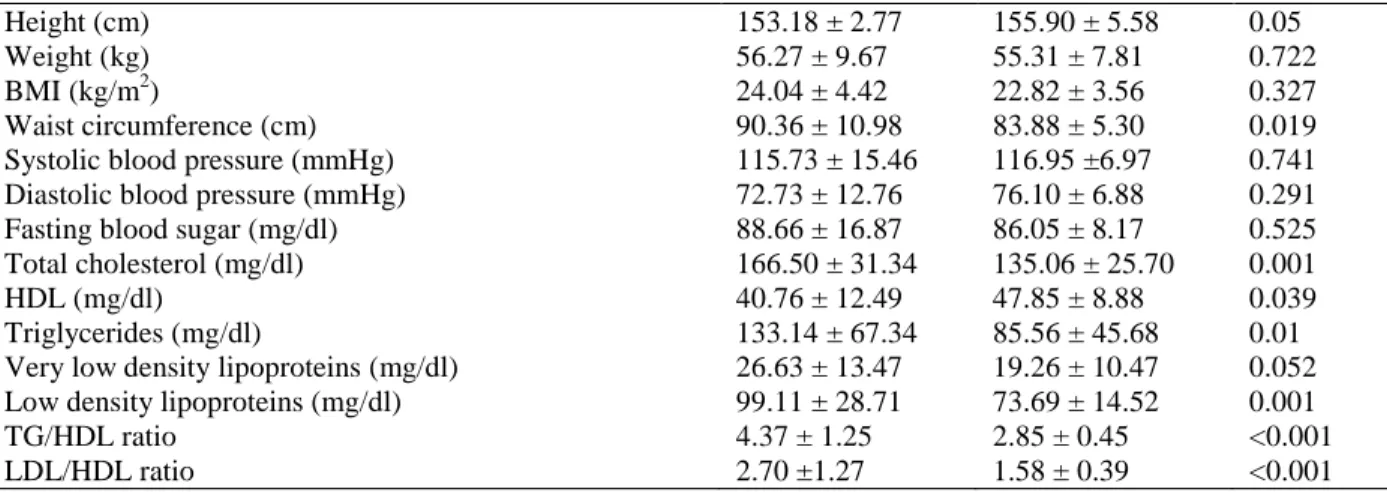
Tables 3-5
compare the clinical and laboratory
parameters studied in male and female and cases
and controls.
Table 1 Clinical and laboratory parameters of patients with lichen planus and controls in both males and females. Cases
(n=50)
Controls (n=50)
Age (years) 41.24 ± 16.17 39.48 ± 11.36 0.530
Height (cm) 158.40 ±17.12 161.24 ±7.56 0.286
Weight (kg) 61.69 ± 10.97 59.97 ± 8.32 0.379
BMI (kg/m2) 24.02 ± 4.29 23.07 ± 2.90 0.198
Waist circumference (cm) 89.25 ± 11.02 90.55 ± 9.78 0.534
Systolic blood pressure (mmHg) 118.44 ± 12.08 117.24 ± 5.46 0.524 Diastolic blood pressure (mmHg) 74.60 ± 10.62 76.68 ± 6.95 0.249 Fasting blood sugar (mg/dl) 87.17 ± 17.32 86.92 ± 10.45 0.931 Total cholesterol (mg/dl) 158.49 ± 33.91 143.47 ± 28.54 0.018
HDL (mg/dl) 38.86 ± 10.49 45.78 ± 7.63 <0.001
Triglycerides (mg/dl) 153.03 ± 99.77 107.91 ± 62.38 0.008
Very low density lipoproteins (mg/dl) 30.61 ± 19.95 22.75 ± 12.70 0.021 Low density lipoproteins (mg/dl) 88.74 ± 30.46 79.02 ± 20.17 0.063
TG/HDL ratio 4.26 ± 1.11 3.19 ± 0.73 <0.0001
LDL/HDL ratio 2.45 ± 1.17
HDL – High-density lipoprotein, VLDL - Very low-density lipoproteins, LDL – Low-density lipoproteins. Table 2 Binary logistic regression model for lichen planus.
Odds ratio 95% C.I. P value
Age (years) 1.009 0.976 1.044 0.595
Female (vs male) 1.142 0.475 2.746 0.767
BMI (kg/m2) 0.912 0.791 1.053 0.209
Dyslipidemia (vs control) 11.842 2.919 48.043 0.001*
Fasting blood sugar (mg/dl) 1.021 0.988 1.056 0.213
* Significant P value.
Table 3 Characteristics of cases and controls.
Characteristics Cases Controls p value
Mean age (years) 41.24 ± 16.17 39.48 ± 11.36 0.530
Waist circumference (cm) in males
Normal 24 (85.71%) 25 (86.21%) 1.00
>102 4 (14.29%) 4 (13.79%)
Waist circumference (cm) in females
Normal 12 (54.55%) 19 (90.48%) 0.016
>88 10 (45.45%) 02 (9.52%)
Triglycerides (mg/dl)
Normal 35 (70%) 47 (94%) 0.002
>150 15 (30%) 03 (6%)
Total cholesterol (mg/dl)
Normal 43 (86%) 50(100%) 0.006
>200 07 (14%) 00 (0%)
LDL (mg/dl)
Normal 45 (90%) 50 (100%) 0.056
>130 05 (10%) 00 (0%)
Reduced HDL (mg/dl) in males
Normal 09 (32.14%) 23 (79.31%) <0.001
<40 19 (67.86%) 06 (20.69%)
Reduced HDL (mg/dl) in females
Normal 07 (31.82%) 09 (42.86%) 0.454
<50 15 (68.18%) 12 (57.14%)
Blood pressure (mm Hg)
Normal 44 (88%) 44 (88%) 1.00
>=130/85 06 (12%) 06 (12%)
Fasting blood sugar (mg/dl)
>100 04 (8%) 00 (0%) Dyslipidemia
Present 19 (38%) 03 (6%) <0.001
Absent 31 (62%) 47 (94%)
Metabolic syndrome
Present 03 (6%) 01 (2%) 0.617
Absent 47 (94%) 49 (98%)
TC/HDL ratio >3.5 <3.5
40 (80%) 10 (20%)
15 (30%) 35 (70%)
<0.001 LDL/HDL ratio
>2.5 <2.5
17 (34%) 33 (66%)
03 (6%)
47(94%) <0.001 On antihypertensive drugs
Yes No
03(6%) 47(94%)
00(0%) 00(100%)
0.242 On hypoglycemic drugs
Yes No
01(2%) 49(98%)
00(0%) 50(100%)
1.000 History of smoking
Absent Present
36 (72%) 14 (28%)
35(70%) 15(30%)
0.826 History of alcohol consumption
Absent Present
39 (78%) 11 (22%)
38(76%) 12(24%)
0.812
Table 4 Clinical and laboratory parameters in patients with lichen planus and controls in males. Cases
(n=28)
Controls (n=29)
P value
Age (years) 41.71 ± 16.50 41.10 ± 11.83 0.873
Height (cm) 162.50 ± 22.05 165.10 ± 6.41 0.545
Weight (kg) 65.95 ± 10.16 63.34 ± 7.04 0.264
BMI (kg/m2) 24.00 ± 4.27 23.25 ± 2.35 0.411
Waist circumference (cm) 88.38 ± 11.17 95.38 ± 9.48 0.013
Systolic blood pressure (mmHg) 120.57 ± 8.25 117.45 ± 4.17 0.075 Diastolic blood pressure (mmHg) 76.07 ± 8.53 77.10 ± 7.08 0.621 Fasting blood sugar (mg/dl) 86.00 ± 17.89 87.55 ± 11.93 0.759 Total cholesterol (mg/dl) 152.19 ± 35.07 149.56 ± 29.37 0.018
HDL (mg/dl) 37.37 ± 8.55 44.29 ± 6.33 0.001
Triglycerides (mg/dl) 168.65± 118.17 124.10± 68.36 0.086
Very low density lipoproteins (mg/dl) 33.73 ± 23.63 25.27± 13.72 0.103 Low density lipoproteins (mg/dl) 80.60 ± 29.78 82.88 ± 22.91 0.746
TG/HDL ratio 4.18 ± 1.00 3.43 ± 0.80 0.003
LDL/HDL ratio 2.26 ± 1.07 0.141
HDL – High-density lipoprotein, VLDL - Very low-density lipoproteins, LDL – Low-density lipoproteins.
Table 5 Clinical and laboratory parameters in patients with lichen planus and controls in females. Cases
(n=22)
Controls (n=21)
P value
Height (cm) 153.18 ± 2.77 155.90 ± 5.58 0.05
Weight (kg) 56.27 ± 9.67 55.31 ± 7.81 0.722
BMI (kg/m2) 24.04 ± 4.42 22.82 ± 3.56 0.327
Waist circumference (cm) 90.36 ± 10.98 83.88 ± 5.30 0.019
Systolic blood pressure (mmHg) 115.73 ± 15.46 116.95 ±6.97 0.741 Diastolic blood pressure (mmHg) 72.73 ± 12.76 76.10 ± 6.88 0.291
Fasting blood sugar (mg/dl) 88.66 ± 16.87 86.05 ± 8.17 0.525
Total cholesterol (mg/dl) 166.50 ± 31.34 135.06 ± 25.70 0.001
HDL (mg/dl) 40.76 ± 12.49 47.85 ± 8.88 0.039
Triglycerides (mg/dl) 133.14 ± 67.34 85.56 ± 45.68 0.01
Very low density lipoproteins (mg/dl) 26.63 ± 13.47 19.26 ± 10.47 0.052 Low density lipoproteins (mg/dl) 99.11 ± 28.71 73.69 ± 14.52 0.001
TG/HDL ratio 4.37 ± 1.25 2.85 ± 0.45 <0.001
LDL/HDL ratio 2.70 ±1.27 1.58 ± 0.39 <0.001
HDL – High-density lipoprotein, VLDL - Very low-density lipoproteins, LDL – Low-density lipoproteins. Table 6 Altered lipid levels in lichen planus: A comparison with previous studies.
Authors Year TG TC HDL LDL VLDL TC/HDL LDL/HDL
Arias-Santiago et al. [14] 2011 S S S S - S S
Arias –Santiago et al. [15] 2011 S S S S - S S
Krishnamoorthy et al. [12] 2014 NS S NS S S - -
Polic [16] 2014 NS NS NS NS - - -
Our study 2014 S S S NS S S S
S=statistically significant with p value <0.05, NS=Not statistically significant, p value>0.05.
TG - Triglycerides, TC - Total cholesterol, HDL - High-density lipoproteins, LDL - Low-density lipoproteins, VLDL -Very low-density lipoproteins,
Discussion
Chronic inflammation causes disturbances in
lipid metabolism such as decrease in
high-density lipoproteins – cholesterol (HDL-C),
increase in very low-density lipoprotein -
cholesterol (VLDL-C) and hypertriglyceridemia.
This dyslipidemia if prolonged enhances the
formation of atherosclerotic plaques and thereby
augments the risk of cardiovascular disease in
such patients. This fact has been observed in
psoriasis.
LP is an idiopathic inflammatory disease of skin
and
mucous
membranes.
Cell-mediated
immunity plays an important role in its
pathogenesis. Both CD8 cytotoxic T cells and
CD4 helper cells are stimulated in the process to
combat the antigens presented by Langerhans
cell. This stimulated lymphocytic infiltrate
attacks keratinocytes and results in generation of
free radicals. During this process, cytokines like
IL-2, IL-4, IL-6, IL-10, and IFN-gamma,
TNF-alpha are released and these cytokines are
implicated in causing dyslipidemia.
4,12Dyslipidemia plays an important role in the
development of cardiovascular diseases, which
has become the leading cause of death in most
developed and developing countries.
13In our
study, we found significantly higher levels of
triglycerides (153.03 vs 107.91 mg/dl, P value =
0.008), total cholesterol (158.49 vs 143.47
mg/dl, P value = 0.018), VLDL (30.61 vs 22.75
mg/dl, P value = 0.021) and significantly lower
levels of HDL (38.86 vs 45.78 mg/dl, P value
<0.001). This is concordant with the study done
by Arias-Santiago
et al.
14(Table 6)
except for
LDL levels which were not significantly higher
(88.74 vs 79.02 mg/dl, P value = 0.063).
males in controls (20.7%) had low HDL levels
which was highly significant (P value <0.001).
However, there were 15 females with LP
(68.2%) and 12 females in control group
(57.1%) showing no significant statistical
difference (P value = 0.454), (
Table 4
and
5
).
Though increased LDL-C/HDL-C ratio (>2.5) is
a sensitive predictor of cardiovascular risk,
recently, total cholesterol/HDL-C (>3.5) has
been found to be a better predictor for
cardiovascular
risk.
The
ratio
of
total
cholesterol/HDL and LDL/HDL more than 3.5
and 2.5, respectively is dangerous.
17,18We found
TC/HDL ratio (4.26 vs 3.19) and LDL/HDL
ratio (2.45 vs 1.78) to be significantly higher
with a P value of <0.0001.
Studies like Atefi
et al.
19, Seyhan
et al.
20and
Lowe
et al.
21have shown significantly altered
glucose levels in LP. But our study did not find
significant prevalence of altered glucose levels
(P value = 0.117) as only 2 females and 2 males
with Lichen planus had FBS>110mg/dL.
Hypertensives were equally distributed in cases
(12%) and controls (12%), (p value=1). Males
and females differed in the prevalence of
abdominal obesity. Abdominal obesity was seen
in 10 females with LP (45.45%) as compared to
2 females in controls (9.52%) which was
statistically significant (p value=0.016); but it
was equally distributed in males (p value=1).
Metabolic syndrome, according to ATP-III
criteria is associated with a higher risk of
cardiovascular events. In our study, only 3 (6%)
patients with LP fulfilled the criteria for
metabolic syndrome and the association was not
statistically significant. (p=0.617)
Conclusion
The results obtained in our study support the
association of dyslipidemia in lichen planus
which was seen even after controlling the
confounding factors. The study also highlights
the importance of routine screening of
dyslipidemia since early intervention may
reduce
the
risk
and
complications
of
cardiovascular disease later in life. However,
there was no association seen between lichen
planus and metabolic syndrome. Further studies
are required to establish this finding.
References
1. Daoud MS, Pittelkow MR. Lichen planus. In: Goldsmith L, Katz S, Gilchrest B, Paller A, Leffell D, Wolff K, editors. Fitzpatrick’s Dermatology in General Medicine. 8th ed. New York: McGraw-Hill: 2012. P. 296. 2. Gorouhi F, Davari P, Fazel N. Cutaneous
and mucosal lichen planus: A comprehensive review of clinical subtypes, risk factors, diagnosis, and prognosis. Sci World J. 2014:742826.
3. Kubiak KW, Reich A. Mediators of pruritus in lichen planus. Autoimmune Dis. 2013;2013:941431.
4. Palit A, Inamadar AC. Pathogenesis of Lichen Planus. In: Khopkar U, Valia A. Lichen Planus, 1st edition. Delhi: Jaypee; 2013. p2
5. Bakry OA, Shoeib MAM, El Shafiee MK, Hassan A. Androgenetic alopecia, metabolic syndrome, and insulin resistance: Is there any association? A case-control study. Indian Dermatol Online J. 2014;5:276-81. 6. Su LH, Chen TH. Association of
androgenetic alopecia with metabolic syndrome in men: a community-based survey. Br J Dermatol. 2010;163:371-7. 7. Padhi T, Garima. Metabolic syndrome and
skin: Psoriasis and beyond. Indian J Dermatol. 2013;58:299-305.
8. Nisa N, Qazi MA. Prevalence of metabolic syndrome in patients with psoriasis. Indian J Dermatol Venereol Leprol. 2010;76:662-5. 9. Zindac I, Albayrak O, Kavala M, Kocaturk
E, Can B, Sudogan S et al. Prevalence of metabolic syndrome in patients with psoriasis. Sci World J. 2012 (2012):312463. 10. Langan SM, Seminara NM, Shin DB, Troxel
11. Expert Panel on Detection, Evaluation, and Treatment of High Blood Cholesterol Education Program (NCEP) Expert Panel On Detection, Evaluation, and Treatment of High Blood Cholesterol in Adults (Adult Treatment Panel III). JAMA. 2001;285:2486-97.
12. Esteve E, Ricart W, Real JMF. Dyslipidemia and inflammation: an evolutionary conserved mechanism. Clin Nutr. 2005;24:16-31.
13. Shenoy C, Shenoy MM, Rao GK. Dyslipidemia in Dermatological disorders. North Am J Med Sci. 2015;7:421-6.
14. Arias-Santiago S, Buendía-Eisman A, Aneiros-Fernández J, Girón-Prieto MS, Gutiérrez-Salmerón MT, Mellado VG et al. Cardiovascular risk factors in patients with lichen planus. Am J Med. 2011;124:543-8. 15. Arias-Santiago S, Buendía-Eisman A,
Aneiros-Fernández J, Girón-Prieto MS, Gutiérrez-Salmerón MT, Mellado VG, Naranjo-Sintes R. J Eur Acad Dermatol Venereol. 2011;25:1398-1401.
16. Polić MV, Miskulin M, Solić K, Pluzarić V, Sikora M, Atalić B. Serum lipids and lichen planus. Coll Antropol. 2014;38:595-9.
17. Lemieux I, Lamarche B, Couillard C, Pascot A, Cantin B, Bergeron J et al. Total cholesterol/HDL cholesterol ratio vs LDL cholesterol/HDL cholesterol ratio as indices of ischemic heart disease risk in men: the Quebec Cardiovascular Study. Arch Intern Med. 2011;161:2685-2692.
18. In: Vasudevan DM, Sreekumari S, Vaidyanathan K, Editors. Textbook of Biochemistry for Medical Students. 7th edition. Delhi: Jaypee; 2013.
19. Atefi N, Majedi M, Peyghambari S, Ghourchian S. Prevalence of diabetes mellitus and impaired fasting blood glucose in patients with lichen planus. Medical J Islamic Repub Iran. 2012;26:22-6.
20. Seyhan M, Ozcan H, Sahin I, Bayram N, Karincaoglu Y. High prevalence of glucose metabolism disturbance in patients with lichen planus. Diab Res Clin Prac. 2007;77:198-202.