AENSI Journals
Australian Journal of Basic and Applied Sciences
ISSN:1991-8178Journal home page: www.ajbasweb.com
Corresponding Author: M.U. Saganuwan, Universiti Teknologi Malaysia Kuala Lumpur, International Business School
Tel: +60167990428 E-mail: [email protected]
Technostress of Accounting Information System and its Effect on Task Performance
1M.U. Saganuwan, 1W.K.W. Ismail, 2U.N.U. Ahmad1Universiti Teknologi Malaysia Kuala Lumpur, International Business School 2Universiti Teknologi Malaysia Johor Bahru, Faculty of Management
A R T I C L E I N F O A B S T R A C T
Article history:
Received 25 July 2014 Received in revised form 8 July 2014
Accepted 15 September 2014 Available online 17 October 2014
Keywords:
Technostress, AIS Information Characteristics, Task Performance, Accountants,
Many factors have been studied to improve the performance of accounting information system(AIS) in organisations, but one factor yet toreceive attention is how technostress is affecting its usage. Technostress is the negative consequences of technology usage which is associated with health related problems and hinders users' performance. The objective of the paper is to extend the technostress literature by studying the impact of AIS information characteristics on technostress and its effects on task performance of accountants.The results of accountants surveyed indicate support for the model, the relationship of scope and integration to technostress creator and technostress creatorto task performance were significant. On the contrary, the relationship of aggregation and timeliness to technostress creatorwere not supported.The implications discussed provided an opportunity for organisations to address technostress associated with AIS usage of accountants.
© 2014 AENSI Publisher All rights reserved. To Cite This Article: M.U. Saganuwan, W.K.W. Ismail, U.N.U. Ahmad., Technostress of Accounting Information System and its Effect on Task Performance. Aust. J. Basic & Appl. Sci., 8(16): 30-37, 2014
INTRODUCTION
The introduction of accounting information system (AIS) in organisations is aimed at improving accountants’ task performance. Undoubtedly, the roles of control within the organization and interface with dominant external agents outside the organization make accounting/accountants integral part of organizations (Burchell, S., 1980). Hence, accountants’ task performance with AIS has implications on organisational performance. Accordingly, AIS is expected to provide accurate, reliable and consistent information for intelligent and effective organizational decisions (Emeka-Nwokeji, N.A., 2012).
Nevertheless, several factors have been found to influence AIS performance, like organisational strategy, job satisfaction, infrastructure, training, demography, among others. One factor yet to receive attention is the effect of technostress on its usage. Technostress according to (Brod, C., 1984) is the inability of the user to cope with the technologies in a healthy manner, that is the struggle to accept or over identifying with computer and computer-related technologies. Nonetheless, it is important to address technostress problem in organisations because of its health related and performance implications (Tarafdar, M., 2007; Wang, K., 2008). This perhaps is what informed the opinions of (Ibrahim, A.I., and Pankajakshi, R. and M.L. Shailaja, 2012) to describe the use of technology as a ‘double-edged sword’.
In the recent past, authors such as (Ragu-Nathan, T.S., 2008; Schuldt, B.A. and J.W. Totten, 2008) focused on the consequences of technostress but (Ayyagari, R., 2012) laid the foundation of research on antecedent of technostress and suggested investigating specific technology relevant in some specific organisational context. Besides, (Tarafdar, M., 2011) advocate increasingly urgent research and wide range of managerial interest in understanding the dark side of information system. Similarly, it is emphasized by (Vaassen, E.H.J. and J.E. Hunton, 2009) that there are many areas to be explored in AIS research because it is eclectic in nature. Thus, the technostress experienced by the accountants using AIS in organisations is an area to be explored. The objective of the research is to extend the technostress literature by introducing the concept of AIS information characteristics.
Literature Review:
The stress problem associated with technology usage was identified by Craig Brod in 1984 as technostress. Many scholars in this field worldwide have published articles on issues surrounding technostress among the users of technology. For example, (Weil, M.M. and L.D. Rosen, 1997) posit that today, information communication technologies (ICTs) is no longer a novelty, but an integral part of our lives and people cannot function without it. Similarly, cautioned that our love for ICTs is blind and we devote long hours on it at work and play without seeing the possible consequences of its usage. Studies revealed that technostress can lead to health related problems such as cardiac arrest, migraine headaches and hypertension. The symptoms and effects of technostress include persistent negative thinking, momentary confusion, inability to concentrate, poor judgment, distorted ideas, mental fatigue depression, anxiety, irritability and impatience. All these have effect on individuals’ productivity at work, which has been the focus of initial scholars in this field of study i.e. consequences of technostress in organisations.
According to (Caro, D.H. and A.S. Sethi, 1985) organization can only maintain a high level of productivity and social integration or derive maximum positive benefits from the technology if itpromotes the individual's personal worth and take measures against technostress. (Caro, D.H. and A.S. Sethi, 1985) posit that the complex nature of technology professionals’ use in their task performance has changed the process of their work significantly and also created a multitasking situation for them, which created in them tension and as well induced stress. They confirmed that technostress inversely affects productivity and offset the expected productivity increases. Furthermore, confirmed that technostress creators negativelyaffect job satisfaction which also lead to decreased organizational and continuance commitment. In addition,they found that technostress inhibitors positively increase job satisfaction and organizational and continuance commitment.
Recently, (Ayyagari, R., 2011) approach technostress research differently by focusing on the antecedent of technostress rather than on its consequences. He suggested that since technologies haveunique characteristics, specific technology can be studied in a specific context. Empirically, he found that information overload as antecedent of technostress worsen technostress in individuals using technology. Consequently, the models of antecedents and consequences of technostress are adapted to study AIS.Since the goal of AIS usage in organisations is to improve the accountants’ performance vis-a-vis organisational performance, this study therefore extends technostress research by investigating the impact of AIS information characteristics on technostress creators and its effect on task performance.
Since technostress is simply described as the inability of the user to cope with or over relying on the technologies in an unhealthy manner to accomplish organisational task, further identified its dimensions. They identified five components technostress that is used in this study as: (a) techno-overload, described circumstances where AIS forced the accountants to work faster for long hours, (b) techno-invasion, described circumstances where AIS makes it possible to reach out to the accountants anytime anywhere regardless work hours, (c) techno-complexity, described circumstances where AIS intricate of the technology threatened accountants job skills, (a) techno-insecurity, described circumstances where accountants using AIS feel threatened of being replaced by more skillful candidates within and outside the organization, (a) techno- uncertainty described circumstances where the AIS pace of change makes the accountants unsettled. However, in this study techno-insecurity is used to depict the effect of technostress creators on task performance.
Theory and Hypotheses:
Person-environment (P-E) fit theory has been used to explain technostress phenomenon in many technostress studies (Yan, Z., 2013). The fundamental principles of the person-environment (P-E) fit theory provided the basis for understanding the variables that is used in this study. Even though contingency approach is the common approach used to explain the performance of AIS and its impact on the organizational performance,it does not account for the stress experience by the accountants using AIS. According to (Edwards, J.R., 1996), in work settings there should be balance between individuals’ characteristics and the work environment; any misfit in this relationship can lead to strain. Therefore, in this study, the misfit in the interaction between accountant and AIS is assumed to lead to technostress. Accordingly, the two misfit situations will occur (Edwards, J.R., 1996), in this case the inability of accountant to deal with the demandplaced by AIS and the inability ofAIS to suit accountant's values. Therefore, themismatch in any of these situations will lead to accountants being stressed, which will have effect on their task performance. Consequently, person-environment (P-E) framework is applied to develop the hypotheses for this study based on the proposed research model in Figure 1.
accountants to effectively do this, (Chenhall, R.H. and D. Morris, 1986) categorized AIS information characteristics into:
Scope: This refers to focus, quantification and time horizon in organization’s transactions. This mean that information collected is focused on the event within or outside the organization, which can be quantified in monetary terms and its relationship with the future. (Naranjo-gil, D., 2004) asserts that scope focus on future vs historical or external vs internal events. They viewed scope from two perspectives of broad and narrow scopes. The former provides information on both economic and non-economic factors while the latter provides traditional internal information; all these help accountants to accomplishing organizational objectives. Irrespective of the domain AIS captures information, scopeis view positively to measure organisational transactionsto bring about efficiency. For example scope information can be used to evaluate competitive actions (Naranjo-gil, D., 2004) and facilitate strategic decision making (Gordon, L.A. and D. Miller, 1976). On the contrary, contextual issues affect the scope of information systems (Abernethy, M.A. and C.H. Guthrie, 1994) web, internet, mobile devices database etc. poses forecasting, internal auditing, internal control and risk management challenges to AIS.
In this context, the scope information characteristics provided by AIS for task performance of accountants, equip and helpthem to utilize this informationto achieve organisational objectives. This act can lead to effective task performance due to AIS usage. Although scope information characteristics is important for task performance, it may perhaps cause or lead information overload, which in turn can lead to technostress. Therefore, it is hypothesized that:
H1: AIS information scope is positively related to technostress.
Timeliness: This refers to the quick provision of information and the regularity of reporting information systematically. This means that timeliness influence accountants to respond to events quickly and makes them effective in an unpredictable environment. Timeliness is related to the speed at which AIS provides the user with satisfying systematic information reports (Sajady, H., 2008) and occurs when the recorded value is not out of date (Xu, H., 2003). Timeliness is an important aspect of the AIS since it helps the users to process financial transactions and collect accounting information correctly and on request and the frequency (Mollanazari, M. and E. Abdolkarimi, 2012). (Sami, M., 2011) found that timeliness influenced organisational performance. From this, timeliness of information should lead to effectiveness, which improves task performance of accountants.Even though the problem of slowness with server and/or computer programmes can frustrate accountants in accessing information handy. Hence, this can lead to technostress.Thus, it is hypothesized that:
H2: AIS information timeliness is positively related to technostress
Aggregation: this refers to formal composition of temporal and functional summation of data collected within periods of time or areas of interest. AIS provide aggregated information to accountants within specified time and such areas like responsibility or functional centers. Aggregated information enhance the decisions of the managers thereby contributes to higher performance in organization. This means that AIS aggregated informationassists the users in the choice of the most appropriate information for specific task context in the organisations. In this light, it is found that aggregatedinformation, and the degree of task difficulty and variability are positively associated (Choe, J.M. and J. Lee, 1993). (Chenhall, R.H. and D. Morris, 1986) and (Ginzberg, M.J., 1980) found similar positive hypotheses in their study. Thus, from of the above, aggregated information can lead to high task performance, nevertheless the difficulties in access and use of information can hinder summation process, which can cause technostress. Therefore, it is proposed that:
H3: AIS information aggregation is positively related to technostress.
Integration: Refer to an aspect of organizational control that harmonizes various segments within the subunits. Booth et al. (2000) in (Rom, A. and C. Rohde, 2007) highlights the dimension of integration as:i) data, ii) hardware/software and iii) information integration. Consistent with this studyis information integration, which he described as business aspects that are about interchange of information between different departments in organisations. Similarly, AIS integration is a response to the requirements for organizational coordination and control i.e. it refers to a system that provides output information which may be effectively used to address problems and requirements of organizational coordination and control (Nicolaou, A.I., 2000). State that there is a direct relationship between AIS integrated information and organisational interdependence and decentralization; similar to positive hypothesis formulated by (Nicolaou, A.I., 2000). Integration in this context refers to incorporating and coordinating the financial and non-financial activities of within and outside the organizationby accountants in order to improvetask performance.Notwithstanding, AIS can expose accountants to more information than they could handle or use, which may lead to technostress.Hence, it is hypothesized that:
H4: AIS integration information is positively related to technostress.
literature that is associated with AIS usage (Tsui, J.S. and F.A. Gul, 1996; Yau, C. and P.K. Auyeung, 1995; Galbraith, J.R., 1973) suggest that AISinformation characteristics can impact on technostress creators. Consistent with the literature therefore, studies have found technostress creators to have significant impact on task performance.
In this context, if the information provided by AIS for task performance (i.e. future vs. historical or external vs. internal events) exceeds accountant's perceived abilities to deal with these information, it means a mismatch. The mismatch can lead to strain due to AIS (technostress), which will affects the accountant's task performance. Therefore, it is hypothesized that:
H1: technostress creators negatively relates to task performance.
Fig. 1:
Methodology:
The population of the study comprise of accountants from listed companies in Nigeria that uses AIS to accomplish task performance. This population is chosen for this study because AIS primarily aid accountants in task performance. Data were obtained from the accountants using AIS. Questionnaires were delivered to respondents through appropriate authorities in these companies to fill. Although 283 responses were received, 27 of these were rejected based on data screening. Therefore, only a sample size of 79.5% of data collected was used for this study. The questionnaire with a seven-point Likert scale response format from 13 sectors of Nigeria economy was administered. Survey items were adopted from the literature of technostress, AIS and task performance (Williams, L.J. and S.E. Anderson, 1991), which were previously used in Nigeria (Ofua, O.J. and T.A. Pereware, 2011; Ogah, I.J., 2013) respectively. A Partial Least Square Path Modeling (Wold, H., 1974; Wold, H., 1985) using Smart PLS 2.0 M3 software (Ringle, C.M., 2005) was employed for the analysis.
Results:
The assessment of individual item reliability was conducted by examining the outer loadings of each construct’s measure using rule of thumb for retaining items with loadings of 0.40 and above (Hair, J.F., 2012). Out of 34 items, 2were deleted from scope and task performance eachbecause it presented loadings below the threshold of 0.40. Thus, in the whole model, only 32 items were retained as they had loadings between 0.55 and 0.95.Convergent validity was assessed by examining the Average Variance Extracted (AVE) of each latent construct, as suggested by (Fornell, C. and D.F. Larcker, 1981). To achieve adequate convergent validity, [45]recommends that the AVE of each latent construct should be .50 or more. Following (Chin, W.W., 1998), the AVE values exhibited high loadings (> .50) on their respective constructs, indicating adequate convergent validity as contained in table 1.
Table 1: Measurement Model Evaluations Results.
Construct Indicator Loadings Composite
Reliability
AVE
Aggregation AISA 0.65 - 0.85 0.93 0.54
Integration AISI 0.83 - 0.96 0.93 0.81
Scope AISS 0.57 - 0.94 0.83 0.51
Timeliness AIST 0.76 - 0.93 0.91 0.72
Task Performance TP 0.58 - 0.87 0.83 0.57
Technostress Creators TSCT 0.55 - 0.92 0.88 0.59
Table 2: Discriminant validity assessment.
Construct 1 2 3 4 5 6
1 Aggregation 0.73
2 Integration 0.72 0.90
3 Scope 0.56 0.51 0.71
4 Timeliness 0.48 0.47 0.35 0.85
5 Task Performance 0.05 -0.01 -0.06 -0.05 0.75
6 Technostress Creators 0.21 0.23 0.14 -0.16 -0.34 0.77
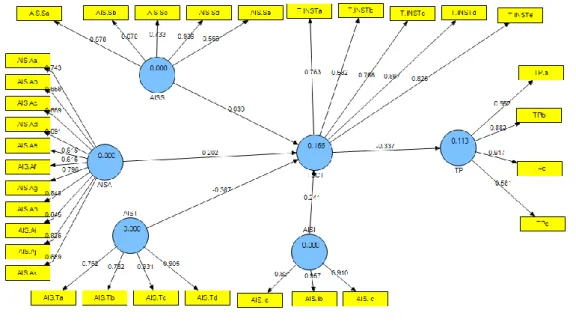
The measurement model was thus confirmed satisfactory and the result was employed to test the structural model in the next sections. The analysis of the measurement model is shown in the figure 2 below.
Fig. 2: Measurement Model.
After assessing the measurement model, the structural model was performed during the tests of the hypotheses in the research model. Smart PLS was used to estimate the path coefficients between the paths of the exogenous and endogenous constructs within the data set. This model was evaluated via the R-square (R2) (Geisser, S., 1975; Stone, M., 1974), the AVE, and bootstrapping procedure. According to (Henseler, J., 2009) the first criterion for assessment of structural model is to examine the coefficient of determination (R2) of endogenous latent variables. Although the acceptable level of R2 value depends on the research context (Hair, J.F., 2010), they propose an R2 value of 0.10 as a minimum acceptable level. Following the acceptable analysis of the measurement model as shown in figure 2, testing of the structural model and research hypotheses could ensue. To test hypotheses 1, 2, 3, 4, and 5, an overall effect was created as shown in Figure 3.
The study applied the standard bootstrapping procedure of 5000 re-samples to assess significance of the path coefficients. Hypothesis 1 predicted the positive relationship between the exogenous variable (AIS scope) and endogenous variable (Technostress Creator). As shown in Table 3, the result indicated that scope had significant positive relationship with technostress creator (β = -0.04, p < 0.39), Hypothesis 1 is supported. Similarly, in examining the influence of aggregation on technostress creator (Hypothesis 2), the results revealed no significant relationship between aggregation and technostress creator (β = 0.02, p < 0.01), Hypothesis 2not supported. Hypothesis 3 predicted that integration is positively related to technostress creator, the result indicated that integration had a significant positive relationship with technostress creator (β = 0.24, p < 0.00), supporting Hypothesis 3. Hypothesis 4 predicted that timeliness is positively related to technostress creator. The result indicated a negative relationship between timeliness and technostress creator (β = -0.34, p < 0.00) Hypothesis 4not supported. Furthermore, Hypothesis 5 predicted a negative relationship between technostress creator and task performance. The result revealed significant negative relationship between technostress creators on task performance (β = -0.34, p < 0.00), supporting Hypothesis 5.
Table 3: Hypothesis Testing.
Hypothesis Relations Beta Standard Error t-value p-value Findings
H1 (+) AISS -> TSCT 0.04 0.14 0.28 0.39 Supported
H2 (+) AISA -> TSCT 0.20 0.09 2.29 0.01 Not Supported
H3 (+) AISI -> TSCT 0.24 0.09 2.70 0.00 Supported
H4 (+) AIST -> TSCT -0.39 0.09 4.32 0.00 Not Supported
H5 (-) TSCT -> TP -0.34 0.05 6.29 0.00 Supported
Notes: * p < 0.10, ** p < 0.05, *** p < 0.01 (one-tailed test)
Discussion and Implications:
The objective of the research is to extend the technostress literature by introducing the concept of AIS information characteristics. Person-environment theory is used to explain why the misfit between accountant abilities and AIS demands lead to technostress. The result indicate that accountants experience stress from the use of AIS which shows a negative effect on their task performance in work setting. Therefore, as modelled, AIS usage provides situation in which misfit exist between accountants and AIS with respect to their perception of task performance.
The proposed model used the AIS dimensions to enhance the misfit between accountants and their environment (AIS usage), thereby using the technostress creators that are attributed to technology usage. The results indicate that AIS dimensions are antecedents of technostress. Although, the aggregation and timeliness AIS dimensionswere not significant as modeled, the plausible explanation for this relationship can be contextual issues related to AIS usage in Nigeria. Literature revealed that inadequate supplies of AIS equipment constituted the major hindrance to its success in Nigeria. However, in situation whereby the supply of AIS equipment are adequate, (Mahmood, F., 2013) asserts that information technology usage by banks impact significantly and positively banking service quality.It implies that inadequacy AIS equipment is responsible for the research finding that there is no significant relationship between the AIS usage and the quality of services provided by bank in Nigeria (Dandago, K.I. and A.S. Rufai, 2014). This explains why the aggregation and timeliness AIS information characteristics have no effect on technostress creator. As modeled therefore, AIS information characteristics are antecedents of technostress creators that provide situation in which misfit exist between accountants and AIS usage with respect to their perception of task performance.
Prior research shows the effects of technostress on technology usage generally in the work places and similarly suggested stressful effects of specific technologies relevant in specific organisational context. The present study therefore builds upon these previous works by investigating the technostress of AIS usage in organisations and its impact on task performance and the result indicate significant level of technostress. This could help the human resource managers to identify how AIS stress is likely to occur.
Further research could consider longitudinal design to confirm the findings of the present study and improve the model. In addition, the measures in this study did not include health related symptoms, including such could add value to the model. Since the effect of technostress of accountants’ task performance is the focus of this study, including mechanism could reduce this effect could also be area for further research.
Conclusion:
Authors’ Contribution:
This article is an idea developed by M. U. Saganuwan out of his PhD research work and the results from performed statistical analysis are presented with discussion and implications. Associate Professor, Dr. W. K. W. Ismail and Dr. U. N. U. Ahmad play an important role of supervision.
REFERENCES
Abernethy, M.A. and C.H. Guthrie, 1994. An Emperical Assessment of the "fit" between Strategy and Management Information System Design. Accounting & Finance, 34(2): 49-66.
Ahmad, U.N.U., S.M. Amin and W.K.W. Ismail, 2012. The Relationship Between Technostress Creators
and Organisational Commitment Among Academic Librarians. Procedia - Social and Behavioral Sciences, 40:
182-186.
Ayyagari, R., 2012. Impact of Information Overload and Task - Technology Fit, in Proceedings of the
Southern Association for Information Systems Conference, Atlanta, GA, USA. p. 18-22.
Ayyagari, R., V. Grover and R. Purvis, 2011. Technostress: technological antecedents and implications.
MIS quarterly, 35(4): 831-858.
Belfo, F. and A. Trigo, 2013. Accounting Information Systems: Tradition and Future Directions. Procedia Technology, 9(0): 536-546.
Brod, C., 1984. Technostress: The human cost of the computer revolution. Reading MA., 1-242.
Burchell, S., C. Clubb, A. Hopwood, J. Hughes and J. Nahapiet, 1980. The roles of accounting in organizations and society. Accounting, Organizations and Society, 5(1): 5-27.
Caro, D.H. and A.S. Sethi, 1985. Strategic management of technostress. The chaining of Prometheus.
Journal of medical systems, 9: 291-304.
Chenhall, R.H. and D. Morris, 1986. The Impact of Structure, Environment, and Interdependence on the
Perceived Usefulness of Management Accounting Systems. The Accounting Review, 61(1): 16-35.
Chin, W.W., 1998. The partial least squares approach to structural equation modeling. Modern methods for business research, 295(2): 295-336.
Choe, J.M. and J. Lee, 1993. Factors Affecting Relationships between the Contextual Variables and the Information Characteristics of Accounting Information. Information Processing & Management, 29(4): 471-486.
Dandago, K.I. and A.S. Rufai, 2014. Information Technology and Accounting Information System in the
Nigerian Banking Industry. Asian Economic and Financial Review, 4(5): 655-670
Edwards, J.R., 1996. An examination of competing versions of the person–environment fit approach to
stress. Academy of Management Journal, 39: 292-339.
Emeka-Nwokeji, N.A., 2012. Repositioning Accounting Information System Through Effective Data
Quality Management : A Framework For Reducing Costs And Improving Performance. International Journal of
Scientific & Technology Research, 1: 86-94.
Fornell, C. and D.F. Larcker, 1981. Evaluating structural equation models with unobservable variables and measurement error. Journal of marketing research, 39-50.
Galbraith, J.R., 1973. Designing complex organizations. Addison-Wesley Longman Publishing Co., Inc. Geisser, S., 1975. The predictive sample reuse method with applications. Journal of the American Statistical Association, 70(350): 320-328.
Ginzberg, M.J., 1980. An organizational contingencies view of accounting and information systems implementation. Accounting, Organizations and Society, 5(4): 369-382.
Gordon, L.A. and D. Miller, 1976. A contingency framework for the design of accounting information systems. Accounting, Organizations and Society, 1(1): 59-69.
Hair, J.F., Jr., W.C. Black, J.B. Babin, R.E. Anderson and R.L. Tatham, 2010. Multivariate DataAnalysis. 7th ed. ed., Upper Saddle River, NJ: Pearson Prentice-Hall.
Hair, J.F., M. Sarstedt, C.M. Ringle and J.A. Mena, 2012. An assessment of the use of partial least squares structural equation modeling in marketing research. Journal of the Academy of ….
Henseler, J., 2009. On the convergence of the partial least squares path modeling algorithm. Computational Statistics, 25(1): 107-120.
Ibrahim, A.I., Information & Communication Technologies in ELT. Journal of Language Teaching and Research, 1: 211-214.
Kumar, R., R. Lal, Y. Bansal and S.K. Sharma, 2013. Technostress in Relation to Job Satisfaction and. 3: 12-14.
Mahmood, F., 2013. Impact of Information Technology Usage by Banks on Customer Satisfaction in
Mollanazari, M. and E. Abdolkarimi, 2012. The Effects of Task , Organization and Accounting Information Systems Characteristics on the Accounting Information Systems Performance in Tehran Stock Exchange.
International Journal of Innovation, Management and Technology, 3(4): 443-448.
Naranjo-gil, D., 2004. The Role of Sophisticated Accounting System in Strategy Management. The International Journal of Digital Accounting Research, 4(8): 125-144.
Nicolaou, A.I., 2000. A contingency model of perceived effectiveness in accounting information systems: Organizational coordination and control effects. International Journal of Accounting Information Systems, 1: 91-105.
Ofua, O.J. and T.A. Pereware, 2011. Technostress: Effects and Measures Among Librarians in University Libraries in Nigeria. International Journal of Digital Library Systems, 2(4): 24-33.
Ogah, I.J., 2013. An Evaluation of the Relevance of Accounting Systems as a Management Decision Tool in Union Bank of Nigeria Plc , Uyo Branch of Akwa Ibom By. Greener Journal of Business and Management Business Studies, 3(1): 38-45.
Pankajakshi, R. and M.L. Shailaja, 2012. The role of information and communication technologies ( ICTs ) in service sector. World Journal of Science and Technology, 2(5): 66-70.
Ragu-Nathan, T.S., M. Tarafdar, B.S. Ragu-Nathan and Q. Tu, 2008. The Consequences of Technostress for
End Users in Organizations: Conceptual Development and Empirical Validation. Information Systems
Research, 19: 417-433.
Ringle, C.M., S. Wende and A. Will, 2005. SmartPLS 2.0 (M3). Germany: SmartPLS.
Rom, A. and C. Rohde, 2007. Management accounting and integrated information systems : A literature review. International Journal of Accounting Information Systems, 8: 40-68.
Sajady, H., M. Dastgir and H.H. Nejad, 2008. Evaluation of the Effectiveness of Accounting Information Systems. International Journal of Information Science and Technology, 6(2): 49-59.
Sami, M., H.H. Abdullah, M.Z. Othman and A. Warokka, 2011. Quality of Information as Strategic Factor in Accounting Information System (AIS) Towards Better Organizational Performance. Jural Riset Manajemen Sains Indonesia (JRMSI), 2(2): 1-17.
Schuldt, B.A. and J.W. Totten, 2008. Technological Factors and Business Faculty. Proceedings of the Academy of Information and Management Sciences, 12(1): 13-19.
Shu, Q., Q. Tu, and K. Wang, 2011. The Impact of Computer Self-Efficacy and Technology Dependence on Computer-Related Technostress: A Social Cognitive Theory Perspective. International Journal of Human-Computer Interaction, 27: 923-939.
Stone, M., 1974. Cross-validatory choice and assessment of statistical predictions. Journal of the Royal Statistical Society. Series B (Methodological), 111-147.
Tarafdar, M., E. Pullins and T.S. Ragu-Nathan, 2011. Examining impacts of technostress on the
professional salesperson's performance. AMCIS 2011 Proceedings.
Tarafdar, M., Q. Tu, B. Ragu-Nathan and T. Ragu-Nathan, 2007. The Impact of Technostress on Role Stress
and Productivity. Journal of Management Information Systems, 24: 301-328.
Tsui, J.S. and F.A. Gul, 1996. Auditors' behaviour in an audit conflict situation: a research note on the role of locus of control and ethical reasoning. Accounting, Organizations and Society, 21(1): 41-51.
Vaassen, E.H.J. and J.E. Hunton, 2009. An eclectic approach to accounting information systems, International Journal of Accounting Information Systems. International Journal of Accounting Information System, 10: 173-176.
Wang, K., Q. Shu and Q. Tu, 2008. Technostress under different organizational environments: An
empirical investigation. Computers in Human Behavior, 24(6): 3002-3013.
Weil, M.M. and L.D. Rosen, 1997. Technostress: Coping with technology @ Work @ Home @ Play, New York: John Wiley. 1-240.
Williams, L.J. and S.E. Anderson, 1991. Job satisfaction and organizational commitment as predictors of organizational citizenship and in-role behaviors. Journal of management, 17(3): 601-617.
Wold, H., 1974. Causal flows with latent variables: Partings of the ways in the light of NIPALS modelling.
European Economic Review, 5(1): 67-86.
Wold, H., 1985. Partial least squares. Encyclopedia of statistical sciences.
Xu, H., 2003. Critical Success Factors for Accounting Information Systems Data Quality, pp: 1-259. Yan, Z., M.K.O. Lee and D.R. Vogel, 2013. A conceptual model of technology features and technostress in
telemedicine communication, 26: 283-297.