514
Original Article
Cosmetic contact sensitivity in general population –
A clinico-epidemiological study
Introduction
“Cosmetics” are defined as “articles intended to be rubbed, poured, or sprayed on, introduced into, or otherwise applied to the human body or any part thereof for cleansing, beautifying, promoting attractiveness, or altering the appearance without affecting the body’s
structure or functions.1 With increasing westernization and enhanced media exposure, the use of cosmetics has increased manifold among the general population. Nowadays almost everyone is using cosmetic products like soaps, creams, shampoos, deodorants and make-up products like hair dyes, lip and nail paints. Most of these substances contain ingredients capable of causing sensitization of the skin, thus leading to cosmetic dermatitis. Various researchers have reported prevalence rates of cosmetic dermatitis ranging from 4-9% in the general population.2 A recent study of cosmetic dermatitis in the US has Mrinal Gupta
Consultant Dermatologist, Treatwell Skin Centre, Jammu, India
Abstract Objective To study the patterns of cosmetic dermatitis among general population and to identify the
most common allergens and cosmetic product causing dermatitis using patch testing.
Methods One hundred and forty consecutive patients (M:F 57:83) with suspected cosmetic dermatitis were examined, detailed history regarding the use of different cosmetics was taken and the pattern of dermatitis was noted. All of them were subjected to patch testing using Indian Cosmetic Series and eight antigens of the Indian Standard Series.
Results The study included 57 (40.7%) males aged between 18 and 74 years and 87 (59.3%) females aged between 18 to 69 years and the majority of patients were in the 40-59 years age group (54.28%; n=76). The most common sites of cosmetic dermatitis observed were hands in 18, face and neck in nine and disseminated dermatitis in 3 patients. Itching was the most common symptom present in 91 (65%) patients and the most common clinical manifestation was erythema and papules in 124 (88.6%) patients. The most frequently implicated cosmetics were hair dyes (58.5%), face creams (42.1%), perfumes (32.1%), soaps (16.4%) and nail paints (13.5%). 79 (56.4%) patients showed positive reaction to one or more allergens on patch testing. The most common allergens giving positive patch test were p‑phenylenediamine (PPD) in 54 (68.4%), fragrance mix in 8 (10.1%), colophony, parabens mix and thiomersal in three patients each (3.8%).
Conclusion The incidence of cosmetic dermatitis is higher among the 40-59 years age group with hands and face being the most commonly affected sites. Hair dyes and creams are the most commonly implicated agents, while PPD, fragrance mix, thiomersal and cetrimide are the most common causative allergens.
Key words
Cosmetic dermatitis, beauticians, hairdressers, occupational dermatoses, hair dye, p -phenylenediamine (PPD).
Address for correspondence Dr. Mrinal Gupta
515 revealed that out of 10,061 patients, 23.8%
females and 17.8% males had positive patch test to at least one allergen from cosmetic source.3 The clinical picture of cosmetic dermatitis depends on the type of products used (and, consequently, the sites of application), exposure, and the patient’s sensitivity.
Many studies have reported that hairdressers and beauticians are among the most commonly affected occupational groups with cosmetic dermatitis.4 Commonly used cosmetics like soaps, creams, lipsticks, foundations, sunscreens, perfumes, and eye, hair, and nail cosmetics can cause allergic contact dermatitis.
This study was carried out to study the patterns of cosmetic dermatitis among general population and to identify the most common allergens and cosmetic products causing dermatitis using patch testing.
Methods
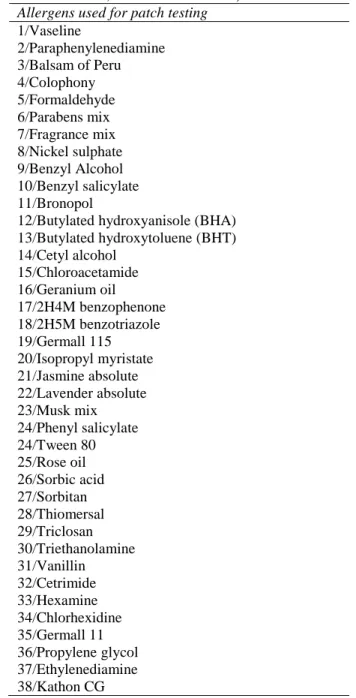
One hundred and forty consecutive patients with suspected allergic contact dermatitis to cosmetics were included in the study after taking an informed consent. Pregnant or lactating women were excluded. Patients having acute dermatitis were patch tested after control of their dermatitis, when they were off systemic corticosteroids or the dose of prednisolone was <20 mg/day. Details about age, gender, personal or family history of atopy (nasobronchial allergy, asthma, and childhood eczema), use of cosmetics and its duration, onset, duration, and distribution of dermatitis were noted. The enrolled patients were patch tested by Finn chambers method with Indian Cosmetic Series and eight antigens of the Indian Standard Series recommended by Contact Dermatitis and Occupational Dermatoses Forum of India (Table 1).5 Patches were applied on the upper back and the patients were asked to return for results after
Table 1 List of allergens used for patch testing (1-8 standard series; 9-38 cosmetic series).
Allergens used for patch testing 1/Vaseline
2/Paraphenylenediamine 3/Balsam of Peru 4/Colophony 5/Formaldehyde 6/Parabens mix 7/Fragrance mix 8/Nickel sulphate 9/Benzyl Alcohol 10/Benzyl salicylate 11/Bronopol
12/Butylated hydroxyanisole (BHA) 13/Butylated hydroxytoluene (BHT) 14/Cetyl alcohol
15/Chloroacetamide 16/Geranium oil 17/2H4M benzophenone 18/2H5M benzotriazole 19/Germall 115 20/Isopropyl myristate 21/Jasmine absolute 22/Lavender absolute 23/Musk mix 24/Phenyl salicylate 24/Tween 80 25/Rose oil 26/Sorbic acid 27/Sorbitan 28/Thiomersal 29/Triclosan 30/Triethanolamine 31/Vanillin 32/Cetrimide 33/Hexamine 34/Chlorhexidine 35/Germall 11 36/Propylene glycol 37/Ethylenediamine 38/Kathon CG
48 hours (D2) and 72 hours (D3). The results were graded according to the International Contact Dermatitis Research Group criteria.6 Only reactions persisting on D3 were considered positive for final analysis. Relevance of a positive patch test results was determined clinically.
516 back phenomenon, active sensitization, and
pigment alteration at test site, when they occurred, were recorded. Patch test to suspected cosmetic agent itself and photopatch test was not done.
Results
The study included 57 (40.7%) males aged between 18 and 74 years and 83 (59.3%) females aged between 18 to 69 years. The majority of patients were in the 40-59 years age group (54.3%; n=76), Table 2. The most commonly affected occupational groups were office workers among males (42.1%; n=24) and housewives among females (77.1%; n=64). The study population comprised seventy-one patients (50.7%) from an urban background. The total duration of dermatitis was less than one year in
55 (39.3%) patients, 1-5 years in 75 (53.6%) and >5 years in 10 (7.1%) patients. The minimum duration was one month and the maximum duration was six years and the mean duration was 16 months. Thirty-eight (27.1%) patients had a history of atopy. The duration of cosmetic usage varied from less than one year in 57 (40.7%) patients to more than five years in 29 (20.7%) patients (Table 3).
Clinically, characteristic acute (erythematous, edematous, oozy, crusted eczematous plaques), subacute and chronic dermatitis (hyperpigmented, lichenified eczematous lesions) involving multiple sites such as face, hands, scalp, neck, upper back and feet was observed in all cases. The most common patterns of cosmetic dermatitis observed were contact dermatitis localized to face in 80 patients
Table 2 Age and sex distribution of patients.
Age (years) Male
N (%)
Female N (%)
Total N (%)
<20 1 (1.75) 2 (2.4) 3 (2.1)
20-39 8 (14.0) 40 (48.2) 48 (34.3)
40-59 39 (68.4) 37 (44.6) 76 (54.3)
60-79 9 (15.8) 4 (4.8) 13 (9.3)
Table 3 Duration of disease among patients.
Duration Male
N (%)
Female N (%)
Total N (%)
<3 months 16 (28.1) 13 (15.7) 29 (20.7)
3-6 months 8 (14.0) 15 (18.1) 23 (16.4)
6-12 months 3 (5.3) 0 (0.00) 3 (2.1)
1-2 years 15 (26.3) 32 (39.7) 47 (33.6)
2-5 years 10 (17.5) 18 (21.7) 28 (20.0)
Table 4 Sites of involvement among patients.
Site Male
N (%)
Female N (%)
Total N (%)
Scalp 31 (54.4) 16 (19.3) 47 (33.6)
Forehead 31 (54.4) 39 (47.0) 80 (57.1)
Cheeks 18 (31.6) 49 (59.0) 67 (47.9)
Lips 0 (0.00) 2 (2.4) 2 (1.4)
Eyelids 0 (0.00) 8 (9.6) 8 (5.7)
Neck 14 (24.6) 20 (24.1) 34 (24.3)
Hands 8 (14.0) 18 (21.7) 26 (18.6)
Back 6 (10.5) 2 (2.4) 8 (5.7)
517 Figure 1 Hand dermatitis in a patient with patch test positivity to PPD. (b) Patch test shows 3+ reaction to PPD.
Figure 2 Pigmented contact dermatitis in a patient with patch test positivity to thiomersal.
Table 5 Etiological profile of the cosmetics used by the patients.
Cosmetic Male
N (%)
Female N (%)
Total N (%)
Hair dye 47 (82.4) 35 (42.2) 82 (58.6)
Cold cream/moisturizer 10 (17.5) 49 (59.0) 59 (42.1)
Lipstick - 5 (6.0) 5 (3.6)
Bindi - 3 (3.6) 3 (2.1)
Perfumes 10 (17.5) 35 (42.2) 45 (32.1)
Nail paints - 19 (22.9) 19 (13.6)
Soaps/face wash 7 (12.3) 16 (19.3) 23 (16.4)
Eyeliner - 9 (10.8) 9 (6.4)
Sindoor - 5 (6.0) 5 (3.6)
518 Table 6 Profile of patch test sensitivity in the study population
Allergen Male
N (%)
Female N (%)
Total N (%)
Paraphenylenediamine 33 (86.8) 21 (51.2) 54 (68.4)
Balsam of Peru 1 (2.6) - 1 (1.3)
Colophony 1 (2.6) 2 (4.9) 3 (3.8)
Formaldehyde - 2 (4.9) 2 (2.5)
Parabens Mix - 3 (7.3) 3 (3.8)
Fragrance Mix 3 (7.9) 5 (12.2) 8 (10.1)
Butylated hydroxytoluene
(BHT) - 1 (2.4) 1 (1.3)
Tween 80 - 1 (2.4) 1 (1.3)
Sorbic Acid - 1 (2.4) 1 (1.3)
Thiomersal - 3 (7.4) 3 (3.8)
Propylene glycol - 1 (2.4)
Kathon CG - 1 (2.4) 1 (1.3)
Total 38 (48.1) 41 (51.9) 79 (100)
followed by dermatitis of scalp in 47, hands in 26 and disseminated dermatitis in 8 patients (Figure 1 & 2) (Table 4). Itching was the most common symptom present in 91 (65%) patients and the most common clinical manifestation was erythema and papules in 124 (88.6%) patients.
The most frequently used cosmetics were hair dyes (58.5%), face creams (42.1%), perfumes (32.1%), soaps (16.4%) and nail paints (13.5%), Table 5.
On performing patch test, 79 (56.4%) patients showed positive reaction to one or more allergens, thus confirming the diagnosis of allergic cosmetic dermatitis. In total, 3100 allergens were applied and out of these, 91 (2.9%) gave a positive reaction.
The most common allergens giving positive patch test were PPD in 54 (68.4%), fragrance mix in 8 (10.1%), colophony, parabens mix and thiomersal in 3 each (3.8%) and formaldehyde in 2 (2.5%) patients (Table 6).
Discussion
The use of cosmetics has increased exponentially over the last few decades due to increased societal pressure and changing fashion
trends. Most allergic reactions are caused by those cosmetics that remain on the skin: “stay-on” or “leave-“stay-on” products such as skin care products (moisturizing and cleansing creams, lotions, milks, tonics), hair cosmetics (notably hair dyes), nail cosmetics (nail varnish), deodorants and other perfumes, and facial and eye make-up products. “Rinse-off” or “wash-off” products, such as soap, shampoo, bath foam, and shower foam, less commonly induce or elicit contact allergic reactions.7 Adverse reactions to cosmetics are due to presence of four classes of ingredients – preservatives, emulsifiers, fragrances and coloring agents. Fragrances, including fragrance mix, balsam of Peru, and cinnamic aldehyde are the most commonly identified allergens in cosmetic-induced allergic contact dermatitis.7 Formaldehyde releasers and parabens are among the most widely used preservatives and are frequent allergens. Other important causes of contact allergy include the active ingredients found in hair- and nail-care products, such as permanent wave solutions, permanent hair coloring, artificial nails, and nail polishes.
519 cosmetic ingredients than men mainly due to
their greater product use. In our study also, the females outnumbered the males (M:F, 1:1.46).
The age of patients in our study ranged from 18 to 74 years. The maximum number of patients belonged to age group of 40 to 59 years, which comprised 54.3% of the total patients (N=76). This is in accordance with study conducted by Warshaw et al.9 in which patients in 40-59 year age group constituted 31.3% of total patients. This can be explained on the basis that in this age group chances of exposure to allergens and irritants are more according to their lifestyle patterns and increased cosmetic exposure in this age group.
Occupational contact dermatitis is underrecognised and underdiagnosed, leading to undertreatment. Beauticians and hairdressers are a high-risk occupational group for development of cosmetic dermatitis. In a study by Warshaw et al.,9 hairdressers and beauticians were the most common patient group constituting 43% of total patients followed by health care workers and students in 16.5% and 4.2%, respectively. This patient group comes in contact to a variety of cosmetic antigens which may act as irritants or allergens, moreover, trauma comprising of rubbing and scrubbing accounts for breaking the barrier system of skin enabling the antigens to penetrate in the skin and cause reactions. In our study, office workers and housewives were the most commonly affected patient groups.
Cosmetic dermatitis can present with variable manifestations. It may acutely present with pruritic papules, vesicles, or bullae. Chronic exposure may result in eczematous dermatitis. Because most cosmetic ingredients are relatively weak allergens, chronic eczematous dermatitis is more common than acute vesicular eruptions. In our study, the total duration of dermatitis was less than one year in 55 patients, 1-5 years in 75
patients and >5 years in 10 patients and the most common presenting symptoms were itching and erythema with papules. This was in accordance with study by Penchalaiah et al.10 in which 76% of patients had disease duration of 1-2 years.
Atopic dermatitis is the major predisposing factor for eczemas. In our study, history of atopy was present in only 27.1% of patients. Atopics have an irritable skin, which is vulnerable to common irritants like soaps, detergents and environmental factors like hot and humid weather, which can precipitate the disease. Warshaw et al.4 found a significant correlation between atopy and cosmetic dermatitis, with a majority of patients with cosmetic dermatitis having atopic diathesis in their study.
Allergic contact dermatitis occurs at the site of contact with an allergen. More than half of the reported cases of cosmetic sensitivity occur on the face and the periocular area.4 The site of eruption usually indicates the causative agent. In a prospective study of 2660 patients of allergic cosmetic dermatitis, face (46·9%), hands (23·5%), neck (17·9%), axillae (12.3%) were the most common sites of involvement.9 In our study, the most common sites of cosmetic dermatitis observed were face in 80 patients, followed by dermatitis of scalp in 47 and hands in 26, which can be attributed to recurrent exposure of cosmetics over these sites.
Mehta,12 in his study on the pattern of cosmetic sensitivity in Indian patients, reported that bindi, hair dye, and face creams were the most commonly suspected cosmetics in contact dermatitis due to cosmetics. The most frequently implicated cosmetics in our study were hair dyes (58.5%), face creams (42.1%), perfumes (32.1%), soaps (16.4%) and nail paints (13.5%).
520 (68.4%), fragrance mix in 8 (10.1%), colophony,
parabens mix and thiomersal in 3 each (3.8%). Minamato13 studied the causative agents for cosmetic dermatitis in Japanese population and patch tested 805 patients of cosmetic dermatitis. p-Paraphenylenediamine (hair dye) was the most common allergen in 7.9%, followed by fragrance mix (4%), colophony (3.2%), lanolin (2.7%), and formaldehyde, parabens, Kathon CG (2.7%, 1.9% and 1.0%, respectively).13
Contact sensitivity from cosmetics is becoming a prevalent health problem and patch testing is an important investigation in patients with suspected allergic contact dermatitis to cosmetics. In a growing economy like India, where the demand of cosmetics is increasing manyfold, hence, there is an urgent need to increase awareness among consumers regarding the adverse effects of cosmetics, the available safer alternatives, and the significance of performing sensitivity testing prior to actual use, in adherence of usage instructions.
Limitations
Cosmetics contain a wide variety of chemicals other than those available in the Standard Cosmetic Series, which could have led to cosmetic dermatitis. Unavailability of these allergens, unavailability of photopatch testing, the small number of patients and not testing with patient’s own cosmetics may have resulted in our missing some cases of cosmetic dermatitis.
References
1. Larsen WG, Jackson EM, Barker MO, Bednarz RM, Engasser PG, O'Donoghue MN et al. A primer on cosmetics. J Am Acad Dermatol. 1992;27:469-84.
2. Warshaw EM, Maibach HI, Taylor JS, Sasseville D, DeKoven JG, Zirwas MJ et al. North American contact dermatitis group patch test results: 2011-2012. Dermatitis. 2015;26:49-59.
3. Orton DI, Wilkinson JD. Cosmetic allergy: incidence, diagnosis, and management. Am J Clin Dermatol. 2004;5:327-37.
4. Warshaw EM, Wang MZ, Mathias CG, Maibach HI, Belsito DV, Zug KA et al. Occupational contact dermatitis in hairdressers/cosmetologists: retrospective analysis of north American Contact Dermatitis Group data, 1994 to 2010. Dermatitis. 2012;23(6):258-68.
5. Sharma VK, Sethuraman G, Garg T, Verma KK, Ramam M. Patch testing with the Indian standard series in New Delhi. Contact Dermatitis. 2004;51:319-21. 6. Wilkinson DS, Fregert OS, Magnusson B,
Bandmann HJ, Calnan CD, Cronin E et al. Terminology of contact dermatitis. Acta Derm Venereol. 1970;50:287-92.
7. de Groot AC. Contact allergens – What’s new? Clin Dermatol. 1997;15:485-92. 8. Dogra A, Minocha YC, Sood VK, Dewan
SP. Contact dermatitis due to cosmetics and their ingredients. Indian J Dermatol Venereol Leprol. 1994;60:72-5.
9. Warshaw EM, Buchholz HJ, Belsito DV,
Maibach HI. Allergic patch test reactions
associated with cosmetics: retrospective analysis of cross-sectional data from the North American Contact Dermatitis Group, 2001-2004. J Am Acad Dermatol. 2009;60:23-38.
10. Penchalaiah K, Handa S, Lakshmi B. Sensitizers commonly causing contact dermatitis from cosmetics. Contact Dermatitis. 2000;43:310-3.
11. Wohrl S, Hemmer W. The significance of fragrance mix, balsam of Peru, colophony and propolis as screening tools in the detection of fragrance allergy. Br J Dermatol. 2001;145:268-73.
12. Mehta SS, Reddy BSN. Pattern of cosmetic sensitivity in Indian patients. Contact Dermatitis. 2001;45:292-3.
13. Minamoto K. Skin sensitizers in cosmetics