Address for correspondence Dr. Hossein Kavoussi
Hajdaie Dermatology Clinic, Golestan Blvd/Ave, Kermanshah, Iran
Ph: 00988334276301
Email: [email protected]; [email protected]
Original Article
Clinical characteristics of pilar cysts with satellite
cyst as a cause of recurrence after surgery
Introduction
Pilar cysts (PCs) or trichelemmal cysts are the most common skin cysts which are usually seen on the scalp of the middle-aged women and are inherited in an autosomal dominant manner.1-4
PCs present as mobile, firm, well-circumscribed and round nodules usually with 1-2 cm of diameter.1,2,5 The diagnosis of PC is usually
made by clinical examination, but rarely, especially in unusual presentations, may high-frequency sonography or magnetic resonance imaging be required.2, 5-7
Complete surgical removal of cyst is the definitive treatment of PC. The most common complication of PC after surgery is the recurrence of cyst, which is often related to incomplete removal of the cyst wall following surgery, but rarely proliferating and malignant PC associated with recurrence. Satellites cysts (SCs) may lead to reversal of cyst in the same place in spite of its complete surgical excision.5,6,8-10
Hossein Kavoussi, Behnamreza Makhsoosi, Mansour Rezaei*, Mahtab Azimi, Reza Kavoussi
Department of Dermatology, Imam Khomeini Hospital, Kermanshah University of Medical Sciences (KUMS), Kermanshah, Iran.
* Health School, Family Health Research Center of Kermanshah University of Medical Sciences (KUMS), Kermanshah, Iran.
Abstract Background Recurrence is the most common post-surgical complication of pilar cysts (PCs), which could be related to the satellite cysts (SCs), associated with PCs. This study was done to explore the characteristics of PCs with SCs.
Methods This analytic cross-sectional study was carried out on 98 patients suffering from PCs. Patients’ demographic data and characteristics of PCs with and without SCs were recorded.
Results Out of 98 (70 women and 28 men) patients with 821 PCs, 58 (5 9.2%) and 67 (8.2%) patients had SCs, respectively. In the patients with SCs, the women to men ratio, mean age and positive familial history were 34/6, 39.67±7.004 years and 85%, respectively. In the PCs with SCs, atypical morphologic presentation was seen in 89.5% of cases. PCs with a diameter of 2 cm were the most common cysts with SCs.
Conclusion We found PCs in women with positive familial history and atypical morphologic presentation and with sizes 1-3 cm were most probably associated with SCs. We recommend sonographic examination before surgery or high accuracy and appropriate time during surgery for PCs with the above mentioned features in order to not to miss the satellite cysts.
Key words
This study was performed to find out the characteristics of PCs with tiny satellite cysts as a post-surgical cause of cyst reversal.
Materials and Methods
Study population and data collection
This analytic cross-sectional study was carried out on 98 patients with PCs in Hajdaie Dermatology Clinic in Kermanshah, Iran over 3 years (2012-15). The patients were included in the study clinically or as cases with unusual presentation through histopathologic documentation. However, the patients with proliferating and malignant PCs were excluded from the study. Demographic data, familial history of PCs and characteristics of PCs such as number, size, morphology and existence of SCs were recorded in the questionnaire.
Definition and detection of PCs associated with SCs
We defined satellite cysts as tiny (usually less than 3 mm) cysts very close to and undetached from the original PCs. For detection of SCs, we performed operation in a very clean field such as appropriate hemostasis and haircut, with high attention and accuracy by two experienced dermatosurgeons. Even in the case of any suspicion, high-frequency sonography was done before and after surgery.
Morphology of PCs
When the cysts were regular, round nodules or tumors, they were considered PCs with typical morphology, but when the cysts were flat or irregular nodules or tumors, they were considered cysts with atypical morphology.
Statistical analysis
Firstly, two files were formed. The first file was based on the number of patients, in which each cyst was analyzed as a separate variable, the second file was based on of the number of cysts, i.e. each cyst was considered one case. One-sample Kolmogorov- Smirnov test (KS) was run to evaluate the normality of the quantitative variable age, which was found to be normal. For comparison of age in the two groups, independent t-test was performed, which showed no significant difference. We used Chi-square test for other qualitative variables such as sex, familial history, etc. Significance level was considered to be 0.05 for test analysis. Analysis of data was carried out by SPSS (version 16) software.
This study was approved by ethical committee of Kermanshah University of Medical Sciences; information of all patients was kept confidential.
Results
This study included 821 PCs in 98 patients, with the number of cysts ranging from 1 to 27 (mean = 8.4±6.3). The sex distribution comprised of 70 (71.4%) women and 28 (28.6%) men. The patients’ age ranged from 22 to 62 (mean age= 38.5±7.7). Familial history was positive in 70 (71.4%) of our patients (Table 1).
The patients with PCs were divided into two groups: patients suffering PCs with and without SCs. From 98 patients, 28 (28.6%) had SCs and 70 (71.4%) had no SCs.
Table 1 Characteristics of our patients Variables
Number of patients 98
Mean age of patients 38.5±7.7 Sex
Female 70 (71.4%)
Male 28 (26.8%)
Family history
Positive 70 (71.4%)
Negative 28 (28.6%)
Number of PCs 821
Mean of number of PCs 8.4±6.3
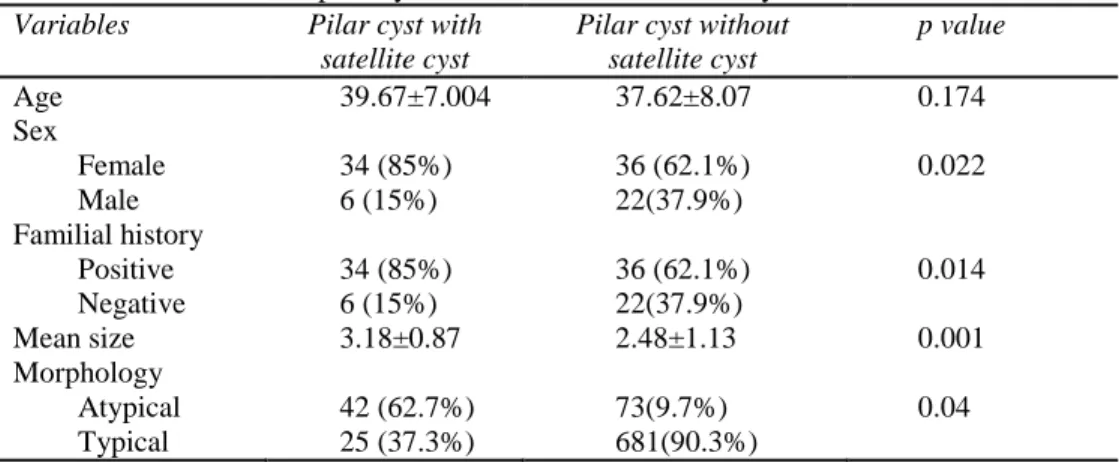
The mean ages of the patients with and without SCs were 39.67±7.004 and 37.62±8.07, respectively. There was no significant difference between the two groups in terms of age (p= 0.174) (Table 2).
Familial history of PCs was seen in 34 (85%) patients with SCs and in 36 (62.1%) patients without SCs. Difference in the familial history was significant between the two groups (p=0.014) (Table 2).
Out of 821 PCs, 67 (8.2%) had SCs and 754 (91.2%) had no SCs. From 821 PCs, 688 (83.8%) manifested as clinically typical (regular nodule or tumor) and 133 (16.2%) manifested as atypical (irregular and flat nodule or tumor). In 67 PCs with SCs, 60 (89.5%) had atypical presentation, and in 754 PCs without SCs, 73 (9.7%) had atypical presentation. There was a
significant difference in term of clinical presentation in both groups (p=0.04) (Table 2).
The mean size of PCs with SCs was 3.18±0.87 cm (ranging from 1 to 5 cm), and that of PCs without SCs was 2.48±1.13 cm (ranging from 1 to 7 cm). A significant difference was seen between the two groups regarding the size of cyst (0.001) (Table 2).
In the PCs with diameters of 2, 1 and 3 cm, SCs were seen in 29(42.5%), 23(34.3%) and 10(14.9%) cases, respectively, which were the most common sizes associated with SCs.
The most common frequencies of PCs associated with SCs were 10 and 6 PCs, and 10 PCs were seen in 9 (13.4%) cases of SCs and 6 PCs were observed in 8 (11.9%) cases of 6 SCs.
Discussion
To the best of our knowledge, this is the first study evaluating the characteristics of patients with PCs associated with SCs, which can be a cause of apparent reversal of cyst despite complete removal of original cyst.
PCs with SCs are most probably seen in women with positive familial history of PCs, with a diameter of 1-3 cm and atypical morphologic presentation.
Table 2 Characteristics of pilar cyst with and without satellite cyst Variables Pilar cyst with
satellite cyst
Pilar cyst without satellite cyst
p value
Age 39.67±7.004 37.62±8.07 0.174
Sex
Female Male
34 (85%) 6 (15%)
36 (62.1%) 22(37.9%)
0.022 Familial history
Positive Negative
34 (85%) 6 (15%)
36 (62.1%) 22(37.9%)
0.014
Mean size 3.18±0.87 2.48±1.13 0.001
Morphology Atypical Typical
42 (62.7%) 25 (37.3%)
73(9.7%) 681(90.3%)
In most of the previous studies, the patients with PCs were in their third and fourth decade,1,3,5 while our patients were in their late fourth decade, and age in the patients with PCs containing satellite cyst was a little higher than that of the patients with PCs without satellite cyst.
We believe PCs in our patients were usually induced at a younger age, but they presented with delay, especially for surgical removal of cysts. PCs in our patients, consistent with most previous studies, were seen frequently in females with autosomal dominant inheritance.1-4
We found PCs with SCs were more prevalent in female patients with positive familial history; therefore, careful examination before surgery for diagnosis of PCs with satellite cyst is suggested to be done in the females with long and dense hair. Also, SCs can be detected in the females through appropriate haircut in suspicious cases.
Our study showed the mean size of PCs with SCs was significantly larger than that of PCs without SCs. Further, the cysts ranging from 1 to 3 cm in diameter most probably had satellite cyst. We think most dermatosurgeons have the tendency to do a small incision in this situation to avoid gross scars. Therefore, in these cases, an appropriate incision in a clean surgical field is essential for detection of SCs.
Our findings showed that one of the key points for detection of PCs associated with SC is its apparent clinical morphology. The PCs with morphologies other than round nodule or tumor are most probably accompanied by SCs.
Conclusion
To conclude, we found that in the PCs with atypical morphology and with a diameter of 1-3cm, especially in the females with positive
familial history, appropriate assessment such as sonography must be carried out before surgery in order to detect probable SCs. Also, during surgery some measures such as appropriate haircut, adequate hemostats, high attention, and employment of skilled assistant may be useful to detect PCs. Future studies are recommended to employ more cases and apply sonography assessment before and after surgery, especially in suspicious cases.
References
1. Thomas VD, Snavely NR, Lee KK, Swanson NA. Benign Epithelial Tumors, Hamartomas, and Hyperplasias. Goldsmith LA, Katz SI, Gilchrest BA, Paller AS, Leffell DJ, Wolff K, eds. Fitzpatrick's Dermatology in General Medicine. 8th ed. New York, NY: McGraw-Hill; 2012. 1334. 2. Antoszewski B, Pisera P, Fijałkowska M,
Kasielska-Trojan A. Giant epidermal cyst of the occipital area. Pol Przegl Chir 2013; 85(11): 666-8.
3. Asilian A, Siadat AH, Shahmoradi Z, Shariat S, Moghadam NA, Soozangar H. Multiple Giant Pilar Cyst Distributed Over the Body Since Childhood. Indian J Dermatol 2016; 61(1): 121.
4. Ramaswamy AS, Manjunatha HK, Sunilkumar B, Arunkumar SP. Morphological spectrum of pilar cysts. N Am J Med Sci 2013; 5(2): 124-8.
5. Al-Khateeb TH, Al-Masri NM, Al-Zoubi F. Cutaneous cysts of the head and neck. J Oral Maxillofac Surg 2009; 67(1): 52-7.
6. Ibrahim AE, Barikian A, Janom H, Kaddoura I. Numerous recurrent trichilemmal cysts of the scalp: differential diagnosis and surgical management. J Craniofac Surg 2012; 23(2): e164-8. 7. Timor-Tritsch IE, Monteagudo A, Santos R.
Fine-t uning the diagnosis of fetal scalp cysts: the value of high-frequency sonography J Ultrasound Med 2008; 27(9): 1363-8.
8. Mehrabi D, Leonhardt JM, Brodell RT. Removal of keratinous and pilar cysts with the punch incision technique: analysis of surgical outcomes. Dermatol Surg 2002; 28(8): 673-7.
of the scalp. Case report. G Ital Dermatol Venereol 2015.
10. Malhotra KP, Shukla S, Singhal A, Husain N. Proliferating trichilemmal cyst with nodal