International Journal of Education
in Mathematics, Science and
Technology (IJEMST)
www.ijemst.com
An Evaluation of UNESCO Publications
on Mathematics Education: From 1989 to
2013
Hakan Yaman, Sefa Dundar, Ulku Ayvaz
Abant Izzet Baysal University
To cite this article:
Yaman, H., Dundar, S., & Ayvaz, U. (2015). An evaluation of UNESCO publications on
mathematics education: From 1989 to 2013.
International Journal of Education in
Mathematics, Science and Technology, 3
(1), 64-76.
This article may be used for research, teaching, and private study purposes.
Any substantial or systematic reproduction, redistribution, reselling, loan, sub-licensing,
systematic supply, or distribution in any form to anyone is expressly forbidden.
Authors alone are responsible for the contents of their articles. The journal owns the
copyright of the articles.
An Evaluation of UNESCO Publications on Mathematics Education: From
1989 to 2013
Hakan Yaman*, Sefa Dündar, Ülkü Ayvaz
Abant Izzet Baysal University
Abstract
The word “UNESCO” was created by being taken the initials of “United Nations Educational, Scientific and Cultural Organization”. UNESCO has undertaken two main objectives as it can be understood from the name of the organization. This organization is an international organization that works for the expedience of the world in long term and as a whole aims to serve to the aims of United Nations including humanitarian purposes. Moreover, the organization aims to support and develop all aspects of the concepts of education, science and culture. Based on these purposes, UNESCO has provided the preparation of many publications as book, journal, report, and article etc. in the field of education. It is seen that some of these publications are related with mathematics education. The aim of this study is to examine the publications of mathematics education published by UNESCO from “Standards and Principles for School Mathematics” document of NCTM issued in 1989 to present. These publications are comprised of article, book, report and documents placed in the publications of education in the web site of the organization. 272 publications of UNESCO were examined with document analysis. In the study, document analysis method, one of qualitative research methods, was used. Investigated publications were analyzed in terms of publication years, publication types, subject areas, contents and related countries. Descriptive analysis method was used in the process of analysis of publications. As the result of investigation of these publications of UNESCO about mathematics education, it is revealed that the publications focused especially on mathematics education programs of countries, international measurement and assessment exams as TIMMS, PISA and subjects about teaching and learning mathematics.
Key words: UNESCO, Mathematics education, Publications of subject areas, Publications of contents, NCTM.
Introduction
The word “UNESCO” was created by being taken the initials of “United Nations Educational, Scientific and Cultural Organization”. The aim of UNESCO, as it is understood from the name of the organization, can be summarized as contributing to global peace, removing poverty, sustainable development and inter-communal dialogue based on shared common values. There are 195 full members and 9 associated members of UNESCO in the world. It is possible to reach the list of the member countries and the date of their membership on the website of the organization.
UNESCO has undertaken two main objectives as it can be understood from the name of the organization. First of all, the organization is international and works for the expedience of the world in long term and as a whole aims to serve to the aims of United Nations including humanitarian purposes. As second aim, the organization aims to support and develop all aspects of the concepts of education, science and culture. (Huxley, 1946: 4). Moreover, the Learning Unlimited Program of UNESCO works to eliminate all barriers and limits affecting lifelong learning negatively (Günay, 2007). In this regard, it can be said that UNESCO gives importance to education. There are many reports of UNESCO about education issued in every two or three years (Spaulding, & Chaudhuri, 1999). The reports issued until 2000 are called as “World Education Report” and include extensive bibliography of conference reports and publications of UNESCO (UNESCO, 1991, 1993, 1995, 1998). However, the reports issued after 2000 are called EFA Global Monitoring Report and last of these reports are issued in 2014.
It has been one of the main aims of the organization to encourage tolerance and peace since the establishment of the organization. The main approach of the organization is educational: the action program is quite extensive
*
Corresponding Author:
and variable including not only international explanation of tolerance and peace concepts but also development of textbooks, production of education materials, organizations of seminar and conference and initiation of “The Associated School Project” (UNESCO, 1997). Education is one of the primary areas of UNESCO. UNESCO believing that education is the key point in social and economic development and undertaking a humanitarian educational vision, has been studying to improve education worldwide since its establishment (www.unesco.org). For example, the organization has carried out its educational activities within the framework of program accepted in World Education Forum in DAKAR in 2000 and determining the goals to be achieved up to 2005 which is called shortly as “Education for All”. UNESCO substantially comes into prominence with studies and agreements setting standards that the organization pioneers in the international field.
When researchers studying the publications of UNESCO are examined, it is seen that one research exists about social studies (Tarhan & Altun, 2014) and any researches exist about mathematics education. Therefore, it is seen important to investigate the publications of UNESCO in the area of mathematics to put forward the general situation of the publications because of the fact that UNESCO is one of the biggest organizations conducting researchers in the areas of science, culture and education. In this study, it was attempted to explain the general situation of the studies of UNESCO about mathematics education from 1989 to today. The aim of the study is to evaluate these studies of UNESCO in terms of the questions below. The research questions are as follows:
1. How is the distribution of the publications of UNESCO about mathematics education according to years?
2. How is the distribution of the publications of UNESCO about mathematics education according to publication series?
3. How is the distribution of the publications of UNESCO about mathematics education according to continents and countries?
4. How is the distribution of the publications of UNESCO about mathematics education according to whether the publications are UNESCO publication or not?
5. How is the distribution of the publications of UNESCO about mathematics education according to subject areas?
6. How is the distribution of the publications of UNESCO about mathematics education according to accessibility (online access)?
Method
Research Design
In this study, aiming to examine the publications of UNESCO about mathematics education, descriptive model was used because of the fact that it was aimed to describe the existing situation as it is (Fraenkel, Wallen & Huy, 2011). Qualitative research method was used in collection, analysis and evaluation of obtained data.
The Investigated Publications
1198 publication were obtained in the expert search section of data base of UNESCO which is called as UNESDOC data base. Because of the difficulty of examination of 1198 publications obtained by purposive sampling method, 272 of these publications whose publication language was English and which were published after the publication of the “Principles and Standards for School Mathematics” document of NCTM, were examined in the scope of this study. Therefore, criterion sampling, one of the purposive sampling methods, was used in the study in the determination process of the publications that would be investigated.
Data Collection
UNESCO offers the publications that has been published and included in its libraries and on its data base to relevant people via four different web sources. These sources are “Online Book for Sale” section where book, multiple media, periodical and scientific maps for professionals in six languages (English, French, Spanish, Russian, Chinese and Arabic) are sold, “UNESDOC data base” section where approximately 120 000 publications in six languages published form 1945 to today are offered to online access freely, “UNESCO Library” in Paris and “archive” section at the same place. In this study, UNESDOC data base having online access was used and it was reached to this data base from the address of http://www.unesco.org/new/en/unesco/resources/online-materials/publications/unesdoc-data base/.
Data Analysis
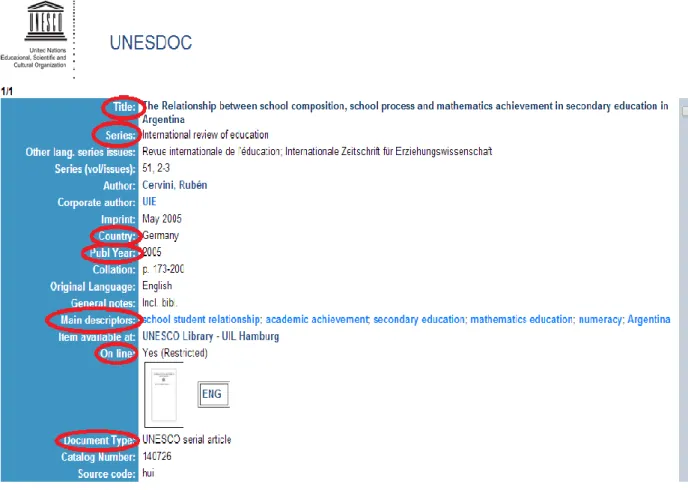
Information about the publications as it is given in Figure 1 is seen when it is clicked on the link of the publications investigated as a result of searching on UNESDOC data base. On this webpage it is seen that title, publication series (if exists), country, publication date, key words, situation of online access and document type of the publications. Publication date, country, publication series, subject area, situation of being a UNESCO publication and online access were determined as the categories of the study.
Figure 1. An example publication tag from UNESDOC data base
Findings
The Distribution of the Publications of UNESCO about Mathematics Education according to Years
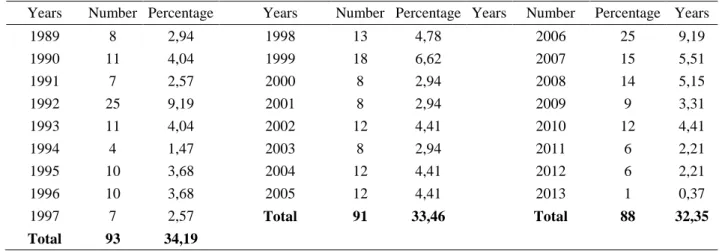
Table 1. The Distribution of the Publications about Mathematics Education on UNESCO Website according to Years
Years Number Percentage Years Number Percentage Years Number Percentage Years
1989 8 2,94 1998 13 4,78 2006 25 9,19
1990 11 4,04 1999 18 6,62 2007 15 5,51
1991 7 2,57 2000 8 2,94 2008 14 5,15
1992 25 9,19 2001 8 2,94 2009 9 3,31
1993 11 4,04 2002 12 4,41 2010 12 4,41
1994 4 1,47 2003 8 2,94 2011 6 2,21
1995 10 3,68 2004 12 4,41 2012 6 2,21
1996 10 3,68 2005 12 4,41 2013 1 0,37
1997 7 2,57 Total 91 33,46 Total 88 32,35
Total 93 34,19
When Table 1 is examined, it is seen that the most publications were published in 1992 (25 publications) in the group of the years between 1989 and 1997 (See Graph 1), in 1999 (18 publications) in the group of the years between 1998 and 2005 (See Graph 2) and in 2006 (25 publications) in the group of the years between 2006 and 2013 (See Graph 3).
Graph 1. The Publications about Mathematics Education Published between the years of 1989 and 1997 and Placed on UNESCO Website
When the publications in 1992 were examined, it is appealed that 15 of 25 publications were published in “Moving into the twenty-first century: (Studies in mathematics education)”series and 13 of the publications were related to investigation of mathematics education systems of different countries. 4 of other 10 publications published in 1992 were related to mathematics education in countries. From this point of view, it can be stated that most of the publications were about the mathematics systems of the countries
When the publications in 1999 were examined, it is seen that 13 of 18 publications were related to mathematics course education programs. 9 of these publications were about mathematics course education programs from 1st grade to 9th grade, separately. 3 of remaining 4 publications were about program comparisons and 1 of them was about program development.
Graph 3. The Publications about Mathematics Education Published between the years of 2006 and 2013 and Placed on UNESCO Website
When the publications in 2006 were examined, it is seen that 22 of 25 publications were related to mathematics course education programs. Among the rest of the publications, 1 publication was about measurement-assessment, 1 publication (for each) was about the use of technology and computer in mathematics education and the other was about counting.
The Distribution of the Publications of UNESCO about Mathematics Education according to Publication Series
When the publications were examined, it is seen that 87 of 272 publications were classified in specific series. The distributions of the publications according to series were given in Graph 4.
Graph 4. The Distributions of Publication Series of the Publications of UNESCO about Mathematics Education according to Years
Graph 5. Publication Series of the Publications of UNESCO about Mathematics Education
When Graph 5 is examined, it is seen that most of the publications were in "Moving into the twenty-first century” series with 14 publications. This series aims to examine mathematics education systems of countries while entering into 21st century. It was followed by "Science and technology education" and "Prospects: quarterly review of comparative education" series with 9 publications in each.
The Distribution of the Publications of UNESCO about Mathematics Education according to Continents and Countries
As the result of examination, it is seen that the publications about mathematics education on UNESCO website were published in the countries of 5 continents (Africa, America, Europe, Asia, Oceania). The distributions of the publications according to the continents were given in Table 2.
Table 2. The Distributions of the Publications about Mathematics Education on UNESCO Website according to the Continents
Continent
Numbers of Countries in Continent
Numbers of Countries about which
Publications Published Number of Publications
f Percentage in terms of numbers of countries in continent f
Number of Publications Per Country
Asia 49 17 34.69 37 2.18
Europe 43 14 32.55 70 5.00
America 41 14 34.14 66 4.71
Oceania 17 5 29.41 13 2.60
Africa 54 14 25.93 62 4.43
*In the table 204 members of UNESCO are given totally (195 countries are full members and 9 countries are associated members).
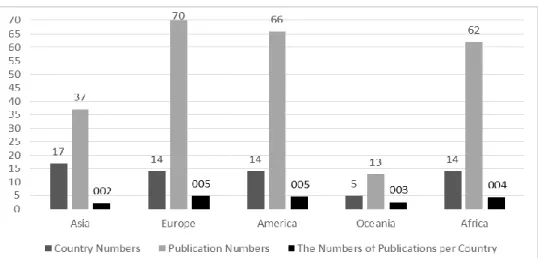
Graph 6. The Graph of the Publications about Mathematics Education Published between the Years of 1989 and 2013 and Placed on UNESCO Website according to the Continents of Related Countries
When Graph 6 is examined, it is seen that Europe was the continent that the number of publications per country was the most with 5 publications and Asia was the continent that the numbers of publications per country was the least with 2,18 publications. Because of the fact that 37 publications were published for 17 countries in the continent of Asia, the number of publications per country was less. Moreover, the numbers of publications published in the countries placed in these continents were given in Table 3.
Table 3. Distribution of the Publications about Math Education on UNESCO Website according to Countries
Country Number Country Number Country Number
No information 24 Belize 3 Argentina 1
French 19 Botswana 3 Bhutan 1
UK 16 Philippines 3 Bulgaria 1
USA. 13 Indonesia 3 Cook Islands 1
Antigua and Barbuda 10 Canada 3 Denmark 1
Bahamas 9 Hungary 3 Philippines 1
South Africa 9 Mauritius 3 Developing countries 1
Australia 8 Senegal 3 Iran 1
Jamaica 8 Trinidad and Tobago 3 Cairo 1
Namibia 8 Uganda 3 Qatar 1
Swiss 7 Zambia 3 Kuwait 1
Thailand 7 Zimbabwe 3 Lesotho 1
Africa Countries* 6 Caiman Islands 2 Malaysia 1
Germany 6 Dominic Republic 2 Malta 1
Kenya 6 Estonia 2 Holland 1
Rwanda 5 Iraq 2 Nigeria 1
Brazil 4 Italy 2 Norway 1
Chili 4 Japan 2 Palau 1
Ghana 4 Egypt 2 Paris 1
India 4 Nepal 2 Romania 1
Sweden 4 Samoa 2 Sri Lanka 1
OECD 4 Singapore 2 Uruguay 1
Pakistan 4 Arabia Countries * 1 Victoria 1
America Countries* 3 Total: 272
*
When Table 3 was examined, it is seen that 24 publications did not have information about country. It is also appealed that 19, 16 and 13 of the publications were published in France, the United Kingdom and the United States of America, respectively. This finding shows that there were more publications in three of the biggest countries in the world. Moreover, it is quite meaningful that the numbers of the publications were the most in France when it is thought that the central office of UNESCO is in France (http://en.unesco.org/feedback/contact-us)
The Distribution of the Publications of UNESCO about Mathematics Education according to whether the Publications are UNESCO Publication or not?
It is seen that the publications about mathematics education were presented under two categories as: UNESCO publication and non-UNESCO publication. The distributions of the publications according to this criterion were given in Graph 7. For these publications to be seen better in terms of years, they were presented in 3 groups of years.
Graph 7. The Distribution of the Publications of UNESCO according to UNESCO and Non-UNESCO Publications
When Graph 7 is examined, it is seen that the numbers of UNESCO publications were the most between the years of 1998 and 2005 with 67 publications and there were nearly 30 publications in other groups of years. Moreover, it is found that the numbers of UNESCO publications have decreased since 1988.
The Distribution of the Publications of UNESCO about Mathematics Education according to Subject Areas
Table 4. The Distributions of the Publications about Mathematics Education on UNESCO Website according to the Subject Areas
Categories Pub. Numbers Subjects Pub. Numbers
Education
Curriculum 86
Mathematics Curriculum 74
Computer-Technology-Material 6
Text Books 5
Course Syllabus 1
General
Education Cases 63
Countries and country comparatives 34
Teacher Education 12
Learning Class, Disabilities of Mathematics, Culture and
Problems and Solving Suggestions 6
Equity and Gender Differences 4
Conference 3
Special Education 2
Higher Education 1
Olympics 1
Gifted and Talented Students 1
Mathematics
Education 89
Mathematics Education 38
Evaluation and Assessment (PISA, TIMMS) 25
Teaching of Mathematics 15
Learning of Mathematics 8
Mathematics Education in Future 1
History of Mathematics Education 2
Subject Areas 16
Number and Numerosity 8
Statistic 3
Fractions 2
Teaching of Arithmetic 1
Problem Solving 1
Street and School Mathematics 1
No subject
(None) 17
The most of the publications in the theme of education programs were about mathematics course education programs. It is also seen that there were not many publications about textbooks (See Graph 9).
Graph 9. The Publications about Education Programs
Graph 10. The Publications about General Education Situations
It is seen that the number of the publications about mathematics education was much more than the number of other sub-categories in the theme of mathematics education (See Graph 11). It is found that there were 38 publications about mathematics education on UNESDOC data base. This sub-category was followed by measurement-evaluation with 25 publications.
Graph 11. The Publications about Mathematics Education
Between the years of 1989 and 2013, 15 publications were published about mathematics teaching and 8 publications were published about mathematics learning. It is seen that there were only 2 publications related to mathematics education history about which more publications have been published with increasing importance in recent years. Moreover only 1 publication was published about mathematics education in future. When it is compared with other sub-categories in the theme of mathematics education, the fewness of the numbers of the publications about mathematics education history and mathematics education in future was striking (See Graph 11).
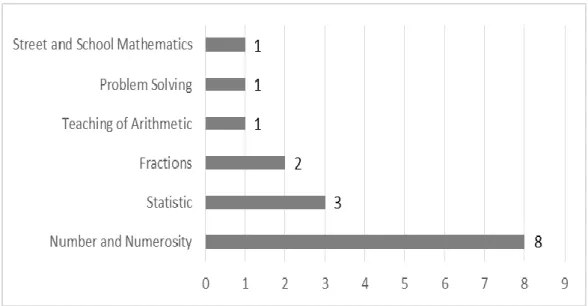
Graph 12. The Publications about Subject Areas
The Distribution of the Publications of UNESCO about Mathematics Education according to Accessibility (Online Access)
When the publications were examined, it is seen that some of the publications on UNESCO website had online access. The publications were examined under two categories to investigate the accessibility of the publications (See Table 5).
Table 5. The Distributions of the Publications about Mathematics Education on UNESCO Website according to the Accessibility (Online Access)
Year Online Access Non-Online Access
1989-1997 61 31
1998-2005 57 33
2006-2013 29 61
Total 147 125
When Table 5 is examined, it is seen that the number of the publications having online access was the most between the years of 1989 and 1997. It is also found that that the number of the publications not having online access was the most between the years of 2006 and 2013. Moreover, it is seen that the numbers of publications having online access have been decreasing from past to present.
Discussion and Conclusion
In this study, evaluating the publications about mathematics education on UNESDOC database, 272 publications were reached. Only 147 of these publications were accessed online. Some of the publications of the rest were not included on data base and some were accessed by user name and password. It is thought that accessing some publications by user name and password contradicts with the identity of the organization because of the fact that the organization is known as a nonprofit and international education, science and culture organization. Since such implementations prevent people to access the publications. When the publications were examined according to years, it was seen that online accessibility decreased. In this era that technology has been developing continuously and becoming an information society, accessing data is provided in digital environments. Despite this, while more publications were accessed online in the past, online accessibility of the publications has been decreasing from past to present.
more after the publication and revision of “Principles and Standards for School Mathematics” document by NCTM in 1989 and 2000.
As a result of analysis of investigated publications according to subject areas, it was found that the publications focused mostly on “Mathematics Education” and “Education Programs” topics. “Mathematics Course Education Programs” was the topic that the most publications were published. It is found that in recent years many publications related to situations of countries have also published as measurement and international evaluation reports like PISA, TIMSS were published. Moreover, it was appeared that there were no more publications about sub-areas in mathematics (arithmetic, algebra, problem solving etc.). According to purpose of establishment of UNESCO, it is also aimed to be developed educational systems of countries. Despite this purpose, it is surprising that there was only one publication about how future mathematics education should be. Moreover, it also contradicts with the aim of UNESCO focusing also differences among cultures that only 4 publications existed related to equality and gender differences in mathematics education.
It is seen that there were more publications in the countries located in the continents of America and Asia. When the publications on UNESDOC data base were examined, it is appeared that the ratio of numbers of countries in each continent where publications were published to the numbers of countries in the continents was 25-35 %. It is thought that the ratio of countries publishing publications was less in Africa because of the fact that the number of countries in Africa is more. It is seen that although the ratio of countries where publications were published was less, the number of publications (4,43 publications) per country was more. It is appeared that the continent where more publications existed was Europe with 5 publications. Similarly, it is found that number of publications per country was also high in America with 4,71 publications. It is seen that although in the continent of Asia, the ratio of the number of countries where publications published to all countries in this continent was approximately 35%, the number of publications per country was the least among the continents with 2,18 publications.
When the publications were examined, it was found that the number of publications published in France was the most with 19 publications among other countries. The reason may be the fact that the central office and library of UNESCO place in this country. Moreover, it was revealed that the number of publications was also high in less developed countries as Antigua and Barbuda (10 publications), Bahamas (9 publications) publications) and South Africa (9 publications) as well as they were published in developed countries as the United Kingdom (16 publications) and the United States of America (13 publications).
When the publications were examined, it is seen that especially the publications published between the years of 1989 and 1997 were published within the scope of series. It was revealed that the number of publications published in series had decreased from past to present and they were published as independent publications. When the series of publications were examined, it was found that the number of the publications in “Moving into the twenty-first century” series was the most. It was followed by the series of “Science and technology education” and “Prospects: quarterly review of comparative education”. However, the numbers of publications were the least in the series of “Science and technology in school curricula, Higher education in Europe, Innovations in science and technology education, Technical paper etc.”
References
Fraenkel, J.R., Wallen, N.E. & Huy, H.H. (2011). How to design and evaluate research in education (Eighth Edition). Mc Graw Hill Companies: New York.
Günay, D. (2007). Değişim çağında yükseköğretim “Yirmibirinci yüzyılda üniversite” (Ed. Coşkun C.). İzmir: Yaşar Üniversitesi Yayını
Huxley, J. (1946). UNESCO: Its purpose and its philosophy. preparatory commission of the UNESCO. Accesed on 15th April from UNESDOC data base.
National Council of Teachers of Mathematics [NCTM] (1989) .Curriculum and evaluation standards for school mathematics. Reston, Virginia.
Spaulding, S. & Chaudhuri, R. (1999). "UNESCO's world education report: Its evolution, strengths and possible futures." International Journal of Educational Development19, no. 1 (March 1999): 53-63.
Tarhan, M. & Altun, A. (2014). UNESCO ve Sosyal Bilgiler Eğitimi. III. Uluslararası Sosyal Bilgiler Eğitimi Sempozyumu (USBES III). Gazi Üniversitesi, 28-30 Nisan 2014.Yayınlanmamış bildiri.
United Nations Educational, Scientific, and Cultural Organization [UNESCO] (1993). World Education Report. UNESCO, Paris.
United Nations Educational, Scientific, and Cultural Organization [UNESCO] (1995). World Education Report. UNESCO, Paris.
United Nations Educational, Scientific, and Cultural Organization [UNESCO] (1997). 50 Years for Education. Paris: UNESCO Publication. Retrieved 10 May 2014, http://www.unesco.org/education/educprog/50y/ brochure/index.htm.
United Nations Educational, Scientific, and Cultural Organization [UNESCO] (1998). World Education Report. UNESCO, Paris