ISSN: 2147-611X
www.ijemst.com
A Sample Webquest Applicable in
Teaching Topological Concepts
Sevda Goktepe Yildiz, Seda Goktepe Korpeoglu Yildiz Technical University
To cite this article:
Goktepe Yildiz, S. & Goktepe Korpeoglu, S. (2016). A sample webquest applicable in
teaching topological concepts.
International Journal of Education in Mathematics, Science
and Technology, 4
(2), 133-146. DOI:10.18404/ijemst.35581
This article may be used for research, teaching, and private study purposes.
Any substantial or systematic reproduction, redistribution, reselling, loan, sub-licensing,
systematic supply, or distribution in any form to anyone is expressly forbidden.
Authors alone are responsible for the contents of their articles. The journal owns the
copyright of the articles.
Volume 4, Number 2, 2016
DOI:10.18404/ijemst.35581
A Sample WebQuest Applicable in Teaching Topological Concepts
Sevda Goktepe Yildiz, Seda Goktepe Korpeoglu
Article Info
Abstract
Article History
Received: 10 February 2015
In recent years, WebQuests have received a great deal of attention and have been used effectively in teaching-learning process in various courses. In this study, a WebQuest that can be applicable in teaching topological concepts for undergraduate level students was prepared. A number of topological concepts, such as countability, infinity, and sets were incorporated into the WebQuest developed. The WebQuest consists of six stages: introduction, task, process, resources, evaluation and conclusion. After the WebQuest activity was applied, the usability of the WebQuest was evaluated, taking into account students’ views. The study was carried out with 29 elementary mathematics pre-service teachers. The data was collected in written form using an interview form that was developed by the researchers. The results indicated that the pre-service teachers have not previously encountered such WebQuest activities however; they display a keen interest in learning about this technology-aided activity and the opportunities to use it in their further lessons.
Accepted: 19 August 2015
Keywords
Mathematics education Pre-service teachers Topological concepts WebQuest
Introduction
In Turkey at primary, middle and high school levels, the geometry syllabus is mostly focused on Euclidean geometry (Kösa, 2011). When graduate and post gradual levels are reached, the students are faced with different geometric spaces. The concepts of topology arise as a topic of study as result of analyzing and developing some concepts of Euclidian spaces and real number space Rn (n≥2) (Mucuk, 2010, p. 45). Topology also involves other geometry types and concepts of Euclidean geometry (Karaaslan, 2013). In early 20th century, various definitions regarding topology science were proposed by mathematicians like Frechet and Housdarff. One of these is a definition which expressed topology as a field of science which analyzes invariant features under topological transformations which is known as “homeomorphisms” (Mucuk, 2010, p. 45). The transformation of a triangle (hollow) to a circle or a tea glass to saucer may be given as an example of this homeomorphism. When the meaning of this word is examined, topology is formed by the combinations of the word of topos that means place or surfaces, and the word logos that means science (Rahimov, 2006).
Courses that include topological concepts at graduate and postgraduate levels are existed. In faculties of education, for instance in the department of elementary mathematics education, concepts such as countability and infinity are included in Abstract Mathematics and Elementary Number Theory courses. In Geometry and Analytical Geometry courses, information regarding different spaces is provided. In the faculty of arts and science, topology is taught as a course itself. At postgraduate level topology is an independently-studied major. Generally, students who have continued topology course or who have encountered topological concepts have some prejudice at the beginning of the courses and they have difficulties in understanding what topology means exactly. Tsoi, Goh, and Chia (2005) indicate that technological aids enjoy a significant potential in ensuring a better understanding of abstract concepts. Alias, DeWitt, and Siraj (2014) concluded that WebQuests are helpful in understanding gas law concepts which in itself is an abstract subject from the field of physics.
ones that learners can mostly access via the Internet. In the process section, the steps that learners must follow are explained step by step. In the evaluation section, the evaluation criteria for the studies of students are given. Finally, in the conclusion section, a short summary of the experience of the learners is included (Dodge, 1997). WebQuests are in two types: the short-term WebQuest and the long-term WebQuest. Short-term ones are completed within 1-3 courses (minimum 45-minute class period and maximum three 45-minute class period); they are easier to design and can be applied fast. On the other hand, the long-term WebQuest may last between 1 week and 1 month and they are mostly carried out as group activities (Dodge, 1997; Watson, 1999). This type of WebQuest provides to analyse in depth the concepts (Watson, 1999). The WebQuest in this article is an example of short term WebQuests. Since Web based teaching and learning activities increase the academic success and motivation of the students (Arıkan, 2006; Çetin, 2010; Hayes & Billy, 2003), both types of WebQuests can be applied in courses.
WebQuests are inquiry-centred activities and enable students the freedom for learning through different resources (Beane, 1997). Moreover, WebQuests allow students to develop their problem-solving skills, high level and critical thinking and creativeness (Abu-Elwan, 2007; Lim & Hernandez, 2007). WebQuests are more efficient in upper cognitive thinking than some other activities (Kanuka, Rourke, & Lafiamme, 2007). Students use internet in an enjoyable way and improves their attitude towards the courses positively via WebQuest activities (Kurtuluş & Kılıç, 2009). WebQuest activity has a high potential to serve as an effective tool in teaching and learning (Laborda, 2009; Alshumaimeri, & Almasri, 2012) and create a positive learning environment (Alias, DeWitt, & Siraj, 2014; Chang, Chen, & Hsua, 2011; Göktepe, 2014). According to the results of Alias, DeWitt, and Siraj’s studies (2014), the WebQuests present students with opportunities to learn in accordance with their own learning style. It helps students in the understanding of abstract physics subjects. Topology is quite abstract science and difficult to understand topological concepts. WebQuest activities can be used for teaching its concepts.
WebQuests focused on elementary school students and pre-service teachers for different branches were examined in this study. Gaskill, McNulty, and Brooks (2006) stated that WebQuests were suitable activities with regards to the philosophy and aims of constructivism theory. In this study, it is concluded that both teachers and students enjoy in courses which are conducted by using WebQuests. Kurtuluş (2009) carried out a web-based teaching activity with middle school students and prepared a WebQuest that could be used in geometry courses. Göktepe (2014) presented a WebQuest sample that introduced the coordinate system to middle school students in her study. WebQuests are also widely used to develop teachers’ professional career (Lim, 2001), effective tools for training teachers (Halat & Jakubowski, 2001; King, 2003; Halat, 2008) and WebQuest model have been applied in pre-service teacher education (e.g., Dobson, 2003; King, 2003). To design a WebQuest activity may provide pre-service teachers to understand “technology’s affordances, constraints, contextual sensitivity, and manipulability” (Mishra & Koehler, 2003) and integrate technology into their future teaching process (Kundu & Bain, 2006). WebQuests are effective tools for providing teachers with the opportunity to integrate Internet into their courses (Beane, 1997). Stathopoulou, Katarinou, and Chavioris (2010) stated that WebQuests would be helpful for teachers in enabling them to see the relationship between culture and mathematics.
examined WebQuest and cooperative learning for teacher training purposes in Singapore. They presented a WebQuest prepared for service special education teachers. Peker and Halat (2009) studied with 73 pre-service teachers in their experimental studies in which they compared the courses conducted by using WebQuests and computer software; they concluded that activities with WebQuests reduced the anxiety of teaching mathematics. In the study of Kurtuluş, Ada, and Yanık (2014) an analysis of the opinions of a middle-school mathematics teacher was carried out who used a WebQuest activity for the first time in his lessons regarding the practicability of WebQuests. The prepared activity concerned the topic of the histogram. It was concluded that WebQuests perpetuate the student’s motivation and increase students’ confidence towards mathematics.
In this context, there are a great number of studies about the effect of WebQuests on pre-service teachers’ motivation, achievement and the practicability of WebQuests. However, there have been limited research studies focused on WebQuests related to the teaching of abstract such as, topological concepts in mathematics. Besides that, this study have been filled the gap by examining whether WebQuests can be used in teaching topological concepts by learners. The studies related to the teaching of topology concepts are very limited (e.g., Karaaslan, 2013; Weeks, 2001; King, 2001). In his book entitled “Exploring the Shape of Space” Weeks (2001) used various activities related to the properties of surface such as the Mobius strip and the Klein bottle. Karaaslan (2013) in his Master’s thesis entitled “A New Subject Recommendation for the Secondary Education Program: Topology”, several new units were presented for undergraduate students. The objectives were created for an introduction to topology and the curves in the plane, lines and surfaces were presented as examples in his study. Furthermore the sections that he prepared were evaluated by taking the opinions of teachers and pre-service teachers into account. It was concluded that topology can provide a different perspective for teachers and researchers unlike other types of geometry. King (2001) designed a lecture-free seminar. In the seminar liberal arts courses (game theory and strategy, mathematical topics in the social sciences, history of elementary mathematics, elementary statistics), introductory courses (calculus I-II, discrete mathematics), intermediate courses (linear algebra, multivariable calculus), advanced courses (abstract algebra, topology) topics are available. Undergraduate students from liberal arts courses to advanced major courses discussed those topics and a non-scientific assessment was performed. King’s (2001) research has been presented an effective learning area. Professors in the universities can create such activities carried out in non-traditional ways.
Mathematical concepts in abstract algebra are related to topological concepts and various studies have been carried about abstract algebra (e.g., Clark et al, 1999; Hazzan, 1999). Clark et al (1999) examined students’ attitudes toward abstract algebra course. Curriculum development program named “An Abstract Algebra Story” was evaluated. It was a computer aided program and based on constructivist theory, in addition to them students was studying in learning groups. Interviews were carried out both students from this program and students that took standard abstract algebra course. Results showed that although abstract algebra was a difficult course, students desired group activities and computer-aid learning environment. Abstract algebra concepts are mostly difficult to understand, reducing abstraction- a way of understanding abstract topics- helps students to understand algebra concepts simply (Hazzan, 1999). Hazzan (1999) investigated undergraduate students’ reducing abstraction level while learning abstract algebra concepts. Semi-structured interviews were performed and the interviews centred on groups, subgroups, cosets, Lagrange’s theorem, and quotient groups. According to the results of the study, reducing abstraction enables students to understand algebra topics.
In this study, a sample WebQuest was developed which can be implemented for the teaching topological concepts. By completing each of the 6 sections mentioned above, a WebQuest was prepared. It is a short-time WebQuest activity that can be completed within an hour. The study provides an opportunity for the evaluation of the WebQuest by considering the opinions of students in the teaching of topological concepts. It offers an opportunity to present topology, which is a highly abstract subject, with the support of technology, in an alternative way.
The Purpose of the Study
The Significance of the Study
A WebQuest activity that can be a teaching material on teaching topology was applied. The evaluation of the WebQuest by students provided an opportunity to see the positive and negative sides of the activity from different point of views. Besides researchers and educators can propose various suggestions about the activities and the content of the WebQuest which can be found in the internet environment so that a teaching material that can used effectively will have been created. At the same time, the WebQuest will form a sample activity for researchers who are interested in teaching topological concepts.
The Developed Webquest
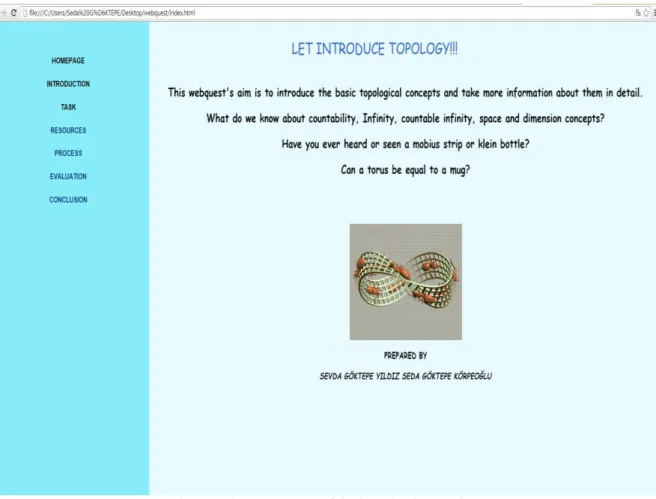
This WebQuest was designed for students at undergraduate level. As suggested by Dodge (1995) the prepared WebQuest consists of 6 sections, namely: introduction, task, information sources, process, evaluation, and conclusion. In the introduction stage, the dictionary definition of topology derived from Greek was provided in this section on account of the necessity of finding various objects or expressions to attract the students’ attention with regard to the subject (Dodge, 1995). In addition to that, there is a page in the form of a Mobius strip.
Figure 1. Screen capture of the introduction section
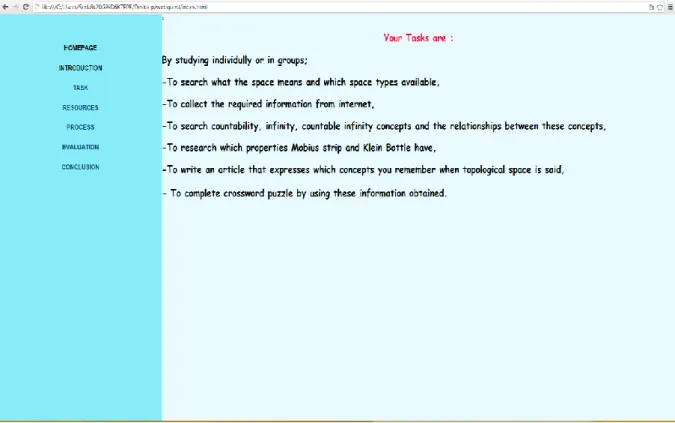
Figure 2. Screen capture of the task section
In the resources section, Dodge (1998) included the necessary knowledge (links) for the WebQuest and carefully-selected web pages. In the information sources section, various web sites from which students could benefit were given and it was stated that the topology books of different researcher can be used. It was explained in the terms of guidance that they can also use different sources of their own in addition to the sources.
Figure 3. Screen capture of the resources section
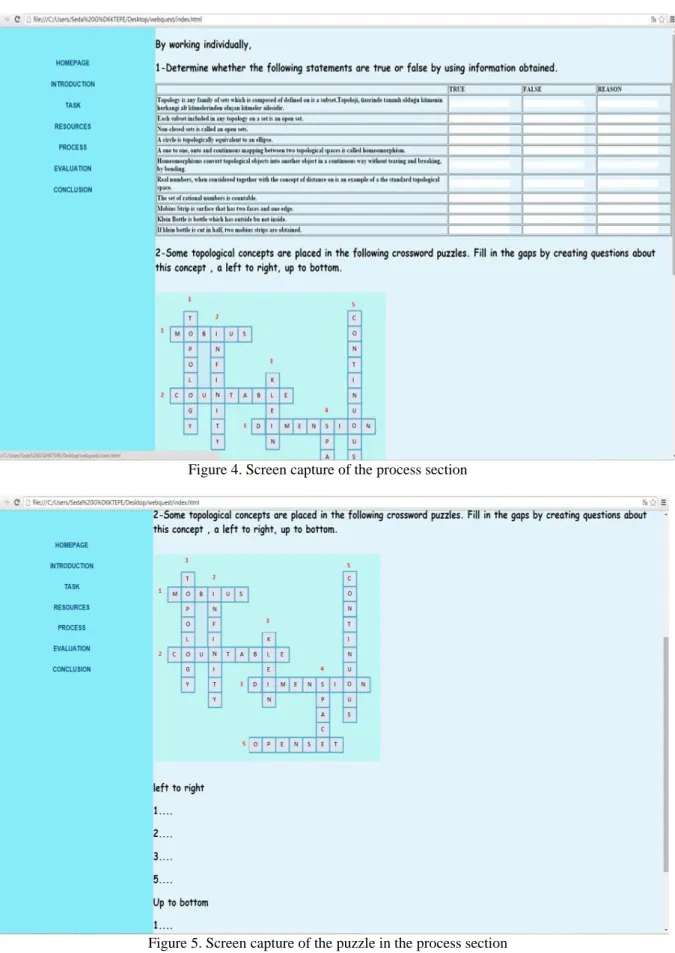
Figure 4. Screen capture of the process section
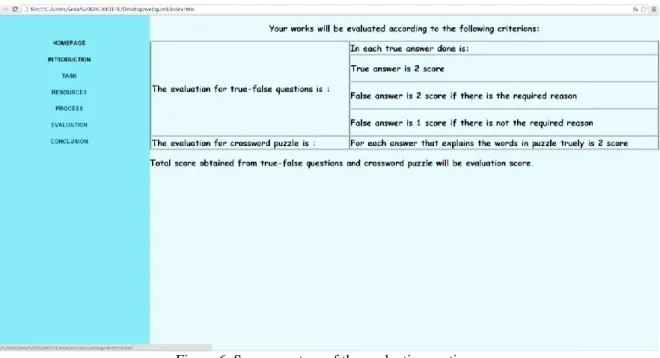
Figure 5. Screen capture of the puzzle in the process section
Figure 6. Screen capture of the evaluation section
In the conclusion section, there is a summary about what they have learned with regard to motivating the students and they are asked to continue their experience. It was stressed that they had acquired information about basic topological concepts and could reach a more advanced mathematical thinking skills by enhancing these information.
Figure 7. Screen capture of the conclusion section
Method
named “Topology and Category” was mostly used. Furthermore, it was benefited from Bernie Dodge WebQuest creation website (http://webquest.org/). The chosen questions are related to topology concept, open-close sets, continuity, accountability, dimension, base and homeomorphisms. An evaluation, that included the true-false questions about these concepts was conducted, after that a crossword puzzle activity was used. Activities were presented through the prepared WebQuest. In the process of evaluating the prepared WebQuest regarding the opinions of pre-service teachers, a content analysis was carried out. The purpose of the content analysis is to gather similar data in connection with certain similar concepts and themes and edit them in a way that the reader can understand (Yıldırım & Şimşek, 2013, p. 260). The data obtained in content analysis were analysed in four phases: Data coding, finding the themes, organization of the codes and themes and identification and interpretation of the findings (Yıldırım & Şimşek, 2013, p. 260). The WebQuest can be accessed from http://webquesttopology.byethost3.com/ address and it can be used as a teaching resource for teachers and researchers.
The Study Group
This study involved 29 pre-service teachers enrolled in elementary mathematics education department at a public university in Istanbul, Turkey. In the selection of the pre-service teachers to participate in the study, purposeful sampling (Patton 2002) was employed. Participants were junior students and all of them completed General Mathematics, Analysis I-II, Abstract Mathematics, Geometry, Computer I-II courses and some of them completed Computer Supported Mathematics Teaching course. They had learned office programs (e.g., MS Word, Powerpoint) and web designing.
Data Collection Tools
After the WebQuest activity developed by the researchers had been carried out, the opinions of pre-service teachers were collected using an interview form. The interview form consisted of 5 open-ended questions and was created in advance by researchers. While creating the form, the opinions of a mathematics education specialist and a topologist were used. The first question used in the interview form is “Have you ever encountered a WebQuest activity? If yes, how was it?” the second question is “In what ways was the WebQuest activity useful in teaching topological concepts?”. The third question is “In your opinion, what are the missing aspects of the prepared WebQuest?”, the fourth question is “What are your suggestions to improve the prepared WebQuest?”, and the fifth question is “If you want to implement this activity with your students, what kind of a WebQuest will you design?”.
Data Analysis
The data collected using the interview form was analysed with the aid of content analysis. For the reliability of the study, both researchers examined the data and made the coding. In the process of determining the themes and placing the answers of the students, the agreement percentage value stated by Miles and Huberman (1994) was used for reliability. This was calculated according to the following formula:
“Agreement Percentage = Consensus (Na) / ((Consensus (Na) + Dissidence (Nd)) x 100”
Interview forms were coded by both researchers and for the coding made by the researchers a 94 % fit was ensured and it was accepted as being reliable.
The Implementation Process
Figure 8. The Implementation Process
Results
The findings regarding the opinions collected from pre-service teachers about the practicability of the WebQuest application developed for the teaching of various topology concepts were displayed in this section. The findings were displayed as direct quotations and descriptively presented in percentage-frequency tables. The answers of the students to the first question indicated that all the 29 students who participated in study stated that they had not encountered a WebQuest activity before. The results are in the interview form are shown in Table 1:
Table 1. The opinions of students regarding whether they have previously encountered a WebQuest activity or not.
Have you ever encountered a WebQuest activity before?
f %
Yes 0 0
No 29 100
In response to the second question, what kind of benefits did the carrying out of the WebQuest activity produce was asked. The responses obtained from the students were appropriate for the following themes: the teaching of topological concepts, the involvement of research and the section of information sources. The frequency-percentage table regarding the responses of students is given in Table 2:
Table 2. The opinions of students regarding the benefits of the WebQuest activity The benefits of WebQuest activity f %
Teaching Topological Concepts 25 86 Gaining Research Ability 2 7 The Section of Information Sources 2 7
Within the scope of this question regarding the benefits of the activity, pre-service teachers provided answers mostly in accordance with the teaching topological concepts theme (86 %). The following answers were provided within this framework: “We learnt the topic of topology.”, “This WebQuest helped me to obtain information about what topology is and its concepts as I did not have any information about the concept of topology before.”, “It helped us to consolidate our knowledge and understanding with activities.”, “Mostly it assisted me in learning definitions.”, “I learnt basic information.”.
Two pre-service teachers gave the answers “It can be helpful as it involves research” and “It is beneficial in terms of the opportunity to use given web sites” and stated that it was beneficial as it involves research. Two pre-service teachers provided answers that the section of information sources was beneficial. “I mostly benefited from the information sources section in such an activity.”, “The suitability, clarity and comprehensibility of information contained within information sources to students is important. If the information sources are complete than it will be beneficial.”
In the third question, pre-service teachers were asked about the missing aspects from the developed WebQuest. The answers of the students were analysed in two themes as formal and contextual inadequacies (Table 3).
Table 3. The opinions of students regarding the missing aspects of the WebQuest The missing aspects of the WebQuest f %
Formal 8 28
Contextual 18 62
When participants were asked about features missing from this activity, approximately 28 % of them stated formal inadequacies and 18 % of them stated contextual inadequacies. However, 3 students could not see any missing aspect in the developed WebQuest. Some of the answers of the students who stated that the WebQuest has some formal missing features are as follows: “The web site looks too simple.”, “It is has visually missing features, the routing signs are missing.”, “It could be visualized a little more effectively.”, “A warning about what constitutes true and false (and how to answer the questions?) should be given before passing the next stage after true-false.”
The students gave the following responses for the contextually missing features: “As the study requires students to carry out research, they may access the wrong information.”, “It would be better if feedback about the correctness of the answers could be provided.”, “More questions could be used in the evaluation stage.” and “It provides very basic information. It may be helpful for starting the subject but the complete learning (mastery) of the topic would not be possible.”, “There could be more opportunities for practice provided.”
The answers of the students who participated in the activity regarding the improvement of the prepared WebQuest in the fourth question of the interview form were summarized under two themes as contextual suggestions and formal suggestions (Table 4).
Table 4. The suggestions for the prepared WebQuest The suggestions for the WebQuest f %
Formal 10 34
Contextual 19 66
34 % of the suggestions of pre-service teachers for the prepared WebQuest concern the formal aspects and 66 % of them are for contextual aspects. Some formal suggestions made for the WebQuest were expressed as follows: “Visual features could be used more.”, “The colourization can be improved.” and “It should be paid attention to visual quality. Students can be activated more.”
The contextual suggestions for the WebQuest are as in the following: “The information can be presented students availably. WebQuest can be used for evaluation.”, “It would be helpful, if a practice section were added.”, “More questions can be used in evaluation.”, “Different tests could be used in the evaluation part.”, “More clues, sources or examples could be used.”, “The number of stages could be increased. The attention of students could be attracted more by using different activities in the evaluation section.”, “An interface that could guide students when they have questions could be used.” and “More sources could be given.”
In the fifth question, the pre-service teachers were asked about what kind of a WebQuest they will design. The answers of this question were analysed under the following themes: “An interesting WebQuest”, “A similar one to the introduced WebQuest” and “WebQuest for different subjects” (Table 5).
Table 5. The opinions of students regarding the design of the WebQuest The opinions regarding the designed WebQuest f %
An interesting WebQuest 12 41
A similar WebQuest to the introduced WebQuest 11 38 A WebQuest for different subjects 6 21
12 of the students stated that they could design a WebQuest that could attract the students’ attention and in which they would use different activities and visuals. The provided the following answers with this thought “I will make it interesting. When there are questions or incoherent parts, I want to have instant messaging. I want to prepare sources too.”, “I will use an evaluation or a form of testing information which students have not seen in daily life. For example, I will use a computer game rather than a crossword puzzle.”, “I will try to make the subject interesting or to arouse curiosity. I will prepare it in a way that will encourage the students for researching.”, “I will try to consolidate the subject with activities, use activities more while presenting the subject and use interesting visuals. I will use more questions in the evaluation section”, “A more visual design could be used as we will deal with middle school students.”, “It can be more interactive and visual.”, “I would design a WebQuest on interesting and rather funny subjects.” and “I will design something with plenty of examples that will make them imagine”.
would design a WebQuest which is similar to one that we watched as it is going to be the first step.”, “It can be similar to this. I can attract students’ attention by providing more information.”, “I would like to design a similar and colourful WebQuest. I will try to encourage students to do more research, try to attract their attention to the subject.”, “I prepared a similar WebQuest to one that we watched and which basic information as a preparation to subject.”, “WebQuest was quite successful but I only paid attention to the things written in the 3rd and 4th
items. Furthermore, there are students who want to use similar crossword puzzle types to the crossword puzzle activities used in the WebQuest. The following answers can be seen: “I can provide crossword puzzles.”, “We can design it like a puzzle”.
6 students stated the particular subjects for the WebQuest that they will prepare. The following responses may be given as examples of the students’ responses. “I want to design a WebQuest while I am teaching three-dimensional objects to my students.”, “I will give information together with enjoyable themes about a subject that can attract their attention. For example, we can produce both visual and true-false questions by designing something similar while teaching polygons.”, “I designed a WebQuest in which visual components are at the forefront.”, “I can design a different and more interesting subject rather than a mathematical concept as a subject. Stars, space, light speed etc.”, “I want to design about equations subject. I would equalize the variables which do not have equilibriums at the WebQuest space.”, “We can present visual based definitions, concepts, symbols, figures informatively to the middle school students. A game which can attract their attention should be designed and the data should be obtained about the research carried out as a result of the game”.
Discussion and Conclusion
In this research, WebQuest that was developed with regard to the teaching of topological concepts introduced in the study, its applicability was researched by eliciting the opinions of pre-service teachers. Generally, participants in this study stated that developed WebQuest suitable for alternative teaching method, consistent with previous research (e.g., Lim, 2001; King, 2003). The study presents a sample WebQuest that can be used in mathematics lessons. The up-to-date versions of this WebQuest can be accessed from this http://webquesttopology.byethost3.com/ web page. The WebQuests which include 6 different stages similar to this WebQuest are also presented in the studies of Göktepe (2014), Alias, Dewitt, and Siraj (2014).
The pre-service teachers responded to the first question as they have not encountered any WebQuest of a similar format previously. Although some of the pre-service teachers had completed the course entitled Computer-Supported Mathematics Teaching as an elective course, they had not encountered technology-aided WebQuest activities at all. This shows that in educational faculties, WebQuest-aided activities are not employed in teaching and learning activities. This result can be linked back to Halat’s (2008) result that essential physical conditions and teacher competencies are required for the implementation of WebQuests.
Participated pre-service teachers focused mostly on teaching topological concepts with regard to the benefits of the WebQuest. Students’ views, such as “We learnt the topic of topology.”, “This WebQuest helped me to obtain information about what topology is and its concepts as I did not have any information about the concept of topology before.” indicated that a WebQuest is a tool for pre-service teachers to learn new information about topological concepts they both know (countability, infinity, etc) and that they do not know (homeomorphisms). In addition, they stated that information sources are beneficial for themselves and for the research that they will carry out using these sources of information. This WebQuest has enabled them to dispose of the ‘information pollution’ caused by the sheer volume of information on the internet by showing the students to how they can particularly benefit from finding and accessing sources on certain subjects. Although Halat and Jakubowski (2001) cite the difficulty of accessing reliable sources as a limitation in this respect, well organized WebQuests can help avoid this situation.
mostly accessing directly ready information in the teaching and learning process. The reason why the WebQuests are not widespread may be the fact that it requires teachers to create innovative materials (Şen & Neufeld, 2006). Teachers and students should therefore be educated about the more effective use of WebQuests (Alshumaimeri & Almasri, 2012).
The pre-service teachers were asked to make suggestions to improve the WebQuest, which was introduced in this study. The suggestions made by students were again examined under the formal and contextual suggestions themes. Formal suggestions by being parallel to the missing parts which were stated in the previous question are in accordance with making webpage more colourful. As for the contextual suggestions, they can be summarized as expanding the evaluation part of WebQuest, increasing the number of sources and giving feedback to students. It is possible to update web page by using these suggestions. After this study is published and WebQuest is used by students who are in different locations, necessary changes can be made in accordance with the obtained feedbacks.
Finally, when pre-service teachers were asked to design their own web pages, and were asked about what kind of a web page they were planning to design. Pre-service teachers stated that they would prepare interactive and interesting WebQuests. There were pre-service teachers who stated that WebQuests could also be prepared for different subjects (for instance, polygons, three-dimensional objects, stars, space etc.) Therefore, pre-service teachers should be encouraged to prepare their own WebQuests. Students can be encouraged to design their own web page by teaching them to use such programs in computer-aided mathematics teaching courses taught at educational faculties. WebQuests can be prepared in different ways; at this stage, various programs may be used such as Front Page or Adobe Dreamweaver. The activity prepared for this study in the WebQuest should be carried out individually but activities which students can perform as a group should also be organized. In spite of carrying out WebQuest studies including almost every subject in foreign sources, activities employing WebQuests have only just started to be put into practice in Turkey. If a slightly less difficult subject was chosen, it may prove easier to prepare the WebQuest activity.
This study is not an experimental study for understanding whether the WebQuest aids in increasing the effectiveness of pre-service teachers in the teaching of topological concepts. Research is needed to empirically validate WebQuest instruments in teaching mathematics. Moreover, examining WebQuests developed by researchers in various web sites such as, QuestGarden can be benefical for preparation different WebQuest. On the other hand, the present study revealed that participating pre-service teachers lack practical knowledge about preparing WebQuest and teaching process, an instructor who introduces WebQuest principles to classroom environment can help them. Group study and peer interactions are especially suitable for WebQuest experiencing in long-term WebQuests (Dodge, 1997). Therefore, peer evaluation may improve the evaluation stages of WebQuest an peer review may enable students to focalise on important features of WebQuest design.
References
Abu-Elwan, R. (2007). The use of webquest to enhance the mathematical problem-posing skills of preservice teachers. International Journal for Technology in Mathematics Education, 14(1), 31-39.
Alias, N., DeWitt, D., & Siraj, S. (2014). An evaluation of gas law WebQuest based on active learning style in a secondary school in Malaysia. Eurasia Journal of Mathematics, Science & Technology Education, 10(3), 175-184.
Allan, J., & Street, M. (2007). The quest for deeper learning: an investigation into the impact of a knowledge-pooling WebQuest in primary initial teacher training. British Journal of Educational Technology, 38(6), 1102-1112.
Alshumaimeri, Y. A., & Almasri, M. M. (2012). The effect of using WebQuests on reading comprehension performance of Saudi EFL students. Turkish Online Journal of Educational Technology, 11(4), 259-306.
Arıkan, Y. D. (2006). The effects of web-supported active learning activities on teacher trainees’ attitudes towards course. Ege Eğitim Dergisi, 7(1), 23–41.
Beane, J.A. (1997). Curriculum integration designing the core of democratic education. New York: Teachers College Press.
Çepni, S. (2009). Araştırma ve Proje Çalışmalarına Giriş. (4. Baskı). Trabzon: Celepler Matbaacılık.
web-based teaching. Unpublished doctoral dissertation, The Enstitude of Educational Sciences, University of Dokuz Eylül, İzmir.
Chang, C-S, Chen, T-S, & Hsu, W-H. (2011). The study on integrating WebQuest with mobile learning for environmental education. Computers & Education, 57, 1228–1239.
Clark, J. M., Hemenway, C., St. John, D., Tolias, G., & Vakil, R. (1999). Student attitudes toward abstract algebra. Problems, Resources, and Issues in Mathematics Undergraduate Studies, 9(1), 76-96.
Dobson, M. C. (2003). Preparing teachers to use technology: The WebQuest in the secondary English language arts methods classroom. Unpublished dissertation, Western Michigan University, Kalamazoo, MI. Dodge, B. (1995). Some thoughts about WebQuests. The Distance Educator,1(3), 12-15.
Dodge, B. (1997). Some thoughts about WebQuests. Retrieved from
http://webquest.sdsu.edu/about_webquests.html
Dodge, B. (1998). WebQuests: A strategy for scaffolding higher level learning. Retrieved from http://edweb.sdsu.edu/webquest/necc98.htm
Gaskill, M., McNulty, A., & Brooks, D. W. (2006). Learning from WebQuests. Journal of Science Education and Technology, 15(2), 133-136.
Göktepe, S. (2014). A WebQuest Example for Mathematics Education. Procedia-Social and Behavioral Sciences, 116, 2175-2179.
Gülbahar, Y., Madran, R. O., & Kalelioglu, F. (2010). Development and evaluation of an interactive WebQuest enviroment: “Web Macerasi.” Educational Technology & Society, 13(3), 139 -150.
Halat, E. & Jakubowski, E. (2001). Teaching geometry using webquest. 19th International Conference on Technology and Education, Tallahasse, Florida.
Halat, E. (2007). Matematik öğretiminde WebQuest’in kullanımına ilişkin öğretmen adaylarının görüşleri. İlköğretim Online, 6(2), 264–283.
Halat, E. (2008). Webquest-temelli matematik öğretiminin sınıf öğretmeni adaylarının geometrik düşünme düzeylerine etkisi. Selçuk Üniversitesi Ahmet Keleşoğlu Eğitim Fakültesi Dergisi, 25, 115-130.
Halat, E., & Peker, M. (2011). The impacts of mathematical representations developed through webquest and spreadsheet activities on the motivation of pre-service elementary school teachers. Turkish Online Journal of Educational Technology, 10(2), 259 -267.
Hayes, M., & Billy, A. (2003). Web-based modules designed to address learning bottlenecks in introductory anatomy and physiology courses. Interactive Multimedia Electronic Journal of Computer-Enhanced Learning, 1(2).
Hazzan, O. (1999). Reducing abstraction level when learning abstract algebra concepts. Educational Studies in Mathematics, 40(1), 71-90.
Iskeceli-Tunc, S., & Oner, D. (2014). Use of webquest design for inservice teacher professional development. Education and Information Technologies, 1-29.
Kanuka, H., Rourke, L., & Laflamme, E. (2007). The influence of instructional methods on the quality of online discussion. British Journal of Educational Technology, 38(2), 260-271.
Karaaslan, K. G. (2013). Ortaöğretim Geometri Ders Programına Yeni Konu Önerisi: Topoloji. (Unpublished master’s thesis). Marmara University, Institute of Educational Sciences, Istanbul, Turkey.
King, D. L. (2001). From calculus to topology: Teaching lecture-free seminar courses at all levels of the undergraduate mathematics curriculum. Problems, Resources, and Issues in Mathematics Undergraduate Studies, 11(3), 209-227.
King, K. P. (2003). The WebQuest as a means of enhancing computer efficacy. Washington, DC: Educational Resources Information Center (ERIC Document Reproduction Service No. ED474439).
Kösa, T. (2011). Ortaöğretim öğrencilerinin uzamsal becerilerinin incelenmesi (Unpublished doctoral dissertation). Karadeniz Technical University, Institute of Educational Sciences, Trabzon, Turkey. Kundu, R., & Bain, C. (2006). WebQuests: Utilizing technology in a constructivist manner to facilitate
meaningful preservice learning. Art Education, 59(2), 6–11.
Kurtulus, A. (2009). Creating web-based math learning tool for turkish middle school students: WebQuest. Turkish Online Journal of Distance Education, 10(2), 109-117.
Kurtuluş, A., & Kılıç, R. (2009). The effect of Webquest-aided cooperative learning method on mathematic learning. E-Journal of New World Sciences Academy Education Science, 4(1), 62-70.
Kurtuluş, A., Ada, T., & Yanık, H. B. (2014). Bir ortaokul matematik öğretmeninin Webquestin uygulamasına yönelik görüşü. Eğitimde Nitel Araştırmalar Dergisi - Journal of Qualitative Research in Education, 2(1), 87-106.
Laborda, J. G. (2009). Using Webquests for Oral Communication in English as a Foreign Language for Tourism
Studies. Educational Technology & Society,12(1), 258-270.
Lim, S. L., & Hernandez, P. (2007). The webquest: an illustration of instructional technology implementation in mft training. Contemporary Family Therapy, 29(3), 163-175.
March, T. (1998). Webquests for learning: Why webquests? An introduction. Retrieved from http://tommarch.com/writings/why-webquests/.
Miles M. B., & Huberman A. M. (1994). An expanded source books qualitative data analysis (second edition). London: SAGE publications.
Mishra, P., & Koehler, M. J. (2003). Not ‘‘what’’ but ‘‘how’’: Becoming design-wise about educational technology. In Y. Zhao (Ed.), What should teachers know about technology? (pp. 99–122). Greenwich, CN: Information Age.
Mucuk, O. (2010). Topoloji ve kategori. Ankara: Nobel Yayın Dağıtım.
Öksüz, C., & Uça, S. (2010). Development of a perception scale on the use of webquests. Ankara University
Journal Of Faculty of Educational Sciences, 43(1), 131-150.
Patton, M. Q. (2002). Qualitative research & evaluation methods (3rd ed.). Thousand Oaks, CA: Sage.
Peker, M., & Halat, E. (2009). Teaching anxiety and the mathematical representations developed through WebQuest and spreadsheet activities. Journal of Applied Sciences, 9(7), 1301-1308.
Rahimov, A. (2006). Topolojik Uzaylar. Ankara: Seçkin Yayıncılık.
Sen, A. & Neufeld, S. (2006). In Pursuit of Alternatives in ELT Methodology: WebQuests. TOJET, 5(7), 49-54. Stathopoulou, Ch., Kotarinou, P., & Chaviaris, P. (2010). Ethnomathematical ideas, drama education techniques and WebQuest: An innovative approach in Geometry’s teaching in upper high school education. Paper presented at 27th Conference of Hellenic Mathematical Society, Chalkida.
Tsoi, M. F., Goh, N. K., & Chia, L. S. (2005). Multimedia learning design pedagogy: A hybrid learning model. US-China Education Review, 2(9), 59-62. Retrieved from http://files.eric.ed.gov/fulltext/ED497687.pdf Wang, F. & Hannafin, M. (2008). Integrating Web Quests in preservice teacher education. Educational Media
International, 45(1), 59-73.
Watson, K. L. (1999). WebQuests in the middle school curriculum: Promoting technological literacy in the classroom. Meridian: A Middle school computer technologies journal, 2(2), 1-3.
Weeks, J. R. (2001). Exploring the shape of space. Emeryville. CA: Key Curriculum Press.
Yang, C., Tzuo, P., & Komara, C. (2011). Using WebQuest as a Universal Design for Learning tool to enhance teaching and learning in teacher preparation programs. Journal of College Teaching and Learning, 8(3), 21–29.
Yıldırım, A. & Şimşek, H. (2013). Sosyal Bilimlerde Nitel Araştırma Yöntemleri (9th ed). Ankara: Seçkin Yayınevi.
Author Information
Sevda Goktepe Yildiz
Yildiz Technical University
Yildiz Technical University Davutpasa Campus, Faculty of Education, Davutpasa Street, 34210 Esenler, İstanbul, Turkey
Contact e-mail: [email protected]
Seda Goktepe Korpeoglu
Yildiz Technical University