Open Access
Research
Induction and inhibition of oocyte maturation by EDCs in zebrafish
Toshinobu Tokumoto*
1,2, Mika Tokumoto
1,2and Yoshitaka Nagahama
2,3Address: 1Department of Biology and Geosciences, Faculty of Science, National University Corporation Shizuoka University, Shizuoka 422-8529,
Japan, 2CREST Research Project, Japan Science and Technology Corporation, Kawaguchi 332-0012, Japan and 3Laboratory of Reproductive
Biology, National Institute for Basic Biology, Okazaki 444-8585, Japan
Email: Toshinobu Tokumoto* - [email protected]; Mika Tokumoto - [email protected]; Yoshitaka Nagahama - [email protected] * Corresponding author
Abstract
Background: Oocyte maturation in lower vertebrates is triggered by maturation-inducing hormone (MIH), which acts on unidentified receptors on the oocyte surface and induces the activation of maturation-promoting factor (MPF) in the oocyte cytoplasm. We previously described the induction of oocyte maturation in fish by an endocrine-disrupting chemical (EDC), diethylstilbestrol (DES), a nonsteroidal estrogen.
Methods: In this study, stimulatory and inhibitory effects of EDCs and natural steroids on oocyte maturation were examined in zebrafish. For effective agents, some details about the mechanism in induction or inhibition of maturation were examined. Possible groups of DES interacting with the MIH receptor are discussed based on relative potency of steroids to induce maturation.
Results: Among agents tested, tamoxifen (TAM) and its metabolite 4-hydroxytamoxifen (4-OHT) showed stimulatory activity similar to DES. The time courses of the change in germinal vesicle breakdown and an intracellular molecular event (the synthesis of cyclin B) induced by TAM were indistinguishable from those induced by MIH. In contrast, pentachlorophenol (PCP) had a potent inhibitory effect on MIH-induced oocyte maturation. PCP inhibited not only MIH-induced maturation but also DES- and TAM-induced maturation. Methoxychlor also inhibited maturation when oocytes were pre-treated with this agent.
Conclusion: These results suggest that EDCs act as agonists or antagonists in the induction of oocyte maturation in fish.
Background
Fish oocytes provide an appropriate experimental system with which to investigate the molecular mechanisms con-trolling meiosis and the embryonic cell cycle. Several fac-tors responsible for the regulation of meiotic maturation in fish oocytes have been identified. These include the iso-lation and characterization of a fish maturation-inducing hormone (MIH) and the components of
maturation-pro-moting factor (MPF) (cdc2, the catalytic subunit, and cyc-lin B, the regulatory subunit) [1]
Oocyte maturation in fish is triggered by MIH, which acts on receptors located on the oocyte membrane and induces the activation of MPF in the oocyte cytoplasm [2]. During the course of maturation, oocytes undergo drastic morphological changes associated with progression of the meiotic cell cycle, among which breakdown of the oocyte Published: 09 December 2005
Reproductive Biology and Endocrinology 2005, 3:69 doi:10.1186/1477-7827-3-69
Received: 05 November 2005 Accepted: 09 December 2005
This article is available from: http://www.rbej.com/content/3/1/69
© 2005 Tokumoto et al; licensee BioMed Central Ltd.
Reproductive Biology and Endocrinology 2005, 3:69 http://www.rbej.com/content/3/1/69
nuclear envelope (germinal vesicle breakdown, GVBD) occurring at the prophase/metaphase transition is usually regarded as a hallmark of the progress of oocyte matura-tion. In a number of teleost species, C21 steroids have been shown to be potent initiators of GVBD in vitro and to be present at high levels in plasma of fish undergoing final oocyte maturation. Among C21 steroids, however, only two were identified as naturally occurring MIH in fish: 17α, 20β-dihydroxy-4-pregnen-3-one (17, 20β-DHP) in amago salmon [3] and 17α, 20β, 21-trihydroxy-4-preg-nen-3-one (20β-S), in the Atlantic croaker and spotted sea trout [4]. Testosterone, as well as other C19 steroids, induces GVBD only at high concentrations. Estradiol-17β and other C18 steroids are generally not effective inducers of oocyte maturation in fish [5]. Recently, a strong candi-date for the MIH receptor, membrane progestin receptor (mPR), was identified [6,7]. In zebrafish, two types of mPRs, α and β, were identified [8]. 17α, 20β-DHP has been shown to induce oocyte maturation by stimulating the de novo synthesis of cyclin B, a regulatory subunit of MPF [9].
Several endocrine-disrupting chemicals or EDCs, Kepon and o,p-DDD, have been reported to antagonize MIH-induced meiotic maturation of fish oocytes in vitro [10]. EDCs such as methoxychlor and ethynyl estradiol also antagonize frog oocyte maturation. One of EDCs, diethyl-stilbestrol (DES), is a nonsteroidal substance which was prescribed during the late 1940s to early 1970s to preg-nant women to prevent abortion, preeclampsia, and other complications of pregnancy. Male and female offspring exposed in utero to DES may develop multiple dysplastic and neoplastic lesions of the reproductive tract, along with other changes, during development [11]. In a previ-ous study, we found that treatment of oocytes with DES alone induces maturation in goldfish and zebrafish [12]. The results suggested that DES might interact with mPR to induce maturation. In the present study, we examined stimulatory and inhibitory effects of other EDCs on zebrafish oocyte maturation and discussed possible groups of DES interacting with the MIH receptor.
Methods
MaterialsZebrafish were purchased from aquatic dealer and were maintained at 28.5°C on a 14 h light/10 h dark cycle [13]. 17, 20β-DHP, DES, TAM, 4-OHT and 17β-estradiol were purchased from Sigma Chemical Co. (St. Louis, MO). 17α-Estradiol, ethynylestradiol, butyl benzyl phthalate, di (2-ethylhexyl) phthalate and pentachlorophenol were obtained from Wako Pure Chemical Industries (Osaka, Japan). Other chemicals were purchased as follows: res-veratorol, Calbiochem (Darmstadt, Germany); DDTs, AccuStandard (New Haven, CT); bisphenol A, Nacalai Tesque (Kyoto, Japan); p-nonylphenol, Kanto Chemical
Co. (Tokyo, Japan); 4-octylphenol, Aldrich Chemical Co. (Milwaukee, WI).
Oocyte preparation and in vitro culture
Gravid female zebrafish which possesses full-grown immature oocytes were selected from a group of mixture of 10–50 male and female that were keep in 20 cm × 25 cm square and 25 cm high acryl case with continuous out-flow water. Ovaries of zebrafish were isolated from sacri-ficed females and placed in fresh zebrafish Ringer's solu-tion (116 mM NaCl, 2.9 mM KCl, 1.8 mM CaCl2, and 5 mM HEPES, pH 7.2) and washed with the same solution. Ovaries were dissected into ovarian fragments (each con-taining 2–10 oocytes) manually by using fine forceps. Fully-grown immature oocytes were exposed in vitro by incubating ovarian fragments in 4 ml of zebrafish Ringer's solution containing each agent (from a 1000-fold stock in ethanol) at 25.0°C or room temperature with gentle agi-tation (40 rpm). To assess the maturation processes, ger-minal vesicles (GVs) were examined under a binocular microscope (SMZ645, Nikon, Tokyo, Japan) after placing the oocytes in clearing solution [14] or GVBD was assessed by scoring the oocytes that became transparent [15]. %GVBD was determined in more than twenty oocytes.
Preparation of oocyte and egg extracts
Intact follicles were carefully isolated by using fine for-ceps. Groups of twenty intact follicles were transferred to a 1.5-ml Eppendorf micro centrifuge tube and crushed with 5 strokes of a plastic pestle in 200 µl of sample buffer for SDS-PAGE. The samples were centrifuged at 5,000 rpm for 5 min at 4°C in a fixed-angle rotor (MX-300 micro centrifuge, TOMY, Tokyo, Japan). The supernatant (100 µl) was collected for electrophoresis and immunoblot-ting.
SDS-PAGE and immunoblotting
Antiserums, which recognize the protein band of zebrafish cyclin B1 and mPRα produced in previous study were used [12]. Proteins were separated by polyacryla-mide gel electrophoresis under denaturing conditions (SDS-PAGE with 10% gel) by the method of Laemmli [16], and transferred to Immobilon membrane (Milli-pore, Billerica, MA). Membranes were blocked in 5% non-fat powdered milk, and incubated with primary antibod-ies for 1 hr at room temperature. Immunocomplexes were visualized using the ECL detection kit (Amersham Bio-sciences, Uppsala, Sweden).
Statistical Analysis
of variance (ANOVA). Data were considered significant at P < 0.05(*) or P < 0.01(**).
Results
Relative potency of various substances in inducing and preventing fish oocyte maturation
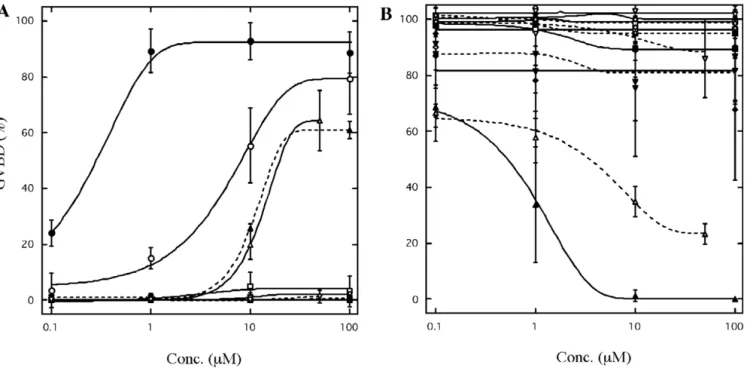
The relative effectiveness of 17,20β-DHP and sixteen other agents including EDCs and several steroid hor-mones in inducing and preventing GVBD was investigated using zebrafish oocytes (Fig. 1). As described previously, DES exhibited strong activity to induce GVBD like 17,20β -DHP. As predicted given their structural similarity to DES, TAM and 4-OHT were also effective in inducing GVBD. TAM and 4-OHT induced 10–20% GVBD at 10 µM. They were relatively less potent than DES and induced 60–70% GVBD even at the highest concentration. As shown in the goldfish oocytes [12], two estrogens did not induce GVBD at the concentration tested. Nine kinds of EDCs: DDTs, phthalates and phenols, did not induce GVBD as in gold-fish. The inhibitory effects of EDCs on 17,20β -DHP-induced oocyte maturation were also examined. Of the
fourteen agents tested, only PCP was effective in inhibit-ing GVBD without pre-incubation (Fig. 1B). When oocytes were treated with 10 µM PCP in addition to 17,20β-DHP, maturation was completely prevented. Methoxychlor also inhibited GVBD when oocytes were pre-incubated with this agent.
EDCs induce natural oocyte maturation
Figure 2 show the morphology of oocytes after three hours treatment with EtOH, 17,20β-DHP, DES, TAM and 4-OHT. Germinal vesicles were seen near the center of oocytes after EtOH treatment whereas they disappeared after the 17,20β-DHP and EDC treatments. Also, 17,20β -DHP- and EDC-treated oocytes became transparent. TAM also induced the translation of cyclin B protein (Fig. 3A), a well-characterized intracellular molecular event that results in an elevation of the kinase activity of MPF. These results show that the TAM-induced maturation and 4-OHT-induced maturation were identical to the physiolog-ical maturation of oocytes as described for DES-induced maturation. To identify the target of TAM and 4-OHT in
Induction and inhibition of oocyte maturation by EDCs Figure 1
Reproductive Biology and Endocrinology 2005, 3:69 http://www.rbej.com/content/3/1/69
the signal transduction pathway to induce GVBD, the time-course of changes in GVBD induced by TAM and 4-OHT was compared with that of GVBD induced by 17,20β-DHP and DES. The time course of oocyte matura-tion induced by TAM and 4-OHT was the same as that
induced by 17,20β-DHP and DES (Fig. 3B), suggesting that the most likely candidate for the target of EDCs is a membrane progestin receptor of 17,20β-DHP. As previ-ously described, 17,20β-DHP-induced and DES-induced oocyte maturation were both prevented by antibody against an N-terminal fragment of goldfish mPRα. Then, the effect of the antibody on the TAM-induced oocyte maturation was examined. Immature oocytes were treated with the antibody for goldfish mPRα before addition of TAM. The extent of GVBD was lowered to approximately 30% in the antibody-treated group, compared to the con-trol IgG group (Fig. 3C). These results strongly suggested that TAM induces oocyte maturation via a MIH-mediated pathway the same as DES.
Inhibition of oocyte maturation by PCP
PCP inhibited oocyte maturation induced by DES (Fig. 4A–b) and TAM (Fig. 4A–c) as well as that induced by 17,20β-DHP (Fig. 4A–a). These results suggested that these compounds induce oocyte maturation by the same mechanism through mPR. An inhibitory effect of PCP on 17,20β-DHP-induced oocyte maturation was observed even at lower concentrations (Fig. 4A–a). IC50 for 0.1 µM 17,20β-DHP-induced maturation was estimated as 0.8 µM. When oocytes were pre-incubated with PCP, matura-tion was completely prevented and the effect was not reduced by washout (Fig. 4B). The result indicates that PCP binds rigidly to the target molecule. Large amounts of 17,20β-DHP could not overcome the inhibitory effect of PCP (Fig. 4C). This result demonstrated that PCP interacts with the target molecules of oocytes to inhibit oocyte mat-uration but not with steroid, 17,20β-DHP.
Effect of natural steroids on inducing oocyte maturation The relative effectiveness of steroids in inducing GVBD was determined (Fig. 5). We selected steroids in which one can consider the effect of alterations of the hydroxy-side at C20, C17 and C3. From the difference in potency between 17,20β-DHP and 17α-Prog, it could be con-cluded that conversion of the 20-keto group to a 20β -hydroxy group was the single stimulatory alteration. Also, a difference in the potency between 17α-steroids and Prog or Preg, showed that addition of a single hydroxyl group at the 17α position increased the ability to induce GVBD. In zebrafish, pregnenolone was almost completely inef-fective in inducing GVBD. The result suggests that a change to the 3-keto group is also important for interac-tion between steroids and the MIH receptor.
Discussion
In this study, the effects of EDCs on the maturation of zebrafish oocytes were examined. We found that treat-ment of oocytes with nonsteroidal substances; TAM and 4-OHT, alone induced maturation as did DES. The mor-phology and an intracellular molecular event induced by
EDCs induce zebrafish oocyte maturation Figure 2
Induction of maturation by tamoxifens Figure 3
Reproductive Biology and Endocrinology 2005, 3:69 http://www.rbej.com/content/3/1/69
EDCs and 17, 20β-DHP were indistinguishable and sug-gest that, at least qualitatively, EDCs and 17, 20β-DHP induced the same type of maturation.
TAM and its metabolite 4-OHT share structural similarity with DES and have been shown to have estrogenic effects the same as DES [17]. TAM is a non-steroidal
anti-estro-Inhibition of maturation by PCP Figure 4
gen commonly used in the treatment of advanced breast cancer and as adjuvant therapy following surgery in early stage disease [18]. Its use has also been approved for reducing the incidence of breast cancer among high-risk women [19]. TAM acts as an estrogen antagonist in mam-mary tissue, but mimics the agnostic effects of estrogen in bone and in the cardiovascular system [20]. In the uterus, TAM acts as a partial estrogen agonist [21]. Previously, we predicted that TAM and 4-OHT might have maturation-inducing activity given their structural similarity to DES. As predicted, these compounds did possess maturation-inducing activity. In general, the potency and biological properties of a compound can be predicted from its struc-ture. It is, therefore, possible to clarify the contribution of a particular structure to the biological response of a target. DES and tamoxifens both have an ethylated stilbene. Studies using DES analogues and tamoxifens indicated that an ethylated stilbene is essential to act as a ligand for mPR to induce oocyte maturation. To consider the possi-ble site of interaction between DES and the MIH receptor, we compared the ability of progestines to induce the mat-uration of zebrafish in this study.
All of the progestins examined except pregnenolone induced a dose-related stimulation of oocyte maturation
similar to that induced by 17,20β-DHP, although poten-cies were significantly different: 17,20β-DHP > 17α-Prog > 17α-Preg> Prog > Preg (Fig. 5). Conversion of the 20-keto group to a 20β-hydroxy group was the single stimu-latory alteration to form a natural MIH, 17,20β-DHP. The results show that addition of a single hydroxyl group to position 17α of progesterone also increased the ability to induce GVBD. Conversion of the hydroxy group to a 3-keto group was also had a stimulatory effect because the potency differed between progesterone and pregnenolone and between 17α-Prog and 17α-Preg. This analytical approach to the structure-activity relationships of steroids revealed that 20β-OH, 17α-OH and 3 = O are critical groups that contribute to the interaction with the MIH receptor. The oxygen atom is thought to make a hydrogen bond with residues in the receptor protein. In the case of 17,20β-DHP, it is thought that three oxygen atoms con-tribute to a hydrogen bond. DES may mimic the hydrogen bond generated by 20β-OH and 3 = O. Loss of a third hydrogen bond may explain the weak activity of DES to induce oocyte maturation.
There have been reported antagonisms and an agonism of MIH-induced oocyte maturation (summarized in Table 1). Pickford and Morris evaluated the effect of methoxy-chlor on progesterone-induced maturation of Xenopus lae-vis [22]. They showed prolonged pre-treatment of the progesterone pesticide methoxychlor significantly reduced the rate of maturation. Fort et al. also demon-strated the inhibitory effects of EDCs, such as ethinylestra-diol, on Xenopus oocyte maturation in a series of their study [23]. In fish, Kepon and o,p-DDD reported to antag-onize MIH-induced meiotic maturation [24]. In the present study, we have also shown that PCP has a potent inhibitory effect on oocyte maturation in fish. Methoxy-chlor was also prevented fish oocyte maturation when pre-treated. PCP is a widely used biocide that has been employed as a wood preservative, herbicide and defoliant [25]. Its extensive use and persistence have resulted in sig-nificant environmental contamination and potential exposure of the general population. The carcinogenic effects of PCP have been evaluated in several animal bio-assays [26]. PCP has been found at 313 of the 1,585 sites in the United States (EPA, 1987). PCP levels in fish used as a biomarker of contamination [27]. This chemical also found in relatively higher levels in wild fish (10 µg/kg) in Japan (Japan Environmental Agency, 1999). The concen-trations of PCP to affect zebrafish oocyte maturation are considerably higher than those present even in highly pol-luted areas of the industrialized world. Then the possibil-ity that PCP affect the oocyte maturation in wild life as an environmental toxicant might be very low. Although the potential to produce adverse reproductive effect is consid-erable. In fact, the relationship between PCP levels in women with reproductive and other endocrine problems
In vitro induction of germinal vesicle breakdown by natural steroids in zebrafish oocytes
Figure 5
Reproductive Biology and Endocrinology 2005, 3:69 http://www.rbej.com/content/3/1/69
were reported [28,29]. We could not rule out the possibil-ity that PCP concentration in vivo may reach to high by biological concentrations and affect the reproductive sys-tems.
Although, we have no data to account for the molecular mechanism for preventing maturation by PCP at present, it is hypothesized that PCP acts as an antagonist for 17,20β-DHP, based on the result that no pre-incubation was required for inhibition of 17,20β-DHP-induced oocyte maturation. Previously, we have shown induction of oocyte maturation in fish by an endocrine disrupting chemical (EDC), DES [12]. Recently we have cloned and identified membrane progestin receptor α (mPRα), a strong candidate for MIH receptor [7]. By using the anti-body for mPRα, it is suggested that DES induced matura-tion via interacmatura-tions with mPRα [12]. Interactions between the MIH receptor and EDCs have been demon-strated previously in fish. Among EDCs, Kepone and o,p'-DDD, have been reported to antagonize binding of 20β-S to the MIH receptor in spotted sea trout, further suggest-ing that EDCs may interact with mPRs [24]. Direct evi-dence of the interaction of EDCs with the MIH receptor remains to be obtained.
Conclusion
Based on our findings that TAM and 4-OHT possess the inducing activity for oocyte maturation as well as DES, ethylated stillbene could be a structure interacting with MIH receptor. These agents induce physiological oocyte maturation. PCP, a widely used biocide, completely blocked oocyte maturation. These results demonstrated that EDCs also disrupt progesterone-dependent system as well as estrogen-dependent one.
The physiological significance of effects of EDCs will be confirmed by binding assay which show direct evidence of the interaction of EDCs with the MIH receptor.
Authors' contributions
TT and MT carried out assay for oocyte maturation and also participated in the design of the study and drafted the manuscript. YN participated in coordination of the study.
Acknowledgements
This work was supported by the CREST Research Project of the Japan Sci-ence and Technology Corporation to Y.N. and Grants-in-Aid for Scientific Research on Priority Areas from the Ministry of Education, Culture, Sports, Science and Technology of Japan (17570175 to T.T.). Part of this study was performed as the National Institute for Basic Biology Cooperative Research Program (4–110 and 5–108 to T.T). M.T. is a Research Fellow of the Japan Science and Technology Corporation.
References
1. Yamashita M, Kajiura H, Tanaka T, Onoe S, Nagahama Y: Molecular mechanisms of the activation of maturation-promoting fac-tor during goldfish oocyte maturation. Dev Biol 1995,
168:62-75.
2. Nagahama Y, Yoshikuni M, Yamashita M, Tokumoto T, Katsu Y: Reg-ulation of oocyte growth and maturation in fish. Curr Top Dev Biol 1995, 30:103-145.
3. Nagahama Y, Adachi S: Identification of maturation-inducing steroid in a teleost, the amago salmon (Oncorhynchus rho-durus). Dev Biol 1985, 109:428-435.
4. Patino R, Thomas P: Gonadotropin stimulates 17 alpha,20 beta,21-trihydroxy-4-pregnen-3-one production from endogenous substrates in Atlantic croaker ovarian follicles undergoing final maturation in vitro. Gen Comp Endocrinol 1990,
78:474-478.
5. Nagahama Y, Hirose K, Young G, Adachi S, Suzuki K, Tamaoki B: Rel-ative in vitro effectiveness of 17 alpha, 20 beta-dihydroxy-4-pregnen-3-one and other pregnene derivatives on germinal vesicle breakdown in oocytes of ayu (Plecoglossus altivelis), amago salmon (Oncorhynchus rhodurus), rainbow trout (Salmo gairdneri), and goldfish (Carassius auratus). Gen Comp Endocrinol 1983, 51:15-23.
6. Zhu Y, Rice CD, Pang Y, Pace M, Thomas P: Cloning, expression, and characterization of a membrane progestin receptor and evidence it is an intermediary in meiotic maturation of fish oocytes. Proc Natl Acad Sci U S A 2003, 100:2231-2236.
7. Tokumoto M, Nagahama Y, Thomas P, Tokumoto T: Cloning and identification of a membrane progestin receptor in goldfish ovaries and evidence it is an intermediary in oocyte meiotic maturation. Gen Comp Endocrinol 2005.
8. Zhu Y, Bond J, Thomas P: Identification, classification, and par-tial characterization of genes in humans and other verte-brates homologous to a fish membrane progestin receptor.
Proc Natl Acad Sci U S A 2003, 100:2237-2242.
9. Kondo T, Yanagawa T, Yoshida N, Yamashita M: Introduction of cyclin B induces activation of the maturation-promoting fac-tor and breakdown of germinal vesicle in growing zebrafish oocytes unresponsive to the maturation-inducing hormone.
Dev Biol 1997, 190:142-152.
10. Thomas P: Nontraditional sites of endocrine disruption by chemicals on the hypothalamus-pituitary-gonadal axis: Interctions with steroid membrane receptors, monoaminer-gic pathways, and signal transduction systems. In Endcrine Dis-ruptors Naz, R.K. edition. , CRC Press; 1999:3-38.
11. Bern HA: Chemically induced alterations in sexual and func-tional development: The Wildlife/Human Connection. In
Advances in Modern Environmental ToxicologyVolume XXI. Colborn, T. and Clement, C. edition. Edited by: Mehlman MA. Prinston, NJ., Prin-ceton Sci. Pub.; 1992:9-15.
Table 1: Effects of endocrine-disrupting chemicals on oocyte maturation
compound Effect on oocyte maturation Reference
Methoxychlor inhibition, Xenopus Pickford and Morris [22]
inhibition, zebrafish This article
Kepon, o,p'-DDD inhibition, spotted sea trout Das and Thomas [24]
Ethinylestradiol inhibition, Xenopus Fort et al. [23]
DES stimulation, goldfish zebrafish Tokumoto et al. [12]
TAM, 4-OHT stimulation, zebrafish This article
Publish with BioMed Central and every scientist can read your work free of charge "BioMed Central will be the most significant development for disseminating the results of biomedical researc h in our lifetime."
Sir Paul Nurse, Cancer Research UK
Your research papers will be:
available free of charge to the entire biomedical community
peer reviewed and published immediately upon acceptance
cited in PubMed and archived on PubMed Central
yours — you keep the copyright
Submit your manuscript here:
http://www.biomedcentral.com/info/publishing_adv.asp
BioMedcentral 12. Tokumoto T, Tokumoto M, Horiguchi R, Ishikawa K, Nagahama Y:
Diethylstilbestrol induces fish oocyte maturation. Proc Natl Acad Sci U S A 2004, 101:3686-3690.
13. Westerfield M: “The Zebrafish Book: a Guide for the labora-tory Use of Zebrafish (Danio rerio).”. , Univ. of Oregon Press, Eugene, OR.; 1995.
14. Lessman CA, Kavumpurath S: Cytological analysis of nuclear migration and dissolution during steroid-induced meiotic maturation in vitro of follicle-enclosed oocytes of the gold-fish (Carassius auratus). Gamete Res 1984, 10:21-29.
15. Pang Y, Ge W: Gonadotropin and activin enhance matura-tional competence of oocytes in the zebrafish (Danio rerio).
Biol Reprod 2002, 66:259-265.
16. Laemmli UK: Cleavage of structural proteins during the assembly of the head of bacteriophage T4. Nature 1970,
227:680-685.
17. MacGregor JI, Jordan VC: Basic guide to the mechanisms of antiestrogen action. Pharmacol Rev 1998, 50:151-196.
18. Kramer BS, Gohagan J, Prorok PC, Smart C: A National Cancer Institute sponsored screening trial for prostatic, lung, color-ectal, and ovarian cancers. Cancer 1993, 71:589-593.
19. Fisher B, Costantino JP, Wickerham DL, Redmond CK, Kavanah M, Cronin WM, Vogel V, Robidoux A, Dimitrov N, Atkins J, Daly M, Wieand S, Tan-Chiu E, Ford L, Wolmark N: Tamoxifen for pre-vention of breast cancer: report of the National Surgical Adjuvant Breast and Bowel Project P-1 Study. J Natl Cancer Inst 1998, 90:1371-1388.
20. Sato M, Rippy MK, Bryant HU: Raloxifene, tamoxifen, nafoxi-dine, or estrogen effects on reproductive and nonreproduc-tive tissues in ovariectomized rats. Faseb J 1996, 10:905-912. 21. Kedar RP, Bourne TH, Powles TJ, Collins WP, Ashley SE, Cosgrove
DO, Campbell S: Effects of tamoxifen on uterus and ovaries of postmenopausal women in a randomised breast cancer pre-vention trial. Lancet 1994, 343:1318-1321.
22. Pickford DB, Morris ID: Effects of endocrine-disrupting con-taminants on amphibian oogenesis: methoxychlor inhibits progesterone-induced maturation of Xenopus laevis oocytes in vitro. Environ Health Perspect 1999, 107:285-292.
23. Fort DJ, McLaughlin DW, Rogers RL, Buzzard BO: Effect of endo-crine disrupting chemicals on germinal vesicle breakdown in Xenopus in vitro. Drug Chem Toxicol 2002, 25:293-308.
24. Das S, Thomas P: Pesticides interfere with the nongenomic action of a progestogen on meiotic maturation by binding to its plasma membrane receptor on fish oocytes. Endocrinology
1999, 140:1953-1956.
25. NTP Toxicology and Carcinogenesis Studies of Two Pen-tachlorophenol Technical-Grade Mixtures (CAS No. 87-86-5) in B6C3F1 Mice (Feed Studies). Natl Toxicol Program Tech Rep Ser 1989, 349:1-265.
26. IARC Monograph Programme on the Evaluation of the Car-cinogenic Risk of Chemicals to Humans: preamble. IARC Monogr Eval Carcinog Risk Chem Hum 1979, 20:7-27.
27. Rogers IH, Birtwell IK, Kruzynski GM: The Pacific eulachon (Thaleichthys pacificus) as a pollution indicator organism in the Fraser River estuary, Vancouver, British Columbia. Sci Total Environ 1990, 97-98:713-727.
28. Peper M, Ertl M, Gerhard I: Long-term exposure to wood-pre-serving chemicals containing pentachlorophenol and lindane is related to neurobehavioral performance in women. Am J Ind Med 1999, 35:632-641.
29. Guvenius DM, Aronsson A, Ekman-Ordeberg G, Bergman A, Noren K: Human prenatal and postnatal exposure to polybromi-nated diphenyl ethers, polychloripolybromi-nated biphenyls, polychlo-robiphenylols, and pentachlorophenol. Environ Health Perspect