What Can Be Implemented Anonymously?
Rachid Guerraoui1and Eric Ruppert2 1
EPFL, Lausanne, Switzerland 2
York University, Toronto, Canada
Abstract. The vast majority of papers on distributed computing as-sume that processes are assigned unique identifiers before computation begins. But is this assumption necessary? What if processes do not have unique identifiers or do not wish to divulge them for reasons of privacy? We consider asynchronous shared-memory systems that are anonymous. The shared memory contains only the most common type of shared ob-jects, read/write registers. We investigate, for the first time, what can be implemented deterministically in this model when processes can fail. We give anonymous algorithms for some fundamental problems: timestamp-ing, snapshots and consensus. Our solutions to the first two are wait-free and the third is obstruction-free. We also show that a shared object has an obstruction-free implementation if and only if it satisfies a simple property called idempotence. To prove the sufficiency of this condition, we give a universal construction that implements any idempotent object.
1
Introduction
Distributed computing typically studies what can be computed by a system of n processes that can fail independently. Variations on the capacities of the processes (e.g., in terms of memory or time), their means of communication (e.g., shared memory or message passing), and their failure modes (e.g., crash failures or malicious failures) have led to an abundant literature. In particular, a prolific research trend has explored the capabilities of a system of crash-prone asyn-chronous processes communicating through basic read-write objects (registers). Several properties have been defined to describe the progress made by an algorithm regardless of process crashes or asynchrony. The strongest is wait-freedom[18], which requires everynon-faulty process to complete its algorithm in a finite number of its own steps. However, wait-free algorithms are often provably impossible or too inefficient to be practical. In many settings, a weaker progress guarantee is sufficient. The non-blocking property (sometimes called lock-freedom) is one such guarantee, ensuring that, eventually,someprocess will complete its algorithm. It is weaker than wait-freedom because it permits indi-vidual processes to starve. A third condition that is weaker still is obstruction-freedom[19], which can be very useful when low contention is expected to be the common case, or if contention-management is used. Obstruction-freedom guar-antees that a process will complete its algorithm whenever it has an opportunity to take enough steps without interruption by other processes.
Virtually all of the literature on those topics assumes that processes have distinct identities. Besides intellectual curiosity, it is practically appealing to re-visit this fundamental assumption. Indeed, certain systems, like sensor networks, consist of mass-produced tiny agents that might not even have identifiers [4].
Others, like web servers [29] and peer-to-peer file sharing systems [11], some-times mandate preserving the anonymity of the users and forbid the use of any form of identity for the sake of privacy [10]. Instead of revealing its identity to a server that houses a shared-memory object, a process might use a trusted third party that can itself be approximated by a decentralized mechanism [16]. This party forwards the process’s invocations to the server (stripped of the pro-cess’s id) and then forwards the server’s responses back to the process. But what can actually be done in an anonymoussystem? In such a system, processes are programmed identically [5, 7, 8, 12, 23, 28]. In particular, processes do not have identifiers. There has been work on anonymous message-passing systems, starting with Angluin [3]. The very small amount of research that has looked at anony-mous shared-memory systems assumed failure-free systems or the existence of a random oracle to build randomized algorithms. (See Sect. 2.)
We explore in this paper, for the first time, the types of shared objects that can be implemented deterministically in an anonymous, asynchronous shared-memory system. We assume that any number of unpredictable crash failures may occur. The shared memory is composed of registers that are (multi-reader and) multi-writer, so that every process is permitted to write to every register. In contrast, usage of single-writer registers would violate total anonymity by giving processes at least some rudimentary sense of identity: processes would know that values written into the same register at different times were produced by the same process. Some problems, such as leader election, are clearly impossible in this model because symmetry cannot be broken; if processes run in lockstep, they will perform exactly the same sequence of operations. However, we show that some interesting problemscanbe solved without breaking symmetry.
We first consider timestamps, which are frequently used to help processes agree on the order of various events. Objects such as fetch&increment and coun-ters, which are traditionally used for creating timestamps, cannot be imple-mented in our model, so we introduce a weaker object called a weak counter which provides sufficiently good timestamps for our applications. We construct, in Sect. 4, an efficient, wait-free implementation of a weak counter.
In non-anonymous systems, thesnapshotobject [1, 2, 6] is probably the most important example of an object that has a wait-free implementation from regis-ters. It is an abstraction of the problem of obtaining a consistent view of many registers while they are being updated by other processes. There are many known implementations of snapshot objects but, to our knowledge, all do make essential use of process identities. Wait-free algorithms generally rely on helping mecha-nisms, in which fast processes help the slow ones complete their operations. One of the challenges of anonymity is the difficulty of helping other processes when it is not easy to determine who needs help. In Sect. 5, we show that a wait-free snapshot implementation does exist and has fairly efficient time complexity. The timestamps provided by the weak counter are essential in this construction. We also give a non-blocking implementation with better space complexity.
In anonymous systems, most objects have no wait-free (or even non-blocking) implementation [18]. However, it is possible to build an obstruction-free implementation of any object by using a subroutine forconsensus, which is a cornerstone of distributed computing that does itself have an obstruction-free
im-Theorem Implemented Object Using Space Progress Uses 1 weak counter registers O(k) wait-free
3 weak counter binary registersO(k) non-blocking 4 m-component snapshot registers m non-blocking 5 m-component snapshot registers O(m+k) wait-free 1 6 binary consensus binary registers unbounded obs-free 7 binary consensus registers O(n) obs-free 4 9 consensus binary registers unbounded obs-free 6, 8 9 consensus registers O(nlogd) obs-free 7, 8 10 idempotent object binary registers unbounded obs-free 3, 9 12 idempotent object registers object-dependent obs-free 3, 7 Fig. 1. Summary of implementations, where n is the number of processes, k is the number of operations invoked, anddis the number of possible inputs to consensus. plementation [19]. Consensus also arises in a wide variety of process-coordination tasks. There is no (deterministic) wait-free implementation of consensus using registers, even if processes do have identifiers [18, 26]. In Sect. 6, we note that an obstruction-free anonymous consensus algorithm can be obtained by simply derandomizing the randomized anonymous algorithm of Chandra [13]. The re-sulting algorithm uses unbounded space. We then give a new algorithm that uses a bounded number of registers, with the help of our snapshots.
Finally, we give a complete characterization of the types of objects that have obstruction-free implementations in our model in Sect. 7. An object can be implemented if and only if it is idempotent:i.e.applying any permitted operation twice in a row (with the same arguments) has the same effect as applying it once. We use a symmetry argument to show this condition is necessary. To prove sufficiency, we give a “universal” construction that implements any idempotent object, using our weak counter object and our consensus algorithm.
To summarize, we show that the anonymous asynchronous shared-memory model has some, perhaps surprising, similarities to the non-anonymous model, but there are also some important differences. We construct a wait-free algo-rithm for snapshots and an obstruction-free algoalgo-rithm for consensus that uses bounded space. Not every type of object has an obstruction-free anonymous im-plementation, however. We give a characterization of the types that do. Table 1 summarizes all anonymous implementations given in this paper, indicating which implementations are used as subroutines for others.
2
Related Work
Some research has studied anonymous shared-memory systems when no fail-ures can occur. Johnson and Schneider [23] gave leader election algorithms using versions of single-writer snapshots and test&set objects. Attiya, Gorbach and Moran [8] gave a characterization of the tasks that are solvable without fail-ures using registers if n is not known. The characterization is the same if n is known [14]. Consensus is solvable in these models, but it is not solvable if the reg-isters cannot be initialized by the programmer [22]. Aspnes, Fich and Ruppert [5] looked at failure-free models with other types of objects, such as counters. They also characterized which shared-memory models can be implemented if
com-munication is through anonymous broadcasts, showing the broadcast model is equivalent to having shared counters and strictly stronger than shared registers. There has also been some research on randomized algorithms for anonymous shared-memory systems with no failures. For the naming problem, processes must choose unique names for themselves. Processes can randomly choose names, which will be unique with high probability. Registers can be used to detect when the names chosen are indeed unique, thus guaranteeing correctness whenever the algorithm terminates, which happens with high probability [25, 30]. Two papers gave randomized renaming algorithms that have finite expected running time, and hence terminate with probability 1 [15, 24].
Randomized algorithms for systems with crash failures have also been stud-ied. Panconesiet al. [28] gave a randomized wait-free algorithm that solves the naming problem using single-writer registers, which give the system some ability to distinguish between different processes’ actions. Several impossibility results have been shown for randomized naming using only multi-writer registers [12, 15, 24]. Interestingly, Buhrmanet al. [12] gave a randomized wait-free anonymous algorithm for consensus in this model that is based on Chandra’s randomized consensus algorithm [13]. Thus, producing unique identifiers is strictly harder than consensus in the randomized setting. Aspnes, Shah and Shah [7] extended the algorithm of Buhrmanet al.to a setting with infinitely many processes.
Solving a decision task can be viewed as a special case of implementing objects: each process accesses the object, providing its input as an argument, and later the object responds with the output the process should choose. Herlihy and Shavit [20] gave a characterization of the decision tasks that have wait-free solutions in non-anonymous systems using ideas borrowed from algebraic topology. They also describe how the characterization can be extended to systems with a kind of anonymity: processes have identifiers but are only allowed to use them in very limited ways. Herlihy gave auniversal constructionwhich describes how to create a wait-free implementation of any object type using consensus objects [18]. Processes use consensus to agree on the exact order in which the operations are applied to the implemented object. Although this construction requires identifiers, it was the inspiration for our obstruction-free construction in Sect. 7. Recently, Bazzi and Ding [9] introduced, in the context of Byzantine systems, non-skipping timestamps, a stronger abstraction than what we call a weak counter. (Our weak counter does not preclude skipping values.)
3
Model
We consider ananonymoussystem, where a collection ofnprocesses execute identical algorithms. In particular, the processes do not have identifiers. The system is asynchronous, which means that processes run at arbitrarily varying speeds. It is useful to think of processes being allocated steps by an adversarial scheduler. Algorithms must work correctly in all possible schedules. Processes are subject to crash failures: they may stop taking steps without any warning. The algorithms we consider aredeterministic.
Processes communicate with one another by accessing shared data structures, called objects. Thetypeof an object specifies what states it can have and what operations may be performed on it. The programmer chooses the initial state of
the objects used. Except for our weak counter object in Sect. 4, all objects are linearizable (atomic) [21]: although operations on an object take some interval of time to complete, each appears to happen at some instant between its invocation and response. An operation atomically changes the state of an object and returns a response to the invoking process. (The weak counter object can be viewed as a set-linearizable object [27].) We consider oblivious objects: all processes are permitted to perform the same set of operations on it and its response to an operation does not depend on the identity of the invoking process. (Non-oblivious objects are somewhat inconsistent with the notion of totally anonymous systems, since processes must identify themselves when they invoke an operation.)
Some types of objects are provided by the system and all other types needed must be implemented from them. Animplementationspecifies the code that must be executed to perform each operation on the implemented object. Since we are considering anonymous systems, all processes execute identical code to perform a particular operation. (We refer to such an implementation as an anonymous implementation.) The implementation must also specify how to initialize the base objects to represent any possible starting state of the implemented object. We assume the shared memory contains the most basic kind of objects: reg-isters, which provide two types of operations. Areadoperation returns the state of the object without changing it. Awrite(v) changes the state tovand returns ack. Every process can access every register. If the set of possible values that can be stored is finite, the register isbounded; otherwise it is unbounded. A bi-nary register has only two possible states. When describing our algorithms in pseudocode, names of shared objects begin with upper-case letters, and names of the process’s private variables begin with lower-case letters.
4
Weak Counters
Aweak counter provides a single operation,GetTimestamp, which returns an integer. It has the property that if one operation precedes another, the value returned by the later operation must be larger than the value returned by the earlier one. (Two concurrentGetTimestamp operations may return the same value.) Furthermore, the value returned to any operation should not exceed the number of invocations that have occurred so far. This object will be used as a building block for our implementation of snapshots in Sect. 5 and our characterization of implementable types in Sect. 7. It is used in those algorithms to provide timestamps to different operations. The weak counter is essentially a weakened form of a fetch&increment object: a fetch&increment object has the additional requirement that all values returned should be distinct. It is known that a fetch&increment object has no wait-free implementation from registers, even if processes have identifiers [18]. By considering our weaker version, we have an object that is implementable, and still strong enough for our purposes.
We give an anonymous, wait-free implementation of a weak counter from unbounded registers. A similar but simpler construction, which provides an im-plementation that satisfies the weaker non-blocking progress property, but uses only binary registers, is then described briefly. Processes must known, the num-ber of processes in the system, (or at least an upper bound onn) for the wait-free implementation, but this knowledge is not needed for the non-blocking case.
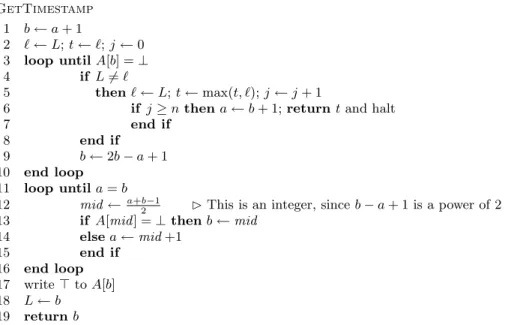
GetTimestamp
1 b←a+ 1
2 ℓ←L;t←ℓ;j←0 3 loop untilA[b] =⊥ 4 if L6=ℓ
5 thenℓ←L;t←max(t, ℓ);j←j+ 1
6 if j≥nthena←b+ 1;returntand halt
7 end if
8 end if 9 b←2b−a+ 1 10 end loop
11 loop untila=b
12 mid← a+b−1
2 This is an integer, sinceb−a+ 1 is a power of 2 13 if A[mid] =⊥thenb←mid
14 elsea←mid+1 15 end if
16 end loop 17 write⊤toA[b] 18 L←b
19 returnb
Fig. 2.Wait-free implementation of a weak counter from registers.
Our wait-free implementation uses an array A[1,2, . . .] of binary registers, each initialized to⊥. To obtain a counter value, a process locates the first entry of the array that is⊥, changes it to⊤, and returns the index of this entry. (See Fig. 2.) The key property for correctness is the following invariant: ifA[k] =⊤, then all entries in A[1..k] are⊤. To locate the first⊥in A efficiently, the algorithm uses a binary search. Starting from the location a returned by the process’s previousGetTimestamp operation, the algorithm probes locationsa+ 1, a+ 3, a+ 7, . . . , a+ 2i
−1, . . .until it finds a⊥in locationb. (For the first operation by the process, we initialize a to 1.) We call this portion of the algorithm, corresponding to the first loop in the pseudocode, phase 1. The process then executes a binary search ofA[a..b] in the second loop, which constitutes phase 2. To ensure processes cannot enter an infinite loop in phase 1 (while other processes write more and more ⊤’s into the array), we incorporate a helping mechanism. Whenever a process writes a ⊤ into an entry of A, it also writes the index of the entry into a shared registerL(initialized to 0). A process may terminate early if it sees thatn writes toL have occurred since its invocation. In this case, it returns the largest value it has seen in L. The local variables j andtkeep track of the number of times the process has seenLchange, and the largest value the process has seen inL, respectively.
Theorem 1. Fig. 2 gives a wait-free, anonymous implementation of a weak counter from registers.
Proof. We first give three simple invariants.
Invariant 1: For each process’s value ofa, ifa >1, thenA[a−1] =⊤.
Once⊤is written into an entry ofA, that entry’s value will never change again. It follows that line 14 maintains Invariant 1. Line 6 does too, since the preceding
iteration of line 3 found thatA[b] =⊤.
Invariant 2: IfA[k] =⊤, thenA[k′] =⊤for allk′ ≤k.
This follows from Invariant 1: whenever line 17 is executed, we have a=b, so A[b−1] is already⊤.
Invariant 3: Whenever a processP executes line 11 during aGetTimestamp operationop,P’s value ofb has the property thatA[b] was equal to⊥at some earlier time duringop.
This is easy to prove by induction on the number of iterations of the second loop.
Wait-freedom: To derive a contradiction, assume there is an execution where some operation by a process P runs forever without terminating. This can only happen if there is an infinite loop in Phase 1, so an infinite number of ⊤’s are written into A during this execution. This means that an infinite number of writes to Lwill occur. Suppose some processQwrites a valuexinto L. Before doing so, it must write⊤intoA[x]. Thus, any subsequent invocation of GetTimestamp by Q will never see A[x] = ⊥. It follows from Invariant 3 that Qcan never again write xintoL. Thus, P’s operation will eventually see ndifferent values inLand terminate, contrary to the assumption.
Correctness: Suppose oneGetTimestampoperationop1 completes before another one,op2, begins. Letr1 andr2 be the values returned byop1 andop2, respectively. We must show that r2 > r1. If op1 terminates in line 6, then, at some earlier time, some process wroter1 into Land also wrote⊤into A[r1]. If op1 terminates in line 19, it is also clear thatA[r1] =⊤whenop1terminates.
Ifop2 terminates in line 19, then A[r2] was ⊥at some time during op2, by Invariant 3. Thus, by Invariant 2, r2 > r1. Ifop2 terminates in line 6,op2 has seen the value inLchangentimes during its run, so at least two of the changes were made by the same process. Thus, at least one of those changes was made by an operationop3that started afterop2began (and hence afterop1 terminated). Since op3 terminated in line 19, we have already proved that the valuer3 that op3 returns (and writes intoL) must be greater than r1. But op2 returns the largest value it sees in L, sor2≥r3> r1.
In any finite execution in whichk GetTimestampoperations are invoked, at mostO(k) of the registers are ever accessed, and the worst-case time for any operation is O(logk). An amortized analysis can be used to prove the stronger bound of O(logn) on the average time per operation in any finite execution. Intuitively, if some process P must perform a phase 1 that is excessively long, we can charge its cost to the many operations that must have written into A sincePdid its previous operation. (See [17] for a detailed proof of the following.)
Proposition 2. If n processes perform a total of k invocations of the Get-Timestamp algorithm in Fig. 2, the total number of steps by all processes is O(klogn) andO(k) registers are accessed.
If we do not require the weak counter implementation to be wait-free, we do not need the helping mechanism. Thus, we can omit lines 2, 4–8 and 18, which allow a process to terminate early if it ever sees that n changes to the shared register L occur. This yields a non-blocking implementation that uses onlybinaryregisters. The proof of correctness is a simplified version of the proof of Theorem 1, and the analysis is identical to the proof of Proposition 2.
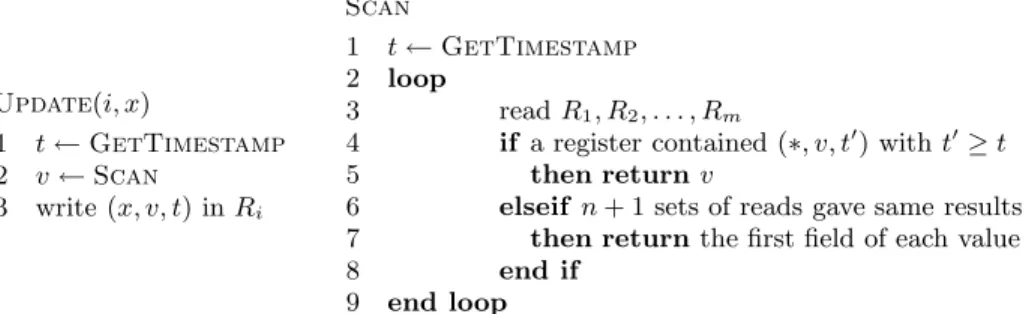
Update(i, x)
1 t←GetTimestamp
2 v←Scan
3 write (x, v, t) inRi
Scan
1 t←GetTimestamp
2 loop
3 readR1, R2, . . . , Rm
4 if a register contained (∗, v, t′) witht′≥t
5 then returnv
6 elseif n+ 1 sets of reads gave same results 7 then returnthe first field of each value 8 end if
9 end loop
Fig. 3.Wait-free implementation of a snapshot object from registers.
Theorem 3. There is a non-blocking, anonymous implementation of a weak counter from binary registers. In any execution withkinvocations of GetTimes-tampin a system ofnprocesses, the total number of steps isO(klogn)andO(k) registers are accessed.
5
Snapshot Objects
The snapshot object [1, 2, 6] is an extremely useful abstraction of the problem of getting a consistent view of several registers when they can be concurrently updated by other processes. It has wait-free (non-anonymous) implementations from registers, and has been widely used as a basic building block for other al-gorithms. A snapshot object consists of a collection of m >1 components and supports two kinds of operations: a process can update the value stored in a com-ponent and atomically scan the object to obtain the values of all the comcom-ponents. Since we are interested in anonymous systems, we consider the multi-writer ver-sion, where any process can update any component. Many algorithms exist to implement snapshots, but all use process identifiers. The following proposition can be proved using a simple modification of the standard non-blocking snapshot algorithm for non-anonymous systems [1]. A proof appears in [17].
Proposition 4. There is a non-blocking, anonymous implementation of anm -component snapshot object from mregisters.
More surprisingly, we show that a standard algorithm for (non-anonymous) wait-free snapshots [1] can also be modified to work in an anonymous system. The original algorithm could create a unique timestamp for each Update op-eration. We use our weak counter to generate timestamps that are not nec-essarily distinct, but are sufficient for implementing the snapshot object. The non-uniqueness of the identifiers imposes a need for more iterations of the loop than in the non-anonymous algorithm. Our algorithm uses m (large) registers, R1, . . . , Rm, and one weak counter, which can be implemented from registers,
by Theorem 1. Each registerRi will contain a value of the component, a view
of the entire snapshot object and a timestamp. See Fig. 3.
Theorem 5. The algorithm in Fig. 3 is an anonymous, wait-free implementa-tion of a snapshot object from registers. The average number of steps per opera-tion in any finite execuopera-tion isO(mn2).
Proof. (Sketch) See [17] for a detailed proof. It can be shown that the regis-ters either keep changing continually, eventually including timestamps that will satisfy the first termination condition, or stop changing so that the second ter-mination condition will eventually be satisfied. Updates are linearized when the write occurs. If a Scan sees n+ 1 identical sets of reads, it can be shown that these values were all in the register at one instant in time, which is used as the linearization point. If a Scanuses the vector recorded from another Scan as its output, the two Scans are linearized at the same time. The timestamp mechanism is sufficient to guarantee that the linearization point so chosen is between the invocation and response of theScan.
6
Consensus
In the consensus problem, processes each start with a private input value and must all choose the same output value. The common output must be the input value of some process. These two conditions are calledagreement andvalidity, respectively. Herlihy, Luchangco and Moir [19] observed that a randomized wait-free consensus algorithm can be “derandomized” to obtain an obstruction-wait-free consensus algorithm. If we derandomize the anonymousconsensus algorithm of Chandra [13], we obtain the following theorem. (A proof appears in [17].)
Theorem 6. There is an anonymous, obstruction-free binary consensus algo-rithm using binary registers.
The construction that proves Theorem 6 uses an unbounded number of bi-nary registers. In this section, we give a more interesting construction of an obstruction-free, anonymous algorithm for consensus that uses a bounded num-ber of (multivalued) registers. First, we focus on binary consensus, where all inputs are either 0 or 1, and give an algorithm usingO(n) registers.
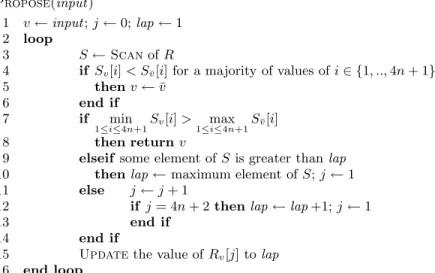
In the unbounded-space algorithm, each process maintains a preference that is either 0 or 1. Initially, a process’s preference is its own input value. Intuitively, the processes are grouped into two teams according to their preference and the teams execute a race along a course of unbounded length that has one track for each preference. Processes mark their progress along the track (which is repre-sented by an unbounded array of binary registers) by changing register values from⊥to⊤along the way. Whenever a processP sees that the opposing team is ahead ofP’s position,P switches its preference to join the other team. As soon as a process observes that it is sufficiently far ahead of all processes on the oppos-ing team, it stops and outputs its own preference. Two processes with opposite preferences could continue to race forever in lockstep but a process running by itself will eventually out-distance all competitors, ensuring obstruction-freedom. Our bounded-space algorithm uses a two-track race course that is circular, with circumference 4n+ 1, instead of an unbounded straight one. The course is represented by one array for each track, denoted R0[1,2, . . . ,4n+ 1] and R1[1,2, . . . ,4n+ 1]. We treat these two arrays as a single snapshot object R, which we can implement from registers. Each component stores an integer, ini-tially 0. As a process runs around the race course, it keeps track of which lap it is running. This is incremented each time a process moves from position 4n+ 1
Propose(input)
1 v←input;j←0;lap←1 2 loop
3 S←ScanofR
4 if Sv[i]< Sv¯[i] for a majority of values ofi∈ {1, ..,4n+ 1} 5 thenv←¯v
6 end if
7 if min
1≤i≤4n+1
Sv[i]> max
1≤i≤4n+1
Sv¯[i] 8 then returnv
9 elseifsome element ofS is greater thanlap 10 thenlap←maximum element ofS;j←1 11 else j←j+ 1
12 if j= 4n+ 2thenlap←lap+1;j←1
13 end if
14 end if
15 Updatethe value ofRv[j] tolap
16 end loop
Fig. 4.Obstruction-free consensus usingO(n) registers.
to position 1. The progress of processes in the race is recorded by having each process write its lap into the components of Ras it passes.
Several complications are introduced by using a circular track. After a fast process records its progress inR, a slow teammate who has a smaller lap number could overwrite those values. Although this difficulty cannot be eliminated, we circumvent it with the following strategy. If a process P ever observes that another process is already working on its kth lap whileP is working on a lower lap,P jumps ahead to the start of lap kand continues racing from there. This will ensure thatPcan only overwrite one location with a lower lap number, once sufficiently manyk’s have been written. There is a second complication: because some numbers recorded inRmay be artificially low due to the overwrites by slow processes, processes may get an incorrect impression of which team is in the lead. To handle this, we make processes less fickle: they switch teams only when they have lots of evidence that the other team is in the lead. Also, we require a process to have evidence that it is leading by a very wide margin before it decides. The algorithm is given in Fig. 4, where we use ¯v to denote 1−v.
Theorem 7. The algorithm in Fig. 4 is an anonymous, obstruction-free binary consensus algorithm that uses8n+ 2 registers.
Proof. We use 8n+ 2 registers to get a non-blocking implementation of the snapshot objectRusing Proposition 4.
Obstruction-freedom: Consider any configurationC. Letm be the max-imum value that appears in any component of R in C. Suppose some process P runs by itself forever without halting, starting from C. It is easy to check that P’s local variablelap increases at least once every 4n+ 1 iterations of the loop until P decides. EventuallyP will havelap ≥m+ 1 andj = 1. Letv0 be P’s local value of v when P next executes line 7. At this point, no entries in R are larger than m. Furthermore,Rv0[i]≥Rv¯0[i] for a majority of the values
i. (Otherwise P would have changed its value of v in the previous step.) From this point onward,P will never change its local valuev, since it will write only values bigger than m to Rv0, and Rv¯0 contains no elements larger thanm, so none of P’s future writes will ever make the condition in line 4 true. During the next 4n+ 1 iterations of the loop, P will write its value of lap into each of the entries ofRv0, and then the termination condition will be satisfied, contrary
to the assumption that P runs forever. (This termination occurs within O(n) iterations of the loop, onceP has started to run on its own, so termination is guaranteed as soon as any process takes O(n4
) steps by itself, since the Scan algorithm of Proposition 4 terminates if a process takesO(n3) steps by itself.)
Validity: If all processes start with the same input valuev, they will never switch to preference ¯vnor write into any component ofR¯v.
Agreement: For each process that decides, consider the moment when it last scans R. Let T be the first such moment in the execution. Let S∗ be the
Scan taken at timeT. Without loss of generality, assume the value decided by the process that did thisScanis 0. We shall show that every other process that terminates also decides 0. Letmbe the minimum value that appears inS∗
0. Note that all values inS∗
1 are less thanm.
We first show that, afterT, at mostn Updateswrite a value smaller than mintoR. If not, consider the firstn+ 1 suchUpdatesafterT. At least two of them are done by the same process, sayP. ProcessPmust do aScanin between the two Updates. ThatScanwould still see one of the values in R0 that is at leastm, since 4n+ 1> n. Immediately after thisScan,P would change its local variablelap to be at leastmand the value oflap is non-decreasing, soP could never perform the secondUpdatewith a value smaller thanm.
We use a similar proof to show that, afterT, at mostnUpdateoperations write a value intoR1. If this is not the case, consider the firstn+1 suchUpdates afterT. At least two of them are performed by the same process, sayP. Process P must do a Scan between the twoUpdates. Consider the last Scanthat P does between these two Updates. That Scan will see at most nvalues in R1 that are greater than or equal tom, since all such values were written into R1 after T. It will also see at most n values in R0 that are less than m (by the argument in the previous paragraph). Thus, there will be at least 2n+ 1 values ofifor whichR0[i]≥m > R1[i] when theScanoccurs. Thus, immediately after theScan,P will change its local value ofv to 0 in line 5, contradicting the fact that it writes intoR1 later in that iteration.
It follows from the preceding two paragraphs that, at all times after T, min
1≤i≤4n+1R1[i] < m ≤ 1≤maxi≤4n+1R0[i]. Any process that takes its final Scan afterT cannot decide 1.
Just as a randomized, wait-free consensus algorithm can be “derandomized” to yield an obstruction-free algorithm, the algorithm of Theorem 4 could be used as the basis of a randomized wait-free anonymous algorithm that solves binary consensus using bounded space.
Theorems 6 and 7 can be extended to non-binary consensus using the follow-ing proposition, which is proved usfollow-ing a fairly standard technique of agreefollow-ing on the output bit-by-bit (see [17]).
Proposition 8. If there is an anonymous, obstruction-free algorithm for binary consensus using a set of objectsS, then there is an anonymous, obstruction-free algorithm for consensus with inputs from the countable setDthat uses|D|binary registers and log|D| copies of S. Such an algorithm can also be implemented using 2 log|D| registers andlog|D| copies of S if |D| is finite.
Corollary 9. There is an anonymous, obstruction-free algorithm for consensus, with arbitrary inputs, using binary registers. There is an anonymous, obstruction-free algorithm for consensus with inputs from a finite set D that uses (8n+ 4) log|D| registers.
7
Obstruction-Free Implementations
We now give a complete characterization of the (deterministic) object types that have anonymous, obstruction-free implementations from registers. We say that an object is idempotent if, starting from any state, two successive invoca-tions of the same operation (with the same arguments) return the same response and leave the object in a state that is indistinguishable from the state a single application would leave it in. (This is a slightly more general definition of idem-potence than the one used in [5].) This definition of idemidem-potence is made more precise using the formalism of Aspnes and Herlihy [6]. Asequential history is a sequence of steps, each step being a pair consisting of an operation invocation and its response. Such a history is called legal (for a given initial state) if it is consistent with the specification of the object’s type. Two sequential historiesH andH′ areequivalentif, for all sequential historiesG,H·Gis legal if and only if
H′·Gis legal. A steppisidempotent if, for all sequential historiesH, ifH·pis
legal thenH·p·pis legal and equivalent toH·p. An object is called idempotent if all of its operations are idempotent. Examples of idempotent objects include registers, sticky bits, snapshot objects and resettable consensus objects.
Theorem 10. A deterministic object type T has an anonymous, obstruction-free implementation from binary registers if and only if T is idempotent. Proof. (⇒) We assume n > 2. The special case n = 2 is deferred to the full paper. Assume there is such an implementation ofT. LetP, QandRbe distinct processes. Let H be any legal history and let p = (op, res) be any step such that H·pis legal. Let α be the execution of the implementation where some process P executes the code for the sequence of operations in H, and then Q executes op. Since the object is deterministic, Qmust receive the resultresfor operationop. Letβ be the execution whereP executes the code for the sequence of operations inH, and then processesQandRexecute the code forop, taking alternate steps. SinceQand R access only registers, they will take exactly the same sequence of steps, and both will terminate and return res. Thus,H·p·p must be legal also.
The internal state ofP is the same at the end ofαandβ. The value stored in each register is also the same at the end of these two runs. Thus any sequence of operations performed by P after α will generate exactly the same sequence of responses as they would if P executed them after β. It follows that, for any historyG,H·p·Gis legal if and only ifH·p·p·Gis legal, soT is idempotent.
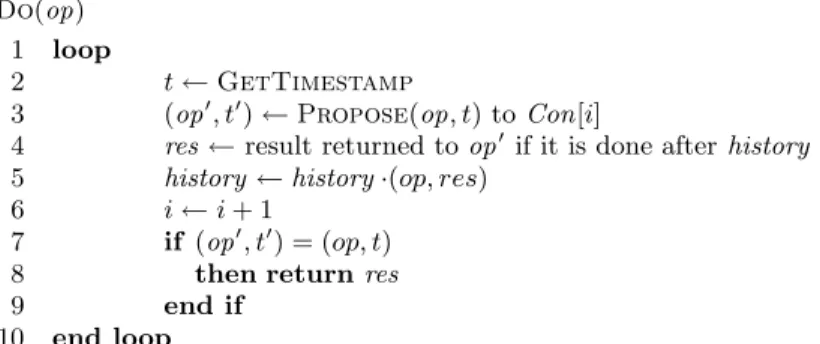
Do(op) 1 loop
2 t←GetTimestamp
3 (op′, t′)←Propose(op, t) toCon[i]
4 res←result returned toop′if it is done afterhistory
5 history←history·(op, res) 6 i←i+ 1
7 if (op′, t′) = (op, t)
8 then returnres 9 end if
10 end loop
Fig. 5.Obstruction-free implementation of an idempotent object from binary registers. (⇐) LetT be any idempotent type. We give an anonymous, obstruction-free algorithm that implementsT from binary registers. The algorithm uses an un-bounded number of consensus objectsCon[1,2, . . .], which have an obstruction-free implementation from binary registers, by Corollary 9. The algorithm also uses the GetTimestamp operation that accesses a weak counter, which can also be implemented from binary registers, according to Theorem 3. These will be used to agree on the sequence of operations performed on the simulated ob-ject. All other variables are local. Thehistory variable is initialized to an empty sequence, and i is initialized to 1. The code in Fig. 5 describes how a process simulates an operationop.
Obstruction-freedom: If, after some point of time, only one process takes steps, all of its subroutine calls will terminate, and it will eventually increase i until it accesses a consensus object that no other process has accessed. When that happens, the loop is guaranteed to terminate.
Correctness: We must describe how to linearize all of the simulated oper-ations. Any simulated operation that receives a result in line 3 that is equal to the value it proposed to the consensus object is linearized at the moment that consensus object was first accessed. All (identical) operations linearized at the momentCon[i] is first accessed are said to belong to groupi.
The following invariant follows easily from the code (and the fact that the object is idempotent): At the beginning of any iteration of the loop by any process P, historyP is equivalent to the history that would result from the the
firstiP−1 groups of simulated operations taking place (in order), whereiP and
historyP are P’s local values of the variables i and history. Thus, the results
returned to all simulated operations are consistent with the linearization. We must still show that the linearization point chosen for a simulated oper-ation is between its invocoper-ation and response. LetD be an execution of Do(op) in groupi. The linearization pointT ofD is the first access in the execution to Con[i]. Clearly, this cannot be afterD completes, sinceDitself accessesCon[i]. LetD′be the execution ofDo(op′) that first accessesCon[i]. (It is possible that
D=D′.) SinceDis linearized in groupi, it must be the case thatop=op′, and
also that the timestamps used in the proposals byDandD′ toCon[i] are equal.
Lett be the value of this common timestamp. Note thatT occurs afterD′ has
invoked, then theGetTimestampoperation thatD calls would have to return a timestamp larger thant. Thus,T is after the invocation of D, as required.
The algorithm used in the above proof does not require processes to have knowledge of the number of processes,n, so the characterization of Theorem 10 applies whether or not processes known. Since unbounded registers are idempo-tent, it follows from the theorem that they have an obstruction-free implemen-tation from binary registers, and we get the following corollary.
Corollary 11. An object typeT has an anonymous, obstruction-free implemen-tation from unbounded registers if and only if T is idempotent.
In the more often-studied context of non-anonymous wait-free computing, counters (with separate increment and read operations) can be implemented from registers [6], while consensus objects cannot be [18, 26]. The reverse is true for anonymous, obstruction-free implementations (since consensus is idempotent, but counters are not). Thus, the traditional classification of object types accord-ing to their consensus numbers [18] will not tell us very much about anonymous, obstruction-free implementations since, for example, consensus objects cannot implement counters, which have consensus number 1.
If large registers are available (instead of just binary registers), the algorithm in Fig. 5 could use, as a consensus subroutine, the algorithm of Theorem 7 instead of the algorithm of Theorem 6. If the number of different operations that are permitted on the idempotent object type isdandkinvocations occur, then the number of registers needed to implement each consensus object isO(nlog(dk)), by Proposition 8, and at most k consensus objects are needed. This yields the following proposition.
Proposition 12. An idempotent object with a operation set of size d has an implementation that usesO(knlog(dk))registers in any execution with k invo-cations on the object.
Acknowledgements We thank Petr Kouznetsov for helpful conversations. This research was supported by the Swiss National Science Foundation (NCCR MICS project) and the Natural Sciences and Engineering Research Council of Canada.
References
1. Y. Afek, H. Attiya, D. Dolev, E. Gafni, M. Merritt, and N. Shavit. Atomic snap-shots of shared memory. J. ACM, 40(4):873–890, 1993.
2. J. H. Anderson. Composite registers. Distributed Computing, 6(3):141–154, 1993. 3. D. Angluin. Local and global properties in networks of processors. In12th ACM
Symp. on Theory of Computing, pages 82–93, 1980.
4. D. Angluin, J. Aspnes, Z. Diamadi, M. J. Fischer, and R. Peralta. Computation in networks of passively mobile finite-state sensors. In 23rd ACM Symp. on PODC, pages 290–299, 2004.
5. J. Aspnes, F. Fich, and E. Ruppert. Relationships between broadcast and shared memory in reliable anonymous distributed systems. In Distributed Computing, 18th Intl Symp., pages 260–274, 2004.
6. J. Aspnes and M. Herlihy. Wait-free data structures in the asynchronous PRAM model. In2nd ACM SPAA, pages 340–349, 1990.
7. J. Aspnes, G. Shah, and J. Shah. Wait-free consensus with infinite arrivals. In 34th ACM Symp. on Theory of Computing, pages 524–533, 2002.
8. H. Attiya, A. Gorbach, and S. Moran. Computing in totally anonymous asyn-chronous shared memory systems. Inf. and Computation, 173(2):162–183, 2002. 9. R. A. Bazzi and Y. Ding. Non-skipping timestamps for byzantine data storage
systems. InDistributed Computing, 18th Intl Conf., pages 405–419, 2004. 10. O. Berthold, H. Federrath, and M. K¨ohntopp. Project “anonymity and
unobserv-ability in the internet”. In10th Conf. on Computers, Freedom and Privacy, pages 57–65, 2000.
11. S. C. Bono, C. A. Soghoian, and F. Monrose. Mantis: A lightweight, server-anonymity preserving, searchable P2P network. Technical Report TR-2004-01-B-ISI-JHU, Information Security Institute, Johns Hopkins University, 2004. 12. H. Buhrman, A. Panconesi, R. Silvestri, and P. Vitanyi. On the importance of
having an identity or, is consensus really universal? In Distributed Computing, 14th Intl Conf., volume 1914 ofLNCS, pages 134–148, 2000.
13. T. D. Chandra. Polylog randomized wait-free consensus. In15th ACM Symp. on PODC, pages 166–175, 1996.
14. C. Drul˘a. The totally anonymous shared memory model in which the number of proces ses is known. Personal communication.
15. O. E˘gecio˘glu and A. K. Singh. Naming symmetric processes using shared variables. Distributed Computing, 8(1):19–38, 1994.
16. D. Goldschlag, M. Reed, and P. Syverson. Onion routing. Commun. ACM, 42(2):39–41, 1999.
17. R. Guerraoui and E. Ruppert. What can be implmented anonymously? Technical Report 200496, School of Computer and Communications Sciences, EPFL, 2004. 18. M. Herlihy. Wait-free synchronization. ACM TOPLAS, 13(1):124–149, 1991. 19. M. Herlihy, V. Luchangco, and M. Moir. Obstruction-free synchronization:
Double-ended queues as an example. In23rd IEEE Intl Conf. on Distributed Computing Systems, pages 522–529, 2003.
20. M. Herlihy and N. Shavit. The topological structure of asynchronous computability. J. ACM, 46(6):858–923, 1999.
21. M. P. Herlihy and J. M. Wing. Linearizability: A correctness condition for concur-rent objects. ACM TOPLAS, 12(3):463–492, 1990.
22. P. Jayanti and S. Toueg. Wakeup under read/write atomicity. In Distributed Algorithms, 4th Intl Workshop, volume 486 ofLNCS, pages 277–288, 1990. 23. R. E. Johnson and F. B. Schneider. Symmetry and similarity in distributed
sys-tems. In4th ACM Symp. on PODC, pages 13–22, 1985.
24. S. Kutten, R. Ostrovsky, and B. Patt-Shamir. The Las-Vegas processor identity problem (How and when to be unique). J. Algs, 37(2):468–494, 2000.
25. R. J. Lipton and A. Park. The processor identity problem. Inf. Process. Lett., 36(2):91–94, 1990.
26. M. C. Loui and H. H. Abu-Amara. Memory requirements for agreement among un-reliable asynchronous processes. In F. P. Preparata, editor,Advances in Computing Research, volume 4, pages 163–183. JAI Press, Greenwich, Connecticut, 1987. 27. G. Neiger. Set-linearizability. In13th ACM Symp. on PODC, page 396, 1994. 28. A. Panconesi, M. Papatriantafilou, P. Tsigas, and P. Vit´anyi. Randomized naming
using wait-free shared variables. Distributed Computing, 11(3):113–124, 1998. 29. M. K. Reiter and A. D. Rubin. Crowds: Anonymity for web transactions. ACM
Trans. on Inf. and System Security, 1(1):66–92, 1998.
30. S.-H. Teng. Space efficient processor identity protocol. Inf. Process. Lett., 34(3):147–154, 1990.