Permutation
P
-values Should Never Be Zero:
Calculating Exact
P
-values When Permutations Are
Randomly Drawn
∗
Gordon K. Smyth & Belinda Phipson
Walter and Eliza Hall Institute of Medical Research
Melbourne, Vic 3052, Australia
Published October 2010; with corrections 9 February 2011
Abstract
Permutation tests are amongst the most commonly used statistical tools in modern genomic research, a process by which p-values are attached to a test statistic by ran-domly permuting the sample or gene labels. Yet permutation p-values published in the genomic literature are often computed incorrectly, understated by about 1/m, wheremis the number of permutations. The same is often true in the more general situation when Monte Carlo simulation is used to assignp-values. Although thep-value understatement is usually small in absolute terms, the implications can be serious in a multiple testing context. The understatement arises from the intuitive but mistaken idea of using permuta-tion to estimate the tail probability of the test statistic. We argue instead that permutapermuta-tion should be viewed as generating an exact discrete null distribution. The relevant literature, some of which is likely to have been relatively inaccessible to the genomic community, is reviewed and summarized. A computation strategy is developed for exact p-values when permutations are randomly drawn. The strategy is valid for any number of permu-tations and samples. Some simple recommendations are made for the implementation of permutation tests in practice.
Keywords: permutation test, Monte Carlo test,p-values, multiple testing, microarry
1
Introduction
A permutation test is a type of non-parametric randomization test in which the null distribu-tion of a test statistic is estimated by randomly permuting the class labels of the observadistribu-tions. Permutation tests are highly attractive because they make no assumptions other than that the observations are independent and identically distributed under the null hypothesis. They are often used when standard distributional assumptions are doubtful or when the null distribu-tion of the test statistic is simply intractable. This article also considers Monte Carlo tests, by which we mean simulation procedures in which pseudo-random instances of a test statistic are generated from its null distribution.
The idea of permutation tests was first described by Fisher (1935), with the assumption that all possible permutations would be enumerated. The idea of limiting the computations to a subset of permutations, randomly drawn from the set of possible permutations, was first examined by Dwass (1957). The idea of Monte Carlo tests seems to have been first suggested
by Barnard (1963). Each of these three original papers included an expression for the exactp
-value arising from the randomization test. None of the expressions were suitable for practical computation at the time, however, and the results on randomly drawn permutations seem to have been largely forgotten by the literature. Dwass (1957) in particular is not easily
readable by applied statisticians, and we have not seen the exact p-value expression from
Dwass (1957) repeated in any subsequent paper. Even recent reviews that cite Dwass (1957)
do not reproduce the exact p-value (Ernst, 2004).
Recent decades have seen an enormous development of bootstrap and re-sampling in-ference techniques (Efron, 1982; Efron and Tibshirani, 1993; Davison and Hinkley, 1997; Manly, 1997). A key concept of this research is the idea that the distribution of an estima-tor or test statistic can be estimated by an empirical re-sampling distribution. While this research has been tremendously valuable for a multitude of purposes, we believe it has had an unfortunate influence on the implementation of permutation tests. Rather than using the
exact p-value expressions from the original papers mentioned above, it has become
com-mon practice to use estimators of p-values in place of genuine probabilities. This estimation
approach is recommended in many textbooks (Higgins, 2004; Efron and Tibshirani, 1993; Good, 1994; Mielke and Berry, 2001). Some recent papers have given confidence intervals
for permutation p-values (Ernst, 2004), again re-inforcing the idea of p-value calculation as
an estimation problem. The view is often expressed that the correctp-values can be estimated
to any required precision by drawing a sufficiently large number of permutations.
This article points out this is only true up to a point. We show that substituting unbiased
estimators for exactp-values often increases the type I error rate of the test. A similar concern
was raised by Onghena and May (1995) and Edgington and Onghena (2007). We also show
that, when a very large number of simultaneous tests is to be done, p-values can never be
estimated with sufficient precision to avoid serious type I error problems at the family-wise
level. Meanwhile, exact p-values that do control the type I error rate correctly are readily
available for little or no additional computational cost.
With the development of large genomic data sets and modern computing facilities, per-mutation tests have become one of the most commonly used statistical tools in modern bio-statistical and genomic research. A google scholar search for “gene” and “permutation test”
finds nearly 8000 genomic articles, likely an underestimate of the number of relevant articles. Permutations are almost always randomly drawn rather than exhaustively enumerated. We were motivated to write this article because of the number of times we have seen
permu-tation p-values computed incorrectly in the genomic literature. Many published algorithms
and software tools return permutation “p-values” that are really estimates of p-values, i.e.,
ˆ
p-values. In most cases, published p-values obtained from permutation tests are understated
by about 1/m, wheremis the number of permutations. The situation is similar when Monte
Carlo simulation is used to assign p-values. Of particular concern is the tendency of many
public software packages to return ˆp-values that can be exactly zero. It is obvious that a
per-mutation test could never yield an exactly zero p-value if all permutations were exhaustively
enumerated, and it makes no inferential sense to assert that the p-value can be reduced to
zero by considering only a subset of the permutations. Most concerning of all is the potential
for multiple testing procedures to be applied to ˆp-values that are exactly zero. This has the
potential to lead to grossly misleading results at the family-wise level, in which the results are judged to be significant at fantastically strong levels, even when all of the null hypotheses are true.
This article contains only a modest amount of novel statistical theory. We provide a new
computational solution for evaluating exactp-values when permutations are drawn at random.
Our main aim is to clarify the need to evaluate exactp-values, and to make the relevant results
more accessible to the genomic community.
2
Estimating
p
-values tends to increase the type I error rate
Randomization tests are used in the following context. A test statistict has been calculated
from the data at hand. We would like to use the null hypothesis tail probabilityp∞=P(T >t)
of the observed test statistic as the p-value, but this probability cannot be directly computed.
In a general sense, the purpose of randomization tests is to estimate p∞. The purpose of this
section is to point out that p-value calculation must take into account not just the estimate
of p∞ but also the margin of error of this estimate. Simply replacing p∞ with an unbiased
estimator can result in a failure to correctly control the type I error rate.
If the test statistict is continuously distributed, then p∞will be uniformly distributed on
(0,1)under the null hypothesis. To control the type I error rate at levelα, if p∞was known,
the null hypothesis would be rejected when p∞≤α. In other words,P(p∞≤α) =α under
the null hypothesis.
Now suppose that ˆpis an unbiased estimator of p∞. It is often true thatP(pˆ≤α)>α,
because ˆp<α occurs with positive probability even whenp∞>α. In general
P(pˆ≤α) =
∫ 1
0
P(pˆ≤α|p∞)d p∞.
To consider a concrete case, suppose that mMonte Carlo data sets are generated under the
null hypothesis, and suppose that ˆp=B/mwhereBis the number of Monte Carlo test
statis-tics greater than or equal tot. Thenmpˆ is binomially distributed with size m and success
the number of Monte Carlo data setsm→∞. This is all conditional on the observed data how-ever. To compute the size of the resulting Monte Carlo hypothesis test, we have to average
over all possible data sets that might have been observed. Sincempˆ|p∞is binomial and p∞is
uniform, the unconditional distribution ofmpˆis a special case of beta-binomial. In fact, it is
easy to show that ˆpfollows a discrete uniform distribution on the values 0,1/m,2/m, . . . ,1:
P(pˆ=b/m) =
∫ 1 0
P(pˆ=b/m|p∞)d p∞
=
∫ 1
0
(
m b
)
pb∞(1−p∞)m−bd p∞
= 1
m+1
for allb=0,1, . . . ,m. Hence the type I error rate of the Monte Carlo test that arises from
using ˆpas a working p-value is
P(pˆ≤α) = ⌊mα⌋+1
m+1 .
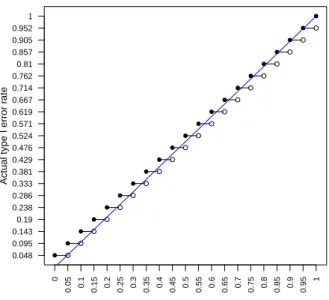
This expression can be greater or less than the nominal sizeα. The discreteness of ˆphowever
ensures that P(pˆ≤α)> α for most values of α near zero, and P(pˆ ≤α)<α for most
values of α near 1 (Figure A). Since α ≤0.05 for most experiments, the true type I error
rateP(pˆ≤α)exceedsα for most practical values ofmandα. The type I error rate always
exceeds α when α =i/mfor some integer i, or whenα <1/(m+1). In factP(pˆ≤α) is
never less than 1/(m+1)regardless of how stringent the desired rateα is chosen.
This demonstrates an unintuitive principle. Inserting an unbiased estimator of a p-value
for the true p-value does not generally lead to a test of the same size. Rather, the type I
error rate of the resulting randomized test is usually greater than that which would arise from
using the true p-value. To achieve a randomized test of the correct size, we must in effect
substitute for the truep-value an estimator with positive bias. The moral is that p-values must
be directly evaluated as probabilities, not treated as if they were unknown parameters to be estimated in a statistical model.
3
Under-estimating
p
-values is dangerous in a multiple
test-ing context
If only one hypothesis is to be tested, mis-calculating ap-value probability by a small amount
will often be of little consequence. In genomic research, however, it is typically the case that many tests are to be conducted. When the number of tests is large, any systematic
under-estimation of p-values can lead to dangerously wrong conclusions at the family-wise level.
Suppose for example that 50,000 tests are to be conducted, one for each transcript in a
tran-scriptome perhaps, and suppose that the resulting p-values are to be adjusted by Bonferroni
or Holm’s methods (Holm, 1979). If eachp-value is under-estimated by just 1/50,000, then it
Nominal type I error rate
Actual type I error r
ate
0
0.05 0.1 0.15 0.2 0.25 0.3 0.35 0.4 0.45 0.5 0.55 0.6 0.65 0.7 0.75 0.8 0.85 0.9 0.95
1
0.048 0.095 0.143 0.19 0.238 0.286 0.333 0.381 0.429 0.476 0.524 0.571 0.619 0.667 0.714 0.762 0.81 0.857 0.905 0.952 1
Figure A: Type I error rate, P(pˆ≤α), arising from using ˆp as a working p-value (y-axis)
versus the nominal sizeα (x-axis) whenm=20. The equality line,P(pˆ≤α) =α, is shown
in blue. The type I error rate is generally above the nominal rate forα <0.5.
level, even if none of the null hypotheses are false. In this case the family-wise type I error rate is radically wrong, even though the type I error rate is only very slightly under-estimated for each individual test.
This situation can arise easily if a permutation test is conducted for each gene on a
mi-croarray platform. To give an example, suppose that permutation ˆp-values are computed from
m=1000 sample permutations for each of 30,000 genes, where the total number of distinct
permutations possible is much larger than 1000. Suppose that a workingp-value is computed
for each gene as ˆp=B/m, whereB is the number of permutations yielding a test statistic
at least as extreme as that observed from the original data. Clearly ˆp=B/mis an unbiased
estimate of the tail probability for the test statistic under the null distribution induced by per-mutating samples. Yet then the number of exact zero values will be around 30, even when there are no differentially expressed genes. These 30 zero values will remain statistically significant regardless of multiple testing procedure or significance level applied.
The basic problem here is that the family-wise error rate depends on the relative accuracy
on the p-values, rather than on additive errors. For the smallest p-values, the error may be
large in relative terms even when it is small in absolute terms. When a non-zero p-value is
4
Exact
p
-values for Monte Carlo tests
It is helpful to consider first the case of Monte Carlo tests, which have much in common with
permutations tests, but are mathematically simpler. Supposetobsis the observed test statistic
for a given hypothesis for a given experiment. The basic assumption of Monte Carlo tests
is that it is possible to generate independent random datasets under the null hypothesis H0.
Typically, this is done by simulation using pseudo-random numbers. Supposemsuch datasets
are simulated under the null hypothesis, each yielding a distinct test statistictsim. In principle,
the ideal p-value is
p∞=P(tsim≥tobs)
but this is unknown. To compute p∞ exactly it would be necessary to generate an infinite
number of simulated datasets, but only a finite numbermare available.
For simplicity, we assume that the test statistict is continuous, so that p∞ is uniform on
the unit interval and all the tsim are distinct. Let B be the number of times out of m that
tsim≥tobs. The previous section showed that using the unbiased estimator ˆp∞=B/min place
ofp∞leads to an invalid test that does not correctly control the type I error rate at the required
level. A more valid approach is to compute the tail probability directly for the Monte Carlo
results. From the point of view of the randomization test, the test statistic isBrather thantobs,
and the required tail probability is P(B≤b). The previous section showed that, under the
null hypothesis, the marginal distribution ofBover all possible data sets is discrete uniform
on the integers from 0, . . . ,m. Hence the exact Monte Carlop-value is
pu=P(B≤b) =
b+1
m+1.
In effect, the randomization test replaces the unknown tail probability p∞ with a biased
es-timator(b+1)/(m+1), the amount of positive bias being just enough to allow for the
un-certainty of estimation and to produce a test with the correct size. This p-value calculation
is presented in a number of textbooks on randomization tests including Davison and Hinkley (1997), Manly (1997) and Edgington and Onghena (2007).
5
Sampling permutations without replacement
Now we consider permutation tests, a type of re-sampling randomization test. The basic setup
for a permutation test is as follows. We observe data pairs(yi,gi),i=1, . . . ,yn, where theyi
are independent data observations and thegiare labels that classify the observations into two
or more groups. The aim of a permutation test is to test the association betweenyandg.
A suitable test statistic t is computed from the (yi,gi). This might be a two-sample t
-statistic, for example, but it could in principle be any statistic designed to test for differences
between the data groups. Write tobs for the observed value of the statistic. The idea of a
permutation test is to assign a p-value to tobs by randomly permuting the class labels gi a
large number of times. Then the empirical distribution of the test statistics tperm from the
being tested is that theyiare independently and identically distributed, versus an alternative
hypothesis in which the distribution ofyidiffers between groups.
For simplicity, we will assume that theyiare all distinct, so that permutation yields distinct
values of the test statistic unless the partition ofyvalues into groups is identical. We assume
that there aremt possible distinct values of the test statistic, not counting the original value,
and that all are equally likely to arise under the permutation distribution.
The original idea of permutation tests was that all possible permutations would be
enu-merated (Fisher, 1935). However mt can be very large indeed for moderate to large sample
sizes, so that complete enumeration may be impractical. In this situation, it is common prac-tice to examine a random subset of the possible permutations. It is important to distinguish two possible scenarios. The random permutations may be drawn without replacement, so that all permutations are distinct. Or permutations may be drawn with replacement, so that the same permutation may be used more than once. We consider the first scenario now. The second scenario is the topic of the next section.
Suppose that a random sample m≤mt permutations is drawn, without repetition, such
that each permutation yields a distinct test statistictperm, different from the original statistic.
Then the situation is essentially the same as for Monte Carlo tests considered in the previous
section. The argument used in the previous section to derive the Monte Carlo p-value applies
again, showing that the exact permutation p-value is pu= (b+1)/(m+1), whereb is the
number oftpermgreater thantobs.
This result includes the situation in which allmt possible distinct permutations are
eval-uated. The exhaustive permutation p-value is pt = (bt+1)/(mt+1), wherebt is the total
number of distinct statistic values exceedingtobs.
6
Sampling permutations with replacement
6.1
Exact
p
-values
We now consider the case in which permutations are randomly drawn with replacement. Each permutation is randomly generated independently of previous permutations or of the original data configuration. This is by far the most common way that permutation tests are used in practice, especially in the genomic literature. This scenario requires careful treatment from a mathematical point of view, because of the possibility that the random permutations may include repetitions of the same permutations and indeed of the original data.
Suppose that an independent random sample of m permutations is drawn with
replace-ment. The resulting test statistics tperm may include repeat values, including possibly the
original observed value tobs. The exact p-value is now slightly less than (b+1)/(m+1),
because of the possibility that the original data is included at least once as one of the random permutations.
WriteBfor the number of permutations out ofmyielding test statistics at least as extreme
astobs. We wish to evaluate the exact permutation p-value pe=P(B≤b)for any givenb. We
do so using a formal conditional approach.
unknown quantity, and note pt = (Bt+1)/(mt+1). Although pt is in principle the ideal
permutationp-value, it is unknown in the scenario we now consider. If the null hypothesis is
true, thenBt follows a discrete uniform distribution on the integers 0, . . . ,mt. Conditional on
Bt =bt,Bfollows a binomial distribution with sizemand probability pt. Hence
pe=
mt
∑
bt=0
P(B≤b|Bt=bt)P(Bt =bt|H0) =
1
mt+1
mt
∑
bt=0
F(b;m,pt) (1)
whereF is the cumulative probability function of the binomial distribution. This expression
is essentially the same as Proposition 1 of Dwass (1957), although Dwass did not seem to intend it for practical computational use. Although not very difficult to derive, this exact
p-value has not been repeated to our knowledge elsewhere in the literature.
6.2
Computation and approximation
Equation (1) provides a formula for the exactp-value, but the summation may not be practical
to evaluate explicitly ifmtis very large. Hence we explore an approximation that can be
eval-uated quickly. Replacing the summation with an integral, and using a continuity correction, yields
pe ≈
∫ 1
0.5/(mt+1)
F(b;m,pt)d pt
=
∫ 1
0
F(b;m,pt)d pt−
∫ 0.5/(mt+1)
0
F(b;m,pt)d pt
= b+1
m+1−
∫ 0.5/(mt+1) 0
F(b;m,pt)d pt. (2)
This shows that pe< pu= (b+1)/(m+1), and also thatpeconverges to puasmt increases.
The last integral in equation (2) is easily evaluated using numerical integration algorithms. We have found it convenient to use Gaussian quadrature.
The valid but conservative p-value pu has been recommended by a number of authors
including Davison and Hinkley (1997), Manly (1997) and Ernst (2004). The extent to which
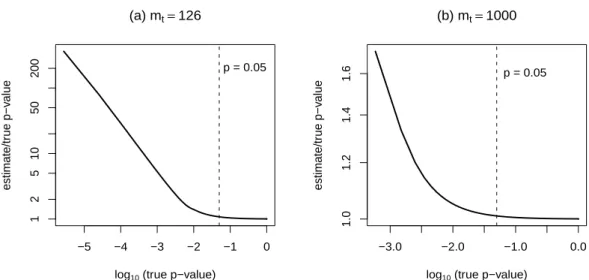
pu over-estimates the exact p-value depends onmt. When mt =1000, puover-estimates the
0.05p-value by about 2%, but smallerp-values are over-estimated by greater relative amounts
(Figure 1b). Whenmt is small,pucan be very conservative (Figure 1a).
6.3
Specific scenarios
The numbermt of possible distinct values of the test statistic is not simply a function of the
number of permutations, but also depends on the form of the test statistic and on the sample sizes. This is because different permutations can lead to the same test statistic, especially for two-sided tests with balanced samples.
Consider a comparison between two groups of sizes n1 and n2. In this situation it is
−5 −4 −3 −2 −1 0 1 2 5 10 50 200
log10 (true p−value)
estimate/tr
ue p−v
alue
p = 0.05
(a) mt=126
−3.0 −2.0 −1.0 0.0
1.0
1.2
1.4
1.6
log10 (true p−value)
estimate/tr
ue p−v
alue
p = 0.05
(b) mt=1000
Figure 1: Ratio of the upper bound pu= (b+1)/(m+1)to the exactp-value. Panel (a) is for
mt =126 and (b) is formt =1000. The number of permutations is m=1000 in each case,
and values are plotted for all possible values ofb.
remainingn2to group 2. If the test statistic is one-sided, or ifn1̸=n2, then each permutation
will generally yield a distinct test statistic. In that case, the number of distinct values of the permuted statistics is
mt+1=
(
n1+n2
n1
) .
For example, a one-sided test with n1 =n2 =5 gives mt+1=
(10
5
)
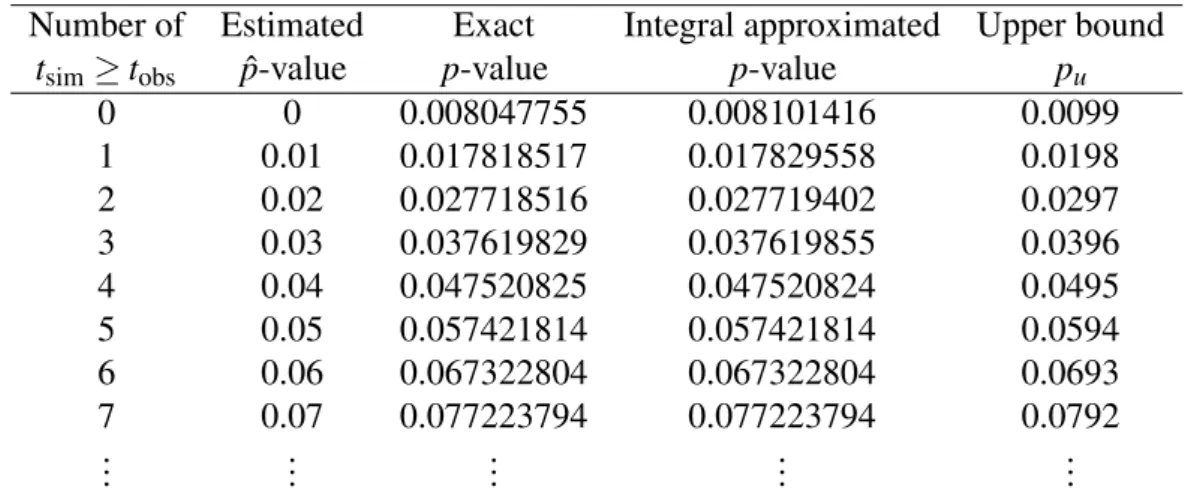
=252. The integral
approximation (2) provides an excellent approximation to the exact p-values (Table 1).
If a two-sided test statistic is used, for example the absolute value of at-statistic, and if
the two groups are of equal sizen1=n2, then each permutation gives the same value of the
test statistic as the corresponding permutation with the two groups reversed. In this case, the
total number of distinct test statistics possible ismt+1=
(n1+n2 n1
) /2.
If there are three or more groups of unequal sizes thenmt+1 is the multinomial coefficient
mt+1=
(
∑k j=1nj
n1. . .nk )
wherekis the number of groups. If some of the group sizesnj are equal, then some
permu-tations will in general give equal test statistics, so the calculaton ofmt will need to consider
the particular configuration of samples sizes.
7
Discussion and recommendations
The approach posited in Section 5, of drawing permutations without repeating previous val-ues of the test statistic, turns out to be a surprisingly difficult combinatorial programming
Table 1: Exact and approximatep-values for a one-sided test between two groups of size five
usingm=100 random permutations.
Number of Estimated Exact Integral approximated Upper bound
tsim≥tobs pˆ-value p-value p-value pu
0 0 0.008047755 0.008101416 0.0099
1 0.01 0.017818517 0.017829558 0.0198
2 0.02 0.027718516 0.027719402 0.0297
3 0.03 0.037619829 0.037619855 0.0396
4 0.04 0.047520825 0.047520824 0.0495
5 0.05 0.057421814 0.057421814 0.0594
6 0.06 0.067322804 0.067322804 0.0693
7 0.07 0.077223794 0.077223794 0.0792
..
. ... ... ... ...
exercise. Hence this approach is seldom used—so much so that we have never seen it in the genomic literature. Nevertheless, this is the superior approach to permutation tests.
Sam-pling without replacment gives rise to a simple easily understood exact p-value in the form
of pu. Even more importantly, it is possible to show that sampling permutations without
re-placement gives more statistical power than sampling with rere-placement for any given number
of permutations m≤mt. Our first recommendation then is that more attention be given to
this problem by computer scientists and combinatorialists, to provide biostatisticians with efficient numerical algorithms to sample permutations without replacement.
Our second recommendation is that “unbiased” estimators of p-values such as ˆpshould
not be used, because they can’t be guaranteed to control the type I error rate. Although the
risk involved in using ˆp in place of the exact p-value may be modest in many applications,
there is no justification for using an invalid p-value when a valid p-value, in the form of pu,
is readily available for no extra cost.
Our third recommendation is that users might consider using the exact p-value pe, at the
cost of a trivial amount of extra computation. Our algorithm to compute pe is implemented
as the function permp in the software package statmod for R available fromhttp://www.
r-project.org. The exact value pe gives a worthwhile gain in statistical power over pu
when the number of permutations mperformed is a more than negligible proportion of the
total number possiblemt.
A referee asked us to warn users that the number of permutationsmshould not be chosen
too small. While this is true, the urgent need to avoid small m disappears when the exact
p-value pe is used in place of ˆp, because pe ensures a valid statistical test regardless of
sample size or the number of permutations. When exact p-values are used, the only penalty
for choosingmsmall is a loss of statistical power to reject the null hypothesis. This is as it
should be: more permutations should generally provide greater power.
The same referee asked us to comment on the difference between permuting genes and permuting samples. One obvious difference between genes and samples is that there are
when genes are permuted. This implies that pu is likely to be a good approximation for pe
in this context. We have avoided discussing gene permutation in this article however because gene permutation has another obvious problem. Permutation assumes that the items being permuted are statistically independent, whereas genes usually cannot be assumed indepen-dent in genomic applications (Goeman and B¨uhlman, 2007; Wu et al, 2010). In general, we recommend permuting samples rather than permuting genes when there is a choice.
Finally, it is worthwhile mentioning that there are alternatives to permutation that alleviate
the problem of smallmt when the number of samples is not large (Dørum, 2009; Wu et al,
2010).
References
Barnard, G.A. (1963) Discussion of “The spectral analysis of point processes” by MS Bartlett.
J.R. Statist. Soc.B,25, 294.
Davison, A.C. and Hinkley, D.V. (1997)Bootstrap methods and their application, Cambridge
University Press, United Kingdom.
Dwass, M. (1957) Modified randomization tests for nonparametric hypotheses. Ann. Math.
Statist.,28, 181–187.
Dørum, G., Snipen, L., Solheim, M., and Saebo, S. (2009). Rotation testing in gene set
enrichment analysis for small direct comparison experiments. Stat. Appl. Genet. Mol.
Biol,8, Article 34.
Efron, B. (1982)The jackknife, the bootstrap and other resampling plans, Society for
Indus-trial and Applied Mathematics, England.
Efron, B. and Tibshirani, R.J.(1993)An introduction to the bootstrap, Chapman & Hall, New
York.
Edgington, E.S. and Onghena, P. (2007) Randomization tests, Fourth Edition, Chapman &
Hall/CRC, Boca Raton, FL.
Ernst, M.D. (2004) Permutation methods: a basis for exact inference. Statistical Science,19,
676–685.
Fisher, R.A. (1935)The Design of Experiments, 3rd Edition, Oliver & Boyd, London.
Goeman, J.J. and B¨uhlmann, P. (2007) Analyzing gene expression data in terms of gene sets:
methodological issues. Bioinformatics,23, 980–987.
Good, P. (1994)Permutation tests: a practical guide to resampling methods for testing
hy-potheses, Springer-Verlag New York, New York.
Higgins, J.J. (2004)An introduction to modern nonparametric statistics, Brooks/Cole, Pacific
Holm, S. (1979). A simple sequentially rejective multiple test procedure. Scandinavian
Journal of Statistics,6, 65–70.
Manly, B.F.J. (1997)Randomization, bootstrap and Monte Carlo methods in biology, Second
Edition, Chapman & Hall, London.
Mielke, P.W. and Berry, K.J. (2001)Permutation tests: a distance function approach,
Springer-Verlag New York, New York.
Onghena, P. and May, R.B. (1995) Pitfalls in computing and interpreting randomization testp
values: A commentary on Chen and Dunlap. Behaviour Research Methods, Instruments,
& Computers,27, 408–411.
Wu, D., Lim, E., Vaillant, F., Asselin-Labat, M., Visvader, J.E. and Smyth, G.K. (2010)
ROAST: rotation gene set tests for complex microarray experiments. Bioinformatics, 26,