Electoral fraud in
the UK
Final report and
recommendations
January 2014
Translations and other formats
For information on obtaining this publication in another language or in a large-print or Braille version please contact the Electoral Commission:
Tel: 020 7271 0500
Email: [email protected]
We are an independent body set up by the UK Parliament. We regulate party and election finance and set standards for well-run elections. We work to support a healthy democracy, where elections and referendums are based on our principles of trust, participation, and no undue influence.
Contents
Foreword 1
Summary of our conclusions and recommendations 3
1 Our review of electoral fraud 9
2 Summary of evidence and views 13
3 Tackling the risk of electoral fraud in specific areas 16
4 Requiring voters to show identification in polling stations 21
5 Postal and proxy voting 28
6 The role of political parties and campaigners 38
Appendices
Appendix A: International voter identification requirements 44 Appendix B: List of consultees and respondents 46
1
Foreword
Electoral fraud is a serious issue. One of the Electoral Commission’s priorities is to ensure both that fraud is prevented from happening and that it is swiftly detected in the relatively rare circumstances that it is committed.
Despite some high-profile cases in recent years when fraud has been
detected and punished, there is no evidence to suggest that there have been widespread, systematic attempts to undermine or interfere with recent
elections through electoral fraud.
Later this year Individual Electoral Registration – a change that we have been calling for since 2003 – will tighten up voter registration. Where vulnerabilities remain in our electoral system, and where these could be exploited by those who want to commit fraud, further action is needed.
In making our recommendations for change, we have been conscious of the need to strike the right balance between making the system accessible, and making it secure. Getting this right will mean that voters and candidates can participate in elections, but corrupt campaigners cannot win votes through fraud.
The need to achieve this balance means that some of the changes that have been suggested during our review should not be pursued – they would tip the balance too far away from accessibility. For example, restricting access to postal voting would prevent many innocent voters from casting their vote, not just the people who attempt to undermine the system.
Perceptions of fraud can be as damaging as actual incidents of electoral fraud. Voters must be able to have confidence in the system and in our review we looked at what more could be done to ensure they can. Following detailed consideration over the last 12 months, we are now recommending a package of measures to deliver this, including three significant moves to tighten our electoral system against fraud.
First, there is no doubt that in some areas of England there is a history of concerns about fraud, and in some cases fraud has been attempted and detected. We have been working closely with Electoral Registration Officers, Returning Officers and police forces to make sure that they have
comprehensive plans in place to tackle the risk of fraud, especially in these higher risk areas. Together with those responsible for preventing and
detecting electoral fraud, we will renew our efforts, targeted in these areas, to ensure that voters can be confident that their vote is safe.
Second, we want to strengthen our existing Code of Conduct for
Campaigners, to prevent campaigners from handling postal votes. We will work with political parties and others to find a way to do this without the need for legislation – but if we are not satisfied that campaigners are prepared to
2
comply with these strengthened requirements voluntarily we will reconsider whether to recommend that the law should be changed.
Finally, we should move to a system where voters are required to produce identification at polling stations. We gathered substantial evidence during our review that the lack of a requirement for ID is both an actual and a perceived weakness in the system. This move would introduce a new requirement for voters casting their ballot in a polling station, and we have considered
carefully whether this will deter some voters from taking part. Our conclusion, again based on the evidence we gathered during the review, is that this risk can be managed and that it is therefore right to make this change, for the sake of the benefits it will bring in terms of improving the security of the system. A similar requirement already exists in Northern Ireland, where ID to vote has been required since 2002, as well as in many other countries.
We intend to consult widely and work with others to identify and develop a proportionate and accessible scheme for verifying electors’ identity at polling stations. There would clearly be costs involved in implementing such a scheme, and we will want to look at this aspect in more detail as we develop it; but we believe that the costs can be managed and are necessary in order to address this significant vulnerability in the system.
Throughout this review, we have listened to voters, campaigners, elected politicians and those who administer the electoral system across the UK. We are grateful for their views, which have been important in informing the recommendations in this report.
The approach we have set out in this report represents a balanced and proportionate set of changes to increase confidence in our electoral system. We look forward to working with Electoral Registration Officers and Returning Officers, political parties, the police and the UK and Scottish Governments to implement our proposals.
Jenny Watson Chair
3
Summary of our conclusions
and recommendations
In autumn 2012 we commenced a wide-ranging review of electoral
vulnerabilities in the UK to identify what could be done to improve confidence in the security of our electoral processes. Our aim was to achieve consensus about how best to ensure that the electoral process in the UK is both secure and accessible.
We have consulted widely with campaigners and electoral administrators, and we have commissioned research with members of the public to understand voters’ views and concerns about electoral fraud. This report makes a number of recommendations that will help to address integrity concerns and
vulnerabilities within the electoral process.
Tackling the risk of electoral fraud in specific areas
Electoral fraud is not widespread across the UK and reports of significant fraud are focused in specific places in England, concentrated in a small number of local authority areas. We do not believe it is likely that fraud has been attempted in more than a handful of wards in any particular local authority area.We do not support introducing temporary restrictions or special measures in specific areas. However, sustained action is needed especially in those areas where there is a higher risk of allegations of, or attempts, at electoral fraud, both to minimise the risk of further allegations and to respond effectively if allegations or attempts at fraud do arise.
In particular, local police forces, Electoral Registration Officers (EROs) and Returning Officers (ROs), political parties and campaigners are all well-placed to identify and respond to the risk of electoral fraud, and must each make a clear commitment to protecting the integrity of the electoral process.
Recommendation 1: Continued urgent action to tackle the risk of electoral fraud in higher risk areas
We have identified a number of specific local authority areas where there is a higher risk of allegations of electoral fraud. EROs and ROs, political parties, candidates and campaigners and police forces – especially in those areas – need to take steps before the May 2014 elections to protect the integrity of elections. However, we expect all EROs, ROs and police forces to have comprehensive plans in place to address the risk of fraud. The steps to be taken are as follows:
4
• EROs and ROs need to be alert to the risk of fraud at elections in their own specific areas, by analysing data from previous elections alongside historic patterns of allegations of fraud at previous elections and other factors (such as the likely closeness of contests, for example) which might lead to a higher risk of fraud. They should use this analysis to target preventative measures in areas of higher risk, including the use of their powers to review registration applications, existing register entries and absent vote applications. In addition, replacement postal ballot packs should be offered to voters who complain that they have had their postal vote stolen or have been pressured into voting in a particular way against their wishes. They should also use their analysis of risk to
develop operational plans with local police forces which target areas where there are specific risks, as well as planning for investigating any allegations which do arise. EROs and ROs also need to explain clearly and publicly what they are doing to prevent and detect electoral fraud, in order to improve confidence in the integrity of elections among voters, elected representatives, candidates and campaigners.
• Political parties, candidates and campaigners need to ensure that their activities do not open to question or undermine the integrity of the electoral process. They should make clear public commitments to
following the provisions of the Code of Conduct for Campaigners, as well as complying with all relevant aspects of electoral law. Campaigners should also play an active role in promoting electoral integrity by identifying electoral register inaccuracies and highlighting suspicious patterns of registration or absent vote applications. Where they have identified evidence of possible electoral fraud, campaigners should provide details of allegations and any supporting evidence to the police to allow them to investigate potential offences.
• Police forces need to ensure that they are ready to support EROs and ROs to protect the integrity of elections in 2014. In particular, they need to help identify specific areas where policing operations on the ground might need to be strengthened (around individual polling places, for example), and to agree robust processes with EROs and ROs for
dealing with and investigating allegations of electoral fraud. Police forces need to communicate clearly and publicly their commitment to protecting the integrity of elections, and reassure electors and campaigners that they will respond quickly to concerns about electoral fraud and
thoroughly investigate allegations. They should ensure that people who have made allegations about electoral fraud are kept informed about the progress of investigations before, during and after elections.
The Electoral Commission will continue to provide electoral integrity
guidance and support to EROs, ROs and police forces across the UK, but we will specifically target our monitoring activities in those areas where there is a higher risk of allegations of electoral fraud in 2014 and beyond. We will work closely with EROs, ROs and police forces to make sure that they have thoroughly analysed the risk of electoral fraud locally, and that their plans represent an effective response to tackle those risks.
5
We will meet EROs, ROs and police forces regularly in these areas, and if we are not satisfied that the right measures have been identified or implemented by EROs, ROs and police forces we will say so and we will make clear what further actions need to be taken.
We will continue to publish data on the outcome of police investigations into cases of alleged electoral fraud each year, to ensure there is transparency about the extent and nature of cases of alleged electoral fraud in the UK.
Requiring voters to show identification in polling
stations
Polling station voting in Great Britain remains vulnerable to personation fraud because there are currently few checks available to prevent someone
claiming to be an elector and voting in their name. This part of the system could become more vulnerable to fraud as other processes (including electoral registration and postal or proxy voting) become more secure. We have therefore concluded that there should be a requirement for electors across Great Britain to present an acceptable form of identification prior to voting at the polling station.
We have found little evidence to suggest that the identity-checking scheme applied in Northern Ireland presents difficulties for people in terms of
accessibility. At the same time, it provides a level of security that virtually eliminates the risk of personation. For these reasons, the system in Northern Ireland should provide the basis for a Great Britain-wide, geographically consistent and compulsory polling station voter identification scheme. Recommendation 2: Verifying the identity of voters in polling stations Electors should be required to show proof of their identity before they can be issued with a ballot paper at polling stations for elections and referendums in Great Britain, as they are already in Northern Ireland and many other
countries.
We will consult widely and work with others to identify and develop a proportionate and accessible scheme for verifying the identity of electors at polling stations. Such a scheme must:
• Be sufficiently robust to verify electors’ identities.
• Be sufficiently accessible to electors.
• Provide for electors to obtain an alternative form of identification specifically for the purpose of voting if they do not have access to any other specified form of identification.
• Be cost-effective and affordable.
We will publish our detailed proposals for a proof of identity scheme, with an estimate of the likely costs of implementing such as scheme, by the end of 2014.
6
We will work with the UK and Scottish Governments to develop legislative proposals for such a scheme which could be introduced for approval by the UK and Scottish Parliaments.
Developing and implementing a robust proof of identity scheme will take time, and we do not believe it is likely that such a scheme could be implemented in time for the scheduled 2015 UK Parliamentary general election. We
recommend that a proof of identity scheme should be in place to be used by no later than for the 2019 European Parliamentary and English local government elections.
Postal and proxy voting
We do not recommend restricting the availability of postal voting in Great Britain. The impact on the overwhelming majority of electors who find postal voting a convenient and secure method of voting would not be proportionate to the potential integrity benefits. There are, however, some changes we want to see made to existing processes in order to make postal and proxy voting more secure, including continued urgent action by ROs and police forces in areas where there is a higher risk of allegations of electoral fraud and changes to stop campaigners handling absent voting materials, including absent voting applications and blank or completed postal ballot packs. We also think there may be potential once Individual Electoral Registration (IER) has been implemented in Great Britain for improving the process of checking the validity of absent vote applications and returned postal ballot packs. We will monitor the implementation of IER during 2014 and 2015, and will consider whether using National Insurance numbers would provide a more robust mechanism for verifying the identity of electors in the absent voting process.
There is broad support for maintaining the current, more limited, availability of absent voting in Northern Ireland, and we do not recommend any changes to the framework there.
The role of political parties and campaigners
Campaigners play a vital role in encouraging participation in elections,including helping to publicise and explain different voting methods to electors who might not be able to vote in person at a polling station.
It is not appropriate, however, for campaigners to be directly involved in the voting process, including completing absent vote applications and postal ballot packs. We have heard concerns from the public and electoral administrators about the impact on vulnerable electors and on perceptions of the integrity of the absent voting process. Other parts of the electoral process – voting in polling stations and the count, for example – are very tightly regulated to prevent the direct involvement of campaigners.
7
We will consult political parties, other campaigners and EROs/ROs on
changes to strengthen the provisions of the Code relating to handling absent vote applications and postal ballot packs, and on how best to ensure
campaigners understand the need to change how they deal with these documents.
We hope that it will not be necessary to create new offences to regulate campaigners’ behaviour. If, however, we are unable to secure support for and agreement by parties and other campaigners to a strengthened Code of Conduct for Campaigners, we will reconsider the case for more direct statutory regulation of campaigner behaviour in future, including whether to recommend new legislation to make it an offence for campaigners to handle any postal voting materials.
We will also review our guidance to EROs and ROs to ensure that electors who may otherwise have been assisted by campaigners are not
disadvantaged. Returning Officers should provide an absent vote application and postal ballot pack collection service for electors, enabling any elector who is genuinely unable to return these documents through the postal service or at a polling station to have their completed documents collected by the RO or their staff. We know that many EROs and ROs already offer this service to electors, but it is important to note that more proactive publicity by
campaigners for this service could require EROs and ROs to put in place additional resources to deal with potential increased demand.
Recommendation 3: Restricting the involvement of campaigners in absent vote administration processes
Campaigners at elections and referendums in the UK should not be involved in the process of assisting other people in completing postal or proxy vote applications or handling postal ballot packs.
Campaigners:
• Should not take, complete or help to complete postal or proxy vote applications.
• Should not take completed postal or proxy vote application forms from electors, including taking completed application forms to post them or deliver them to the Electoral Registration Officer.
• Should not include an intermediary address for the return of postal or proxy vote applications – all applications should be returned directly to EROs.
• Should not take, complete or help to complete postal ballot papers.
• Should not take, complete or help to complete postal voting statements.
• Should not take completed postal ballot packs, including taking completed postal ballot packs to post them or deliver them to the Returning Officer.
To ensure that electors themselves are not disadvantaged, EROs and ROs should provide a facility to collect these documents from electors who are
8
genuinely unable to return them through the postal service or to a polling station. Many EROs and ROs already offer such a service.
We will discuss these changes with political parties, other campaigners and ROs/EROs, and will encourage campaigners to commit to following a revised Code of Conduct for Campaigners for elections after May 2014, including at the May 2015 UK Parliamentary general election. We will make public details of which parties and campaigners have agreed to follow the Code.
We will also encourage political parties to incorporate compliance with the revised Code of Conduct for Campaigners into their own existing internal codes and disciplinary processes for their members and candidates. We will continue to monitor and report on any potential breaches of the Code – through feedback from Returning Officers, electors, other campaigners and media reports.
If we are unable to secure support and agreement by parties and other campaigners to a strengthened Code of Conduct for Campaigners, we will reconsider the case for more direct statutory regulation of campaigner
behaviour in future, including whether to recommend new legislation to make it an offence for campaigners to handle any postal voting materials.
9
Our review of electoral
1
fraud
In autumn 2012 we commenced a wide-ranging review of electoral 1.1
vulnerabilities in the UK to identify what could be done to improve confidence in the security of our electoral processes. Our aim was to achieve consensus about how best to ensure that the electoral process in the UK is both secure and accessible.
Review process
We consulted a range of people and organisations, including elected 1.2
representatives, political parties, professionals working in the elections field, the police and prosecuting authorities, academics, voluntary organisations and think tanks. We also conducted research with, and sought views from, members of the public, and analysed police data on cases of alleged electoral fraud.
Phase 1 of our review focused on understanding the issues and 1.3
developing an evidence base from which options for change could be identified. This stage involved external engagement and consultation with a range of individuals and organisations, and research with members of the public.
Phase 2 of our review saw the publication (in May 2013) of our evidence 1.4
and issues paper, in which we summarised our views on the evidence of electoral fraud in the UK.1 We set out our analysis of the nature and extent of electoral fraud:
• There is a consistent underlying level of concern about electoral fraud. This is shared by a broad range of people including voters, those standing for election and those running elections.
• Reports of electoral fraud are not widespread across the UK; reports of significant fraud are focused in specific places in England and are concentrated in a small number of local authority areas.
• We do not believe it is likely that fraud has been attempted in more than a handful of wards in any particular local authority area.
1
The Electoral Commission (May 2013) Electoral fraud in the UK: evidence and issues paper. Available at:
http://www.electoralcommission.org.uk/__data/assets/pdf_file/0004/155335/Electoral-fraud-evidence-and-issues-paper-2013.pdf
10
• The majority of cases of alleged electoral fraud relate to local government elections in England, rather than elections to the UK Parliament or other legislative bodies.
• Relative to the scale of participation by candidates and electors, only a small number of cases of alleged electoral fraud are reported to the police each year.
• Electoral fraud tends to be committed by candidates or their supporters. Where significant cases of organised electoral fraud have been found to have taken place, they have been committed and coordinated by a relatively small number of individuals.
• The majority of people in communities affected by electoral fraud are victims rather than offenders.
Our evidence and issues paper also set out a number of possible 1.5
options for change to address electoral fraud vulnerabilities. These were:
• Restricting the availability of postal voting in Great Britain
• Providing alternatives to postal voting, such as advance voting
• Prohibiting political parties, candidates, canvassers and campaigners from handling postal vote application forms and postal ballot packs
• Restricting proxy voting
• Requiring voters to present photographic identification at polling stations
• Introducing measures to improve security in or around polling stations Phase 3 of the review has focused on developing our conclusions and 1.6
recommendations. These are outlined in this final report.
Our approach
Our approach to assessing possible responses to electoral fraud 1.7
vulnerabilities has been guided by the following themes. Balancing security and accessibility
The challenge in any democracy is achieving the appropriate balance 1.8
between the accessibility and security of the electoral system. Security means ensuring everyone can be confident that their vote gets counted and that no one can steal or interfere with their vote. Accessibility means ensuring that everyone who is eligible to vote gets the chance to vote without facing
unnecessary or disproportionate barriers. It is important to ensure the integrity of all electoral processes in the UK, but this must be balanced against the risks to effective voter participation.
This balance requires serious consideration. For example, proposals to 1.9
improve security by introducing voter identification requirements at polling stations should take account of the likely impact on the accessibility of the voting process, either for all electors or particular groups of electors, and should include measures to minimise any adverse impact.
Similarly, making changes to improve accessibility may introduce or 1.10
11
acceptance by the voter that they are moving out of the polling station
environment where the secrecy of the ballot is guaranteed by supervision by the elections staff. Individual voters need to understand this trade-off between forfeiting that guarantee of supervised secrecy and the convenience of postal voting, and EROs and the Electoral Commission should make sure that voters therefore are aware of and understand these issues when making a choice about which voting method to use.
Cost-effectiveness and workability
The benefits of any changes to the electoral process should outweigh 1.11
the costs. This means that the benefits of implementing any recommendations – such as improvements to security and public confidence – should be worth the costs of doing so, both in resource and administrative terms and in terms of any impact on participation. Any new system should be workable and straightforward to administer.
This report outlines further work we will undertake to develop detailed 1.12
proposals for changes to support our recommendations, including developing estimates of likely implementation costs.
Complexity of opinion
People hold different views on how best to respond to electoral fraud 1.13
vulnerabilities and do not always share the same interests and priorities. The views of voters, for example, do not always concur with those of campaigners, or those of electoral administrators. We aim to put voters first by
recommending changes that will help improve the security of the electoral process so that people can be confident (a) that their vote can be cast without interference; (b) that their vote will be counted; and (c) that fraudulent votes will not be counted. At the same time, campaigners can act in voters’ interests by encouraging participation and providing them with information - but they should not get involved in the administration of elections. That is the exclusive job of electoral administrators, whose job it is to ensure that elections are secure and accessible for voters.
The need for additional anti-fraud measures
Electoral fraud has the potential to affect the outcome of elections as 1.14
well as undermining trust and confidence in democracy .Our report makes a number of recommendations that will help to address integrity concerns and vulnerabilities within the electoral process. Specifically, it recommends:
• Taking continuing firm action to tackle the risk of electoral fraud in higher risk areas
12
• Strengthening our existing Code of Conduct for Campaigners to prevent campaigners from handling postal votes2
• Requiring electors to show proof of their identity before they can be issued with a ballot paper at polling stations for elections and referendums in Great Britain
2
The Code of Conduct for Campaigners can be downloaded from our website:
http://www.electoralcommission.org.uk/__data/assets/pdf_file/0006/154176/Code-of-conduct-campaigners-2013.pdf
13
Summary of evidence
2
and views
This chapter sets out the views of the public,3 electoral administrators, 2.1
candidates, elected representatives and political parties about electoral fraud. In particular, it considers the extent to which they believe that changes to the current system are necessary to improve security, and how any changes should be balanced against the need to ensure continued accessibility and participation.
Sources of evidence and views
We commissioned a two-stage study of public attitudes to electoral 2.2
fraud. The first stage (carried out in January and February 2013) focused on the public’s understanding of and concerns about electoral fraud; the second stage (conducted in May to July 2013):
• Built on Stage 1 findings in order to understand how we can best address concerns around electoral fraud among the general public.
• Explored any changes that should be made to the current electoral system and tested options for changes set out in our May 2013 evidence and issues paper.
• Further explored perceptions and understanding of undue influence relating to elections.
We have published the analysis reports from both phases of this 2.3
research on our website at http://www.electoralcommission.org.uk/find-information-by-subject/electoral-fraud/electoral-fraud-vulnerabilities-review.
In autumn 2012 we invited a range of people and organisations to submit 2.4
evidence and views on electoral fraud. We received 81 responses to this initial consultation, including from elected representatives, political parties,
professionals working in the elections field, the police and prosecuting authorities, academics, voluntary organisations and think tanks.
In May 2013 we published an evidence and issues paper. This provided 2.5
an analysis of the evidence available on electoral fraud and invited views on a range of options for addressing vulnerabilities within the system.
3
Public views were gauged through qualitative research, which consisted of interview sessions and focus groups with members of the general public in a range of locations across the UK.
14
We received 63 responses to the evidence and issues paper. The 2.6
highest concentration of responses came from electoral administrators, Electoral Registration Officers and Returning Officers, MPs, councillors and political party Nominating Officers (see Appendix B for the full list of
respondents).
Views of the public
The evidence from our research with members of the public suggests 2.7
that people do not have a deep understanding about electoral fraud but they do have a general concern about the possibility of fraud taking place.4 Views are rarely influenced by first-hand experience of electoral fraud and are more likely to be based on cases reported by the media and people’s own set of assumptions, some of them unfounded.
When people were given information about methods of voting of which 2.8
they had not previously been aware, this created or enhanced a perception that they knew little about the electoral system overall.
However, once participants were provided with specific information 2.9
about security measures already in place; the roles and responsibilities of the police, the Commission and local authorities; and statistics on the number of reported cases of electoral fraud in the UK, they tended to be reassured and levels of concern either stayed low or reduced.
Overall, the research found that people believed that: 2.10
• Changes were necessary to improve the security of certain parts of the system, as well as voter confidence.
• Any measures should not be implemented at the expense of voter participation.
• Any measures should be proportionate to the scale and risk of fraud happening, and be applied nationally to ensure consistency and equality of treatment for all voters.
Views of electoral administrators
Electoral administrators broadly agreed that instances of electoral fraud 2.11
are not widespread across the UK, but rather are more likely to be reported as having taken place on a significant scale in specific places within a small number of local authorities.
4
There was a small ‘research effect’ whereby asking about the topic of electoral fraud and discussing potential vulnerabilities in the system in more detail increased concerns.
15
They expressed concern that some fraud could potentially go 2.12
undetected, specifically in relation to cases of personation5 and undue
influence6, and about fraud being detected and reported, but no further action being taken due to insufficient evidence.
Although electoral administrators expressed support for some of our 2.13
proposals, they wanted to be sure that the costs of any additional
administrative burdens were properly considered in the context of the benefits they might bring, and that changes would not adversely affect the accessibility of the electoral process and levels of participation.
Views of candidates, elected representatives and
political parties
On the whole candidates, elected representatives and political parties 2.14
were more likely to have reservations about some of the more far-reaching of our options for change than other respondents, viewing such measures as disproportionate to the scale of the problem and expressing concern about their possible impact on the accessibility of the process and participation. Some did, however, voice concern about alleged fraudulent activity within specific electoral areas (particularly among certain communities7) and these respondents were more likely to be supportive of temporary measures, such as suspending certain voting methods or introducing polling station
identification requirements in areas where there had been recent proven cases of electoral fraud.
5
The offence of personation occurs when an individual votes as someone else (whether that person is living or dead or fictitious), either by post or in person at a polling station as an elector or as a proxy.
6
A person is guilty of undue influence if they directly or indirectly make use of or threaten to make use of force, violence or restraint, or inflict or threaten to inflict injury, damage or harm in order to induce or compel any voter to vote or refrain from voting. A person may also be guilty of undue influence if they act with the intention of impeding or preventing the voter from freely exercising their right to vote.
7
16
Tackling the risk of
3
electoral fraud in specific areas
Electoral fraud vulnerabilities in specific areas
While the data reported by the police shows that every UK police force 3.1
has investigated cases of alleged or suspected electoral fraud in the last three years, it is clear that there are some areas where cases are more frequently reported and therefore investigated.
These areas are generally limited to individual wards within a number of 3.2
local authority areas. We have identified the following 16 local authority areas (out of just over 400 across the UK as a whole) where there appears to be a greater risk of cases of alleged electoral fraud being reported:
• Birmingham • Blackburn with Darwen
• Bradford • Burnley
• Calderdale • Coventry
• Derby • Hyndburn
• Kirklees • Oldham
• Pendle • Peterborough
• Slough • Tower Hamlets
• Walsall • Woking
These areas are often characterised by being densely populated with a 3.3
transient population, a high number of multiple occupancy houses and a previous history of allegations of electoral fraud.
These areas are also often home to communities with a diverse range of 3.4
nationalities and ethnic backgrounds. We have heard some strongly held views, based in particular on reported first-hand experience by some
campaigners and elected representatives, that electoral fraud is more likely to be committed by or in support of candidates standing for election in areas which are largely or predominately populated by some South Asian
communities, specifically those with roots in parts of Pakistan or Bangladesh. These concerns reflect issues also highlighted by a small number of 3.5
previous studies of political and electoral participation, which have suggested that extended family and community networks could be mobilised to secure
17
the support of large numbers of electors in some areas, effectively constituting a ‘block vote’ - although this would not necessarily involve electoral fraud.8
Some people who have raised concerns about the risk of electoral fraud 3.6
within specific South Asian communities have also argued that the wider availability of postal voting in Great Britain since 2001 has increased the risk of electoral fraud associated with this approach, as the greater safeguards of secrecy provided by polling stations are removed. We have also heard
concerns and allegations about the intimidation of electors outside polling stations in specific areas.
Evidence from police data and prosecutions shows that people accused 3.7
of electoral fraud and people convicted of fraud come from a range of backgrounds including white British, South Asian and other European
backgrounds. It would be a mistake to suggest that electoral fraud only takes place within specific South Asian communities.
We are, however, concerned about the extent to which electoral fraud 3.8
affects or originates from within specific communities. The evidence and views we have heard raise significant questions about whether individuals within these communities are able effectively to exercise their right to vote, and whether they are able to participate in elections on the same basis as other electors across the UK. All electors should be free to cast their votes in the way they wish. It is not acceptable to explain or excuse electoral fraud on the basis of actual or perceived differences in cultural approaches to democratic participation.
Further work on electoral fraud vulnerabilities in specific communities We have begun further work to identify relevant evidence in order to help 3.9
address concerns about the vulnerability of some South Asian communities, specifically those with roots in parts of Pakistan or Bangladesh, to electoral fraud.
The objective of this work is not to attempt to ‘quantify’ electoral fraud in 3.10
these communities. Rather, recognising that allegations arise more frequently from or about some of these communities, the work has three broad
objectives:
• To research whether common factors can be identified in areas where electoral fraud has been reported or attempted and develop our
understanding of any such commonalities.
• To review what differences may be in place between areas that have seen cases of electoral fraud and areas which may have similar demographics but where there have not been cases of such fraud.
8
See, for example, Baston, L. (2013) The Bradford Earthquake, report commissioned by The Joseph Rowntree Reform Trust. Democratic Audit.
18
• To design better strategies to prevent electoral fraud at future elections. We intend to use a case study approach to this research involving eight 3.11
areas (e.g. electoral wards), with four areas that have had cases of electoral fraud and four areas that, demographically and culturally, roughly match these areas but where fraud has not been reported.
We intend to work with recognised academic experts as well as other 3.12
professional researchers in delivering this work. We expect to involve both activists and voters in each area to understand their views on political culture and practices, and what may or may not distinguish them from other areas.
We intend to complete this research and publish our findings by late 3.13
2014.
Action to address the risk of electoral fraud in
specific areas
During the first phase of our review, it was suggested to us that there 3.14
should be temporary restrictions or the suspension of certain voting methods – in particular postal and proxy voting – in areas where there had been recent proven cases of electoral fraud. When we sought further views on the
implications of a “special measures” approach, however, there was little support for the proposal among respondents to our consultation or members of the public.
Overall, this approach was not seen as a proportionate response, 3.15
penalising the vast majority of law-abiding voters and campaigners in an area in order to deal with the risk of criminal actions by a relatively small number of corrupt campaigners. Several suggested that the focus should be on
identifying and dealing with the perpetrators of fraud, rather than penalising the whole electorate in specific areas by introducing temporary restrictions. A small number of respondents to our consultation did see a case for 3.16
temporary measures to be imposed in certain circumstances. They suggested that the Electoral Commission and/or the UK Government could make a case for special measures to be imposed in an area where there had been a proven court case or election petition and where there was the full support of the police.
On balance, however, we would not support introducing temporary 3.17
restrictions or special measures in specific areas. We agree with concerns expressed during our consultation and research that temporary restrictions would be counterproductive because they might:
• Increase concerns among voters that fraud must be widespread in areas where restrictions have been imposed.
• Confuse electors (particularly if restrictions applied in specific wards in the same local authority area).
19
• Have a displacement effect: those intent on committing electoral fraud may respond to the imposition of restrictions in a particular electoral areas by engaging in activity in other geographical areas, or parts of the system that are less likely to be detected.
• Be unworkable in practice: some electoral administrators said that
implementing a “two-tier” system in a single local authority area would be difficult to administer.
However, sustained action is needed in those areas where there is a 3.18
higher risk of allegations of electoral fraud, both to minimise the risk of further allegations and also to respond effectively if allegations do arise.
We work with Electoral Registration Officers (EROs), Returning Officers 3.19
(ROs), political parties, Royal Mail, the Association of Chief Police Officers (ACPO), the Association of Chief Police Officers in Scotland (ACPOS), the CPS and the Crown Office & Procurator Fiscal Service to promote electoral integrity and to make sure that elections are safe and secure.
In particular, local police forces, EROs and ROs, political parties and 3.20
campaigners are all well-placed to identify and respond to the risk of electoral fraud, and must each make a clear commitment to protecting the integrity of the electoral process. We have set out below our recommendations for the specific actions which need to be taken especially in those areas where there is a higher risk of allegations of electoral fraud, although we expect all EROs, ROs and police forces to have comprehensive plans in place to address the risk of fraud. We have also set out how we propose to monitor and review whether those actions have been put in place.
Recommendation 1: Continued urgent action to tackle the risk of electoral fraud in higher risk areas
We have identified a number of specific local authority areas where there is a higher risk of allegations of electoral fraud. EROs and ROs, political parties, candidates and campaigners and police forces – especially in those areas – need to take steps before the May 2014 elections to protect the integrity of elections. However, we expect all EROs, ROs and police forces to have comprehensive plans in place to address the risk of fraud. The steps to be taken are as follows:
• EROs and ROs need to be alert to the risk of fraud at elections in their own specific areas, by analysing data from previous elections alongside historic patterns of allegations of fraud at previous elections and other factors (such as the likely closeness of contests, for example) which might lead to a higher risk of fraud. They should use this analysis to target preventative measures in areas of higher risk, including the use of their powers to review registration applications, existing register entries and absent vote applications. In addition, replacement postal ballot packs should be offered to voters who complain that they have had their postal vote stolen or have been pressured into voting in a particular way against their wishes (see paragraph 5.37 of this report). They should
20
also use their analysis of risk to develop operational plans with local police forces which target areas where there are specific risks, as well as planning for investigating any allegations which do arise. EROs and ROs also need to explain clearly and publicly what they are doing to prevent and detect electoral fraud, in order to improve confidence in the integrity of elections among voters, elected representatives, candidates and campaigners.
• Political parties, candidates and campaigners need to ensure that their activities do not open to question or undermine the integrity of the electoral process. They should make clear public commitments to
following the provisions of the Code of Conduct for Campaigners, as well as complying with all relevant aspects of electoral law. Campaigners should also play a proactive role in promoting electoral integrity by identifying electoral register inaccuracies and highlighting suspicious patterns of registration or absent vote applications. Where they have identified evidence of possible electoral fraud, campaigners should provide details of allegations and any supporting evidence to the police to allow them to investigate potential offences.
• Police forces need to ensure that they are ready to support EROs and ROs to protect the integrity of elections in 2014. In particular, they need to help identify specific areas where policing operations on the ground might need to be strengthened (around individual polling places, for example), and to agree robust processes with EROs and ROs for
dealing with and investigating allegations of electoral fraud. Police forces need to communicate clearly and publicly their commitment to protecting the integrity of elections, and reassure electors and campaigners that they will respond quickly to concerns about electoral fraud and
thoroughly investigate allegations. They should ensure that people who have made allegations about electoral fraud are kept informed about the progress of investigations before, during and after elections
The Electoral Commission will continue to provide electoral integrity
guidance and support to EROs, ROs and police forces across the UK, but we will specifically target our monitoring activities in those areas where there is a higher risk of allegations of electoral fraud in 2014 and beyond. We will work closely with EROs, ROs and police forces to make sure that they have thoroughly analysed the risk of electoral fraud locally, and that their plans represent an effective response to tackle those risks.
We will meet EROs, ROs and police forces regularly in these areas, and if we are not satisfied that the right measures have been identified or implemented by EROs, ROs and police forces we will say so and we will make clear what further actions need to be taken.
We will continue to publish data on the outcome of police investigations into cases of alleged electoral fraud each year, to ensure there is transparency about the extent and nature of cases of alleged electoral fraud in the UK.
21
Requiring voters to show
4
identification in polling stations
The majority of electors in the UK cast their votes at their local polling 4.1
station. At the 2010 UK Parliamentary general election, 22 million votes (representing just over 82% of all votes) were cast in a polling station.
The physical arrangements in place at polling stations are designed to 4.2
ensure the secrecy of the ballot – voters can complete their ballot paper within the privacy of a polling booth, and deposit their completed paper in a ballot box, which is locked and sealed at the start of polling and which is not opened until it arrives at the count centre.
Voters living in England, Scotland and Wales are not required to produce 4.3
any form of identification (ID) when voting at a polling station. Since 2002, voters in Northern Ireland have been required to present photographic identification before they can be issued with their ballot paper at the polling station. Alongside Individual Electoral Registration (IER), the requirement for photographic ID to be presented when voting at a polling station was
introduced to overcome personation and electoral fraud, which were widely perceived to occur in Northern Ireland.
This chapter outlines why we are recommending that voters should be 4.4
required to provide some form of identification when they cast their vote in person at a polling station in Great Britain.
Polling station vulnerabilities in Great Britain
In Great Britain, polling station staff may ask the following statutory 4.5questions to further establish the identity of a voter, particularly if they suspect any attempt at personation:
• Are you the person registered in the register of electors for this election as follows? (the whole entry from the register is then read out); and
• Have you already voted here or elsewhere at this election, otherwise than as proxy for some other person?
If a voter in a polling station is informed that their name has been 4.6
marked on the register as having already voted, but they dispute that this is true, polling staff may issue a tendered ballot paper. Once completed, this ballot paper is not placed in the ballot box, but is placed in a separate packet and not counted. The vote of the person tendering is only added (and the vote of the person personating struck off) if, after investigation, it can be
satisfactorily proved that personation took place.
These limited checks make it relatively difficult to prevent and detect 4.7
22
polling stations in recent years, and have said that in some cases it has been difficult to identify suspects or provide reliable evidence to support
prosecutions.
The lack of a mechanism for verifying voter identities in polling stations 4.8
and the risk of personation was cited as the main vulnerability of polling station voting by the members of the public we surveyed and by respondents to our evidence and issues paper.
Changes to improve the security of the postal voting process have been 4.9
introduced since 2007, with voters using this method being required to provide a signature and date of birth when applying for and completing their postal ballot, which are then subject to verification (see paragraph 5.5 of this report). The Electoral Registration and Administration Act 2013 provided for the introduction of IER in Great Britain, which is scheduled to be implemented from June 2014. This will require a person’s details (date of birth and National Insurance number) to be verified against Department for Work and Pensions (DWP) records before they can be added to the register, which will make it much harder to register fictitious electors, whether for the purpose of committing electoral or other fraud.
As different parts of the electoral process are tightened up (for example, 4.10
postal voting), those intent on committing fraud may shift their focus to the remaining weaknesses of the system, with polling station voting becoming more vulnerable to electoral fraud in the future.
Proposals for reducing polling station vulnerabilities
We consulted on different options for checking and verifying people’s 4.11identify when they go to vote in a polling station:
• Requiring all voters to present an approved form of photographic identification when attending a polling station on polling day.
• Giving polling station staff the power to ask voters to sign for their ballot paper and amending the legislation so that Presiding Officers must withhold the ballot paper should any elector refuse to sign.9
9
Provisions were included in the Electoral Administration Act 2006 for the electors to provide a signature before being issued with a ballot paper. At that time the UK Government decided not to commence the provisions, however, because the legislation did not include a clear sanction to withhold the ballot paper should the elector refuse to sign, potentially giving rise to confusion, inconsistency of practice and potential legal challenge. The Government indicated its intention to clarify the primary legislation at the earliest opportunity, although no
23
• Giving Presiding Officers the power to ask voters to confirm their date of birth if they have this on record before receiving their ballot paper
(Presiding Officers in Northern Ireland already have this power). Voter identification at polling stations
Our research and consultation showed that there is support for requiring 4.12
some form of proof of identity to be shown by voters at polling stations. Our post-election survey following the Police and Crime Commissioner elections in November 2012 found that two-thirds (64%) of respondents said that requiring people to show some form of identification at the polling station would be a ‘very effective’ means of averting electoral fraud.10
However, members of the public and some political parties expressed 4.13
significant concerns about the possible impact that a specific requirement for photographic identification could have on accessibility and participation.
In particular, people were concerned that a requirement for photographic 4.14
identification would discriminate against certain groups of electors, who would not necessarily have any form of photographic documentation, such as a passport or driving licence. People suggested that the additional burden of presenting photographic identification would fall disproportionately on young people, the elderly and some Black and Minority Ethnic communities. These people might therefore find it harder to participate in elections.
Respondents to our consultation also tended to associate the 4.15
introduction of photographic identification with national identity cards, and had reservations about its introduction in the absence of any national ID system.
Balanced against these views, there is no evidence (from our public 4.16
opinion polls, nor from the Chief Electoral Officer) to suggest that voters in Northern Ireland experience any difficulties in coping with the requirements of photographic voter identification.
The idea of voters being requested to provide a non-photographic form 4.17
of identification at the polling station was welcomed in principle by both the public and electoral administrators.
Those who supported this option said they thought it would improve 4.18
security in the system overall, be low cost, straightforward to implement, unlikely to affect voter participation, improve voter confidence in the process and give voters some reassurance that no one else would be able to use their vote.
There were some concerns from electoral administrators about the 4.19
potential cost of implementing any new system, particularly in terms of public
10
24
awareness activity to support implementation, and also the possible
consequence of queues forming at polling stations as it could take longer for people to cast their vote.
A consistent finding was that there would need to be consideration about 4.20
the types of acceptable ID in order to make voting at a polling station as accessible as possible to people, while making sure that it is easy to implement and administer.
Many other countries currently require voters to present some form of 4.21
identification at the polling station. Appendix A sets out the different types of voter ID used in a selection of countries.
Voter identification at polling stations in Northern
Ireland
Between 1985 and 2002, voters in Northern Ireland were required to 4.22
present one of a number of specified identity documents at the polling station. The list included a number of non-photographic identity documents.
Nonetheless, the system was considered to be inadequate because of the ease with which identity documents could be falsified and the fact that non-photographic identity documents were regarded as providing insufficient proof of identity. These limitations resulted in the adoption of a photographic voter identification scheme in Northern Ireland, which was applied for the first time (under the provisions of the Electoral Fraud (Northern Ireland) Act 2002) at the November 2003 Northern Ireland Assembly elections.
The Chief Electoral Officer’s 2003-04 report concluded that the 4.23
photographic identification scheme in Northern Ireland had “almost entirely removed the opportunity for personation”. Since the introduction of
photographic ID at polling stations there have been no reported cases of personation.
The Northern Ireland scheme requires voters to produce one of the 4.24
following documents to confirm their identity:
• A UK, Irish or EEA driving licence (photographic part).
• A UK, Irish or EU passport (EU passports are not accepted at UK Parliamentary elections).
• A specified public transport pass.
• An Electoral Identity Card issued by the Chief Electoral Officer for Northern Ireland.
The document does not need to be current, but the Presiding Officer 4.25
must be satisfied that the photograph is of a good enough likeness before issuing a ballot paper.
The list includes an Electoral Identity Card, which an elector can apply 4.26
for free of charge from their local Area Electoral Office. While the Electoral Identity Card is intended only for voter identification purposes, the card “has
25
come to be widely accepted as proof of identity for many purposes including access to financial services, travel and entry to licensed premises”.11 Electoral Identity Cards with a Braille overlay are available for blind or partially sighted electors.
There have now been eight elections in Northern Ireland since the 4.27
introduction of photographic identification and public awareness levels remain high. In our report on the 2007 Northern Ireland Assembly election, 99% of voters surveyed indicated that they had experienced no difficulties with
electoral ID on polling day. This percentage has largely remained unchanged since photographic ID was introduced. While voters understand the
requirement for photographic identification, they do need to be consistently reminded to bring it with them on polling day. There is, however, little
evidence of voters being turned away from the polling station for presenting an incorrect form of identification.
According to the Electoral Office for Northern Ireland (EONI) almost 4.28
100,000 Electoral Identity Cards were issued during the first year of
implementing the new requirement. This represented less than 10% of the registered electorate at that time. On average 25,000 new or replacement cards are issued annually of which half are provided to those registering to vote at schools for the first time. The cost of implementing the Electoral Identity Card scheme included significant initial setup costs involving data capture and validation as well as card production and distribution. The Electoral Commission also spent more money on its public awareness
campaigns in Northern Ireland during 2002 and 2003, in order to publicise the new requirements around electoral registration. EONI had initially entered into a ten-year contract for the provision of the cards, but this contract was terminated in April 2009 and the production of ID cards is now carried out in house by the EONI. Presiding Officers in Northern Ireland did not require any additional training following the move to the photographic ID requirement, other than being told what the new acceptable forms of ID were.
Our conclusion
Polling station voting in Great Britain remains vulnerable to personation 4.29
fraud because there are currently few checks available to prevent someone claiming to be an elector and voting in their name. This part of the system could become more vulnerable to fraud as other processes (including electoral registration and postal or proxy voting) become more secure. We have therefore concluded that there should be a requirement for electors across Great Britain to present an acceptable form of identification prior to voting at the polling station.
11
Chief Electoral Officer for Northern Ireland (2010) Report of the Chief Electoral Officer for Northern Ireland 2009-2010, p. 31.
26
We acknowledge that people have raised concerns about any 4.30
requirement for photographic identification to be presented when voting at a polling station – principally, they are concerned that this could disenfranchise voters who may not have easy access to a qualifying form of ID.
Nevertheless, we have found little evidence to suggest that the 4.31
photographic scheme applied in Northern Ireland presents difficulties for people in terms of accessibility (it is backed up by an Electoral Identity Card, made available free of charge to electors who do not possess any of the other acceptable forms of photographic ID). At the same time, it provides a level of security that virtually eliminates the risk of personation.
For these reasons, our preliminary conclusion is that the system in 4.32
Northern Ireland should provide the basis for a Great Britain-wide,
geographically consistent and compulsory polling station voter identification scheme.
Introducing a proof of identity requirement for voters in polling stations in 4.33
Great Britain is likely to involve additional costs, particularly if the scheme includes the provision of electoral identity cards for electors who do not have access to any of the specified forms of identification. There would also be some initial costs for training polling station staff and also for publicising the new requirement (which we would expect to include in our planning for the Electoral Commission’s public awareness activity in advance of any
scheduled elections).
While the number of electors who could require an electoral identity card 4.34
in Great Britain is likely to be significantly larger than in Northern Ireland (given the size of the respective populations), there are also likely to be opportunities to take advantage of economies of scale in the management of the production process; and there will certainly be lessons to learn from Northern Ireland about managing both the set-up and on-going running costs of an electoral identify card scheme.
Our view is that the potential costs associated with a requirement for 4.35
identity are likely to be worthwhile and necessary in order to address a significant electoral fraud vulnerability.
We will undertake further consultation and analysis to identify a 4.36
proportionate and accessible scheme for verifying identity at polling stations in Great Britain, using as our starting point the Northern Ireland model. This will include consideration of the acceptable forms of photographic ID to be
included in the scheme and more detailed analysis of the likely costs involved in setting up and maintaining the scheme.
Recommendation 2: Verifying the identity of voters in polling stations Electors should be required to show proof of their identity before they can be issued with a ballot paper at polling stations for elections and referendums in Great Britain, as they are already in Northern Ireland and many other
27
We will consult widely and work with others to identify and develop a proportionate and accessible scheme for verifying the identity of electors at polling stations. Such a scheme must:
• Be sufficiently robust to verify electors’ identities.
• Be sufficiently accessible to electors.
• Provide for electors to obtain an alternative form of identification specifically for the purpose of voting if they do not have access to any other specified form of identification.
• Be cost-effective and affordable.
We will publish our detailed proposals for a proof of identity scheme, with an estimate of the likely costs of implementing such as scheme, by the end of 2014.
We will work with the UK and Scottish Governments to develop legislative proposals for such a scheme which could be introduced for approval by the UK and Scottish Parliaments.
Developing and implementing a robust proof of identity scheme will take time, and we do not believe it is likely that such a scheme could be implemented in time for the scheduled 2015 UK Parliamentary general election. We
recommend that a proof of identity scheme should be in place to be used by no later than for the 2019 European Parliamentary and English local government elections.
28
Postal and proxy voting
5
Since 2001, anyone on the electoral register in Great Britain has been 5.1
able to apply to vote by post instead of in person at a polling station, without providing a reason or attestation.12 In Northern Ireland, anyone applying to vote by post must give a reason why they are unable to go to the polling station and the application must be attested: reasons include blindness or other disability, a person’s occupation, service (i.e. a member of the armed forces or family of a member of the armed forces) or employment.
Postal voting is an increasingly popular method of participation for 5.2
electors across Great Britain. At the most recent UK Parliamentary general election in May 2010, postal ballot packs were sent to 6.9 million electors, representing 15% of all registered electors.13 The proportion of electors in Northern Ireland who were sent a postal ballot pack (1.4%) was much lower than elsewhere in the UK.
Turnout among postal voters is consistently higher than people who vote 5.3
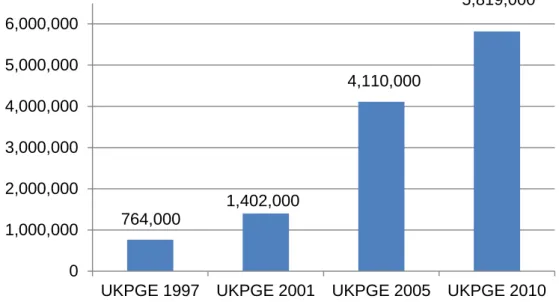
at polling stations: 5.8 million postal votes were returned at the 2010 UK Parliamentary general election (see Figure 1 overleaf), representing a turnout among electors who had applied for a postal vote of 83%, compared with 63% of those who were only able to vote at a polling station.
Even at the Police and Crime Commissioner (PCC) elections held in 5.4
November 2012, where turnout was just 15% of the eligible electorate, just under 50% of electors issued with a postal ballot returned it. This compares to only 9.2% of ‘in person’ electors who used their vote. Our research with voters has also found that people who vote by post consistently report high levels of satisfaction with and confidence in the postal voting process.
12
An attestation is a declaration of support for an elector’s absent vote application by an approved individual.
13
At the 2012 Police and Crime Commissioner elections the proportion of the electorate who were sent postal ballot packs was as high as 40% in Sunderland and a further five counting areas had a take up of over 30%: South Tyneside; Stevenage; Telford and Wrekin;
29
Figure 1: Number of postal votes returned by close of poll at UK Parliamentary General Elections 1997-2010
Since 2007 electors who want to apply to vote by post in Great Britain 5.5
have been required to provide their date of birth and a sample signature. These personal identifiers must also be provided on a postal voting statement submitted with their ballot paper, and they are compared with the original identifiers to provide a check that the ballot paper has been completed by the elector themselves. Similar checks are carried out on postal votes in Northern Ireland. These checks mean that Returning Officers (ROs) will not count postal votes where they are not satisfied that the postal voting statement has been completed by the original applicant. Before these checks were
introduced in 2007, postal votes were submitted with a witnessed Declaration of Identity by the elector, which was never checked or verified against other records.
Across the UK, electors can also apply to appoint a proxy to vote on their 5.6
behalf. In Great Britain an application to appoint a proxy for an individual election does not usually need to be attested, although most emergency applications will require an attestation for elections in May 2014 and beyond. Some applications for a proxy appointment for an indefinite or specified period, which can only be made for specific reasons such as a disability or being overseas, also need to be attested. An attestation can only be given by certain people listed in legislation who must confirm that the reason an elector is applying to vote by proxy is valid. In Northern Ireland an elector must
provide a specific reason for the appointment of a proxy. At the 2010 UK Parliamentary general election, 0.3% of voters across the UK (143,801 in total) appointed a proxy.
Absent voting vulnerabilities
Despite the additional measures introduced since 2007 to improve the 5.7
security of postal voting in Great Britain, some areas of the process remain
764,000
1,402,000
4,110,000
5,819,000
0 1,000,000 2,000,000 3,000,000 4,000,000 5,000,000 6,000,000