THE LEARNING FRAMEWORK IN NUMBER AND ITS IMPACT ON TEACHER KNOWLEDGE AND PEDAGOGY
A report prepared on behalf of
the NSW Department of Education & Training for the Count Me In Too program 2008
by Associate Professor Janette Bobis University of Sydney
2009 RepoRt
o
u
t
h
w
a
l
e
S
D
e
pa
R
t
m
e
N
t
o
f
e
D
u
c
a
t
io
N
&
t
R
a
iN
iN
g
2009 RepoRt
C
2
0
0
9
,
N
e
w
S
o
u
t
h
w
a
l
e
S
D
e
pa
R
t
m
e
N
t
o
f
e
D
u
c
a
t
io
N
&
t
R
a
iN
iN
g
c
oNteNtSe
xecutiveS
ummaRy iva
im of thiS StuDy ivR
eSeaRchD
eSigN ivS
ummaRy ofR
eSultS aNDR
ecommeNDatioNS vt
heL
earningF
rameworki
nn
umber aND itSi
mpact oNt
eacheRK
NowleDge aNDp
eDagogy1
i
NtRoDuctioN1
B
acKgRouND1
t
heL
earningF
rameworki
nn
umber1
a
im of thiS StuDy2
R
eSeaRchD
eSigN4
p
RoceDuRe aNDi
NStRumeNtS4
t
heS
emi-
StRuctuReD iNteRviewS5
D
ocumeNtS5
R
eSultS7
B
acKgRouND toc
aSeS
tuDyS
choolS7
S
uRveyR
eSultS8
i
NteRview aNDD
ocumeNtD
ata19
S
ummaRy ofR
eSultS aNDR
ecommeNDatioNS38
R
efeReNceS45
a
ppeNDixa
46
a
ppeNDixB
49
cmit
plaNNiNg matRix49
a
ppeNDixc
50
C
ountm
ei
nt
ooe
valuatioN2008
50
S
ectioN1
50
S
ectioN2
52
o
u
t
h
w
a
l
e
S
D
e
pa
R
t
m
e
N
t
o
f
e
D
u
c
a
t
io
N
&
t
R
a
iN
iN
g
2009 RepoRt
e
xecutiveS
ummaRya
im of thiS StuDyThis study is concerned with teacher professional learning and the impact of this learning on teaching practices. Its focus is on teacher knowledge of the Learning Framework In Number [LFIN] from the
Count Me In Too [CMIT] numeracy project operating in Department of Education & Training (DET) schools across New South Wales (NSWDET, 2007).
In particular, the study addresses the following research questions: 1. What are teachers’ perceptions about the degree to which
CMIT is being implemented at the school and classroom levels? 2. What are teachers’ perceptions about the extent of their
knowledge of the Learning Framework In Number?
3. Do teachers perceive that the Learning Framework In Number
has impacted on teaching practices at the school, classroom and student levels? If so, how? If not, why?
4. How confident do teachers feel about identifying children’s levels of mathematical development on the LFIN?
5. To what extent is the CMIT planning matrix a useful tool for identifying the level of reported implementation of the program at the school and classroom levels?
R
eSeaRchD
eSigNThree primary schools were purposively selected by NSW Department of Education and Training authorities and then invited to participate in the study. Criteria for selection were based on a school’s action plan detailing 2008 outcomes and processes for the implementation of CMIT in their school and their willingness to participate in the evaluation. A case study of each school was compiled that specifically focused on teacher knowledge of the Learning Framework In Number
and its impact on their pedagogy.
Information was gathered from three main sources: 1. Survey;
2. Semi-structured interviews with staff from each of the schools; and
3. Documents (such as school management plans and teacher programs).
v
2009 RepoRt
C
2
0
0
9
,
N
e
w
S
o
u
t
h
w
a
l
e
S
D
e
pa
R
t
m
e
N
t
o
f
e
D
u
c
a
t
io
N
&
t
R
a
iN
iN
g
S
ummaRy ofR
eSultS aNDR
ecommeNDatioNSThis section summarises the main findings in terms of the research questions and makes recommendations for the CMIT program. 1. what aRe teacheRS’ peRceptioNS aBout the DegRee to which
cmit iS BeiNg implemeNteD at the School aND claSSRoom levelS?
Information concerning teachers’ perceptions about the degree to which CMIT is implemented at their schools and in their classrooms was gathered initially via the survey and then supplemented by interview data. The CMIT planning matrix (Appendix B) was used in the survey to allow teachers to self-rate themselves and their school according to the group of descriptors they felt best described the way CMIT operated on four aspects—Whole School Management, Teaching Practice, Assessment Practices and the Parent and Community Focus. Survey responses from all three schools consistently indicated that within each school, there was minimal involvement of parents with limited information about how the program operates being disseminated to the community. This aspect of the program was not targeted for follow-up at the interview stage of the current study so reasons for this perception cannot be elaborated upon. However, it is a potential area for study in future evaluations of the program. Survey respondents particularly from Schools A and C generally perceived that CMIT was operating at the Whole School Management level, Teaching Practice and the Assessment Practice aspects at a level consistent with Group 2 or 3 Descriptors from the matrix. From the interview data, it was found that variation in this perception occurred across grade and stage levels—with Kindergarten and Year 1 teachers the most convinced that CMIT was operating in quite a robust manner in their classrooms and the classrooms of teachers from the same stage. This more positive perception is possibly due to the fact that in most cases, CMIT had been operating slightly longer in the infant classes than in the higher grades, therefore it was more established in terms of consistency in programming and the development of resources. Variation in perceptions was also related to the amount of experience an individual teacher or Stage team had implementing the program. In the case of School A, where teachers undertook CMIT training in Stage teams (subsequently redesigning aspects of their programming and the way they structured their classrooms for instruction collaboratively) there was a more consistent view as to the degree to which CMIT was operating. Additionally, the practice at School A of conducting classroom visits between the different grades increased individual teachers’ awareness of other teachers’ pedagogy in mathematics.
Overall, a more robust implementation of CMIT and an explicit use of the LFIN were more evident at School B than for either of
2009 RepoRt
o
u
t
h
w
a
l
e
S
D
e
pa
R
t
m
e
N
t
o
f
e
D
u
c
a
t
io
N
&
t
R
a
iN
iN
g
the other schools. For example, more than half of School B survey respondents considered Assessment to be best described by Group 1 or 2 Descriptors on the CMIT planning matrix. This means that the majority of respondents perceived there to be an understanding by teachers at their school of the LFIN and that flexible use of the SENA guided their assessment of students and informed their instructional practices. Consistent with survey findings, interviews confirmed that whole school professional development focusing explicitly on the LFIN occurred at School B and that there was an emphasis on integrating the Framework into teaching programs.
reCommendation 1.1
Count Me In Too Facilitators should focus on developing a deeper and shared understanding of the Learning Framework In Number among all staff through whole school professional development.
reCommendation 1.2
To enhance consistency in programming, that also includes a focus on the Framework to guide instruction, school administrators should encourage collaborate programming at the Stage level.
2. what aRe teacheRS’ peRceptioNS aBout the exteNt of theiR KNowleDge of the Learning Framework in number?
Information about the extent to which teachers considered they understood the LFIN and the extent to which they considered it to have increased their awareness of children’s development in number was gathered by the survey and during the interview. In both instances, teachers were asked to self-rate their perceptions on a scale from 0 to 4 (nil to excellent). Data from both the survey and the interviews revealed that the majority of teachers from each school agreed that knowledge of the LFIN had significantly increased their awareness of children’s mathematical develop in number—with 17 out of 28 (60.7%) survey respondents and 17 out of a total 22 (77.2%) interviewees rating the extent of its impact at the top two levels. However, both survey respondents and interviewees were reluctant to rate their understanding at the highest (excellent) level, despite evidence obtained during the interviews indicating that a total of eight teachers could comprehensively interpret student strategy development and clearly articulate appropriate instruction in terms of the LFIN at Level 4 (excellent). Only one survey respondent from each of the schools self-rated their understanding as excellent, but no interviewees did so. Interviewees’ explanations of their ratings revealed that while many teachers felt they had learnt a great deal about the LFIN, their increased awareness had made them realise that they still had much more to learn about the Framework and how to use it to guide their instruction. This perception generally
vii
2009 RepoRt
C
2
0
0
9
,
N
e
w
S
o
u
t
h
w
a
l
e
S
D
e
pa
R
t
m
e
N
t
o
f
e
D
u
c
a
t
io
N
&
t
R
a
iN
iN
g
the LFIN and their interpretation of its use. In particular, teachers from each of the schools remarked that while they may have felt very confident about their understanding of the LFIN and its implications for their programming when working with a particular group or stage of children, a recent shift in the grade they taught meant that they now had to broaden their understanding to include new aspects of the Framework. In such cases, teachers remarked that they required more time to build the same level of familiarity with the LFIN. At the other end of the spectrum, interviewees felt that their need to refer to another staff member or support documentation to either verify students’ placement on the LFIN or to select suitable activities for particular students, meant that their understanding of the LFIN was low and therefore rated it at only Level 1 or 2. An aspect of the CMIT program to be encouraged, is the degree to which professional conversations about the LFIN and associated learning experiences for students can assist within-school consistency and validity of teacher judgements. Additionally, such conversations have the potential to strengthen staff collaboration and continue to increase the professional knowledge of teachers. Hence, it is important that teachers do not shy away from seeking advice from other sources for fear that they may be considered to possess inadequate knowledge of the LFIN. At School B, where the majority of interviewees had implemented CMIT for a number of years, four teachers expressed the desire to learn more about the ‘theory’ behind the Framework. This indicates their readiness to move to a more sophisticated level of operation with the LFIN. However, it also poses a potential problem regarding where and how these teachers might access this level of information. A possible solution for the future might lie in pre-service teacher education programs and their ability to include relevant theory as background in their mathematics education methods courses. As revealed by the current study, only one interviewee from each case study school had received any substantial introduction to the LFIN or an equivalent theoretical framework of children’s arithmetical development during their initial teacher education. While a theoretical background by itself is insufficient for effective classroom implementation of such frameworks of learning, this information could at least provide the foundations of understanding upon which school-based professional development programs might build upon more easily.
A trend across all three case study schools was the link between the length of time that teachers had been involved with the implementation of CMIT and their self-identified level of understanding of the LFIN. In each case, the more time a teacher indicated they had been involved in the program, the more highly they tended to rate their understanding and level of confidence using it to plan for instruction. However, ‘time’ by itself was not the definitive factor for improving teachers’ abilities to understand and integrate the LFIN into their pedagogy. Instead, it
2009 RepoRt
o
u
t
h
w
a
l
e
S
D
e
pa
R
t
m
e
N
t
o
f
e
D
u
c
a
t
io
N
&
t
R
a
iN
iN
g
was shown that each of the schools had implemented strategies over this time to embed the LFIN more seamlessly into their programming and teaching. At School B, whole school professional development with an explicit focus on understanding the Framework was undertaken, at School A the Framework was prominently displayed in infant classrooms to guide instructional decision-making, and at School C, it was highlighted in teaching programs so as to inform the learning experiences provided to students.
reCommendation 2.1
Regular conversations focussing on the identification of students’ strategy development, the Framework and appropriate learning experiences should be encouraged at the whole school and stage or grade levels to assist teachers validate their decision making and develop consistency in their judgements.
reCommendation 2.2
While initial and on-going professional development in CMIT and the LFIN, future development involving the LFIN should accommodate the needs of some teachers to delve deeper into the theory behind it.
reCommendation 2.3
Teacher education programs should incorporate theoretical frameworks detailing children’s cognitive development of mathematics into their pre-service early childhood and primary mathematics methods courses. 3. Do teacheRS peRceive that the Learning Framework in
number haS impacteD oN teachiNg pRacticeS at the School, claSSRoom aND StuDeNt levelS? if So, how? if Not, why?
Teachers’ perceptions about the extent to which the Framework impacted on their teaching practices were obtained via Section 2 of the survey and from the interview. Additionally, verification of teacher perceptions was made possible through examination of the support documentation interviewees presented (school management plans and teaching programs) and when similar information was reported by a number of interviewees.
Survey respondents’ perceptions as to the extent to which CMIT operated in their schools in terms of teaching and assessment practices varied slightly from school to school. While the majority of respondents from Schools A and C selected Group 2 or 3 Descriptors on the CMIT planning matrix for these aspects, respondents from School B tended to select Group 1 or 2 Descriptors. This means that the majority of respondents from School B considered themselves and their colleagues to have a thorough understanding of the LFIN and that this knowledge was used by teachers to guide their assessment and instructional decision making in the classroom. The robust
ix
2009 RepoRt
C
2
0
0
9
,
N
e
w
S
o
u
t
h
w
a
l
e
S
D
e
pa
R
t
m
e
N
t
o
f
e
D
u
c
a
t
io
N
&
t
R
a
iN
iN
g
survey respondents was consistently confirmed by other data. For instance, more survey respondents and interviewees from School B were able to clearly articulate how the LFIN could be used to assess students’ strategy development and plan for appropriate instruction than from either of the other two schools.
Another recent change in practice that was noted by interviewees at Schools A and B was the perceived movement away from a reliance on repeated use of SENA testing as a source of information about students’ strategy development to more continuous assessment methods via classroom observations and record keeping. This shift in practice is consistent with a more robust implementation of the CMIT program as described on the CMIT Planning Matrix.
Overall, participants considered the extent to which the LFIN influenced their personal instruction to be quite significant, with 17 out of 28 (60.7%) of survey respondents rating it at the top two levels. In particular, the Framework was perceived by interviewees at each school to be extremely influential in the instructional decision making of Kindergarten to Year 2 teachers more so than for teachers of other grades. As mentioned earlier, this was often perceived to be due to the extra time that CMIT had been operating in these grades as compared with that of other grades and the tendency for infant teachers to program collaboratively more often. For some teachers, the LFIN was considered more “user friendly”, and therefore more influential, than the syllabus due to the detail about specific strategies and the sense of direction it provided for instruction of individual students.
In each of the case study schools, changes to the way teachers programmed, organised their students for instruction, and the way they taught their students were referred to by interviewees as a direct result of their CMIT training and their increased understanding of the LFIN. For instance, interviewees at each school made reference to strategies for differentiating tasks to suit the various abilities of their students. Teachers’ programs sighted during interviews provided tangible evidence of such differentiation and indicated the extent to which CMIT activities had become embedded into the number programs at each school.
A number of interviewees expressed the view that an introduction to CMIT early in a teacher’s career or at a point when a teacher experienced a shift to a different grade, meant that it was more likely to have a greater impact on the way they taught mathematics. These two points in a teacher’s career were considered to be more influential when new information and teaching practices became firmly established as part of a teacher’s routine practice. Importantly, those who wish to drive the professional development momentum at both the school and system levels should be aware and take advantage of these critical times in teachers’ careers.
2009 RepoRt
o
u
t
h
w
a
l
e
S
D
e
pa
R
t
m
e
N
t
o
f
e
D
u
c
a
t
io
N
&
t
R
a
iN
iN
g
reCommendation 3.1
Schools should encourage their teachers to move away from a reliance on repeated use of SENA testing as a sole source of information about students’ strategy development to more continuous assessment methods via classroom observations and record keeping.
reCommendation 3.2
Schools should take advantage of critical transitional points in teachers’ careers when professional development is most sought and influential in establishing long-term and robust teaching practices.
4. how coNfiDeNt Do teacheRS feel aBout iDeNtifyiNg
chilDReN’S levelS of mathematical DevelopmeNt oN the lfiN?
Information about how confident teachers’ felt using the LFIN to identify students’ mathematical development and to plan for appropriate instruction was gathered by the survey and during the interviews. As discussed in relation to research question 2, there was a clear trend across all three schools linking the length of time a teacher had been utilising CMIT to their self-rated confidence level. That is, the more time teachers indicated that they had been implementing the program, the more confident they felt about their understanding of the LFIN and their ability to use it to guide their assessment and instructional decision-making. As discussed earlier, ‘time’ by itself was not considered the determining factor for a teacher’s improved confidence level. Rather, the professional support at the school and, in particular, the stage-level, was considered more influential.
reCommendation 4.1
Schools should focus on building collaborative support mechanisms in their schools to assist teachers embed aspects of the LFIN in their programming. Such mechanisms should be particularly focussed at building coherent Stage level teams.
5. to what exteNt iS the cmit plaNNiNg matRix a uSeful tool foR iDeNtifyiNg the level of RepoRteD implemeNtatioN of the pRogRam at the School aND claSSRoom levelS?
Survey respondents were required to use the CMIT planning matrix to rate the degree to which they perceived the program operated in their schools and classrooms in terms of four aspects—Whole School Management, Teaching Practice, Assessment Practices and the Parent and Community Focus. Overall, within-school ratings were quite consistent for each aspect. In particular, every respondent from School A rated Parent and Community Focus at Level 4. Similarly, respondents from Schools B and C rated the same aspect at Level 3 or 4 Descriptors. It was also revealed that respondents from the same stage or grade level were more likely to rate aspects in a similar
xi
2009 RepoRt
C
2
0
0
9
,
N
e
w
S
o
u
t
h
w
a
l
e
S
D
e
pa
R
t
m
e
N
t
o
f
e
D
u
c
a
t
io
N
&
t
R
a
iN
iN
g
less comprehensive or robust form of CMIT was being implemented at their schools than teachers from K–2 grades. Most importantly, survey respondent ratings were generally consistent with other data sources. For example, ratings by School B respondents indicated that there was a fairly robust implementation of CMIT for most aspects on the matrix at that particular school. This in fact was found to be the case. Interviewees described practices and provided documented evidence that ‘Descriptors’ from Level 1 and 2 of the matrix were indeed occurring at School B. In this case, the CMIT planning matrix proved to be a fairly accurate instrument for gauging the level of implementation of the program and has the potential to act as a guide to other schools wishing to enhance their involvement in the program.
reCommendation 5.1
Schools should use the CMIT planning matrix to monitor the degree to which CMIT operates in their schools according to all four aspects contained in the matrix. Such regular self-assessment will assist future development of the program, increase the professional dialogue surrounding the program and improve communication as to the consistency to which CMIT is operating at the whole school and classroom levels.
2009 RepoRt
o
u
t
h
w
a
l
e
S
D
e
pa
R
t
m
e
N
t
o
f
e
D
u
c
a
t
io
N
&
t
R
a
iN
iN
g
t
heL
earningF
rameworki
nn
umber aND itSi
mpact oNt
eacheRK
NowleDge aNDp
eDagogyi
NtRoDuctioNThis report presents the findings of an investigation into the Count Me in Too numeracy program operating in Department of Education and Training (DET) primary schools throughout New South Wales. Data for the study were collected from August to November, 2008. The study focuses on teacher knowledge of the Learning Framework In Number (LFIN)—a researched-based framework describing children’s cognitive development in early number.
B
acKgRouNDThe Count Me In Too (CMIT) numeracy program is an on-going professional development initiative of the Department of Education and Training in New South Wales (NSWDET, 2007). Its two main aims are to help teachers understand children’s mathematical development and to improve children’s achievement in mathematics. CMIT began in 1996 as a pilot program involving 13 schools and gradually expanded to involve nearly 1700 primary schools over a ten-year period across the state. Key aspects of the program include the Learning Framework In Number (LFIN) and a diagnostic interview or Schedule for Early Number Assessment (SENA) (Wright, Martland & Stafford, 2006). The LFIN is used by teachers to not only identify the level of development each child has attained but provides instructional guidance as to what each student needs to work towards.
t
heL
earningF
rameworki
nn
umberLearning frameworks, also known as progress maps or learning trajectories provide a description of skills, understandings and knowledge in a sequence in which they typically occur, thus giving a virtual picture of what it means to progress through an area of learning. Thus they provide a pathway or map for monitoring individual development over time. A student’s location on a framework can be utilized as a guide to determining the types of learning experiences that will be most useful in meeting the student’s individual needs at that particular stage in their learning. A number of professional development programs now exist that utilize such theoretical frameworks with the aim of increasing teachers’ understanding of children’s mathematical thinking (e.g., Bobis et al., 2005; Carpenter et al., 1999; Van den Heuvel-Panhuizen, 2001). The CMIT Learning Framework In Number was initially developed by Wright (1994) and has since undergone further development through the impact of a wide range of research in early number (e.g., Bobis,
2
2009 RepoRt
C
2
0
0
9
,
N
e
w
S
o
u
t
h
w
a
l
e
S
D
e
pa
R
t
m
e
N
t
o
f
e
D
u
c
a
t
io
N
&
t
R
a
iN
iN
g
Numeral Identification
1. Number word sequences by 10s and 100s 2. Forward number word sequences
3. Backward number word sequences
4. Building addition and subtraction through counting by ones 5. Building addition and subtraction through grouping
6. Building place value through grouping
7. Building multiplication and division through equal counting and grouping
8. Building fractions through sharing and partitioning
The LFIN provides a description of the knowledge and skills characterising major stages of development in each of these components. Teachers use these stage descriptions to profile their students’ knowledge in each key component. Such information then provides instructional guidance as to what each student needs to progress. An important step in a teacher’s ability to utilise the framework in their instructional decision-making is their understanding of how all components are interrelated. For a more detailed description of the LFIN see Wright, Martland and Stafford (2006) and NSWDET (2007).
Research by Cobb, Yackel and Wood (1992) and others (e.g., Swafford, Jones & Thornton, 2000) indicates that knowledge of children’s mathematical thinking is particularly influential in changing teachers’ instructional strategies and can potentially increase their abilities to cater for various levels of children’s mathematical understanding. It is therefore critical to explore teachers’ knowledge of the LFIN and the extent to which such knowledge impacts on their instructional decision-making to ensure professional development programs can best accommodate the needs of our teachers.
a
im of thiS StuDyThe aim of this study is to explore teacher knowledge of the Learning Framework In Number (LFIN) from the Count Me In Too numeracy program and the impact this knowledge has on their pedagogy. In particular, the study addresses the following research questions: 1. What are teachers’ perceptions about the degree to which
CMIT is being implemented at the school and classroom levels? 2. What are teachers’ perceptions about the extent of their
knowledge of the Learning Framework In Number?
3. Do teachers perceive that the Learning Framework In Number
has impacted on teaching practices at the school, classroom and student levels? If so, how? If not, why?
2009 RepoRt
o
u
t
h
w
a
l
e
S
D
e
pa
R
t
m
e
N
t
o
f
e
D
u
c
a
t
io
N
&
t
R
a
iN
iN
g
4. How confident do teachers feel about identifying children’s levels of mathematical development on the LFIN?
5. To what extent is the CMIT planning matrix a useful tool for identifying the level of reported implementation of the program at the school and classroom levels?
4
2009 RepoRt
C
2
0
0
9
,
N
e
w
S
o
u
t
h
w
a
l
e
S
D
e
pa
R
t
m
e
N
t
o
f
e
D
u
c
a
t
io
N
&
t
R
a
iN
iN
g
R
eSeaRchD
eSigNThree primary schools were purposively selected by NSW Department of Education and Training authorities and then invited to participate in the study. Criteria for selection were based on a school’s action plan detailing 2008 outcomes and processes for the implementation of CMIT in their school and their willingness to participate in the evaluation. A case study of each school was compiled that specifically focused on teacher knowledge of the Learning Framework In Number
and its impact on their pedagogy.
Information was gathered from three main sources: 1. Survey;
2. Semi-structured interviews with staff from each of the schools; and
3. Documents (such as school management plans and teacher programs).
p
RoceDuRe aNDi
NStRumeNtS the SuRveyThe survey (see Appendix C) consisted of three main sections. The first section sought biographical and contextual information about the school and the individual teacher completing the survey. Section 2 consisted of the CMIT planning matrix (see Appendix B). This matrix consists of ‘descriptors’ of various aspects of CMIT (including the LFIN) that are arranged in four categories—School Management, Teaching practice, Assessment and Parent and Community Focus—and four ‘levels’ of implementation. The matrix was initially developed by NSWDET authorities to assist schools in their planning and implementation of CMIT. Teachers were asked to rate the level they perceive best describes the implementation of CMIT at their school and in their own classroom.
The third section of the survey required an open-ended response to a scenario involving a description of a student’s reaction to a mathematical task. Teachers were asked to use the available evidence to approximate the child’s performance as described by the LFIN and to make suggestions about the types of activities/learning experiences that would most suit the child’s level of understanding. The survey was completed anonymously by teachers at their own convenience and then placed in individual, unmarked envelopes. The sealed envelopes were submitted to the school office and collected by the researcher at the time of the school visit. Respondents completed the survey approximately 2 weeks prior to the school visit by the researcher to conduct interviews.
2009 RepoRt
o
u
t
h
w
a
l
e
S
D
e
pa
R
t
m
e
N
t
o
f
e
D
u
c
a
t
io
N
&
t
R
a
iN
iN
g
t
heS
emi-
StRuctuReD iNteRviewSK–4 teachers, executive staff and the CMIT facilitator (if different from K–4 staff) at each school were invited to be interviewed following-on from the survey. At least one Year 5 and/or 6 teacher from both Schools A and B were interviewed due to their executive status on staff or because of their close involvement with the CMIT or Counting On programs in their respective schools. A total of 22 interviews were conducted, comprising 8 teachers from School A and 7 teachers from both School B and School C. Each interview took approximately 45 – 60 minutes and was conducted in a private office within the school grounds during school hours. Relief teaching was provided for the duration of the interview so that teachers were not inconvenienced by time taken for the interview.
The interviews established background biographical details for each interviewee before seeking information specifically related to professional learning and the implementation of CMIT and the LFIN. Teachers were asked about their confidence concerning the identification of individual students’ on the LFIN and the subsequent planning for student instruction. The interviews were digitally recorded and later transcribed for the purpose of analysis. All teachers’ names and the names of their schools occurring in the results section of this report have been substituted with an alias.
D
ocumeNtSIt was requested that teachers bring documents such as school management plans and individual or collaborative teacher programs to the interviews to help support their oral explanations of planning and teaching practices. Examples of these documents were collected from each case study school.
aNalySiS
Descriptive statistics were used to analyse the items on the survey requiring teachers to provide quantitative responses (Sections 1 and 2 of the survey). The third section of the survey required an open-ended response to a scenario involving a description of a student’s response to a mathematical task and was intended to elicit teachers’ knowledge of the LFIN, establish their ability to approximate a child’s performance as described on the Framework and to make appropriate instructional decisions about the types of activities/learning experiences that would most suit the child’s level of development. Responses to this section were analysed according to a rubric, derived from the CMIT planning matrix (see Appendix B) and designed to distinguish the extent of respondents’ understanding of the LFIN and its impact on their instructional decision-making (see Table 1). It must be emphasized that an allocation to a particular level on the rubric does not indicate
6
2009 RepoRt
C
2
0
0
9
,
N
e
w
S
o
u
t
h
w
a
l
e
S
D
e
pa
R
t
m
e
N
t
o
f
e
D
u
c
a
t
io
N
&
t
R
a
iN
iN
g
that one teacher is considered a better teacher than any other—it simply means that they were considered to have a different level of understanding of the Framework or were perhaps less or more likely to utilise the LFIN in their instructional decision-making.
Interview data were transcribed and read for emerging themes. Responses to questions requiring interviewees to indicate a rating from 0 to 4 for certain aspects of their knowledge and utilisation of the LFIN were collated for each school.
Documents in the form of school management plans and individual teacher programs were analysed in conjunction with interview data since all documents provided by teachers were intended to support, elaborate and verify their responses to interview questions. Teacher programs and lesson plans, when available, were analysed to determine the type and level of impact the LFIN had on planning for student learning at the school and classroom levels.
2009 RepoRt
o
u
t
h
w
a
l
e
S
D
e
pa
R
t
m
e
N
t
o
f
e
D
u
c
a
t
io
N
&
t
R
a
iN
iN
g
R
eSultSFollowing a brief introduction to the background of each school, information obtained from the survey will be presented for all schools. Data collected during site visits via interviews and documents will be presented and discussed separately for each school.
B
acKgRouND toc
aSeS
tuDyS
choolS School aCase study School A is situated in an urban environment in the Sydney Region. With a student population of approximately 480—a high proportion of whom are of Asian descent—the school serves a diverse multicultural community from mostly middle socio-economic backgrounds.
CMIT has been operating in the Infant classrooms for approximately 3 years at School A and in 2008 it was, for the first time, being implemented Kinder to Year 4 (one Year 5 teacher with a high proportion of low achieving students was also CMIT trained). However, with staff turnover and internal shifts of teachers between grades, the experience of teachers actually implementing CMIT in their classrooms ranges from just 3 months (Year 5/6 classroom teacher and executive staff member) to 7 years (Kindergarten teacher with CMIT experience from a previous school), with only one teacher of 3 years experience having been introduced to the theoretical aspects of CMIT and the LFIN during her teacher education at university.
School B
Case study School B has a student population of approximately 356 students and is situated in the South Western Sydney Region. Ninety-two percent of the students are from non-English speaking backgrounds, predominately of Arabic origin (63%). The school is part of the Priority Schools Funding Program as it serves a low socio-economic community.
Of the 26 teaching staff, 36% are in their first five years of teaching. Experience implementing CMIT in the classroom varied from just 5 months for a Year 1 teacher to almost 8 years for another Year 1/2 teacher who had been introduced to the program in her first year of teaching at the current school. Only one teacher (Year 1 teacher with 3 years teaching experience) had been introduced to the theoretical aspects of CMIT and the LFIN during her teacher education at university. The average length of involvement in the program of all staff responding to the survey is 5 years, making the staff of School B the most experienced CMIT users of all three case study schools in terms of actual ‘time’ spent implementing the program.
8
2009 RepoRt
C
2
0
0
9
,
N
e
w
S
o
u
t
h
w
a
l
e
S
D
e
pa
R
t
m
e
N
t
o
f
e
D
u
c
a
t
io
N
&
t
R
a
iN
iN
g
School c
Situated in the South West Sydney Region, School C has a student population of approximately 330 students—40% of whom come from an Arabic-speaking background. The school is part of the Priority Schools Funding Program due to the significant number of families from low socio-economic backgrounds. As a result the school receives additional support in terms of funds and staffing that are directed to Literacy and Numeracy resources and programs throughout the school. Staff ranged in teaching experience from less than a year to 16 years, with an average of just over 2 years experience implementing CMIT. Only one Year 2 teacher, with just 3 years teaching experience had received CMIT instruction while undertaking her teacher education at university.
S
uRveyR
eSultSTwenty-eight surveys were returned from the three case study schools—10 from both School A and School C and 8 from School B. Section 1 of the survey collected contextual information about the individual schools and respondents. This information was reported in the previous section on backgrounds to case study schools. Section 2 of the survey required teachers select the level they perceived best described the implementation of CMIT at their school and in their own classroom. The level descriptors were taken directly from the CMIT planning matrix prepared by the NSWDET authorities to assist schools self-identify and to plan for progressive improvement in the level of CMIT implementation at the school, classroom and community areas. A rating of Level 1 is considered to reflect a more robust implementation of CMIT, whereby most aspects would be seamlessly integrated into normal administration and teaching practices. At the opposite end of the scale, a Level 4 rating is considered to reflect a potentially superficial or rudimentary implementation of some aspects of the program and little or no implementation of other aspects. Results of this section are reported separately for each school but some comparisons between schools are made where appropriate. SectioN 2 SuRvey ReSultS
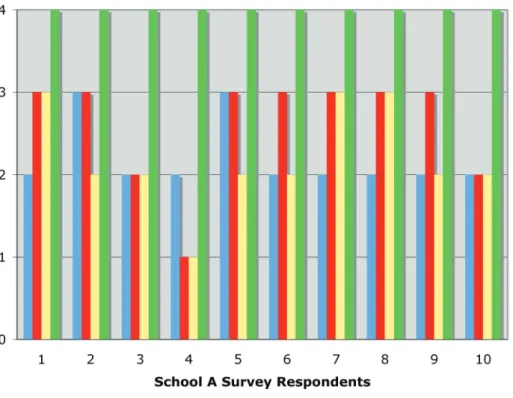
Figure 1 presents the results for all 10 respondents of the survey from School A, Questions 1 to 4 of Section 2. It can be seen that overall there was a fair amount of consistency in teacher ratings, particularly for Question 4 when teachers were asked to select the group of descriptors that best described the way CMIT has a ‘Parent and Community Focus’ in their school. All teachers selected Descriptor Group 4 for this aspect, indicating that parents may have minimal involvement in CMIT and limited information about how it operates in the school.
2009 RepoRt
o
u
t
h
w
a
l
e
S
D
e
pa
R
t
m
e
N
t
o
f
e
D
u
c
a
t
io
N
&
t
R
a
iN
iN
g
Figure 1. School A survey responses to school and classroom aspects of CMIT Section 2 Questions 1 – 4.
All but two of the respondents considered that Descriptor Group 2 best describes the way CMIT operates in their school at the whole school management level. This means that CMIT is perceived by the majority of respondents to be operating at quite a sophisticated level according to the planning matrix (Appendix B). For instance, a ‘Stage team’ approach to CMIT planning takes place, with ongoing professional learning meetings occurring, provisions for the training of new staff and improvements in teaching and learning is evident as a result of CMIT implementation.
Regarding teaching practices at the classroom level, seven of the respondents considered CMIT to be operating most like the descriptors contained in Group 3. That is, the results of individual assessment interviews (SENA results) and the LFIN are used initially to form ability groups but there may be limited opportunities for students to move between groups throughout the year. Teachers operating at this level of CMIT implementation generally encourage students to explain their mathematical thinking strategies and incorporate concrete materials into chosen learning experiences. Two respondents considered that teaching practices operate at the second level (Respondents 2 and 10) while another (Respondent 4) thought a more robust implementation was evident, giving a Level 1 rating.
10
2009 RepoRt
C
2
0
0
9
,
N
e
w
S
o
u
t
h
w
a
l
e
S
D
e
pa
R
t
m
e
N
t
o
f
e
D
u
c
a
t
io
N
&
t
R
a
iN
iN
g
Assessment descriptors were perceived to be operating similar to Group 2 by the majority of School A survey respondents, with others selecting Group 1 and Group 3 Descriptors. This indicates that at the very least, all respondents considered that student progress is monitored via the SENA, with the majority agreeing that teachers generally understood the LFIN and used it flexibly to guide assessment and grouping for instructional purposes.
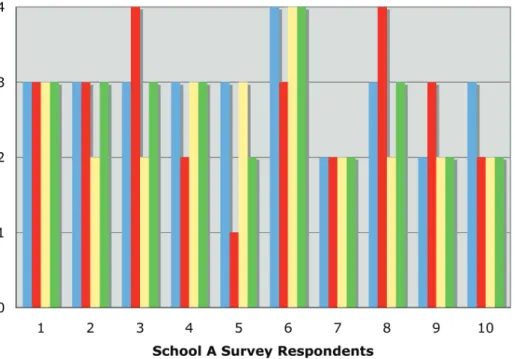
Figure 2 presents the same information for School B. Taken as a whole, the results indicate a more robust implementation of CMIT is occurring at this school than either School A or School C. There were more individual respondents selecting Descriptor Group 1 and 2 ratings relating to all aspects on the CMIT planning matrix than in the other case study schools—except for the Parent and Community Focus, but this is still considered by the majority of respondents to be operating in a more robust way than elsewhere. In particular, five of the eight respondents considered assessment practices at the school were best described by Group 1 or 2 Descriptors. This means that the majority of respondents perceived there to be an understanding by teachers at School B of the LFIN and that flexible use of the SENA guided their assessment of students and informed their instructional practices. Similarly, the majority of respondents selected Group 1 or 2 Descriptors to indicate the extent to which CMIT impacted on teaching practices at the classroom level. Again, this indicates that the majority of respondents from School B consider themselves and their colleagues to have a thorough understanding of the LFIN and that this knowledge is used by teachers to guide their instructional decision making.
Figure 2. School B survey responses to school and classroom aspects of CMIT Section 2 Questions 1 – 4.
2009 RepoRt
o
u
t
h
w
a
l
e
S
D
e
pa
R
t
m
e
N
t
o
f
e
D
u
c
a
t
io
N
&
t
R
a
iN
iN
g
Case study School C results for Section 2 Questions 1 to 4 are represented in Figure 3. Overall, the 10 survey respondents from School C indicate that CMIT is perceived to be operating around Descriptor Group 2 or 3 levels for most aspects of the program. No respondent used descriptors from Group 1—the most robust implementation of CMIT as described in the Planning Matrix—to describe any aspect of CMIT. Similar to perceptions at School A, the majority of respondents consider the Parent and Community Focus of CMIT to be operating at Group 4 Descriptors, but with some indicating Group 3, possibly due to the use of parent-helpers in the K–2 classrooms.
Whole school management descriptors were considered by just over half of School C respondents (six out of ten) to be operating at Group 2, with all others selecting Group 3 descriptors. This means that for the majority of respondents, a Stage team approach to the coordination and planning of CMIT is operating and that provision for new staff to be trained is available. It also indicates that professional learning in CMIT is being provided, possibly by the school-based facilitator, and that external support is also sought.
The two respondents indicating a Group 2 Descriptor for the way CMIT operates in relation to Teaching Practice were both Kindergarten teachers. This suggests that CMIT might be operating in a more robust way for some teaching Stage teams than others at School C.
Figure 3. School C survey responses to school and classroom aspects of CMIT Section 2 Questions 1 – 4.
12
2009 RepoRt
C
2
0
0
9
,
N
e
w
S
o
u
t
h
w
a
l
e
S
D
e
pa
R
t
m
e
N
t
o
f
e
D
u
c
a
t
io
N
&
t
R
a
iN
iN
g
Questions 5 to 8 of Section 2 on the survey aimed to elicit respondents’ personal perceptions about the level to which they understood and felt confident using the LFIN to assess children’s learning and plan appropriate instruction. Teachers were asked to use a rating scale from 0 (no understanding or confidence) to 4 (excellent /extensively). Hence, for this set of survey questions, the higher ratings generally indicate more desirable and confident responses in terms of teachers understanding of the LFIN and the perceived extent to which it impacted on their pedagogy. However, without an explanation or rationale for each rating, caution should be used interpreting the results. For instance, during site visits, interviewees were asked to rate themselves on similar items and to explain their rating. While some interviewees rated themselves only a 1 or a 2 for their understanding of the LFIN (e.g., Respondent 5 from School A), some explained the fairly low rating was because they now know that they “have a lot more to learn”. This may also be a reason why some teachers did not wish to indicate Excellent (Level 4) for any aspect of their understanding of the LFIN despite their obvious familiarity working with the LFIN in the classroom. Hence, because clarification of ratings was sought during site visits, results will be discussed in more detail when interview data is presented for each school. An overview of the results for the survey questions for each school now follows.
The results for School A survey responses to Section 2 Questions 5 to 8 are presented in Figure 4.
2009 RepoRt
o
u
t
h
w
a
l
e
S
D
e
pa
R
t
m
e
N
t
o
f
e
D
u
c
a
t
io
N
&
t
R
a
iN
iN
g
Generally, respondents rated their understanding of the LFIN as Adequate (Level 2) or higher with the majority considering their understanding as Good (Level 3). Respondent 6, who displayed the most positive responses overall, indicated on the survey that she is also the CMIT Facilitator so it is understandable that this respondent would be more experienced and confident in most aspects of the LFIN and its impact on instruction. Six respondents (Respondents 2, 3, 7, 8, 9, and 10) rated Question 7 (confidence identifying a student’s stage of development on the LFIN), as only Adequate. Once again, explanations for these ratings are important and will be reported with the interview data. However, given that four School A respondents indicated that they had less than 12 months experience implementing CMIT in their classrooms (Respondents 2, 5, 9 and 10) it is highly likely that this lack of experience influenced their self-ratings on these items. Survey respondents from School B (see Figure 5) generally indicated a ‘Good’ (Level 3) rating to each of the questions concerned with their understanding and implementation of the LFIN. Half of the respondents considered that there had been ‘Extensive’ (Level 4) increases in their awareness of children’s development in number knowledge and strategies as a result of their introduction to the LFIN. Only one respondent (Respondent 5) selected ratings at ‘Minimal’ (Level 1) for their understanding, increase in awareness and for their confidence identifying the stage of development using the LFIN. Interestingly, the same respondent considered that the LFIN had a Level 2 impact on their instruction. Clarification as to the rationale for Respondent 5’s ratings may be provided by a closer examination of the interview data discussed later in this report.
14
2009 RepoRt
C
2
0
0
9
,
N
e
w
S
o
u
t
h
w
a
l
e
S
D
e
pa
R
t
m
e
N
t
o
f
e
D
u
c
a
t
io
N
&
t
R
a
iN
iN
g
Results for the same items for School C respondents are presented in Figure 6. Taken as a whole, the range in responses is more varied than for Schools A and B with a greater number of respondents selecting Level 1 or 2 ratings to describe their understanding and confidence working with the LFIN. Importantly, respondents who rated any aspect relating to their knowledge and implementation of the LFIN as a Level 3 or 4 were either Kindergarten teachers (Respondents 2, 3 and 9), the CMIT Facilitator (Respondent 8) or executive staff (Respondent 1 Year 5 teacher) with at least 4 to 5 years experience working with CMIT in their classrooms. The remaining respondents (Respondents 4, 5, 6, 7 and 10) each had less than 2 years experience implementing the program with Respondent 10 indicating less than a few months experience. Respondent 3, who indicated the highest level of confidence about their understanding of the LFIN and their ability to use it to identify children’s developmental stages and plan for instruction also had the greatest number of years experience working with CMIT in the classroom (approximately 6 years). While reasons for individual ratings still need to be clarified via interview data, there is a clear trend at School C indicating that the more exposure to CMIT the more teachers felt confident about their understanding of the LFIN and their ability to use it to guide their assessment and instructional decision-making.
Figure 6. School C responses to Section 2 Questions 5 - 8 SectioN 3 SuRvey ReSultS
Section 3 of the survey presented an excerpt from an interview in which a child’s early arithmetical strategies were being assessed. Respondents were required to respond with advice for the teacher of
2009 RepoRt
o
u
t
h
w
a
l
e
S
D
e
pa
R
t
m
e
N
t
o
f
e
D
u
c
a
t
io
N
&
t
R
a
iN
iN
g
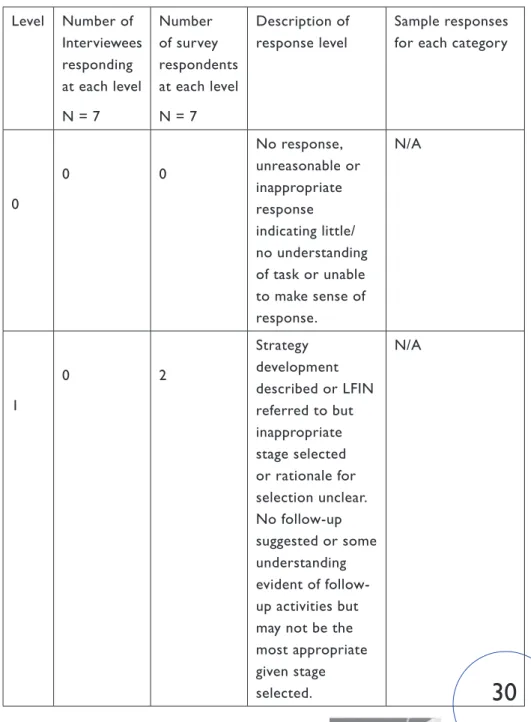
this child regarding (a) the child’s numerical development, and (b) what to teach the child. Due to the enormous variation in responses to this item, a rubric was established to assist with analysis of respondents’ comments. The rubric, along with the number of respondents from each school falling into each level and sample responses, is presented in Table 1. As indicated earlier, an allocation to a particular level on the rubric does not indicate that one teacher is considered a better teacher than any other—it simply means that they are considered to have a different level of understanding of the LFIN, can articulate a response more clearly, or are perhaps less or more likely to utilise the LFIN in their instructional decision-making.
tabLe 1
Rubric for analysing teachers’ responses to the assessment scenario (Section 3) of the survey School A (n = 10), School B (n = 8), School C (n = 10), Total (n = 28)
Level Number of teachers responding at each level per school & total (%) for all schools
Description of
response level Sample responses and list of respondents in each category
0
School A = 2 School B = 0 School C = 3 Total = 5 (17.8%)
No response, unreasonable or
inappropriate response indicating little/no understanding of task or unable to make sense of response.
No response
(Respondents 10, 20 & 25).
Depends on how old the child is (Respondent 23).
Respondents 4, 10, 20, 23, 25
16
2009 RepoRt
C
2
0
0
9
,
N
e
w
S
o
u
t
h
w
a
l
e
S
D
e
pa
R
t
m
e
N
t
o
f
e
D
u
c
a
t
io
N
&
t
R
a
iN
iN
g
1
School A = 3 School B = 2 School C = 3 Total = 8 (28.5%)
Strategy development described or LFIN
referred to but inappropriate stage selected. No follow-up suggested or some understanding evident of follow-up activities but may not be the most appropriate given stage selected.
Child is counting from 1 for addition (Respondent 7)
Teach them to count-on for quicker number recognition (Respondent 9)
Child is emergent and needs the more efficient method of counting-on from larger number (Respondent 14)
Respondents 6, 7, 9, 14, 15, 19, 21, 22
2
School A = 3 School B = 1 School C = 3 Total = 7 (25%)
Appropriate strategy described or LFIN referred to. Follow-up learning experiences mostly appropriate.
Perceptual level. Teach child to count on from the larger number (Respondent 17)
Respondents 1, 2, 5, 17, 24, 27, 28
2009 RepoRt
o
u
t
h
w
a
l
e
S
D
e
pa
R
t
m
e
N
t
o
f
e
D
u
c
a
t
io
N
&
t
R
a
iN
iN
g
3
School A = 2 School B = 4 School C = 1 Total = 7 (25%)
Comprehensive understanding of strategy development LFIN and/or uses LFIN to justify choice of appropriate follow-up learning experiences.
Student is Perceptual moving to Figurative. Needs to recognise concealed numbers e.g. conceal some counters and say how many altogether. Child must calculate how many are concealed. (Respondent 3)
Level 1 Perceptual. Still needs concrete materials and counts from 1. Reinforce counting forwards and backwards to increase confidence, working towards counting on from numbers other than 1. Activities such as ‘Rabbit ears’ will help reduce reliance on concrete materials (Respondent 16)
Respondents 3, 8, 11, 12, 16, 18, 26
Three survey respondents (1 from School A and 2 from School C) did not respond to this section on the survey so were given an automatic Level 0 rating according to the rubric. Only two other respondents received this level rating due mainly to the fact that their answers did not explicitly address the question.
Seventy-eight percent of respondents (23 out of 28) provided responses that were rated at Level 1 or above, with 50% receiving ratings in the top two levels. Respondents from Schools A and C dominated Level 1 and 2 ratings indicating that respondents from these two schools were clearly able to use the available information to either identify the type of strategy used by the child in the scenario or suggest appropriate follow-up instruction. However, Level 1 type responses usually did not refer to a specific stage from the LFIN or, if they did,
18
2009 RepoRt
C
2
0
0
9
,
N
e
w
S
o
u
t
h
w
a
l
e
S
D
e
pa
R
t
m
e
N
t
o
f
e
D
u
c
a
t
io
N
&
t
R
a
iN
iN
g
14 suggested the child was demonstrating ‘Emergent’ characteristics when a ‘Perceptual’ strategy assessment is more appropriate.
Respondents providing Level 2 type responses usually provided an appropriate description of the strategy being used by the child or used the correct terminology from the LFIN. However, they normally suggested follow-up instruction indicating the child now needed to “count-on from the larger number” (e.g., Respondent 17). While this is certainly a necessary strategy development suggestion for the future of this child, there are a few more urgent skills and processes this child needs prior to being able to develop the more sophisticated strategy of counting-on. Such appropriate strategy development was more typically suggested by responses rated as Level 3.
Level 3 type responses were provided by a quarter of all respondents. Such responses provided evidence of a comprehensive understanding of strategy development via their ability to analyse the information provided in the scenario. They were also able to use their knowledge of the LFIN and strategy development to justify their choice of appropriate follow-up learning experiences. For instance, Respondent 16 detailed how the child in the scenario “Still needs concrete materials and counts from 1. Reinforce counting forwards and backwards to increase confidence, working towards counting on from numbers other than 1.” The same respondent was also able to suggest appropriate activities such as ‘Rabbit ears’ and to justify their selection: “(This) will help reduce (the child’s) reliance on concrete materials”.
Over half of the responses demonstrating Level 3 characteristics were from School B respondents. Consistent with results from Sections 1 and 2 on the survey, respondents from this school not only possess the most experience with CMIT in terms of the number of years they have implemented it in their classrooms, but they also generally rate themselves more highly in terms of their confidence in understanding and using the LFIN to guide their instruction. Importantly, the trend across all three case study schools linking length of time in which respondents have implemented CMIT with their self-identified levels of understanding, and confidence using, the LFIN is further supported by the results of Section 3 on the survey. However, it should not be assumed that ‘time’ by itself is the definitive factor for improving teachers’ abilities to understand and integrate the LFIN into their pedagogy. The interview data will be critical in identifying what these schools are doing with their ‘time’ that seems to be having such a positive impact on teachers’ abilities to implement CMIT.
2009 RepoRt
o
u
t
h
w
a
l
e
S
D
e
pa
R
t
m
e
N
t
o
f
e
D
u
c
a
t
io
N
&
t
R
a
iN
iN
g
i
NteRview aNDD
ocumeNtD
ataA major purpose of the interviews was to validate information obtained from the survey data collected from each of the case study schools. In particular, interviews were a critical means by which teachers’ reasons for their personal ratings about the LFIN and its perceived impact on their knowledge and instructional decision-making could be verified. The interviews established background biographical details for each interviewee before seeking information specifically related to professional learning and the implementation of CMIT and the LFIN. Teachers were then asked about their confidence concerning the identification of individual students’ on the LFIN and the subsequent planning for student instruction (see Appendix D for the interview questions). The discussion of interview data for each case study school is presented separately. Where appropriate, comparisons between schools are made to help highlight commonalities and differences. Individual and stage-team teaching programs were presented by a few interviewees at each of the schools to help explain and justify descriptions of their planning and teaching practices. Reference to these documents is integrated into the discussion of interview data. School a
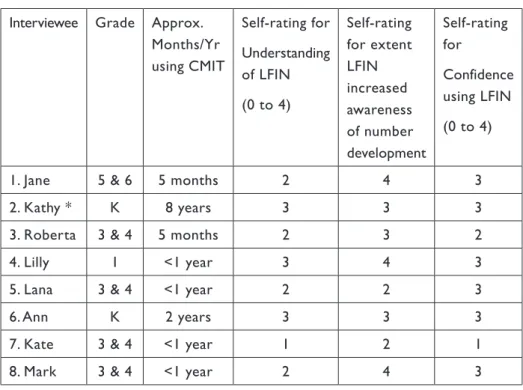
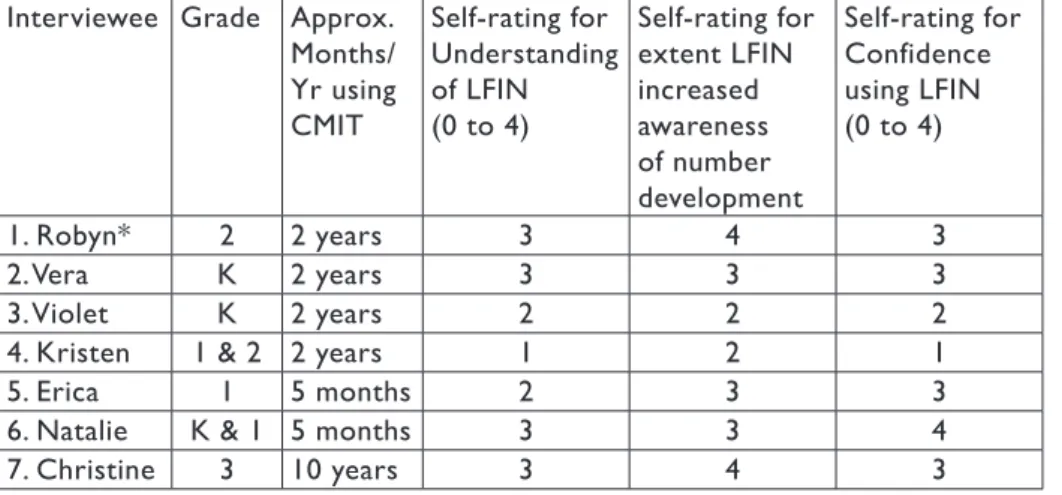
Eight teachers from School A were interviewed, including two Kindergarten teachers (one of whom is the newly-appointed Facilitator), one Year 1 teacher, four teachers of mixed Year 3/4 classes and one Year 5/6 teacher. As mentioned earlier, CMIT had been operating in Infant classrooms for the past three years and was only introduced to teachers of Years 3 and 4 in term 2 of the current year. Hence, despite most interviewees being quite experienced teachers (five out of eight teachers had more than 6 years experience and two had more then 10 years experience), the majority of teachers interviewed had only one year or less experience implementing CMIT. The Facilitator, on the other hand, had implemented the program at a previous school so had more than 7 years experience. Background information for each interviewee, along with their self-ratings for their understanding and confidence using the LFIN is presented in Table 2.
20
2009 RepoRt
C
2
0
0
9
,
N
e
w
S
o
u
t
h
w
a
l
e
S
D
e
pa
R
t
m
e
N
t
o
f
e
D
u
c
a
t
io
N
&
t
R
a
iN
iN
g
Table 2. Summary of background information and their self-ratings for their understanding and confidence using the LFIN Interviewee Grade Approx.
Months/Yr using CMIT
Self-rating for Understanding of LFIN (0 to 4)
Self-rating for extent LFIN increased awareness of number development
Self-rating for
Confidence using LFIN (0 to 4)
1. Jane 5 & 6 5 months 2 4 3
2. Kathy * K 8 years 3 3 3
3. Roberta 3 & 4 5 months 2 3 2
4. Lilly 1 <1 year 3 4 3
5. Lana 3 & 4 <1 year 2 2 3
6. Ann K 2 years 3 3 3
7. Kate 3 & 4 <1 year 1 2 1 8. Mark 3 & 4 <1 year 2 4 3
* CMIT Facilitator Generally, teachers at School A received their CMIT training in stage teams. This was considered a benefit by Ann, a Kindergarten teacher, because “you can discuss it with everyone … you start to plan what you’re going to change and you have that shared experience to refer back to”. Similarly, a Year 4 teacher with only a few months experience implementing CMIT, considered the team training “a real positive thing, because we’ve been able to pull out the Framework (at stage meetings) and everybody knows what it’s about” (Mark). The fact that nearly the entire K–4 staff was implementing CMIT meant that “we’ve got that flow of information coming up about the kids” and there is a lot more “sharing of information” with teachers from other stages. Sharing of information across stages and whole school professional development in CMIT was further fostered through a process of classroom observation visits. Ann explained, “Kindergarten teachers saw two Stage 1, and the Stage 1 saw a Kindergarten and a Stage 2, and Stage 2 teachers saw a Kindergarten and Stage 1”. Pre-observation visits to “break the ice” and debriefing sessions were considered to have “opened-up the professional discussion” as teachers started asking one another for specific ideas about how to teach concepts they did not feel confident teaching.
Another positive outcome from undertaking training in groups noted by interviewees at School A, was how changes to programming and teaching practices occurred more easily and were consistent amongst stage team members. For instance, Mark noted that Stage 2 teachers