691
© 2018 by the Serbian Biological Society How to cite this article: Ćirić M, Nikolić N, Krizmanić J, Gavrilović B, Pantelić A, Petrović VM. Diatom diversity and ecological status of the Lasovačka and Lenovačka streams near Zaječar: Consideration of WFD implementation in Serbia. Arch Biol Sci. 2018;70(4):691-8.
Diatom diversity and ecological status of the Lasovačka and Lenovačka streams near
Zaječar: consideration of WFD implementation in Serbia
Miloš Ćirić1,*, Nataša Nikolić2, Jelena Krizmanić2, Bojan Gavrilović3, Ana Pantelić4 and Vladimir M. Petrović5
1University of Belgrade, Scientific Institution Institute of Chemistry, Technology and Metallurgy, Njegoševa 12, 11000
Belgrade, Serbia
2University of Belgrade, Faculty of Biology, Studentski trg 16, 11000 Belgrade, Serbia
3Serbian Academy of Sciences and Arts, Geographical Institute “Jovan Cvijić”, Department of Physical Geography, Đure
Jakšića 9, Belgrade, Serbia
4University of Belgrade, Scientific Institution Institute of Chemistry, Technology and Metallurgy, Centre of Excellence in
Environmental Chemistry and Engineering, Njegoševa 12, 11000 Belgrade, Serbia
5University of Belgrade, Scientific Institution Institute of Chemistry, Technology and Metallurgy, Department of Ecology and
Technoecomonics, Njegoševa 12, 11000 Belgrade, Serbia
*Corresponding author: [email protected]
Received: April 12, 2018; Revised: June 1, 2018; Accepted: June 13, 2018; Published online: July 17, 2018
Abstract: The development and improvement of the monitoring system of rivers according to the requirements of the Water Framework Directive (WFD) is essential for all European states because assigning a wrong ecological status class (misclassification) to a water body can have significant economic consequences. In order to point out some of the key issues of WFD implementation in Serbia, we conducted a one-year study of the composition and abundance of diatoms in the phytobenthos in two streams, the Lasovačka and Lenovačka, in eastern Serbia. The physicochemical quality elements were also used in the assessment of their ecological status. The diatom community exhibited a higher species richness in the Lasovačka (88 taxa) than in the Lenovačka stream (63 taxa). Such a detailed study enabled us to record some of the rare taxa, e.g. Caloneis budensis in the Lasovačka, which was the first finding of this species in Serbia. The Lasovačka and Lenovačka streams were downgraded to moderate and poor ecological status, respectively, because of the high nitrogen load. Since the monitoring results based on the diatom indices resulted in the assignment of two streams to a good ecological status, the possible reason for the mismatch between the biological and physicochemical quality elements could be due to the lack of analysis of benthic invertebrate fauna or the application of diatom indices that are insufficiently sensitive to the specific environmental pressure. The results of this study show that conducting a comprehensive ecological investigation of rivers within the framework of the WFD in Serbia is urgently needed.
Key words: diatoms; WFD; new record; ecological status; streams
INTRODUCTION
From the moment the EU Water Framework Directive (WFD) was enforced, it was continuously deployed, providing ecological assessment and classification systems with the aim of achieving “good ecological status” and “good surface water chemical status” in all types of surface water bodies by 2015 [1]. As a non-EU state, Serbia took part in the implementation of this EU water policy after a delay of more than ten years. The first monitoring program according to the WFD
was performed in Serbia in 2012 [2], but it has not been fully implemented [3].
system of monitoring based on the WFD was applied in Serbia.
The aims of this study were to analyze the diver-sity of diatom communities in the Lenovačka and Lasovačka streams during a one-year period, and to assess the ecological status of the streams using differ-ent chemical parameters of water and diatom indices proposed by Serbian legislation, as well as the EPI-D and the Trophic Diatom Index (TDI) which are ap-plied in other EU countries. The achievement of the first goal will contribute to better understanding of diatom flora in similar habitats, while the second aim of the authors was to focus on some important issues of WFD application in Serbia.
MATERIALS AND METHODS
Study site and sampling plan
In the past, the Lenovačka and the Lasovačka streams were two major tributaries of the Grliška River, the left tributary of Beli Timok (the rivers Beli and Crni Timok form Veliki Timok, the right tributary of the Danube and the largest river in eastern Serbia). Both streams receive water from several small tributaries. In 1989 a dam was constructed on the Grliška River and a reservoir for water supply was formed about 16 km southwest of the city of Zaječar in eastern Ser-bia. A brief description of the climatic conditions and precipitation of the studied area is given in Gavrilović et al. 5].
The samples for water quality and diatom analy-ses were collected monthly from April 2012 to March 2013 at one site in each stream (the Lenovačka stream (43°48’42.06’’N; 22°11’36.84’’E, 198 m a.s.l.) and the Lasovačka stream (43°48’19.38’’N; 22°12’6.84’’E, 213 m a.s.l.) (Supplementary Fig. S1)). The Lenovačka and the Lasovačka streams are shallow watercourses with large differences in depth, width and water velocity. Thus, during high flow in April, the estimated veloci-ties (the time it takes for a floating object to travel 10 m in the middle of a stream) were 0.26 m/s and 0.45 m/s, respectively. At the sampling sites during months with continuous water flow, the stream width varied from 2-6 m in the Lenovačka, and from 3-11 m in the Lasovačka stream, while the depth changed
from 3-30 cm and 8-50 cm, respectively. Although the stream banks were surrounded by forest trees, for the purpose of sampling, open spots (without shade) were chosen. Since the first of the abovementioned streams dries up almost regularly every year, samples from the Lenovačka stream were not taken in August, Septem-ber and OctoSeptem-ber in 2012. In addition, sampling of the two streams was not conducted in December 2012 due to the high snow cover and inaccessibility of the sites.
Water quality analysis
To assess the ecological status of the two streams, the following physical and chemical water parameters were monitored: pH, dissolved oxygen (DO), total ammonia nitrogen (TAN), nitrates (NO3-), total phos-phorus (TP) and chlorides (Cl-); water temperature (T), conductivity (COND) and nitrites (NO2-) were also measured. A water field kit MULTI 340i/SET (WTW, Weilheim, Germany) was used to record T, DO, pH and COND in situ. Water samples for other parameters were adequately transported (as quickly as possible at 4ºC) and analyzed at the Institute of Chemistry, Technology and Metallurgy (University of Belgrade) and the Public Water Company in Zaječar. TAN, NO2- and TP were determined with a UV Vis spectrophotometer (PerkinElmer Inc., Waltham, USA) after direct nesslerization [6], formation of the azo dye [7] and according to the ammonium molyb-date method after persulfate digestion [8], respec-tively. NO3- was measured by ion chromatography (Dionex 2020i); Cl- was analyzed according to the argentometric method [9].
Analysis of diatom community
[11-15]. In order to calculate the relative abundance of diatoms growing on stones, 400 valves per sample were counted. According to the indicator values of the identified taxa, diatom indices were calculated in the streams using OMNIDIA 6 software. Three diatom indices, Indice de Polluo-Sensibilité (IPS), Comission for Economical Community (CEE) and EPI-D were used for ecological status assessment, while the TDI was used as an indicator of the streams’ trophic state. The same software was used for Shannon-Wiener in-dex calculation.
Data analysis
The data used in this study were monthly values of two different sets: physical and chemical parameters and diatom indices. For the first set, different percen-tiles were computed using an empirical distribution function with interpolation (MS Excel) method (e.g. the 10th percentile for DO and the 80th percentile for other parameters). For the second data set, basic de-scriptive statistics were calculated using STATISTICA 6.0. Since the recommended class limits exist only for IPS and CEE in the Serbian legislation, for the EPI-D and TDI indices we used the boundaries from some EU countries as an illustration of their applicability to our river systems [3].
RESULTS
Physical and chemical parameters of water
Physical and chemical water parameters of the Lasovačka and Lenovačka streams showed seasonal variations that are characteristic for small and me-dium lowland watercourses of the North Temperate Zone. In the Lasovačka stream, the highest water tem-perature was recorded in July (20.0ºC), while in the Lenovačka the maximum was observed one month before (31.2ºC). Water was the coldest in January in both streams, 4.5ºC and 1.0 ºC, respectively. In most samples from the Lasovačka stream, DO was above 8.5 mg/L (Table 1), except in August and September when it was 8.2 mg/L; in the Lenovačka, the maximum was recorded in January (14.6 mg/L) and minimum in June (10.3 mg/L).
Table 1. Water quality parameters in two investigated streams ex-pressed as minimum and maximum values. Extreme and average values of measured physical and chemical water parameters in the Lasovačka and Lenovačka streams are presented.
Parameter Unit Lasovačka stream Lenovačka stream
pH 7.1-8.4 (7.9) 7.1-8.6 (8.1)
T ºC 4.5-20.0 (13.0*) 1.0-31.2 (11.0*)
COND µS/cm 373-600 (507) 230-900 (647*)
DO mg/L 8.2-11.8 (9.9) 10.3-14.6 (12.3)
TAN mg/L 0.00-0.25 (0.11*) 0.02-0.30 (0.23*)
NO3- mg/L 0.0-5.8 (1.8*) 0.4-6.8 (3.3*)
NO2- mg/L 0.00-0.02 (0.01*) 0.00-0.04 (0.01*)
TP mg/L 0.01-0.64 (0.03*) 0.01-0.15 (0.06*)
Cl- mg/L 1.9-9.0 (6.0*) 2.6-36.0 (13.3*)
*The mean/median values are in brackets. If a data set deviated from normality, then the median (marked with an asterisk) was used as a measure of central tendency.
T – water temperature, COND – conductivity, DO – dissolved oxygen, TAN – total ammonia nitrogen, NO3- – nitrates, NO2- – nitrites, TP –
total phosphorus, Cl- – chlorides.
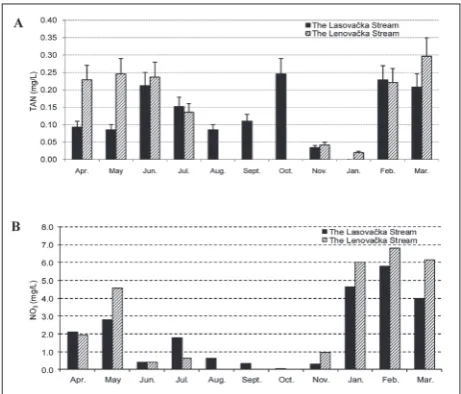
When it comes to nitrogen species in the Laso-vačka stream, an increased concentration of TAN was recorded at the beginning of summer (0.21 mg/L) and autumn (0.25 mg/L), and in winter (0.21-0.23 mg/L) (Fig. 1A). Nitrates were highest in 2013 and in the first two months of the study (Fig. 1B). In addition,
Fig. 1. Seasonal dynamics of nitrogen compounds in two inves-tigated streams. A – Measured values of total ammonia nitrogen (TAN) concentrations in water. Error bars indicate uncertainty
in measurements (for TAN: ±18%); B – Measured values of NO3
-concentration in water. Error bars indicate uncertainty in meas-urements (for NO3-:11%). Monthly variation of nitrogen species
(TAN and NO3-) in the Lasovačka and Lenovačka streams from
the low levels of TP recorded in the first half of the research period were followed by a noticeable peak in October (Fig. 2).
In the Lenovačka stream, the highest concentra-tion of TAN was recorded in March (0.30 mg/L), while the minimum was recorded in January (0.02 mg/L). The NO3- patterns for the two streams were similar, although the Lenovačka had mostly higher concen-trations of nitrates during the study (Fig. 1B). Finally, the maximum of TP in the Lenovačka stream was in winter (0.15 mg/L).
Diversity of diatoms
Higher species richness was recorded in the Lasovačka stream than in the Lenovačka. A total of 88 different diatom taxa from 38 genera were identified in 11 sam-ples taken from the Lasovačka. The highest number of taxa belonged to the genera Gomphonema (9) and Navicula (7). A total of 63 taxa from 26 genera were identified in 9 samples from the Lenovačka stream. The highest number of taxa belonged to the genera Navicula (8) and Nitzschia (7).
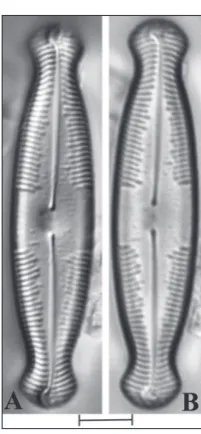
During the floristic analysis of diatoms in the Lenovačka stream, Caloneis budensis (Grunow) Kram-mer was recorded. As far as we know, this is the first finding of this taxon in Serbia. Caloneis budensis (Grunow) Krammer (Fig. 3); Basionym: Navicula bu-densis Grunow; Synonym: Pinnulariaappendiculata var. budensis (Grunow) Cleve; Heterotypic synonym: Caloneismacedonica Hustedt [11] (p. 19).
We recorded a single specimen with lanceo-late valve and distinctly wide, capitate apices. Valve
length was 36.43 μm, breadth 8.1 μm. The axial area is lanceolate and very narrow at the apices, widening towards the center to form a transverse fascia, wide towards the margin. Raphe is lateral, arched, with ex-ternal proximal raphe ends dilated. Striae are radiate at the center, becoming convergent towards the apices. Striae are crossed by distinct longitudinal lines on ei-ther side of the axial area. Striae number 20/10 µm. C. budensis was recorded only in a sample collected in January in conditions of very low temperature, al-kaline pH, moderate electrolyte concentrations and high nitrate concentration (Fig. 1B, Table 1).
The composition of the community that devel-oped on gravel in the Lasovačka stream bed showed pronounced seasonal variations. In the Lasovačka stream, the diversity of diatoms peaked in January 2013 (H=3.79) and was minimal in October 2012 (H=1.15). The diversity of diatoms in the Lenovačka showed the highest value in April 2012 (H=3.46), while the mini-mum was recorded in January 2013 (H=1.93).
When it comes to seasonal dynamics of diatom communities, the two investigated streams showed slightly different patterns of dominant species shifts. In the Lasovačka stream, Achnanthidium minutis-simum var. minutissimum prevailed in April 2012 (30.7%), while in the early summer of the same year Amphora pediculus and Gomphonema tergestinum were the most abundant diatoms, with more than 30% contribution to the total abundance. In August, more than half of the diatom species growing on stones in
Fig. 2. Changes in total phosphorus (TP) concentrations in two streams during the research. Error bars indicate uncertainty in measurements (for TP: ±13%). Monthly variation of total phos-phorus in the Lasovačka and Lenovačka streams from April 2012 to March 2013.
this stream belonged to Rhoicosphenia abbreviata. In the following months, in autumn and the beginning of winter (January 2013), the epilithic diatom commu-nity was almost exclusively dominated by A. pediculus (32.3-85.0%). Finally, in the two last winter months of the study, only Humidophila contenta and Merid-ion circulare var. circulare had more than one-fifth contribution to the total abundance. Similar to the Lasovačka stream, in the Lenovačka in April, individ-uals of A. minutissimum var. minutissimum were the most abundant (18.7%), but in this stream A. minutis-simum var. minutissimum was followed by several codominant species: Navicula reichardtiana (17.7%), Nitzschia dissipata (10.5%) and N. fonticola (16.7%). During the remaining study period, A. pediculus was the most frequently found diatom in the Lenovačka stream, with 53-71% of the total abundance.
Water quality assessment
The two tributaries of the Grlište Reservoir are not listed in the official guidelines for surface and ground-water bodies [16] because they can be considered small streams. Nevertheless, they are very important as the main water source of the aforementioned drinking water reservoir, and according to their characteristics they can be classified as type 3 water bodies. Another reason why we think that these streams should be clas-sified as type 3 water bodies is because the reservoir was created on the river of type 3 water body.
Assessment based on physical and chemical water parameters
As can be seen in Table 2, the Lasovačka and the Lenovačka streams can be assigned to the third and fourth classes, respectively, based on national legislation [17], which is in compliance with the WFD. Although the Lasovačka and Lenovačka streams could be allo-cated to a high or good class based on DO, TP and Cl-, the high nitrogen loading downgraded the quality of the water bodies to a moderate and poor status.
Assessment based on diatom indices
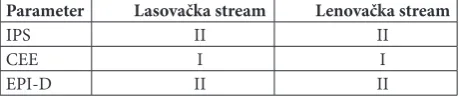
Two diatom indices (IPS and EPI-D) showed a good ecological status (second class), while the CEE
indi-cated first class in both streams (Table 3). In addition, the TDI index pointed to moderate to elevated nutri-ent levels in the Lasovačka stream (TDI: 52.0-79.3), while in the Lenovačka, the TDI values suggested an even higher trophic status (TDI:64.7-80.8). However, there were some differences in seasonal dynamics between the IPS and the other two indices used for ecological status assessment. While the values of CEE and EPI-D were repeatedly inside the boundaries of one class (CEE – first class, EPI-D – second class), the IPS fluctuated across the upper and lower limits of “good” class.
Table 2. Determination of WFD classes based on the 10th per-centile for DO and the 80th percentile for other parameters in two investigated streams. The ecological status assessment of the Lasovačka and Lenovačka streams was based on the physico-chemical quality elements.
Parameter Unit Lasovačka stream Lenovačka stream
pH -* -*
DO mg/L II I
TAN mg/L III III
NO3- mg/L III IV
TP mg/L II II
Cl- mg/L I I
Final III IV
DO – dissolved oxygen, TAN – total ammonia nitrogen, NO3- –
nitrates, TP – total phosphorus, Cl- – chlorides. Water quality class
(WFD): I – high, II – good, III – moderate, IV – poor, V – bad. * – according to the national legislation I, II, III and IV classes have the same upper and lower pH limits (6.5-8.5), so this parameter was omitted from the assessment of the ecological status because the 80th
percentile for pH in both streams fell into this range.
Table 3. Determination of WFD classes based on diatom indices in two investigated streams. Ecological status assessment of the Lasovačka and Lenovačka streams was based on the biological quality elements (diatom indices).
Parameter Lasovačka stream Lenovačka stream
IPS II II
CEE I I
EPI-D II II
The classes were based on the average index values for the study period. Ecological status class (WFD): I – high, II – good, III – moderate, IV – poor, V – bad.
DISCUSSION
A detailed one-year analysis of physicochemical pa-rameters and phytobenthic communities was con-ducted for the first time for two tributaries of the Grliška River. The Lasovačka and Lenovačka streams belong to the type 3 water body, i.e. streams of mean depth at an altitude of up to 500 m [17]. Based on the examined chemical parameters and according to the WFD, the Lasovačka stream had a moderate (i.e. third class water quality), while the Lenovačka stream had a poor ecological status. Although for both streams the concentrations of DO and TP assigned them to second class quality, TAN and NO3- concentrations were elevated, which lowered their water quality. Ku-mar and Oumen [18] state that nitrate increase may be due to an anthropogenic impact, agricultural ac-tivity and increased precipitation; since the streams are located in the vicinity of agricultural land, it is possible that this was the reason for the high nutrient load. Finally, the values of the TDI index indicated a nutrient-rich environment in both streams and a higher trophic status for the Lenovačka stream than for the Lasovačka, which was in agreement with the results of chemical analyses of the water. Thus, for further WFD implementation in Serbia this index could be taken into consideration for the assessment of a river’s trophic state.
The species recorded in the Lasovačka and Le-novačka streams are widely distributed in freshwater ecosystems [15]. The most numerous taxa of Gompho-nema and Navicula are common in streams of Europe and Serbia [3,19]. During the study, C. budensis was recorded in the Lasovačka River, and in the diatom flora of Serbia for the first time [20]. In AlgeBase it is reported as a taxon with cosmopolitan distribution [21], nowhere found in large numbers [11], and is also regarded as a rare taxon in the German Red List for diatoms [22]. Our finding of C. budensis in the Lasovačka stream is in agreement with Bahls [23], who found this taxon in similar ecological conditions.
In order to assess the ecological status of the Lasovačka and Lenovačka streams, IPS [24], CEE [25] and EPI-D [26] indices were used. The calculated indi-ces did not fluctuate so much during the investigated period and were almost continually inside the bound-aries of one class. This is in accordance with earlier
findings that although climate may affect community structure, diatom indices are not subject to marked seasonal variation, which means that samples can be collected throughout the year 27]. According to Ser-bian regulations, IPS and CEE indices are used for the assessment of the ecological status and they are indi-cators of eutrophication and organic pollution. In the Lasovačka and Lenovačka streams, IPS pointed to the second, while CEE to the first class of ecological status. Therefore, both streams had a good ecological status, i.e., they belonged to the second class of ecological sta-tus. Based on the chemical parameters, the Lasovačka and Lenovačka streams had a moderate (medium) wa-ter quality. The index reference values used in Serbia are taken from other regions, and since environmental factors vary, each region should have its own indica-tor list that would more accurately reflect the level of contamination of a given aquatic ecosystem [28].
CONCLUSIONS
The Lasovačka and Lenovačka streams belong to third and fourth classes of water quality, respectively. Al-though for the both streams some chemical param-eters (DO and TP) and all diatom indices pointed to the second class, because of the high concentration of nitrogen (TAN and NO3-) the quality of the water was reduced. Both streams were characterized by diversi-fied diatom communities, with genera Navicula and Gomphonema as the most numerous. The presented data increase our knowledge of the ecological status of the Lasovačka and Lenovačka streams; however, fur-ther investigations are necessary since diatom flora of southeastern Europe have been insufficiently studied.
Funding: The study was financed by the Serbian Ministry of Ed-ucation, Science, and Technological Development, Grant Nos. OI176018 and OI172001.
Acknowledgments: We would like to thank Goran Zebić and Milijana Vučković for their assistance in the field.
Author contributions: All authors have contributed sufficiently to the project to be included as authors. MC made a sampling plan, performed the statistical analysis and wrote the main part of the manuscript. NN analyzed the diatom flora of the Lenovačka stream, helped with the writing of the discussion and made the tables. JK helped with the determination of diatom taxa and wrote the part related to new species of diatom flora of Serbia. BG was involved in field work, proofreading of the text and helped with the counting of diatoms from the Lasovačka stream. AP analyzed the chemical parameters of the water, while VP helped with the sampling and the creation of the map and figures.
Conflict of interest disclosure: To the best of our knowledge, no conflict of interest, financial or other, exists.
REFERENCES
1. Commission of the European Communities. Water Frame-work Directive (WDF) 2000/60/EC of the European Parlia-ment and of the council of 23 October 2000 establishing a framework for community action in the field of water policy. Off J Eur Communities. 2000;L327:1-72.
2. The Agency for Environmental Protection. Status of surface waters Serbia - Analysis and design elements for monitor-ing. Belgrade: Ministry of Agriculture and Environmental Protection of Republic of Serbia; 2015. 232 p. Serbian. 3. Jakovljević O, Popović S, Vidaković D, Stojanović K,
Krizmanić J. The application of benthic diatoms in water quality assessment (Mlava River, Serbia). Acta Bot Croat. 2016;75(2):199-205.
4. The Agency for Environmental Protection. Results of testing the quality of surface and groundwater in 2011. Belgrade: Ministry of Energy, Development and Environmental Pro-tection of Republic of Serbia; 2012. 634 p. Serbian.
5. Gavrilović B, Popović S, Ćirić M, Gotovina Ž, Pantelić A, Subakov Simić G, Vidović M. Seasonal aspects of water qual-ity in the Grlište reservoir, Eastern Serbia. Environment. 2014;1:17-21.
6. Greenberg AE, Clesceri LS, Eaton AD. Method 4500-NH3 C.
In: Greenberg AE, Clesceri LS, Eaton AD, editors. Standard
methods for the examination of water and wastewater. 18th
ed. Washington (DC): American Public Health Association (DC); 1992.
7. Clesceri LS, Greenberg AE, Eaton AD. Method 4500-NO2- B.
In: Clesceri LS, Greenberg AE, Eaton AD, editors Standard
methods for the examination of water and wastewater. 20th
ed. Washington (DC): American Public Health Association (DC); 1998.
8. Clesceri LS, Greenberg AE, Eaton AD. Method 4500-P D. In: Clesceri LS, Greenberg AE, Eaton AD, editors. Standard
methods for the examination of water and wastewater. 20th
ed. Washington (DC): American Public Health Association (DC); 1998.
9. Clesceri LS, Greenberg AE, Eaton AD. Method 4500-Cl- B.
In: Clesceri LS, Greenberg AE, Eaton AD, editors Standard
methods for the examination of water and wastewater. 19th
ed. Washington (DC): American Public Health Association (DC); 1995. Co-published by American Water Works Asso-ciation and Washington Press Club Foundation (US). 10. EN 13946 Water quality – Guidance standard for the routine
sampling and pretreatment of benthic diatoms from rivers. Geneva: Comité European de Normalisation; 2003. 14 p. 11. Krammer K, Lange-Bertalot H. Bacillariophyceae. 1. Teil:
Naviculaceae. In: Ettl H, Gerloff J, Heynig H, Mollenhauer D, editors. Süßwasserflora von Mitteleuropa 2/1, Jena: G. Fischer Verlag; 1986. p.1-876 . German.
12. Krammer K, Lange-Bertalot H. Naviculaceae: neue und wenig bekannte Taxa, neue Kombinationen und Synonyme sowie Bemerkungen zu einigen Gattungen. 1st ed. Berlin, Stuttgart: J. Cramer; 1985. 230 p. German.
13. Lange-Bertalot H, editor. Diatoms of Europe: diatoms of the European inland waters and comparable habitats. Vol. 2, Navicula sensu stricto. 10 genera separated from Navicula sensu lato. Frustulia. Ruggell: A.R.G. Gantner Verlag K.G.; 2001. 526 p.
14. Lange-Bertalot H, editor. Diatoms of Europe: Diatoms of the European Inland Waters and Comparable Habitats. Ruggell: A.R.G. Gantner Verlag KG; 2009. 916 p. (Levkov Z, editor. Amphora sensu lato; vol. 5).
15. Hofmann G, Werum M, Lange-Bertalot H. Diatomeen im Süßwasser - Benthos von Mitteleuropa. Bestimmungsfl ora Kieselalgen für die ökologische Praxis. 2nd ed. Königstein: Koeltz Scientific Books; 2013. 908 p. German.
17. Ministry of Agriculture, Trade, Forestry and Water Manage-ment of Republic of Serbia. Regulation on the parameters of ecological and chemical status of surface waters and param-eters of chemical status and quantitative status of groundwa-ters. Off Gaz Repub Serb. 2011;74:1-25. Serbian.
18. Kumar N, Oommen C. Phytoplankton composition in rela-tion to hydrochemical properties of tropical community wetland. Appl Ecol Env Res. 2011;9:279-92.
19. Andrejić J, Krizmanić J, Cvijan M. Diatom species composi-tion of the Nišava river and its tributaries Jerma and Temska rivers (Southern Serbia). Arch Biol Sci. 2012;64(3):1127-40. 20. Vidaković D, Jakovljević O, Predojević D, Radovanović S,
Subakov-Simić G, Lazović V, Krizmanić J. An updated list of Serbian diatom flora: New recorded taxa. Arch Biol Sci. 2018;70(2):259-75.
21. Guiry MD, Guiry GM. AlgaeBase. World-wide electronic
publication [Internet]. Galway: National University of Ire-land. [updated 2017 July 4; cited 2018 Mar 2] Available from: http://www.algaebase.org.
22. Lange-Bertalot H, Steindorf A. Rote Liste der limnische Kieselalgen (Bacillariophyceae) Deutschlands. Schr.-R. f. Vegetationskunde. 1996;28:633-77. German.
23. Bahls L. Northwestern Diatoms: a photographic catalogue of species in the Montana Diatom Collection with ecologi-cal optima, associates, and distribution records for the nine northwestern United States. Vol. 3. Helena, Montana: Mon-tana Diatom Collection; 2006. 481 p.
24. Coste M. Étude des méthodes biologiques d’appréciation quantitative de la qualité des eaux. Rapport Cemagref QE Lyon-AF Bassin Rhône Méditerranée Corse. 1982. 218 p. French.
25. Descy JP, Coste M. A test of methods for assessing water quality based on diatoms. Verhandlungen der
Internation-alen Vereinigung für Theoretische und Angewandte Lim-nologie. 1991;24:2112-6.
26. Dell’Uomo A. L’Indice Diatomico de Eutrofi zzacione/ Pol-luzione (EPI-D) nel Monitoraggio delle Acque Correnti. Linee Guida. Roma: APAT. 2004. Italian
27. Kelly MG, Whitton BA. The trophic diatom index: a new index for monitoring eutrophication in rivers. J Appl Phycol. 1995;7:433-44.
28. Bellinger BJ, Cocquyt C, O’Reilly CM. Benthic diatoms as indicators of eutrophication in tropical streams. Hydrobio-logia. 2006;573:75-87.
29. Working Group 2A. Common implementation strategy for the Water Framework Directive (2000/60/EC), guidance document No. 13, overall approach to the classification of ecological status and ecological potential [Internet]. Lux-embourg: Office for Official Publications of the European Communities. [2005 May 23]. Available from: http://circa. europa.eu/Public/irc/env/wfd/library.
30. Habdija I. Ecological study on superficial fresh waters of Croatia according to Water Framework Directive criteria (Synthesis and Conclusions). 2nd Book. Zagreb: Faculty of Science (University of Zagreb) and Elektroprojekt D.D.; 2008. 391 p.
Supplementary Data
Supplementary Fig. S1. Map and location of sampling sites in the two investigated streams.