Available online throug
ISSN 2229 – 5046
ANALYTICAL SOLUTION OF CASSON FLUID
BOUNDARY LAYER FLOW AND HEAT TRANSFER DUE TO STRETCHING SHEET
MAHANTESH M. NANDEPPANAVAR*
Department of Mathematics,
Government College (Autonomous), Kalaburgi-585105, Karnataka, INDIA.
ELISHA DEVDAS
Department of Mathematics,
Government College, Mudgal, Karnataka, INDIA.
(Received On: 27-05-19; Revised & Accepted On: 24-06-19)
ABSTRACT
I
n this chapter we have studied flow and heat transfer characteristics of Non-Newtonian casson fluid over an inclined stretching sheet. The governing equations which are derived from the Navier- Stokes equations of motion and Prandtle boundary layer concept respectively. The governing equations of motion and heat transfer are basically Non-linear partial differential equations which are difficult to solve, hence we have converted these partial differential equations into Non-linear ordinary differential equations by using suitable Non-dimensionalization with respective boundary conditions. These ordinary differential equations are solved numerically using Ranga-Kutta fourth order method with an efficient shooting technique. Using the drawn graph, we have discussed the results of the present study. Numerical values of skin friction and Nusselt numbers are calculated and tabulated. Our results are in good agreement with the earlier published data for some limiting conditions
Key Words: Flow, Heat Transfer, Prandtl number, Runge-kutta Method, Nusselt number.
1. INTRODUCTION
The flow of viscous incompressible fluid over stretching sheet is one of the most applicable flows in manufacturing industries and technological process. Such as glass fiber production, wire drawing, paper production, plastic sheets,
glass blowing, artificial fibers, hot rolling, metal and polymer processing industries and others. Hayat et al. [1] have
studied the mixed convection stagnation point flow of an incompressible fluid flow over stretching sheet under convective boundary conditions. Pramanik [2] has investigated the boundary layer flow of Non-Newtonian fluid and heat transfer due to an exponentially stretching surface in the presence of suction or blowing. Swati Mukhopadlyaya
et al. [3] have examined the boundary layer flow of Non-Newtonian fluid of an exponential stretching surface in the presence of an applied magnetic field. Mahdy and Chamkaha [4] have studied the unsteady two dimensional flow of Non-Newtonian nano fluid over a contracting cylinder using Buongiorno’s model and casson fluid model. Sarojimma, and Vasundhra [5] have investigated the flow, heat and mass transfer characteristics of magneto hydrodynamic casson fluid in a parallel plate channel with stretching walls due to a uniform transverse magnetic field. . Mahdy [6] has investigated the effect of slip at the boundary of unsteady two dimensional magneto hydro dynamic flow of
Non-Newtonian fluid over stretching surface in the presence of suction or blowing. Emmanuel Maurice et al. [7] have
examined the flow of casson fluid over a vertical porous surface with chemical reaction in the presence of magnetic field. Mustafa and Junaid [8] have presented the magneto hydrodynamic flow and heat transfer of casson nano fluid
over a non-linearly stretching sheet. Hayat et al. [9] have reported the effect of inclined magnetic field and heat transfer
in the flow of a third grade fluid of an exponentially stretching surface. Sathies and Gangadhar [10] have studied two dimensional magneto hydro dynamic stagnation point flow of electrically conducting Non-Newtonian casson fluid and
heat transfer due to a stretching sheet in the presence of mass transfer and chemical reaction. Kalaivanan et al. [11]
have reported the effect of inclined magnetic field on slip flow of casson fluid over stretching sheet. Sarojamma and Vendabai [12] have examined the effect of magnetic field and heat resource on the steady boundary layer flow and heat
transfer of casson nano-fluid on a vertical cylinder stretching exponentially. Sugunamma et al. [13] have studied an
unsteady free convection flow of casson fluid bounded by a moving vertical flat plate in a rotating system with
convective boundary conditions. Akbar et al. [14] have examined magneto hydrodynamic flow and heat transfer of
electrically conducting viscoplastic fluids through a channel. Saidulu and Ventaka [15] have presented the boundary layer flow of a Non-Newtonian casson fluid accompanied by heat and mass transfer due to a porous exponentially stretching sheet. Bala [16] has investigated the steady two dimensional magneto hydrodynamic boundary layer flow of casson fluid over an exponentially stretching surface in the presence of thermal radiation and chemical reaction. Ajayi
et al. [17] have studied the effects of viscous dissipation on the motion of casson fluid over an upper horizontal thermal
stratified melting surface of paraboloid revolution. Pushpalatha et al. [18] have reported the effects of unsteady
magneto hydrodynamic casson fluid flow towards a stretching surface with cross diffusion. Vajravelu et al. [19] have
investigated a coupled Non-linear boundary value problem obtained from a mixed convective flow of a Non-Newtonian
fluid at a vertical stretching sheet with variable thermal conductivity. Adamu et al. [20] have studied the effect of mass
transfer on the magneto hydrodynamic flow of the casson fluid through a porous media of a stretching surface with chemical reaction and suction. Sharada and Shankar [21] have investigated the effects of different parameters of the mixed convection partial slip flow of a casson fluid over a vertically stretching sheet with convective boundary conditions. Eswara and Sreenadh [22] have studied the steady two dimensional magneto hydrodynamic convective boundary layer flow of a casson fluid over a permeable stretching surface in the presence of thermal radiation and
chemical reaction. Gireesha et al. [23] have investigated the effect of Non-uniform heat generation/absorption in heat
and mass transfer for magneto hydrodynamic casson fluid boundary layer flow over a permeable stretching sheet through a porous medium.
In light of the above literatures, it is evident that numerous investigations have been conducted on the flow and heat transfer of casson fluid due to exponentially stretching sheet. However to the best of the author’s knowledge the problem of flow and heat transfer of casson fluid due to an exponential inclined stretching sheet, has not yet addressed. In the present paper, we therefore considered flow and heat transfer of casson fluid due to exponential inclined stretching sheet. The governing equations are transformed into Non-linear ordinary differential equations using suitable similarity transformation and the results are solved numerically using the fourth Range-Kutta method. We investigated the effect of the relevant parameters by using several set of values of the parameters and the results are analyzed for the flow and heat transfer characteristics.
2. MATHEMATICAL FORMULATION
Consider the steady two dimensional flow of an incompressible viscous Non-Newtonian fluid over an exponential stretching sheet. The sheet is stretched along the x-axis by the action of two equal and opposite forces as shown in the
figure below with velocity
( )
0x L
u x
=
U e
. The Sheet is considered to vary as an exponential function of the distancefrom the origin where the slit is situated. Here L is the reference length and
U
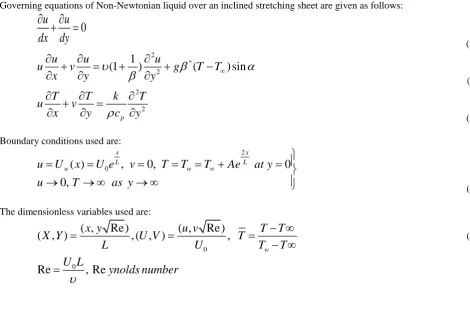
0is the reference Velocity.Governing equations of Non-Newtonian liquid over an inclined stretching sheet are given as follows:
0
u
u
dx dy
∂
∂
+
=
(1) 2
* 2
1
(1
)
(
) sin
u
u
u
u
v
g
T
T
x
y
υ
β
y
β
∞α
∂
∂
∂
+
=
+
+
−
∂
∂
∂
(2)2
2
p
T
T
k
T
u
v
x
y
ρ
c
y
∂
+
∂
=
∂
∂
∂
∂
(3)Boundary conditions used are:
2
0
( )
,
0,
0
0,
x x
L L
w w
u
U
x
U e
v
T
T
T
Ae
at y
u
T
as y
∞
=
=
=
=
=
+
=
→
→ ∞
→ ∞
(4)The dimensionless variables used are:
0
( ,
Re)
( ,
Re)
( , )
, ( , )
,
w
x y
u v
T
T
X Y
U V
T
L
U
T
T
− ∞
=
=
=
− ∞
(5)0
Re
U L
, Re
ynolds number
υ
0
U
V
X
Y
∂
∂
+
=
∂
∂
(6)2 2 2
1
1
X0
U
U
U
U
V
e Gr Sin T
X
Y
β
Y
α
∂
∂
∂
+
= +
+
=
∂
∂
∂
(7)2
2
1
2
Pr
T
T
T
U
V
UT
X
Y
Y
∂
+
∂
=
∂
−
∂
∂
∂
(8)The transformed boundary conditions are:
,
0 ,
1
0
0,
0
X
U
e
V
T
at Y
U
T
as Y
=
=
=
=
→
→
→ ∞
(9)
Introducing Stream function
ψ
( , )
X Y as
:,
U
V
dY
dX
ψ
ψ
∂
∂
=
= −
(10)The converted equations in terms of
ψ
are:T 3 2 3
,
1
1
0
( , )
XY
e Gr Sin T
Y
X Y
ψ
ψ
ψ
α
β
∂
∂
∂
+
+
+
=
∂
∂
(11)2
2
( , )
Pr
2 Pr
0
( , )
T
T
T
T
Y
X Y
Y
ψ
∂
+
∂
−
∂
=
∂
∂
∂
(12)The boundary conditions in terms of
ψ
are:,
0,
1
0
0,
0
X
e
T
at Y
Y
X
T
as Y
Y
ψ
ψ
ψ
∂
=
∂
=
=
=
∂
∂
∂
→
→
→ ∞
∂
(13)The partial differential equations in terms of
ψ
are converted into ordinary differential equations using the followingsimilarity transformations:
2
2
( , )
2
f( ),
( , )
( )
Where
2
X
X
X Y
e
T X Y
Y
e
ψ
η
θ η
η
=
=
=
(14)The converted Ordinary differential equations with respective boundary conditions are:
2
1
1
'''
'' 2 f '
2
sin
0
'' Pr(
' 4 ' )
0
f
ff
Gr
f
f
α θ
β
θ
θ
θ
+
+
−
+
=
+
−
=
(15)(0)
0,
'(0) 1,
(0) 1
'( )
0,
( )
0
f
f
f
θ
θ
=
=
=
Skin friction
It is given by : 2 3 2 0 0
1
2
Re
''(0)
2
2
''(0)
w f w X w y f XC
u
U
e
u
Where
f
y
L
C
f
Re
τ
ρ
µ
τ
µ
=
=
∂
−
= −
=
∂
−
=
(17) Nusselt number:The local heat transfer rate from surface of stretching sheet into cooling liquid is given by:
0 2 )
(
Re
'(0)
2
w y X w XT
q
k
y
T
T
e
k
L
θ
= ∞
∂
= −
∂
−
= −
Local Nusselt number is given by:
1
Re
'(0)
(
)
2
w X X w
xq
x
Nu
k T
T
∞L
θ
−
=
=
−
(18)u
Re
wL
is the local
Re
ynolds number
.
υ
=
3. MEHOD OF SOLUTION
The governing ordinary differential equation (15) to (16) are converted into an equivalent initial value problem and guessing the missing conditions
* *
1 2
''(0)
'(0)
f
=
β
and
θ
=
β
We represent the new series solution of this problem in the form of series which is in terms of
1
−
e
−η.Let us choose
Z =
1
−
e
−η (19)Substituting (19) in equation (15) and (16) we get the ordinary differential equations with the boundary conditions in terms of Z as:
3 2 3 2 3 2 2 2 2 2 2
1
1
(1
)
(1
) (3
)
(1
)(
1)
0
2(1
)
sin
0
(1
)
(1
)(1 Pr )
4 Pr(1
)
0
d f
d f
z
z
f
z
f
dz
dz
df
df
z
Gr
dz
dz
d
d
df
z
z
f
z
dz
dz
dz
β
α θ
θ
θ
θ
+
−
+ −
−
− −
− =
−
−
+
=
−
+ −
−
−
−
=
(20)The initial conditions are:
( )
0,
df
( )
1,
( )
1,
0
f z
z
z
at z
dz
θ
=
=
=
=
The initial conditions are also converted as: 2
1 2
2
,
,
0
d f
d
z
dz
dz
θ
β
β
=
=
=
(22)1
and
2β
β
are obtained using Newton-Raphson method.The new series solutions of equation (20) are assumed as:
0 0
( )
( )
k k k k k kf z
A z
z
B z
θ
∞ = ∞ =
=
=
∑
∑
(23)'
'
k kA s and B s
are to be determined using initial conditions (21) and (22).It is possible to have series solution in z due to the fact that
z
= −
1
e
−η<
1
.Substituting (23) in (20) and equating the coefficients of various powers of z to zero we get a recursive relation for
'
'
k k
A s and B s
and using the initial conditions we get the first few coefficients as:0 1 1
1
2 01
1 22!
A
=A
=
A
=
β
B
=
B
=
β
(24) The remaining coefficients are obtained using (24) and recursive relation.
Now reverting back to
η
as:0
0
(1
)
( )
( )
(1
)
k k k k k k
A
e
f
B
e
η ηη
θ η
− ∞ = ∞ − =
−
=
=
−
∑
∑
(25) This is new series solution of considered problem.4. RESULTS AND DISCUSSIONS
Here we have obtained NSS (new series solution) for the inclined stretching sheet /shrinking sheet problem in the
powers of
1
−
e
−η. This solution has good convergence because of the fact that1
−
e
−η<
1
.This new series solution is also compared with numerical Runge-Kutta fourth order method with shooting technique, which found a very good agreement.
We now discuss the results pertaining to the inclined stretching sheet problem form the fluid dynamics point of view. Figure 2 and 3 show the effect of inclination angle on flow and heat transfer. Plot 2 reveals that as the angle of
inclination increases from 0 to
2
π
the momentum boundary layer thickness increases, i.e when the inclination is
increased the gravity effect becomes prominent which assist the liquid to flow freely. The inclination reduces the thermal boundary layer thickness as shown in Fig. 3. The results clearly reveal that inclination of the trenching can be
effectively used a desired temperature between that seen in the horizontal (
γ
=0) and vertical2
π
γ
=
stretchingsheet problems.
The effect of Prandtl number Pr on flow and heat transfer is projected in Figs. 6 and 7. Fig.6 clearly illustrates that increasing values of Pr reduces the horizontal velocity and Fig.7 indicates that large values of Prandtl number results in thinning of the thermal boundary layer .
The inclination angle is to reduce both skin friction at the wall and the Nusselt number. The effect of Prandtl number on these parameters is the opposite. In the numerical solution of the BVP there is a distinct problem that arises regarding
the choice of ‘
∞
’. The chosen infinity and the actual infinity the numerical computation cannot generally coincide. Itis the common experience of all numerical investigators that the results between the chosen infinity and the actual infinity are not exactly zero through negligibly small. This is typical of the stretching sheet problem as well. DTM with pade’ approximation reflects the correct results beyond infinity. In the absence of pade’ approximation any numerical method which investigators use for solving the BVP yields not so accurate results beyond the actual infinity. It is on this reason that we use the DTM with pade’ approximation. It is to be noted that the series solution obtained for the
GFS equation can be put, on expanding the powers of
1
−
e
−ηand rearranging in the following form0 0
( )
k,
( )
kk k
f
η
Ae
ηθ η
Be
η∞ ∞
− −
= =
=
∑
=
∑
5. REFFERENCE
1. This new series solution is very simple way to find solution for the inclined stretching sheet problem.
2. The inclination of
α
can be efficiently used to have a desired temperature in the system.3. The effect of parameters
α
,Gr, and Pr on the dynamics of cooling liquid are qualitatively similar but exceptPr, which has opposite effect
4. T. Hayat, S. A. Shehzadi, A. Alsaedi, M.S. Alhothuali: Mixed Convection Stagnation Point Flow of Casson
Fluid with Convective Boundary Conditions. Chin Phys. Lett. Volume 29, Number 11(2012) 114704.
5. S. Pramanik: Casson Fluid Flow and Heat Transfer Past Exponentially Porous Stretching Surface in The
Presence of Thermal Radiation. Ain Shans Engineering Journal (2014)5,205-212.
6. Swati Mukhopadlyaya, Iswar Chandra Moindala, and Tasawar Hayat.: MHD Boundary Layer Flow of Casson
Fluid Passing Through an Exponentially Stretching Permeable Surface with Thermal Radiation. Chin. Phys.B. Volume 23, Number 10 (2014), 104701.
7. A. Mahdy and A.Chamkha: Heat Transfer and Fluid Flow of a Non-Newtonian Fluid over an Unsteady
Contracting Cylinder. International Journal of Numerical methods for heat and fluid flow ,Volume 25,Iss 4, pp. 703-723.
8. G.Sarojimma, B. Vasundhra, K: MHD Casson Fluid Flow, Heat and Mass Transfer in a Vertical Channel with
stretching walls. IJSIMR Volume 2, (2014), pp, 800-810,ISSN 2347-307X(Print) ,ISSN 2347-3142 (online).
9. A. Mahdy: Unsteady MHD Slip Flow of Non-Newtonian Casson Fluid due to Stretching Sheet with Sunction
or Blowing Effect. Journal of Applied Fluid Mechanics, Volume 9, Number 2, pp. 785-793, 2016, ISSN 1735-3572, EISSN 1735-3645.
10. Emmanuel Maurice, Arthur,Ibrahim Yakubu, Letis Bortey Bortteir.: Analysis of Casson Fluid Flow over a
Vertical Porous Surface With Chemical Reaction in the Presence of Magnetic Field. Journal of Applied Mechanics and Physics, 2015, 3, 713-723.
11. M. Mustafa, and Junaid Ahmed Khan: Model for Flow of Casson Nano-Fluid -Past a Non-linearly Stretching
Sheet Considering Magnetic Field Effects. AIP ADVANCES 5, 077148(2015).
12. T. Hayat, Anum Shafiq, A. Alsaedi, and Asghar: Effect of Inclined Magnetic Field in Flow of Third Grade
Fluid with Thetmal Condactivity. AIP ADVANCES 5.087108(2015).
13. P. Sathies Kumar and K. Gangadhar: Effect of Chemical Reaction on Slip Flow of MHD Casson Fluid over
Stretching Sheet with Heat and Mass Transfer. Advances in Applied Sciences Research, 2015,6(8):205-223,ISSN: 0976-8610.
14. R. Kalaivanan, P. Renuka, N. Vishnu Ganesh, A..K AbdulHakeem, B.Ganga, S. Saranya: Effects of Aligned
Magnetic Field on Slip Flow of Casson Fluid over a Stretching Sheet.Procedia Engineering127(2015)531-538
15. G. Sarojamma and K. Vendabai: Boundary Layer Flow of Casson Nano-Fluid Past a Vertical Exponentially
Stretching Cylinder in The Presence of a Transverse Magnetic Field with Internal Heat Generation/ Absorption. Int. Journal of Mechanical, Aerospace, Industrial, Mechatronic and Manufacturing Engineering Volume, 9 Number 1,201.
16. V. Sugunamma, B. Ramadevi, J.V. Ramana Reddy, N. Sandeep: Hall Current on Free Convection Casson
Fluid Flow in a Rotating System with Convective Boundary Conditions and Constant Heat source. Chemical and Process Engineering Research, Volume.41 (2016), 2225-0913, ISSN 2224-7467(print), ISSN 2225-0913 (online).
17. Akbar,NS, Tripathi, D. Beg, A and Khan, ZH.: MHD Dissipation Flow and Heat Transfer of Casson Fluids
18. N. Saidulu and A Venkata Lakshmi: Slip Effect on MHD Flow of Casson Fluid over an Exponentially Stretching Sheet in The Presence of Thermal Radiation, Heat Source/Sink and Chemical Reaction. European Journal of Advances in Engineering and Technology, 2016, 3(1); 47-55, ISSN: 2394-658X.
19. P. Bala Anki Reddy: MHD Boundary Layer Slip Flow of a Casson Fluid over an Exponentially Stretching
Surface in The Presence of Thermal Radiation and Chemical Reaction. Journal of Naval Architecture and Marine Engineering, Volume 1312(2016), 23537.
20. T.M. Ajayi.A.J. Omowaye, and I.L. Animasaun.: Viscous Dissipation Effects on The Motion of Casson Fluid
over an Upper Horizontal Thermally Stratified Melting Surface of a Paraboloid of Revolution: Boundary Layer Analysis. Journal of Applied Mathematics Volume 2017, Article ID 1697 136.
21. K. Pushpalatha, J.V. Ramana Reddy, V. Sugunamma, and N. Sandeep: Numerical Study of Chemically
Reacting Unsteady Casson Fluid Flow Past a Stretching Surface With Cross diffusion and Thermal Radiation. Open Eng.2017; 7:69-76.
22. K. Vajravelu, K. V. Prasad, Hanumesh Vaidya, Neelufer Z. Basha, and Chinu-on Ng,. Mixed Convective Flow
of Casson Fluid over a Vertical Stretching sheet. Int. Journal of Applied and Computational Mathematics 2017,Volume 3, Number3, p. 1619-1638.
23. Adamu Gizachew Chanie, Bandari Shankar, Mahantesh M. Nandeppanavar: Mass Transfer on MHD Flow of
a Casson Fluid Through a Porous Media Due to a Stretching Sheet With The Effect of Chemical Reaction and Sunction. Imperial Journal of Interdisciplinary research, Volume 3 (2017), 2454-1362 ISSN: 2454-1362.
24. K Sharada, B Shankar: MHD Mixed Convection Flow of a casson Fluid With convective Boundary Condition
and Effect of Partial Slip In The Presence of Joule Heating Over a vertically Stretching sheet. IJIRSET Volume 6 (2017), ISSN (Print) 2347-6710.
25. M.Eswara Rao and S.Sreenadh: MHD Flow of a Casson Fluid over an Exponentially Inclined Permeable
Stretching Surface with Thermal Radiation, Viscous Dissipation and Chemical Reaction. Global Journal of Pure and Applied mathematics, Volume 13,Number 10(2017),pp.7529-7548, ISSNo973-1768.
26. B.J. Gireesha, B. Mahanthesh, M.M Rashidi: MHD Boundary Layer Heat and Mass Transfer of a Chemically
Reacting Casson Fluid over a Permeable Stretching Surface with Non uniform Heat source/Sink. Int.J .Industrial Mathematics, Volume 7, Number 3, 2015, ISSN: 2008-5621, Article ID IJIM-00628.
Figure-2: variation of f ‘(
η
) with inclinationγ
.Figure-3: variation of
θ η
( )
with the inclinationγ
.Figure-5: variation of
θ η
( )
with GrFigure-6: variation of f ’(
η
) with P.Figure-8: Variation of f ‘
( )
η
withβ
.Figure-9: variation of
θ η
( )
withβ
.Source of support: Nil, Conflict of interest: None Declared.