Proceedings of the
4th International Workshop on Petri Nets and Graph
Transformation
(PNGT 2010)
Functorial Analysis of
Algebraic Higher-Order Net Systems
with Applications to Mobile Ad-Hoc Networks
Ulrike Golas, Kathrin Hoffmann, Hartmut Ehrig, Alexander Rein and Julia Padberg
20 pages
Guest Editors: Claudia Ermel, Kathrin Hoffmann
Managing Editors: Tiziana Margaria, Julia Padberg, Gabriele Taentzer
Functorial Analysis of
Algebraic Higher-Order Net Systems
with Applications to Mobile Ad-Hoc Networks
∗Ulrike Golas1, Kathrin Hoffmann23, Hartmut Ehrig2,
Alexander Rein2and Julia Padberg3
Konrad-Zuse-Zentrum f¨ur Informationstechnik Berlin, Germany
2hoffmann|ehrig|[email protected]
Technische Universit¨at Berlin, Germany
Hochschule f¨ur Angewandte Wissenschaften Hamburg, Germany
Abstract: Algebraic higher-order (AHO) net systems are Petri nets with place/
transition systems, i.e. place/transition nets with initial markings, and rules as to-kens. In several applications, however, there is the need for explicit data modeling. The main idea of this paper is to introduce AHO net systems with high-level net systems and corresponding rules as tokens. We relate them to AHO net systems with low-level net systems as tokens and analyze the firing and transformation prop-erties of the corresponding net class transformation defined as functors between the corresponding categories of AHO net systems.
All concepts and results are explained with an example in the application area of mobile ad-hoc networks. From an abstract point of view, mobile ad-hoc networks consist of mobile nodes which communicate with each other independent of a stable infrastructure, while the topology of the network constantly changes depending on the current position of the nodes and their availability. To ensure satisfactory team cooperation in workflows of mobile ad-hoc networks we use the modeling technique of AHO net systems.
Keywords:algebraic higher-order nets, mobile ad-hoc networks, skeleton functor
1
Introduction and Related Work
Place/transition (P/T) systems and their variants are an established process definition language for the representation, validation and verification of workflow procedures (see, e. g., [vdA03] for an overview), where P/T nets represent process schemes and P/T systems describe the behavior of process instances due to their initial markings. The paradigm of nets as tokens has been introduced by Valk [Val98] where so-called object nets are token within another net, called a system net. In elementary object systems, object nets can move through a system net and interact
∗This work has been partly funded by the research project
for
MA`NET (seehttp://tfs.cs.tu-berlin.de/formalnet/) of
with both the system net and other object nets. This allows to change the marking of the object nets, but not their net structure.
In [HME05, EHP+07], the concept of reconfigurable place/transition net systems has been introduced which is most important to model changes of the net structure while the system is kept running. In detail, a reconfigurable P/T net system consists of a P/T net with marking and a set of rules. In these nets, not only the follower marking can be computed but also the structure can be changed by rule application to obtain a new P/T net system that is more appropriate with respect to some requirements of the environment. For rule-based transformations of P/T net systems we use the framework of net transformations [EEPT06] following the double-pushout (DPO) approach of graph transformation systems and the notation of Petri nets as monoids [MM90]. The basic idea behind net transformations is the stepwise development of P/T net systems by given rules. One may think of these rules as replacement systems where the left-hand side is replaced by the right-hand side while preserving a context.
In low-level Petri nets, the tokens are indistinguishable. The integration of Petri nets with data type descriptions has led to high-level nets as powerful specification techniques like alge-braic high-level (AHL) nets [PER95], which can also be transformed within the DPO approach [Pra08]. In [HME05], we have introduced the paradigm nets and rules as tokens by a high-level model with a suitable data type part. The model called algebraic higher-order (AHO) net system exploits some form of control not only on the rule application but also on token firing. An AHO net system is defined by an AHL net system with net places and rule places, where the mark-ing is given by suitable low-level net systems or rules, respectively, on these places. As shown in [BRHM06], this paradigm has been very useful to model applications in the area of mobile ad-hoc networks.
Mobile ad-hoc networks (MANETs) consist of mobile nodes forwarding data to other nodes based on the network connectivity independent from a stable infrastructure. The constant change of the network’s topology depends on the current position of the nodes and their availability. A typical example of a complex application is a team communicating using hand-held devices and laptops as in emergency scenarios [PHE+07]. In such a scenario, each team member performs specific activities while different teams collaborate through the interleaving of all the different workflows. Normally, workflows in mobile environments are not fixed once and for all at design time but are constantly adapted at run time predicting disconnections or reorganizing activities. This requires on the one hand a suitable description of the distributed workflows and on the other hand expressive techniques for the adaption.
of AHO net systems. This functor is based on the corresponding functor from high-level to low-level nets [Urb03]. All concepts and results are explained with an example in the area of mobile ad-hoc networks. In contrast to [PEH07], where we have used merely low-level net systems, we present now a pipeline emergency scenario where we use data dependent workflows.
This paper is organized as follows: InSection 2, we introduce as motivating example a pipeline emergency scenario using data dependent workflows. InSection 3, we define AHO net systems with AHL net systems and rules as tokens as well as their firing behavior and transformations. In Section 4, we present the skeleton functor transforming AHO net systems with high-level tokens to such with low-level tokens and show that enabling and firing is preserved. Finally, in
Section 5, we give a conclusion and an outlook to future work.
2
Motivation: Emergency Scenario
In emergency scenarios, we can obtain an effective coordination among team members consti-tuting a mobile ad-hoc network through the use of net system and rule tokens. In this way,
y less 5 = tt
Notify residents of the evacuation
persons Assist handicapped
the extent possible Guide persons to the immediate area
Evacuate homes in p:Tok p’’’:Tok L x x p:Tok p’’’:Tok p’’:Tok p’:Tok R x x x x x x p:Tok p’’’:Tok K r l
Request to control
traffic into the area Identify the locationgas is highest
Additional reading the gas indicator
Shut off electricity and gas lines gas company
Call the
Reading the gas indicator
Expand the area of evacuation Deny entry
Stand by p10:Nat Evacuate homes in
the immediate area
y y p1:Tok p3:Tok p4:Tok p6:Tok p9:Tok p12:Tok p14:Tok p15:Tok p13:Tok p2:Tok p5:Tok p7:Tok x x x x x x x x x x x x x x x x x x x y x x x p11:Tok x x x y geq 5 = tt Result >= 5% LEL
Result < 5% LEL x x
p8:Tok x
n
m:Mor cod(m) =n applicable(rl,m) =tt n
tσ:Trans token firing
transform(rl,m)
net transformation
rl rules:Rules
(AHON SIG,X),AHL enabled(n,tσ) =tt
net:Net
fire(n,tσ)
AHLNetSys AHLRule
cooperative work can be adequately modeled by high-level Petri nets with initial markings. The net structure can be adapted to new requirements of the environment during run time by a set of rules, i.e. token firing and net transformation can be interleaved with each other. In contrast to [PEH07], where we have used merely low-level net systems, we present a pipeline emergency scenario based on data dependent workflows. This means that we use AHL net systems and corresponding rules as tokens.
In this section, we introduce our emergency scenario and illustrate the main idea of algebraic higher-order (AHO) net systems using high-level net system and rule tokens, while the detailed definitions can be found inSection 3. According to the pipeline emergency scenario1, a natural
gas leak of unknown source is detected in a residential area. At the scene, the company officer calls the gas company and requests an additional law enforcement officer to control traffic into the area. Upon the arrival of the gas company, the firefighters evacuate the homes in the immediate area, subsequently deny entry to this area and finally stand by with fully charged hose lines. In fact, the firefighter company as well as the gas company collaborate through the exchange of messages to achieve the common goal.
y less 5 = tt Request to control
traffic into the area Identify the locationgas is highest
Additional reading the gas indicator
Shut off electricity and gas lines gas company
Call the
Reading the gas indicator
Expand the area of evacuation Deny entry
Stand by p10:Nat Evacuate homes in
the immediate area
y y p1:Tok p3:Tok p8:Tok p4:Tok p6:Tok p9:Tok p12:Tok p14:Tok p15:Tok p13:Tok p2:Tok p5:Tok p7:Tok x x x x x x x x x x x x x x x x x x x y x x x p11:Tok x x x x x x
Result < 5% LEL Result >= 5% LEL
y geq 5 = tt
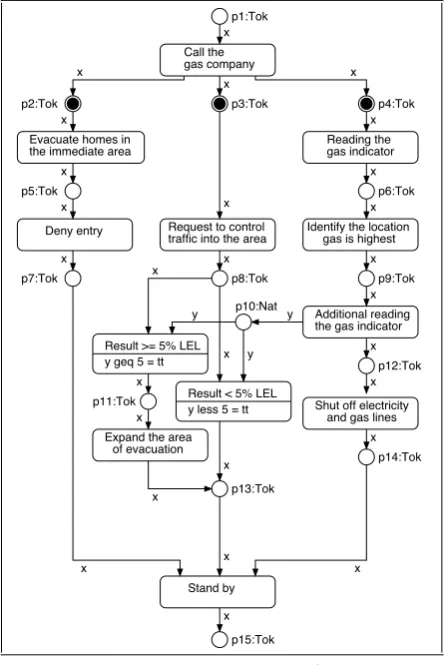
Figure 2:AHLNetSys0
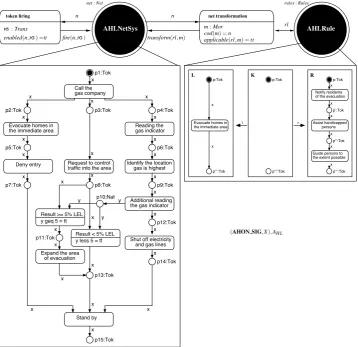
In Figure 1, the cooperative workflow enacted by the firefighter company is de-picted in the algebraic high-level (AHL) net system AHLNetSys = (AHLNet,M)
with AHL netAHLNet and markingMas token on the placenet. Such an AHL net system token is called object net system. This object net system is coordinated by an AHO net system at the system level con-sisting of the places and transitions in the upper row of Figure 1 and the data type part(AHON SIG,X,AHL)(seeSection 3).
The AHO net system consists of two places
net holding AHL net systems and rules
holding transformation rules. It allows on the one hand to trigger firing steps and on the other hand to apply rule based trans-formation steps for the object net system firing the transitions token firing and net transformationas indicated by the net in-scriptionsfire(n,tσ)andtransform(rl,m),
respectively.
The execution of the workflow is con-trolled by firing the transitions on the sys-tem level. To start the activities of the firefighter team the transitionCall the gas
companyis fired at the object level using the transitiontoken firingat the system level. The result
is the new AHL net systemAHLNetSys0= (AHLNet,M0)shown inFigure 2.
Next we focus on the dynamic changes of the workflow at run time. The firefighters responsi-ble for the evacuation process need more detailed information how to proceed. To introduce the refinement of theEvacuate homes-transition into the AHL net systemAHLNetSys0 we provide the ruleAHLRuleinFigure 1.
y less 5 = tt Request to control
traffic into the area Identify the locationgas is highest
Additional reading the gas indicator
Shut off electricity and gas lines Reading the gas indicator
Expand the area of evacuation p2:Tok
gas company Call the
Notify residents of the evacuation
persons Assist handicapped
the extent possible Guide persons to
Deny entry Stand by p10:Nat y y p3:Tok p8:Tok p4:Tok p6:Tok p9:Tok p12:Tok p14:Tok p15:Tok p13:Tok p5:Tok p7:Tok x x x x x x x x x x x x x x x y x x x p11:Tok x x x x x p1:Tok x x x p’’:Tok p’:Tok x x x x x x
Result >= 5% LEL y geq 5 = tt
Result < 5% LEL
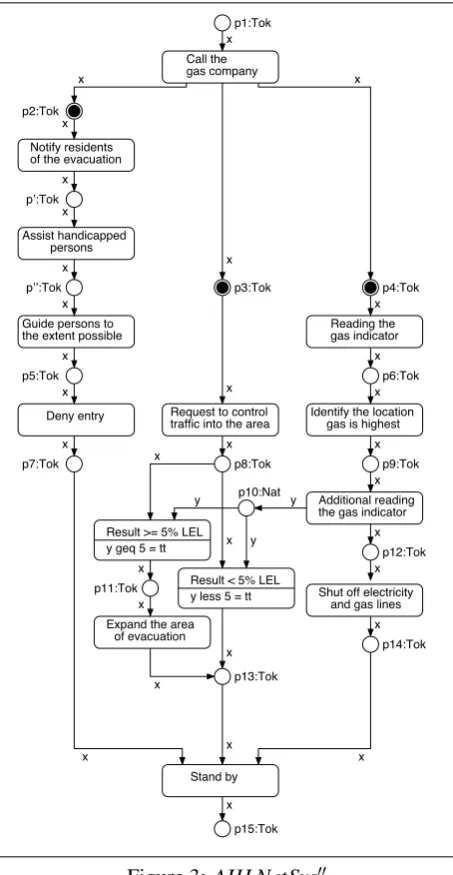
Figure 3:AHLNetSys00
The rule AHLRule= (L ←l K →r R)
consists of the three AHL net systems
L,K, and R, called left-hand side, inter-face, and right-hand side, respectively. The marking of the AHL net system L
demands that the evacuation process is not yet started because there is one to-ken in the pre domain of the Evacuate homes-transition.
To apply the rule AHLRule to the object net AHLNetSys, the transition
net transformation is fired at the sys-tem level. The application of the rule refining the Evacuate homes-transition is achieved as follows: First, the match morphism m identifies the rele-vant parts of the left hand sideL of the rule AHLRule in the AHL net system
AHLNetSys0. As a next step, the Evac-uate homes-transition is deleted and we obtain an intermediate AHL net system. Afterwards, the transitions Notify resi-dents, Assist handicapped persons, and
Guide personstogether with their (new) environments are added to the interme-diate system leading to the new AHL net systemAHLNetSys00shown inFigure 3. Thus we obtain the rule based transfor-mation AHLNetSys0 =⇒ AHLNetSys00
via (AHLRule,m) and the result of fir-ing the transition net transformation at the system level is the replacement of the AHL net system AHLNetSys0 by
AHLNetSys00on the placenet.
that he is able to determine the isolation perimeter. Note that these activities depend on the exchange of messages and data concerning the result of reading the gas indicator and the final analysis of these results by the company officer.
In this paper, we restrict the initial marking of the AHL net systemAHLNetSysto one object net system and one corresponding rule to help the reader focus on the main concepts. In our example, only a predefined refinement of the object net system is applicable. Such a situation may be useful for modeling purposes or to show properties of a small object net, which is then transformed using rules that preserve these properties. But in general, different rules are avail-able which are applicavail-able depending on the state of the object net. Their application can be further restricted by application conditions on the rule level or additional firing conditions for the transitions on the system level. Moreover, new rules may be added at runtime which allow to handle unforeseen events. For a full description of the emergency scenario, more object net systems and rules should be defined as, e. g., those given in [BRHM06,PHE+07].
3
AHO Net Systems with High- and Low-Level Tokens
In this section, we introduce our formal framework for modeling data-dependent workflows in mobile ad-hoc networks as motivated by the emergency scenario inSection 2. For this purpose, we introduce algebraic higher-order (AHO) net systems which allow algebraic high-level (AHL) net systems and rules as tokens. This extends our approach in [HME05] where we used AHO net systems with P/T systems and rules as tokens. AHL net systems resp. P/T systems are nets together with initial markings. These and the corresponding rules are used as tokens to model the interaction of token firing and net transformations.
3.1 Review of the Categories PTSys and AHLNetSys
In the following, we review the category PTSys of P/T systems [HME05] and the category
AHLNetSysof AHL net systems [Pra08], which are used as tokens for the corresponding AHO
net systems. We use the notation of Petri nets as monoids [MM90], where a P/T net is defined by PT Net = (P,T,pre,post) with pre and post domain functions pre,post :T →P⊕. A P/T system is given byPT Sys= (PT Net,M)with a P/T netPT Net and a markingM∈P⊕, where
P⊕ is the free commutative monoid over the setP of places with binary operation⊕. More-over, each function f:A→Bcan be extended to a monoid homomorphism f⊕:A⊕→B⊕with
f⊕(∑a∈Akaa) =∑a∈Akaf(a).
Note thatMcan also be considered as a functionM:P→Nwhere only for a finite setP0⊆P
we haveM(p)≥1 with p∈P0. We can switch between these notations by defining∑p∈PM(p)· p=M∈P⊕ and M(p) =ap for M=∑p∈Papp∈P⊕. Moreover, for M1,M2∈P⊕ we have M1 ≤M2 if M1(p)≤M2(p) for all p∈P. Note that the inverse of ⊕ is only defined in
M1 M2ifM2≤M1.
Definition 1(CategoryPTSysof P/T Systems) Given P/T systemsPT Sysi= (PT Neti,Mi)with
PT Neti= (Pi,Ti,prei,posti)fori=1,2, a P/T system morphism f:PT Sys1→PT Sys2is given
(1) fP⊕◦pre1=pre2◦fT and fP⊕◦post1=post2◦fT
(2) M1(p)≤M2(fP(p))for allp∈P1
Moreover, f is called strict if fPand fT are injective and
(3) M1(p) =M2(fP(p))for allp∈P1.
The category defined by P/T systems and P/T system morphisms is denoted byPTSyswhere the composition and identities are defined componentwise for places and transitions.
P/T systems are called low-level nets due to the fact that the tokens are indistinguishable. In contrast, a high-level net may hold different kinds of tokens and the firing behavior depends on the token kind. In AHL systems, the tokens are data elements and thus distinguishable.
Definition 2(CategoryAHLNetSysof AHL Net Systems) An algebraic high-level (AHL) net
systemAHLNetSys= (AHLNet,M)with
AHLNet= ((SIG,X),P,T,pre,post,cond,type,A)
consists of an algebraic signatureSIG= (sorts,opns) with sorts and operation symbols, addi-tional variablesX, sets of placesPand transitionsT, pre and post domain functions pre,post:
T→(TSIG(X)⊗P)⊕, firing conditionscond:T→Pf in(Eqns(SIG;X)), a typing of placestype: P→sorts, aSIG-algebraA, and an initial markingM∈CP⊕. TSIG(X)is the term algebra with
variables overX,TSIG(X)⊗P={(term,p)|term∈TSIG(X)type(p),p∈P},Eqns(SIG;X)are all equations over the signatureSIGwith variablesX, andCP=A⊗P={(a,p)|a∈Atype(p),p∈P}. Given AHL net systemsAHLNetSysi= (AHLNeti,Mi)withAHLNeti= ((SIG,X),Pi,Ti,prei, posti,condi,typei,A)fori=1,2, an AHL net system morphismf:AHLNetSys1→AHLNetSys2
is given by f= (fP,fT)with functions fP:P1→P2and fT :T1→T2satisfying
(1) (id⊗fP)⊕◦pre1=pre2◦fT and(id⊗fP)⊕◦post1=post2◦fT,
(2) cond2◦fT =cond1
(3) type2◦fP=type1
(4) ∀a∈Atype1(p1),p1∈P1:M1(a,p1)≤M2(a,fp(p1))
Moreover, f is called strict if fPand fT are injective and
(5) M1(a,p1) =M2(a,fP(p1))for alla∈Atype1(p1)andp1∈P1.
The category defined by AHL net systems and AHL net system morphisms is denoted by
AHLNetSyswhere the composition and identities are defined componentwise for places and
transitions.
Definition 3(Firing Behavior of AHL Net Systems) Given an AHL net systemAHLNetSys= (AHLNet,M) with AHLNet = ((SIG,X), P, T,pre,post,cond,type,A), the set of variables
Var(t)⊆X of a transitiont∈T are the variables of the net inscriptions in pre(t),post(t), and
cond(t).
Letσ:Var(t)→Abe a variable assignment with term evaluationσ#:TSIG(Var(t))→A, then
(t,σ)is a consistent transition assignment iffcond(t)is valid inAunderσ. The setCT of consis-tent transition assignments is defined byCT ={(t,σ)|(t,σ)consistent transition assignment}.
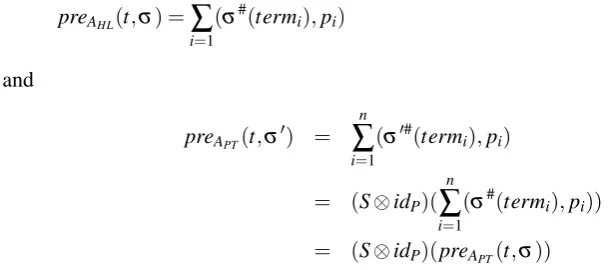
A transitiont∈T is enabled inMunderσ iff(t,σ)∈CT andpreA(t,σ)≤M, wherepreA: CT →CP⊕ is defined for pre(t) =∑in=1(termi,pi) by preA(t,σ) =∑ni=1(σ#(termi),pi), and
similarly for postA(t,σ). Then the follower marking is computed by M0 =M preA(t,σ)⊕
postA(t,σ).
Intuitively, a pushout in the categories PTSysandAHLNetSysmeans the gluing of two net systems along an interface system. The pushout object is constructed componentwise for tran-sitions and places in the categorySETwith corresponding pre and post domain functions and initial markings.
Definition 4(Pushouts in the categoryPTSys) The pushout(PN2,M2)
n
→(PN3,M3)
g
←(PN1,
M1)of the P/T system morphismsm:(PN0,M0)→(PN1,M1)and f :(PN0,M0)→(PN2,M2),
wheremis strict, can be constructed as pushout inPTNet[EP04], i.e. component-wise for places and transitions. The markingM3is defined by
1. ∀p1∈P1\m(P0):M3(gP(p1)) =M1(p1)
2. ∀p2∈P2\f(P0):M3(nP(p2)) =M2(p2)
3. ∀p0∈P0:M3(nP◦fP(p0)) =M2(fP(p0))
forPibeing the sets of places ofPNifori=0,1,2,3.
Definition 5 (Pushouts in the category AHLNetSys) The pushout (AHLNet2,M2) →n
(AHLNet3,M3) g
←(AHLNet1,M1) of the AHL net system morphisms m:(AHLNet0,M0)→
(AHLNet1,M1)and f:(AHLNet0,M0)→(AHLNet2,M2), wheremis strict, can be constructed as pushout inAHLNet[PER95], i.e. componentwise for places and transitions. The marking
M3is defined by
1. ∀p1∈P1\m(P0),a∈Atype1(p1):M3(a,gP(p1)) =M1(a,p1)
2. ∀p2∈P2\f(P0),a∈Atype2(p2):M3(a,nP(p2)) =M2(a,p2)
3. ∀p0∈P0,a∈Atype0(p0):M3(a,nP◦fP(p0)) =M2(a,fP(p0))
forPibeing the places ofAHLNetifori=0,1,2,3.
Remark 1 Note that Items 2 and 3 combined are equivalent to ∀p2 ∈ P2,a ∈ Atype2(p2) :
3.2 AHO Net Systems with AHL Net Systems as Tokens
An algebraic higher-order (AHO) net system can be considered as an algebraic high-level (AHL) net system modeling the system level. The main difference is that an AHO net system contains not an algebra, but a class algebra, i.e. an algebra with classes instead of sets as base sets. This specific class algebra Adefines net systems and rules as tokens at the object level. The class algebraAincludes domains likeANet, which is the class of all net systems of a specific kind of
low-level or high-level net systems and cannot be restricted to be a set. In the following, we introduce AHO net systems which have AHL net systems and corresponding rules as tokens.
First we introduce an algebraic signature for the class algebra of AHO net systems which can be used for low-level and high-level net systems as tokens, the enabling and firing of transitions as well as the applicability of rules, and the rule based transformation of net systems.
Definition 6(Signature for AHO Net Systems) The signature for algebraic higher order (AHO)
net systems with net systems and rules as tokens is given by:
AHON SIG =
sorts: Net,Trans,Bool,Mor,Rules
opns: undefined:→Net,
tt,ff :→Bool,
enabled:Net×Trans→Bool,
fire:Net×Trans→Net,
applicable:Rules×Mor→Bool,
transform:Rules×Mor→Net cod:Mor→Net
Note that the signatureAHON SIGdoes not fix the type of net systems which may be used as tokens. This is achieved by the corresponding class algebrasAHL for AHL net systems andAPT
for P/T systems as tokens, which are both class algebras for the signatureAHON SIG.
For AHL, (AHL)Net is the class of all AHL net systems AHLNetSys including a special undefined element specified by a constant. In order to model the consistent transition assign-ments of AHL net systems we define the domain(AHL)Transto be the classSetsof all sets. Note,
however, that only setssof the forms={(t,σ)}with(t,σ)∈CTAHLare relevant, whereCTAHL
is the set of all consistent transition assignments,t∈TAHLis a transition andσ:Var(t)→DAHL
a corresponding variable assignment of some AHL net systemAHLNetSys= ((SIGAHL,XAHL), PAHL,TAHL,preAHL,postAHL,condAHL,typeAHL,DAHL, MAHL). For the definition of the
opera-tions enabledHL and fireHL we use the extended pre and post domain functions preDAHL and
postDAHL(seeDefinition 3).
In order to model the applicability of rules and rule based transformations of AHL net systems [Pra08] we use the operationsapplicableHLandtransformHLdefined on the domains(AHL)Morof
allAHLNetSys-morphisms and(AHL)Rulesof all rulesrl= (L l
←K→r R)for AHL net systems. A rule rl is applicable to AHLNetSys0 via match morphism m:AHLNetSys →AHLNetSys0
if L =AHLNetSys and m satisfies the gluing condition w.r.t. rl, which means that we have a pushout complement AHLNetSys0 in (1) below. In this case, we can construct the pushout
AHLNetSys0⇒AHLNetSys00via(rl,m). Note that due to the fact that pushouts are only unique up to isomorphism, we have to fix a concrete construction for the definition of transformHL
selecting a specific pushout for each transformation according the one inDefinition 5.
L
m
(1)
K l
o
o r //
R
(2)
AHLNetSys0oo AHLNetSys0 //AHLNetSys00
Definition 7 (Class Algebra AHL for AHL Net Systems as Tokens) Given the signature
AHON SIG, the class algebra AHL for AHL net systems and corresponding rules as tokens
is given by
AHL= ((AHL)Net,(AHL)Trans,(AHL)Bool,(AHL)Mor,(AHL)Rules,
undefinedHL,ttHL,ffHL,enabledHL,fireHL,applicableHL,transformHL)
with
(AHL)Net={AHLNetSys|AHLNetSysis an AHL net system} ∪ {unde f}
the class of all AHL net systems including undefined,
(AHL)Trans=Setsthe class of all sets,
(AHL)Bool={true,false},
(AHL)Mor={m:AHLNetSys→AHLNetSys0|mAHLNetSys-morphism},
(AHL)Rules={rl= (L l
←K→r R)|l,rstrictAHLNetSys-morphisms},
undefinedHL=undef,ttHL=true,ffHL=false,
enabledHL:(AHL)Net×(AHL)Trans→(AHL)Booldefined fors∈(AHL)TransbyenabledHL(undef, s) = false and for AHLNetSys = ((SIGAHL,XAHL), PAHL, TAHL,preAHL,postAHL,condAHL, typeAHL,DAHL,MAHL)by
enabledHL(AHLNetSys,s) =
true if∃t,σ :s={(t,σ)},t∈TAHL,(t,σ)∈CTAHL
preDAHL(t,σ)≤MAHL
false else
fireHL:(AHL)Net×(AHL)Trans→(AHL)Net withfireHL(undef,s) =undef and forAHLNetSys=
(AHLNet,MAHL)with
fireHL(AHLNetSys,s) =
(AHLNet,MAHL0 ) ifenabledHL(AHLNetSys,s) =true,s={(t,σ)},
MAHL0 =MAHL preDAHL(t,σ)⊕postDAHL(t,σ)
undef else
applicableHL:(AHL)Rules×(AHL)Mor→(AHL)Boolwith
applicableHL(rl,m) =
(
true ifL=AHLNetSys∧msatisfies gluing condition w.r.t.rl
false else
transformHL:(AHL)Rules×(AHL)Mor→(AHL)Netwith
transformHL(rl,m) =
AHLNetSys00 ifapplicableHL(rl,m) =trueand
AHLNetSys0(=rl⇒,m)AHLNetSys00
undef else
codHL:(AHL)Mor→(AHL)Netwith
codHL(m) =AHLNetSys0form:AHLNetSys→AHLNetSys0.
Now we are able to define AHO net systems with AHL net systems and rules as tokens and the corresponding categoryAHONAHL. An AHO net system is defined using a “class algebra based” AHL net system, i.e. an AHL net systemAHONAHL in the sense ofDefinition 2, where
the algebraAis allowed to be a class algebra likeAHL inDefinition 7. But note that the carrier
set (AHL)Net does not include class based AHL net systems like itself to avoid set theoretical
problems of self inclusion.
Definition 8 (Category AHONAHL of AHO Net Systems) Given the signatureAHON SIG
(seeDefinition 6) and the class algebraAHL(seeDefinition 7), an AHO net systemAHONAHL–
with AHL net systems and rules as tokens – is a (class algebra based) AHL net system
AHONAHL= ((AHON SIG,X),P,T,pre,post,cond,type,AHL,MHL)
where the signatureAHON SIGwith sufficiently large family of setsXof variables and algebra
AHLare fixed. The initial markingMHL∈(AHL⊗P)⊕can be represented byMHL:AHL⊗P→N.
A morphism f :AHON1AHL→AHON2AHLof AHO net systems is anAHLNetSys-morphism. This means that for AHO net systems AHONiAHL = ((AHON SIG,X),Pi,Ti,prei,posti,condi,
typei,AHL,MiHL)fori=1,2, we have f = (fP:P1→P2,fT :T1→T2)with
(=) T1 cond1 s s hhhhhhhhhhhh hh fT
pre1 //
post1
/
/
(=)
(TAHON SIG(X)⊗P1)⊕
(id⊗fP)⊕
Pf in(Eqns(AHON SIG,X))
T2 cond2
k
k
WWWWWWWWWWWWWW pre2 //
post2
/
/(TAHON SIG(X)⊗P2)⊕
P1 fP type1 * * T T T T T T T T T T
(=) sorts(AHON SIG)
P2 type2
4 4 j j j j j j j j j j
andM1HL(a,p1)≤M2AHL(a,fP(p1))for allp1∈P1anda∈(AHL)type1(p1).
The categoryAHONAHL of AHO net systems based on the class algebraAHLconsists of all
AHO net systems as objects and AHO net system morphisms as morphisms.
Example 1 (AHO Net System for Emergency Scenario) The AHO net system AHONAHL =
• the signatureAHON SIG (see Definition 6), theAHON SIG-algebra AHL (see
Defini-tion 7), and variablesXNet={n},XTrans={tσ},XBool=∅,XMor={m},XRules={rl},
• the set of placesP={net,rules}withtype(net) =Net andtype(rules) =Rules,
• the set of transitionsT ={token firing,net transformation}with pre and post domain and firing conditions as shown inFigure 1, and
• the initial markingMHL= (AHLNetSys,net)⊕(AHLRule,rules), whereAHLNetSysand AHLRuleare shown as marking on the placesnetandrules, respectively. The data type part of the AHL net systemsAHLNetSys and L, K and R in AHLRule is given by the signature and corresponding algebra of natural numbers and boolean values together with a sortTokfor black tokens.
As shown in [Pra08] for algebraic high-level net systems with fixed data type, the category
AHONAHL is a weak adhesive HLR category where pushouts are constructed componentwise, because the fact thatAHL is a class algebra instead of a classical algebra does not affect these
properties.
3.3 AHO Net Systems with P/T Systems as Tokens
In order to define a net class transformation from AHO net systems with high-level net system and rules as tokens to those with low-level net systems and rules as tokens we briefly introduce the second kind of AHO net system. In fact, we can use the same signatureAHON SIG(see
Definition 6) but use a different class algebraAPT for P/T systems and corresponding rules as
tokens.
APT = ((APT)Net,(APT)Trans,(APT)Bool,(APT)Mor,(APT)Rules,
undef,true,false,enabledPT,firePT,applicablePT,transformPT)
The main difference is that (APT)Net is the class of all P/T systems (including a constant
for undefined) and (APT)Mor, (APT)Rules as well as applicablePT and transformPT are based
on PTSys-morphisms instead of AHLNetSys-morphisms (see Definition 7). The operations
enabledPT andfirePT are defined for P/T systemsPT Sys= (PT Net,MN) = (PN,TN,preN,postN, MN)and a sets∈(APT)Transby
enabledPT :(APT)Net×(APT)Trans→(APT)Boolwith enabledPT(undef,s) =false,
enabledPT(PT Sys,s) = (
true if∃t∈TN:s={t}andpreN(t)≤MN
false else
firePT :(APT)Net×(APT)Trans→(APT)Net with firePT(undef,s) =undef and
firePT(PT Sys,s) =
(PT Net,MN0) ifenabledPT(PT Sys,s) =truewiths={t}and
MN0 =MN preN(t)⊕postN(t)
This class algebra leads to AHO net systemsAHONPT with P/T systems and rules as tokens
and to the corresponding categoryAHONPT. Note that our class algebraAPT is more general
than the one in [HME05], where(APT)Net is restricted to all P/T systems which are subsystems
of a given super net system.
Definition 9(CategoryAHONPTof AHO Net Systems) Given the signatureAHON SIG(see
Definition 6) and the class algebraAPT, an AHO net systemAHONPT with P/T systems and rules
as tokens is a (class algebra based) AHL net system AHONPT = ((AHON SIG,X),P,T,pre, post,cond,type,APT,MPT)with fixed(AHON SIG,X)andAPT.
Together with corresponding AHL net system morphisms we obtain the categoryAHONPTof AHO net systems based on class algebraAPT.
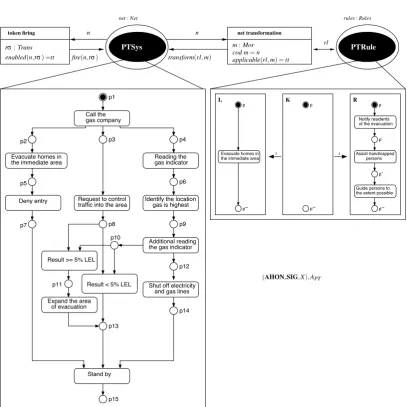
Example 2 An example of an AHO net system with P/T systems and rules as tokens is de-picted inFigure 4, which is analogously defined to the AHO net systemAHONAHL inFigure 1,
but theAHON SIG-algebra is given byAPT and the initial marking byMPT = (PT Sys,net)⊕
(PT Rule,rules), wherePT Sysis a P/T system andPT Rulea P/T system rule.
4
Net Class Transformation for AHO Net Systems
Since several net classes form different categories, net class transformations are expressed by functors. Well-known examples of net class transformations are the concepts offlatteningand
skeletonas introduced in [Urb03]. In this section, the extended skeleton of AHO net systems is introduced. It is expressed by the functorFSkel:AHONAHL→AHONPTbased on the skeleton functorSkel:AHLNetSys→PTSys. Both functors are defined and some interesting properties of the functorFSkel are verified.
4.1 Extended Skeleton Functor for AHO Net Systems
The functorFSkel:AHONAHL→AHONPTextends the skeleton functorSkel:AHLNetSys→
PTSys(see [Urb03]) that “forgets” the data type of an AHL net system but preserves the token
count on the places and the multiplicity of the edges.
Definition 10 (Functor Skel) Given the AHL net system AHLNetSys = ((SIG,X),P,T,pre,
post,cond,type,A,M)and a morphism f= (fP,fT):AHLNetSys→AHLNetSys0, the skeleton
functorSkel:AHLNetSys→PTSysis defined by
Skel(AHLNetSys) =PT Sys= (P,T,pre0,post0,M0)
Skel(f) = f0:Skel(AHLNetSys)→Skel(AHLNetSys0)
withpre0(t) =πP⊕(pre(t)),post0(t) =πP⊕(post(t))for allt∈T, whereπP⊕:(TSIG(X)⊗P)⊕→
P⊕is a projection,M0(p) =∑a∈Atype(p)M(a,p), and fP0(p) =fP(p)and fT0(t) = fT(t)for allp∈P
Result < 5% LEL Request to control
traffic into the area Identify the locationgas is highest
Additional reading the gas indicator
Shut off electricity and gas lines gas company
Call the
Reading the gas indicator
Expand the area of evacuation
Notify residents of the evacuation
persons Assist handicapped
the extent possible Guide persons to
Deny entry
Stand by p10 Evacuate homes in
the immediate area
p1
4 p 3
p
p6
p9
p12
p14
p15 p13 p8
p
p’’’ p’’ p’
R
p
p’’’
K
r l
the immediate area Evacuate homes in
p
p’’’
L
p7 p5 p2
p11 Result >= 5% LEL
n
m:Mor cod m=n applicable(rl,m) =tt n
tσ:Trans
token firing
transform(rl,m)
net transformation
rl
rules:Rules
(AHON SIG,X),APT
enabled(n,tσ) =tt
net:Net
fire(n,tσ)
PTSys PTRule
Figure 4: Algebraic higher-order net systemAHONPT
Remark 2 The skeleton functor Skel :AHLNetSys → PT Sys preserves pushouts, double-pushout (DPO) transformations, and also enabling and firing of transitions.
The extended skeleton functor FSkel for AHO net systems “forgets” the data type part of
the object net systems using the skeleton functor Skel. Moreover, this functor replaces the
AHON SIG-algebraAHL for AHL net systems and the corresponding rules by the algebraAPT
for P/T systems and the corresponding skeleton rules.
Definition 11(FunctorFSkel) Given the AHO net systemAHONAHL= ((AHON SIG,X),P,T,
FSkel(AHONAHL) =AHONPT = ((AHON SIG,X),P,T,pre,post,cond,type,APT,MPT)
with fixed class algebraAPT (seeSubsection 3.3) andMPT :APT⊗P→Ndefined by
(∗)MPT(aPT,p) =
∑
aHL∈(AHL)type(p)
∑
Stype(p)(aHL)=aPT
MHL(aHL,p)
foraPT ∈APT,aHL∈AHL, andS:AHL→APT defined as familyS= [Ss:(AHL)s→(APT)s]s∈Y
forY ={Net,Trans,Bool,Mor,Rules}is given fora∈(AHL)sby
Ss(a) =
Skel(a) fors∈ {Net,Mor,Rules}
undef fors=Net,a=undef
{t} fors=Transanda={(t,σ)}witht∈T
a for (s=Transanda6={(t,σ)}witht∈T), ors=Bool
For a morphism f = (fP,fT):AHONAHL→AHONAHL0 of AHO net systems it is defined by FSkel(f) = f0:AHONPT →AHONPT0 with f0= (fP,fT).
Remark3 Note thatS:AHL →APT defined above by the family[Ss]s∈Y is not anAHONSIG
-homomorphism since it is not compatible with the enable-operations as shown in the introduction of theSubsection 4.2.
In the following theorem, we show thatFSkel is a functor and preserves pushouts along strict
morphisms and transformations.
Theorem 1
1. FSkel:AHONAHL→AHONPTis functor.
2. FSkel preserves pushouts along strict morphisms and double pushout transformations.
Proof.
1. From the definition, it is clear that FSkel is compatible with composition and identities.
Mainly, we have to show that it is well-defined for the marking, i.e. for f :AHON1AHL→
AHON2AHL in AHONAHL with M1HL(aHL,p)≤M2HL(aHL,fP(p))we have to show that
M1PT(aPT,p)≤M2PT(aPT,fP(p))for FSkel(f):FSkel(AHON1AHL)→FSkel(AHON2AHL) in
AHONPT. Using (*) inDefinition 11inSection 4we have that
M1PT(aPT,p) =
∑
S(aHL)=aPT
M1HL(aHL,p)
≤
∑
S(aHL)=aPT
2. First, we show that FSkel preserves pushouts along strict morphisms. Let AHONiAHL =
(ANiAHL,MiHL)fori=0,1,2,3 and (1) be a pushout inAHONAHL(seeDefinition 5) along the strict morphism f1.
(AN0AHL,M0HL)
f1 //
f2
(1)
(AN1AHL,M1HL)
g1
(AN2AHL,M2HL)
g2 //
(AN3AHL,M3HL)
(AN0PT,M0PT)
f1 //
f2
(2)
(AN1PT,M1PT)
g1
(AN2PT,M2PT)
g2 //
(AN3PT,M3PT)
ApplyingFSkelwe obtainAHONiPT = (ANiPT,MiPT)in (2) withANiPT obtained fromANiAHL by replacingAHLbyAPT. We have to show that (2) is a pushout inAHONPT(see
Defini-tion 4). According to the pushout construction inAHLNetSys(seeDefinition 5) along the strict morphism f1in (1) we have thatMiHL (i=0,1,2,3) with
M3HL(aHL,g1(p1)) =M1HL(aHL,p1)for p1∈P1\f1(P0)
and
M3HL(aHL,g2(p2)) =M2HL(aHL,p2)forp2∈P2.
By definition ofFSkelwe have
MiPT(aPT,p) =
∑
S(aHL)=aPT
MiHL(aHL,p)
for i=0,1,2, 3, wherePiare the places ofANiHL resp.ANiPT. It remains to show that
M3PT(aPT,g1(p1)) =M1PT(aPT,p1)for p1∈P1\f1(P0) and M3PT(aPT,g2(p2)) =M2PT(aPT,p2)for p2∈P2.
For p1∈P1\f1(P0), we have that
M3PT(aPT,g1(p1)) =
∑
S(aHL)=aPT
M3HL(aHL,g1(p1))
=
∑
S(aHL)=aPT
M1HL(aHL,p1) =M1PT(aPT,p1)
Similarly,M3PT(aPT,g2(p2)) =M2PT(aPT,p2)for allp2∈P2.
Hence, (2) is a pushout inAHONPT which implies that FSkel preserves pushouts along
4.2 Firing Properties of the Net Class Transformation
In this subsection, we analyze under which conditions the net class transformation FSkel :
AHONAHL→AHONPTpreserves enabling and firing of transitions at the system level.
As explained above,h:AHL→APTbased on the skeleton functorSkel:AHLNetSys→PTSys
is not a homomorphism because this functor preserves the firing behavior, but in general it does not reflect enabling and firing of transitions. This means thatenabledHL(AHLNetSys,{(t,σ)}) =
bimpliesenabledPT(Skel(AHLNetSys)),{t}) =bforb=truebut not forb=false.
Definition 12 (Firing Properties of FSkel) Given an AHO net system AHONAHL =
((AHON SIG,X),P,T,pre,post,cond,type,AHL,MHL) with FSkel(AHONAHL) =AHONPT we
say thatFSkelpreserves
1. consistent transition assignments, if∀t∈T,σ :Var(t)→AHL:
(t,σ)∈CTAHL⇒(t,σ0)∈CTPT forσ0=S◦σ
2. enabling, if∀(t,σ)∈CTAHL:
preAHL(t,σ)≤MHL⇒preAPT(t,σ
0)≤
MPT= (S⊗idP)⊕(MHL)
3. firing, if forMHLenabled under(t,σ)∈CTAHL:
MHL0 =MHL preAHL(t,σ)⊕postAHL(t,σ)
⇒ MPT0 = (S⊗idP)(MHL0 ) =MPT preAPT(t,σ
0)⊕post
APT(t,σ
0)
Remark4 In general, the functor FSkel :AHONAHL →AHONPT does not preserve consistent
transition assignments, especially ifcond(t)includes an equation of the formenabled(n,tσ) =
ff (see introduction of Subsection 4.2). But FSkel preserves consistent transition assignments
if cond(t) includes only special equations of the form enabled(n,tσ) =tt, fire(n,tσ) =n0,
applicable(rl,m) =tt, transform(rl,n) =n0, and cod(m) =n. In this case, Skel preserves en-abling, firing, pushouts, DPO-transformations (seeRemark 2), and codomains.
Theorem 2(Firing Properties ofFSkel) For an AHO net system AHONAHL, FSkel:AHONAHL→
AHONPTpreserves enabling and firing if it preserves consistent transition assignments.
Proof. Suppose that the arc inscriptions ofAHONAHL are only variables or sums of variables. If
this is not the case, we modify the AHO net system by introducing for each termtmin the arc inscriptions a new variablexand an equationx=tmfor the corresponding transition.
For allt∈T,σ:Var(t)→AHL we have that(t,σ)∈CTAHL implies(t,σ0)∈CTPT forσ0= S◦σ.
1. FSkel preserves enabling.For(t,σ)∈CTAHLandpreAHL(t,σ)≤MHLwe have that
preAPT(t,σ
0
where (**) holds becausepre(t) =∑ni=1(termi,pi)andσ:Var(t)→AHLimplies
preAHL(t,σ) =
n
∑
i=1
(σ#(termi),pi)
and
preAPT(t,σ
0) = n
∑
i=1
(σ0#(termi),pi)
= (S⊗idP)(
n
∑
i=1
(σ#(termi),pi))
= (S⊗idP)(preAPT(t,σ))
Note thatσ0=S◦σ implies σ0#(termi) =S(σ#(termi)) because by assumption the arc
inscriptionstermi are only variables. Otherwise we would needS:AHL→APT to be an
AHON SIG-homomorphism which is not true in general.
2. FSkel preserves firing.
MPT0 = (S⊗idP)(MHL0 )
= (S⊗idP)(MHL preAHL(t,σ)⊕postAHL(t,σ))
= (S⊗idP)(MHL) (S⊗idP)(preAHL(t,σ))⊕ (S⊗idP)(postAHL(t,σ))
= MPT preAPT(t,σ
0
)⊕postAPT(t,σ
0 )
Example 3 The result of the extended skeleton functor FSkel applied to the AHO net system AHONAHL inFigure 1 is the AHO net system AHONPT = ((AHON SIG,X),P,T,pre,post, cond,type,APT,MPT)with P/T system and rule tokens inFigure 4.
The firing conditions ofAHONAHLinFigure 1consist only of equations of the formenabled(n, tσ) =tt,applicable(rl,m) =tt, andcod(m) =nso that consistent transition assignments are
pre-served by the extended skeleton functor (seeRemark 4). Moreover, byRemark 4we obtain new equations of the form fire(n,tσ) =n0 andtransform(rl,n) =n0 if we replace the arc inscrip-tionsfire(n,tσ)andtransform(rl,n)byn0and introduce the new equations as conditions for the
transitionstoken firingandnet transformation, respectively. According toRemark 4,FSkel still
preserves consistent transition assignments including also there new equations. Hence, we can assume without loss of generality that the arc inscriptions ofAHONAHL inFigure 1on the
sys-tem level are only variables. Thus, due toTheorem 2, the enabling and firing ofAHONAHL in
Figure 1is preserved byFSkel.
In more detail, consider the consistent transition assignment (token firing,σ) with σ(n) =
AHLNetSys and σ(tσ) be the consistent transition assignment of the object net system
σ0(n) =Skel(AHLNetSys) =PT Sys,σ0(tσ) =Call the gas companyandPT Sys= (PT Net,M)
is a consistent transition assignment of the AHO net systemAHONPT (seeFigure 4). Moreover,
the transitiontoken firingis enabled inAHONPT underσ0and the follower marking is defined by MPT0 = (PT Sys0,net)⊕(PT Rule,rules)with PT Sys0= (PT Net,M0), where M0 is given by the marking of the three places in the post domain of theCall the gas company-transition.
5
Conclusion and Future Work
In this paper, we have introduced AHO net systems, a special kind of algebraic high-level nets with net systems and corresponding rules as tokens. Moreover, we have analyzed the skeleton functorFSkel:AHONAHL→AHONPT relating AHO net systems based on AHL net systems to AHO net systems based on P/T nets.
In [Urb03], net class transformations have been introduced to allow a model developer to change the underlying Petri net class during the modeling step. This concept has been applied on classes of marked place/transition nets and algebraic high-level nets. In addition to the
func-torSkel:AHLNetSys→PTSyswe should analyze the functorsFlat:AHLNetSys→PTSys
andData:PTSys→AHLNetSysas given in [Urb03] leading to corresponding functorsFFlat :
AHONAHL→AHONPTandFData:AHONPT→AHONAHL.
The functor Flat:AHLNetSys→PTSysrelates AHL net systems to P/T systems as well, but in contrast to Skel it preserves the data type information as each possible marking of the AHL net system is considered to be a place in the P/T system. The data type is flattened into the set of places, hence the name. The functorData:PTSys→AHLNetSyslifts a P/T system to an AHL net system by providing a trivial data type that describes the black tokens. This functor preserves the net structure and adds a one-sorted specification and an algebra where the carrier set has only one element, that is the black token. Similar to [Urb03], the corresponding functorsFFlat:AHONAHL→AHONPTandFData:AHONPT→AHONAHLformalize net class transformations at the level of tokens of an AHO net system. These net class transformations allow changes of the underlying Petri net class at the token level.
The signature and algebra in this paper are tailored to our needs to represent MANETs with AHO net systems. But the underlying principles including the analysis using the skeleton func-tor can be transferred to other high-level systems based on additional sorts and operations. A more thorough analysis concerning the properties that are required for the algebra would be an interesting line of future work.
Bibliography
[vdA03] W. van der Aalst. The Application of Petri Nets to Workflow Management.Journal of Circuits, Systems and Computers8(1):21–66, 2003.
[BRHM06] P. Bottoni, F. Rosa, K. Hoffmann, M. Mecella. Applying Algebraic Approaches for Modeling Workflows and their Transformations in Mobile Networks.Journal of Mobile Information Systems2(1):51–76, 2006.
[EEPT06] H. Ehrig, K. Ehrig, U. Prange, G. Taentzer. Fundamentals of Algebraic Graph Transformation. EATCS Monographs. Springer, 2006.
[EHP+07] H. Ehrig, K. Hoffmann, J. Padberg, U. Prange, C. Ermel. Independence of Net Transformations and Token Firing in Reconfigurable Place/transition Systems. In
Proc. of ATPN 2007. LNCS 4546, pp. 104–123. Springer, 2007.
[EP04] H. Ehrig, J. Padberg. Graph Grammars and Petri Net Transformations. InLectures on Concurrency and Petri Nets Special Issue Advanced Course PNT. LNCS 3098, pp. 496–536. Springer, 2004.
[HME05] K. Hoffmann, T. Mossakowski, H. Ehrig. High-Level Nets with Nets and Rules as Tokens. InProc. of ATPN 2005. LNCS 3536, pp. 268–288. Springer, 2005.
[MM90] J. Meseguer, U. Montanari. Petri Nets are Monoids.Information and Computation
88(2):105–155, 1990.
[PEH07] J. Padberg, H. Ehrig, K. Hoffmann. Formal Modeling and Analysis of Flexible Pro-cesses in Mobile Ad-Hoc Networks.Bulletin of the EATCS91:128–132, 2007.
[PER95] J. Padberg, H. Ehrig, L. Ribeiro. Algebraic High-Level Net Transformation Sys-tems.MSCS5:217–256, 1995.
[PHE+07] J. Padberg, K. Hoffmann, H. Ehrig, T. Modica, E. Biermann, C. Ermel. Maintain-ing Consistency in Layered Architectures of Mobile Ad-Hoc Networks. InProc. of FASE 2007. LNCS 4422, pp. 383–397. Springer, 2007.
[Pra08] U. Prange. Towards Algebraic High-Level Systems as Weak Adhesive HLR Cate-gories.ENTCS203(6):67–88, 2008.
[RMPM03] F. Rosa, V. Martino, L. Paglione, M. Mecella. Mobile Adaptive Information Sys-tems on MANET: What We Need as Basic Layer? InProc. of MMIS 2003. 2003.
[Urb03] M. Urb´aˇsek.Categorical Net Transformations for Petri Net Technology. PhD thesis, TU Berlin, 2003.