ISSN: 2501 - 1235 ISSN-L: 2501 - 1235 Available on-line at: www.oapub.org/edu
DOI: 10.46827/ejpe.v6i6.3284 Volume 6 │ Issue 6│ 2020
A COMPARATIVE STUDY ON PSYCHOMOTOR
COMPONENTS AMONG THE DISTRICT LEVEL
CRICKET PLAYERS OF BANGLADESH
Sanjib Kumar Dey1i,
Ashok Kumar Goon2
1Department of Physical Education, Noakhali Science and Technology University, Bangladesh 2Department Physical Education and Sport Science, Visva-Bharati University, Santiniketan, India
Abstract:
Psychomotor ability is related to motor control and cognitive aspect. Cricket players need an optimum range of psychomotor ability to perform well in batting, bowling, wicket keeping and fielding. The purpose of this study was to measure the psychomotor capacity that was tested by kinesthetic perception, reaction ability, and coordinating ability among the different age groups cricket players in Bangladesh. Male district level cricket players from Noakhali District Sports Association (NDSA), Bangladesh were randomly selected. The total number of subjects pertaining to the kinesthetic perception was 68; reaction ability 72; and coordinating ability was 76 (including all three groups; U-14, U-16, U-18). The Statistical Package for the Social Sciences (SPSS) version 14.0 was used for all analyses. One-way ANOVA method was applied for analyzing the data obtained from the present study if there were significant difference found in different groups than the Scheffe post hoc test was used to analyze the mean differences and their significance. For testing the Hypothesis, the level of significance was set at 0.05. There is a significant difference exists among different age levels cricket players in respect of coordinating ability. A proper training schedule must be taken to enhance psychomotor ability.
Keywords: cricket; psychomotor ability; kinesthetic perception; reaction ability;
coordinating ability
1. Introduction
Traits of the psychomotor are the relation between cognitive dimensions [1] and motor movements. Psychomotor dimension is demonstrated by motor techniques such as movement, coordination, reaction ability, manipulation, kinesthetic perception, dexterity, grace, strength, and movement speed. These traits formed by psycho, i.e., mind
and motor, i.e., movement. All moves should be wise in the concern of ‘motor’ otherwise
it will be time consuming. Due to the progressive intelligibility of the team sports all motor moves regulated by mind [2]. Therefore, most sports moments are mostly unpredicted and it hides on the brain of the player [3]. However, the certain intermittent sport in which players need the ultimate level of physical fitness [4] as the cricket game depends on a high fitness level. Otherwise, physical inactivity and poor fitness in teens raise the burden on health worldwide [5]. However, quick start and stop, and rapid change of direction are essential for good athletic performance. Running speed is not only an athletic event but an important factor in almost all field games, i.e., cricket [6]. Because cricket batsmen have to batting for more or less 4 hours, and players need to fielding 90
over’s in a test match and a bowlers need to bowl more or less 10 over’s. In these 4 hours,
batsmen need to concentrate on each and every ball otherwise a single technical error will make the batsmen out.
Therefore, motor fitness, perception, cognition is important elements for the ability
to batting, bowling, wicket keeping and fielding. On the other hand, successful ‘running
between the wickets’ depends on efficient psychomotor performance and high sprinting
capabilities [5, 6]. The cricket game involves the various psychomotor components [9]. Psychomotor capacity is characterized as a wide range of actions which require physical movement related to the processing of intuitive conscious thoughts. The performance of the psychomotor can be measured by speed precision and kinesthetic perception [10]. There are varied intermittent team sports in Bangladesh. Cricket is countries most popular watched game. Hence the interest of research in cricket is increased day by day. Nicholls (2001) and his team stated that, “During visual perception, features such as color and motion are analyzed separately. This is illustrated by the fact that lesions in discrete regions of the brain result in selective loss such features, rather than an overall reduction in quality of visual images” (p.427) [11].
completely mediates the relationship between psychomotor capacity and reading and mathematical achievement [17]. Short memory helps make the correct decision during batting. Cognitivism as a philosophy of learning is concerned with the cycle of cognition related to learning. While the role of cognitive function in the cognitive domain is obvious, it is less so in psycho-motor or affective domains [18].
The organization and components of psychomotor skills were investigated by administering a diverse set of cognitive and psychomotor tasks to a group of recent graduates of high school [19]. Researchers conclude that initial psychomotor performance is limited by work-memory limitations and the ability to track time [19]. Amazingly, there is a negative correlation found between ratio 2D:4D and fine motor speed [20]. However, manual second to fourth digit ratio is a balance between prenatal testosterone and
estrogen hormone [21, 22, 23]. The initiation of prenatal androgenisation masculine’s the
human body and can have an effect on sports performance [24, 25, 26, 27].
Altogether, fielders in cricket game require the ability, in sometimes very warm conditions, to sustain a concentrated effort of six hours or more without fatigues. Their bodies must at any time be competent for explosive works. So, the psychomotor function in all departments of cricket game is the fundamental requirement for success. Several psychomotor, physiological, and physical protocols were used in modern cricket coaches to identify young talent. Those tests are being used because of accessibility in district level cricket players in Noakhali, Bangladesh. The present study decides on the parameter of the psychomotor as its importance in cricket game. At present, different age groups of district level cricket players are practicing at Noakhali district in the same manner followed by the same coach. So, the researcher would like to know about the impact of the various group training. The researchers thus found a research gap regarding the comparative analysis of cricket psychomotor ability among the three different age groups, such as under-14, under-16, and under-18 district level cricket players.
2. Objectives of the Study
The main purpose of this study was to compare the psychomotor function among different age groups of district level cricket players.
1) To measure the kinesthetic perception of district level Bangladeshi cricket players.
2) To measure the reaction ability of district level Bangladeshi cricket players.
3) To measure the coordinating ability of district level Bangladeshi cricket players.
3. Materials and Methods
3.1 Participants
subjects pertaining to this variable (including all age groups) was 68. Further, with regard to the variable interpretation of Reaction ability, the research was included in three different-level age groups, i.e. under 14 (N=22), under 16 (N=15) and under 18 (N=35) age groups. The total number of subjects pertaining to this variable (including all age groups) was 72. Finally, with regard to the variable interpretation of Coordinating ability, the research was included in three different-level age groups, i.e. under 14 (N=21), under 16 (N=20) and under 18 (N=35) age groups. The total number of subjects pertaining to this variable (including all age groups) was 76. Kinesthetic perception was measured by distance perception jump test. Reaction ability was measured by Nelson hand reaction test. Coordinating ability was measured by Eye hand coordination test (ball transfer). Age of subjects determines from their Bangladesh National Birth Certificate.
3.2 Hypothesis of the Study
H1 It was hypothesized that there may be significant differences exists among three
different age groups of cricket players.
3.3 Significance of the Study
1) This study may offer some methodical data about psychomotor function to the
physical education teachers, coaches, instructors and organisers.
2) The result may present the knowledge about the kinesthetic perception, reaction
time and coordinating ability of different age groups cricket players in Bangladesh.
3) The study will be supportive to physical education teacher, coaches and other related professionals to prepare scientific training schedules for of different age groups in Bangladesh.
4) The study would be supportive in future for screening and selecting the aspiring
cricket players.
5) The result may provide in sequence for potential examination in the field of physical education and sports education.
6) The consequence would be useful to recognize whether there will be any
significant differences among different age level cricket players.
3.4 Study Location
The present study, Noakhali Shaheed Bulu Stadium under Noakhali District Sports Association (NDSA) of Bangladesh was considered for study place.
Table 1: Demographic status of the subject
14 years 16 years 18 years
Mean SD Mean SD Mean SD
Age (years) 13.90 0.3 15.5 0.52 16.74 1.09
Playing Experience (years) 1.27 0.46 2.2 0.42 2.75 1.09
Standing height (cm) 170.69 2.83 168.86 2.96 171.90 3.17
Weight (kg) 58.27 9.41 54.2 6.56 59.58 7.4
BMI (kg/m²) 20.49 1.73 19.6 1.74 20.23 2.22
Resting heart rate (beats per minute) 88.81 9.92 86.7 16.42 79.2 8.72
Resting respiratory rate (breath per minute) 17.81 4.64 18.8 4.28 21.57 4.80
Resting systolic blood pressure (mmHg) 121.81 7.22 124.8 9.61 124.25 9.81
Resting diastolic blood pressure (mmHg) 74.72 7.0 79.7 8.09 76.4 8.36
Socio economic status average average average
3.5 Selection of variables
In this present study three psychomotor components were considered as variables for the measurement of psychomotor function, such as follows:
• Kinesthetic perception
• Reaction ability
• Coordinating ability
3.6 Administration of the Tests A. Distance Perception Jump Test
Purpose: To measure the kinesthetic perception by using “Distance perception jump
test”.
Reliability: A coefficient of 0.44 was obtained in respect of two trails and 0.61 was found in respect of ten trails.
Procedures: The performer was instructed to sense the distance between the two lines
without a practice trial. The blindfold was marked on the subject’s eyes and the subject
instructed to jumped from behind the starting line and trying to land with the heels as close to the target line as possible. He was allowed to see where he lands on each trial. Trials: Ten trials were given for each participant.
Scoring: Distance was measured from the target line to the farthest heel of each jump and recorded in nearest inches.
B. Nelson Hand Reaction Test
Purpose: To measure the reaction ability by using “Nelson hand reaction test”.
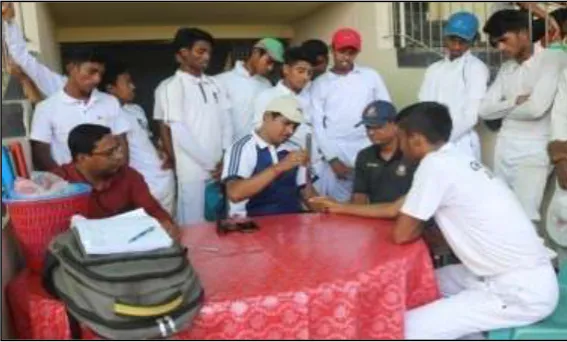
Procedures: The tester held the stick timer near the top, letting in hang between the
subjects’ thumb and index finger. The subjects were directed to look at the concentration
zone and tell to react by catching the stick when it is release. When the subject caught the timer, the score was read just above the upper edge of the thumb.
Figure 2: Participating in Nelson hand reaction test
Trials: Total twenty trials were given to each participant.
Scoring: The five slowest and five fastest trails were discarded from 20 trails and an average of the middle ten was recorded as the score. Numbers of the timer represent thousands of a second. Score may be recorded to the nearest 5/1000 of seconds.
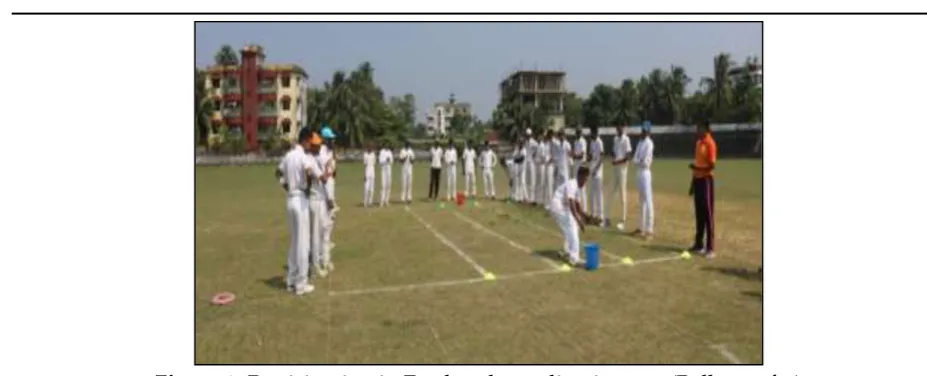
C. Eye Hand Coordination Test (Ball transfer)
Purpose: To measure the coordinating ability by using “Eye hand coordination test (Ball
Figure 3: Participating in Eye hand coordination test (Ball transfer)
Procedures: This test is simultaneously measuring the agility and speed of the performer. Primarily two lines were set up about 10 meters apart with a two box and end line box have a 10 ball. On the signal "ready", the participant places their front foot behind the
starting line. On the signal “Go!" the participant runs towards the other box and picks up a ball and returns to place it behind the starting and keep the ball above the box, then returns to pick up the second ball and total 10 ball respectively. After finishing all the balls (ten balls) the subject’s runs with it back across the line.
Trials: Two trials were given after a slow practice trial to each participant.
Scoring: Best ball transferring time was recorded from left box to right box (up to 10 balls) and time was recorded in nearest seconds.
3.7 Procedures for data collection
Before administering the test all the subjects as well as tester was properly oriented through demonstration by the investigator and they motivated to give their best effort in performing all test items (Kinesthetic perception, Reaction ability, Coordinating ability) prescribe for them. Age, standing height, weight, resting respiratory rate, resting heart rate, resting blood pressure, year of experiences were also measured for demographic status of the performer. All the data was collected in ten (10) consecutive days in a same time and environment respectively. All the subjects were performed the test one by one.
3.8 Statistical applications
4. Results
In the following, all the results are presented with tables, for better understanding of the research outcome. After presenting all the data, the researcher discussed the results parameter wise with scientific evidence and references.
Table 2: Descriptive statistics of Coordinating Ability among different age level cricket players
Category N Mean Std. Dev. Std. Error
Under-14 21 64.85 4.452 0.413
Under-16 20 61.85 2.680 0.583
Under-18 35 59.88 3.260 0.331
*The mean difference is significant at the 0.05 level.
Table 3: Analysis of variance of Coordinating ability among different age level cricket players
Table 4: Scheffe post hoc test among different age level cricket players
Coordinating ability
Group Mean
Difference
Std. Error
Sig.
Under 14 Under 16 Under 18
64.85 61.85 3.007 1.093 .027
61.85 59.88 4.971 .966 .000
64.85 59.88 1.964 .981 .142
Table 5: Descriptive statistics of Reaction Ability among different age level cricket players
Category N Mean Std. Dev. Std. Error
Under-14 22 8.42 1.600 0.413
Under-16 15 8.35 1.745 0.583
Under-18 35 8.86 1.960 0.331
Table 6: Analysis of variance of reaction ability among different age level cricket players
Table 7: Scheffe post hoc test among different age level cricket players
Reaction ability
Group Mean
Difference
Std. Error
Sig.
Under 14 Under 16 Under 18
8.42 8.35 .073 .607 .993
8.35 8.86 -.509 .560 .663
8.42 8.86 -.435 .493 .679
*The mean difference is significant at the 0.05 level.
Source of variance Sum of Squares df Mean Square F Sig.
Between Groups 324.533 2 162.266
13.240 0.000
Within Groups 894.664 73 12.255
Source of variance Sum of Squares df Mean Square F Sig.
Between Groups 3.947 2 1.973
0.599 0.552
Table 8: Descriptive statistics of kinesthetic perception among different age level cricket players
Category N Mean Std. Dev. Std. Error
Under-14 18 2.89 1.673 0.321
Under-16 15 2.51 1.871 0.401
Under-18 35 2.96 1.249 0.317
Table 9: Analysis of variance of kinesthetic perception among different age level cricket players
*Significant difference at the 0.05 level.
Table 10: Scheffe post hoc test among different age level cricket players
Kinesthetic perception
Group Mean
Difference
Std. Error
Sig. Under 14 Under 16 Under 18
2.89 2.51 .381 .465 .717
2.89 2.96 -.065 .386 .986
2.51 2.96 -.446 .410 .557
*The mean difference is significant at the 0.05 level.
5. Discussions
The result of the present study shows that under-14 mean performance of the coordinating ability was 64.85. Similarly, under-16 mean performance was 61.85. Further, under-18 mean performance was 59.88. So, the coordinating ability is increases with the age in respect of 14 years to 18 years of Bangladeshi cricket players. This test is simultaneously measuring the agility and speed of the performer. Amazingly, Cricket players (batsmen) needs to shuttle the sprints repeatedly when they toke run on Crease. So, the performance of coordinating ability has increased in respect to age. In cricket game, the ability to field, throw and hit requires a high-level of coordination and agility [28].
The obtained mean values of coordinating ability are 64.85 (14 years), 61.85 (16 years) and 59.88 (18 years). Further one-way analysis of variance (ANOVA) statistics was employed for comparison of significant differences among different age groups cricket players and found significant differences among the groups. The obtained F value is 13.24 and sig. value 0.00 where the analysis existed with the degrees of freedom of (df=73, 2). The post-hoc analysis result shows statistically significant mean differences between 14 years and 16 years (MD 3.007, significant level 0.027), 16 years and 18 years (MD 4.971, significant level 0.00) and finally, in the concern of 14 years and 18 years (MD 1.964, significant level 0.142).
The obtained mean values of Reaction ability are 8.42 (14 years), 8.35 (16 years) and 8.86 (18 years). Further one-way analysis of variance (ANOVA) statistics was employed for comparison of significant differences among different age groups cricket players and found no significant differences among the groups. The obtained F value is
Source of variance Sum of Squares df Mean Square F Sig.
Between Groups 2.156 2 1.078 0.608 0.547
0.599 and sig. value 0.552 where the analysis existed with the degrees of freedom of (df=69, 2). As the analysis of variance (Anova), the level of sig. was more than 0.05; there exist no significant difference among the groups. Therefore, Scheffe post hoc test was not employed.
The obtained mean values of kinesthetic perception are 2.89 (14 years), 2.51 (16 years) and 2.96 (18 years). Further one-way analysis of variance (ANOVA) statistics was employed for comparison of significant differences among different age groups cricket players and found no significant differences among the groups. The obtained F value is 0.608 and sig. value 0.547 where the analysis existed with the degrees of freedom of (df=65, 2). As the analysis of variance (Anova), the level of sig. was more than 0.05; there exist no significant difference among the groups. Therefore, Scheffe post hoc test was not employed.
6. Conclusions
The performance of the psychomotor ability of cricket player is increases with the age within the certain range. There is a significant difference exists among different age levels cricket players in respect of coordinating ability, and no significant difference observed in case of reaction ability, and kinesthetic perception.
7. Recommendations
In light of the present study the following recommendations is proposed for future investigations:
1) Similar study may be conducted on different age groups of female subjects.
2) Further study can be taken up by using other measuring methods on mentioning
other psychological and neurophysiological variables.
3) Studies of similar nature may be conducted on other training programmers.
4) In future similar study may be conducted on larger subjects with same variables.
5) Further study of similar nature may be planned in relation to others
anthropometric variables.
Acknowledgement
The researcher’s is thankful to all the participants (Noakhali District Cricket Players),
District Cricket Coach (BCB), and Noakhali District Sports Association (NDSA), Bangladesh.
Conflicts of Interest
About the Author
Sanjib Kumar Dey, Deputy Director, Department of Physical Education, Noakhali
Science and Technology University, Noakhali, Bangladesh currently pursuing Master’s
of Physical Education (M.P.Ed) Degree in Department of Physical Education and Sport Science, Visva-Bharati, Santiniketan, West Bengal, India. In multiple International seminars and Conferences, he presented several research papers. He has also published articles in prestigious National and International journals. He acted as a Councilor of Bangladesh Badminton Federation & Bangladesh Athletics Federation, Dhaka, Bangladesh.
References
[1] De A, Mondal S. Yoga and brain wave coherence: A systematic review for brain
function improvement. Heart Mind 2020;4:33. https://doi.org/10.4103/hm.hm_78_19.
[2] Islam MS. Introducing drone technology to soccer coaching. Int J Sports Sci Phys
Educ 2020;5:1–4. https://doi.org/10.11648/j.ijsspe.20200501.11.
[3] Islam MS, Kundu B. Soccer Passing Accuracy Differentiates Between High and
Low Digit Ratio (2D:4D) Soccer Players. Am J Sports Sci 2020;8:49–55.
https://doi.org/10.11648/j.ajss.20200803.11.
[4] Islam MS, Kundu B, Saha S. Relationship between repeated sprint ability and
accuracy of soccer shooting performance in young players. Eur J Phys Educ Sport Sci 2019;5. https://doi.org/10.5281/zenodo.3381127.
[5] De A, Ghosh S. Effect of healthy activity programmes on kinesthetic perception
and self-concept among school students. Int J Adv Sci Res 2016;1:29–33.
[6] Roy T, De A, Nandi DSC. A study on mental toughness in relation to agility and
reaction ability among female kho kho players. Int J Home Sci 2016;2:406–9.
[7] Possin KL. Visual spatial cognition in neurodegenerative disease. Neurocase
2010;16:466–87. https://doi.org/10.1080/13554791003730600.
[8] Heppe H, Kohler A, Fleddermann M-T, Zentgraf K. The relationship between
expertise in sports, visuospatial, and basic cognitive skills. Front Psychol 2016;7. https://doi.org/10.3389/fpsyg.2016.00904.
[9] Anshuman M. COMPARISION OF SELECTED SPORTS SPECIFIC
PSYCHOMOTOR ABILITIES BETWEEN BATSMEN AND BOWLERS IN CRICKET 2015:9.
[10] Sandy. Psychomotor ability. NeuRA Libr 2019.
https://library.neura.edu.au/schizophrenia/signs-and-symptoms/cognition/psychomotor-ability/ (accessed March 23, 2020).
[11] Nicholls JG, Martin AR, Wallace BG, Fuchs PA. From Neuron to Brain. Fourth.
Sunderland, Massachusetts, USA: Sinauer Associates, Inc.; 2001.
[12] Goble D, Christie CJ-A. Cognitive, physical and physiological responses of school
[13] Islam MS. Relationship of abdominal muscle endurance with selected anthropometric measurements in soccer players. Int J Physiol Nutr Phys Educ 2018;3:1088–90.
[14] Rampinini E, Sassi A, Morelli A, Mazzoni S, Fanchini M, Coutts AJ.
Repeated-sprint ability in professional and amateur soccer players. Appl Physiol Nutr Metab
2009;34:1048–54. https://doi.org/10.1139/H09-111.
[15] Rampinini E, Bishop D, Marcora SM, Ferrari Bravo D, Sassi R, Impellizzeri FM.
Validity of simple field tests as indicators of match-related physical performance in
top-level professional soccer players. Int J Sports Med 2007;28:228–35.
https://doi.org/10.1055/s-2006-924340.
[16] Ghosh SN, De A, Mondal S. Stress hormones and sports performance: A critical
analysis. Int J Physiol Nutr Phys Educ 2018;3:1752–7.
[17] Murrihy C, Bailey M, Roodenburg J. Psychomotor Ability and Short-term
Memory, and Reading and Mathematics Achievement in Children. Arch Clin
Neuropsychol 2017;32:618–30. https://doi.org/10.1093/arclin/acx033.
[18] Shaker D. Cognitivism and psychomotor skills in surgical training: from theory to
practice. Int J Med Educ 2018;9:253–4. https://doi.org/10.5116/ijme.5b9a.129b.
[19] Chaiken SR, Kyllonen PC, Tirre WC. Organization and Components of
Psychomotor Ability. Cognit Psychol 2000;40:198–226.
https://doi.org/10.1006/cogp.1999.0729.
[20] Wang Y, Wang H-L, Li Y-H, Zhu F-L, Li S-J, Ni H. Using 2D: 4D digit ratios to
determine motor skills in children. Eur Rev Med Pharmacol Sci 2016;20:806–9.
[21] Manning JT, Scutt D, Wilson J, Lewis-Jones DI. The ratio of 2nd to 4th digit length:
a predictor of sperm numbers and concentrations of testosterone, luteinizing hormone
and oestrogen. Hum Reprod 1998;13:3000–4. https://doi.org/10.1093/humrep/13.11.3000.
[22] Manning J, Kilduff L, Cook C, Crewther B, Fink B. Digit Ratio (2D:4D): A
Biomarker for Prenatal Sex Steroids and Adult Sex Steroids in Challenge Situations. Front Endocrinol 2014;5. https://doi.org/10.3389/fendo.2014.00009.
[23] Garn SM, Burdi AR, Babler WJ, Stinson S. Early prenatal attainment of adult
metacarpal-phalangeal rankings and proportions. Am J Phys Anthropol 1975;43:327–32.
https://doi.org/10.1002/ajpa.1330430305.
[24] Manning JT. Digit Ratio (A pointer to Fertility, Behavior, and Health). United
States of America: Rutgers University Press; 2002.
[25] Manning JT, Hill MR. Digit ratio (2D:4D) and sprinting speed in boys. Am J Hum
Biol Off J Hum Biol Counc 2009;21:210–3. https://doi.org/10.1002/ajhb.20855.
[26] Manning JT, Taylor RP. Second to fourth digit ratio and male ability in sport: implications for sexual selection in humans. Evol Hum Behav Off J Hum Behav Evol Soc 2001;22:61–9.
[27] Islam MS, Kundu B. Digit ratio and soccer. Orthop Sports Med Open Access J
[28] Hoefs J. Nine Fitness Components of Cricket. SportsRec 2011.
https://www.sportsrec.com/316348-nine-fitness-components-of-cricket.html (accessed
July 26, 2020).
Creative Commons licensing terms