ISSN-L: 2501 - 1235 Available on-line at: www.oapub.org/edu
doi: 10.5281/zenodo.1973258 Volume 6 │ Issue 5 │ 2020
INVESTIGATION OF BALANCE PERFORMANCES OF
COMPETITIVE WOMEN TEAM ATHLETES
Deniz Bal, Sinan Çelikbilek, Yakup Akif Afyoni Mugla Sitki Kocman University, Faculty of Sport Science, Mugla, Turkey
Abstract:
In this study, it was aimed to examine the effect of balance-enhancing training applied to competitor women in different team sports. The sample of the study consisted of a total 36 women competitors studying in the Faculty of Sports Sciences and participating in inter-university competitions. The necessary permissions were obtained for the athletes who voluntarily participated in the study, and the consent form was filled in. Athletes who were injured and had any disability were not included in the study. The average age, height and body weight of the athletes are respectively; for handball player (n=12) (21.5±1.49 years, 170.0±2.26 cm, 64.0±2.68 kg); for basketball players (n=12) (20.6±1.47 years, 180.3±3.27 cm, 75.8±3.36 kg) and futsal player (n=12) (24.3±1.25 years, 177.8±3.05 cm, 73.8±3.36 kg). In the research, pretest and posttest experimental methods were used. The athletes were examined in 3 groups for 8 weeks, 2 days a week, 8 movements of balance-improving training program, and the change in their balance was examined. In the study, the Y Balance Test (YDT) was used before and after the balance-enhancing training program in women handball, futsal and basketball athletes from the team sports, and the arithmetic averages (X) and standard deviations (SD) were recorded in the computer environment before and after the post-test measurements. Descriptive statistics of the volunteers were taken and subjected to normality test. Peer sample and paired sample t test were used to examine the relationships between sports branches, the level of significance within and between the groups was examined at the level of 0.05. The balance training performed for 8 weeks caused positive changes in handball players (p <0.05) but did not caused any change in the basketball and futsal players. As a result, it was found that basketball and futsal players participating in the research had better balance than women's handball players did. Given the importance of balance in asymmetric sports, coaches may be advised to put studies that develop this feature into training programs.
Keywords: woman athlete, performance, balance, Y Balance Test
1. Introduction
For the success in sports, the athlete must perform at a high level in terms of physiological and motoric features. Generally, balance ability is one of the basic motoric features that are ignored. Balance includes the integration of motor and cognitive functions with senses from visual, vestibular and position sensation (proprioception) (1, 2).
Improved balance is important not only for the daily activities of individuals, but also for the continuity of the dynamic and rapid movements that are common in their sport performances. Studies have linked weakness in balance performance in both male and female athletes with an increased risk of lower limb injuries. From the kinesiological point of view, it is possible to preserve the sequence under the influence of gravity, internal and external forces of the trunk, and the sum of the forces acting on the trunk can be reset (3). When the literature is examined, it is tried to train and develop using devices such as bosu ball, trampoline, duradisc and balance board in developing balance skills (4, 5). Maintaining the balance and stable posture is an integral part of most movement practices (6). It is a complex motor capability that includes balance control, integration of sensory inputs as well as the planning and implementation of flexible motion patterns (7). The integration of information from sensor systems provides the person with information about her/his orientation to maintain posture control in space that allows regulatory reflexive movements (8).
Y Balance Test (YBT), a rechargeable device that improves balance ability, is a functional test including strength, flexibility, neuromuscular control, stability, range of motion, balance, and propriosis (9). In addition, it is reported that the distance values obtained from the YBT are used effectively in determining the risks of injury due to injury and lower limb asymmetry (10). Initially the test was produced only to take balance measurements, but today it has used in balance-enhancing workouts. For preventive measures before sporting injuries, the YBT gives us accurate information about how close the athletes are to sporting injuries.
Therefore, in this study, it was aimed to develop and compare balance characteristics by applying an 8-week balance-improving training program including handball, futsal and basketball women team athletes, experimental and control groups of these 3 branches. In this study, the effect of balance training of women athletes in different branches on balance development and consequently prevent increased injuries in sports branches due to weak balance.
2. Material and Methods
compare the balance characteristics of competitor women in different branches. After the balance-enhancing studies applied for 8 weeks, the pre-test and post-test balance measurements of the groups were taken and the change in their balance was examined at the end of the program. Then, averages of balance scores were taken and comparisons between groups were made.
The YBT protocol used to measure the balance characteristics of athletes was carried out using a standard test protocol that has been reliably proven previously. At first, the subjects watched a standard video demonstration after six trials before the test. Later, all subjects performed the test by removing their shoes to reduce the possible effects the shoes could stabilize. In the starting line, the test was started by standing with one foot on the posture plate to the farthest side of the foot, and then the front opposite leg posteromedial and posterolateral directions were extended. The test order was 3 attempts on the right foot, reaching anteriorly, and then 3 attempts on the left side, reaching the anterior direction. This procedure was repeated for posteromedial and then posterolateral extension directions. During the trials, the access foot was not allowed to touch the ground or to obtain balance from the access indicator or support tube. If the subject could not test according to the above criteria in six trials, the subject failed in this direction, no data was collected, and another trial was performed. This procedure was repeated for posteromedial and then posterolateral extension directions. During the trials, the access foot was not allowed to touch the ground or to obtain balance from the access indicator or support tube. If the subject could not test according to the above criteria in six trials, the subject failed in this direction, no data was collected, and another trial was performed (11).
3. Data Collection Tools
3.1 Height Length Measurement
Athletes’ height was measured (a 0.01 cm precision) with digital height meter without shoes (12).
3.2 Body Weight Measurement
Athletes were measured without wearing shoes by wearing shorts, t-shirts, socks measured with an electronic scale (a sensitivity of 0.1 kg) (12).
3.3 Leg Length Measurement
Athletes' leg lengths were measured with tape measure (12).
3.4 Y Balance Test (YBT)
abilities on the Y Balance Test platform, they tried to reach the maximum distance they could reach in the anterior, posterolateral and posteromedial directions with the other foot. The test was repeated 3 times in all directions, averaged, and recorded in centimeters. Individual limb dynamic balance was evaluated with YBT (11).
3.5 Training Program
In the gym 2 days a week, with the sports clothes, the groups are divided into groups. In the first and second weeks, first four movements in one set; in the 3rd and 4th weeks, all movements in one set, in the 5th and 6th week, all movements are two set and finally all movements in the 7th and 8th week were performed one set. General and special warming was done for 20 minutes before the study.
3.6 Movement to be Implemented in the Training Program Movement 1
Athletes jump with their arms wide open and changing their feet on one leg and move to the other cushion.
Movement 2
The same movement is applied by changing the arrangement of the cushions, waiting for 3-4 seconds after jumping on each mattress.
Movement 3
The cushions are lined up one after the other, this time athletes’ direction is different,
likewise, the movement is completed by changing the feet and jumping. When the movement is completed, the movement is repeated without going down from the cushion.
Movement 4
In this movement, double feet are jumped, and the direction is passed to the other cushion. Reverse movement is repeated without getting off the cushion.
Movement 5
The same movement as the previous move is performed on one leg.
Movement 6
The cushions are arranged in two mutual positions; the athletes stand on the cushions on one leg and roll the ball to each other.
Movement 7
The sequence is the same again, one of the athletes throws the ball on one foot on the other, allowing her to meet the ball with the head on one leg.
Movement 8
All athletes climb on a cushion on one leg and place the ball in their hands, leaning to the left and right, in order.
3.7 Statistical Analysis of Data
pre-test and post-pre-test results of the experimental groups with the co-sampling pre-test, it was explained with Paired Samples T-Test. The arithmetic mean and standard deviations of the obtained data were obtained and the control and experiment groups of three different branches were formed by testing the normality.
4. Results
Table 1: Descriptive Statistics of competitor women team athletes.
Features Branch n X±sd
Age (Years)
Handball (n=12) 21.5±1.49
Futsal (n=12) 24.25±1.25
Basketball (n=12) 20.6±1.47
Height (cm)
Handball (n=12) 170.0±2.26
Futsal (n=12) 177.8±3.05
Basketball (n=12) 180.3±3.27
Body Weight (kg)
Handball (n=12) 64.0±2.68
Futsal (n=12) 73.8±3.36
Basketball (n=12) 75.8±3.46
Leg Length (cm)
Handball (n=12) 89.5±1.10
Futsal (n=12) 92.25±0.97
Basketball (n=12) 93.5±1.27
When the descriptive statistics of competitors are examined, ıt is observed that the
average age of basketball team athletes compared to handball and futsal team athletes is low; and their height, weight and leg length are more than other branches.
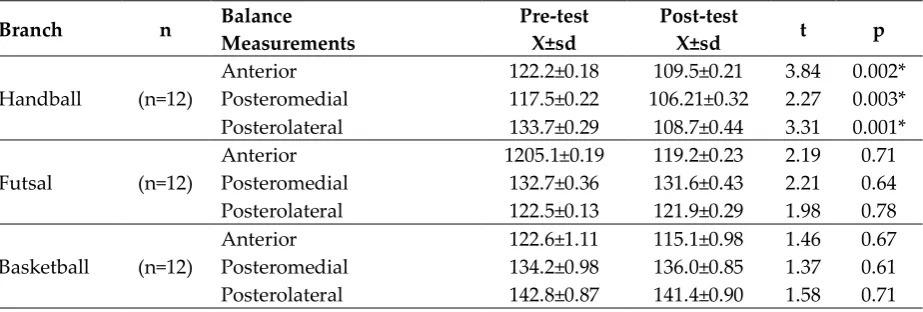
Table 2: Comparison of pre-test and post-test of competitor women team athletes
Branch n Balance
Measurements
Pre-test X±sd
Post-test
X±sd t p
Handball (n=12)
Anterior 122.2±0.18 109.5±0.21 3.84 0.002* Posteromedial 117.5±0.22 106.21±0.32 2.27 0.003* Posterolateral 133.7±0.29 108.7±0.44 3.31 0.001*
Futsal (n=12)
Anterior 1205.1±0.19 119.2±0.23 2.19 0.71 Posteromedial 132.7±0.36 131.6±0.43 2.21 0.64 Posterolateral 122.5±0.13 121.9±0.29 1.98 0.78
Basketball (n=12)
Anterior 122.6±1.11 115.1±0.98 1.46 0.67 Posteromedial 134.2±0.98 136.0±0.85 1.37 0.61 Posterolateral 142.8±0.87 141.4±0.90 1.58 0.71 * p<0.05
5. Discussion
In this study, it was aimed to investigate the effect of balance enhancing training applied to competitor women in different team sports. When the descriptive statistics of competitors are examined, it is observed that the average age of basketball team athletes compared to handball and futsal team athletes is low; and their height, weight and leg length are more than other branches. As a result of the balance measurements, there is a significant difference between the post-test posteromedial mean values of the handball subjects and the pre-test mean values (p<0.05). There was no significant difference between the balance pretest and posttest measurements of futsal and basketball team athletes (p>0.05). 8-week balance exercises performed on handball team athletes with high risk of injury are of more positive effects.
Balance provide a basis for good performance and nervous system is defined as the transmitter in the muscle. Man's ability to balance can be defined as a determining factor in the development of other motor systems (13). It is stated that senior athletes display balance control in relation to the requirements of each discipline.
Learning and training a sport over a long time improves the effectiveness of dynamic and static postural control in daily life activities (14). Elite athletes predominantly use precise sensory information to organize the posture according to their branch's requirements (15). For example, somatosensory signs are more informative than autolithic signs for body orientation in experienced gymnasts (16).
It is stated that as a result of the 8-week program that included the Wii balance exercise applied to 16 young weightlifters, the lower limb muscle strength increased and this increase affected balance performance and improved balance skill (17). These results
are in line with our study. Şahin at al., found that the effects of six-week balance disc exercises on dynamic balance and posture control improved the exercise's dynamic balance and posture control (18).
In their study, Deliceceoglu et al., found that the 8-week technique-weighted goalball training affect leg strength and anterior features in female goalball athletes (19). Aggarwal found significant increases in balance performance in another study examining the effects of a 6-week balance exercise on thirty people (20). Holm et al., have seen that 8-week neuromuscular exercise programs have a significant improvement in dynamic balance scores in female handball players (21). Other study found that significant difference between the control group and the training group after 6 weeks of balance training in healthy young individuals (22).
6. Conclusion
7. Recommendations
In general, it is thought that the balance of basketball and futsal team athletes compared to handball players is improved and there is no change in balance characteristics since they are not affected by the balance exercises. Given the importance of balance, especially in asymmetric sports, coaches maybe advised to put these studies to improve this feature into training programs.
References
1. Howe T. E., Rochester L., Jackson A., Banks P. M., Blair V. A. (2007). Exercise for improving balance in older people. Cochrane Database Syst Rev.; 17(4):CD004963. 2. Rugelj D. (2010). The effect of functional balance training in frail nursing home
residents. Arch Gerontol Geriatr.; 50(2): 192-97.
3. Sucan S., Yılmaz A., Can Y., Suer C. (2005). Aktif futbol oyuncularının çeşitli denge parametrelerinin değerlendirilmesi. Sağlık Bilimleri Dergisi Journal of Health
Sciences.14 (1) 36-42.
4. Kidgell D. J., Horvart D. M., Jackson B. M., Seymour P. J. (2007). Effect of six weeks of dura disc and mini trampoline balance training on postural sway in athletes with functional ankle instability. J. of Strength and Con. Research, 21(2), 466-469. 5. Kaya M., Pulur A. (2003). 13-15 Yaş gubu spor yapan erkek doğuştan görme engellileri
statik ve dinamik denge etkinliklerinin karşılaştırılması, Gazi üniversitesi beden eğitimi ve spor yüksekokulu, yüksek lisans tezi, Ankara
6. Carr, J. H., and Shepherd, R. (1998). Neurological Rehabilitation: Optimising Motor Performance, Oxford: Butterworth-Heineman,
7.Ferdjallah, M., Harris, G. F., Smith, P., Wertsch, J. J.(2002). Analysis of postural control synergies during quiet standing in healthy children and children with cerebral palsy, Clinical Biomechanics, 17, 203-210.
8. Cobb, S. V. G. (1999). Measurement of postüral stability before and after ımmersion in a virtual environment, Applied Ergonomics, 30, 47-57,
9. Gordon, A. T., Ambegaonkar, J. P., & Caswell, S. V.(2013). Relationships between core strength, hip external rotator muscle strength, and star excursion balance test performance in female lacrosse players. International journal of sports physical therapy, 8(2), 97.
10. Gribble, P. A., Hertel, J., Plisky, P. (2012). Using the Star Excursion Balance Test to assess dynamic postural-control deficits and outcomes in lower extremity injury: A literature and systematicreview. J Athl Train., 47: 339–357.
11. Robinson, R. and Gribble, P. (2008). Kinematik predictors of performance on the Star Excursion Balance Test. Journal of Sport Rehabilitation, 17(4), 347-357.
12. Zorba E., ve Ziyagil M., A. (1995). Vücut kompozisyonu ve ölçüm metotları, Erek
13. Aksu, S. (1994). Denge eğitiminin etkilerinin postüral stres testi ile değerlendirilmesi, Hacettepe Üniversitesi Sağlık Bilimleri Enstitüsü Bilim Uzmanlığı Tezi, Ankara
14. Perrin, P., Deviterne, D., Hugel, F., Perrot, C. (2002). Judo, better than dance, develops sensorimotor adaptabilities ınvolved in balance control, Gait and Posture, 15, 187–
194.
15. Vuillerme, N., Danion, F., Marin, L., Boyadjian, A., Prieur, J. M., Weise, I., Nougier, V. (2001). The effect of expertise in gymnastics on postural control, Neurosci Lett, 303, 83–86.
16. Bringoux, L., Marin, L., Nougier, V., Barraud, P. A., Raphel, C. (2000). Effects of gymnastics expertise on the perception of body orientation in the pitch dimension, J Vestib Res, 6, 251-258,
17. Siriphorn A., Chamonchant D. (2015). Wii balanca board exercise improves balance and lower limb muscle strength of overweight young adults, J Phys Ther Sci, 27: 41–46.
18. Şahin G., Şeker H., Yeşilırmak M., Çadır A. (2015). Denge diski egzersizlerinin dinamik denge ve duruş kontrolü üzerindeki etkisinin incelenmesi, Spor ve
Performans Araştırmaları Dergisi, 6(1); 50-57.
19. Deliceoğlu, G., Çavuş, T. P., Karaman, G., Kocahan, T., Tortu, E., Tekçe, A. (2017). Goalball antrenmanının kadın goalball paralimpik takımının kuvvet, denge ve esneklik parametrelerine etkisinin incelenmesi, Gaziantep Üniversitesi Spor Bilimleri Dergisi, Cilt:2, Sayı:1, s.78.
20. Aggarwal A., Zutshi K., Munjal J., Kumar S., Sharma V. (2010). Comparing stabilization training with balance training in recreationally active individuals, International Journal of Therapy and rehabilitation, 17(5); 244.
21. Holm I., Fosdahl M. A., Friis A., Risberg M. A., Myklebust G., Steen H. (2004). Effect of neuromuscular training on proprioception, balance, muscle strength, and lower limb function in female team handball players, Clinical Journal of Sport Medicine; 14(2); 88-94.
Creative Commons licensing terms