Available online throug
ISSN 2229 – 5046
ON STATIONARY CONVECTION IN ROTATORY HYDRODYNAMIC
TRIPLY DIFFUSIVE CONVECTION IN A DENSELY PACKED POROUS MEDIUM
JYOTI PRAKASH
*,
SHWETA MANAN
**, PANKAJ KUMAR AND KAKA RAM
*
Department of Mathematics and Statistics,
Himachal Pradesh University, Summer Hill, Shimla-171005, India.
**
Department of Mathematics, S.V.S.D.P.G. College, Bhatoli, H.P., India.
(Received On: 18-03-18; Revised & Accepted On: 09-04-18)
ABSTRACT
T
he present paper mathematically establishes that ‘the principle of the exchange of stabilities’ for rotatory hydrodynamic triply diffusive convection analogous to Stern (Tellus, 12, (1960), pp. 172-175) type in a densely packedporous medium is valid in the regime |𝑅|𝐴𝜎
2𝜋4 +𝑇𝑎𝑃12≤1, where 𝑅 is the thermal Rayleigh number, 𝐴 is a porous parameter, 𝑇𝑎 is the Taylor number, 𝑃1 is a constant and 𝜎 is the thermal Prandtl number. It is further proved that the above result is uniformly valid for any combination of rigid and free boundaries.
Keywords: Triply diffusive convection; Principle of the exchange of stabilities; Rayleigh number; Taylor number;
Porous medium; Darcy Model.
INTRODUCTION
Research on convective fluid motion in porous media has been an area of great activity due to its importance in the predication of ground water movement in aquifers, in engineering geology, in assessing the effectiveness of fibrous materials, in nuclear engineering, in chemical process industry, food processing industry, solidification and centrifugal costing of metals and rotating machinery, geophysics, petroleum industry and biomechanics. Double diffusive convection in porous medium has been extensively studied. For a broad view of the subject one may be referred to Nield and Bezan [11], Murray and Chen [9], Nield [10], Taunton et al. [25], Kuznetsov and Nield [6], Vafai [30] and Kellner and Tilgner [5], Vadasz [29], Nield and Bezan [11], Tagare et al. [24], Malashetty and Begum [8].
Only double diffusive convection has been investigated by these researchers. However, it has been recognized later that there are many fluid systems, in which more than two components are present. The oceans contain many salts having concentrations less than a few percent of the sodium chloride concentration. Multi-component concentrations can also be found in magmas and substratum of water reservoirs. The subject with more than two components (in porous and non porous medium) has attracted the attention of many researchers Griffiths [2, 3], Poulikakos [14], Pearlstein and Harris [12], Terrones and Pearlstein [26], Rudraiah and Vortmeyer [20], Lopez et al. [7], Tracey [27, 28], Straughan and Tracey [23] and Prakash et al. [16, 18, 19]. The essence of the works of these researchers is that small salinity of a third component with a smaller mass diffusivity can have a significant effect upon the nature of convection; and ‘oscillatory’ and direct ‘salt finger’ modes are simultaneous possible under a wide range of conditions.
The establishment of the nonoccurrence of any slow oscillatory motions which may be neutral or unstable implies the validity of the principle of the exchange of stabilities (PES). The validity of this principle in stability problems eliminates the unsteady terms from the linearized perturbation equations which results in notable mathematical simplicity since the transition from stability to instability occurs via a marginal state which is characterized by the vanishing of both real and imaginary parts of the complex time eigenvalue associated with the perturbation. Pellew and Southwell [13] proved the validity of PES (i.e. occurrence of stationary convection) for the classical Rayleigh-Benard instability problem. However no such results existed for other more general hydrodynamic configurations. Banerjee
et al. [1] established such a criterion for magnetohydrodynamic Rayleigh-Benard convection problem which has further been extended by Gupta et al. [4] for thermohaline convection problems. Recently Prakash et al. [15] extended these results to some triply diffusive configurations.
Corresponding Author: Shweta Manan
**,
The aim of the present paper is to establish criteria for characterizing non oscillatory motions which may be neutral or unstable for rotatory hydrodynamic triply diffusive configuration in a densely packed porous medium analogous to Stern [22] type. It is proved that for rotatory hydrodynamic triply diffusive convection analogous to Stern [22] in
densely packed porous medium, if |𝑅|𝐴𝜎
2𝜋4 +𝑇𝑎𝑃12≤1, then an arbitrary neutral or unstable mode of the system is
definitely non oscillatory in character and in particular PES is valid where 𝑅 is thermal Rayleigh number, 𝐴 is a porous parameter, 𝑇𝑎 is the Taylor number and 𝜎 is the Prandtl number. It is further proved that the above result is uniformly valid for all the combinations of rigid and free boundaries.
MATHEMATICAL FORMULATION OF THE PROBLEM
An infinite horizontal porous layer filled with a viscous and Boussinesq fluid, statically confined between two horizontal boundaries 𝑧= 0 and 𝑧=𝑑, respectively maintained at uniform constant temperatures 𝑇0 and 𝑇1 (>𝑇0) and uniform concentrations 𝑆10 , 𝑆20 and 𝑆11(>𝑆10), 𝑆21(>𝑆20) is kept rotating at a constant rate 𝛺�⃗ about the vertical (see fig. 1). It is further assumed that the cross-diffusion effects of the stratifying agencies can be neglected. The Darcy model has been used to investigate the triply diffusive convection in a densely packed porous medium.
Figure-1: Geometrical Configuration
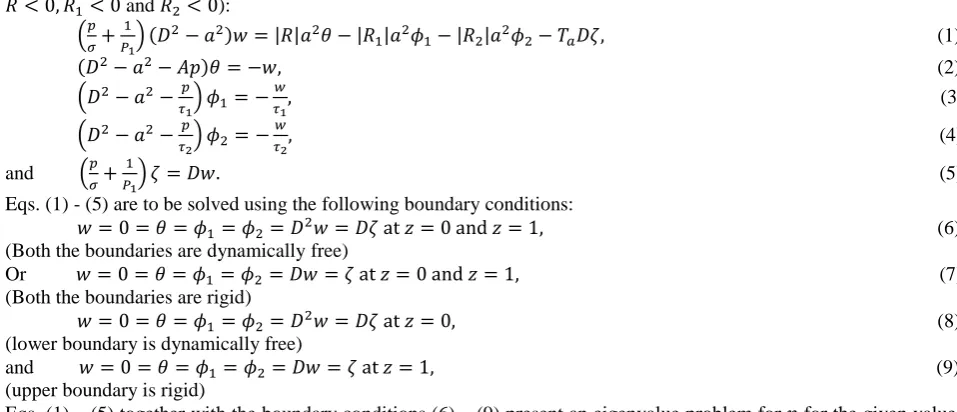
The equations that govern the motion of triply diffusive fluid layer in a densely packed porous medium (Darcy Model) under the action of a uniform vertical rotation, in the non-dimensional form, are as follows (Prakash et al. [17], with
𝑅< 0,𝑅1< 0 and 𝑅2< 0):
�𝑝𝜎+𝑃1
1�(𝐷
2− 𝑎2)𝑤= |𝑅|𝑎2𝜃 −|𝑅
1|𝑎2𝜙1−|𝑅2|𝑎2𝜙2− 𝑇𝑎𝐷𝜁, (1)
(𝐷2− 𝑎2− 𝐴𝑝)𝜃=−𝑤, (2)
�𝐷2− 𝑎2− 𝑝
𝜏1� 𝜙1=−
𝑤
𝜏1, (3)
�𝐷2− 𝑎2− 𝑝
𝜏2� 𝜙2=−
𝑤
𝜏2, (4)
and �𝑝
𝜎+ 1
𝑃1� 𝜁=𝐷𝑤. (5)
Eqs. (1) - (5) are to be solved using the following boundary conditions:
𝑤= 0 =𝜃=𝜙1=𝜙2=𝐷2𝑤=𝐷𝜁 at 𝑧= 0 and 𝑧= 1, (6)
(Both the boundaries are dynamically free)
Or 𝑤= 0 =𝜃=𝜙1=𝜙2=𝐷𝑤=𝜁 at 𝑧= 0 and 𝑧= 1, (7) (Both the boundaries are rigid)
𝑤= 0 =𝜃=𝜙1=𝜙2=𝐷2𝑤=𝐷𝜁 at 𝑧= 0, (8)
(lower boundary is dynamically free)
and 𝑤= 0 =𝜃=𝜙1=𝜙2=𝐷𝑤=𝜁 at 𝑧= 1, (9) (upper boundary is rigid)
Eqs. (1) – (5) together with the boundary conditions (6) – (9) present an eigenvalue problem for 𝑝 for the given values of the other parameters and govern rotatory triply diffusive convection in a porous medium.
The meaning of the symbols involved in equations (1)-(9) from the physical point of view are as follows : 𝑧 is the vertical coordinate, 𝐷 is the differentiation w.r.t. 𝑧, 𝑎2 is square of the wave number, 𝜎> 0 is the Prandtl number,
𝜏1> 0 and 𝜏2> 0 are the Lewis numbers for the two concentration components with mass diffusivity 𝜅1,𝜅2
respectively, 𝑅< 0 is the thermal Rayleigh number, 𝑅1< 0 and 𝑅2< 0 are the two concentration Rayleigh numbers,
𝑇𝑎> 0 is Taylor number, 𝑝 = 𝑝𝑟+𝑖𝑝𝑖 is the complex growth rate where 𝑝𝑟 and 𝑝𝑖 are real constants, 𝑤 is the vertical
velocity, 𝜃 is the temperature and 𝜙1 and 𝜙2 are the two concentrations. The governing equations also involve two more positive constants namely 𝑃1= 𝑘1
𝜖𝑑2 and 𝐴= 1 + �
𝜌𝑠0𝑐𝑠0 𝜌0𝑐0 �
1−𝜖
𝜖 , where 𝑘1 is the permeability, 𝜖 is the porosity of
We prove the following theorem:
Theorem: If (𝑤,𝜃,𝜙1,𝜙2,𝑝,𝜁), 𝑝𝑟≥0 is a solution of Eqs. (1)– (9) with < 0,𝑅1< 0, 𝑅2< 0,𝑇𝑎> 0 and |𝑅|𝐴𝜎
2𝜋4 + 𝑇𝑎𝑃12≤1, then 𝑝𝑖= 0. In particular 𝑝𝑟= 0 implies 𝑝𝑖= 0, if
|𝑅|𝐴𝜎
2𝜋4 +𝑇𝑎𝑃12≤1.
Proof: Multiplying Eq. (1) by 𝑤∗ (the complex conjugate of 𝑤) and integrating the resulting equation over the vertical range of z, we obtain
�𝑝𝜎+𝑃1
1� ∫ 𝑤
∗(𝐷2− 𝑎2)𝑤𝑑𝑧= 1
0 |𝑅|𝑎2∫ 𝑤∗𝜃𝑑𝑧 − 1
0 |𝑅1|𝑎2∫ 𝑤∗𝜙1𝑑𝑧 1
0 −|𝑅2|𝑎2∫ 𝑤∗𝜙2𝑑𝑧 − 𝑇𝑎∫ 𝑤∗𝐷𝜁𝑑𝑧
1
0 . 1
0 (10)
Making use of Eqs. (2) – (5) and the fact that 𝑤(0) = 0 =𝑤(1), we can write |𝑅|𝑎2∫ 𝑤1 ∗𝜃𝑑𝑧=
0 −|𝑅 |𝑎2∫ 𝜃 (𝐷2− 𝑎2− 𝐴𝑝∗)𝜃∗𝑑𝑧 1
0 , (11)
−|𝑅1|𝑎2∫ 𝑤01 ∗𝜙1𝑑𝑧=|𝑅1|𝑎2𝜏1∫ 𝜙1�𝐷2− 𝑎2−𝑝
∗
𝜏1� 𝜙1
∗𝑑𝑧, 1
0 (12)
−|𝑅2|𝑎2∫ 𝑤01 ∗𝜙2𝑑𝑧=|𝑅2|𝑎2𝜏2∫ 𝜙2 (𝐷2− 𝑎2−𝑝
∗
𝜏2)𝜙2
∗𝑑𝑧 1
0 , (13)
−𝑇𝑎∫ 𝑤01 ∗𝐷𝜁𝑑𝑧=𝑇𝑎�𝑝
∗
𝜎 + 1 𝑃1� ∫|𝜁|
2𝑑𝑧 1
0 . (14)
Combining Eqs. (10) – (14), we get
�𝑝𝜎+𝑃1
1� ∫ 𝑤
∗(𝐷2− 𝑎2)𝑤𝑑𝑧=−|𝑅| 1
0 𝑎2∫ 𝜃 (𝐷2− 𝑎2− 𝐴𝑝∗)𝜃∗𝑑𝑧 1
0 + |𝑅1|𝑎2𝜏1
∫ 𝜙1�𝐷2− 𝑎2−𝑝
∗
𝜏1� 𝜙1
∗𝑑𝑧+ |𝑅
2|𝑎2𝜏2∫ 𝜙2 (𝐷2− 𝑎2−𝑝
∗
𝜏2)𝜙2
∗𝑑𝑧 1
0 1
0 +𝑇𝑎�
𝑝∗ 𝜎 +
1 𝑃1� ∫ |𝜁|
2𝑑𝑧. 1
0 (15)
Integrating the various terms of Eq. (15), by parts, for a suitable number of times and utilizing the boundary conditions (6) - (9), we obtain
�𝑝𝜎+𝑃1
1� � (|𝐷𝑤|
2+𝑎2|𝑤|2)𝑑𝑧= 1
0 −|𝑅| 𝑎 2
∫ (|𝐷𝜃|2+𝑎2|𝜃|2+𝐴𝑝∗|𝜃|2)𝑑𝑧+ |𝑅
1|𝑎2𝜏1∫ �|𝐷𝜙1|2+𝑎2|𝜙1|2+𝑝
∗
𝜏1|𝜙1|
2� 𝑑𝑧+ |𝑅 2|𝑎2𝜏2 1
0 ∫ �|𝐷𝜙2|2+ 1
0 1
0
𝑎2𝜙22+𝑝∗𝜏2𝜙22𝑑𝑧−𝑇𝑎𝑝∗𝜎+1𝑃101𝜁2 𝑑𝑧.
(16)
Equating the imaginary parts of both sides of Eq. (16) and cancelling 𝑝𝑖(≠0) throughout from the resulting equation, we have
1
𝜎∫ (|𝐷𝑤|2+𝑎2|𝑤|2)𝑑𝑧= 1
0 |𝑅|𝐴𝑎2∫|𝜃|2𝑑𝑧 − 1
0 |𝑅1|𝑎2∫ |𝜙1|2𝑑𝑧 1
0 −|𝑅2|𝑎2∫ |𝜙2|2𝑑𝑧 1
0 +𝑇𝜎𝑎∫ |𝜁|2𝑑𝑧. 1
0 (17)
Now, multiplying Eq. (2) by its complex conjugate and integrating the various terms of resulting equation, by parts, for an appropriate number of times and making use of the boundary conditions on 𝜃, it follows that
∫1(|𝐷2𝜃|2+ 2𝑎2|𝐷𝜃|2+𝑎4|𝜃|2)𝑑𝑧
0 + 2𝐴𝑝𝑟∫(|𝐷𝜃|2+𝑎2|𝜃|2)𝑑𝑧 1
0 +𝐴2|𝑝|2∫ |𝜃|2 1
0 𝑑𝑧=∫ |𝑤|2 1
0 𝑑𝑧. (18)
Since 𝑝𝑟≥0, it follows from Eq. (18), that 2𝑎2∫1|𝐷𝜃|2𝑑𝑧
0 <∫ |𝑤|2 1
0 𝑑𝑧. (19)
Now, since 𝜃 and 𝑤 satisfy the boundary conditions, namely, 𝜃(0) = 0 =𝜃(1), 𝑤(0) = 0 =𝑤(1) respectively, we have by Rayleigh-Ritz inequality (Schultz [21])
∫1|𝐷𝜃|2𝑑𝑧
0 ≥ 𝜋2∫ |𝜃|2𝑑𝑧, 1
0 (20)
and ∫1|𝐷𝑤|2𝑑𝑧
0 ≥ 𝜋2∫ |𝑤|2𝑑𝑧. 1
0 (21)
Utilizing inequalities (20) and (21) in inequality (19), we get
𝑎2∫1|𝜃|2𝑑𝑧 0 ≤
1
2𝜋4∫|𝐷𝑤|2𝑑𝑧
1
0 . (22)
Multiplying Eq. (5) by 𝜁∗ on both sides and equating real parts on both sides, we obtain
𝑝𝑟
𝜎∫ |𝜁|2𝑑𝑧+ 1 𝑃1
1
0 ∫ |𝜁|2𝑑𝑧= real part of�∫ 𝜁∗𝐷𝑤 1
0 𝑑𝑧� 1
0
≤ �∫ 𝜁1 ∗𝐷𝑤𝑑𝑧
0 � ≤ ∫ |𝜁∗𝐷𝑤|𝑑𝑧
1
0
≤ �∫1|𝐷𝑤|2𝑑𝑧 0 �
1/2
�∫1|𝜁|2𝑑𝑧 0 �
1/2
Since 𝑝𝑟≥0, above inequality implies that
1 𝑃1�∫ |𝜁|
2𝑑𝑧 1 0 �
1/2
≤ �∫1|𝐷𝑤|2𝑑𝑧 0 �
1/2
, (23)
which gives
∫1|𝜁|2𝑑𝑧
0 ≤ 𝑃12∫ |𝐷𝑤|2𝑑𝑧 1
0 . (24)
Using inequalities (22) and (24) in Eq. (17), we get
�1𝜎− �|2𝜋𝑅|𝐴4 +
𝑇𝑎𝑃12
𝜎 �� ∫ |𝐷𝑤|2𝑑𝑧+ 𝑎2
𝜎∫ |𝑤|2𝑑𝑧 1
0 + |𝑅1|𝑎2∫|𝜙1|2𝑑𝑧 1
0 + 1
0 |𝑅2|𝑎2∫ |𝜙2|2𝑑𝑧 1
0 < 0, (25)
which clearly implies (for 𝑝𝑖≠0) that |𝑅|𝐴𝜎
2𝜋4 +𝑇𝑎𝑃12> 1. (26)
Hence if |𝑅|𝐴𝜎
2𝜋4 +𝑇𝑎𝑃12≤1, then we must have 𝑝𝑖= 0.
This establishes the desired result.
The essential content of the theorem from the physical point of view are that for the problem of rotatory hydrodynamic triply diffusive convection in a porous medium analogous to Stern [22] type of an arbitrary neutral or unstable mode of
the system is definitely nonoscillatory in character if |𝑅|𝐴𝜎
2𝜋4 +𝑇𝑎𝑃12≤1 and in particular PES is valid if
|𝑅|𝐴𝜎
2𝜋4 +𝑇𝑎𝑃12≤1.
REFERENCES
1. Banerjee M. B., Gupta. J. R., Shandil R. G., Sood S. K., Banerjee B. and Banerjee K., On the Principle of Exchange of Stabilities in the Magnetohydrodynamic Simple Benard problem, J. Math. Anal. Appln., 108 (1985), 216 – 22.
2. Griffiths R. W., A Note on the Formation of Salt Finger and Diffusive Interfaces in Three Component Systems, Int. J. Heat Mass Transf., 22 (1979), 1687-1693.
3. Griffiths R. W., The Influence of a Third Diffusing Component upon the Onset of Convection, J. Fluid Mech., 92 (1979), 659-670.
4. Gupta J. R., Sood. S. K. and Bhardwaj U. D., On the Characterization of Non Oscillatory Motions in a Rotatory Hydromagnetic Thermohaline Convection, Ind. J. Pure Appl. Math., 17 (1986), 100 – 107.
5. Kellner M. and Tilgner A., Transition to Finger Convection Double Diffusive Convection, Phys. Fluids, 26 (2014), 1-10.
6. Kuznetsov A. V. and Nield D. A., The Effects of Combined Horizontal and Vertical Heterogeneity on the Onset of Convection in a Porous Medium: Double Diffusive Case, Trans. Porous Med., 72(2008), 157-170. 7. Lopez A. R., Romero L. A. and Pearlstein A. J., Effect of Rigid Boundaries on the Onset of Convective
Instability in a Triply Diffusive Fluid Layer, Phys. Fluids A, 2 (1990), 897-902.
8. Malashetty M. S. and Begum I., The Effect of Rotation on the Onset of Double Diffusive Convection in a Sparsely Packed Anisotropic Porous Layer, Trans. Porous Med., 88 (2011), 315-345.
9. Murray B. T. and Chen G. F., Double-Diffusive Convection in Porous Media, J. Fluid Mech., 201 (1989), 147-166.
10. Nield D. A., Onset of Thermohaline Convection in Porous Medium, Water Resour. Res., 4 (1968), 553-560. 11. Nield D. A. and Bezan A., Convection in Porous Media, Springer Verlag, New York, 2006.
12. Pearlstein A. J. and Harris R. M., Terrones. G., The Onset of Convection Instability in a Triply Diffusive Fluid Layer, J. Fluid Mech., 202 (1989), 443-465.
13. Pellew A. and Southwell R. V., On the Maintained Convective Motion in a Fluid Heated from Below, Proc. Roy. Soc. London A., 176 (1940), 312-343.
14. Poulikakos D., The Effect of a Third Diffusing Component on the Onset of Convection in a Horizontal Porous Layer, Phys. Fluids, 28 (1985), 3172-3174.
15. Prakash J., Bala. R. and Vaid K., On the Characterization of Nonoscillatory Motions in Magnetorotatory Triply Diffusive Convection, Proc. Ind. Nat. Sc. Acad., 80 (2014), 197-209.
16. Prakash J., Bala R. and Vaid K., On the Characterization of Magnetohydrodynamic Triply Diffusive Convection, J. Magn. Mag. Mater. 377 (2015), 378–385.
17. Prakash J., Manan S. and Ram K., On Exchange Principle in Rotatory Hydrodynamic Triply Diffusive Convection in Porous Medium: Darcy Model, H. P. U. Journal, 3 (2015), 53-60.
19. Prakash J., Vaid K., Bala. R. and Kumar. V., Characterization of Rotatoryhydrodynamic Triply Diffusive Convection, Z. Angew. Math. Phys (ZAMP), 66 (2015), 2665–2675.
20. Rudraiah M. and Vortmeyer D., The Influence of Permeability and of a Third Diffusing Component upon the Onset of Convection in a Porous Medium, Int. J. Heat Mass Trans., 25 (1982), 457-464.
21. Schultz M. H., Spline Analysis, Prentice- Hall Inc., Englewood Cliffs, NJ, 1973.
22. Stern M. E., The Salt Fountain and Thermohaline Convection, Tellus, 12 (1960), 172-175.
23. Straughan B. and Tracey J., Multi-Component Convection Diffusion with Internal Heating or Cooling, Acta Mech., 133 (1999), 219-239.
24. Tagare S. G., RamanaMurthy. M. V. and Rameshwer Y., Nonlinear Thermohaline Convection in Rotating Fluids, Int. J. Heat Mass transfer, 50 (2007), 3122-3140.
25. Taunton J. W., Lightfoot E. N. and Green T., Thermohaline Instability and Salt Fingers in Porous Medium, Phys. Fluids, 15 (1972), 748-753.
26. Terrones G. and Pearlstein A. J., The Onset of Convection in a Multicomponent Fluid Layer, Phys. Fluids A, 1 (1989), 845-853.
27. Tracey J., Multi-Component Convection-Diffusion in a Porous Medium, Conti. Mech. Thermodyn., 8 (1996), 361-381.
28. Tracey J., Penetrative Convection and Multi-Component Diffusion in a Porous Medium, Adv. Water Res., 22 (1998), 399-412.
29. Vadasz P., Coriolis Effect on Gravity-Driven Convection in a Rotating Porous Layer Heated from Below, J. Fluid Mech., 276 (1998), 351-375.
30. Vafai K., Hand book of Porous Media, Marcel Dekker Inc., New York, 2000.
Source of support: Nil, Conflict of interest: None Declared.