International Journal Advances in Social Science and Humanities
Available online at: www.ijassh.com
RESEARCH ARTICLE
The Effect of Learning Styles on Problem Solving Ability among High
School Students
Mehraj Ahmad Bhat*
Department of Education, Aligarh Muslim University, U.P., India.
*Corresponding Author: Email: [email protected]
Abstract
This research characterized the preferred learning styles of a sample of high school students, and also investigated which preferred learning style had better problem solving ability. In order to evaluate learning style preferences Kolb‟s learning style inventory was administered and to assess the problem solving ability L.N. Dubey‟s Problem solving ability test adapted by the investigator was used. The learning style characteristics examined include, accommodator, assimilator, converger and diverger. The sample of the study consisted of (598) high schools students of grade 10th. The findings of the study revealed that the most preferred learning style is Assimilator followed by Accommodator, Diverger and Converger. The results of analysis of variance showed that learning styles affects the problem solving ability of students and the post hock test depicted that assimilator learning styles had better problem solving ability than the other learning styles.
Keywords: Learning styles, Problem solving ability, High school students.
Introduction
Research in the area of individual differences in learning styles is based on the theory whereas these styles are relatively stable preferences used by each individual to organise and process information for problem solving or to approach a learning task; and most of the learning style inventories being self-inventories testify this fact.
The term „learning style‟ and „cognitive style‟ are
often used interchangeably in the literature; however researchers [1,2] consider the learning style as broader construct. Focusing on learning styles, Newble and Entwistle [3] distinguish between learning styles viewed in terms of information processing strategies and those related to personality traits. The later are relatively consistent preferences of students to learn in characteristic ways, rather than the manner in which they actually approach a learning task and which strategies they use in practice [4].
It is a general surveillance in the classroom that some students prefer learning through interactive activities like games, simulation, problem solving, and critical thinking activities in a many-sided motivated learning environment. Some get
pleasure from the experience of workbooks and handouts to be completed under planned instructions. Others prefer individual study or working in a group by helping through peer interactions.
They desire a teaching which fulfils their needs of information processing. Students prefer different teaching styles with diverse reasons ranging from their prior experiences for acquiring good grades. The secret behind their choice of instruction is the archetypal way of their information processing mechanism [5]. According to Rita Dunn as cited in [6], “Learning style is the way that he or she
concentrates on, processes, internalizes, and remembers new and difficult academic information or skills varying with age, achievement, culture, global versus analytical
processing preference and gender” (p.6). The individual‟s familiar of their learning styles can do extremely well in their academic field by using various sources of information to optimize their quality of learning [7].
It is a common belief that the “Problem Solving” has an important place in children‟s learning in
gradually becoming the primary goal of education at school. One of the most important goals for teaching is teaching students to use basic facts and concepts flexible so that they can deal with new situations, predict various consequences and solve problems. In classroom situations, problem solving can be viewed from two angles, a way of thinking and a way of teaching. Psychologists have investigated and are interested in the former aspect i.e. as way of thinking, while the teachers are interested in problem solving as way of teaching.
Learning style has an important place in the lives of individuals. When the individual knows his/her learning style, s/he will integrate it in the process of learning so s/he will learn more easily and fast and will be successful. Another advantage of the identification of the own learning style by the student is that it will help the student to become an effective problem solver. The more successful the individual is at solving the problems s/he faces, the more control s/he will take over his/her own life [8]. It is important that individuals receive education in areas suitable for their learning styles. A person educated in an area having no relationship to his/her learning style may lack confidence and s/he may be less successful; s/he may as a result become frustrated.
Kolb’s Learning Style Model
Learning styles are not inborn characteristics but, are developed through experience [9]. They are rather the combination of how people perceive and process the information that characterizes their own learning style. Kolb structures this process in a four-stage model that encompasses two continuums:
The concrete-abstract continuum (vertical axis) is concerned with how people perceive new Information. Consequently, some learners might have a tendency to deal with novel problem situations according to concrete experience (CE), while others will prefer to approach them by abstract conceptualization (AC). In contrast to this, the active-reflective continuum (horizontal axis) is about how we process new information. Some learners have a predisposition to try things out by active experimentation (AE), while others might be inclined to think and evaluate by reflective observation (RO). Preferences in the learning way that represent every learning style are different from each other. In order these are
learning by “feeling” for concrete experience, “watching” for reflective observation, “thinking” for abstract conceptualization and “doing” for
active experimentation. That is, according to Kolb learning style model, a person perceives the knowledge by thinking and feeling, integrates the knowledge by watching and doing. Kolb defined the experiential learning theory as a four stage learning circle that contains the ability of Concrete Experience, Reflective Observation, Abstract Conceptualization and Active Experimentation. Only one ability do not
determines the person‟s learning style. Every person‟s learning style is a component of four learning ability [9]. The graphical representation
of Kolb‟s learning style model as shown in below figure.
Fig. 1: Graphical representation of Kolb’s learning style model
This cycle exhibits four learning styles: Converging, Diverging, Assimilating, and Accommodating. These dimensions are needed for quality of learning. The characteristics of the Assimilating, Diverging, Converging and
Accommodating learning style that are in Kolb‟s
learning style model and the people who have own these learning styles have been explained below [10,11].
Converging Learning Style includes abstract conceptualization and active experimentation learning styles. The main characteristics of the people who own this learning style are problem solving, decision making, analyzing the thoughts logically and systematic planning. Learning by doing is important for these people. These people choose jobs that need technological abilities such as medicine, engineering, economy, computer science [12].
Diverging Learning Style includes concrete experience and reflective observation learning styles. The most important characteristics of these people who own this learning style are thinking ability, being aware of value and concept. These people revise changing concrete
Accommodating (feel and do)
Diverging (feel and watch)
Converging (think and do)
situations from many points of view and organize relations meaningfully. They attend to give patient, objective, careful judge, but they do not attend to action. They take into consideration their thoughts and feelings while they form their thoughts. These people choose jobs such as socials practices, journalism, psychology, literature and art/theatre [12]
Assimilating Learning Style includes abstract conceptualization and reflective observation learning styles. The main characteristic of these people is creating conceptual model. They focus on abstract concept and thoughts while they learn something. These people choose jobs such as biology, education, teacher, law, sociology, librarian and mathematic [12].
Accommodating learning Style includes concrete and active experimentation learning style. The main characteristics of these people who own this learning style are making plan, carrying out plans and being in new experiment. People accommodate themselves easily to the changes and they are broadminded while they learn something new. They choose jobs such as salesmanship, public administration, education administration, administration and banking [12].
Objectives of the Study
To carry out the study in a systematic way following objectives were formulated.
To investigate the preferred learning styles of students studying in high schools.
To know the effect of learning styles on problem solving ability.
Research Questions
The results of the study would answer the following questions.
What are the most preferred learning style of
students‟ studying in high schools.
Does the learning style effect on problem solving ability?
Method and Procedure
The samples of this survey study comprised of 598 high school students currently enrolled in class 10th of South Kashmir of Jammu and Kashmir.
This study was delimited to students of class 10th. Secondly the learning styles were measured
by using Kolb‟s Learning Style Inventory based on Kolb‟s Experiential Learning Theory. Thirdly the
quality of problem solving ability was assessed by Problem Solving Ability Test by (L.N. Dubey) modified by the investigator.
The Learning Style Inventory (LSI) was a self descriptive inventory consisted of 12 questions, each followed by four answers. The respondents were asked to rank their answers from one to four by describing their preferences. These preferences were then mapped on the four respective poles: Concrete experience (CE), Abstract conceptualization (AC), Active experimentation (AE) and Reflective observation (RO).
These four poles constituted four quadrants relating to four learning styles: Converging, Diverging, Assimilating, and Accommodating. The scores of AC-CE and AE-RO show the learner‟s
preference for the abstract dimension over the reflective dimension and for the active dimension over the reflective dimension respectively (Kolb 2005). The specific learning style of a student is measured by plotting the scores of AC-CE and AE-RO on a grid. The values for AC-CE are placed on vertical axis and on the horizontal axis score AE-RO are plotted to identify the diverging, the accommodating, the converging and the assimilating learning styles.
The Problem Solving Ability Test consists of twenty items based on multiple choice with four alternatives, each question carried one point (1) for right answer and zero (0) point for wrong answer. Data were tabulated and analyzed by using descriptive and inferential statistical measures through SPSS 20, by using, percentage and one-way ANOVA.
Results
Investigating the Preferred Learning Style of high School Students
In order to find out the secondary school students most preferred learning style, frequencies and percentage distributions were calculated and presented at Table 1.
Table 1: Distribution of total sample according their learning styles
Learning
Styles Frequency Percentage (%)
Accommodator 168 28.1
Assimilator 169 28.3
Converger 109 18.2
Diverger 152 25.4
Total 598 100.0
Fig. 2: Graphical representation in percentage wise distribution of learning style of the total sample
To Know the Effect of Learning Styles on Problem Solving Ability
In order to know the differences in means of different learning styles according to their problem solving ability descriptive statistics was used. The results are shown in Table 2.
Table 2: Comparison of learning styles according to their means with problem solving ability
Learning styles
N Mean Std. Deviation Std. Error
Accommodator 168 10.48 3.17 .24
Assimilator 169 12.00 2.71 .21
Converger 109 10.19 2.10 .29
Diverger 152 11.64 3.11 .25
Total 598 11.15 3.10 .13
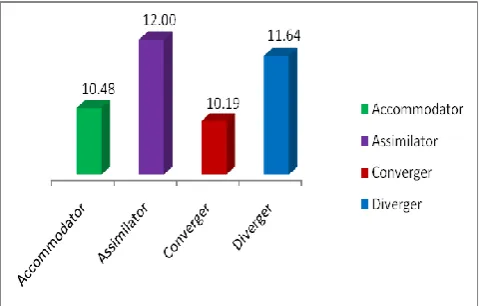
From the perusal of table 2 it indicates that assimilator learning style has best problem solving ability, because their mean value is (12.00) followed by diverger (11.64), accommodator (10.48) and converger (10.19). The mean difference of learning styles according to their problem solving ability is represented graphically in fig. 3.
Fig. 3: Graphical representation of mean difference of learning styles according to their problem solving ability
In order to know the significant differences among the different learning styles one-way ANOVA was used. The results are shown in table 3.
Table 3: Effect of learning styles on problem solving ability of secondary school students
Source of variance
Sum of Squares
df Mean
Square
F sig.
Between groups 331.817 3 110.606
12.29 .000**
Within Groups 5346.029 594 9.000
Total 5677.846 597
Significant at 0.01 level
According to table 3 it depicts that, „f‟ value was
calculate (12.29) which is significant at 0.01 level. So, it means that there exists significant difference in different learning styles in relation to their problem solving ability. It may, therefore be concluded that learning style influenced the problem solving ability of secondary school students.
It was found that there is significant difference within the groups. In order, to know the significant difference in problem solving ability between each group of learning styles, the data was analysed with the help of post hock test (Scheffe). The results are shown in the table 4.
Table 4: Multiple comparisons between the groups to know the difference
(I) Learning Styles
(J) Learning Styles
Mean Difference
(I-J)
Std. Error
Sig.
Accommodators Assimilator -1.51190
* .33 .000
Converger .29543 .37 .887
Diverger -1.15006* .33 .009
Assimilator Converger 1.80734* .37 .000
Diverger .36184 .33 .762
Converger Diverger -1.44550* .38 .002
*The mean difference is significant at the 0.05 level.
The table 4 reveals that there is significant difference between accommodator and assimilator, because the mean value of assimilator is (12.00), which is higher than the mean value of accommodator (10.48), the table also indicates that there is significant difference between assimilator and converger, because the mean value of assimilator is (12.00), which is higher than the mean value of converger (10.19). Therefore, it may be concluded that assimilator learning styles shows best problem solving ability than their counterparts.
Discussion
(RO). As a result, they can understand a wider range of information, which they are able to organize into a concise and logical form. They are interested in ideas and concepts and value the logic and accuracy of these ideas more than their practical applications. These results are in line with the views of [15-17].
The findings of the study also revealed that
learning style influenced the problem solving ability of high school students, and the post hock test depicts that that assimilator learning styles shows best problem solving ability than their counterparts. No parallel study is available to support or contradict the findings of the study.
Therefore, it is recommended that the teachers use interactive and creative methods such as large and small group discussion, problem solving, brain storming, self- learning, debate-based learning and problem-debate-based learning in
their teaching to raise the level learning among the students.
The next implication is that educational psychologists need to develop insights into the specific learning styles which are favoured by the educational system. If students can be enabled to be more aware of themselves and the ways in which they are likely to achieve better, they can be encouraged to develop more effective and more flexible learning styles. On the other hand, two major strategies have been proposed for enhancing students' achievement. One is through providing learning environments that match students' learning styles [18-20] The second strategy is through teaching for a balanced use of styles or flexibility [21-23] In this regard, the basic principle is that, in order for students to benefit maximally from instruction and assessment, at least some of each should match their learning styles. Therefore, flexibility is crucial for students as well as for teachers.
Conclusion
The main purpose of the study was to identify the preferred learning style and also to investigate which preferred learning style had better problem solving ability. The results provide a comparatively complete profile of individual learning styles, suggesting essential modes of learning and individual differences as well. Once a teacher be acquainted with the profile of learning style characteristics of students in his/her class room, teaching strategies can be best used to take advantage of learners' preferences. Students who are taught in the modes in which
they are most comfy are likely to feel more certain and competent. Simply knowing students' learning style preferences will not identify a single teaching strategy best for all students, but it does suggest a range of alternatives and those most likely to succeed. One particular application of these profiles is to assist students to be aware of how they best prefer to learn. It also assists students to know that teachers care about their learning, and want to help learners in the best way possible.
References
1. Dunn R, Dunn K, Price GE (1979) Identifying individual learning styles. National Association of Secondary School Principal.
2. Keffe JW (1979) Students learning students. National Association of Secondary School Principal. 3. Newble EI, Entwistle JN (1986) Learning style and approaches: Implications for medical education. Medical Education, 17:165-171.
4. Katz N ((1981) Individual learning style: Israeli norms and cross-cultural equivalence of Kolb‟s learning style inventory. Journal of Cross-Cultural Psychology, 19 (3), 361-379.
5. Claxton C, Murrell P (1987) Learning styles: Implications for improving educational practices. Higher Education Report No. 4. Washington, DC: George Washington University.
6. Yeh WP (2004) Learning styles, learner characteristics, and preferred instructional activities in computer-based technical training for
adults. Available: http://
digital.library.okstate.edu/etd/umi-okstate-1239. 7. Régnier JC (1995) Cognitive styles, learning and
teaching mathematics. Proceedings of the 19th International conference for the psychology of mathematics education, 1:219.
8. Biggs J (2001) Enhancing Learning: A Matter of Style or Approach? Perspectives on Thinking, Learning and Cognitive Styles, R. J. Sternberg, L. F. Zhang (Eds.). Mahwah, Lawrance Erlbaum Associates.
9. Kolb DA (1984) Experiential learning: Experience as the source of learning and development. Englewood Cliffs, NJ: Prentice Hall.
10.Aşkar P, Akkoyunlu B (1993) Kolb Learning Style Inventory, Education and Science, 87:37-47.
12.Kaya F, Özabacı N, Tezel Ö (2009) Investigating primary school second grade students‟ learning styles according to the Kolb learning style model in terms of demographic variables. Turkish Science Education, 6(1):11-25. Retrieved fromhttp://www.tused.org/internet/tused/archive/v6/ i1/text/tusedv6i1s2.pdf
13.Kolb DA, Boyatzis RE (1999) Experiential Learning Theory: Previous Research and New Directions. Mahwah, NJ: Erlbaum.
14.Kolb AY, Kolb, DA (2009) The learning way: Meta-cognitive aspects of experiential learning. Simulation & Gaming, 40(3):297-327.
15.Bhatti R (2013) On the Effect of Learning Style on Scholastic Achievement. Current Issues in Education, 16 (2).
16.Tabrizi JS, Alizadeh O, Koshavar H (2013)
Identifying Students‟ learning Styles as a Way to
Promote Learning Quality. Res Dev Med Educ, 2(1):35-39
17.Ibrahimoglu N, Unaldi I, Samancioglu M, Baglibel M (2013) The relationship between personality traits and learning styles: A cluster analysis. Asian Journal of Management Sciences and Education, 2(3).
18.Adderley KBV (1987) The effects of student cognitive style, teacher cognitive style, and
instructional method on the achievement of baccalaureate nursing students. Dissertation Abstracts in Humanities and Social Sciences, 47(8A):29-49.
19.Grout CM (1991) An assessment of the relationship between teacher teaching style and student learning style with relation to academic achievement and absenteeism of seniors in a rural high school in north central Massachusetts. Dissertation Abstracts International, Section A: Humanities and Social Sciences. 51(8A):19-26. 20.Kagan J (1965) Information processing in the child.
In PM Mussen, J.J Conger, J.Kagan (Eds.), Readings in child development and personality. New York, NY: Harper & Row
21.Saracho ON, Spodek B (1986) Cognitive style and children‟s learning: Individual variation in cognitive process. In L.G. Katz (Ed.). Current topics in early childhood education. Norwood, New Jersey: Ablex Publishing Company.
22.Sternberg R.J (1997) Thinking Styles. Cambridge, Cambridge University Press.
23.Zhang LF (2004) Predicting cognitive development, intellectual styles and personality traits from self-rated abilities. Learning and Individual Differences,
15: 67-88.