
ENHANCEMENT OF THE REMOVAL OF CADMIUM(II)
FROM WATER RESOURCES BY 2,5-HEXANEDIONE
BIS(SALICYLOYLHYDRAZONE) USING FLOATION
TECHNIQUE
Bakir Jeragh
[a]*and Ahmed A. El-Asmy
[a]Keywords: Cd(II) removal; 2,5-hexanedione bis(salicyloylhydrazone); natural water; flotation; spectrophotometry
The removal of Cd(II) is improved using 2,5-hexanedione bis(salicyloylhydrazone) (HDSH) as complexing agent, and oleic acid (HOL) as collector by flotation method. The optimum conditions are: pH ~ 5; Cd(II) = 2×10⁻⁴ mol L-1, surfactant = 1×10⁻³ mol L−1 and HDSH = 1×10⁻⁴ mol L-1; ionic strength [different concentrations of NaCl, KCl, KNO
3 and CaCl2]; temperature [25±2 °C] and shaking time [3 min]
were optimized. The effect of added ions (Na+, K+, Ca2+, Mg2+, Mn2+, Co2+, Ni2+, Cu2+, Zn2+, Hg2+, Al3+, Cl-, SO
4--, NO3-, ClO4-, H2PO4
-and CH3COO- ions) was investigated on the recovery of Cd(II). The Cd(II)-HDSH complex was floated quantitatively (~100 %) under the
recommended conditions. The proposed procedure was satisfactorily applied to the analysis of Cd(II) in natural [Nile, Sea, underground and lake] waters. The solid complex formed between HDSH and Cd(II) was characterized to have the formula [Cd2(HDSH-4H)(H2O)4].
*Corresponding Author
E-Mail: [email protected]
[a]Chemistry Department, Faculty of Science, Kuwait University, Kuwait, P.O.Box 5969, Safat 1360, Kuwait
Introduction
The industrial effluents alter the flow of materials and introduce chemicals to the environment. The rate increases as a result of urbanization. Most of the effluents contain heavy metals which have major hazards because of their toxicity to human beings.1
Numerous techniques for the separation of metal ions have been reported.2-5 However, most of these suffer from
lengthy separation, limitation of the volume sample, time consuming, multistage, lower enrichment factor and consumption of harmful organic solvents. These problems have been overcome using flotation2,3,5 which received
attention due to simplicity, rapidity, economy, good separation efficiency (>95 %) for small impurity agents in the concentration range (10-6–10-2 mol L-1) and a large
applications for species having different nature and structure, flexibility and friability of equipment.6 The flotation is
incorporated as a clean technology for wastewater treatment.7 So, it is chosen for the removal methods.8-12
Although a number of reagents are reasonable for flotation
2,13-18 or spectrophotometric determination13,19-25 of metal
ions, the method has not been used to analyze Cd(II) with HDSH. Therefore, the present work was undertaken to enhance the Cd(II) removal from natural waters using HDSH as a new complexing agent.
Experimental
Apparatus
The flotation cell used had a 15 mm inner diameter and 290 mm long. The pH was measured using Hanna Instruments 8519 pH meter provided with a glass electrode. The IR spectra were recorded on a Mattson 5000 FT-IR Spectrophotometer using KBr disc. The Cd(II) concentration in the mother liquor, after flotation, was determined using a Perkin-Elmer Atomic Absorption Spectrophotometer.
Reagents
The reagents and solvents were of analytical grade and were used as supplied. Second distilled water was used for washing and dilutions. The glassware was cleaned by washing with water. Oleic acid (HOL) was used directly as received. Its stock solution, 6.36×10⁻² mol L-1, was prepared
from food grade with specific gravity 0.895 (J. T. Baker Chemical Co.) by dispersing 20 ml in 1 L kerosene. Cd(II) stock solution, 1×10⁻² mol L-1, was prepared by dissolving
the requisite amount of Cd(NO3)2.2H2O in 1:1 (v/v) ethanol
/ water and standardized complexometrically with EDTA. HCl and/or NaOH were used for adjusting the pH.
Preparation of HDSH and its Cd(II) complex
Scheme 1. Preparation reaction of HDSH
The Cd(II) complex was prepared by heating HDSH (0.7 g, 2 mmol) in 30 ml ethanol and CdCl2.2H2O (0.876 g, 4
mmol) in 20 ml ethanol on a water bath for 4 h. The precipitate was filtered off, washed with diethyl ether and finally dried in a vacuum desiccator over anhydrous CaCl2.
Elemental analysis: [Cd2(HDSH-4H)(H2O)4] [Calcd.
(Found)] C=35.47 (35.30); H=4.17 (3.58); N=8.26 (7.48). IR bands (cm-1): 3554; 1635; 1608; 1075; 426 for the
stretching vibrations of H2O, C=O, C=N, N-N and Cd-N,
respectively. 1H NMR signals (ppm): 12.480; 7.945-7.041;
1.990; 3.362 for OH, CHph; CH2 and CH3, respectively.
In the IR spectrum of [Cd2(HDSH-4H)(H2O)4], the υ(OH)
and δ(OH) bands disappeared indicating the deprotonation of the phenolic OH and its participation in bonding. The disappearance of (C=O) and (NH) bands indicated the enolization of CONH and its participation in coordination. It is evident from the appearance of new bands at 1531-1577 and 1223-1258 cm-1 due to ν(C=N*) and ν(C-O) vibrations.
The bands at 3292, 930 and 600 cm-1 in [Cd
2
(HDSH-4H)(H2O)4] are attributed to υ(OH), ρr(H2O) and ρw(H2O) of
coordinated water.26
Procedures
Flotation
A solution containing 2x10⁻⁴ mol L-1 Cd(II) was mixed
with HDSH (1x10⁻⁴ mol L-1) and 5 ml double distilled water.
The pH was adjusted at ≈ 5. The solution was then transferred quantitatively to the flotation cell and made up to 10 ml with double distilled water. The cell was shaken well for few seconds to ensure complete complexation. To this solution, 3 ml of 1x10⁻³ mol L-1 HOL were added and the
cell was then inverted upside down many times. After complete separation, the scum containing Cd(II)-HDSH complex was separated, eluted with 5 ml of 4 M HCl, diluted to 10 ml in a volumetric flask and subjected to AAS determination. The floatability (F %) of the analyte was calculated by:
where Ci and Cf are the initial and final concentrations of
Cd(II) in the mother liquor, respectively.
Temperature
To study the effect of temperature on the flotation efficiency, two flotation cells were prepared: one containing the solution of Cd(II) and HDSH and the second containing the surfactant. The two were either heated or cooled to the same temperature. The surfactant solution was quickly poured into the solution of the investigated ion (inside a cell
jacketed with 1 cm thick fiberglass insulation) at zero time. The mixture was then floated under the same conditions.
Application
Natural water samples
The water samples were obtained from the Mediterranean Sea, Nile, tap, underground and lake. Each of pre-filtered water sample was poured into a beaker and 8 ml of concentrated HNO3 and 3 ml of H2O2 (30 %) were added for
complete decomposition of the organic matter. The sample, while stirring, was evaporated to one-tenth volume. After adjusting the sample pH to the desired value, the flotation and spectrophotometric determination were preformed according to the recommended procedure.
Results and Discussion
Flotation process
To study the optimum conditions for maximum flotation of Cd(II), different factors were investigated.
pH
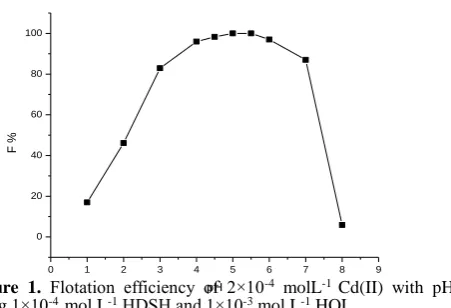
The pH, which is highly significant as it affects the metal-ligand interaction, was optimized first. The experiments using 1×10⁻⁴ mol L-1 HDSHand 1×10⁻³ mol L-1 of HOL
surfactant were carried out to evaluate the optimum pH giving maximum flotation of 2×10⁻⁴ mol L-1 of Cd(II). The
data graphically represented in Fig. 1 showed that the efficiency of flotation increases gradually with pH, reaching maximum (~ 100%) at 4.5-5.5 and then starting to decrease.
Figure 1. Flotation efficiency of 2×10⁻⁴ molL-1 Cd(II) with pH
using 1×10⁻⁴ mol L-1 HDSH and 1×10⁻³ mol L-1 HOL.
At pH 4.5-5.5, Cd(II)-HDSH being hydrophobic by combination with undissociated HOL begins to dissociate at pH ≥ 5.2, through hydrogen bonding or chemically with OL-.
The hydrophobic particulates are floated to the solution surface by air bubbles. At pH > 7, the floatability diminishes due to the solubility of the formed precipitate or the oleic acid may give a white turbidity of sodium oleate dispersed in the bulk of the floating medium. Therefore, pH ~ 5 was chosen for further experiments.
O
OH NHNH2 2
+
CH3
O H3C
O
CH3
N H3C
N NH HN
O O
HO OH
Reflux for 2 hr. EtOH
i
f
%
100
i
C
C
F
C
0 1 2 3 4 5 6 7 8 9
0 20 40 60 80 100
F
%
Oleic acid concentration
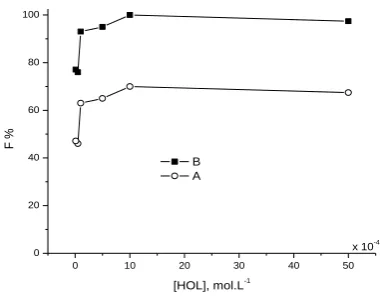
Experiments were conducted to float Cd(II) with HOL only, but the efficiency was found ~60 %. Therefore, other experiments were carried out to find the most suitable concentration of HOL for removing 2×10⁻⁴ mol L-1 Cd(II) at
pH ~5 using 1×10⁻⁴ mol L-1 HDSH. The floatability reached
~100% when HOL concentration was 1-5x10⁻³ mol L-1;
below this concentration, the flotation decreased due to the presence of insufficient amount of HOL required for complete floatation. At higher concentration, the decrease in the removal may be attributed to the changes of precipitate state.29 The lower flotation at high HOL concentration may
be due to the formation of a hydrate micelle coating on the solid surface.29 As a result, the hydrophobicity of the surface
was not suitable for flotation.11 Therefore, HOL
concentration must be 1×10⁻³ mol L-1. The data are
presented in Fig. 2.
Figure 2. Floatability of 5×10⁻⁵ molL-1 Cd(II) versus [HOL] at pH
~5 in absence (A) and presence (B) of 1×10⁻⁴ mol L-1 HDSH.
HDSH concentration
The variation in the concentration of HDSH at pH ~5 showed that, the floatability of Cd(II) increased abruptly and reached its maximum percentage (~100 %) at M:L ratio of 1:1. Excess HDSH had no effect facilitating the separation of Cd(II) from unknown matrices [10-4 mol L-1 HDSH was
used in all subsequent experiments.
CdII) concentration
The use of different concentrations of Cd(II) at HDSH = 1×10⁻⁴ mol L-1 and HOL = 1×10⁻³ mol L-1 and pH ~5
showed that the maximum floatation efficiency (~100%) of Cd(II) remained constant whenever the ratio of Cd(II) to HDSH is 1:1, 1:2, 1:3. etc. The decrease in flotation at higher concentrations of Cd(II) is attributed to the insufficient amount of HDSH to bind all Cd(II) ions existing in solution.
Reaction temperature
The variation of temperature in the range 5-90 °C had no marked effect on the floatation efficiency of Cd(II) ([Cd2+]=
2×10⁻⁴ , [HDSH] = 1×10⁻⁴ and [HOL] = 1×10⁻³ mol L-1 and
pH ~5). Accordingly, all experiments (unless otherwise stated) were carried out at room temperature (25±2 °C).
Stirring time
The influence of stirring time showed that a maximum floatation (~100%) was attained after 3 min of shaking indicating that the flotation-separation is not time consuming.
Ionic strength
Table 1 summarizes the effect of ionic strength varied with different salts that are usually present in natural water samples. It is to be noted that the ionic strength of the medium had no marked effect on the flotation process.
Table 1. Effect of ionic strength on the floatability of 2×10⁻⁴ mol
L-1 Cd(II) using 1×10⁻⁴ mol L-1 HDSH and 1×10⁻³ mol L-1 HOL at
pH ~5.
Salt Concentration, mol L-1 F %
KCl 0.01
0.10
99.8 99.5
NaCl 0.01
0.10
100.0 99.9
KNO3 0.01
0.10
99.7 99.7
CaCl2 0.01
0.10
99.7 99.5
Effect of cations and anions
The effect of some cations and anions which are normally present in fresh and saline waters was investigated to assess the applicability of the proposed method to recover Cd(II) added to water samples. The tolerable amounts of each ion (presented as ion: Cd ratio) are summarized in Table 2. Inspection of the data shows that the investigated cations and anions did not interfere. Some ions (Hg2+, CO
32- and
H2PO4-) can interfere at concentration more than the
recommended in Table 2. This interference could be removed by increasing the concentration of HDSH in experiments required higher concentration of HDSH.
Water samples
Various water samples were selected to provide a wide variety of sample matrices characterized by different types of interferents. The samples were pretreated as described previously. To 10 ml aliquots of the investigated water sample, 2.5 or 5 mg L-1 Cd(II) was added after adjusting the
pH to ~5. The data are presented in Table 3 and are satisfactory over than 95%.
0 10 20 30 40 50
0 20 40 60 80 100
B A
F
%
[HOL], mol.L-1
Table 2. Effect of some cations and anions on the flotation of [Cd2+] = 2×10⁻⁴, [HDSH] =1×10⁻⁴, [HOL] = 1×10⁻³ mol L-1 and pH ~5.
Cations Cation/Cd(II) ratio F % Anion Cation/Cd(II) ratio F %
Na+ 8000 100.0 Cl- 4000 100.0
K+ 8000 100.0 SO
42- 5000 100.0
Co2+ 2000 100.0 NO
3- 3000 99.7
Ni2+ 2100 99.5 CH
3COO- 1200 99.2
Cu2+ 1700 98.5
Zn2+ 400 99.2
Table 3. Recovery (R %) of Cd(II) added to 10 ml of water samples containing [HDSH] = 1×10⁻⁴ and [HOL] = 1×10⁻³ mol L-1
at pH ~5.
Water source Cd(II) mg L-1 R %
Added found
Tap 2. 5
5.0
2.46 4.97
98.4 99.4
Nile 2. 5
5.0
2. 48 4.85
99.2 97.0
Sea 2. 5
5.0
2. 49 4.97
96.0 99.4
Underground 2. 5
5.0
2.45 4.92
98.0 98.4
Lake 2. 5
5.0
2.40 4.77
96.0 95.4
Effect of foreign ions
To asses the usefulness of the proposed method, the effect of the investigated diverse ions on Cd(II) analysis was studied (Table 2). The interfering cations were added as chlorides while the anions as sodium salts. The tolerance of the method with respect to foreign ions was investigated with solutions containing 5.59 mg L-1 Cd(II) and various
amounts of foreign ions. The tolerance criterion for a given ion was taken as the deviation of the absorbance by more n ~2% from the value expected for the system Cd(II)-HDSH.
Inspection of the data shows that most of the investigated ions at high ion: analyte ratio did not interfere. However, Al(III), Ba(II), Cu(II), citrate and bicarbonate ions interfere when added with more than 2 folds of Cd(II) [not cited in Table 2]. The interferences could be overcome by adding excess HDSH. EDTA interfered seriously which may be attributed to a competition between EDTA and HDSH for chelation with Cd(II).
Cause of Flotation
The flotation process is attributed to the coordination of HDSH that acts as a bidentate ligand coordinating through the C=N and C-O groups. The IR spectrum of the scum solid has no absorption bands corresponding to oleic acid. HOL may bind with [Cd2(HDSH-4H)(H2O)4] giving
hydrophobic aggregates that floats on the solution surface by air bubbles.
Acknowledgment
This work was supported financially by the research sector, Kuwait University (project No. SC06/12). The authors acknowledge this support and all service labs.
References
1Igwe, J. C., Abia, A. A., African J. Biotechnol.,2006, 5,
1167-1179.
2Karimi, H., Ghaedi, M., Shokrollahi, A., Rajabi, H., Soylak, M.,
Karimi, B., J. Hazard. Mater., 2008, 152, 248-252.
3El-Menshawy, A. M., Kenawy, I. M., El-Asmy, A. A. J. Hazard. Mater., 2010,173, 523- 527.
4Mortada, W. I., Hassanien, M. M., El-Asmy, A. A., J. Trace Elem.
Med. Biol., 2013, 27, 267-272.
5Ghazy, S. E., El-Shazly, R. M., El-Shahawi, M. S., Al-Hazmi, G.
A. A., El-Asmy A. A., J. Iran. Chem. Soc.,2006, 3, 140-150.
6Stoica, L., Dinculescu, M., Plapcianu, C. G., Water Res., 1998, 32,
3021-3030.
7Rubio, J., Souza, M. L., Smith, R. W., Minerals Eng., 2002, 15,
139-155.
8Doyle, F. M., Int. J. Miner. Process., 2003, 72, 387-399.
9Lazaridis, N. K., Peleka, E. N., Karapantsios, Th. D., Matis, K.A., Hydrometallurgy, 2004,74, 149-156.
10 Doyle, F. M., Liu, Z. J. Colloid Interface Sci., 2003, 258,
396-403.
11Saad, E., El-Shahawi, M., Mansour, R. A., El-Asmy, A. A.,
Talanta, 2008,76, 1041- 1046.
12El-Asmy, A. A., Yousef, W. M., Akl, M. A., Eur. J. Chem., 2010, 1(3), 169-174.
13El-Menshawy, A. M., Salama, A., El-Asmy, A. A., CJASS, 2008, 53(5), 206-213.
14Kim, Y., Kim, K., Lee, C., Bull. Korean Chem. Soc., 1999, 20,
431-435.
15El-Asmy, A. A., Al-Gammal, O. A., Saleh, H., Spectrochim. Acta, Part A, 2008, 71, 39 – 44.
16Tavallali, H., Lalehparvar, S., Nekoei, A.,. Niknam, K., J. Chinese Chem. Soc., 2011, 58, 199-206
17Ulewicz, M., Walkawiak, W., Jang, Y., Kim, J. S., Bartsch, R. A., Anal. Chem.,2003, 75, 2276-2279.
18Sasaki, T., Moshizuki, K., Ishitawa, S., Bull. Chem. Soc. Jpn., 1982, 55, 3717.
20Abu-Baker, M. S., Sedaira, H., Hashem, E. Y., Talanta, 1994, 41,
1669-1674.
21Malik, A. H., Rao, A. L. J., Talanta, 1997, 44, 177.
22Kara, D., Alkan, M.M., Talanta, 2001, 55, 415-423.
23 Hashem, E. Y., Abu-Baker, M. S., Hussain, S. M., Spectrochim. Acta, part A, 2003, 56, 761-769.
24Zaijun, L., You, F., Zhongyun, L., Jian, T., Talanta, 2004, 36,
647-651.
25Tarafder, P. K., Thakur, R., Microchem. J., 2005, 80, 39-43.
26El-Asmy, A. A., Al-Abdeen, A. Z., Abo El-Maaty, W. M.,
Mostafa, M. M., J. Spectrochim. Acta Part A, 2010, 75, 1516-1522.
![Table 2. Effect of some cations and anions on the flotation of [Cd2+] = 2×10⁻⁴, [HDSH] =1×10⁻⁴, [HOL] = 1×10⁻³ mol L-1 and pH ~5](https://thumb-us.123doks.com/thumbv2/123dok_us/7834114.2089714/4.595.51.545.76.173/table-effect-cations-anions-flotation-cd-hdsh-hol.webp)
