NEW THIAZOLONE DERIVATIVES: DESIGN, SYNTHESIS,
ANTICANCER AND ANTIMICROBIAL ACTIVITY
Dattatraya N. Pansare,*
[a]Rohini N. Shelke,
[a]Mininath C. Khade,
[a]Vrushali N.
Jadhav
[a], Chandraknat D. Pawar,
[b]Rajiv A. Jadhav,
[a]Saroj R. Bembalkar
[a]Keywords: 2-thioxothiazolidin-4-one, 3-fluorobenzaldehyde, amino acids, anticancer, antimicrobial
In order to explore the anticancer and antimicrobial activity associated with the thiazolone framework, several new (Z) -2-((5-(3-fluorobenzylidene)-4-oxo-4,5-dihydrothiazol-2-yl)amino)carboxylic acid derivatives have been synthesized in water as a solvent. All synthesized compounds were evaluated for anticancer and antimicrobial activity in vitro. Amongst these, the 3-methylbutanoic and the 3- or 4-methylpentanoic acid derivatives, the 3-hydroxy-, the 3-(1H-imidazol-4-yl) and the 3-(4-hydroxyphenyl)propanoic acid derivatives and the succinic acid derivative showed high antibacterial and antifungal activity. The unsubstituted propanoic acid derivative exhibited significant antibacterial activity against B. subtilis and significant antifungal activity against fungal strains, i.e., A. flavus. The in vitro anticancer studies revealed that the 3-(hydroxy)-, the 3-(1H-imidazol-4yl)- and the 3-(4-hydroxyphenyl)propanoic acid, or the succinic acid derivatives are the most active compounds against MCF-7 and BT-474 human breast cancer cell lines.
* Corresponding Authors Fax: +91 0240-2400413
E-Mail: [email protected]
[a] Department of Chemistry, Deogiri college, Station road, Aurangabad 431 005, MS, India
[b] Department of Chemical Technology, Dr. Babasaheb Ambedkar Marathwada University, Aurangabad-431 004, MS, India.
INTRODUCTION
Since the last five decade very rapid progress has been made in the area of cancer cell biology, though most cancer treatments are still multimodal, involving the chemotherapy.1 Cancer is the second leading cause of death
in the world after cardiovascular diseases and it is projected to begin the primary cause of death there within the coming year.2,3 The breast cancer may be one of the oldest known
forms of cancerous tumors in humans. Worldwide, breast cancer is the most common cancer in women, after skin cancer, representing 16 % of all female cancers.4
The heterocyclic chemistry has great importance for the medicinal chemists due to the high therapeutic activity of heterocyclic compounds. The compounds containing the 2-thioxothiazolidin-4-one (rhodanine) ring scaffold has been gaining prominence in recent years, because its derivatives are known to possess a broad spectrum of pharmacological activities, such as antimicrobial,5-9 antidiabetic,10
anticancer,11-14 antiviral,15,16 antifungal,17 anticonvulsant,18
anti-tuberculosis19,20 and anti-HIV.21,22 The identification of
new structures that can be potentially useful in designing new, potent selective and less toxic anticancer agent is still a significant challenge to medicinal chemistry researchers.23,24
The recent reports suggested that a chain containing free carboxyl group at the rhodanine nucleus had importance in the observed anticancer and antimicrobial activity.25,26
We initiated a program to synthesize thiazolone derivatives having amino acids chain as antimicrobial agents.
In continuation of our work,27we have developed the new
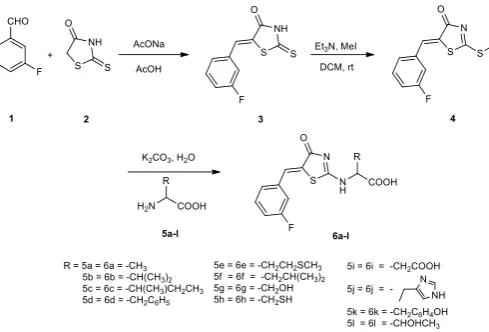
protocol for the synthesis of (Z)-5-(3-fluorobenzylidene)-2-thioxothiazolidin-4-one (3) (Scheme 1) by the condensation of 2-thioxothiazolidin-4-one and 3-fluorobenzaldehyde. The compound (3) was then subjected to a Knoevenagel condensation with the appropriate rhodamines synthesized using the reported procedure.28,29
EXPERIMENTAL SECTION
The compounds 2-thioxothiazolidin-4-one, 3-fluorobenzaldehyde, anhydrous sodium acetate, triethylamine, amino acids, dichloromethane, iodomethane and various solvents were commercially available (Sigma-Aldrich and Avra labs). Reaction courses were monitored by TLC on silica gel precoated F254 Merck plates. Developed plates were examined with UV lamps (254 nm). IR spectra were recorded on an FT-IR (Bruker). Melting points were recorded on SRS Optimelt, melting point apparatus and are uncorrected. 1H NMR spectra were recorded on a 400 MHz
Bruker spectrometer and were recorded in DMSO-d6 solvent 13C NMR spectra were recorded in DMSO-d
6 solvent on a
100 MHz Bruker spectrometer. Chemical shifts are reported as δ ppm units (TMS). The following abbreviations are used; singlet (s), doublet (d), triplet (t), quartet (q), multiplet (m) and broad (br). Mass spectra were taken with Micromass-QUATTRO-II of WATER mass spectrometer.
The general procedure of (Z)-5-(3-fluorobenzylidene)-2-thioxothia-zolidin-4-one (3)
n-hexane). After completion of the reaction, the reaction mixture was poured into the ice-cold water. The precipitate was filtered, washed with water (3×10 mL), dried, and purified by recrystallization from ethanol as a solvent to give a 90 % yield.
Yellow solid. Yield: 90 %. m.p. 198–200 ºC; ES-MS m/z (%): 239.29, IR νmax/cm–1: 3010 (NH), 1702 (C=O), 1594
(C=C), 1483 (C=N), 1436 (C=S), 1279 (C–N). 1H NMR
(DMSO-d6): δ = 7.30–7.32 (m, 4H, Ar–CH), 7.60 (s, 1H,
=CH), 13.90 (s, 1H, NH). 13C NMR (DMSO-d
6): δ = 113.5,
114.5, 116.3, 124.7, 130.9, 136.4, 143.2, 163.5, 168.4, 193.7.
General procedure of (Z)-5-(3-fluorobenzylidene)-2-(methyl-thio)thiazol-4(5H)-one (4)
In a 100 ml round bottom flask, the compound (3) (1 mmol) and triethylamine (1.5 mmol) were added in dichloromethane (10 ml) at room temperature. Iodomethane (1.5 mmol) was added to the stirred reaction mixture and the mixture was stirred for 2 h at room temperature. The progress of the reaction was monitored by TLC (10 % chloroform: methanol). After completion of the reaction, the reaction mixture was concentrated in-vacuo. The residue was washed out with water (3×15 mL) to afford the crude product. The crude product was recrystallized using ethanol as solvent.
Yellow solid. Yield: 92 %. m.p. 160–162 ºC; ES-MS m/z (%): 253.05, IR νmax/cm–1: 1703 (C=O), 1599 (C=C), 1577
(C=N), 1287 (C=S), 1086 (C–N). 1H NMR (DMSO-d 6): δ =
2.90 (s, 3H, S-CH3), 7.10–7.21 (m, 4H, Ar–CH), 7.82 (s, 1H, =CH), 13C NMR (DMSO-d
6): δ = 14.5, 113.9, 114.5, 124.1,
130.9, 136.4, 143.2, 152.0, 162.8, 163.5, 167.4.
General procedure of (Z)-2-((5-(3-fluorobenzylidene)-4-oxo-4,5-dihydrothiazol-2-yl)amino) substituted carboxylic acids (6a-l).
In a 100 ml round bottom flask, the compound (4) (1 mmol), amino acids (5a-l) (1.5 mmol) and potassium carbonate (1.5 mmol) were mixed in water (1 mL) at room temperature and the reaction mixture was stirred for 30-55 min at room temperature. The progress of reaction was monitored by TLC (10 % chloroform: methanol). After completion of reaction, the reaction mixture was concentrated in-vacuo. The residue was washed with water (3×15 mL) to afford the crude product. The compounds ( 6a-l) were recrystallized from ethanol and isolated as yellowish solids.
(Z)-2-((5-(3-Fluorobenzylidene)-4-oxo-4,5-dihydrothiazol-2-yl)amino)propanoic acid (6a)
Yellow solid. Yield: 92 %, m.p. 189–191 ºC; ES-MS m/z (%): 294.28, IR νmax/cm–1: 3744 (COOH), 3397 (OH), 1742
(HO–C=O), 1642 (C=O), 1564 (C=C), 1549 (C=N), 1206 (C-S), 1086 (C–N). 1H NMR (DMSO-d
6): δ = 1.40–1.42 (d,
3H, C–CH3), 4.55–4.57 (q, 1H, CH), 7.30–7.32 (m, 4H, Ar– CH), 7.70 (s, 1H, =CH), 10.20 (s, 1H, NH), 12.65 (s, 1H, COOH). 13C NMR (DMSO-d
6): δ=16.8, 53.5, 113.9, 114.5,
124.2, 129.7, 132.7, 136.5, 152.1, 158.3, 162.3, 167.7, 174.2.
(Z)-2-((5-(3-Fluorobenzylidene)-4-oxo-4,5-dihydrothiazol-2-yl)amino)-3-methylbutanoic acid (6b)
Yellow solid. Yield: 94 %, m.p. 204–206 ºC; ES-MS m/z (%): 322.35, IR νmax/cm–1: 3414 (OH), 3215 (NH), 3013
(CH–Ar), 1732 (HO–C=O), 1684 (C=O), 1551 (C=C), 1593 (C=N), 1012 (C-S), 1091 (C–N). 1H NMR (DMSO-d
6): δ =
0.91–0.93 (d, 6H, CH(CH3)2), 1.50–1.52 (m, 1H, CH), 4.41–4.43 (d, 1H, CH), 7.25–7.27 (m, 4H, Ar–CH), 7.88 (s, 1H, =CH), 11.62 (s, 1H, NH), 13.12 (s, 1H, COOH). 13C NMR (DMSO-d6): δ = 18.8, 30.5, 61.3, 113.8, 114.4, 124.2,
130.2, 132.3, 135.9, 152.3, 158.1, 162.7, 167.2, 174.2.
(Z)-2-((5-(3-Fluorobenzylidene)-4-oxo-4,5-dihydrothiazol-2-yl)amino)-3-methylpentanoic acid (6c)
Yellow solid. Yield: 92 %, m.p. 165–167 ºC; ES-MS m/z (%): 336.38, IR νmax/cm–1: 3398 (OH), 3212 (NH), 3017
(CH–Ar), 1735 (HO–C=O), 1692 (C=O), 1557 (C=C), 1583 (C=N), 1013 (C-S), 1097 (C–N). 1H NMR (DMSO-d
6): δ =
0.91–0.93 (t, 3H, CH2–CH3), 1.15–1.17 (d, 3H, CH3) 1.52–
1.54 (m, 2H, CH2), 1.81–1.83 (m, 1H, CH), 4.43–4.45 (d,
1H, CH), 7.21–7.23 (m, 4H, Ar–CH), 7.80 (s, 1H, =CH), 11.64 (s, 1H, NH), 13.29 (s, 1H, COOH). 13C NMR
(DMSO-d6): δ = 11.2, 15.4, 25.7, 36.4, 58.4, 113.4, 114.5,
124.9, 130.6, 132.3, 135.9, 152.9, 158.1, 162.4, 167.3, 175.2.
(Z)-2-((5-(3-Fluorobenzylidene)-4-oxo-4,5-dihydrothiazol-2-yl)-amino)-3-phenylpropanoic acid (6d)
Yellow solid. Yield: 90 %, mp 138–140 ºC; ES-MS m/z (%): 370.40, IR νmax/cm–1: 3396 (OH), 3211 (NH), 2992
(CH–Ar), 1737 (HO–C=O), 1692 (C=O), 1551 (C=C), 1581 (C=N), 1017 (C-S), 1098 (C–N). 1H NMR (DMSO-d
6): δ =
2.51–2.53 (d, 2H, CH2), 4.45–4.47 (q, 1H, CH), 7.25–7.27 (m, 9H, Ar–CH), 7.89 (s, 1H, =CH), 11.75 (s, 1H, NH), 13.31 (s, 1H, COOH). 13C NMR (DMSO-d
6): δ = 36.4, 58.4,
113.5, 114.6, 124.9, 125.9, 125.7, 128.6, 128.9, 130.7, 132.3, 135.3, 136.9, 152.2, 158.5, 167.1, 175.2.
(Z)-2-((5-(3-Fluorobenzylidene)-4-oxo-4,5-dihydrothiazol-2-yl)-amino)-4-(methylthio)butanoic acid (6e)
Yellow solid. Yield: 92 %, mp 142–144 ºC; ES-MS m/z (%): 354.42, IR νmax/cm–1: 3396 (OH), 3210 (NH), 2980
(CH–Ar), 1732 (HO–C=O), 1698 (C=O), 1541 (C=C), 1586 (C=N), 1014 (C-S), 1091 (C–N). 1H NMR (DMSO-d
6): δ =
2.01–2.03 (q, 2H, CH2), 2.20 (s, 3H, CH3), 2.61–2.63 (t, 2H,
CH2), 4.43–4.45 (q, 1H, CH), 7.30–7.32 (m, 4H, Ar–CH), 7.78 (s, 1H, =CH), 11.61 (s, 1H, NH), 13.15 (s, 1H, COOH).
13C NMR (DMSO-d
6): δ = 15.3, 29.8, 30.5, 56.8, 113.5,
114.6, 124.9, 127.7, 128.6, 136.9, 152.2, 158.5, 162.4, 167.3, 174.7.
(Z)-2-((5-(3-Fluorobenzylidene)-4-oxo-4,5-dihydrothiazol-2-yl)-amino)-4-methylpentanoic acid (6f)
Yellow solid. Yield: 94 %, mp 187–189 ºC; ES-MS m/z (%): 336.38, IR νmax/cm–1: 3397 (OH), 3217 (NH), 3011
(CH–Ar), 1736 (HO–C=O), 1695 (C=O), 1555 (C=C), 1583 (C=N), 1013 (C-S), 1091 (C–N). 1H NMR (DMSO-d6): δ =
1.71–1.73 (t, 2H, CH2), 4.44–4.46 (q, 1H, CH), 7.29–7.31 (m, 4H, Ar–CH), 7.76 (s, 1H, =CH), 11.72 (s, 1H, NH), 13.35 (s, 1H, COOH). 13C NMR (DMSO-d
6): δ = 22.7, 24.4,
40.3, 55.4, 113.4, 114.4, 124.9, 129.2, 132.1, 135.4, 152.2, 159.1, 162.3, 167.1, 174.2.
(Z)-2-((5-(3-Fluorobenzylidene)-4-oxo-4,5-dihydrothiazol-2-yl)-amino)-3-hydroxypropanoic acid (6g)
Yellow solid. Yield: 96 %, m.p. 185–187 ºC; ES-MS m/z (%): 310.30, IR νmax/cm–1: 3450 (OH), 3211 (NH), 3008
(CH–Ar), 1738 (HO–C=O), 1688 (C=O), 1551 (C=C), 1511 (C=N), 1019 (C-S), 1097 (C–N). 1H NMR (DMSO-d
6): δ =
3.62 (s, 1H, CH), 4.02–4.04 (t, 1H, CH), 4.23–4.25 (d, 2H, CH2), 7.31–7.33 (m, 4H, Ar–CH), 7.93 (s, 1H, =CH), 11.60
(s, 1H, NH), 13.13 (s, 1H, COOH). 13C NMR (DMSO-d 6): δ
= 59.2, 62.2, 113.4, 114.4, 124.9, 129.2, 130.3, 132.1, 136.4, 151.9, 158.1, 167.9, 172.2.
(Z)-2-((5-(3-Fluorobenzylidene)-4-oxo-4,5-dihydrothiazol-2-yl)-amino)-3-mercaptopropanoic acid (6h)
Yellow solid. Yield: 94 %, mp 179–181 ºC; ES-MS m/z (%): 326.70, IR νmax/cm–1: 3455 (OH), 3201 (NH), 3017
(CH–Ar), 2500 (SH), 1738 (HO–C=O), 1695 (C=O), 1559 (C=C), 1503 (C=N), 1014 (C-S), 1095 (C–N). 1H NMR
(DMSO-d6): δ = 1.50 (s, 1H, SH), 3.11–3.13 (d, 2H, CH2),
4.13–4.15 (t, 1H, CH), 7.22–7.24 (m, 4H, Ar–CH), 7.68 (s, 1H, =CH), 11.61 (s, 1H, NH), 13.11 (s, 1H, COOH). 13C
NMR (DMSO-d6): δ = 26.3, 60.4, 113.4, 114.4, 124.9, 127.5,
132.5, 135.6, 152.9, 158.3, 162.3, 167.2, 178.2.
(Z)-2-((5-(3-Fluorobenzylidene)-4-oxo-4,5-dihydrothiazol-2-yl)-amino)succinic acid (6i)
Yellow solid. Yield: 92 %, mp 214–216 ºC; ES-MS m/z (%): 338.40, IR νmax/cm–1: 3464 (OH), 3213 (NH), 3020
(CH–Ar), 1732 (HO–C=O), 1689 (C=O), 1549 (C=C), 1503 (C=N), 1030 (C-S), 1089 (C–N). 1H NMR (DMSO-d
6): δ =
2.60–2.62 (d, 2H, CH2), 3.71–3.73 (t, 1H, CH), 7.35–7.37
(m, 4H, Ar–CH), 7.88 (s, 1H, =CH), 11.70 (s, 1H, NH), 13.12 (s, 2H, COOH). 13C NMR (DMSO-d
6): δ = 35.9, 53.3,
113.4, 114.4, 124.9, 130.1, 132.5, 135.6, 136.4, 152.9, 158.3, 162.3, 167.2, 178.2.
(Z)-2-((5-(3-Fluorobenzylidene)-4-oxo-4,5-dihydrothiazol-2-yl)-amino)-3-(1H-imidazol-4-yl)propanoic acid (6j)
Yellow solid. Yield: 94 %, m.p. 152–154 ºC; ES-MS m/z (%): 360.38, IR νmax/cm–1: 3435 (OH), 3215 (NH), 3011
(CH–Ar), 1739 (HO–C=O), 1681 (C=O), 1552 (C=C), 1508 (C=N), 1033 (C-S), 1092 (C–N). 1H NMR (DMSO-d
6): δ =
2.92–3.94 (d, 2H, CH2), 3.73–3.86 (t, 1H, CH), 7.31–7.33
(m, 4H, Ar–CH), 7.77 (s, 1H, =CH), 7.86 (s, 1H, =CH), 8.98 (s, 1H, =CH), 11.62 (s, 1H, NH), 13.12 (s, 1H, NH), 13.34 (s, 1H, COOH). 13C NMR (DMSO-d
6): δ = 28.9, 58.3,
113.4, 114.4, 117.9, 124.9, 124.7, 124.7, 127.9, 128.6, 132.1, 136.2, 152.3, 158.2, 167.5, 176.2.
(Z)-2-((5-(3-Fluorobenzylidene)-4-oxo-4,5-dihydrothiazol-2-yl)amino)-3-(4-hydroxyphenyl)propanoic acid (6k)
Yellow solid. Yield: 92 %, m.p. 212–214 ºC; ES-MS m/z (%): 386.44, IR νmax/cm–1: 3462 (O=C-OH), 3392 (OH),
3211 (NH), 2992 (CH–Ar), 1732 (HO–C=O), 1697 (C=O), 1553 (C=C), 1591 (C=N), 1011 (C-S), 1089 (C–N). 1H
NMR (DMSO-d6): δ = 2.80–2.98 (d, 2H, CH2), 4.43–4.45 (t,
1H, CH), 5.30 (s, 1H, OH), 7.30–7.32 (m, 8H, Ar–CH), 7.87 (s, 1H, =CH), 11.72 (s, 1H, NH), 13.32 (s, 1H, COOH).
13C NMR (DMSO-d
6): δ = 36.3, 58.6, 113.9, 114.7, 115.8,
127.7, 128.9, 129.2, 130.2, 135.3, 136.9, 152.2, 155.7, 158.5, 162.7, 167.8, 174.3.
(Z)-2-((5-(3-Fluorobenzylidene)-4-oxo-4,5-dihydrothiazol-2-yl)amino)-3-hydroxybutanoic acid (6l)
Yellow solid. Yield: 90 %, m.p. 173–175 ºC; ES-MS m/z (%): 324.56, IR νmax/cm–1: 3462 (OH), 3201 (NH), 3010
(CH–Ar), 1733 (HO–C=O), 1682 (C=O), 1534 (C=C), 1516 (C=N), 1042 (C-S), 1115 (C–N). 1H NMR (DMSO-d6): δ =
1.10–1.12 (d, 3H, CH3), 3.51–3.55 (d, 1H, CH), 3.63 (s, 1H,
OH), 3.93–3.95 (m, 1H, CH), 7.25–7.27 (m, 4H, Ar–CH), 7.75 (s, 1H, =CH), 11.60 (s, 1H, NH), 13.10 (s, 1H, COOH).
13C NMR (DMSO-d
6): δ = 19.6, 64.3, 66.5, 113.9, 114.7,
124.8, 130.3, 132.4, 136.1, 152.2, 158.3, 162.4, 167.8, 174.2.
Antimicrobial tests
The antimicrobial activity of compounds were tested against six bacteria; Bacillus subtilis (NCIM-2063),
Staphylococcus aureus (NCIM-2901), Escherichia coli
(NCIM-2256), Enterococcus faecalis (NCIM-5443),
Pseudomonas aeruginosa (NCIM-2037), Salmonella
typhimurium (NCIM-2501) and six fungal strains;
Aspergillus oryzae (NCIM-570), Penicillium chrysogenum
(NCIM-707), Fusarium oxysporum (NCIM-1282), Candida
albicans (NCIM-3471), Aspergillus flavus (NCIM-539) and
Aspergillus niger (NCIM-1196). The antibacterial activity of
compounds was monitored by observing their Minimum inhibitory concentration (MIC, μg mL-1) as previously
mentioned30 by broth dilution methods with Ciprofloxacin
and Ampicillin as control drugs.
The antifungal study was carried by the standard agar dilution method and Fluconazole and Miconazole were used as control drugs. Ethanol was used as solvent control for both antibacterial and antifungal testing.
All the synthesized compounds were also tested for their general cytotoxicity on MCF-7 and BT-474 human breast cancer cell line. This test is performed as previously mentioned MTT colorimetric assay.31 Cytotoxicity of the
compounds was determined by calculating their IC50 values
(μM mL-1), the concentration of compound required to
RESULT AND DISCUSSION
Several new (Z)-2-((5-(3-fluorobenzylidene)-4-oxo-4,5-dihydrothiazol-2-yl)amino) substituted organic acid derivatives (6a-l) were synthesized and characterized by 1H
and 13C NMR, IR spectroscopy.
A new protocol for the synthesis of (Z)-5-(3-fluorobenzylidene)-2-thioxothiazolidin-4-one (3) by the condensation of 2-thioxothiazolidin-4-one and 3-fluorobenzaldehyde as the initial step of the reaction route has been developed.
Table 1. Physical data of the synthesized compounds 3, 4
and 6a-la
aReaction condition (6a-l): Compound (4) (1 mmol), amino acids
(5a-l) (1.5 mmol), K2CO3 (1.5 mmol), 1 ml water at room
temperature.bIsolated yields
The compound (3) was then subjected to a Knoevenagel condensation with the appropriate 2-thioxothiazolidin-4-one, to synthesize a new series of target compounds (6a-l).
Scheme 1 Synthesis of (Z)-2-((5-(3-fluorobenzylidene)-4-oxo-4,5-dihydrothiazol-2-yl)amino) substituted acid (6a-l).
The structures of the desired compounds were confirmed by IR, 1H NMR and 13C NMR. The compound 3 was
prepared in prominent good yields via a Knoevenagel condensation between the corresponding heterocyclic cores of Rhodanine and 3-fluorobenzaldehyde (Scheme 1).
The 2-thioxothiazolidin-4-one based compounds were synthesized by conventional heating with sodium acetate, which acts as a base and glacial acetic acid as catalysts. In theory, of E and Z geometrical isomers may exist according to the configuration around the exocyclic double bond (CH=C) for (Z)-5-(3-fluorobenzylidene)-2-thioxothia-zolidin-4-one (3).
The 1H NMR spectrum of the compound 3 shows only
one signal for the methine proton in the range δ 7.66, which show the presence of one isomer only, and at lower field values than those expected for the E-isomers, which was strongly indicated that the compounds have the Z-configuration. The IR spectrum of compound 3, showed a strong absorption band at 1702 cm-1 that is due to a carbonyl
group. The mass spectrum revealed a molecular ion peak at m/z=239.29 corresponding to a molecular formula C10H6FNOS2. The latter has been reported as
thermodynamically more stable than the E-configuration.32,33
Compound 4 was synthesized from compound 3 and the structures of the desired product were confirmed by IR,
1H NMR, 13C NMR and mass spectral analysis. The IR
spectrum of (Z)-5-(3-fluorobenzylidene)-2-(methylthio)-thiazol-4(5H)-one (4), showed a strong absorption band at 1704 cm-1 belongs to a carbonyl group. The mass spectrum
revealed a molecular ion peak at m/z = 253.05 corresponding to a molecular formula C11H8FNOS2. The 1H
NMR spectra of the compound 4 show only one signal for the methine proton in the range δ 7.82, sulfur attached methyl group proton shows a singlet at δ 2.85.
We synthesized a series of new (Z)-2-((5-(3-fluorobenzylidene)-4-oxo-4,5-dihydrothiazol-2-yl)amino) substituted carboxylic acids (6a-l) from the compound 4 and different types of amino acids (5a-l), (Scheme 1, Table 1). The displacement of a methylthio group by various amino acids from the C2 position of the thiazolone ring and the structures of the desired compounds (6a-l) were confirmed by IR, 1H NMR, 13C NMR analysis.
The IR spectrum of (Z)-2-((5-(3-fluorobenzylidene)-4-oxo-4,5-dihydrothiazol-2-yl)-amino)propanoic acid (6a), showed a strong absorption band at 1742 cm-1 belongs to the
carbonyl of a carboxylic group and 3397 cm-1 due to the
presence hydroxyl group. The mass spectrum revealed a molecular ion peak at m/z=294.28 corresponding to a molecular formula C13H11FN2O3S. The 1H NMR spectrum
revealed that the signals of 6a (as a representative example), show the methyl group protons doublet in the range of δ 1.40–1.50, the methine proton (adjacent to carboxylic acid group) shows a quartet in the range of δ 4.50–4.70, phenyl ring protons show a multiplet in the range of δ 7.40–7.70, one signal appears for the alkene proton in the range δ 7.72, amine group proton shows singlet at δ 10.10, and the carboxylic acid proton shows singlet at δ 12.65.
Comp .
Substituent (R) Time, min
Yield, %b
M.P., ºC
3 - 240 90 198-200
4 - 120 92 160-162
6a -CH3 35 92 189-191
6b -CH(CH3)2 30 94 204-206
6c -CH(CH3)CH2CH3 35 92 165-167
6d -CH2C6H5 35 90 138-140
6e -CH2CH2SCH3 40 92 142-144
6f -CH2CH(CH3)2 55 94 187-189
6g -CH2OH 50 96 185-187
6h -CH2SH 40 94 179-181
6i -CH2COOH 50 92 214-216
6j 3-(1H-imidazol-4yl) 35 94 152-154
6k -CH2C6H4OH 45 92 212-214
Table 2. Antibacterial activity of synthesized compounds 3, 4 and 6a-6l
Compound B.s. S.a. E.c. E.f. P.a. S.t.
3 MIC 35.70 35.57 10.37 34.70 30.90 30.95
MBC 55.13 56.15 36.40 46.14 33.76 34.75
4 MIC 31.70 31.50 31.39 35.13 35.30 33.90
MBC 45.13 45.17 45.40 45.12 55.73 31.75
6a MIC 36.14 36.12 33.17 34.16 28.35 28.35
MBC 44.55 44.56 44.53 47.54 37.16 32.18
6b MIC 7.10 13.10 48.40 48.10 52.13 52.15
MBC 18.20 23.30 69..40 63.10 52.20 51.90
6c MIC 55.70 56.57 56.37 33.70 33.90 6.85
MBC 58.14 58.16 48.40 58.10 38.76 19.85
6d MIC 33.70 33.50 32.39 35.10 25.30 37.90
MBC 48.15 47.10 47.40 47.10 58.60 32.70
6e MIC 9.50 8.75 30.10 34.10 28.50 27.30
MBC 32.10 32.10 48.50 48.50 32.70 33.10
6f MIC 7.45 8.78 48.40 48.10 52.13 52.15
MBC 16.20 20.30 59..40 60.10 55.20 56.90
6g MIC 38.70 38.57 19.37 38.70 32.90 6.95
MBC 54.13 55.15 35.40 58.10 37.76 18.75
6h MIC 33.70 33.50 33.39 35.10 26.30 36.90
MBC 47.10 47.15 47.47 48.10 58.60 32.70
6i MIC 9.50 8.10 30.10 34.10 28.50 27.30
MBC 34.10 34.10 48.50 45.50 35.70 33.10
6j MIC 7.10 8.50 38.40 38.10 42.13 51.15
MBC 16.20 20.30 59..40 60.10 55.20 56.90
6k MIC 38.70 38.57 18.37 39.70 33.90 8.95
MBC 59.13 54.15 36.40 36.10 36.76 16.75
6l MIC 37.10 38.10 39.40 36.10 32.13 32.15
MBC 44.20 42.30 58..40 63.10 55.20 56.90
Ciprofloxacin MIC 14.70 13.69 12.69 15.69 11.69 15.69
MBC 33.19 33.10 22.10 32.10 14.10 34.10
Ampicillin MIC 3.71 3.20 3.20 3.20 3.86 3.46
MBC 5.29 5.43 1.43 1.43 2.71 1.86
aValues are the average of three readings. MIC= minimal inhibitory concentration, in mg L-1, MBC = 1.43-5.43 in mg L-1. B.s.- Bacillus
subtilis (NCIM-2063), S.a.-Staphylococcus aureus (NCIM-2901), E.c.- Escherichia coli (NCIM-2256), E.f. - Enterococcus faecalis
(NCIM-5443), P.a.- Pseudomonas aeruginosa (NCIM-2037), S.t.- Salmonella typhimurium (NCIM-2501)
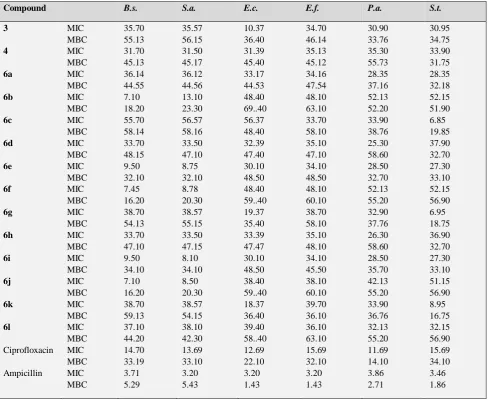
The antimicrobial activities of the synthesized compounds against selected Gram-positive and Gram-negative bacteria and multidrug-resistant bacteria are illustrated in Table 2 and Table 3. The majority of the synthesized compounds show a variety of antibacterial, antifungal and cytotoxic activity. The compounds 3 was found to be the most active against E. coli and the compounds 6c, 6g and 6k were found to be active against S. typhimurium.
Some of the studied compounds are more potent against selected microorganisms than a standard antibacterial drug Ciprofloxacin. For example, against E. Coli the compound 3
while against B. subtilis the compounds 6b, 6e, 6f, and 6j
have better MIC values than the values found for Ciprofloxacin. Against S. aureus, the compounds 6b, 6e,
6f,6i and 6j proved to be more active than Ciprofloxacin.
The compounds 6g and 6k showed antifungal activity against four fungus strains, namely A. oryzae, P. chrysogenum, C. albicans and A. flavus. The compound 6a
showed activity against A. flavus, the compound 6c against
P. Chrysogenum and F. oxysporum while the compound 6e
was found to be active against P. chrysogenum. Remaining compounds of the series (3, 4, 6d, 6f, 6h, 6i, 6j and 6l were found to be inactive against fungi.
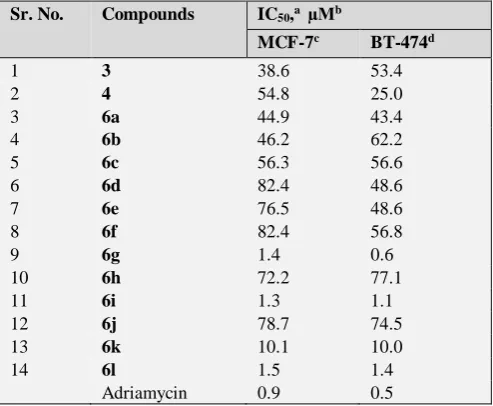
All the synthesized compounds were tested for their cytotoxic activity against MCF-7 and BT-474 cell lines (Table 4). (Table 4). Three compounds, 6g, 6i and 6l
showed good activity against the studied cancer cell lines, the IC50 values against MFC-7 and BT-474 cell lines were
found to be 1.4 and 1.3, 1.5 and 0.6, or 1.1 and 1.4 µM mL-1,
respectively. The IC50 values for reference drug Adriamycin
against MFC-7 and BT-474 cells were found to be 0.9 and 0.5 µM mL-1, respectively. The cytotoxicity of the newly
Table 3. Antifungal activity of synthesizing compounds 3, 4 and 6a-l
aValues are the average of three readings. A.o.- Aspergillus oryzae (NCIM-570), P.c.- Penicillium chrysogenum (NCIM-707), F.o.-
Fusarium oxysporum (NCIM-1282), C.a.- Candida albicans (NCIM-3471), A.f.- Aspergillus flavus (NCIM-539) and A.n.- Aspergillus Niger (NCIM-1196).
Structure-activity relationship (SAR)
The results of the antimicrobial screening demonstrated some facts about the structural-activity relationship (SAR) of the synthesized thiazolone derivatives. The notable highlights of structure-activity relationship are the followings:
The biological activity profile of molecules is strongly affected by the branching pattern and chain length of alkyl moieties. Attachment of a methyl group at C2 position on the thiazolone moiety (6a) makes molecule active against bacterial and fungal strains, probably due to its small size and electron donating effects. When this methyl group is replaced by isopropyl (6b) and 2-methylbutyl (6c) groups, the molecules become active on a broader spectrum (against the majority of the studied strains). This shows that the presence of branching at the carbon located on the C2 position of the thiazolone ring has a positive effect on appearing or strengthening of antimicrobial activity. Attachment of 2-methylpropyl group (6f) at the same position makes the molecule to be specific towards the B. subtilis and S. aureus. Substitution of the alkane chain with a carboxylic group (6i), also resulted in specificity towards
B. subtilis and S. aureus.
Table 4. In vitro cytotoxicity of compounds towards the MCF-7 and BT-474 cells, after 24 h.
aGI
50(Growth inhibition of 50 %): Concentration of drug that
decreases the growth of the cells by 50 % compared to a non-treated control cell. bValues are the average of three readings; cMCF-7: Human Breast cancer cell line, dBT-474: Human Breast
cancer cell line; e-Adriamycin: positive control compound
Compound A.o. P.c. F.o. C.a. A.f. A.n.
3 MIC 32.50 52.39 34.50 34.50 18.30 18.30
MFC 53.10 53.10 74.12 54.10 35.20 75.33
4 MIC 37.00 37.20 33.20 33.20 33.20 30.00
MFC 36.20 46.60 81.10 42.30 34.88 35.00
6a MIC 31.50 31.39 31.50 34.50 12.30 19.30
MFC 46.10 46.10 62.12 32.10 33.20 41.33
6b MIC 33.00 31.20 31.20 32.20 32.20 34.00
MFC 43.20 44.50 45.10 66.30 33.88 48.00
6c MIC 35.50 17.39 17.50 57.50 36.30 39.30
MFC 49.40 34.40 34.32 36.30 34.30 35.33
6d MIC 32.30 35.40 32.30 57.50 67.50 34.50
MFC 42.30 52.20 84.10 52.00 72.30 51.50
6e MIC 36.30 13.80 51.20 31.25 44.25 30.55
MFC 36.80 34.70 65.18 60.18 30.64 45.69
6f MIC 34.00 34.20 34.20 55.20 34.70 31.00
MFC 43.20 44.60 49.10 65.35 35.88 48.00
6g MIC 5.55 16.36 39.50 18.50 16.30 36.30
MFC 10.10 44.10 32.11 35.10 32.22 32.23
6h MIC 32.00 32.50 34.40 68.40 58.10 34.40
MFC 51.34 52.25 84.15 72.05 33.30 54.50
6i MIC 42.35 55.80 41.26 31.26 74.26 35.58
MFC 55.80 35.78 62.38 62.38 32.84 43.29
6j MIC 43.40 34.24 54.26 34.66 34.26 33.07
MFC 53.25 42.65 43.15 64.48 33.89 58.08
6k MIC 34.55 17.30 16.50 16.50 16.30 33.30
MFC 45.10 33.75 53.52 32.10 34.20 35.33
6l MIC 42.00 32.60 62.50 59.50 58.70 34.00
MFC 58.30 55.20 64.10 62.50 62.30 51.50
Fluconazole MIC 5.60 1.68 28.65 5.70 9.42 2.28
MFC 9.35 5.75 46.00 9.62 17.80 5.75
Miconazole MIC 40.25 5.30 7.18 1.34 43.20 156.30
MFC 85.18 151.28 20.20 6.18 142.20 140.12
Sr. No. Compounds IC50,a µMb
MCF-7c BT-474d
1 3 38.6 53.4
2 4 54.8 25.0
3 6a 44.9 43.4
4 6b 46.2 62.2
5 6c 56.3 56.6
6 6d 82.4 48.6
7 6e 76.5 48.6
8 6f 82.4 56.8
9 6g 1.4 0.6
10 6h 72.2 77.1
11 6i 1.3 1.1
12 6j 78.7 74.5
13 6k 10.1 10.0
14 6l 1.5 1.4
Substitution by phenylmethyl group (6d) at the C2 position of the thiazolone moiety gave completely inactive molecule towards all tested strains, while the 4-hydroxyphenyl (6k) substitution made the molecule to be active towards S. typhimurium, and P. chrysogenum, F. oxysporum, C. Albicans and A. flavus. The compound (6j) containing methyl-imidazole ring at the C2 position of the thiazolone moiety resulted in appearing of specific activity towards the Gram-positive bacteria B. subtilis and S. aureus. The compound (6e) with the terminal methylthio group is active toward.B. subtilis, S. aureus and P. chrysogenum, while compound (6h) with terminal mercapto group was proved to be inactive towards these bacterial and fungal strains.
CONCLUSION
The objective of our present study is to synthesize and investigation of the potent anticancer and antimicrobial activities of some new (Z)-2-((5-(3-fluorobenzylidene)-4-oxo-4,5-dihydrothiazol-2-yl)amino) substituted organic acids.
This is the first reported synthesis of the (Z)-2-((5-(3-fluorobenzylidene)-4-oxo-4,5-dihydrothiazol-2-yl)amino) substituted organic acids in water as solvent with excellent yields in shorter reaction time making the process economically lucrative for industrial application. Some derivatives were found to be more active against several bacteria and fungi strains than the common antimicrobial agents.
In vitro anticancer studies revealed that the compounds 6g,
6i, 6k and 6l are most active against MCF-7 and BT-474 human breast cancer cell lines.
Acknowledgment
The authors thankful to Head, Department of Chemical Technology, Dr. Babasaheb Ambedkar Marathwada University, Aurangabad 431004 (MS), India for providing the laboratory facility. The authors are also thankful to the Advanced Centre for Treatment Research and Education in Cancer (ACTREC) Mumbai, for cytotoxic screening.
REFERENCES
1Ruiz, F. M., Gil-Redondo, R., Morreale, A., Ortiz, A. R., Fabrega,
C., Bravo, J., Structure-based discovery of novel non-nucleosidic DNA alkyltransferase inhibitors: virtual screening and in vitro and in vivo activities, J. Chem. Inf. Model., 2008, 48, 844. https://doi.org/10.1021/ci700447r
2Nikhil, D., Amnerkar, M., Kishore, P., Bhusari, P., Preliminary
anticancer activity of some prop-2-eneamido, thiazole and 1-acetylpyrazolin in derivatives of aminobenzothiazoles, Digest J. Nanomaterials and Biostructures., 2010, 5(1), 177.
3Hoaglad, H. C., Hematologic complications of cancer
chemotherapy, Semin. Oncology., 1982, 9, 95.
4Porter, P. N., “Westernizing” women's risk? Breast cancer in
lower-income countries, Engl. J. Med., 2008, 358(3), 213.
https://doi.org/10.1056/NEJMp0708307
5Ramachandran, R., Rani, M., Kabilan, S., Design, synthesis and
biological evaluation of novel 2-[(2,4-diaryl-3-
azabicyclo[3.3.1]nonan-9-ylidene)hydrazono]-1,3-thiazolidin-4-ones as a new class of antimicrobial agents,
Bioorg. Med. Chem. Lett., 2009, 19, 2819.
https://doi.org/10.1016/j.bmcl.2009.03.093
6Li, X., Qin, Z., Yang, T., Zhang, H., Wei, S., Li, C., Chen, H.,
Meng, M., Synthesis and biological activity of bi/tricyclic azasugars fused thiazolidin-4-one and thiazinan-4-one by
microwave-assisted tandem
Staudinger/aza-Wittig/cyclization, Bioorg. Med. Chem. Lett., 2012, 22, 2712.
https://doi.org/10.1016/j.bmcl.2012.02.103
7Tomasic, T., Zidar, N., Rupnik, V., Kovac, A., Blanot, D., Gobec,
S., Kikelj, D., Masic, L. P., Synthesis and biological evaluation of new glutamic acid-based inhibitors of MurD ligase, Bioorg. Med. Chem. Lett. 2009, 19, 153.
https://doi.org/10.1016/j.bmcl.2008.10.129
8Sink, R., Kovac, A., Tomasic, T., Rupnik, V., Boniface, A.,
Bostock, J., Chopra, I., Blanot, D., Masic, L. P., Gobec, S., Zega, A., Synthesis and biological evaluation of N-acylhydrazones as inhibitors of MurC and MurD ligases,
Chem. Med. Chem. 2008, 3, 1362.
https://doi.org/10.1002/cmdc.200800087
9Habib, N. S., Rida, S. M., Badawey, E. A. M., Fahmy, H. T. Y.,
Ghozlan, H. A., Synthesis and antimicrobial activity of rhodanine derivatives, Eur. J. Med. Chem., 1997, 32, 759.
https://doi.org/10.1016/S0223-5234(97)88919-2
10Sortino, M., Delgado, P., Juarez, S., Quiroqa, J., Abonia, R.,
Insuasty, B., Noqueras, M., Rodero, L., Garibatto, F. M., Enriz, R. D., Zacchino, S. A., Synthesis and antifungal activity of (Z)-5-arylidenerhodanines, Bioorg. Med. Chem.,
2007, 15, 484.
https://doi.org/10.1016/j.bmc.2006.09.038
11Ravi, S., Chiruvella, K. K., Rajesh, K., Prabhu, V., Raghavan, S.
C., 5-Isopropylidene-3-ethyl rhodanine induce growth inhibition followed by apoptosis in leukemia cells, Eur. J. Med. Chem., 2010, 45, 2748.
https://doi.org/10.1016/j.ejmech.2010.02.054
12Zhou, H., Wu, S., Zhai, S., Liu, A., Sun, Y., Li, R., Zhang, Y.,
Ekins, S., Swaan, P. W., Fang, B., Zhang, B., Yan, B., Design, synthesis, cytoselective toxicity, structure-activity relationships, and pharmacophore of thiazolidinone derivatives targeting drug-resistant lung cancer cells., J. Med. Chem., 2008, 51, 1242.
https://doi.org/10.1021/jm7012024
13Sala, M., Chimento, A., Saturnino, C., Gomez-Monterrey, I. M.,
Musella, S., Bertamino, A., Milite, C., Sinicropi, M. S., Caruso, A., Sirianni, R., Tortorella, P., Newlino, E., Campiglia, P., Pezzi. V., Synthesis and cytotoxic activity evaluation of 2,3-thiazolidin-4-one derivatives on human breast cancer cell lines, Bioorg. Med. Chem. Lett.2013, 23, 4990. https://doi.org/10.1016/j.bmcl.2013.06.051
14Penthala, N. R., Yerramreddy, T. R., Crooks, P. A., Synthesis and
in vitro screening of novel N-benzyl aplysinopsin analogs as potential anticancer agents, Bioorg. Med. Chem. Lett. 2011,
21, 1411. https://doi.org/10.1016/j.bmcl.2011.01.020
15Dayam, R., Sanchez, T., Clement, O., Shoemaker, R., Sei, S.;
Neamati, N., Beta-diketo acid pharmacophore hypothesis. 1. Discovery of a novel class of HIV-1 integrase inhibitors. J. Med. Chem, 2005, 48, 111.
https://doi.org/10.1021/jm0496077
16Elbarbary, A. A., Khodair, A. I., Pedersen, E. B., Nielsen, C.,
Synthesis and evaluation of antiviral activity of 2-deoxyuridines with 5-methylene-2-thiohydantoin substituents in the 5-position. Monatsh. Chem. 1994, 125, 593.
17Petrikaite, V., Tarasevicius, E., Pavilonis, A., New ethacridine
derivatives as the potential antifungal and antibacterial
preparations. Medicina2007, 43, 657.
18Ergenc, N., Capan, G., Synthesis and anticonvulsant activity of
new 4-thiazolidone and 4- thiazoline derivatives. II Farmaco, 1994, 49, 133.
19Kucukguzel, S. G., Kocatepe, A., De Clercq, E., Sahin, F.,
Gulluce, M., Synthesis and biological activity of 4-thiazolidinones, thiosemicarbazides derived from diflunisal hydrazide. Eur. J. Med. Chem. 2006, 41, 353.
https://doi.org/10.1016/j.ejmech.2005.11.005
20Chandrappa, S., Kavitha, C. V., Shahabuddin, M. S., Vinaya, K.,
Ananda Kumar, C. S., Ranganatha, S. R., Raghavan, S. C., Rangappa, K. S., Synthesis of 2-(5-((5-(4- chlorophenyl)furan-2-yl)methylene)-4-oxo-2-thioxothiazoli-din-3-yl)acetic acid derivatives and evaluation of their cytotoxicity and induction of apoptosis in human leukemia cells, Bioorg. Med. Chem., 2009, 17, 2576.
https://doi.org/10.1016/j.bmc.2009.01.016
21Balzarini, J., Orzeszko, B., Maurin, J. K., Orzeszko, A., A
Synthesis and anti-HIV studies of 2-adamantyl-substituted thiazolidin-4-ones. Eur. J. Med. Chem. 2007, 42, 993.
https://doi.org/10.1016/j.ejmech.2007.01.003
22Chen, H., Yang, T., Wei, S., Zhang, H., Li, R., Qin, Z., Li, X.,
Synthetic bicyclic iminosugar derivatives fused thiazolidin-4-one as new potential HIV-RT inhibitors, Bioorg. Med. Chem.
Lett.2012, 22, 7041.
https://doi.org/10.1016/j.bmcl.2012.09.100
23Galal, S. A., Hega, K. H., Kassa, A. S., Rodriguez, M. L., Kerwin,
S. M., El-Khamry, A. A., El Diwani, H. I., New transition metal ion complexes with benzimidazole-5-carboxylic acid hydrazides with antitumor activity, Eur. J Med. Chem. 2009,
44, 1500. https://doi.org/10.1016/j.ejmech.2008.07.013
24Asmaa, A., Magd-El, D., Amira, S., Abd-El, A., Hana, M. R.,
Mashalla, M.S., New Synthesis of Furochromenyl Imidazo [2a-1b] Thiazole Derivatives, Studies on Their Antitumor Activities, J. Am. Sci. 2010, 6(5), 251.
25Lu, Y., Wang, Z., Li, C. M., Chen, J., Dalton, J. T., Li, W., Miller,
D. D., Synthesis, in vitro structure-activity relationship, and in vivo studies of 2-aryl-thiazolidine-4-carboxylic acid amides as anticancer agents, Bioorg. Med. Chem. Lett. 2010,
18, 477. https://doi.org/10.1016/j.bmc.2009.12.020
26Mickevicius, V., Voskiene, A., Jonuskiene, I., Kolosej, R.,
Siugzdaite, J., Venskutonis, P. R.; Kazernaviciute, R., Braziene, Z., Jakiene, E., Synthesis and Biological Activity of 3-[Phenyl(1,3-thiazol-2-yl)-amino]propanoic Acids and Their Derivatives. Molecules, 2013, 18, 15000.
https://doi.org/10.3390/molecules181215000
27(a) Pansare, D. N., Shelke, R. N., Pawar, C. D., A facile
synthesis of (Z)-2-((5-(4-chlorobenzylidene)-4-oxo-4,5-dihydrothiazol-2-yl)amino)substituted acid using microwave irradiation and the conventional method. Lett. Org. Chem., 2017, 14(7), 517.
https://doi.org/10.2174/1570178614666170524142722 (b) Pansare, D. N., Shelke, R. N., Shinde, D. B., A facial synthesis and anticancer activity of (Z)-2-((5-(4- nitrobenzylidene)-4-oxo-4,5-dihydrothiazol-2-yl)amino)-substituted acid, J. Het. Chem., 2017, 54(6), 3077.
https://doi.org/10.1002/jhet.2919;
(c) Pansare, D. N., Shinde, D. B., A facile synthesis of novel series (Z)-2-((4-oxo-5-(thiophen-2-yl methylene)-4,5-dihydro thiazol-2-yl)amino) substituted acid, J. Saudi. Chem. Soc.,
2017, 21, 434. https://doi.org/10.1016/j.jscs.2015.10.005 ; (d) Pawar, C. D., Chavan, S.L., Pawar, U. D., Pansare, D. N., Deshmukh, S. V., Shinde, D. B., Synthesis, anti-proliferative activity, SAR and Kinase inhibition studies of thiazol-2-yl- substituted sulfonamide derivatives, J. Chin. Chem. Soc.,
2018, https://doi.org/10.1002/jccs.201800312 ; (e) Pawar, C. D., Pansare, D. N., Shinde, D. B., (Substituted)-benzo[b]thiophene-4-carboxamide synthesis and antiproliferative activity study, Lett. Drug. Des. Disc., 2018, https://doi.org/10.2174/1570180815666181004114125 ; (f); Pawar, C. D., Pansare, D. N., Shinde, D. B., Synthesis of new 3-(substituted phenyl)-N-(2-hydroxy-2-(substituted phenyl)ethyl)-N-methylthiophene-2-sulfonamide derivatives as antiproliferative agents, Eur. J. Chem., 2018, 9(1), 13.
https://doi.org/10.5155/eurjchem.9.1.13-21.1669 ; (g) Pawar, C. D., Pansare, D. N., Shinde, D. B., Synthesis and antiproliferative activity of 3-(substituted)-4,5,6,7-tetrahydro-6-(substituted)-1H-pyrazolo[3,4-c]pyridine derivatives,Eur. J. Chem.,2017,8(4), 400.
https://doi.org/10.5155/eurjchem.8.4.400-409.1645
28Lesyk, R., Zimenkovsky, B., Subtelna, I., Nektegayev, I.,
Kazmirchuk, G., Acta Polon. Pharm. Drug Res., 2003, 6, 457-466.
29Lesyk, R. B., Zimenkovsky, B. S., Curr. Org. Chem. 2004, 8,
1547.
30Jin, X., Zheng, C. J., Song, M. X., Wu, Y., Sun, L. P., Li, Y. J.,
Yu, L. J., Piao, H. R., synthesis and antimicrobial evaluation of L-phenylalanine-derived C5-substituted rhodanine and chalcone derivatives containing thiobarbituric acid or 2-thioxo-4-thiazolidinone, Eur. J. Med. Chem. 2012, 56, 203.
https://doi.org/10.1016/j.ejmech.2012.08.026
31Denizot, F., Lang, R. J., Rapid colorimetric assay for cell growth
and survival. Modifications to the tetrazolium dye procedure giving improved sensitivity and reliability, Immunol. Methods.,1986, 89, 271. https://doi.org/10.1016/0022-1759(86)90368-6
32Ishida, T., In, Y., Inoue, M., Ueno, Y., Tanaka, C., Hamanaka, N.,
Structural elucidation of epalrestat(ONO-2235), a potent aldose reductase inhibitor, and isomerization of its double bonds. Tetrahedron Lett., 1989, 30, 959.
https://doi.org/10.1016/S0040-4039(00)95290-0
33Momose, Y., Meguro, K., Ikeda, H., Hatanaka, C., Oi, S., Sohda,
T., Studies on antidiabetic agents. X. Synthesis and biological activities of pioglitazone and related compounds,
Chem. Pharm. Bull., 1991, 39, 1440.
This paper was presented at the “International Symposium on Exploring New Horizons in Chemical Sciences”, January 10–
12, 2019, Aurangabad, India (ENHCS–2019).