ADVANCED NANOCATALYSTS FOR BIODIESEL
PRODUCTION
Linus N. Okoro
[a]*and Gubihama Joel
[a]Keywords:: Nanocatalyst, transesterification, biodiesel, catalyst characterization, homogenous catalysts.
Global energy consumption is on the rise due to increasing industrial capacity of nations. This has made humans to be over reliant on fossil fuel for energy production. Diminishing fossil fuel reserve and long-term increase in average climate temperature has given rise to energy shortage and environmental degradation. Renewable energy is an alternative that will offer clean, sustainable and efficient energy. Solar, wind and hydro have all been explored in this regard. Biodiesel is another promising resource with great potential. It is diesel produced from organic sources containing free fatty acids through the transesterification reaction process that utilizes alcohols and catalysts. Research has been undertaken over the years to improve the efficiency of biodiesel production aimed at reducing complexities and cost. The type of catalysts used influences reaction conditions and biodiesel yield. Heterogeneous nanocatalyst has shown great potential in eradicating complexities and reducing cost. This review will focus on most recent research works that have used nanocatalyst to produce biodiesel. Possible areas of research can be explored for advancement in biodiesel production using nanotechnology.
* Corresponding Authors
E-Mail: [email protected]
[a] Department of Petroleum Chemistry/Engineering
School of Arts and Sciences, American University of Nigeria,
Wuro Hausa 640101, Yola, Nigeria
INTRODUCTION
Fossil fuel is an integral part of our day to day lives. It is the major source of energy to mankind. Due to high energy content associated with carbon fossil fuels, a large amount deposited in earth reserves have already been explored. This has resulted in energy shortage as fossil fuel reserves continue to diminish. Even with the advent of renewable energy resource, fossil fuel consumption rate continues to rise. At the present rate of consumption, experts predict complete run out of fossil fuels by the year 2050.1
Fossil fuels also emit greenhouse gases which depletes the ozone layer thereby increasing global temperature levels. One effective way of controlling global warming is through reduction on the use of fossil fuels. This can be achieved by using renewable energy from wind, solar and hydrothermal sources. Various technologies have emanated from these sources and are already in use in many countries. Experts have projected an estimated 70 % drop in greenhouse gas emissions by 2040 due to increase in the demand and use of renewable energy.2
Biodiesel is another type of renewable energy resource gotten from animals and plants. It is biodegradable and nontoxic due to its zero greenhouse gas emissions. One major advantage of biodiesel is the ability to exhibit excellent cold flow properties similar to diesel from fossil fuels. Because the majority of biodiesel source emanates from edible sources, it has become a major concern as large scale production will result in competition with food supply. Therefore, a lot of research has been dedicated to the use of nonedible sources for biodiesel production.3
Biodiesel also known as Fatty Acid Methyl Esters (FAME) is obtained from reaction between Free Fatty Acids
(FFA) or tricylglycerols (TAGs) and a short chain alcohol either ethanol or methanol using catalyzed or non-catalyzed thermal reactions. In order to increase the efficiency of biodiesel production, a catalyst is used. Catalyzed reactions involve the use of homogeneous or heterogeneous substances. Heterogeneous catalysts are suitable for biodiesel fabrication as a result of non-corrosiveness and re-usability without the need for regeneration. However, the use of heterogeneous catalyst on large scale plants comes with some handling complexities. In most cases, biodiesel is used as blends with fossil fuel diesel so as to avoid engine modifications. Biodiesel improves the purity of diesel thereby making it cleaner and environmentally friendly. Nevertheless, they are used 100 % but only in rare cases.4
The cost of producing biodiesel is cheaper compared to conventional fossil fuel diesel. This is attributed to the cheap raw materials (used and waste oil, and fats from food industry, household and restaurant) that are used. Using nano-catalyst for biodiesel production is expected to further reduce the general cost of biodiesel production. Their very small particle size in the range of 1 to 100 nm increases their specific surface area thereby making them highly active and favorable in the heterogeneously-catalyzed biodiesel production.5
characteristics have made nanocatalysts ideal for production of environmentally friendly fuels like biodiesel. However, nanomaterials are yet to be utilized on an industrial scale due some problems associated with their usage. These problems include difficulty in separation, high pressure drop, and formation of pulvurent materials.
After nanocatalysts are synthesized, it is important to investigate their chemical composition and crystal structure. The primary aim of characterizing nanocatalysts is to study their physical and chemical properties. Secondary objectives include degree of aggregation, size distribution, surface area and surface size. This is because the presence of organic ligands on surface catalyst or their sized distribution may influence their properties and possible applications. Credible characterization methods which allow compliance with regulations for large scale industrial application have been developed. Challenges associated with nanomaterial analytics is the lack of appropriate reference materials for tool calibration, complexities in sample preparation and data interpretation.6 Difficulty in measurement of concentration
especially in large scale production and waste/effluent monitoring are great barriers in the analysis of nanoparticles. Therefore, upscale production requires various methods of characterizations to be employed in other to obtain maximum information on the properties of the synthesized nanoparticles. In characterization process, the nanoparticles surface, that carries the ligands that influence the physical properties, are analyzed. Some of the characterization techniques that will be discussed in this review include Fourier Transform Infrared Spectroscopy (FTIR), Transmission Electron Microscopy (TEM), X-Ray Photoelectron Spectroscopy (XPS), Thermo Gravimetric Analysis (TGA), X-ray Diffraction spectroscopy (XRD), Scanning Electron Microscope (SEM), NMR, Carbon Hydrogen Nitrogen Sulfur test (CHNS), Energy Dispersive X-Ray Spectroscopy (EDX), Brunauer Emmett Teller (BET), Value Stream Mapping (VSM), N2 adsorption-desorption
(NAD) and UV-Vis diffuse reflectance (UDR).
METHODOLOGY
For the purpose of this review, only research works published in reputable journals from 2017 to 2019 were used. This is to limit the scope of the study and to focus on more recent advancement on the topic. Google Scholar search engine was used to search for the journals. Open source journals that provided full article were utilized for the review. A comprehensive analysis dissecting key findings and subtopics was undertaken on each paper under review.
LITERATURE REVIEW
In most cases, scientist prefer to systematicaly synthesize nanocatolyst in the laboratory using methodologies from existing literature. However shorter route have been utilized to save time by some researchers. For instance, Keihani et al. purchased calcium oxide nano-catalyst from a malaysian vendor for the transesterification of chicken fat. The nanocatalyst was characterized to determine its physical properties. SEM showed 99 % purity and 50 nm particle size. 1 wt. % of the catalyst produced biodiesel of 94.4 % yield
with oil to methanol ratio of 9:1 used. The reaction reached completion in 5 hours at 65 °C. Keihani et al. used the synthesized biodiesel to make various biodesel blends (B25, B50 and B75) with petroleum diesel in order to test improvement in fuel properties. They found B75 and B100 blends to be the best blend due to its favourable density and viscosity range when compared with international standards.7
Thermal decomposition
When catalysts are subjected to pre-treatment under high temperature, the amount of active sites on the catalysts surface increase. This activity is referred to as thermal decomposition. Thermal decomposition increases the efficiency of the catalysts by eliminating substances that are absorbed on the surface of the catalyst when exposed to the atmosphere. For instance, CaO exposed to air absorbs water and carbon dioxide on the basic sites thus reducing the amount of basic sites on it. Thermal decomposition sometimes determines the shape and basicity of the obtained catalysts as increase in temperature desorbs molecule that obstruct the active sites.
Thermal decomposition technique was explored by Mazaheri et al. to produce heterogenous CaO nanocatalyst by calcinating, hydrating and dehydrating shells of Chicoreus brunneus (Adusta murex). Commercial CaO was also calcined at high temperature (900 °C) to eliminate contaminants. Both nanocatalysts were stored in a desiccator so as to prevent decrease in catalytic activity. The derived nanocatalysts were characterized using analytical techniques such as FTIR, XRD, TEM and BET. Mazaheri et al. developed two models of transesterification processes known as artificial neural networking and ant colony that predicted an optimal biodiesel yield of 93.5 % with minimal kinematic viscosity of 4.42 mm2s-1 using CaO nanocatalyst
in 35:1 methanol to RBO at reaction temperature and time of 1100 °C and 1 h 12 min, respectively. The biodiesel produced was in conformity with EN 14214 and ASTM D6751 standards.8
Using a conical reactor and thermal decomposition process, 10 g per batch of the nanoferrites catalysts were synthesized and then characterized using XRD. Dantas et al. investigated how Cu2+ ions will affect the morphology,
magnetism and structure of nanoferrites catalyst Ni0.5Zn0.5Fe2O4 and its consequential influence the activity
of the catalyst in the transesterification of soybean oil to FAME. The catalyst’s texture was analyszed by N2
absorption, heat content analyzed by temperature-programmed desorption and the magnetism measured. The biodiesel produced was also analyzed by gas chromatography. Dantas et al. noticed that whenever the doping of Cu2+ ions increased from 0.0 to 0.4, the saturation
magnetization value and the surface area of the catalyst reduced by 36.4 and 37 percent respectively. Hoewver the catalyst still retained its ferromagnetic properties as demonstrated by its attraction to magnets. Their findings points to an increase in biodiesel yield within 5.5-85 % range facilitated by the presence of Cu2+ ions which
signifies the potential application of these nanoferrite Cu2+
In another study conducted by Raghavendra et al. ZnO nanoparticles were synthesyzed by thermaly decomposing/ treating zinc nitrate with Garcinia gummi-gutta seed extracts. Fixed amount of Zn(NO3)2.6H2O was used used a source of
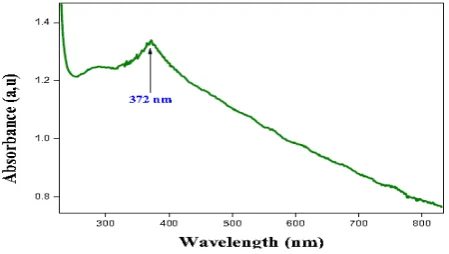
zinc and dissolved in 10 ml each of G. gummmi-gutta seed extracts (0.2, 0.3, 0.4 and 0.5 g). Each of the mixtures was subjected to high temperatures to form ZnO nanoparticles by first dehydrating then decomposing. Effects of the varous plant extracts were determined in the transesterification process to produce FAMEs. Initial characterization of the nanocatalysts was performed by various techniques such as FTIR, UV-visible, SEM and XRD. Figure 1 shows the spectrum of UV-Vis analysis which reveal a sharp peak at 372 nm wavelength. They further evaluated the nanoparticles for antioxidant and photoluminescence properties. 1.5 wt.% of the derived ZnO nanoparticles were used for the transesterification of the G. gummi-gutta oil by adding it to methanol at 9:1 methanol to oil ratio. The reaction lasted for 2 h at 64 °C. Biodiesel yield of 80.1 % was obtained and the cold flow proerties studied comformed with ASTM standard.10
Figure 1. UV-Visible spectrum of ZnO nanoparticles.
Husin et al. used a slighly different approach by synthesizing solid nanocatalyst from fiber bunches of empty palm oil fruit for the transesterification of palm oil. Empty fruit bunch of palm oil was cleaned, dried and burnt to ashes. The K2O-riched ash was further calcined at 600 °C
temperature to produce nanoparticles with enhanced active sites. The nano particles were then characterized using XRD and SEM. XRD analysis showed that the catalyst had potassium oxide K2O as the highest peak while the size of
the particle fell in the 150-400 range as indicated by SEM analysis. 97 % of biodiesel yield was obtained when 1% of the catalyst at reaction time and temperature of 3 h and 600 °C, respectively. Their findings indicated that the nanocatalyst is cost effective and efficient.11
Co-precipitation
Co-precipitation is used to produce highly acidic or basic catalysts by first preparing two component complex carrier. The carrier is then impregnated with a strong salt to get a mesoporous basic nanocatalyst or an organic ester to synthesize basic nanocatalyst. Nanocatalysts prepared using this process tend to easily separate from the final product.
Co-precipitation method was employed by Gardy et al. to synthesize a recyclable mesoporous and efficient solid acid nano-catalyst TiO2/PrSO3H. Initial pretreatment of titanium
nanoparticles TiO2 NPs was conducted using ammonium
hydroxide to produce a carrier with active receptive sites.
The carrier was then added to 1,3-propane sulfone in appropriate proportion to get the co-precipitate catalyst at 80 °C denoted as TiO2/PrSO3H. Gardy et al. went further to
produce biodiesel from used cooking oil using the synthesized nanocatalyst. Various analytical methods including FTIR, XRD, TEM, XPS and TGA were used to characterize the synthetic nano-catalyst. Reaction for 9 h at 60 °C yielded 98 % of FAME when 4.5 wt.% loaded catalyst was used together with methanol at 1:15 oil to methanol molar ratio. The acid nanocatalyst was recycled five times without losing its efficiency. The biodiesel produced satisfied European Standard EN and American society testing and materials standards, ASTM.12
In another similar study, Vijayakumar et al. succesfully prepared KF-Al2O3 nanocatalyst by co-precipitation method
for the transesterification of beef processing industrial sludge to biodiesel. The transesterification reaction was supported by ultrasonic irradiation. Characterization of the nanacatalyst was accomplished using XRD, SEM and FTIR. Yield of biodiesel was 97 % was when 6 wt.% loaded catalyst was used in 1:15 oil to methanol molar ratio for a reaction time of 3 h. The nanocatalyst recycled seven times without dimininshing in effeciency. The high effeciency was attributed to enhanced surface area of the nanocatalyst and the ultrasonic wave effect as well. Results from the qaulity test performed on the biodiesel showed that the biodiesel was within ASTM D6751 standards.5
Bayat et al. also used the co-precipitation method to prepare an efficient nanocatalyst Fe3O4@Al2O3 which they
used for the transesterification of waste cooking oil to FAME. The process involved the initial formation of magnetic suspension containing Fe3O4 nanoparticles which
is added to aluminium isopropoxide and sonicated for 2 h. The obtained nanoparticles were washed, dried and characterized using analytical methods. XRD analysis showed the standard cubic crystal pattern of Fe3O4
nanocatalyst, while DLS characterization showed mean particle size of 193 nm. The VSM analysis confirmed high saturation magnetization of the catalyst. Analysis of variance ANOVA showed the temperature and time effect on the reaction exceeded that of methanol to oil ratio. In fact, temperature/time significance exceeded any other interaction. Results also showed that the rate constant was within 0.001 to 0.157 min-1 and activation energy was 55.48
kJ mol-1 for the transesterification reaction. The reaction was endergonic ∆H = 54.08 kJ mol-1and nonspontaneous ∆G =
93.80 kJ mol-1. They recovered the catalyst was heated at
400 °C and the catalyst was recycled four times without diminishing efficiency.1
A solid nanocatalyst CuO-Mg was prepared by Varghese et al. by co-precipitation of copper acetate (5 M) with aqueous NaOH doped with MgCl2. Furthermore, a novel
transesterification model based on the assistance of ultrasonication was used to synthesize FAME using the CuO-Mg nanocatalyst. Transesterification at 60 °C for 30 min with 6:1 oil to methanol ratio yielded 71.78 % biodiesel although total FAME conversion could reach up to 82.83 %. Visual analysis of the synthsized biodiesel using gas GC-MS was also performed. Figure 2 shows the GC chromatogram of FAME and SFO biodiesel produced.14
Figure 2. GC Chromatogram of FAMEs of SFO biodiesel.
Impregnation
Impregnation is used when preparing doped catalyst by amalgamating alkali metals with the parent catalyst under high temperature. For instance, the catalytic strength of CaO catalyst is enhanced by impregnating alkali metals ions onto nano CaO catalyst. The CaO solid carrier is first suspended in water before the precursor (aqueous) is added. Finally, the combined catalyst is subjected to high temperatures in order to transform the precursor to its active state. However, care must be taken not to overheat during calcination as doing so will result to surface sintering even though high temperatures favors the formation of crystals (combination of carrier and active component). The type of alkali ion used in impregnation determines activity of the doped catalyst. In most cases, the precursors used are ions of K+, Li+ and Na+.
Using the impregnation method, Liu et al. prepared a solid base nano-magnetic catalyst, K/ZrO2/γ-Fe2O3, to synthesize
biodiesel. ZrOCl2-8H2O was added to a mixture containing
FeCl2.4H2O and FeCl3.6H2O (in 1:2 mole ratio) and
subsequently, ammonia 25 wt.%was added to produce a gel-sol (Zr(OH)4-Fe(OH)3). The gel-sol was then impregnated
with aqueous solution of KOH to obtain KOH/(Zr(OH)4
-Fe(OH)3). Further calcination of the precursor was
performed to produce K/ZrO2/γ-Fe2O3 nanocatalyst viewed
as nano-magnetic catalyst. Figure 3 shows the diagrammatic illustration of the nano-magnetic catalyst. XRD, BET, VSM, TEM, SEM and EDX analysis was used to characterize the catalyst. XRD revealed particle size within 15-25 nm range. Reaction conditions of 10:1 methanol molar ratio, 5 % catalyst and 65 °C for 3 h resulted in optimum biodiesel yield above 93.6 wt%. The catalyst was recycled six times without depreciating in strength.
The difficulty experienced in core shell production demonstrates great potential for use in green biodiesel production.15
Figure 3. Synthesis of nano-magnetic catalyst K/ZrO2/γ-Fe2O3.
In another research conducted by Mostafa et al. , the wet impregnation method was used to prepare different K-La nanocatalysts supported on zeolite ZSM-5 and tested each to produce biodiesel from soybean oil. The optimal catalyst was found to be the one containing 7 wt.%of La loaded with 1 wt.%of K. when they used the catalyst with methanol to oil molar ratio of 12:1 at 60 °C, yield of FAME reached 90 % in 3h of reaction time. High catalytic activity of K-La/ZSM nanocatalyst was attributed to high number of basic sites. The nanocatalyst was characterized using various analytical methods which include SEM, XRD, TEM, FTIR and N2 adsorption in order to determine its physical and
chemical properties.3
Figure 4.1H-NMR spectra of transesterified soybean oil.
Rafati et al. prepared several type of nanocatalysts (MgO-NaOH, CaO-(MgO-NaOH, CaO-KOH, MgO-KOH) by impregnating or loading different strong bases on Ca(NO3)2.4H2O. It involveed the addition of a strong base to
Ca(NO3)2.4H2O dissolved in ammonia solution to form
Mixing
Mixing is the method used to produce catalysts of metal oxide mixtures. Significant amount of the active component (metals) are mixed with oxides. This produces a favorable catalyst with smaller area and concentration of basic active sites. Often times, impregnation method is ensured to form higher active catalysts. For instance, CaO/NiO mixed oxide was first prepared as a carrier before impregnating it with KF to form an enhanced CaO-KF/NiO-KF nanocatalyst.
The mixing method was employed by Hassan et al. . Sol-gel samples of CaO-X nanocatalysts were prepared and used for the transesterification of palm oil. The Pechini procedure, whereby dissolved Ca(NO3).4H2O (1.0, 1.5, 2.0 mol) was
slowly added to citric acid/deionized water to form a visous gel, was employed. The gel was further dried and calcined at 850 °C to produce CaO-X nanocatalyst. The prepared nanocatalysts were characterized for crystallinity and morphology using NAD analysis and XRD. Using all the catalysts for the the transesterification process, they synthesized biodiesel. According to their results, the incomplete reaction during synthesis of CaO-1.0 formed water on the catalyst surface which lowered its basic strenght thereby lowering the catalitic activity of the catalyst. CaO-2.0 was found to be mesoporous with high catalytic activity. This was demonstrated by formation 81 % FAME within 3 h reaction time.16
Bharti et al. used sol-gel mixing method to prepare calcium oxide nano catalysts. They used H-NMR, SEM, TEM, XRD, FTIR and BET to characterize the nanocatalyst. Figure 4 shows H-NMR transesterified soybean oil. XRD results showed the particulate size of the catalyst with range upto 8 nm, surface area about 67.781 m2 g-1 and pore
diameter was 3.302 nm. They used 3.675 wt.% of the nanocatalyst in methanol to oil ratio of 11:1 to synthesize FAME in 97.61% yield from soybean oil at 60 °C for 2 h reaction time.17
The sol-gel mixing and impregnation methods were used seperately to prepare KF/γ-Al2O3 nanaocatalysts by two
procedures. First, by adding a certain amount of KF-2H2O and γ-Al2O3 in ethanol to form a clear white gel which was
vaporized, dried, milled and calcined at high temperature to
form KF/γ-Al2O3-OP nanocatalyst and secondly by directly impregnating KF over commercial γ-Al2O3under equivalent
conditions devoid of ethanol. The synthesized nanocatalyst was usedfor the tri-component coupling transesterification of dimethyl carbonate, canola oil and methol. 10.0 wt.%KF was loaded and calcinated at 400 °C for the formation of nano catalyst. They applied 5.0 wt.% of the catalyst to methanol which was further added to the oil at molar ratio of dimethyl carbonate (DMC)/oil/methanol of 1:1:8. A reaction time of 2 h at 65 °C yielded 98.8 % biodiesel. High conversion rate of biodiesel has been attributed to the surface to volume ratio and high basicity of the catalyst.18
Aradhya and Math synthesized strontium oxide (SRO) nanocatalyst by mixing urea and strontium oxide to form an initial homogeneous solution which is further heated up to 900 °C. A solid nanocatalyst was formed and used used to produce biodiesel from boiled vegetable oil. They further undertook an investigative study on The performance characteristics of biodiesel blends formed by mixing with
diesel was compared with conventional diesel oil when fueled in compression ignition (CI) diesel. Their results showed close similarity between properties of conventional diesel and that of B20 biodiesel.19
Ali et al. .20 prepared a nano magnetic CaO/Fe
3O4 catalyst
by chemically mixing 0.003M of calcium nitrate solution with 3.5g of Fe3O4. A precipitate was formed by adding 2 M
of sodium hydroxide to the mixture and dried at 80 °C. Finally CaO/Fe3O4 loaded nanocatalyst was formed by
calcination of the dried precipitate at 550 °C for 1 h. The nanocatalyst was further characterized using FTIR, SEM, XRD and EDX analytical methods. The synthesized catalyst which was complemented by CaFe2O4 was used in the
producing biodiesel. Biodiesel with 69.7% yield was synthesized after 300 min of transesterification reaction at 65 °C using 10 wt.% of CaO/Fe3O4 nanocatalyst loaded on
methanol in 20:1 methanol/oil molar ratio. The quality of biodiesel produced was within EN and ASTM standard.20
CONCLUSION AND RECOMMENDATION
Protecting our ecosystem from harmful greenhouse gases is essential hence there is a need to explore advanced methods for producing renewable alternatives. A lot of progress has been achieved over the years in the use of nanocatalyst for biodiesel synthesis. This review has covered methodologies usedwith the goal of improving the efficiency of transesterification reactions.
Characteristics such as high basicity, regeneration and reusability in addition to proper preparation and environmental safety make nanocatalysts suitable for biodiesel production. Various investigations covered in this review lead to the conclusion that nanocatalyst for biofuel production can enhance biodiesel production by far greater percentage compared to homogeneous catalyst. The various types of nanocatalysts used in recent times are metal oxides (CuO), metal oxide supported by metal oxide (KF-ZnO- Fe3O4) and metal supported on metal oxides (Au-ZnO).
It is recommended for future researchers to put greater emphasis on testing possibility and efficiency of nanocatalyst from biomass source. Experiments using inorganic (metal oxides) and organic (biomass) nanocatalysts can be undertaken concurrently to examine differences or changes in reaction conditions and biodiesel yield. We hope that this review will guide future researchers interested in nanocatalyst for biodiesel synthesis.
REFERENCES
1Bayat, A., Baghdadi, M., Bidhendi, G. N., Tailored magnetic
nano-alumina as an efficient catalyst for transesterification of wastecooking oil: Optimization of biodiesel production using response surface methodology, Energ. Convers. Manag.,
2018, 157, 395-405.
https://doi.org/10.1016/j.enconman.2018.09.086
2Hu, S., Guan, Y., Wang, Y., Han, H., Nano-magnetic catalyst
KF/CaO–Fe3O4 for biodiesel production, Appl. Energ., 2011,
88, 2685-2690.
3Mostafa, F., Zinatizadeh, L., Akbar, A., Parasto, N., Fataneh, J.,
Catalytic Performance and Characterization of Promoted K-La/ZSM-5 Nanocatalyst for Biodiesel Production, Iran J. Chem. Eng., 2018, 37(2), 33-44.
4Rafati, A., Kambiz, T., Maryam, N., Production of Biodiesel by
Electrolysis Method from Waste Cooking Oil Using Heterogeneous MgO-NaOH Nano Catalyst, Energ. Sources, Part A, 2018, 41(9), 1062-1074.
https://doi.org/10.1080/15567036.2018.1539139
5Vijayakumar, B., Sivakumar, P., Ramesh, K., Choksi, H., Sircar,
A., Sono-Chemical Biodiesel Production from Beef Processing Industrial Sludge in the Presence of nano-KF-Al2O3, Int. Conf. Thermal. Eng., Gandhinagar, 2019.
https://journals.library.ryerson.ca/index.php/ictea/article/view /1150
6Mourdikoudis, S., Pallares, R. M., Thanh, N. T., Characterization
Techniques for Nanoparticles: Comparison and Complementarity Upon Studying Nanoparticles Properties,
Nanoscale, 2918, 10, 12871–12934.
https://doi.org/10.1039/C8NR02278J
7Keihani,M., Esmaeili, H., Rouhi, P., Biodiesel Production from
Chicken Fat Using Nano-calcium Oxide Catalyst and Improving the Fuel Properties via Blending with Diesel, Phys. Chem. Res., 2018, 6(3), 521-529.
8Mazaheri, H., Ong, H. C., Masjuki, H. H., Amini, Z., Harrison, M.
D., Wang, C.-T., Kusumo, F., Alwi, A., Rice bran oil based biodiesel production using calcium oxide catalyst derived from Chicoreus brunneus shell, Energy, 2017, 144, 10-19.
https://doi.org/10.1016/j.energy.2017.11.073
9Dantas, J., Leal, E., Mapossa, A. B., Cornejo, D. R., Costa, A. F.,
Magnetic nanocatalysts of Ni0.5Zn0.5Fe2O4 doped with Cu
and performance evaluation in transesterification reaction for biodiesel, Fuel, 2017, 191, 463-471.
https://doi.org/10.1016/j.fuel.2016.11.107
10Raghavendra, M., Yatish, K. V., Lalithamba, H. S.,
Plant-mediated green synthesis of ZnO nanoparticles using Garcinia gummi-gutta seed extract: Photoluminescence, screening of their catalytic activity in antioxidant, formylation and biodiesel production, Eur. Phys. J., 2017,
132(358), 358, 1-11. https://doi.org/10.1140/epjp/i2017-11627-1
11Husin, H., Asnawi, T. M., Firdausi, A., Husaini, H., Ibrahim, I.,
Hasfita, F., Solid Catalyst Nanoparticles derived from Oil-Palm Empty Fruit Bunches (OP-EFB) as a Renewable Catalyst for Biodiesel Production, IOP Conf. Ser: Mater. Sci.
Eng., 2018, 358(3rd. Int. Conf. Global Sustain. Chem: Eng.
(ICGSCE-2017, 15-16 February, Purajaya, Malaysia)
https://doi.org/10.1088/1757-899X/358/1/012008
12Gardy, J., Hassanpour, A., Lai, X., Ahmed, M. H., Rehan, M.,
Biodiesel Production from Used Cooking Oil Using a Novel Surface Functionalised TiO2 Nano-catalyst, Appl. Catal. B, 2017, 207,297-310.
https://doi.org/10.1016/j.apcatb.2017.01.080
13Ashok, A., Kennedy, L. J., Vijaya, J. J., Aruldoss, U.,
Optimization of biodiesel production from waste cooking oil by magnesium oxide nanocatalyst synthesized using coprecipitation method, Clean Technol. Environ. Policy,
2018, 20(6), 1219–1231, DOI: 10.1007/s10098-018-1547-x
14Varghese, R., Jose, S., Joyprabu, H. and Johnson, I.,
"Ultrasonication Assisted Production of Biodiesel from Sunflower Oil by Using CuO: Mg Heterogeneous Nanocatalyst," IOP Conf. Ser.: Mater. Sci. Eng., 2017,
225(Int. Conf. Mater. Alloys, Exp. Mech. (ICMAEM, 3-4 July 2017, Narsimhy Reddy Eng. College, Tamilnadu, India, 2017. https://doi.org/10.1088/1757-899X/225/1/012213
15Liu, K., Wang, R., Yu, M., Biodiesel production from soybean
oils by a novel nano-magnetic solid base catalyst (K/ZrO2/γ
-Fe2O3), RSC Adv., 2017, 7, 51814-51821.
https://doi.org/10.1039/C7RA10067A
16Hassan, N., Ismail, K. N., Hamid K. H. K., Hadi, A., CaO
Nanocatalyst for Transesterification Reaction of Palm Oil to Biodiesel: Effect of Precursor’s Concentration on the Catalyst Behavior,", IOP Conf. Ser: Mater. Sci. Eng., 2018,
358(3rd. Int. Conf. Global Sustain. Chem: Eng.
(ICGSCE-2017, 15-16 February, Purajaya, Malaysia),
https://doi.org/10.1088/1757-899X/358/1/012059
17Bharti,P., Singh, B., Dey, R. K., Process Optimization of
Biodiesel Production catalyzed by CaO nanocatalyst Using Response Surface Methodology, J. Nanostructure Chem.,
2019, 9, 269-280. https://doi.org/10.1007/s40097-019-00317-w
18Tang, Y., Ren, H., Feiqin, C., Xuefan, G., Zhang, J., Nano
KF/Al2O3 particles as an efficient catalyst for no-glycerol
biodiesel production by coupling transesterification, RSC Adv.,2017, 7, 5694-5700.
https://doi.org/10.1039/C6RA25782H
19Aradhya, P. J., Math, M. C., Biodiesel Production From Boiled
vegetable oil Using Self Synthesized Strontium Oxide Nano Catalysts, Int. J. Innov. Res. Adv. Eng., 2019, 6(6), 36-42.
20Ali, M. A., Al-Hydary, A. I., Al-Hattab, A. T., Nano-Magnetic
Catalyst CaO-Fe3O4 for Biodiesel Production from Date
Palm Seed Oil," Chem. React. Eng. Catal., 2017, 12(3), 460-468. https://doi.org/10.9767/bcrec.12.3.923.460-468
21Bankovic-Ilic, I. B., Miladinovic, R. M., Stamenkovic, O. S.,
Veljkovic, V. B., Application ofNano CaO-based catalysts in Biodiesel Synthesis, Renew. Sust. Energ. Rev., 2017, 72, 746-760. https://doi.org/10.1016/j.rser.2017.01.076
22Kumar, D., Ali, A., Nanocrystalline Lithium Ion Impregnated
Calcium Oxide As Heterogeneous Catalyst, Energ. Fuels,
2010, 24, 2091-2097. https://doi.org/10.1021/ef901318s
23Jadhav, S. D., Tandale, M. S., Optimization of transesterification
process using homogeneous and nano‐heterogeneous catalysts for biodiesel production from Mangifera indica oil,
Sust. Energ., 2017, 37(1), 533-545.
https://doi.org/10.1002/ep.12690