Available online throug
ISSN 2229 – 5046
HALL EFFECTS ON THE PERISTALTIC PUMPING
OF A HYPERBOLIC TANGENT FLUID IN A PLANAR CHANNEL
K. SUBBA NARASIMHUDU
1, M. V. SUBBA REDDY*
21
Research Scholar, Department of Mathematics,
Rayalaseema University, Kurnool-518002, (A.P.), India.
2
Professor, Department of CSE,
Sri Venkatesa Perumal College of Engineering & Technology, Puttur-517583, (A.P.), India.
(Received On: 23-02-17; Revised & Accepted On: 18-03-17)
ABSTRACT
I
n this paper, we investigated the effect of Hall on the peristaltic pumping of a hyperbolic tangent fluid in a planar channel under the assumption of long wavelength. The expressions for the velocity and axial pressure gradient are obtained by employing perturbation technique. The effects of Weissenberg number, power-law index, Hall parameter, Hartmann number and amplitude ratio on the axial pressure gradient, time-averaged volume flow rate and the friction force at the wall are analyzed with the help of graphs.Keywords: Hyperbolic tangent fluid, power-law index, Hall parameter, Hartmann number peristaltic pumping.
1. INTRODUCTION
Extensive study of peristalsis has been carried out for a Newtonian with a periodic train of sinusoidal peristaltic waves. The inertia – free peristaltic trsnsport with long wavelength analysis was given by Shapiro et al. [14]. The early developments on the mathematical modeling and experimental fluid mechanics of peristaltic flow were given in a comprehensive review by Jaffrin and Shapiro [8]. However, the rheological properties of the fluids can affect these characteristics significantly. Moreover, most of the physiological fluids are known to be non-Newtonian. It is well known that some fluids which are encountered in chemical applications do not adhere to the classical Newtonian viscosity prescription and are accordingly known as non-Newtonian fluids. One especial class of fluids which are of considerable practical importance is that in which the viscosity depends on the shear stress or on the flow rate. The viscosity of most non-Newtonian fluids, such as polymers, is usually a nonlinear decreasing function of the generalized shear rate. This is known as shear-thinning behavior. Such fluid is a hyperbolic tangent fluid (Ai and Vafai [1]). Nadeem and Akram [11] have first investigated the peristaltic flow of a hyperbolic tangent fluid in an asymmetric channel. Nadeem and Akbar [10] have analyzed the peristaltic transport of a Tangent hyperbolic fluid in an endoscope
numerically. Akbar et al. [2] have discussed the
Based on Experimental controls, it was shown that the controlled application of low intensity and frequency pulsing magnetic fields could modify cell and tissue behavior. Biochemistry has taught us that cells are formed of positive or negative charged molecules. This is why these magnetic fields applied to living organisms may induce deep modifications in molecule orientation and in their interaction. An impulse magnetic field in the combined therapy of patients with stone fragments in the upper urinary tract was experimentally studied by Li et al. [9]. It was found that impulse magnetic field (IMF) activates impulse activity of ureteral smooth muscles in 100% of cases. Elshahed and Haroun [4] have investigated the peristaltic flow of a Johnson-Segalman fluid in a planar channel under the effect of a magnetic field. Hayat and Ali [6] have investigated the peristaltic motion of a MHD third grade fluid in a tube. Hayat
et al. [7] have first investigated the Hall effects on the peristaltic flow of a Maxwell fluid trough a porous medium in channel. Magnetohydrodynamic peristaltic flow of a hyperbolic tangent fluid in a vertical asymmetric channel with heat transfer was studied by Nadeem and Akram [12]. Prasanth Reddy and Subba Reddy [13] have analyzed the peristaltic pumping of third grade fluid in an asymmetric channel under the effect of magnetic fluid. Effect of variable viscosity on the peristaltic flow of a Jeffrey fluid in a tube under the effect of a magnetic field was investigated by Gangavathi et al. [5]. Recently Eldabe [3] have studied the Hall Effect on peristaltic flow of third order fluid in a porous medium with heat and mass transfer.
© 2017, IJMA. All Rights Reserved 71 Motivated by these, we investigated the effect of Hall on the peristaltic pumping of a hyperbolic tangent fluid in a planar channel under the assumption of long wavelength. The expressions for the velocity and axial pressure gradient are obtained by employing perturbation technique. The effects of Weissenberg number, power-law index, Hall parameter, Hartmann number and amplitude ratio on the axial pressure gradient, time-averaged volume flow rate and the friction force at the wall are analyzed with the help of graphs.
2. MATHEMATICAL FORMULATION
We consider the peristaltic motion of a hyperbolic tangent fluid in a two-dimensional symmetric channel of width 2a
under the effect of magnetic field. The flow is generated by sinusoidal wave trains propagating with constant speed
c
along the channel walls. A uniform magnetic field0
B is applied in the transverse direction to the flow. The magnetic Reynolds number is considered small and so induces magnetic field neglected. Fig. 1 represents the physical model of the channel.
Figure-1: The Physical Model
The wall deformation is given by
2
( , )
cos
(
)
Y
H X t
a
b
π
X
ct
λ
= ±
= ± ±
−
, (2.1)where b is the amplitude of the wave,
λ
- the wave length andX
andY
- the rectangular co-ordinates withX
measured along the axis of the channel andY
perpendicular toX
. Let( , )
U V
be the velocity components in fixedframe of reference
( , )
X Y
.The flow is unsteady in the laboratory frame
( , )
X Y
. However, in a co-ordinate system moving with the propagation velocity c (wave frame (x, y)), the boundary shape is stationary. The transformation from fixed frame to wave frame is given by,
,
,
x
=
X
−
ct y
=
Y u
= −
U
c v
=
V
(2.2)where
( , )
u v
and( , )
U V
are velocity components in the wave and laboratory frames respectively.The constitutive equation for a Hyperbolic Tangent fluid is
(
0)
tanh
( )
n
τ
= −
η
∞+
η η
+
∞Γ
γ
γ
(2.3)where
τ
is the extra stress tensor,η
∞ is the infinite shear rate viscosity,η
o is the zero shear rate viscosity,Γ
is the time constant,n
is the power-law index andγ
is defined as1
1
2
i j ij ji2
γ
=
∑∑
γ γ
=
π
(2.4)where
π
is the second invariant stress tensor. We consider in the constitutive equation (2.3) the case for which0
η
∞=
andΓ <
γ
1
, so the Eq. (2.3) can be written as( )
(
)
(
[
]
)
0 0
1
1
01
1
n n
n
The above model reduces to Newtonian for
Γ =
0
andn
=
0
.The equations governing the flow in the wave frame of reference are
0
u
v
x
y
∂
+
∂
=
∂
∂
(2.6)(
)
(
)
2 0 21
yx xxB
u
u
p
u
v
mv
u
c
x
y
x
x
y
m
τ
τ
σ
ρ
∂
+
∂
= −
∂
−
∂
−
∂
+
−
+
∂
∂
∂
∂
∂
+
(2.7)(
)
(
)
2 0 21
xy yy
B
v
v
p
u
v
m u
c
v
x
y
y
x
y
m
τ
τ
σ
ρ
∂
+
∂
= −
∂
−
∂
−
∂
−
+ +
∂
∂
∂
∂
∂
+
(2.8)where
ρ
is the densityσ
is the electrical conductivity,B
0 is the magnetic field strength andm
is the Hall parameter.The corresponding dimensional boundary conditions are
u
= −
c
aty
=
H
(2.9)0
u
y
∂
=
∂
aty
=
0
(2.10)Introducing the non-dimensional variables defined by
2
0
, ,
, , ,
,
x
y
u
v
a
pa
b
x
y
u
v
p
a
c
c
δ
c
φ
a
λ
δ
λ
η λ
=
=
=
=
=
=
=
0 0 0
, ,
xx xx,
xy xy,
yy yy,
H
ct
a
h
t
a
c
c
c
λ
λ
τ
τ
τ
τ
τ
τ
λ
η
η
η
=
=
=
=
=
0
Re
ac
,
We
c
, ,
a
q
q
a
c
ac
ρ
γ
γ
η
Γ
=
=
=
=
(2.11)into the Equations (2.6) - (2.8), reduce to (after dropping the bars)
0
u
v
x
y
∂
+
∂
=
∂
∂
(2.12)(
)
2 2 2Re
1
1
xy xxu
u
p
M
u
v
u
x
y
x
x
y
m
τ
τ
δ
∂
+
∂
= −
∂
−
δ
∂
−
∂
−
+
∂
∂
∂
∂
∂
+
(2.13)(
)
(
)
2 3 2 2Re
1
1
xy yyv
v
p
M
u
v
m u
v
x
y
y
y
y
m
τ
τ
δ
δ
∂
+
∂
= −
∂
−
δ
∂
−
δ
∂
−
+ +
δ
∂
∂
∂
∂
∂
+
(2.14)where xx
2 1
n We
(
1
)
u
x
τ
= − +
γ
−
∂
∂
, xy1
n We
(
1
)
u
2v
y
x
τ
= − +
γ
−
∂
∂
+
δ
∂
∂
,(
)
2
1
1
yy
v
n We
y
τ
= − +
δ
γ
−
∂
∂
,1
2 2
2 2
2 2 2
2
u
u
v
2
v
x
y
x
y
γ
=
δ
∂
+
∂
+
δ
∂
+
δ
∂
∂
∂
∂
∂
and 0 0M
aB
σ
η
=
is the Hartmann number.Under lubrication approach, neglecting the terms of order
δ
and Re, the Eqs. (2.13) and (2.14) become(
)
2 2
1
1
1
1
p
u
u
M
n We
u
x
y
y
y
m
∂
=
∂
+
∂
−
∂
−
+
© 2017, IJMA. All Rights Reserved 73
0
p
y
∂
=
∂
(2.16)From Eq. (2.15) and (2.16), we get
(
1
)
22 2 22(
1
)
1
dp
u
u
M
n
nWe
u
dx
y
y
y
m
∂
∂
∂
=
−
+
−
+
∂
∂
∂
+
(2.17)The corresponding non-dimensional boundary conditions in the wave frame are given by
1
u
= −
aty
= = +
h
1
φ
cos 2
π
x
(2.18)0
u
y
∂
=
∂
aty
=
0
(2.19)The volume flow rate
q
in a wave frame of reference is given by0
h
q
=
∫
udy
. (2.20)The instantaneous flow
Q X t
(
, )
in the laboratory frame is0 0
(
, )
(
1)
h h
Q X t
=
∫
UdY
=
∫
u
+
dy
= +
q
h
(2.21)The time averaged volume flow rate
Q
over one periodT
c
λ
=
of the peristaltic wave is given by0
1
1
T
Q
Qdt
q
T
=
∫
= +
(2.22)3. SOLUTION
Since Eq. (2.17) is a non-linear differential equation, it is not possible to obtain closed form solution. Therefore we employ regular perturbation to find the solution.
For perturbation solution, we expand
u
,
dp
dx
andq
as follows( )
20 1
u
=
u
+
Weu
+
O We
(3.1)( )
20 1
dp
dp
dp
We
O We
dx
=
dx
+
dx
+
(3.2)( )
20 1
q
=
q
+
We q
+
O We
(3.3)Substituting these equations into the Eqs. (2.17) - (2.19), we obtain
3.1. System of order
We
0(
)
2 2(
)
0 0
0
2 2
1
1
1
dp
u
M
n
u
dx
y
m
∂
= −
−
+
∂
+
(3.4)and the respective boundary conditions are
0
1
u
= −
aty
=
h
(3.5)0
0
u
y
∂
=
3.2. System of order
We
1(
)
2 2 21 1 1 2 2
1
1
ou
dp
u
M
n
n
u
dx
y
y
y
m
∂
∂
∂
= −
+
−
∂
∂
∂
+
(3.7)and the respective boundary conditions are
1
0
u
=
aty
=
h
(3.8)1
0
u
y
∂
=
∂
aty
=
0
(3.9)3.3 Solution for system of order
We
0Solving Eq. (3.4) using the boundary conditions (3.5) and (3.6), we obtain
(
)
00 2
1
cosh
1
1
1
cosh
dp
y
u
n dx
h
β
β
β
=
− −
−
(3.10)2
(1
)(1
)
where
β
=
M
−
n
+
m
The volume flow rate
q
0 is given by(
)
00 3
1
sinh
cosh
1
cosh
dp
h
h
h
q
h
n dx
h
β
β
β
β
β
−
=
−
−
(3.11)From Eq. (3.11), we have
(
) (
)
[
]
3 0
0
1
cosh
sinh
cosh
q
h
n
h
dp
dx
h
h
h
β
β
β
β
β
+
−
=
−
(3.12)3.4 Solution for system of order
We
1Substituting Eq. (3.10) in the Eq. (3.7) and solving the Eq. (3.7), using the boundary conditions (3.8) and (3.9), we obtain
(
)
(
)
(
)
(
)
2 0 11 2 3
sinh 2
2sinh
cosh
1
cosh
1
1
cosh
3
1
cosh
2sinh
sinh 2
cosh
dp
h
h
y
dp
y
n
dx
u
n dx
h
n
h
y
y
h
β
β
β
β
β
β
β
β
β
β
β
−
=
−
− +
+
−
−
(3.13)The volume flow rate
q
1 is given by(
)
2 0 1
1 3 1
1
sinh
cosh
1
cosh
dp
dp
h
h
h
q
A
n dx
h
dx
β
β
β
β
β
−
=
+
−
(3.14)where
(
)
1 4 3 3
4 3cosh
2sinh 2
sinh
cosh
cosh 2
6
1
cosh
h
h
h
h
h
A
n
n
h
β
β
β
β
β
β
β
−
+
−
=
−
.From Eq. (3.14) and (3.12), we have
(
)
[
]
2 3 1 0 1 21
cosh
sinh
cosh
q
n
h
dp
dp
A
dx
h
h
h
dx
β
β
β
β
β
−
=
−
−
(3.15)where
(
)
(
)
2 2 2
4 3cosh
2sinh 2
sinh
cosh
cosh 2
6
1
cosh
sinh
cosh
h
h
h
h
h
A
n
n
h
h
h
h
β
β
β
β
β
β
β
β
β
β
−
+
−
=
−
−
© 2017, IJMA. All Rights Reserved 75 Substituting Equations (3.12) and (3.15) into the Eq. (3.2) and using the relation
dp
0dp
We
dp
1dx
=
dx
−
dx
and neglecting terms greater thanO We
( )
, we get(
) (
)
[
]
(
(
)
)
2
3 5
3
1
cosh
sinh
cosh
6
sinh
cosh
q
h
n
h
q
h
dp
WeAn
dx
h
h
h
h
h
h
β
β
β
β
β
β
β
β
β
+
−
+
=
−
−
−
(3.16)The dimensionless pressure rise per one wavelength in the wave frame is defined as
1 0
dp
p
dx
dx
∆ =
∫
(3.17)The dimensionless frictional force at the wall per one wavelength in the wave frame is defined as
( )
1 0
dp
F
h
dx
dx
=
∫
−
(3.5)Note that, as
M
→
0
,We
→
0
andn
→
0
our results coincide with the results of Shapiro et al. [14].4. RESULTS AND DISCUSSION
In this section, we have carried out numerical calculations and plotted graphs to study effects of the Weissenberg number
We
, the power-law indexn
, the Hall parameterm
, the Hartmann numberM
and the amplitude ratioφ
on the axial pressure gradient, pumping characteristics and the friction force at the wall. In the case of free-pumping that iswhen
∆ =
p
0
, the corresponding time-averaged volume flow rate is denoted byQ
0. The maximum pressure against which the peristalsis work as a pump, that is,∆
p
corresponding toQ
=
0
is denoted by∆
p
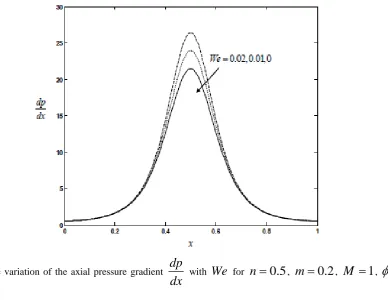
0.Fig. 2 illustrates the variation of the axial pressure gradient
dp
dx
withWe
forn
=
0.5
,m
=
0.2
,M
=
1
,0.5
φ
=
andQ
= −
1
. It is observed that, the axial pressure gradientdp
dx
increases with increasing Wiessenbergnumber
We
.The variation of the axial pressure gradient
dp
dx
withn
forWe
=
0.01
,m
=
0.2
,M
=
1
,φ
=
0.5
and1
Q
= −
is depicted in Fig. 3. It is found that, the axial pressure gradientdp
dx
decreases with an increase in power-lawindex
n
.Fig. 4 depicts the variation of the axial pressure gradient
dp
dx
withm
forn
=
0.5
,We
=
0.01
,M
=
1
,0.5
φ
=
andQ
= −
1
. It is noted that, the axial pressure gradientdp
dx
decreases with increasing Hall parameterm
.The variation of the axial pressure gradient
dp
dx
withM
forn
=
0.5
,m
=
0.2
,We
=
0.01
,φ
=
0.5
and1
Q
= −
is shown in Fig. 5. It is observed that, on increasing Hartmann numberM
increases the axial pressuregradient
dp
Fig. 6 shows the variation of the axial pressure gradient
dp
dx
with
φ
forn
=
0.5
,m
=
0.2
,M
=
1
,We
=
0.01
and Q= −1. It is found that, the axial pressure gradient dp
dx
increases with increasing amplitude ratio
φ
.The variation of the pressure rise
∆
p
withQ
for different values ofWe
withn
=
0.5
,m
=
0.2
,M
=
1
and0.5
φ
=
is depicted in Fig. 7. It is noted that, the time-averaged volume flow rate Q increases with increasing Wiessenberg numberWe
in pumping(
∆ >
p
0
)
, free-pumping(
∆ =
p
0
)
and co-pumping(
∆ <
p
0
)
regions.Fig. 8 illustrates the variation of the pressure rise
∆
p
with Q for different values ofn
withWe
=
0.01
,m
=
0.2
,
M
=
1
andφ
=
0.5
. It is found that, the time-averaged flow rate Q decreases with increasingn
in both the pumping and free pumping regions, while it increases with increasingn
in the co-pumping region.The variation of the pressure rise
∆
p
withQ
for different values ofm
withn
=
0.5
,We
=
0.01
,M
=
1
and0.5
φ
=
is illustrated in Fig. 9. It is observed that, the time-averaged flow rateQ
decreases with increasingm
in the pumping region, while it increases with increasingm
in both the free pumping and co-pumping regions.Fig. 10 depicts the variation of the pressure rise
∆
p
withQ
for different values ofM
withn
=
0.5
,m
=
0.2
,0.01
We
=
andφ
=
0.5
. It is noticed that, the time-averaged flow rateQ
increases with increasingM
in the pumping region, while it decreases with increasingM
in both the free-pumping and co-pumping regions.The variation of the pressure rise
∆
p
withQ
for different values ofφ
withn
=
0.5
,m
=
0.2
,M
=
1
and0.01
We
=
is depicted in Fig. 11. It is observed that, the time-averaged flow rateQ
increases with increasingφ
in both the pumping and free pumping regions, while it decreases with increasingn
in the co-pumping region for chosen( )
0
p
∆ <
.Figs. 12-16 shows the variation of the friction force
F
withQ
for different values ofWe
,n
,m
,M
andφ
. From these figures it is noted that there exists a critical value ofQ
below which F resists the flow and above which Fassist the flow.
Fig. 12 shows the variation of the friction force
F
withQ
for different values ofWe
withn
=
0.5
,m
=
0.2
,1
M
=
andφ
=
0.5
. It is found that, the friction forceF
increases with increasingWe
.The variation of the friction force
F
withQ
for different values ofn
withm
=
0.2
,We
=
0.01
,M
=
1
and0.5
φ
=
is shown in Fig. 13. It is observed that below the critical value ofQ
, the friction forceF
increases with increasingn
, while above the critical value ofQ
it decreases with increasingn
.Fig. 14 depicts the variation of the friction force
F
withQ
for different values ofm
withn
=
0.5
,We
=
0.01
,1
M
=
andφ
=
0.5
. It is noted that below the critical value ofQ
, the friction forceF
increases with increasingm
, while above the critical value ofQ
it decreases with increasingm
.The variation of the friction force
F
withQ
for different values ofM
withn
=
0.5
,m
=
0.2
,We
=
0.01
© 2017, IJMA. All Rights Reserved 77 Fig. 16 shows the variation of the friction force
F
withQ
for different values ofφ
withn
=
0.5
,m
=
0.2
,1
M
=
andWe
=
0.01
. It is found that below the critical value ofQ
, the friction forceF
decreases increasingφ
,while above the critical value of
Q
increases with increasingφ
.5. CONCLUSIONS
In this paper, we investigated the effect of Hall on the peristaltic pumping of a hyperbolic tangent fluid in a planar channel under the assumption of long wavelength. The expressions for the velocity and axial pressure gradient are obtained by employing perturbation technique. It is found that, the axial pressure gradient and time-averaged flow rate in the pumping region increases with increasing the Weissenberg number
We
, the Hartmann numberM
and the amplitude ratioφ
, while they decreases with increasing power-law indexn
and Hall parameterm
. Also, it is found that below the critical value ofQ
the friction forceF
decreases with increasingM
andφ
while it increases with increasingWe n
,
andm
; above the critical value ofQ
the friction force increases with increasingWe M
,
andφ
while it decreases with increasingn
andm
. The results for Newtonian fluid can be obtained as the special cases of our analysis by choosingM
=
0
,n
=
0
andWe
=
0
.Figure-2: The variation of the axial pressure gradient
dp
dx
withWe
forn
=
0.5
,m
=
0.2
,M
=
1
,φ
=
0.5
Figure-3: The variation of the axial pressure gradient
dp
dx
withn
forWe
=
0.01
,m
=
0.2
,M
=
1
,φ
=
0.5
and
Q
= −
1
.Figure-4: The variation of the axial pressure gradient
dp
dx
withm
forn
=
0.5
,We
=
0.01
,M
=
1
,φ
=
0.5
© 2017, IJMA. All Rights Reserved 79
Figure-5: The variation of the axial pressure gradient
dp
dx
withM
forn
=
0.5
,m
=
0.2
,We
=
0.01
,0.5
φ
=
andQ
= −
1
.Figure-6: The variation of the axial pressure gradient
dp
dx
withφ
forn
=
0.5
,m
=
0.2
,M
=
1
,We
=
0.01
Figure-7: The variation of the pressure rise
∆
p
withQ
for different values ofWe
withn
=
0.5
,m
=
0.2
,1
M
=
andφ
=
0.5
.Figure-8: The variation of the pressure rise
∆
p
withQ
for different values ofn
withWe
=
0.01
,m
=
0.2
,1
© 2017, IJMA. All Rights Reserved 81
Figure-9: The variation of the pressure rise
∆
p
withQ
for different values ofm
withn
=
0.5
,We
=
0.01
,1
M
=
andφ
=
0.5
.Figure-10: The variation of the pressure rise
∆
p
withQ
for different values ofM
withn
=
0.5
,m
=
0.2
,0.01
Figure-11: The variation of the pressure rise
∆
p
withQ
for different values ofφ
withn
=
0.5
,m
=
0.2
,1
M
=
andWe
=
0.01
.Figure-12: The variation of the friction force
F
withQ
for different values ofWe
withn
=
0.5
,m
=
0.2
,1
© 2017, IJMA. All Rights Reserved 83
Figure-13: The variation of the friction force
F
withQ
for different values ofn
withm
=
0.2
,We
=
0.01
,1
M
=
andφ
=
0.5
.Figure-14: The variation of the friction force
F
withQ
for different values ofm
withn
=
0.5
,We
=
0.01
,1
Figure-15: The variation of the friction force
F
withQ
for different values ofM
withn
=
0.5
,m
=
0.2
,0.01
We
=
andφ
=
0.5
.Figure-16: The variation of the friction force
F
withQ
for different values ofφ
withn
=
0.5
,m
=
0.2
,1
M
=
andWe
=
0.01
.REFERENCES
1. Ai, L. and Vafai, K. An investigation of Stokes’ second problem for non-Newtonian fluids, Numerical Heat Transfer, Part A, 47(2005), 955–980.
2. Akbar, N.S., Hayat, T., Nadeem, S. and Obaidat, S.
© 2017, IJMA. All Rights Reserved 85 4. Elshahed, M. and Haroun, M. H. Peristaltic transport of Johnson-Segalman fluid under effect of a magnetic
field, Math. Probl. Engng, 6 (2005), 663–677.
5. Gangavathi, P., Ramakrishna Prasad, A. and Subba Reddy, M. V. Effect of variable viscosity on the peristaltic flow of a Jeffrey fluid in a tube under the effect of a magnetic field: application to Adomian decomposition method, International Journal of Mathematical Archive, 3(6), 1-11.
6. Hayat, T and Ali, N. Peristaltically induced motion of a MHD third grade fluid in a deformable tube,
7. Hayat, T., Ali, N, and Asghar, S. Hall effects on peristaltic flow of a Maxwell fluid in a porous medium, Phys. Letters A, 363(2007), 397-403.
8. Jaffrin, M.Y. and Shapiro, A.H. Peristaltic Pumping, Ann. Rev. Fluid Mech., 3(1971), 13-36.
9. Li, A.A., Nesterov, N.I, Malikova, S.N. and Kilatkin, V.A. The use of an impulse magnetic field in the combined of patients with store fragments in the upper urinary tract. Vopr kurortol Fizide. Lech Fiz Kult, 3(1994), 22-24.
10. Nadeem, S. and Akbar, S. Numerical analysis of peristaltic transport of a Tangent hyperbolic fluid in an endoscope, Journal of Aerospace Engineering, 24(3) (2011), 309-317.
11. Nadeem, S. and Akram, S. Peristaltic transport of a hyperbolic tangent fluid model in an asymmetric channel, Z. Naturforsch., 64a (2009), 559 – 567.
12. Nadeem, S. and Akram, S. Magnetohydrodynamic peristaltic flow of a hyperbolic tangent fluid in a vertical asymmetric channel with heat transfer, Acta Mech. Sin., 27(2) (2011), 237–250.
13. Prasanth Reddy, D. and Subba Reddy, M.V. Peristaltic pumping of third grade fluid in an asymmetric channel under the effect of magnetic fluid, Advances in Applied Science Research, 3(6)(2012), 3868 – 3877.
14. Shapiro, A.H., Jaffrin, M.Y. and Weinberg, S.L. Peristaltic pumping with long wavelengths at low Reynolds number, J. Fluid Mech. 37(1969), 799-825.
Source of support: Nil, Conflict of interest: None Declared.