Revision of the
Lima
clade (
Miconia
sect.
Lima
,
Miconieae, Melastomataceae) of the Greater Antilles
Lucas C. Majure1,2,3, Eldis R. Bécquer4, Walter S. Judd2,3
1 Department of Research, Conservation and Collections, Desert Botanical Garden, Phoenix, Arizona 85008 USA 2 Department of Biology, University of Florida, Gainesville, Florida 32611–8525 USA 3 Florida Mu-seum of Natural History, University of Florida, Gainesville, Florida 32611–0575 USA 4 Jardín Botánico Nacional, Universidad de La Habana, La Habana, Cuba
Corresponding author:Lucas C. Majure ([email protected])
Academic editor:Sandra Knapp | Received 27 May 2016 | Accepted 26 September 2016 | Published 13 October 2016
Citation: Majure LC, Bécquer ER, Judd WS (2016) Revision of the Lima clade (Miconia sect. Lima, Miconieae, Melastomataceae) of the Greater Antilles. PhytoKeys 72: 1–99. doi: 10.3897/phytokeys.72.9355
Abstract
Miconia sect. Lima is an entirely Greater Antillean clade that consists of 19 known species of shrubs and small trees, which were previously recognized under the polyphyletic genera Leandra and Ossaea. The highest species richness in the clade is represented on Cuba (10 species), followed by Hispaniola (8 spe-cies) and then Jamaica (1 spespe-cies). Here we present a taxonomic revision of the clade based on the study of species in the field, herbarium specimens, as well as a DNA-based phylogeny reconstruction. The Lima clade most likely originated on Cuba and then spread to Jamaica once and Hispaniola multiple times. Species of this clade can be recognized by the well developed bulla-based hairs of the adaxial leaf surface, as well as the clavate-dendritic hairs produced along the primary, secondary and tertiary veins of the adaxial leaf surface, mostly towards the leaf base, terminal inflorescences, acute petal apices, slightly bulla-based hairs produced subapically along the petal abaxial surface, and anthers with a dorso-basal appendage and a single, dorsally oriented pore. Descriptions, synonymies, along with distribution maps and illustrations/ figures, are given for each species. Miconia pagnolensis sp. nov. is newly described in this revision.
Keywords
Caribbean, Cuba, Hispaniola, Jamaica, Leandra, Ossaea, phylogeny
http://phytokeys.pensoft.net
Copyright Lucas C. Majure et al. This is an open access article distributed under the terms of the Creative Commons Attribution License (CC BY 4.0), which permits unrestricted use, distribution, and reproduction in any medium, provided the original author and source are credited.
Table of contents
Introduction ... 3
Systematics of Miconia section Lima ...6
Taxonomic history ... 6
Morphology ... 7
Phylogenetics and evolution ... 9
Biogeography ... 10
Morphological evolution ... 11
Ploidy ... 12
Species concepts ... 12
Materials and methods ... 12
Results ... 13
Miconia sect. Lima Majure & Judd, J. Bot. Res. Inst. Texas. 7: 266. 2013 ... 13
Key to the species of the Lima clade ... 14
Taxonomic treatment ... 17
1. Miconia jashaferi Majure & Judd, J. Bot. Res. Inst. Texas. 7: 268. 2013. .... 17
2. Miconia hirtistyla Majure & Judd, PhytoKeys 33: 69. 2014. ... 22
3. Miconia cubacinerea Majure & Judd, J. Bot. Res. Inst. Texas 7: 268. 2013. ....25
4. Miconia tentaculicapitata Majure & Judd, J. Bot. Res. Inst. Texas. 7: 269. 2013. ..28
5. Miconia norlindii (Urb.) Majure & Judd, J. Bot. Res. Inst. Texas. 7: 269. 2013. ... 30
6. Miconia asperifolia (Naudin) Majure & Judd, J. Bot. Res. Inst. Texas. 7: 268. 2013. ... 36
7. Miconia hybophylla (Urb.) Majure & Judd, J. Bot. Res. Inst. Texas. 7: 268. 2013. ... 42
8. Miconia granulata (Urb.) Majure & Judd, J. Bot. Res. Inst. Texas. 7: 268. 2013. ... 44
9. Miconia cubana (Alain) Majure & Judd, J. Bot. Res. Inst. Texas. 7: 268. 2013. ... 47
10. Miconia argentimuricata Majure & Judd, J. Bot. Res. Inst. Texas. 7: 268. 2013. ... 49
11. Miconia bullotricha Bécquer & Majure, PhytoKeys 33: 65. 2014. ... 55
12. Miconia ottoschmidtii (Urb.) Majure & Judd, J. Bot. Res. Inst. Texas. 7: 269. 2013. ... 58
13. Miconia lima (Desr.) M.Gómez, Anales Hist. Nat. 23: 69. 1894. ... 63
14. Miconia limoides (Urb.) Majure & Judd, J. Bot. Res. Inst. Texas. 7: 269. 2013. ... 73
15. Miconia phrynosomaderma Majure & Judd, J. Bot. Res. Inst. Texas. 7: 269. 2013. ... 77
16. Miconia marigotiana (Urb. & Ekman) Majure & Judd, J. Bot. Res. Inst. Texas 7: 269. 2013. ... 80
18. Miconia pedunculata Majure & Judd, J. Bot. Res. Inst. Texas. 7: 269. 2013. ....88
19. Miconiapagnolensis Majure & Judd, sp. nov. ... 90
Names not validly published ... 92
Acknowledgments ... 92
References ... 93
Index to numbered collections... 97
Introduction
Tribe Miconieae (Melastomataceae) is a widely distributed, species rich (ca. 1800 species), Neotropical clade of trees and shrubs, which is most diverse in montane regions of Cen-tral and South America and the West Indies. The group has been divided into numerous genera, with ca. 16 recognized until only recently (Michelangeli et al. 2008). Phyloge-netic analyses have shown that with few exceptions (e.g., Mecranium Hook.f.; see Skean 1993), all of these genera are polyphyletic (Bécquer-Granados et al. 2008, Goldenberg et al. 2008, Martin et al. 2008, Michelangeli et al. 2004, 2008; Kriebel et al. 2015, Majure et al. 2015, Reginato and Michelangeli 2016) and undiagnosable, if recognized in the broad sense as currently circumscribed (e.g., Leandra Raddi s.l.; Majure et al. 2013). Generic limits in this group have long been considered problematic and arbitrary (Cogniaux 1891, Gleason 1932, Macbride 1941, Wurdack 1972, Judd 1989, Judd and Skean 1991).
Figure 1.Photomicrographs of indumentum characters and epidermal features of members Miconia pe-dunculata (A–C) and M. lima (D–F). A–B Adaxial leaf surface of M. pedunculata (scale bar = 0.75 mm), B close-up of bulla-based hairs on adaxial leaf surface (scale bar = 0.6 mm), C abaxial leaf surface show-ing pits and strigose hairs (scale bar = 0.6 mm; all from Pimentel 806), D adaxial leaf surface of M. lima showing bulla-based hairs filling areoles (scale bar = 0.375 mm; all from Judd 5194), E abaxial leaf surface showing marginal, recurved bulla-based hairs covering dentations (scale bar = 0.375 mm), and F abaxial leaf surface showing pitting and epidermis covered in bulla-based hairs. All photos taken by G.M. Ionta.
pleisiomorphy in the Lima, Paralima and Pseudolima clades, although character re-constructions using parsimony are equivocal (Majure et al. 2015). Having strongly bulla-based hairs that entirely or nearly completely cover the areoles, however, is a synapomorphy of a subclade (with reversals within it) of the Lima clade (Majure et al. 2015). The Lima clade can be differentiated from the Pseudolima clade by the growth architecture. Members of the Pseudolima clade produce terminal inflorescences that often appear axillary as a result of their deflection to a lateral position from the rapid growth of lateral buds. The Lima clade has inflorescences that are clearly terminal (Ma-jure et al. 2015). The Paralima clade is easily distinguished from the Lima clade by the production of globular stellate hairs on the stem, abaxial leaf surface and hypanthium, and several species of the Paralima clade produce truly axillary inflorescences or both axillary and terminal inflorescences (e.g., M. glomeruliflora Judd, Bécquer & Majure, M. ovatifolia Judd, Bécquer & Majure; Majure et al. 2015, Judd et al. in prep).
Systematics of Miconia section Lima
Taxonomic history
2015) other than one complete copy at BM. Incomplete copies of the flora were sent out by the British Museum of Natural History to HH, K, MICH, and NY (see Stafleu and Cowan 1981). Two species collected by Charles Wright in Cuba, Miconia argen-timuricata Majure & Judd and M. cubacinerea Majure & Judd, were the next species to be described by Grisebach (1866), as Calycogonium muricatum Griseb. and Clidemia cinerea Griseb., respectively. Miconia jashaferi Majure & Judd was then described by Britton and Wilson (1920) as Ossaea shaferi Britton & Wilson. Urban (1923, 1926, 1927, 1929), and Urban and Ekman (1929, 1931) then described a series of new species based on material primarily collected by the Swedish botanist Erik L. Ekman (1883–1931) from Cuba and Hispaniola. These were all described under the genus Ossaea (i.e., O. capitata Urb., O. granulata Urb., O. hybophylla Urb., O. limoides Urb., O. norlindii Urb., O. ottoschmidtii Urb., O. polychaeta Urb., O. turquinensis Urb.). Ma-jure and Judd (2013a–b) and MaMa-jure et al. (2014a) subsequently described four more species from the clade from Haiti (M. phrynosomaderma Majure & Judd), the Domini-can Republic (M. paralimoides Majure & Judd) and Cuba (M. bullotricha Bécquer & Majure, M. hirtistyla Majure & Judd), and one new species from Massif de la Hotte, Haiti, is described herein. Majure and Judd (2013a) transferred all of the previously described species in this clade to Miconia based on our current understanding of the polyphyletic nature of the genera in which they had been placed (Bécquer-Granados et al. 2008, Goldenberg et al. 2008, Martin et al. 2008, Michelangeli et al. 2004, 2008, Majure et al. 2014c).
Morphology
Habit and stems. Species within the Lima clade form evergreen shrubs to small trees ranging in height from 0.5 to 5 m tall. The height of several species, however, is com-pletely unknown. Stems are rectangular or cylindrical in cross section and lack longi-tudinal ridges (Fig. 9M).
Leaves. Leaves are opposite, decussate and generally slightly anisophyllous. The blades are elliptical, ovate or lanceolate (narrowly ovate), with crenulate or dentate margins that are generally obscured by bulla-based hairs (Fig. 1E; see Indumentum below); the margins may be flat or slightly revolute. Venation is acrodromous with the 1–3 pairs of secondary veins arching towards the leaf apex; these are basal to supraba-sal. Tertiary veins are percurrent, more or less perpendicular to the midvein and often connected by quaternary veins. Leaf shape in certain species is quite useful for species delimitation, such as the elliptical-rhombic leaves of Miconia marigotiana, which are unique in the group.
placement or orientation can be useful for identifying species. Certain species show complete leaf areole coverage, on the adaxial surface, by volcaniform, bulla-based hairs (Fig. 1D), as in M. lima, M. limoides, M. marigotiana and M. paralimoides. Conversely, M. jashaferi, M. hirtistyla and M. cubacinerea have poorly-formed, slender, lacrimal-shaped bulla-based hairs that cover most, but not all, of the adaxial leaf surface. Clavate-dendritic hairs are common on most species at the leaf blade bases (where the petiole enters the leaf) and are most easily observed on developing leaves. Miconia jashaferi, however, exhibits filiform hairs at this position. Clavate-dendritic hairs can commonly be found also at the apices of the calyx tube in most species (but see Morphological Evo-lution below). Most species within the Lima clade exhibit tranluscent or colored glan-dular hairs, which may be present on most portions of the plant body (stem, both leaf surfaces, hypanthium). These are smaller than and occur between (at the base) or below the bulla-based hairs. Domatia composed of bulla-based or linear hairs are common in certain species, generally at the union of the primary and secondary veins but can also be found at the unions of the tertiary and primary, as well as tertiary and secondary veins (e.g., M. asperifolia, M. hybophylla). The directionality of the bulla-based hairs of the stem of specific species is very useful for species delimitation. For example, only M. limoides and M. phrynosomaderma exhibit downward oriented hairs on the stem surface.
Inflorescences. Inflorescences are terminal in all species of the Lima clade and are formed typically from 3-flowered dichasia; inflorescences are generally quickly surpassed by rapidly growing, lateral shoots. The flowers may be pedicellate or sessile and thus form open to relatively dense, and even slighly capitate (e.g., M. jashaferi; Fig. 3A) cymose inflo-rescences. Bracts subtending 3-flowered dichasia are either granulate, lacrimal or in some taxa (e.g., M. pedunculata; Fig. 22A) foliose. Bracteoles are similar in form to the bracts.
Hypanthium and calyx lobes. The hypanthia are mostly 4–5 lobed, or mostly sp-eherical (Fig. 12H). However, slight lobing is often obscured by the production of dense bulla-based hairs. Calyx lobes are triangular with acute to acuminate apices (Fig. 3E). The calyx teeth may be equal or longer than the calyx lobes and are terete (Fig. 3E) and often reflexing when in fruit.
Corollas. Corollas are actinomorphic or nearly so, with 4–5 ovate to obovate or ob-long petals; these are symmetric or slightly assymetric with acute to acuminate apices. The petal apices often exhibit 1–several bulla-based hairs on the abaxial surface (e.g., Fig. 14B). Petals are white, rose, red, purple or white with a purple tinge abaxially and are generally reflexed in flower.
Stamens. Stamens are 8–10 with glabrous filaments. The anthers are white to yel-low and may or may not have a dorso-basal appendage; they typically have one, dor-sally-inclined pore (Fig. 3C).
while the rest of the species have glabrous styles. However, a crown of needle-like hairs often is present at the base of the styles (along ovary apex) of most species (e.g., Fig. 3E).
Fruit.Fruit in the Lima clade are multi-seeded, mostly spherical berries that range in color from purple, purple-black to black (Figs 9I, N, 15F, 19C, 27D). There is still much missing data for fruit color and size for numerous taxa within this group, as fruit are not well-preserved in herbarium specimens, and many specimens lack fruit altogether.
Phylogenetics and evolution
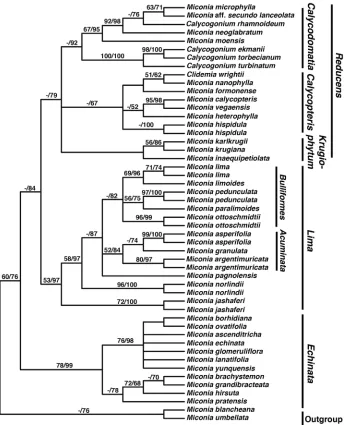
Majure et al. (2015) reconstructed a phylogeny of the Lima clade using five plastid intergenic spacers (accD-psaI, psbK-psbI, rpl32-trnL, trnH-psbA, trnV-ndhC) and two nuclear, ribosomal loci (ETS and ITS). They included 11 of the 19 species of the Lima clade, i.e., all species for which material was available in silica from field collections or from “recently” collected herbarium material (e.g., within the last 10 years). They were able to include two accessions per species for six of the included species (Fig. 2). Other closely related members of the Caribbean clade were included as outgroup taxa (i.e., Miconia sect. Calycopteris Judd, Bécquer & Majure; Judd et al. 2014; Miconia sect. Echinata Judd, Bécquer & Majure; Majure et al. 2015; Miconia sect. Calycodomatia Skean, Judd & Majure; Majure et al. 2015, Miconia sect. Krugiophytum (Cogn.) Ma-jure & Judd; MaMa-jure et al. 2014b, as well as Miconia blancheana Urb. and M. umbellata (Mill.) Judd & Ionta). The phylogeny presented here is based on Majure et al. (2015). The Lima + Calycopteris + Paralima + Pseudolima + Calycodomatia clade is referred to as the Sandpaper clade, because of the many species of the group that have bulla-based hairs on the upper leaf surface (see Majure et al. 2015; Fig. 2).
The Lima clade is most closely related to the Reducens clade, composed of Miconia sect. Calycopteris, sect. Krugiophytum and sect. Calycodomatia. Most of the members of those other three sections have reduced inflorescences and lack the conspicuous bulla-based hairs of the Lima clade (except for sect. Krugiophytum). They also have conspicu-ous to reduced globular-stellate hairs, again, except for sect. Krugiophytum, whose mem-bers possess sessile-glandular hairs like those of the Lima clade (Majure et al. 2015).
and M. paralimoides in our phylogeny, are phylogenetically adjacent, however, M. parali-moides apparently is more closely related to M. pedunculata than to either M. lima or M. limoides, contrary to relationships initially suspected based on morphology alone (Majure and Judd 2013b). Miconia limoides is sister to M. lima, andthe Cuban M. ottoschmidtii is unresolved in the same subclade as well (i.e., the Bulliformes subclade; Majure et al. 2015). Thus, M. ottoschmidtii and M. pedunculata must be included in what Majure and Judd (2013a) termed the M. lima complex, which we refer to here as the Bulliformes subclade. The Bulliformes subclade is restricted to Hispaniola and Cuba. Miconia marigotiana and M. phrynosomaderma also are likely members of the Bulliformes subclade, although they have not been recollected since the type material was collected by Ekman. They are linked to the Bulliformes subclade by their bulla-based hairs on the adaxial leaf surface almost completely filling the leaf areoles, as well as the descending stem hairs in M. phrynosoma-derma (found otherwise only in M. limoides of the Bulliformes subclade). Another subclade is formed by M. argentimuricata, M. asperifolia, M. granulata and M.pagnolensis (i.e., the Acuminata subclade) represented by members from Cuba, Haiti, and Jamaica. Miconia cubana and M. hybophylla also are most likely members of this subclade, as they produce large, open inflorescences (i.e., in M. cubana and M. hybophylla, as in M. asperifolia and M. argentimuricata). They also tend to have less well-developed bulla-based hairs on the upper leaf surface, similar to other members of the Acuminata clade. Miconia hybophylla also is linked to M. asperifolia by the production of well-developed domatia in the axils of the primary and secondary, as well as the primary and tertiary and secondary and tertiary veins. Miconia bullotricha may also form part of the Acuminata subclade in that it pro-duces deflexed inflorescences, which are similar to the partially deflexed inflorescences in M. granulata, demonstrates a similar leaf shape (narrowly ovate), as do both M. granulata and M. argentimuricata in many specimens, and occurs over serpentine soils, as do both M. argentimuricata and M. granulata.
Miconia argentimuricata, M. asperifolia, M. jashaferi, M. lima, M. norlindii, M. ot-toschmidtii, and M. pedunculata are likely cladospecies (sensu Donoghue 1985), as multi-ple accessions of each of these species form clades in our phylogeny (Majure et al. 2015; Fig. 2). We were unable to assess the monophyly of the rest of the species, as multiple ac-cessions were unavailable for phylogenetic analysis. However, considering the morpholog-ical apomorphies uniting the populations of most of the other members of the clade, they also likely represent cladospecies (see Majure and Judd 2013a-b, Majure et al. 2014a).
Biogeography
eastern Cuba, and subsequently dispersed to the Massif de la Hotte, Haiti (M. pagnolensis) and to Jamaica (M. asperifolia). The unsampled species, M. hybophylla, most likely sister to M. asperifolia, would have represented yet another dispersal of the Lima clade to Hispan-iola; thus four dispersals to Hispaniola from Cuba are most likely for the Lima clade. The Bulliformes subclade dispersed twice to Hispaniola, once to the Massif de la Selle-Sierra de Baoruco (M. lima, M. limoides) and once to the Cordillera Central (M. paralimoides, M. pedunculata). There was then broader dispersion of M. lima throughout Hispaniola and a subsequent dispersal of M. limoides to the Massif de la Hotte (Majure et al. 2015).
The Lima clade appears to have evolved primarily on serpentine soils of Cuba and then dispersed and adapted several times to limestone-derived soils, soils mixed with limestone, or other substrates (e.g., clay soils in M. asperifolia; Majure et al. 2015). A number of taxa within the Lima clade are still mostly restricted to serpentine soils (M. bullotricha, M. granulata, M. jashaferi), or at least occur in parts of their range on serpentine (M. argentimuricata, M. ottoschmidtii).
Morphological evolution
There are very few morphological synapomorphies for the Lima clade, but the pro-duction of clavate-dendritic hairs on the upper leaf surface is a synapomorphy of a subclade of the group (only excluding M. jashaferi in our analyses), as is the produc-tion of dilated styles (excluding only M. jashaferi and M. norlindii, the two basalmost taxa in our phylogeny). The production of very well-developed bulla-based hairs on the upper leaf surface that mostly fill the areoles also is a synapomorphy of a subclade (excluding M. jashaferi and M. norlindii), and the production of sessile, glandular hairs is a synapomorphy for the entire clade. The sessile-glandular hairs on the upper and lower leaf surfaces are homologs to the globular-stellate hairs produced in close relatives (Calycopteris and Calycodomatia clades; Majure et al. 2015) and have also evolved in the Pseudolima clade, as well as a few members of the Paralima clade. Thus, although the sessile-glandular hair type is synapomorphic for the Lima clade, it is not a unique synapomorphy within the Sandpaper clade (Majure et al. 2015).
Ploidy
Chromosome numbers are unknown in this group.
Species concepts
Criteria for the recognition of species in this group are based upon morphological cohe-siveness or the morphological-phenetic/diagnostic species concepts (Judd 1981, Wheeler and Platnick 2000, Judd 2007), as well as phylogenetic or apomorphic species concepts (Donoghue 1985, Judd 2007), thus unifying our knowledge regarding the evolutionary history of a species along with its morphological characteristics (i.e., producing a more unified species concept; DeQueiroz 2007). A species thus consists of populations of in-dividuals that can be morphologically diagnosed from other populations based on syna-pomorphies or suites of characters, and when the information is available, also form part of the same lineage or clade. Species consisting of metaspecies complexes and resulting from the invasion of new niches by closely related and subsequently divergent popula-tions (peri- or parapatric speciation, or peripherial isolate speciation) would appear to be a highly likely in this clade, considering the restriction of many of these taxa to high elevation mountain ranges (see Judd et al. 2015a for an example of this). A given popula-tion evolving within a metapopulapopula-tion could easily diverge from the rest of the lineage via niche specialization or other processes leading to allopatric speciation. However, within the Lima clade, we do not have direct evidence of speciation via metaspecies lineages; all of the species included in phylogenetic analyses with multiple accessions appear to form clades. So it appears that the most common mode of speciation in this group is through cladogenesis, which may be brought about through the restriction of many species to specific ecological niches (e.g., high elevation cloud forests on limestone-derived, clay soils, or other substrates or low elevation sclerophyllous forests on serpentine soils). Thus, most species within the Lima clade have at least a few apomorphic characters (uniting their populations), as well as quantitative character differences, which may or may not be apomorphies. We do not have any information regarding ploidy in this group, so we cannot determine whether or not hybridization and subsequent genome duplication may have played a role in the origin and subsequent evolution of any of the species.
Materials and methods
char-acters were analyzed from herbarium specimens, photos, alcohol preserved material, or from live plants in the field. Phenological, distributional and ecological data were derived mostly from specimen label data or observations taken in the field. Measure-ments for reproductive characters (e.g., hypanthium length, calyx tube, lobe and tooth length, ovary length and width, etc.) were based on Judd (2007) and were taken from herbarium material rehydrated via boiling for several minutes in water mixed with a detergent (see Judd 2007). Illustrations were based on herbarium specimens.
Typifications of species described by Urban are carried out, in part, using the criteria of Bécquer (2012). However, as Urban never actually explicitly stated the re-pository of type material, and there is potential confusion as to where holotypes may have originally been deposited, since all specimens of Melastomataceae were lost in the allied bombings of Berlin during the second World War, we have chosen to lectotypify those species for clarity (see also McNeill 2014).
Although Alain and Liogier both refer to Henri Alain Liogier, we maintain those entries seperately, as Liogier used only the name, Bro. Alain, while collecting in Cuba, but generally used Henri Alain Liogier (or Alain Henri Liogier) while collecting in Hispaniola after he left the Catholic religious order. Collections made by Erik Ekman in Hispaniola are preceeded with an H, as his collection numbers were started anew during his work in Haiti and the Dominican Republic (see also Index to numbered collections).
Results
Miconia sect. Lima Majure & Judd, J. Bot. Res. Inst. Texas. 7: 266. 2013
Type.Miconia lima (Desr.) M.Gómez (Melastoma lima Desr., Encycl. [J. Lamarck &
al.] 4: 47. 1797).
less perpendicular to the midvein, sometimes mostly obscured by bulla-based hairs on the adaxial leaf surface, connected by quaternary veins, the primary, secondary, tertiary and quaternary veins mostly impressed on the adaxial surface and raised on the abaxial surface, domatia present or absent, occurring at the junctions of primary, secondary and tertiary veins, forming a pocket-like structure in the axils of the primary and innermost secondary veins or formed from a tuft of hairs in the vein axils. Inflorescences terminal, although often surpassed by the rapid growth of axillary shoots, the flowers in 3-flow-ered dichasia, sessile, subsessile or pedicellate, thus forming open cymes or sessile and nearly headlike clusters. Flowers 4–5(7)-merous, mostly actinomorphic or nearly so; hy-panthium 4–5-lobed, the lobes sometimes obscured by retrorse or antrorse bulla-based hairs, bulla-based hairs long and well developed, or granulate, hypanthium also with sessile glands; calyx lobes triangular, acute to acuminate, often covered by sessile glands throughout the adaxial surface or such glands restricted to the apex of the adaxial surface, abaxial surface covered in bulla-based hairs and more or less sessile glands; calyx teeth ca. equal to or longer than calyx lobes, terete, mostly reflexed in fruit, covered in long and well developed, or granulate bulla-based hairs, sessile glands present or absent; calyx tube often with long stemmed, clavate-dendritic hairs produced from apex along the margin, sessile glands more or less present on adaxial surface, abaxial surface covered in bulla-based hairs; petals ovate to obovate or slightly oblong, symmetric or asymmetric, white, red, rose, purple, or white with purple tinge abaxially, apices acute to acuminate, with moderately bulla-based hairs produced from the abaxial surfaces just below the petal apex and occasionally from the medial portion of the petal as well; stamens 8–10, not geniculate, the filaments glabrous, the anthers with or without a small dorso-basal appendage and a single, dorsally inclined pore; style straight to moderately curved, gen-erally expanded in the middle, the stigma punctiform; ovary 2–5(7) locular, more or less inferior, with axile placentation, the placenta intruded into each locule, the ovary apex without a collar but commonly with a crown of multicellular hairs, the upper portion of the ovary pubescent (bulla-based hairs) to mostly glabrous (i.e., with only crown hairs present). Fruit a globose and slightly 4- or 5-lobed berry, purple-black at maturity. Seeds angular, obpyramidal, obovoid to obovoid-falcate, with a linear to oblong, dark colored raphe that extends the length of the seed; testa smooth; appendage absent.
Miconia sect. Lima is a clade of 19 species restricted to the Greater Antilles (ex-cluding Puerto Rico).
Key to the species of the Lima clade
1 Upper leaf surfaces appearing velvety or soft, covered in narrowly dilated (poorly developed bulla-based) hairs with long, attenuate apices, these mostly not covering leaf areoles, thus the lamina clearly visible ...2
2 Inflorescence an expanded, compound cyme, very delicate, with proximal inflorescence branches 8–25 mm long; bracts and bracteoles not foliose; calyx lobes and teeth 4; ovary 4-locular and 4-lobed; Pinar del Río, Cuba ... ...9. M. cubana
– Inflorescence a dense cluster of sessile flowers (glomerulate), robust, with proximal inflorescence branches 0–5.5 mm long; bracts and bracteoles foli-ose; calyx lobes and teeth 5–7; ovary 3-locular and unlobed; eastern Cuba .3 3 Leaf apices narrowly acute to acuminate; leaf margins composed of large and
small bulla-based hairs (appearing jagged); inflorescences pendant; Baracoa, Moa, Sierra de Cristal, eastern Sierra Maestra, Cuba ...1. M. jashaferi
– Leaf apices broadly acute; leaf margins with only one size of bulla-based hairs (appearing smooth); inflorescences erect; Baracoa and western Sierra Maes-tra, Cuba ...4
4 Abaxial leaf surface conspicuously pitted as a result of the bulla-based hairs produced on the adaxial surface; styles pubescent; calyx teeth 4.5–4.6 × 0.2– 0.4 mm; Pico Turquino region, Cuba ...2. M. hirtistyla
– Abaxial leaf surface not conspicuously pitted; styles glabrous; calyx teeth 5.7– 6.2 × 0.6–0.7 mm; Baracoa region, Cuba ...3. M. cubacinerea
5 Inflorescence bracts and bracteoles ovate, obovate or elliptic, broad and folia-ceous; bracteoles 3–7 × 1.6–6.5 mm; flowers in glomerulate heads; inflores-cences appearing long pedunculate or sessile ...6
– Inflorescence bracts and bracteoles oblong, acute or linear, not broad and foliaceous; bracteoles 0.4–3.5 × 0.15–0.8 mm; flowers well separated or if in glomerate heads then in expanded inflorescences not appearing long pedun-culate or sessile ...7
6 Leaves 5-veined; adaxial leaf surface with bulla-based hairs completely cover-ing leaf areoles, not produced in rows; proximal inflorescence branches ab-sent; Pico Turquino region, Cuba ...4. M. tentaculicapitata
– Leaves 7–9-veined; adaxial leaf surface with bulla-based hairs not completely covering leaf areoles, well spaced and produced in lateral rows; proximal in-florescence branches 15–45 mm long; Cordillera Central, Dominican Re-public ...18. M. pedunculata
7 Stem indumentum of descending bulla-based hairs with the apices recurved upwards, the hairs long and shaggy ...8
– Stem indumentum of ascending or spreading bulla-based hairs, the hairs long and shaggy or granulate ...9
8 Areoles of adaxial leaf surface completely filled by bulla-based hairs; abaxial leaf surface completely covered in erect to slightly spreading bulla-based hairs; flowers sessile or subsessile; petals not clawed; anthers lacking dorso-basal appendage (or very poorly developed to 0.1mm long); calyx teeth erect or spreading, not reflexed in fruit; restricted to southern Hispaniola, i.e., Massif de la Selle/Sierra de Bahoruco ...14. M. limoides
or slightly spreading; flowers pedicellate; petals clawed; anthers with dorso-basal appendage to 0.3 mm long; calyx teeth reflexed in fruit; restricted to Massif du Nord, Haiti ...15. M. phrynosomaderma
9 Stem indumentum mostly granulate, the hairs mostly spreading or appearing so, their apices truncate or short attenuate, with longest hairs to 0.2–0.5 mm long ...10
– Stem indumentum of longer hairs, their apices long attenuate, mostly ascending or occasionally spreading, with longest hairs 0.6–2.2 mm long ...15
10 Bulla-based hairs on adaxial leaf surface rounded with conspicuously large and small hairs, not meeting at the bases, thus areoles not completely filled ...12
– Bulla-based hairs on adaxial leaf surface angled, the bases expanded, appear-ing to meet at the bases, thus completely fillappear-ing the areoles ...14
12 Petiole with two hairs types, adaxial surface with long attenuate hairs, abaxial surface with granulate hairs; domatia very well developed in the axils of the primary and secondary, primary and tertiary veins, and secondary and ter-tiary veins; Haiti ...7. M. hybophylla
– Petiole with one hair type, granulate on both surfaces or only slightly elongat-ed; domatia poorly developed, if present restricted to the axils of the primary and secondary veins, Cuba ...13
13 Leaf apices narrowly acute to acuminate; domatia absent; leaves 3-veined, narrowly ovate to narrowly elliptic ...8. M. granulata
– Leaf apices widely acute to obtuse; domatia present at least at the junction of primary and secondary veins; leaves 5-veined, broadly elliptic to broadly ovate ...5. M. norlindii
14 Stem indumentum generally with apices attenuate and strongly recurved up-wards; abaxial leaf surface hairs erect throughout the lamina and along veins; innermost pair of secondary veins produced 2–6 mm from the leaf base; floral buds globose; calyx teeth 1.75–2.2 mm long; mountains of Guantánamo province ...11. M. bullotricha
– Stem indumentum generally granulate with apices truncate or only short at-tenuate and recurved upwards or not; abaxial leaf surface hairs mostly spread-ing or appressed throughout the lamina, appressed to spreadspread-ing along the veins; innermost pair of secondary veins produced 0.8–25 mm from the leaf base; floral buds quadrangular; calyx teeth 0.4–0.8 mm long; widespread on Cuba ...12. M. ottoschmidtii
15 Abaxial leaf surface covered in dense, strongly appressed hairs mostly obscur-ing the epidermis; inflorescence 0.9–2.8 × 1.2–2.8 cm, stout; restricted to the Cordillera Central, Dominican Republic ...17. M. paralimoides
16 Abaxial leaf surfaces with bulla-based hairs mostly restricted to veins, thus the lamina clearly visible; petals with 2–4 subapical hairs; ovaries 5 locular; leaves ovate to broadly elliptic; eastern Cuba and Jamaica ...17
– Abaxial leaf surfaces with bulla-based hairs not restricted to veins, thus the lamina partially or almost entirely obscured; petals with 1–2 subapical hairs; ovaries 2–4 (5) locular; leaves mostly elliptic, narrowly elliptic, elliptic-rhom-boid, or occasionally ovate; Cuba and Hispaniola ...18
17 Leaves drying silver to bronze; adaxial leaf surface covered in basally strongly angular, well-formed bulla-based hairs of mostly one size, these usually with long attenuate apices; tertiary veins inconspicuous on adaxial surface; hypan-thium hairs to 2.7 mm long, thus concealing the hypanhypan-thium; ovary not or only weakly lobed; eastern Cuba ...10. M. argentimuricata
– Leaves drying green, yellow or brown, adaxial leaf surface covered in basally rounded bulla-based hairs of conspicuously small and large sizes, the large hairs usually surrounded by the smaller hairs, apices either truncate or short attenuate; tertiary veins conspicuous on adaxial surface; hypanthium hairs to 0.4 mm long, not concealing the hypanthium; ovary strongly 5-lobed; Jamaica ...6. M. asperifolia
18 Leaves narrowly ovate to elliptic-rhomboid, apices narrowly acute; abaxial leaf surface hairs appressed; carpels 2 ...16. M. marigotiana
– Leaves elliptic, narrowly elliptic or ovate, apices acute or truncate; abaxial leaf surface hairs appressed, spreading or erect; carpels 4–5 ...19
19 Shrubs 1.5–5 m tall; leaf blades 0.7–5.7 × 0.42–3.2 cm, apices acute to acumi-nate; petioles 3–21 mm long; widespread on Hispaniola ...13. M. lima
– Shrubs 0.5–0.9 m tall; leaf blades 0.9–2.3 × 0.5–1.2 cm, apices obtuse to acute; petioles 1.5–4.5 mm long; restricted to Massif de la Hotte, Haiti ... ...19. M. pagnolensis
Taxonomic treatment
1. Miconia jashaferi Majure & Judd, J. Bot. Res. Inst. Texas. 7: 268. 2013.
Figs 3, 9A–D
Ossaea shaferi Britton & Wilson, Mem. Torrey Club 16: 92. 1920.
Type: CUBA. Camp La Gloria, South of Sierra Moa, 24–30 Dec 1910, J.A.Shafer 8152 (holotype: NY! [NY00099714]; isotypes: A! [A00073129], CAS [CAS0003716]).
Type. Based on Ossaea shaferi Britton & Wilson
Description. Evergreen shrub, 1–1.5 m tall; stems round in cross section, not
Figure 3. Illustration of Miconia jashaferiA habit (Ekman3849) B petal (Alain 871) C stamen (Alain 871) D style (Alain 871) E immature fruit longitudinal section (Alain 871) F seed (Acuña SV-13275). Reproduced with permission from Majure et al. (2014a).
pla-centa, 3-locular; berries globose, slightly 4-lobed, purple at maturity, 7.5 mm long (in-cluding calyx tube), 7.3 mm wide; seeds 0.8–1.6 mm long, obpyramidal, often falcate, testa smooth, light brown, raphe black, smooth, extending the length of the seed.
Phenology. Miconia jashaferi has been collectedflowering and in immature fruit
from July through August. Individuals have been collected in mature fruit in Novem-ber and DecemNovem-ber.
Distribution (Fig. 4). Miconia jashaferi is known from the mountains of
northeastern Cuba, including the Baracoa, Moa and Toa regions, as well as the Sierra de Cristal.
Ecology. Miconia jashaferi grows in thorny, xerophytic scrub and semidry
mon-tane rainforest on serpentine soils from 110 – 800 m in elevation. Some associated me-lastomes include Miconia baracoensis Urb., Pachyanthus reticulatus Britton & P.Wil-son, Miconia moensis (Britton) Alain, Mecranium integrifolium Triana subsp. alainii Skean and Miconia walterjuddii Bécquer & Michelangeli.
Conservation status. Miconia jashaferi is a locally widespread species in eastern
affect localized populations of this species. Likewise, populations are highly fragement-ed and occupy less than 500 km2, so we suggest this species have a preliminary conser-vation assessment of endangered.
Discussion. Miconia jashaferi is resolved as sister to the rest of the Lima clade
(Fig. 2) in our phylogenetic analyses. However, three other species likely form a clade with M. jashaferi (M. cubacinerea, M. hirtistyla, and M. tentaculicapitata). All four of these species share the characters of large foliaceous bracts subtending the flowers, long calyx teeth, long, filiform hairs produced on the adaxial surface of the calyx tube, 3-carpellate ovaries and relatively large fruit compared with the rest of the members of the clade. Miconia jashaferi has often been confused with Miconia ovatifolia (Urb.) Judd, Bécquer & Majure (=Ossaea ovatifolia Urb.) of the Paralima clade (Majure et al. 2015), as the adaxial leaf indumentum is somewhat similar, consisting of poorly developed bulla-based hairs (Figs 3, 9A–D). These two taxa are easily separated by hair type, in that M. ovatifolia has globular-stellate hairs on most surfaces of the plant and axillary, as well as obviously terminal inflorescences.
The stem indumentum of Miconia jashaferi initially is reddish or purplish and then quickly turns white, in what appears to be the death of the hairs produced, which are eventually shed entirely.
Specimens examined.CUBA. Prov. Guantánamo: near Laguna del Galano,
río Iberia, Taco Bay, 25 Jul 1960, López-Figueiras UO-2191 (HAC, HAJB); Entre el río y la cumbre de La Iberia, Taco bay, 25 Jul 1960, López-Figueiras UO-2237 (HAC, HAJB); Camp Toa to Camp La Barga, 400–450 m, 22–26 Feb 1910, Shafer 4143 (US); Baracoa, Alturas de Baracoa, Mina Amores, ca. 24 km from Baracoa, bridge at entrance to mine area near where río Camarones & río Baez meet; 20°25.484'N, -74°37.202'W, 110 m, 21 Jun 2002, Skean 4165 (FLAS). Prov.Holguín: Cayo Chico (Coco), Moa, 15 Apr 1945, Acuña 12633 (HAC, NY); Monte La Breña, Moa, Ori-ente, 5 Nov 1945, Acuña 13275 (HAC, NY); Monte La Breña, Moa, Oriente, 5 Nov 1945, Acuña 13276 (HAC); Monte La Breña, Moa, Oriente, 5 Nov 1945, Acuña 13277 (HAC); Near Cayoguan River, Moa region, 13–14 Jul 1949, Alain 871 (GH, NY); Charrascos de la mina La Melba, 27 Apr 1973, Álvarez & Berazaín HFC-24074 (HAJB); Moa: La Melba, charrascales cerca del aserrío, Nov 1969, Bisse HFC-15391 (HAJB, JE); Moa: camino desde Moa hacia La Melba, 21 Dec 1968, Bisse & Lippold HFC-11382 (HAJB, JE); Moa: La Melba, pluvisilva de montaña cerca del aserrío, 500 msm, 27 Dec 1968, Bisse & Lippold HFC-11532 (HAJB, JE); Moa: Charrascales al oeste de Yamaniguey, Jun 1967, Bisse & Rojas HFC-3208 (HAJB, JE); Moa: La Breña camino cerca del río Limones, 400 msm, 24 Apr 1981, Bisse & al. HFC-45062 (B, HAJB, JE); Mina Delta, Moa region, 21 Jul 1944, Clemente NSC-4056 (HAC, IJ, NY); Monte La Breña, Moa, Aug 1945, Clemente et al. 4706b (HAC); Camino nuevo de las minas de Cayoguán, Jul 1949, Clemente et al. 6778 (HAC); Baracoa, valle del río Toa, arriba de Baracoa, 30 Jan 1971, Grudzinskaya 764 (HAC); La Breña Woods, Moa region, Oriente, 1 Aug 1945, León LS-22578 (GH, HAC, NY); Moa. Parque Nacional Alejandro de Humboldt, carretera a La Melba, km 28, 14 nov 2013, Michelangeli et al. 2262 (NY); Moa. Subida a Santa Teresita, 2 km E de Yamaniguey y de alli subida hacia el S-SW 3.5-5.5 km, 20.32.13.N -74.45.46 W, 390-440 msm, 16 Nov 2013, Michelangeli & al. 2284 (HAJB, NY); Moa, 1 Dec 1942, Montero 21295 (HAC, NY); Moa. Alrededores de la Melba, 2 Apr 1990, II Expedición Bot. Nac. “J. Bisse” HPR-6398 (HAJB); Moa-Baracoa, Nov 1965, Yeno 1087 (HAC). Prov.Santiago de Cuba.
Falda sur de la Sierra de Cristal, 28 Dec 1955, Alain & López-Figueiras 4726 (HAC, HAJB). South of Sierra de Cristal, 28 Dec 1955, Alain 4774 (GH, HAC, HAJB); S slopes of El Cristal, 2–7 Apr 1956, Alain 5489 (GH, HAC, HAJB); Sierra del Cristal: falda sur de la sierra, cabezadas del río San Miguel, 600-800 msm, Apr 1968, Bisse & Köhler HFC-8179 (HAJB, JE); Mayarí Arriba: Sierra Cristal, orillas del arroyo Cristal, 640 msm, 20 Feb 1976, Bisse & al. HFC-30339 (B, HAJB, JE).
2. Miconia hirtistyla Majure & Judd, PhytoKeys 33: 69. 2014.
Fig. 5
Type. CUBA. Southern Oriente and Pico Turquino, high [Sierra] Maestra, July 1922,
Hno.León LS-10923 (holotype: NY! [NY01101267]; isotypes: GH!, HAC!).
Description. Evergreen shrub (height unknown); stems round in cross section, not
into the surrounding bulla-based hairs of the ovary apex, stigma punctate; ovary 1.2–2.8 × 1.5–2.5 mm, apex convex, pubescent with bulla-based hairs, placentation axile, placenta apparently not deeply intruded, 3-locular; berries not seen, mature seeds not seen.
Phenology. Miconia hirtistyla was collected in bud, at anthesis, and in immature
fruit in March and July.
Distribution (Fig. 4). Miconia hirtistyla is only known from the western Sierra
Maestra, Cuba.
Ecology. Miconia hirtistylaoccurs in montane rainforest, pine forest and elfin forest on rocky soils at elevations of 700–1800 m. Associated melastomes include Miconia argentimu-ricata Majure & Judd, Miconia norlindii (Urb.) Majure & Judd and Miconia nystroemii Urb.
Conservation status. Miconia hirtistyla is mostly known from the very, well protected forests of Parque Nacional Pico Turquino. Although the species has not been collected recently, and we know nothing regarding its reproductive biology or population numbers, it is most likely not threatened by anthropogenic disturbance and habitat loss. However, at present we must categorize the species as data deficient, owed to the lack of data. Field-work will be necessary to appropriately assess the conservation status of this species.
Discussion. Although generally confused with M. jashaferi, M. hirtistyla is most phenetically similar to M. cubacinerea, and the two species may be sister taxa. The two species differ in abaxial leaf surface indumentum and the degree of pitting on the abax-ial leaf surface, calyx teeth length (i.e., 4.5–4.6 mm in M. hirtistyla vs. 5.7–6.2 mm in M. cubacinerea), petal form (i.e., clawed in M. hirtistyla), and style indumentum (i.e., pubescent styles in M. hirtistyla).
Specimens examined. CUBA. Prov. Granma: A lo largo del camino de Minas
del Frio a Montpie, 23 Apr 1978, Bisse et al. HFC-37347 (B, HAJB, JE); Valle del arroyo Escondido, 700–1000 msm, 26 Apr 1978, Bisse et al. HFC-37628 (B, HAJB, JE); Bartolomé Masó. Estribo del Pico Turquino, 20 Apr 1979, Bisse et al. HFC-40517 (B, HAJB, JE); Manguito, pinares de la loma La Botella, 1200–1400 msm, 22 Mar 1970, Lippold HFC-16283 (HAJB, JE). Prov.Santiago de Cuba: Oriente, Pico Turquino, 12–26 Jul 1936, Acuña SV-10189 (HAC); Oriente, Sierra Maestra, Cima del Pico Turquino, 10 July 1936, Acuña SV-22705 (HAC); Oriente, Sierra Maestra, steep rocks of Loma Regino, 25 Jul 1922, E.L. Ekman 14617 (S); southern Oriente and Pico Turquino, high [Sierra] Maestra, Jul 1922, Fre. León LS-10927 (GH, NY).
Prov. Granma/Santiago de Cuba. Oriente, date not given, Acuña SV-15144 (HAJB).
3. Miconia cubacinerea Majure & Judd, J. Bot. Res. Inst. Texas 7: 268. 2013.
Fig. 6A
Clidemia cinerea Griseb., Cat. Pl. Cub. [Grisebach] 97. 1866.
Oxymeris cinerea (Griseb.) Triana, Trans. Linn. Soc. London 28: 92. 1871. Type: Based on Clidemia cinerea Griseb.
Leandra cinerea (Griseb.) Cogn., Fl. Bras. (Martius) 14: 71. 1886. Type: Based on Clidemia cinerea Griseb.
Maieta cinerea (Griseb.) M.Gómez, Anales Hist. Nat. 23: 71. 1894. Type: Based on Clidemia cinerea Griseb.
Type. Based on Clidemia cinerea Griseb. (non Miconia cinerea Cogn. in Mart., Fl. Bras. (Martius) 14, pt. 4: 290. 1887).
Description. Evergreen shrub, 2 m tall; stems round in cross section, not ridged,
ovate, 2–2.1 mm long, with one apically oriented pore, anther thecae 1.7–1.9 mm long, anthers lacking dorso-basal appendage; style (immature) ca. 3.5 mm long, glabrous, only slightly dilated in the middle, collar absent, style subtended by multicellular, linear (needle-like) hairs, which are the same as the hairs of the ovary apex, stigma punctate; ovary ca. 2.3 × 2.2 mm, apex convex, pubescent with linear hairs, placentation axile with shallowly intruded placenta, 3-locular; berries globose, 3.8 mm long (immature and including calyx tube), 7 mm wide; seeds not seen.
Phenology. The type collection of Miconia cubacinerea was gathered in bud in
June.
Distribution (Fig. 4).Miconia cubacinerea is only known from the Elemento
Nat-ural Destacado Yunque de Baracoa region of Cuba, based upon the type gathering and one other collection from that area.
Ecology. Little information is available regarding the ecology of this species. How-ever, the vegetation of Yunque de Baracoa is primarily evergreen sclerophylous shrub-land over limestone. Miconia cubacinerea likely forms part of the very humid interior karstic formation of Yunque de Baracoa, according to Alain & Acuña 7538. Associated melastomes include Clidemia wrightii Griseb., Conostegia lindenii Cogn., Miconia yun-quensis Judd, Bécquer & Majure and Miconia heterophylla (Naudin) M. Gómez.
Conservation status. This species in only known from the type specimen and one
other gathering from 1960, thus we consider that is it data deficient, as it has not been collected from the Yunque de Baracoa area since that time. More fieldwork will be necessary to fully evaluate the conservation status of M. cubacinerea.
Discussion. Miconia cubacinerea is most phenetically similar to Miconia hirtistyla, but the two species differ in leaf indumentum, the degree of pitting on the abaixal leaf surface, calyx teeth length, petal form (i.e., non-clawed in M. cubacinerea), and style indumentum (i.e., glabrous in M. cubacinerea); see also discussion under M. hisrtistyla.
Specimens examined.CUBA. Prov. Guantánamo: Interior del Yunque de
Ba-racoa, Yunque de BaBa-racoa, 500 m, 14 Jan 1960, Alain & Acuña 7538 (HAC, HAJB).
4. Miconia tentaculicapitata Majure & Judd, J. Bot. Res. Inst. Texas. 7: 269. 2013.
Fig. 6B–F
Ossaea capitata Urb., Repert. Spec. Nov. Regni Veg. 22: 237. 1926.
Type: CUBA. Arroyo del Cristo (tributary of Yara), Sierra Maestra, south of Na-gua, 7 Aug 1922, E L.Ekman 14748 (lectotype: S! [S05-3771], designated here; isolectotypes: G! [G00353943], NY! [NY00099635, NY00099636]).
Type. Based on Ossaea capitata Urb.
Description. Evergreen shrub, height unknown; stems round in cross section, not
margins dentate, but dentations obscured by large bulla-based hair, venation acrodro-mous, 5-veined, the midvein and 2 pairs of arching secondary veins, secondary veins basal to suprabasal, the innermost pair suprabasal, produced 1.5–6 mm from leaf base, positioned 1.9–5 mm in from margin at widest point of blade, tertiary veins percurrent, more or less perpendicular to midvein, 1.1–3.5 mm apart at midleaf, intertertiary veins present, tertiary veins often joined by quaternary veins; adaxial leaf surface covered in well-developed bulla-based hairs, these dense, meeting at their bases and covering the leaf areoles, widest hair bases to 1.5 mm, apices of bulla-based hairs mostly recurved towards the leaf apex or margin, young leaf adaxial surface producing occasional long-stemmed, clavate-dentritic hairs along the primary an secondary veins, sessile, glandular hairs produced along the primary, secondary, tertiary, and quaternary veins between the bulla-based hairs; abaxial leaf surface covered in bulla-based hairs, these erect, spreading or ascending, those along the primary, secondary, and tertiary veins larger than hairs produced throughout the lamina, the lamina clearly visible, appearing as a series of pits from depressions of the bulla-based hairs produced from the upper leaf surface, sessile, glandular hairs produced throughout the lamina and along veins; petioles 0.4–1.5 cm long, covered in ascending, bulla-based hairs on both surfaces. Inflorescences terminal, 3–5 flowered, flowers produced in glomerulate clusters, 0.8–1.4 × 1.5–2.5 cm, the peduncle absent or to 0.4 cm long, proximal inflorescence branches absent, pedicels absent; bracts oblong or elliptic, 4.2–11 mm long; bracteoles ovate, rotund to broadly elliptic, 3–4 × 4.3–6.5 mm, covered in bulla-based hairs abaxially. Flowers 6–7-merous, sessile; hypanthium 4–5 mm long, short-oblong to globose, unlobed, slightly constrict-ed below the torus, free portion of the hypanthium 0.8–1.5 mm long, abaxial surface covered in bulla-based hairs from 2.7–4 mm long, and occasional, sessile, glandular hairs near the bases of the bulla-based hairs; adaxial surface (i.e., free portion) covered in bulla-based hairs; calyx teeth 6–7, 5–8 × 0.5–0.8 mm, spreading to recurved, covered in bulla-based hairs; calyx lobes more or less triangular, apex acute, 2.2–2.7 × 0.9–1 mm, covered in bulla-based hairs abaxially and long, filiform hairs adaxially; calyx tube not tearing, 0.2–1.4 mm long with bulla-based hairs abaxially and long, filiform hairs adaxially; petals 6–7, color unknown, oblong to obovate, 5.7–6.7 × 2.6–2.7 mm, with an acuminate apex and membranous margin, without bulla-based hairs produced abax-ially; stamens 8; filaments 3.2–4 mm long, glabrous, anthers 2.1–2.8 mm long, with one apical to ventrally oriented pore, anther thecae 2.3–2.6 mm long, anthers without a dorso-basal appendage; style 6.2–6.6 mm long, glabrous, not dilated in the middle, collar absent, style subtended by a crown of multicellular, linear to elongate-triangular (needle-like) hairs, which are slightly longer than the surrounding bulla-based hairs of the ovary apex, stigma punctate; ovary 4–4.9 × 3.5–4.5 mm, apex convex, glabrous, except for the linear or elongate-triangular hairs forming crown, placentation axile with shallowly intruded placenta, 3-locular; berries globose, purple at maturity, 6–7 mm long (including calyx tube), 5–6 mm wide, seeds 0.7–0.8 mm long, obpyramidal, testa smooth, light brown, raphe black, smooth, extending the length of the seed.
Phenology. Specimens flowering, with immature and mature fruit have been
Distribution (Fig 4). Miconia tentaculicapitata is restricted to the Sierra Maestra of Cuba. It has been collected primarily in two localities, surrounding the Yara River (along Arroyo el Cristo) in the Granma province and from Loma del Gato in the San-tiago de Cuba province.
Ecology. Very little information is available regarding the ecology of M. tentaculi-capitata, but collections of Ekman (14748, 14823) were both from along streams (“on rocks along the river”), so this species likely inhabits moist, rocky outcrops in riparian habitats.
Conservation status. Insufficient data are available for a critical evaluation of the conservation status of M. tentaculicapitata, thus we suggest a designation of data defi-cient (DD) according to IUCN (2012) criteria. However, the areas of the Sierra Maes-tra from where the type collection was made (Ekman 14748) are contained within Turquino National Park, and the species also is found with the Reserva Ecológica (RE) Loma del Gato-Monte Líbano. Therefore, this species is likely protected from habitat loss and any major anthropogenic disturbance.
Discussion.Miconia tentaculicapitata is most likely closely related to M. jashaferi, M. hirtistyla, M. cubacinerea, as the four species share several morphological characters (e.g., foliaceous bracts and bracteoles, long, filiform hairs on the adaxial calyx tube sur-face, and 3 locular ovaries). The specimens Linden2102 (BR, K, P), which are the basis for M. lima in Cuba (Alain 1957), were misidentified and actually are M. tentaculicapi-tata. However, one of the two specimens of Linden 2102 at BR (13239718) actually contains a fragment of a leaf of M. lima in the packet, most likely a contaminant from a specimen of M. lima during specimen preparation or investigation.
Specimens examined.CUBA. Prov. Granma: Sierra Maestra, Arroyo el Cristo,
one of the tributaries of Rio Yara, on rock along the river, 10 Aug 1922, Ekman 14823 (S, US). Prov.Santiago de Cuba: Loma, San Juan, 1 Jul 1925, Hioram 7218 (HAC, IJ, NY); Loma del Gato, Cobre Range of Sierra Maestra, 1 Aug 1924, León LS-12331 (HAC, NY); Nimanima, 1843–1844, Linden 2102 (BR, K, P). Prov.
Granma/San-tiago de Cuba. Sierra Maestra (Oriente), 10 Oct 1922, Ekman s.n. (HAJB).
5. Miconia norlindii (Urb.) Majure & Judd, J. Bot. Res. Inst. Texas. 7: 269. 2013.
Figs 7F–H, 9E–J
Ossaea norlindii Urb., Symb. Antill. (Urban) 9(1): 124. 1923.
Type: CUBA. Oriente, Sierra Maestra, La Gran Piedra, supra Daiquiri, ca. 1000 m, 29 Oct 1916, Ekman 8136 (lectotype: S! [S05-3782], designated here; isolec-totypes: L! [LD1669114], US! [US00123696]).
Ossaea turquinensis Urb. Symb. Antill. (Urban) 9(1): 122. 1923.
Type: CUBA. Oriente, Sierra Maestra, in silva jugo septentr. mont. Pico Turquino, ca. 1750 m, 8 Apr 1915, Ekman 5303 (lectotype: S! [S05-3789], designated here).
Figure 8. Distribution of Miconia norlindii (closed circles) and M. granulata (open circles).
hairs forming crown, placentation axile with deeply intruded placenta, 3–4 locular; berries globose, 4-lobed to unlobed, purple at maturity, 3.1–4 mm long (including calyx tube), 3.4–4 mm wide, seeds 0.6–0.7 mm long, obpyramidal, testa smooth, light brown, raphe dark brown, smooth, extending the length of the seed.
Phenology. Miconia norlindii has been collected in flower from November
through February.
Distribution (Fig 8). Miconia norlindii is restricted to the Sierra Maestra and
Sierra de Imías of eastern Cuba.
Ecology. Miconia norlindii occurs in wet montane rainforest and cloud forests
occasionally along streams from 800–1800 m. Some associated melastomes include Pachyanthus pedicellatus Urb., Miconia nystroemii Urb., Miconia rufa (Griseb.) Triana, Miconia turquinensis Urb. & Ekman, Graffenrieda rufescens Britton & P.Wilsonand Meriania albiflora Carmenate & Michelangeli
Conservation status. Bécquer (2007) considered M. norlindii to be threatened,
Discussion. Urban described Ossaea turquinensis from sterile material. Based on morphological comparisons, O. turquinensis falls into the range of variation of O. nor-lindii and the two are here considered conspecific. The name M. norlindii was selected and used for this species by Majure and Judd (2013a), as both species were described in the same publication and Miconia turquinensis Urb. & Ekman was already occupied.
Specimens examined.Cuba. Prov. Granma: Buey Arriba. Alrededores del
Pico Turquino, 12–26 Jul 1936, Acuña 10193 (HAC); cima del Pico Turquino, Sierra Maestra, 1 Aug 1935, Acuña 13934 (HAC); Gran Piedra, 27–29 Sept 1959, Acuña 9914 (HAC); La Gran Piedra, 26 Sept 1959, Acuña et al. 21122 (HAC); Gran Piedra, Sierra Maestra, 11 Jan 1960, Alain et al. 7438 (HAC, HAJB); Guamá. Camino entre Pico Joaquín y El Turquino, 1800-1900 msm, 19 Nov 2003, Bécquer HFC-81644 (HAJB); Santiago de Cuba: falda este de Gran Piedra, 26 Apr 1969, Bisse & Lippold HFC-14699 (HAJB, JE); Sierra Maestra: Pico cardero, 1000-1300 msm, 13 May 1971, Bisse & Lippold HFC-19431 (HAJB, JE); Sierra Maestra. El Uvero, pluvisilva de la loma La Francia, 800-1000 msm, 3-5 Feb 1972, Bisse HFC-21323 (HAJB, JE); IBID HFC-21335 (HAJB, JE); Sierra Maestra: Pico Cuba, cima, 1800 msm, 12 May 1971, Bisse & Lippold HFC-18815 (HAJB, JE); Sierra Maestra: subida desde Pico Cardero hasta Pico Cuba, 1300-1800 msm, 10 may 1971, Bisse & Lippold HFC-19016 (HAJB, JE); IBID HFC-19091 (HAJB, JE); Sierra Maestra: El Uvero, Loma Siberia, 900-1100 msm, 29 Mar 1969, Bisse & Lippold HFC-13735 (HAJB, JE); Gran Piedra, loma al sur del cafe-tal francés, 1000-1100 msm, Jun 1967, Bisse & Rojas HFC-3794 (HAJB, JE); Sierra Maestra, Loma del Gato, 1 Jan 1948, Chrysogone NSC-5814 (HAC); Loma del Gato, Cobre Range, Sierra Maestra, 900 m, 1 Jan 1949, Chrysogone 6374 (HAC, IJ, NY); Si-erra de Cobre, Loma del Gato, Hongolosongo, Jan 1933, Clemente 207 (HAC); Sierra Maestra, Loma del Gato, 1 Jan 1948, Clemente NSC-5814 (GH); Santiago de Cuba. Entre Motel La Gran Piedra y La Isabelica, 26 Apr 1989, Dietrich & al. HFC-67420 (B, HAJB, JE); Sierra Maestra, supra Firmeza, 1000 m, 10 Nov 1917, Ekman 8890 (GH, NY, S); Sierra Maestra, on the water divide between Río Yara and Río Palmamocha, between the last of the picachos and the foot of Loma Joaquín, 1300 m, 19 Jul 1922, Ekman 14447 (NY, S); Gran Piedra, la Isabelica, 1150 msm, 20 00 20N, 75 37 10W, 15, Nov 2001, Greuter & al.25752 (B, HAJB); Gran Piedra, 5 Feb 1971, Grudzinskaya 759 (HAC); Loma del Gato, Cobre Range of Sierra Maestra, 900–1000 m, 11 Jul-14 Aug 1921, León LS-10114 (HAC, NY); southern Oriente and Pico Turquino, Sierra Maestra, 1 Jul 1922, León LS-10920 (HAC, IJ, NY); Cordillera de la Gran Piedra, Sierra Maestra, ca. 1200 m, 18 Mar 1956, López-Figueiras 2610 (HAC, HAJB, US); Cordillera de la Gran Piedra, Sierra Maestra, ca. 1200 m, 25 Mar 1956, López-Figueiras 2657 (HAC, HAJB); Alto de la Francia, Uvero, 8 Feb 1971, Stuchlik 771 (HAC); Si-erra Maestra, Alto de la Francia, 8 Feb 1971, Tinchanitzkaja 757-758 (HAC).
6. Miconia asperifolia (Naudin) Majure & Judd, J. Bot. Res. Inst. Texas. 7: 268. 2013.
Figs 10E–H, 15G–J
Clidemia asperifolia Naudin, Ann. Sci. Nat., Bot. sér. 3, 17: 342. 1852.
Type: JAMAICA. “1843–1844, Purdie s.n. In insula Jamaica, loco haud indicato. Planta a celeberrimo Hooker communicate”. (lectotype: K![K000812434], desig-nated here; isolectotype: TCD! [TCD0005264]).
Ossaea asperifolia (Naudin) Triana, Trans. Linn. Soc. London 28: 147. 1871–72. Type. Based on Clidemia asperifolia Naudin
Leandra eggersiana Cogn., Monogr. Phan. [A.DC. & C.DC.] 7: 641. 1891.
Type: JAMAICA. Quashi Hill, 5000 ft, 27 Jan 1888, H.F.A. von Eggers 3759 (lectotype: BR! [BR0000005188772], designated here; isolectotype: BR! [BR0000005188116]).
Ossaea eggersiana (Cogn.) Urb., Repert. Spec. Nov. Regni Veg. 17: 406. 1921. Type. Based on Leandra eggersiana Cogn.
Type. Based on Clidemia asperifolia Naudin
Description. Evergreen shrub, 2–5 m tall; stems round in cross section, not
Figure 11. Distribution of M. asperifolia (open stars), M. hybophylla (closed star), M. argentimuricata (closed circles), and M. bullotricha (open circles).
teeth 0.3–1.3 × 0.2–0.5 mm, ascending or spreading, covered in bulla-based hairs; calyx lobes triangular, apex acute, 0.5–1 × 0.7–1.8 mm, covered in bulla-based hairs abaxially and sessile, sparse, glandular hairs adaxially; calyx tube not tearing, 0.4–0.8 mm long with bulla-based hairs abaxially and sessile, glandular hairs adaxially; petals 5, white, elliptic, 5.5–5.7 × 1.3–3.3 mm, with an acute apex and membranous margin, with one to four slightly bulla-based hairs produced abaxially, just below the apex, to 0.7 mm long; stamens 10; filaments 2–2.2 mm long, glabrous, anthers 1.3–2.4 mm long, with one dorsally oriented pore, anther thecae 1.1–2 mm long, anthers with a dorso-basal appendage 0.1–0.2 mm long; style 5.2–5.4 mm long, glabrous, slightly dilated in the middle, collar absent, style subtended by a crown of multicellular, linear to elongate-triangular (needle-like) hairs, which are slightly longer than the surround-ing bulla-based hairs of the ovary apex, stigma punctate; ovary 1.8–4.5 × 2.9–5.6 mm, apex flat, pubescent with bulla-based hairs, except for the linear or elongate-triangular hairs forming crown, placentation axile with deeply intruded placenta, 5 locular; ber-ries globose, 5-lobed, purple at maturity, 3–5.5 mm long (including calyx tube), 4.1– 5.8 mm wide, seeds 0.5–0.7 mm long, obpyramidal, often falcate, testa smooth, light brown, raphe light brown, smooth, extending the length of the seed.
Phenology. Miconia asperifolia has been collected in flower and fruit from
Febru-ary through August.
Distribution (Fig 11). Miconia asperifolia is found in the Blue and John Crow
Ecology. Miconia asperifolia occurs in rainforests or montane, broadleaf cloud forests from 300–1500 m in elevation [see Shreve (1914) for a detailed account of these forests]. Some associated melastomes include Blakea trinervia L., Conostegia montana D.Don, Mi-conia dodecandra (Desr.) Cogn., Micona quadrangularis Naudin, Miconia laevigata (L.) DC., Miconia tetrandra (Sw.) D.Don ex G.Don, and Mecranium virgatum (Sw.) Triana.
Conservation status. Miconia asperifolia is a widespread species, which also occurs in the protected Blue Mountains National Park, so the species should be considered stable.
Discussion.Miconia asperifolia is resolved as sister to M. granulata in a subclade consisting of Cuban species. However based on morphological similarity, M. asperifolia appears likely to be sister to M. hybophylla, a rare Haitian species not included in our phylogenetic analysis (see below under discussion about M. hybophylla). Both species have similar adaxial leaf surfaces with well-formed by slightly compressed bulla-based hairs composed of larger hairs generally surrounded by smaller hairs. Both species also have numerous well-formed domatia in the axils of the primary and secondary, pri-mary and tertiary, and secondary and tertiary veins, as well as large, expanded, cymose inflorescences (Figs 10, 15G–J). Populations of M. asperifolia differ slightly between the John Crow and Blue Mountains with those in the John Crow Mountains tending to have larger leaves and less well developed bulla-based hairs on the upper leaf surface, however, these characters form a gradient from one geographic area to the next and represent only minor intraspecific variation. Shade forms of M. asperifolia often have poorly formed hairs on the upper leaf surface (Fig. 15I), which resemble a putatively closely related Cuban species, M. cubana (Fig. 12).
William Purdie was assigned by J.D. Hooker to collect plants in Jamaica during the years 1843–1844 (Sinha 1972). Naudin (1852) states that his new species, Cli-demia asperifolia, was brought to his attention by Hooker based on material sent from Jamaica (“In insula Jamaica, loco haud indicato. Planta a celeberrimo Hooker com-municate.”). Thus, we conclude that the specimens collected by Purdie are the type material and have been used as the lectotype (see above).
Specimens examined. JAMAICA. Portland Parish: Trail from Morce’s Gap
1160 m, 17 May 1987, Judd 5359 (FLAS, F, IJ, JBSD, MO, S); Blue Mountains. Catherines Peak (along road from Newcastle to radio towers at peak itself), 1150–1500 m, 25 May 1987, Judd 5477 (FLAS, IJ); Blue Mountains, 1.3 to 2 mi N of Newcastle on rd. to Hollywell and Hardwar Gap, from 18°4.68'N -76°43.156'W to 18°4.955'N -76°43.531'W, 1200–1231 m, 11 Jan 2011, Judd 8300 (FLAS, IJ); 0.5 mi N of Hard-war Gap, near the waterfall, 3900 ft, 29 Apr 1956, Proctor 10163 (HAC, IJ, NY, US); West slope of Mt. Horeb above Hardwar Gap, 4200 ft, 11 May 1955, Proctor 10192 (IJ, NY); Blue Mountains, along road from Newcastle to Catherine’s Peak, 1330 m, 15 Jul 1986, Skean 1869 (FLAS, IJ, NY); Blue Mountains, along road from Newcastle to Catherine’s Peak, 15 Jul 1986, Skean 1869 (FLAS, IJ, NY, US); along the trail to Mt. Horeb originating where Woodcutter’s Gap trail intersects the paved road to Cath-erine’s Peak, 1430 m, 15 Jul 1986, Skean 1877 (FLAS, IJ, NY). St. Thomas Parish: Corn Puss Gap, N slope, 2000 ft, 6 Jan 1945, Barry s.n. (IJ); Corn Puss Gap, 2100 ft, 25 Apr 1946, Barry s.n. (IJ); Slopes, Cuna Cuna Gap, 1–13 Mar 1909, Britton 4046 (US, NY); ridge above highest point of Cuna-Cuna Pass, leading towards Lookout Bump, 17 deg 60'N, 76 deg 23'W, 800–900 m, 19 Jan 2004, Christenhusz & Tuomisto 3132 (IJ); eastern end of the Blue Mountains (near jct. with John Crow Mts.) NE of Hayfield, along Cuna Cuna trail, 17°59'24.7"N, -76°22'52.7"W, 22 Jan 2011, Judd 8337 (FLAS, IJ); along the Wild Cane River 1.1 miles due southeast of Macungo Hill, 1500 ft, 14 May 1968, Proctor 28711 (FLAS, IJ). Portland/St. Thomas Parish:
Quashi Hill, 5000 ft, 27 Jan 1888, Eggers 3757 (BR).
7. Miconia hybophylla (Urb.) Majure & Judd, J. Bot. Res. Inst. Texas. 7: 268. 2013.
Fig. 10A–D
Ossaea hybophylla Urb., Ark. Bot. 21A(5): 51. 1927.
Type: HAITI. Massif des Cahos, Petite-Riviére de l’Artibonite, Pérodin, at In-gram, 7 Mar 1925, E.L. Ekman H3440 (lectotype: S! [S-R-10017], designated here; isolectotypes EHH n.v., G! [G00353948], NY! [NY00099692], US! [US00123686], K! [K000535605]).
Leandra hybophylla (Urb.) Alain, Sida 18: 1026. 1999. Type. Based on Ossaea hybophylla Urb.
Type. Based on Ossaea hybophylla Urb.
Description. Small evergreen tree (height unknown); young stems purplish,
bulla-based hairs, placentation axile with deeply intruded placenta, 4-locular; imma-ture berries globose, 4-lobed, color at maturity unknown, but probably more or less purple, 2.5–2.7 mm long (including calyx tube), 3.1– 3.3 mm wide, seeds 0.4–0.5 mm long, obpyramidal,testa smooth, raphe smooth, extending the length of the seed.
Phenology. Flowers at anthesis, as well as buds and immature fruit were present
on the type collection, which was gathered in March.
Distribution. (Fig 11). Haiti, Massif du Cahos, Petite-Riviére de l´Artibonite,
Pérodin, at Ingram; known only from the type collection.
Ecology. Nothing is known regarding the ecology of this species.
Conservation status. Insufficient data are available for determining the
conserva-tion status of this species, although M. hybophylla is very likely endangered as a result of forest clearing for subsistence agriculture and charcoal production in west-central Haiti.
Discussion. Miconia hybophylla is likely sister to M. asperifolia and can be easily recognized as a smaller, more compact version of M. asperifolia, as compared with oth-er species in the Lima clade. The two species also share very, well developed domatia in the axils of the primary and secondary veins, as well as the axils of the tertiary with primary and tertiary with secondary veins.
Specimens examined. This species is only known from the type specimen.
8. Miconia granulata (Urb.) Majure & Judd, J. Bot. Res. Inst. Texas. 7: 268. 2013.
Figs 7A–E, 9K–P
Ossaea granulata Urb., Symb. Antill. (Urban) 9(1): 125. 1923.
Type: CUBA. Provincia Oriente [Guantánamo], Baracoa at Minas de Yberia (pr. Taco Bay) in “charrascales,” 800 m, 7–8 Dec 1914, E.L. Ekman 3789 (lectotype: S! [S05-3777], designated here; isolectotype: NY! [NY00099690]).
Type. Based on Ossaea granulata Urb.
Description. Evergreen shrub, to 2 m tall; young stems round in cross section,