IN VITRO BIOLOGICAL SCREENING AND NOVEL SYNTHESIS
OF CHALCONES USING REUSABLE POLYAMINE CATALYST
A. N. Kasat,
[a]R. L. Magar,
[b]S. A. Dake,
[b]S. B. Shinde,
[b]V. K. Mourya,
[c]U. A. Deokate,
[c]V. M. Joshi
[d]and R. P. Pawar
[b]*Keywords: chalcone synthesis; antibacterial activity; flavones; polyamine catalyst
A simple and efficient method for the synthesis of chalcone derivatives using polyamine catalyst has been described. The antibacterial activity of chalcones are also evaluated by using gram positive (S. aureus, B. subtillus) and gram negative bacteria (Klebsiella pneumonia, P. aerugenosa) microorganisms.
*Corresponding Author
E-mail: [email protected]
[a] Government College of Pharmacy, Aurangabad-431005, (MS), India
[b] Department of Chemistry, Deogiri College, Station Road, Aurangabad-431005, (MS), India
[c] Government College of Pharmacy, Amravati-444601, (MS), India
[d] K. R. A. Arts, Science and Commerce College, Deola, Dist. Nashik, (MS), India
INTRODUCTION
Flavonoids are the largest group of naturally occurring phenolic compounds, abundantly occurs in different plant both in free state and as glycosides. The presence of these pigments is responsible for the various colors and combination of such colors exhibited by bark, leaves, flowers, fruits and seeds of plants.1 Flavonoids are present in
vegetables, fruits, berries and beverages such as tea, red wine and fruit juices, having similar effects as antioxidants. Acyclic flavonoids include chalcones & aurones which also contain C6-C3-C6 backbone.2
They were formerly considered to be minor flavonoids. Chalcones are open chain flavonoids in which two aromatic rings are joined by three carbons α, β-unsaturated carbonyl system. They are the important intermediates of flavonoids synthesis.
Aurones, (Z)-2-benzylidenebenzofuran-3-(2H)-ones are responsible for the bright yellow colour of some ornamental flowers.They are biosynthesized from chalcones by the key enzyme aureusidin synthase.3 They contribute to the yellow
flower color in several ornamental plants.
Chalcones are readily accessible via two well-established routes comprising a base catalyzed aldol condensation or acid mediated aldolisation of 2-hydroxyacetophenone and benzaldehyde. The base catalyzed aldol condensation is usually preferred route toward the chalcone formation.
Several methods have been reported for the synthesis of chalcones.4 Under acidic conditions cyclization of chalcones
leads to the formation of corresponding hydroxyl dihydrochalcone, 2-hydroxy heterochalcones. Chalcone derivatives are known as versatile physiologically active compounds.5-6
Chalcones have been reported to possess many useful properties, including anti-inflammatory,7 anti-microbial,8
antifungal,9 antioxidant,10 antitumor,11 antimalarial,12
antiprotozoal,13 antibacterial properties,14 antifilarial
activity,15 mosquito larvicidal activity,16 anticonvulsant
activity,17 mammalian α-amylase inhibitory activity,18
cyclo-oxygenase inhibitory activity,19 monoamine oxidases
inhibitory activity.20
In reported work, we developed a new methodology for the synthesis of biologically important chalcones using the mixture of aldehydes and acetophenones in presence of polyamine catalyst. The recovered polyamine catalyst was recycled and reused several times to carry out the same reaction, without any loss in its efficiency (Scheme 1).
Scheme 1. Synthesis of chalcones by using polyamine catalysts
RESULTS AND DISCUSSION
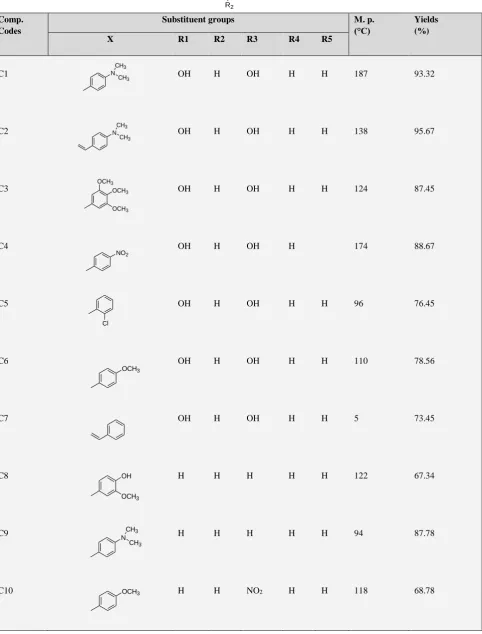
Chalcones are synthesized using various catalysts like ionic liquid resins, clays, non-aqueous cation-exchange resin etc. Herein, we are reporting a simple and easy method for chalcone synthesis by using novel silica gel supported poly amine catalyst. The catalyst was prepared from solution of 3-aminopropyl-trimethoxy silane in dry toluene. The chalcone obtained using this catalyst is having more yields and it can be reusable. The activity of chalcones was found to be better. Structures of different chalcones synthesized are shown in Table 1.
Determination of minimum inhibitory concentration (MIC)
MIC of synthesized chalcone was determined using tube dilution technique against gram positive (S. aureus,B. subtillus) and gram negative bacteria (Klebsiella pneumonia, P. aerugenosa). The turbidity was measured by colorimeter at 620 nm. Colorimetrically, the MIC was found to be 125 μg mL-1.
CH3
O
R1
+ H
O
R2
Polyamine Catalyst
2M NaOH
O
R1 R2
Table 1. Synthesis of chalcones using N,N-dibasic polyamine catalyst
Comp. Codes
Substituent groups M. p.
(°C)
Yields (%)
X R1 R2 R3 R4 R5
C1 OH H OH H H 187 93.32
C2 OH H OH H H 138 95.67
C3 OH H OH H H 124 87.45
C4 OH H OH H 174 88.67
C5 OH H OH H H 96 76.45
C6 OH H OH H H 110 78.56
C7 OH H OH H H 5 73.45
C8 H H H H H 122 67.34
C9 H H H H H 94 87.78
C10 H H NO2 H H 118 68.78
N CH3
CH3
N CH3
CH3
OCH3
OCH3
OCH3
NO2
Cl
OCH3
OH
OCH3
R5
R2
R1 R3
R4
X O
N CH3
CH3
Table 2. MIC Results of C9 compound against gram positive and gram negative bacteria
Sr. No. Concentration, μg mL-1 Transmittance, %
S. aureus K. pneumonia B. subtillus P. aeruginosa
C9a 1000 99 100 97 99
C9b 500 96 99 98 97
C9c 250 95 93 94 95
C9d 125 84 83 91 91
C9e 62.5 27 31 47 51
Table 3. MIC Results of C10 compound against gram positive and gram negative bacteria
Sr. No. Concentration Transmittance
S. aureus K. pneumonia B. subtillus P. aeruginosa
C10a 1000 99 100 98 99
C10b 500 97 99 97 97
C10c 250 95 97 96 93
C10d 125 96 94 93 92
C10e 62.5 28 52 52 54
This concentration was used to study zone of inhibition of synthesized compounds. MIC results of chalcone C9 are shown in Table 2, Figure 1 and MIC results of chalcone C10 are shown in Table 3, Figure 2.
Figure 1. Graph indicating MIC of C9 against gram positive and gram negative bacteria
Figure 2. Graph indicating MIC of C10 against gram positive and gram negative bacteria
The results of MIC confirmed that the chalcone derivatives C9 and C10 showed inhibition growth of gram positive (S. aureus, B. subtillus) and gram negative bacteria (K. pneumonia, P. aerugenosa). MIC of 125μg/ml of testing compound is the concentration used to determine zone of inhibition against various microorganisms.21
Antibacterial activity of novel chalcone compounds
The chalcone are found to be antibacterial in nature. Various food borned pathogens are common agents responsible for various diseases. Several gram negative bacteria are harmful for human beings. The chalcone were used for bacterial growth inhibition. Compounds C9 and C10 are found to be antibacterial and showed a broad range of antibacterial activity. 22
Zone of Inhibition
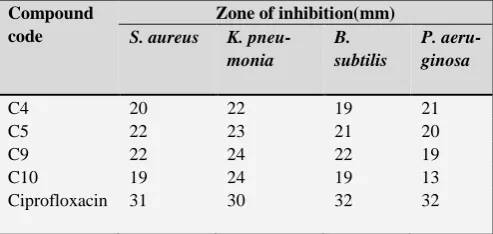
As per MIC results, it was founds that 125 µg/ml concentration is the minimum inhibitory concentration to inhibit further microbial growth. This concentration of compounds were used for the study of zone of inhibition on various microorganism. 100 µg of Ciprofloxacin was taken as standard and DMF were used as control.
Table 4. Zone of inhibition of compounds
Compound code
Zone of inhibition(mm) S. aureus K.
pneu-monia
B. subtilis
P. aeru-ginosa
C4 20 22 19 21
C5 22 23 21 20
C9 22 24 22 19
C10 19 24 19 13
Figure 3. Zone of inhibition of compounds
EXPERIMENTAL SECTION
Melting point of the synthesized compounds were determined in melting point apparatus made by viggo. The IR was monitored in the range of 400-4000 cm-1 IR spectra
of final derivatives were recorded using a Shimadzu FT-IR spectrometer, MASS analyses of synthesized compounds were done on Micromass TOF mass spectrometer, and NMR analysis by VARIAN USA Mercury plus 300 MHz NMR spectrometer.
Preparation of silica gel supported polyamine catalyst
Silica gel supported polyamine catalyst was prepared by known literature processes. Silica gel was synthesized under acidic conditions. To control the population density of hydroxyl groups in the silica gel, it was calcinated at 600°c for 6 hours. Surface fictionalization of the silica gel was carried out by suspending the gel in solution of 3-aminopropyl-trimethoxy silane in dry toluene and refluxed at boiling temperature for 24 hours.23
General procedure for synthesis of chalcones derivatives
The substituted chalcone derivatives were prepared by stirring a mixture of substituted acetophenone (0.01 mol) and aromatic benzaldehyde (0.01 mol) in catalytic amount of polyamine catalystin adequate amount of ethanol for 3-4 hrs in presence of 2M NaOH. The reaction mixture was poured on crushed ice and neutralized with dilute HCl. The precipitated product was filtered and purified by recrystallisation in ethanol.
Spectral data of selected compounds from Table 1.
(2E)-1-(2,4-dihydroxyphenyl)-3-[4-(dimethylamino)-phenyl]prop-2-en-1-one (C1): M.F. C17H17NO3; FT-IR
(KBr): ν=1629.85, 1693.50, 852.54, 852, 1300.02, 1261.45, 3552.88 cm-1, 1HNMR (300 MHz, CDCl
3, δppm):
3.04(6H,s,-N(CH3)2), 6.85(1H,d, α-H), 7.90 (1H,d, β-H),
7.05-7.80(7H,m, H), 9.25(1H,s, OH), 9.20(1H,s, Ar-OH),MS (EI, 70 eV): (M+) 283.32, M+1= 284.10
(2E)-3-[4-(dimethylamino)phenyl]-1-phenylprop-2-en-1-one (C9): M.F. C17H17NO, FT-IR (KBr): γ =1602.85,
1641.42, 819.75, 850.61, 1230.58, 1307.74 cm-1; 1HNMR
(300 MHz, CDCl3, δppm): 7.90 (1H,d, β-H), 6.85(1H,d,αH),
3.05(6H,s, -N(CH3)2), 7.05-7.80(8H,m, Ar-H). MS (EI, 70
eV): (M+) 251.32, M+1= 252.50
CONCLUSIONS
A new methodology for the synthesis of biologically important chalcones using the mixture of aldehydes and acetophenones and novel catalyst silica gel supported polyamine has been developed. The advantages of this catalyst is environmental friendly approach, recycled and reused several times, mild condition, etc. In biological screening C9 and C10 compounds were found to be potential antibacterial against gram positive and gram negative bacteria.
Compounds C9 and C10 were showed better zones of inhibition which confirms their effectiveness against the test microorganisms. These zone of inhibitions were measured in mm scale as shown in Table 4 and the respective graphs were plotted (Figure 3).
ACKNOWLEDGEMENT
Authors are thankful to the Principal Dr. S. S. Khadbadi,
Government College of Pharmacy, Aurangabad and Dr. S. N. Thore, Deogiri College, Aurangabad for encouragement during the process of carrying out this work.
REFERENCES
1Bhat, S. V., Nagaswami, B. A., Sivakumar, M. Chemistry of Natural products; Narosa Publishing House Pvt Ltd page no.585.
2Malikov, V. M., Yuldashev, M. P. Chem. Nat. Compound, 2002, 38, 358.
3Nagao T, Abe F, Kinjo J, Okabe H. Biol. Pharm. Bull. 2002,7,
875.
4aSarda, S. R., Jadhav, W. N., Bhusare, S. R., Wasmatkar, S. K.,
Dake S. A., Pawar, R. P., Int. J. Chem, Tech, Res., 2009, 1(2), 265-269;bSarda, S. R., Jadhav, W. N., Tekale, S. U.,
Jadhav, G. V., Patil, B. R., Suryawanshi, G. S., Pawar, R. P.,
Lett. Org. Chem., 2009, 6(6), 481-484; cSarda, S. R., Jadhav, W. N., Shete, A. S., Dhopte, K. B., Sadawarte, S. M., Gadge, P. J., Pawar, R. P. Synth. Commun., 2010, 40, 2178-2184; dSarda, S. R.,, Mirgane, S. R., Jadhav, W. N., Bhosale, S. V., Domb, A. J., Kharat, K. R., Pawar, R. P.,
Chalcones: The bioactive molecules, “The Biochemistry of Chalcones”, Lap Lambert Academic Publishing AG and CompanyGermany, 2011.
5Detsi, A., Majdalani, M., Kontogiorgis, C. A., Dimitra, H. L.,
Kefalas, P., Bioorg. Med. Chem., 2009,17, 8073-8085.
6Hanson, J. R., Natural Product Reports, 2010, 27, 887–899. 7Yadav, H. L. Gupta, P., Pawar, P. S. Singour, P. K. Patil, U. K., Med. Chem. Res., 2010,19, 1-8.
9Bag, S., Ramar, S., Degani. M. S., Med. Chem. Res., 2009, 18,
309-316.
10Vasilev, R. F., Kancheva, V. D., Fedorova, G. F., Batovska, D. I.,
Trofimov, A. V., Kinet. Catal.,2010,51, 507-515.
11Achanta, G., Modzelewska, A., Feng, L. Khan, S. R., Huang, P., Mol. Pharm.,2006,70, 426-433.
12Motta, L. F., Gaudio, A. C., Takahata, Y., Internet Electronic J. Mol. Design,2006, 5, 555-569.
13Lunardi, F., Guzela, M., Rodrigues, A. T., Corre, R., Eger
-Mangrich, I., Steindel, M., Grisard, E. C., Assreuy, J., Calixto, J. B., Santos. A. R. S., Antimicrob. Agents Chemotherapy,2003,47, 1449-1451
14Hamdi, N., Fischmeister, C., Puerta, P. Valerga. M. C., Med. Chem. Res.,2010,19, 1-16.
15Awasthi, S. K., Mishra, N., Dixit, S. K., Singh, A., Yadav, M.,
Yadav, S. S., Rathaur, S., Am. J. Tropical Med. Hygiene,
2009,80, 764-768.
16Begum, N. A., Roy, N. , Laskar, R. A., Roy, K., Med. Chem. Res.,2010,19, 1-14.
17Kaushik, S., Kumar, N., Drabu, S., Pharm. Res.,2010,3,
257-262.
18Najafian, M., Ebrahim-Habibi, A., Hezareh, N., Yaghmaei, P.,
Parivar, K., Larijani, B., Mol. Biol. Reports,2010,10, 271-274.
19Zarghi, A., Zebardast, T., Hakimion, F., Shirazi, F. H., Rao, P.
N. P., Knaus, E. E., Bioorg. Med. Chem.,2006,14, 7044
-7050.
20Chimenti, F., Fioravanti, R., Bolasco, P. Chimenti, A., Secci, D.,
Rossi, F., Yanez, M., Francisco, O. F., Ortuso, F., Alcaro, S.,
J. Med. Chem.,2009,10, 1-8 .
21Indian pharmacopoeia. New Delhi: Govt. of India, 1996, 2(A),
104-08.
22Ananthnarayan, R., Paniker, J. Textbook of Microbiology; 5th Ed.,
Madras: orient Longman, 1997, 36-44.
23Espinola, J. G. P., Oliveria, S. F., Lemus, W. E. S., Airoldi, A.
G., Moreria, J. C. A., Colloids Surf. A. Physicochem. Eng. Aspects, 2000, 166, 45.