Proceedings of the
12th International Workshop on Graph Transformation
and Visual Modeling Techniques
(GTVMT 2013)
Monitor-Oriented Compensation Programming Through Compensating
Automata
Christian Colombo and Gordon J. Pace
12 pages
Guest Editors: Matthias Tichy, Leila Ribeiro
Managing Editors: Tiziana Margaria, Julia Padberg, Gabriele Taentzer
Monitor-Oriented Compensation Programming Through
Compensating Automata
Christian Colombo1and Gordon J. Pace2
1[email protected]2[email protected]
Dept. of Computer Science, University of Malta, Malta
Abstract: Compensations have been used for decades in areas such as flow man-agement systems, long-lived transactions and more recently in the service-oriented architecture. Since compensations enable the logical reversal of past actions, by their nature they crosscut other programming concerns. Thus, intertwining compen-sations with the rest of the system not only makes programs less well-structured, but also limits the expressivity of compensations due to the tight coupling with the system’s behaviour.
To separate compensation concerns from the normal system behaviour, we pro-pose compensating automata, a graphical specification language dedicated to com-pensation programming. Compensating automata are subsequently employed in a monitor-oriented fashion to program compensations without cluttering the actual system implementation. This approach is shown applicable to a complex case study which existing compensation approaches have difficulty handling.
Keywords:compensations, runtime verification, monitor-oriented programming
1
Introduction
Since compensations enable the logical reversal of past actions and are, by their nature, history-based, while typical recovery is usually programmed statically (e.g., try-catch-block), compensation programming has to be programmed dynamically to take into consideration the current execution path (which is to be reversed). Programming compensations statically is pos-sible but limits their expressivity [LVF10]. On the other hand, programming compensations dynamically using traditional means of code organisation results in unstructured code which has to continuously keep track of the history. A recurring approach for compensation programming [CP12] involves associating compensation blocks to corresponding system blocks in a try-catch-blockfashion which cannot handle complex compensation logic [GFJK03].
A natural way of programming dynamic elements while preserving separation of concerns is runtime verification [BGR07,MJG+12]. The main contribution of this paper is an instantiation of the monitor-oriented programming (MOP) paradigm [MJG+12] for compensation program-ming: monitor-oriented compensation programming (MOCP) (§2) in which compensations are programmed separately from the system, and incorporated within a compensation monitor which listens for relevant system events and programs compensations accordingly. A central aspect of MOCP is the specification language which programs the monitor. Due to the advantages that au-tomata bring to monitoring, namely that monitoring states are directly programmable/visible to the user, we propose compensating automata (§3) — a novel graphical compensation notation. Finally, we show how MOCP can be applied to a sophisticated e-procurement system from the literature (§4) which existing compensation notations have difficulty in handling [GFJK03].
2
Programming Compensations
refund is sent to the customer;(iii)If goods were delivered to the wrong address, the shipment should be returned.
To facilitate programming of compensations we propose a complete separation of concerns with the system not keeping track ofhowandwhatto compensate but simply knowswhen com-pensations are to be triggered. Such a design pattern necessitates a compensation monitor which listens for system activities and programs compensations accordingly. As soon as the system communicates with the compensation monitor that it needs to start compensating, the compen-sation monitor takes over and communicates to the system which (compensating) actions need to be executed. The figure below shows the overall setup with the system communicating events to the compensation monitor and the latter communicating compensations if it receives a signal on thecompensateline.
Compensation
Compensation events
System
compensations
program Monitor compensate
In order to program the compensation monitor, we propose a dedicated formalism which is solely concerned with programming compensations. Based on the literature [CP12], a compen-sating formalism should support two main activities: that of programmatically collating pensations and that of activating them. Collating compensations usually involves installing com-pensations with the possibility of replacing previously installed comcom-pensations. Once compen-sations are activated, the mechanism should allow for an indication that the compencompen-sations have been applied, and that the system can resume execution (and the compensation monitor to revert back to collating compensations). In what follows we informally introduce and motivate the constructs of the proposed compensation notation,compensating automata:
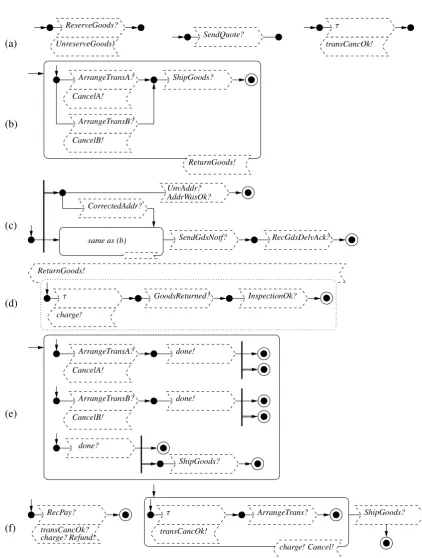
Basic compensation installationsThe formalism should allow actions to be designated as com-pensations for other actions. Subsequently, upon completion of an action, the corresponding compensation is pushed onto a stack. If compensation is invoked, the actions on the stack are executed in the reverse order of their counterparts. In the EPS, this corresponds to a number of ex-amples such as “unreserving” previously reserved goods. This is depicted in Fig.1(a)[left]1where the automaton transitions upon theReserveGoodsevent while installing the compensation Un-reserveGoods. Some activities such as sending a quotation might not have a compensation (e.g.,
Fig.1(a)[middle]). Similarly, we allow automatic installation of compensations with no associ-ated event by annotating the forward arrow withτ(see Fig.1(a)[right]).
Replacing compensationsCompensations may have to be replaced at some point and therefore it should be possible to delimit compensation patterns which upon being matched are replaced by another compensation. For example, as soon as the goods are shipped, then it no longer makes sense to cancel the transport arrangement. Instead, this is replaced by the shipment back of the goods once they reach their destination. Compensation replacement is depicted in Fig.1(b) where an automaton monitoring transport arrangement is scoped so that when the goods are shipped, any accumulated compensations (CancelA orCancelB) are discarded and replaced by theReturnGoods.
1We use the following abbreviations: trans (transport), canc (cancellation), addr (address), unv (unavailable), notf
(a)
ReserveGoods?
UnreserveGoods!
SendQuote?
transCancOk! τ
(b)
ArrangeTransA?
CancelA!
ArrangeTransB?
CancelB!
ShipGoods?
ReturnGoods!
(c)
CorrectedAddr?
same as (b) SendGdsNotf? RecGdsDelvAck? UnvAddr?
AddrWasOk?
(d)
ReturnGoods!
τ
charge!
GoodsReturned? InspectionOk?
(e)
ShipGoods? CancelA!
ArrangeTransB?
CancelB!
done?
done!
done! ArrangeTransA?
(f)
τ ArrangeTrans?
charge! Cancel! transCancOk!
transCancOk? charge? Refund!
RecPay? ShipGoods?
Stopping compensation activationSometimes a business process should not be reversed com-pletely. For example if goods have been shipped, but returned (e.g.,the goods notification re-mains unacknowledged), the system checks whether the reason is a wrong address. If it is the case, the compensation should be temporarily suspended — deviated to another state — until the system attempts to verify the address was correct. If the address was correct then the sys-tem signals the monitor to continue compensating. Otherwise, the syssys-tem should continue by re-attempting shipping to the corrected address while the compensation monitor continues to collate compensations from the “deviated-to” state onwards. A deviation is shown in Fig.1(c) as a bold line with two outgoing arrows: a plain arrow which is taken on the first traversal and a double arrow taken on a deviation.
Compensations having compensationsCompensation actions may have compensations them-selves. For example, while goods are being shipped back (the compensation in the previous point), compensations might still be needed since the process might also fail at some stage. As depicted in Fig.1(d), the ReturnGoods action is expected to give rise to a number of system events including the shipment of the goods back to the supplier and inspecting the goods to en-sure that they are as expected. Note that if inspection fails, then the compensation of the shipment would involve a charge to the customer.
Concurrent communicating compensation handlersTo enable better decomposition of com-pensations, concurrent compensation handlers can synchronise. For example a more efficient way of booking transport is to start the booking process with the two shipping companies and then cancel one as soon as the other is confirmed. Known as speculative choice, this can be encoded by communicating automata as shown in Fig.1(e). Communication can also be used during compensation execution. In our example, the refund operation has to wait for the trans-port cancellation (if this has taken place) so that any fees incurred can be passed on to the user. Fig.1(f) shows the payment and the transport automata where theRefundhas to wait for either chargeortransCancOk(signifying transport cancellation charge and no charge respectively).
Following from this informal introduction, the next section gives the formal syntax and se-mantics of compensating automata.
3
Formalising Compensating Automata
A compensating automaton (CA) is intended to enable the user to program the compensation monitor so that depending on the sequence of system events, compensations are collated and possibly later executed if the system signals compensate. As such a CA should not only be aware of, but also able to affect system activities.
Definition 1 A CA event I is a non-empty subset of activities in an alphabet Σ, I ⊆Σ, and triggers if one of the activitiesi∈I is observed by the monitor. We takeτto be a special event which immediately triggers without external stimulus, and useΣτto denoteΣ∪ {τ}. A CA action Ois a set of monitor-executable activities,O⊆Σ, which are carried out concurrently. CAs can run concurrently and may need to communicate. This is achieved by distinguishing between the set of system activitiesΣS and the set of local activitiesΣL(whereΣS∩ΣL=∅andΣS∪ΣL= Σ).
q0
Event1?
Comp1!
Event2?
q4
τ
Comp3!
Event3?
q3
Comp2!
q5
q1 q2
Figure 2: An example of a compensating automaton
automaton states. For such an event, a transition defines a compensation which should be in-stalled to compensate for it. To enable local communication, transitions can also trigger over local events and can dually trigger local events themselves. Moreover, transitions may some-times specify a third state to support deviation. CAs’ states may be of two types: basic or nested. Nested states support compensation scoping,i.e.,compensations which expire and are thus dis-carded and replaced with a specified compensation. Finally, a compensation in the context of CAs is an action, which may include both system and local activities, and may itself have pro-grammed compensations in terms of CAs.2
Definition 2 A CA is a quintupleA=(Στ,Q,δ,q0,F): an alphabetΣτ, a set of statesQ, a set of transitionsδ, an initial stateq0∈Q, and a set of final statesF⊆Q. We useAto represent the set of CAs andAbfor the set of vectors of CAs. We will use variablesA,A0∈ Ato range over CAs andbA,Ab0∈Abto range over vectors of CAs. Furthermore, Q=B∪N whereNandBrepresent nested states and basic states respectively. q∈N is a tupleA × Cb whereCis the compensation used for replacing the compensations of the nested vector.
A transitiont∈δis a quintuple: a source state, an event-action tuple together with their com-pensation, and a destination state — t∈(Q×2Στ×2ΣL× C ×Q). A deviating transition t0 is a
sextuple consisting of a source state, an event-action tuple together with their compensation, a deviation state, and a destination state —t0∈(Q×2Στ×2ΣL× C ×Q×Q). To simplify the
pre-sentation of the semantics, we represent non-deviating transitions as deviating transitions with blank state◦. Using D=Q∪ {◦}, the set of transitions δis a subset of the Cartesian product (Q×2Στ×2ΣL× C × D ×Q). We will write event(t) and src(t) to respectively refer to the event
and source state of a transitiont. Finally, a compensationc∈ Cis an element of: (2ΣLτ×2Σ×Ab).
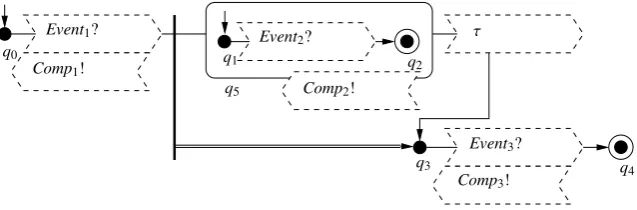
Example1 As an example of a CA we consider Fig.2where stateq5contains a nested
automa-ton with initial stateq1, final stateq2 and a single transition with event Event2, no action, and
no compensation. The parent automaton has three basic states,q0,q3, andq4and a nested state. Furthermore, it has three transitions one of which is a deviation connectingq0to the nested state
andq3as the deviating state. Note that compensation Comp1is installed upon receivingEvent1, Comp2upon completion of the nested automaton, and Comp3upon receivingEvent3.
Since a CA may have nested vectors of automata, its configuration should be
ingly nested by a vector of configurations. Each basic (non-nested) configuration has to keep track of: (i) the automaton and the state it is in; (ii) the execution “direction” — whether it is currently collating compensations (conceptually the system state is progressingforward) or ac-tivating compensations (conceptually the system state is progressingbackwards); and (iii) the collated compensation in terms of a stack, including the installed compensations and deviations. The execution direction is represented byRdef={S,R}, signifying forward and backward execution respectively, while a stackS ∈ Sis a sequence of stack elementsSdef=Stack∗where each element of typeStackcan either be a compensation or a deviation,Stack::=C | D.
Definition 3 A configuration is defined as: BConf::=Basic(A ×Q× R × S)
NConf ::=BConf | Nest(BConf,Conf) Conf ::=Vect(seq NConf)
To abbreviate we dropAwhen clear from the context and use (q,S)rto denoteBasic(A,q,r,S) wherer∈ R(e.g.,ifr=S, (q,S)S is a forward-executing configuration); and (q,S)rcf to denote
Nest(Basic(A,q,r,S),cf). The initial configuration of a vector of CAs is given by theinfunction which starts each automaton from its respective initial state:
in(Ab)
def
=[(q01,[])S
in(q01),(q02,[])Sin(q02),...,(q0n,[])Sin(q0n))]
Note that to handle state nesting we call the infunction overloaded to states: if the state is nested, the configuration of the nested vector of automata is obtained by callinginonce more, otherwiseinreturns an empty configuration.
in(q) def= (
in(Ab0) ifq=(bA0,c)
[] otherwise
A configuration reaches a point where it cannot proceed further when either the automaton has reached a final state during forward execution,i.e.,no further installations can occur, or all the compensations have been activated during backward execution.
Definition 4 A basic configuration cf is said to beterminated, written (cf), if and only if it has reached a final state and it is in forward direction: ((q,S)r)=defq∈F ∧r=S. A basic
configuration cf is said to becompensated, written (cf), if and only if it has an empty stack and it is in backward direction: ((q,S)r)def=S =[] ∧r=R. Nested configurations are neither terminated nor compensated since execution continues with the parent. A vector configuration is said to haveterminatedif all sub-configurations are either terminated or compensated and at least one has terminated3:
([cf1,cf2,...,cfn])
def
=∃i∈1..n· (cfi)∧ ∀j∈1..n· (cfj)∨(cfj)
On the other hand, a vector configuration is said to havecompensated if all sub-configurations have compensated:([cf1,cf2,...,cfn])
def
=∀i∈1..n·(cfi).
Definition 5 The push operation on stacks, denoted s#S, adds an element s onto the top of stackS wheresis either a compensationc∈ Cor a deviationd∈ D:
3The decision to consider a vector configuration as terminated even if only one of the sub-configurations has
c#S def= c:S d#S def= (
S ifd=◦
d:S otherwise
To ensure monitoring remains cheap, CAs should be deterministic.
Definition 6 A CA, (Σ,Q,δ,q0,F), is said to be deterministic if and only if: (i) if a state has an outgoingτtransition, then it may have no other outgoing transitions:
∀t,t0∈δ·(t,t0∧src(t)=src(t0)) =⇒ τ<event(t)
(ii) there are no outgoing transitions with shared labels from the same state:
∀t,t0∈δ·(t,t0∧src(t)=src(t0)) =⇒ event(t)∩event(t0)=∅
(iii) once a final state is reached, no further transitions may be taken:∀t∈δ·src(t)<F.
Furthermore, a CA is said to be well-formed if it contains no loops made up of transitions with labels overΣL∪τ.
3.1 Semantics
We give the semantics of CAs in SOS style [Plo81] in terms of a labelled transition system where states are configurations.
Definition 7 The semantics of a vector of CAs is given by the least transition relation −→x
(with−→ ⊆x Conf×Trace×Conf) satisfying the rules in Fig.3(using++to denote vector concate-nation) where an element ofTraceis either (i) an automaton transition,i.e.,an activity triggering local action inΣτ×2ΣL; (ii) a compensation action, i.e.,a local activity triggering an action in
ΣLτ×2Σ; (iii) a compensate signalwhich switches the automaton from collating to activating compensations; and (iv) a silent transition,τ, representing the rest of the automaton activities. Thus, we defineTraceas:Trace::=Forw(Στ×2ΣL)|Back(ΣLτ×2Σ)||τ.
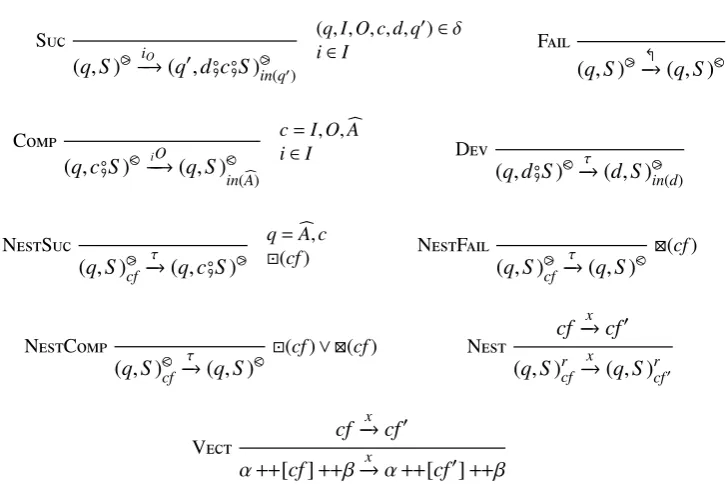
The first rule, Suc, deals with the basic automaton transitions such that if the transition event
triggers, then the action is carried out and the compensation and deviation are pushed onto the stack. If the destination state (q0) is nested, then the corresponding nested initial configuration is given by calling theinfunction. When a CA receives thecompensatesignal, denoted, rule Failturns the execution mode of the automaton from forward to backwards. Once the execution
direction is backwards, if the topmost stack element is a compensation, then rule Comppops it
from the stack and activates it. Recall that each compensation action has an associated (possibly empty) vector of automata as compensation. Thus the resulting configuration is a nested con-figuration including the concon-figuration for the compensation of the compensation. If the topmost stack element is a deviation, then the automaton should stop activating compensations and re-sume collating them. Rule Devdeviates the execution by reverting the configuration direction
from backwards to forwards and sets the deviation state as the new configuration’s state. Since this state may be nested, the resulting configuration is nested.
Upon successful completion of a nested vector of automata,i.e.,its configuration is terminated, rule NestSucis responsible to pass control back to the parent by discarding the corresponding
Suc
(q,S)S−→iO (q0,d #c#S)
S in(q0)
(q,I,O,c,d,q0)∈δ
i∈I Fail
(q,S)S−→ (q,S)R
Comp
(q,c#S)R−−i→O (q,S)R in(Ab)
c=I,O,Ab
i∈I Dev
(q,d#S)R→−τ (d,S)S in(d)
NestSuc (q,S)S
cf
τ
−
→(q,c#S)S
q=Ab,c
(cf) NestFail (q,S)S
cf
τ
−
→(q,S)R (cf)
NestComp (q,S)R
cf
τ
−
→(q,S)R
(cf)∨(cf) Nest
cf→−x cf0
(q,S)rcf →−x (q,S)rcf0
Vect
cf→−x cf0
α++[cf]++β→−x α++[cf0]++β
Figure 3: The semantic rules for compensating automata
backwards. When the parent configuration has a backward direction and the nested configuration is terminated or compensated, rule NestComptriggers and passes control back to the parent so
that the latter continues with its compensation. Whenever a nested configuration is reached, the Nestrule is required to enable nested configurations to progress. Similarly, the Vectrule enables
individual configurations within a vector to progress independently (α,β:seq Conf).
Example2 Referring back to the previous example, upon receivingEvent1, the transition from
q0proceeds toq1through ruleSucwhich pushes the compensation and deviation onto the stack
and invokes thein function on stateq5. More interestingly, upon reachingq2with configuration
(q5,[q3,({τ},{Comp1},[])])S(q
1,[({τ},∅,[])])S, ruleNestSuctriggers and installs compensationComp2
while discarding the nested configuration. This leads to configuration
(q5,[({τ},{Comp2},[]),q3,({τ},{Comp1},[])])S.
An interesting change occurs if the failure event occurs, triggering theFailrule. In this case
the configuration direction turns backwards to(q5,[({τ},{Comp2},[]),q3,({τ},{Comp1},[])])Rand
subsequently ruleCompbegins consuming and triggering the compensations on the stack.
Af-ter triggering compensation Comp2, the resulting topmost stack element is a deviation. This causes rule Dev to trigger and the configuration is turned into forward direction once more:
(q3,[({τ},{Comp1},[])])S.
stan-dard way of checking that a compensation formalism is sane [BHF04], by ensuring that the monitor-triggered compensations are the correct compensation for the actions carried out by the system,i.e.,assuming perfect compensations the outcome of the system behaviour plus the exe-cution of compensations would be logically equivalent to performing no action4; (ii) stability — it is crucial that the monitor does not contain live loops which would result in keeping the sys-tem waiting forever; and (iii) determinism — deterministic monitoring ensures that the monitor produces the same result under equivalent observations. While the proofs for these properties cannot be included here due to space limitations, these have been carried out in full [Col12].
4
Programming with Compensating Automata
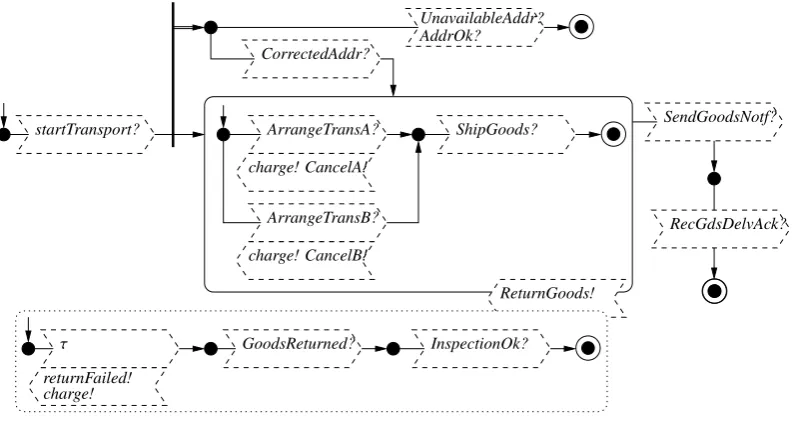
The compensation logic for the EPS has been programmed as a vector of five automata whose monitoring logic applied to the EPS would satisfy all the compensation features as described in [GFJK03]. Here we only present the part of the EPS which deals with transporting the order while giving the full detail in [Col12]. The compensation logic modelled in the compensating automaton shown in Fig.4can be summarised as: (i) if the process fails before the goods have been shipped, then the transport arrangement is simply cancelled; (ii) if the process fails after the goods have been shipped, then the goods are returned (using compensation scoping); (iii) if the return of the goods fails, thenreturnFailedcommunicates with the compensating automaton handling the order so that the action which restores the goods back to stock is discarded (through the compensation of the compensation); (iv) if the return of the goods fails, thencharge! com-municates with the compensating automaton handling the payment (not shown here) so that the customer would still pay for the items (through the compensation of the compensation); and (v) if the failure occurred due to an incorrect address which is later corrected, then the transport is reattempted without affecting the procurement further.
5
Related Work and Conclusion
Compensation concerns often crosscut other programming concerns and thus attempting to pro-gram compensations within the main flow of a propro-gram would clutter the propro-gram and also limit the expressivity of compensation programming. In this paper, we have presented an alterna-tive approach to compensation programming through the use of runtime monitoring techniques — monitoring system activities to instantiate compensations. The contributions of this paper in-clude: (i) an instantiation of the MOP framework to compensations, advocating complete separa-tion of compensasepara-tion concerns; (ii) a compensation programming notation, CAs, which includes a new compensation construct, the deviation, used to redirect compensation; (iii) formalisation of the syntax, semantics, and self-cancellation of these automata; and (iv) programming com-pensations for an EPS — showing CAs to be useful for handling non-trivial compensation logic. Our work is mainly inspired by the MOP framework [MJG+12] which has been proposed as a means of separating programming concerns. In this paper, we have instantiate MOP to compensation programming,i.e.,monitor-oriented compensation programming.
4Note that this definition can be considered at various levels of abstraction. In our case, we assume that the user
AddrOk?
ArrangeTransA?
charge! CancelA!
ArrangeTransB?
charge! CancelB!
ShipGoods?
GoodsReturned? InspectionOk?
returnFailed! charge! startTransport?
ReturnGoods!
τ
SendGoodsNotf?
RecGdsDelvAck? CorrectedAddr?
UnavailableAddr?
Figure 4: The compensating automaton for the transportation aspect of the EPS
Monitoring and steering of loosely coupled systems is not new [ACM+07, BG11] and has been mostly motivated by the need for autonomous adaptation and self-healing in the context of the highly dynamic service-oriented architecture. Our work differs in that while all these approaches support monitor-triggered compensations, they do not separate compensations from other concerns such as exception handling. Our strict separation of concerns allows the use of more dedicated compensation constructs such as the deviation, enabling a fine interplay of normal and compensation execution.
There are numerous formalisations and notations [bpm08,BF04,BHF04,HZWL08,LMMT08] which support compensations including some which are pictorial (e.g., Petri net-based for-malisms [HZWL08], communicating hierarchical transaction-based timed automata (CHTTA) [LMMT08], and BMPN [bpm08]). None of these formalisms are designed to support monitoring-orientation, nor do they support a notion similar todeviation.
A limitation of the current approach is that the system has a single feedback line through which it can signal compensations. This is a limitation when there are several different potential compensations from which the system can choose (for example see [BF04]). In the future we aim to lift this limitation by using monitoring techniques to decide which compensation should be run in the given runtime context.
Bibliography
[ACM+07] D. Ardagna, M. Comuzzi, E. Mussi, B. Pernici, P. Plebani. PAWS: A Framework for Executing Adaptive Web-Service Processes.IEEE Software24:39–46, 2007.
[BF04] M. J. Butler, C. Ferreira. An Operational Semantics for StAC, a Language for Mod-elling Long-Running Business Transactions. In COORDINATION. LNCS 2949, pp. 87–104. 2004.
[BG11] L. Baresi, S. Guinea. Self-Supervising BPEL Processes. Software Engineering, IEEE Transactions on37(2):247 –263, 2011.
[BGR07] H. Barringer, D. Gabbay, D. Rydeheard. From Runtime Verification to Evolvable Systems. InRV. LNCS 4839, pp. 97–110. 2007.
[BHF04] M. J. Butler, C. A. R. Hoare, C. Ferreira. A Trace Semantics for Long-Running Transactions. In25 Years CSP. LNCS 3525, pp. 133–150. 2004.
[bpm08] Business Process Modeling Notation, v1.1. 2008. http://www.bpmn.org/ Documents/BPMN 1-1 Specification.pdf(Last accessed: 2010-02-17).
[Col12] C. Colombo.Runtime Verification and Compensations. PhD thesis, Dept. of Com-puter Science, University of Malta, 2012.
http://staff.um.edu.mt/ data/assets/pdf file/0013/173020/cc phd.pdf
[CP12] C. Colombo, G. Pace. Recovery within Long Running Transactions.ACM Comput-ing Surveys45, 2012. To appear.
[GFJK03] P. Greenfield, A. Fekete, J. Jang, D. Kuo. Compensation is Not Enough. InEDOC. Pp. 232–239. 2003.
[HZWL08] Y. He, L. Zhao, Z. Wu, F. Li. Formal Modeling of Transaction Behavior in WS-BPEL. InCSSE. Pp. 490–494. 2008.
[LMMT08] R. Lanotte, A. Maggiolo-Schettini, P. Milazzo, A. Troina. Design and verification of long-running transactions in a timed framework.Sci. Comput. Program.73:76–94, 2008.
[LVF10] I. Lanese, C. Vaz, C. Ferreira. On the Expressive Power of Primitives for Compen-sation Handling. InESOP. LNCS 6012, pp. 366–386. 2010.
[MJG+12] P. O. Meredith, D. Jin, D. Griffith, F. Chen, G. Ros¸u. An Overview of the MOP Runtime Verification Framework.STTT 14:249–289, 2012.
[Plo81] G. Plotkin. A structural approach to operational semantics. Technical report, Dept. of Computer Science, Aarchus University, Denmark, 1981. DAIMI FM-19.