Designing an English Course Book for High
School Students Based on 2013 Curriculum with
Local Content Materials
Hasmiati
Universitas Negeri Makassar, Indonesia
Arifuddin Hamra
Universitas Negeri Makassar, Indonesia
Haryanto Atmowardoyo Universitas Negeri Makassar, Indonesia
Syarifuddin Dollah
Universitas Negeri Makassar, Indonesia
Abstract—This study investigates English course book for Senior High School Students based on 2013 Curriculum in order to obtain the 2013 English curriculum objectives. The researchers carried out a research and development method by applying designing the appropriate English course book to be used for the students of Senior High School to improve their English proficiency. The respondents of this study were the tenth grade students of SMA Negeri 1 Sungguminasa Kabupaten Gowa and the English teachers of the school. The instrument of this research was a questionnaire. This questionnaire was designed for need analysis to measure the students’ self perception, prior knowledge of the content of the basic competence of the tenth grade students, and their expectations in learning English and to determine the English course book materials in case of the quality, content, design, strategy use, and the attractiveness of the teaching materials. The results show that the existing an English course materials were far from the competency target curriculum because they do not agree with the English course materials, and they did not meet the students’ need which was based on the content standard of the school curriculum.
Index Terms—designing, English course book, High School students, 2013 curriculum, local content materials
I. INTRODUCTION
Teachers, students, and textbooks/course books are among the main elements of foreign or second language classrooms. In general, schoolbooks/course books signify the unseen syllabus of the linguistic lessons in a definite package of curriculum. Though linguistic course books are broadly used all over the world, they are often evaluated because of exposing irregularities between “learning aspects’ and ‘profitable parts”. The exploration for economic income, community approval, assortment preference and suitability for teaching space use are subjects of tension in seeing ELT course books (Sheldon, 1988). As a consequence of this condition, it is significant to choose on which linguistic course books are greatest valuable for learners in certain situations.
Based on the observation in the school where this research will be conducted, most of the students have low English proficiency which comes from various aspects. One of the aspects is the use of English course book which is not fully relevant to the student’s need. Most of the teachers implement English course books which are provided by the government although the books do not match with the school curriculum. So, the researcher assumes that the English course books may contribute the main cause of the low English proficiency of the students. Therefore, this research plans to design an English course book to improve the students’ English proficiency.
This study will design an effective English course book for the first grade of Senior High School based on 2013 curriculum that is expected will improve the students’ English proficiency. The English course book is hoped will provide teachers and learners with the arrangement of professionally developed materials, allowing teachers to spend their valuable time more on facilitating learning materials. It is hoped that the English course book can b e used flexibly and can be adapted and supplemented to meet the needs of specific classes.
Dialogues around the benefits and weaknesses of teacher-designed resources frequently focus on a judgment by using course books. An important advantage of teacher-produced materials is contextualization (Howard and Major, 2003). A main disapproval of profitable resources, mainly those made for the world-wide EFL market is that they are essentially basic and not intended at any definite group of students or any certain social or scholastic setting. For many educators, designing or adapting their own instruction resources, allows them to take into account their certain education setting and to overcome the lack of ‘fit’ of the course book.
In designing an English course book, the researcher will create choices around the greatest suitable organizing value or emphasis for the resources and activities. Then this can be altered over the course of the programme if essential. Most course books continue organized about language rules features and the PPP (presentation, practice, production) model of instruction, frequently with an “unrelenting arrangement” which can be “intensely unengaging” (Harmer, 2001 in Howard and Major, 2003). Through taking additional control over resources construction, the researcher can select from the variety of potentials, including themes, conditions, ideas, purposes, competences etc, or a combination of these values, as first points to improve an English course book that focus on the developing needs of her particular group of learners.
Based on the previous description, this research intends to design an English Course Book for High School Students based on 2013 Curriculum with local content materials for the purpose of the students learning English effectively so that they have good English language skills in accordance with the 2 013 Curriculum. This study will analyze the existing students’ English proficiency and English course books, the 2013 curriculum, what the students’ want, what the students’ lack, and what the students wish to learn.
A. Problem Statement
This study wants to develop English course Book for Senior High School students based on 2013 curriculum in order to obtain the 2013 English curriculum objectives. Considering the previous description, the main research problem is designing the appropriate English course book to be used for the students of Senior High School to improve their English proficiency. Therefore, the research question is “What kind of English course book is effective to improve the students’ English achievement?”
B. Objective of the Research
In relation to the problem statement and the research questions above this research is aimed at finding out an effective English course book to improve the students’ English achievement.
C. Significance of the Research
The result of the research is expected to be useful information for educators especially English teachers in providing English course books as resources to teaching learning process. So, the English course book that has been developed is expected to give more useful contribution to the improvement of English classroom interaction as an effort to improve the competence and performance of the students in learning English at Senior High School. It is hoped by reading the result of this research English teachers can make learning activities more informative, interesting, and relevant for Senior High School students based on 2013 Curriculum. In addition, this study will produce suitable an English course book based on 2013 curriculum with local content materials which meets the students’ need in the learning process.
D. Scope of the Research
This research is under the umbrella of applied linguistics and focuses on the English course book development. This research designed an English course book for Senior High School students based on 2013 curriculum with local content materials. English competencies in the syllabus of 2013 curriculum was analyzed and become a basic consideration in designing an English course book for Senior High School students with local content materials.
Some Previous Related Research Studies
In 1987, Coleman carried out an ethnographic study at Universitas Hasanuddin in Makassar, South Sulawesi (Coleman 1987, 1996a). In a three-year longitudinal study, Coleman observed various English classes consisting of 20 to 110 students, and came to the conclusion that in English classes students did not, and were not expected to fully participate in the classroom activity. In an attempt to improve the participation of the students in the classroom, an experiment was conducted at the same university, and “attempted ... to put all the participants – lecturers and students – into a type of event which could no longer be perceived as a ‘lesson’” (Coleman, 1996a: 80-81). In this pilot project, classes were divided into smaller groups (of about 40 students) and every teacher was allocated a student’s textbook and a teacher’s textbook, while every student was asked to use the student’s textbook, called “Risking Fun”. They were then assigned a class to teach using the “Risking Fun” which had clear instructions and procedural guidelines for every single activity.
guidance.
Another ethnographic study was carried out by Saleh (1994) in IKIP (Institute of Teacher Training) Semarang, Central Java. He observed classes for a semester and interviewed thirteen teachers at the English language Department to study their content selection and use of methods. With regard to material selection, he found that teachers selected their course materials in accordance with the curriculum, and with some consideration of the students’ readiness for learning. He concluded that this selection process was generally guided by the teachers’ beliefs: beliefs about the structure and the function of the curriculum, about the students’ needs and capacity, their beliefs about teaching and learning theories, their beliefs about the classroom as well as the social context of the students’ learning, and their beliefs about teachers’ roles.
A study of Javanese SMU (Senior High School) learning styles, and autonomous learning, was conducted by Whachida (2001). This researcher claims that she used an ethnographic approach rather than an experimental design. The problem is, can conditions like planning one’s own learning programs and choosing materials be fulfilled considering that the syllabi and course books, for instance, are dictated by the government and teachers and students still view teachers as the one who has the authority to make decisions at the action level? As Wachidah (p. 2001: 297) points out, “SMU learners generally have ... little experience in conducting learning autonomy, and I believe that they do not yet have the capacity to make autonomous decisions at the action level (i.e., to determine the steps or procedures to accomplish a task).”
Some Pertinent ideas
English is only a foreign language in Indonesia, whereas the Indonesian language is the national, official language of Indonesia and, at the same time, the lingua franca among speakers of different mother tongues. As the first foreign language in Indonesia, English has been made a compulsory subject from SLTP up to university level in the country, and has even been extended during the last few years to a number of primary schools in capital cities. However, this requirement for study alone does not seem to strongly motivate Indonesian students to learn it. As Kartasasmita (1997) claims, we cannot expect Indonesian students in general to be motivated to study English simply because it is mandatory. He argues that this is particularly the case because “despite the fact that English has such an important role in society, we can observe that, for high school graduates to enter higher education in Indonesia, their English competence is not a determining factor” (Kartasasmita, p. 1997: 19-20). If English is unlikely to be used in real communication by Indonesian students nor is it a gatekeeper for Indonesian higher education, it is very likely that they will not make significant efforts to learn it.
In one of the few course books on foreign language learning that discuss both foreign learning and second language acquisition, VanPatten and Lee (1990) put an emphasis on foreign language learning, rather than foreign language teaching. In one chapter of this book, VanPatten (1990) argues that current theories and hypotheses in foreign language (FL) teaching are based on the ones developed by SLA specialists due to the lack of research in FL learning. In other words, he suggests that there is a need to increase research in the field of FL learning to contribute theories to FL teaching which remains the “consumer” (VanPatten, p. 1990: 18) rather than a contributor to SLA theory enrichment. This implies that, on one hand, there is a relationship between SL and FL learning and teaching, but on the other, they describe two different phenomena, and therefore cannot be used interchangeably. Gass (1990) points out that as far as research findings are concerned, there has not been a clear separation between the contexts of FL and SL. She believes that the differences made between them are mainly caused by different programs and teacher training, rather than the obvious difference between the contexts of the two.
In relation to English Language Teaching, it is naive to accept that what is applicable in the ESL context is also applicable in the EFL one. In an EFL classroom, students and the teacher are likely to come from similar linguistic and cultural backgrounds (Tickoo, 1995). Therefore, both EFL students and teachers have similar expectations and perceptions, for instance, of the way to behave and participate appropriately in the classroom. Having a similar linguistic background, students usually communicate using a language other than English (Tickoo, 1995). This certainly reduces their opportunity to use the language for real communication. In addition, EFL students may never encounter actual English use outside the classroom. Consequently, they may not see the direct relevance of learning English to their needs.
II. METHOD
The main objective of this research is to design an English course book for Senior High School students grade 10 based on 2013 curriculum. The designing of the English course book will be based on the core competencies of 2013 curriculum. The core competencies of the 2013 curriculum will be focused on the first grade Senior High School’s competencies. Since this research is a developmental research, the general stages will be ordered into five phases: analysis, design, development, implementation, and evaluation (Gustafson, 1981).
study.
This study used questionnaires (students’ need analysis questionnaire and questionnaire for the English teachers). The questionnaire for need analysis will be conducted to measure the students’ self perception, prior knowledge of the content of the basic competence of the tenth grade students, and their expectations in learning English. The teachers’ questionnaire will be given to determine the English course book materials in case of the quality, content, design, strategy use, and the attractiveness of the teaching materials. The questionnaire will also explore the extent of motivation, conceptual knowledge, and the learning interactions to improve the English skills. In addition, the questionnaire will measure the attractiveness of the teaching materials, the teacher involvement, providing reinforcement, evaluation, and learning in the real world. The questionnaires will be administered to teachers and students to measure the aspects of acceptability, feasibility, and affectivity.
The data analysis will be conducted by applying qualitative and quantitative. The data as a result of questionnaires and tests will be analyzed quantitatively and the data as a result of the observation, document, and interview will be analyzed qualitatively.
III. RESULTS
Many research activities were conducted to answer the research questions of the study. As noted in chapter two, the purpose of this research is to design an English course book with local content materials for Senior High School students based on 2013 curriculum, and the writing design was based on the process of writing a course book developed by Jolly and Bolitho in Tomlinson (1998) and the ADDIE procedures by identifying the existing problem, conducting the analysis of instrument, conducting survey of students’ need.
Identifying the existing an English course book materials
In the preliminary step this study is to find out what English competences are covered in English syllabus of 2013 curriculum, what kind of English course book is effective to improve the students’ English achievement, what is the students’ perception toward designed English course book, and what is the teachers’ perception toward designed English course book.
The English teachers choose the commercial books because they are completed with syllabus, lesson plans; so they do not necessarily design syllabus and lesson plans by themselves, and they are easy to get because of the kindness and help of the publishers; they do not use the required books published by the government. In reality, most of the students do not get the target of the school curriculum; they are not able to speak English well, to listen to the English news or English movies, to read English text books, and write even English simple sentences/paragraph well. The commercial books lack of contextualization, the local contents are not presented appropriately.
The result of the need analysis in terms of an English course book materials used by the teachers. Some existing problems faced by the teacher were identified through questionnaire. Based on the questionnaire, from 3 teachers in SMA Negeri 1 Sungguminasa Kab. Gowa indicated that the existing an English course materials were far from the competency target curriculum because they do not agree with the English course materials, and they did not meet the students’ need which was based on the content standard of the school curriculum.
Some respondents stated that the vocabularies were too high for the students and this could affect the students’ motivation to learn. Besides, some teachers gave their opinion that there was unsynchronized between the target curriculum and students comprehension. In other words, some materials on the existing course books do not meet which the students need. The students studied unnecessary teaching items more often than the compulsory subjects.
The result of the teachers’ questionnaire toward the existing course book
The result on the teachers’ questionnaire consists of curriculum compatibility, concept validity, concept organization, samples used, and evaluation materials. Need analysis finding: teachers’ questionnaire toward the existing English course book in SMA Negeri 1 SungguminasaKab. Gowa.
Curriculum compatibility of the existing book is still not appropriate enough with 2013 curriculum, all the teachers responds the curriculum compatibility has not appropriate with 2013 curriculum. The materials of the book do not cover all the standard competencies and the core competencies which are stated in 2013 curriculum.
Figure 1: The result of need analysis in SMA Negeri 1 SungguminasaKab. Gowa.
Concept organization of the existing book is still not appropriate enough with 2013 curriculum, all the teachers responds the concept organization has not appropriate with 2013 curriculum. The concept of the book is not presented based on the relationship between concept structure in English and the concept is not set up with the concept which becomes the base to comprehend the next concept. In other words the concept organization is not presented systematically.
Samples used of the existing book is still not appropriate enough with 2013 curriculum, all the teachers responds the samples used has not appropriate with 2013 curriculum. The samples represented are not relevant with the concept that had been explained so the samples used do not explain the concept presented and the samples are not real with the students’ life. At last the samples presented can be comprehended by the students easily. In other words, the samples are not interested for the students and do not motivate them.
Evaluation materials of the existing book are quite enough refers to teaching goals/competencies determined and are quite enough refers to the concept that has been studied. The evaluation materials are sufficient in considering cognitive, affective, and psychomotor domain and are sufficient in considering the level of difficulties. However, the valuation materials cannot comprehended easily by the students although by answering the questions and doing the exercises, the process of learning take places.
Figure 2: The result analysis of students in SMA Negeri 1 Sungguminasa Kab. Gowa.
Analysis of the validity and reliability of instruments
In analyzing the data, instrument should present the validity and reliability. There are two aspects of instrument of this research, namely (1) the validity and reliability testing and (2) the instrument assessment by the experts in their fields. Validity testing of this research instruments were conducted by applying out a questionnaire to 3 teachers and 120 students at SMA Negeri 1 SungguminasaKab. Gowa. The validity test used SPSS statistical program version 15.0 for windows with Pearson product Moment Correlation technique to correlate the scores on each item with the total score of questionnaire items. Based in the result of the instrument analysis, the students’ and the teachers’ perspective about the instructional materials were delivered to know the coefficient of Pearson product moment correlation were then compared to the value of r table at 5% significance level and degree of freedom (df) = n-2. Value r-count > r-table shows that items of questionnaire were valid, if the value r count < r table the item of questionnaires were invalid, the value of r table for 123 respondents are the 5% significant level is 0,514. The validity testing in this research was done by calculating the reliability coefficient of Cronbach Alfa using SPSS 15 for windows as follows:
1. All the items of the questionnaire are valid based on the t-test with two tailed, and reliability according to Cronbach’s Alpha based on standardized items is 0.95.
Expert’s validation of the instruments and dissertation product
The instruments used in this study and the dissertation product have been validated by two experts in their fields before administering the instruments. The improvements on the instrument and the product of the research had been done, and they were ready to use.
The result of design
In the teaching and learning process, an English course book design should be considered. This present study applied the Model of Teaching English (MTE) presented by (Syatriana and Hamra, 2011), as in figure 5. The purpose of this teaching model is to get good oral and written English performance and competence. It considers the learning environment: the teachers and students.
Figure 3. Model of Teaching English (Syatriana&Hamra, 2011)
Here are some strategies used in the newly designed course books (new course book: Listen and Practice) relating to PPP Procedure.
1. Presentation (meaningful, memorable, and realistic examples, clear models, briefness), with various activities (Look, say, observe carefully)
This strategy asks the learners to see, say and observe the teaching materials are presented. The teacher gives an explanation as needed so that the learners can understand so that they can practice the skills that the teaching materials.
2. Practice (attractive to generate motivation, within the students’ reach) with various activities as follows: a. Matching
In implementing this strategy learners were asked to match a variety of ways, for example between the word with the object.
b. Completing
In learning, learners are asked to complete a sentence or an incomplete picture by providing/not providing complementary
c. Ask and answer
In a pairing of learners asked questions and answers based on the training provided by teachers. d. Oral Work
The learners were asked to practice the exercises orally prepared in the learning material. Learners carry out an audible command or as instructed by the teacher or other students in working groups.
e. Pattern drill
The learners were asked to practice answering questions orally and in writing from the description or simple writing. 3. Production (situational role play, debates, discussions, problem solving, narratives, descriptions, quizzes and games.
a. Role playing
This activity provides opportunities for learners to play a role in group. b. Debates
In this activity the learners are given the opportunity to argue in accordance with situational phenomenon that is happening in society.
c. Discussion
Learners are given the opportunity to discuss about the only thing that needs clarification or discussion. d. Problem solving
Learners are involved in a variety of problem-solving activities of a particular case that exists in the community. e. Narratives
In these activities the learners describe something in English, both written and spoken well. g. Quizzes and games
Learners are involved in interesting quizzes and games in accordance with the ability and skill levels of learners.
The result of development
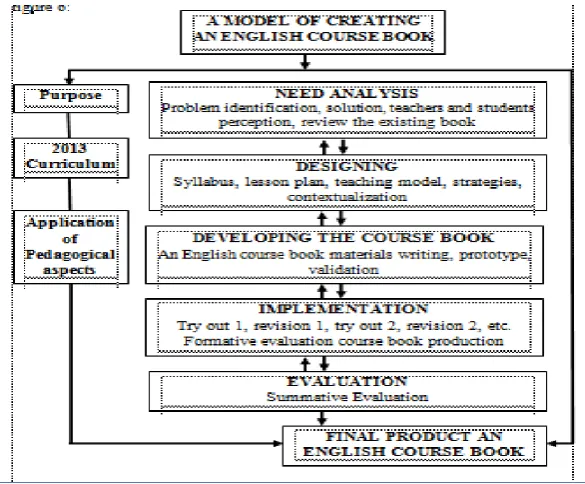
Since this study is developmental, deep discussion on creating a model of creating an English course book was administered among the English teachers in the need analysis step of the study relating to the purpose of writing an English course book based on 2013 curriculum and the application of pedagogical aspects.
The English course book material development based on 2013 curriculum is based on the components from ADDIE model, Dick and Carey, IDLS model, and Jolly and Bolitho in Tomlinson (1998). The main procedure is based in ADDIE model and some details of developing an English course book materials are based on IDLS and Jolly and Bolitho, and 2013 curriculum as in figure 4:
Figure 4: An English Course Book Material Development Based on 2013 Curriculum
IV. DISCUSSIONS
The findings of this study suggest that the failure of EFL teaching and learning in rural Indonesia is due to the complex interplay of a number of issues, including the following:
a. Cultural values, i.e. the value of harmonious relationships in a feudal community, b. Sociolinguistic situation, i.e. the status and function of English,
c. Material conditions, and
d. Methodology, i.e. teachers’ teaching practices.
Learning materials play an important role in teaching and learning activities in the classrooms. Learning materials are often the most substantial and observable component of pedagogy. They determine the quality of language input and the language practice during the learning process in the classroom. The select of linguistic instruction resources can decide the value of learning-teaching practice. As a part of the resources used in the linguistic teaching space, the textbook can frequently play a vital part in learners ‘achievement or failure.
Designing instruction resources is not an easy work. The difficulties which are confronted by those who are accountable for the instruction and learning are complex, in this case the teaching-learning of English. It requests thoughts to encounter desires, needs, and lacks. These thoughts are frequently enclosed what is named needs analysis. Needs analysis include quires with who, why, where, and when. The first two main significant queries are those with who and why while others just follow them. One needs analysis in order that he can work in line with the desires, needs, and lacks elaborate so that he can attain the intentional purposes.
Course resources form an significant portion of greatest English teaching programmes. From textbooks, videotapes and images to the Internet, instructors trust deeply on a varied variety of resources to support their instruction and their learners’ learning. But, in spite of the recent rich array of English language teaching resources commercially obtainable, numerous instructors remain to create their own resources for teaching space use. Certainly, most instructors use considerable period discovery, choosing, assessing, adapting and creating resources to use in their instruction.
their certain learning setting and to overcome the shortage of ‘fit’ of the course book.
In conclusion, the benefits of teacher-designed resources can be summed up in the notion that they dodge the ‘one-size-fits-all’ method of most commercial resources.
The selection of linguistic instruction resources can decide the value of learning-teaching practice. As a part of the resources used in the linguistic teaching space, the textbook can frequently play a vital part in learners’ achievement or failure. In a practical /communicative practice the important part of the resources is to stimulate learners’ understanding, negotiation and expression under communicating conditions. As each learner has his/her own learning degree and style, the resources should not limit learners’ linguistic learning course by specifying definite stages and the organization of the content would offer chances for self-study and assessment.
Designing teaching materials needs reflections to encounter desires, needs, and lacks. These reflections are frequently enclosed what is named needs analysis. Needs analysis involves questions with who, why, where, and when. This should disclose learning desires with regard to English linguistic skills in listening, speaking, reading, writing, vocabulary understanding and syntax; as well as single learner’s learning inclinations. It is not just learning desires that are related to the instructor as resources designer, but, similarly significant is information about learners ‘understandings (life and educational), their first language and stages of literateness in it, their goals, their interests and their purposes for learning English.
Textbooks are intended for universal courses ‘to be used worldwide’ or they are set according to definite requests in a country. The key matter in choosing textbooks is to examine for the suitability of the textbook in a certain instruction setting. It is problematic to discover a faultless book which is appropriate for a certain group of students, however the goal is to examine for the correct kind of book that fits into the recent instruction condition better than other resources.
Designing teaching materials needs considerations to meet needs, wants, and lacks. These considerations are usually covered what is called needs analysis. It is hoped that by conducting a need analysis, a good thoughtful of the notion of learning resources will be gained.
V. CONCLUSION
After developing an English course book for Senior High School students based on 2013 curriculum with local contents, the researchers concludes that the appearance of the English course book is quite interesting, the guidance of the book is easy enough to be comprehended by the students and the content framework can help the students to understand the materials presented in the course books.
The keywords of the English course book can help the students to comprehend the materials of the books; the language used is quite easy to be understood by the students and the use of pictures is sufficient to help the students to comprehend the materials.
Example given in the English course books is sufficient to help the students to comprehend the materials and the conclusions can help the students to understand the materials. The exercises of the course books are sufficient to help the students to understand the materials and the key answers are sufficient to help the students to study independently.
The reference sources of the English book is adequately help the students to study the materials and the practical work procedure is quite enough to be comprehended by the students, so the students have moderate self-confidence in studying the materials of the English course book.
The results of this study provide a starting point to course designers, especially English for ten grade students of senior high school, into what kind of materials that should be implemented in the classroom. The findings also give nuance that before starting an instructional process; the teachers should analyze the students’ needs. However, the findings possess limitation since they only provide information about the needs from the students’ point of view. The results provide no information about the needs based on the teacher’ points of view. Therefore, further research is needed to cover the information about the learning need based on the teachers’ point of view.
REFERENCES
[1] Ampa, A.T. (2013). Developing Multimedia Learning Materials for Speaking Skills Based on Contextual Teaching and Learning. Unpublished Dissertation. Postgraduate Program. State University of Makassar.
[2] Carlson, Cristine. (2008). Alternative Learning Materials in the Subject of English – an Investigation among Pupils in Secondary School. Online http: www. dspace.mah.se/.../Christine's%20Dissertation.pdf. Accessed in April 26th 2014. [3] Carter, Ronald &Nunan, David.( 2001). The Cambridge Guide to Teaching English to Speakers of Other Languages.
Cambridge: Cambridge University Press.
[4] Coleman, H. (1987). “Teaching Spectacles and Learning Festivals”. ELT Journal, 41/2: 97-103. [5] Coleman, H. (1996b). Society and the Language Classroom. Cambridge: Cambridge University Press. [6] Ellis, A. K. (2004). Exemplars of Curriculum Theory. Larchmont, NY: Eye on Education.
[7] Ena, Ouda. (2013). Visual Analysis of E-Textbooks for Senior High School in Indonesia. Ph. D. Thesis, Chicago: Loyola University Chicago.
[8] Farrell, Joseph. P. (2003). Textbooks. Encyclopaedia of Education. South Dacota: Feral House.
[10] Goldsmith, L.T. and Mark, J. (1999). What is A Standards-Based Mathematics Curriculum? Educational Leadership, 57, 3, Pp. 40–45.
[11] Hargreaves, A. (1995). Changing Teachers, Changing Times. London: Cassell.
[12] Howard, J and Major, J.( 2003). Guidelines for Designing Effective English Language Teaching Materials. Online. http://www.paaljapan.org/resources/proceedings/PAAL9/pdf/Howard.pdf. (Accessed 24/4/ 2014.
[13] Kartasasmita. (1997). “Teaching English to ITB Undergraduates: Observation and Suggestions”. In H. Coleman, T. Soedradjat, and G. Westaway (Eds.), Teaching English to University, Undergraduates in Indonesian context: Issues and Development, 19-24. Bandung: ITB Press and Research in Development Education, School of Education, University of Leeds, GB.
[14] Ladson-Billings, G. (2009a). Race Still Matters: Critical Race Theory in Education. In M.W. Apple, W. Au & L. A. Gandin (Eds.), The Routledge International Handbook of Critical Education (pp.96-122). Hoboken: Routledge.
[15] Ladson-Billings, G. (2009b). The Dream Keepers: Successful Teachers of African American Children. San Fransisco: Jossey Bass.
[16] Litz, D. R.A. (2005). Textbook Evaluation and ELT Management: A South Korea Case Study. Asian EFL Journal, no volume and page numbers given. Retrieved from http://www.asian-efl-journal.com/Litz_thesis.pdf. (accessed 28/4/2014).
[17] Mares, C. (2003). Writing a Course Book. In B. Tomlinson (Ed), Developing Materials for Language Teaching (pp.130-140). London: Continuum.
[18] Marsh, Colin J. (2004). Key Concepts for Understanding Curriculum. New York: RoutledgeFalmer.
[19] Masuhara, H. & Tomlinson, B. (2008). Materials for General English. In B.Tomlinson (Ed), English Teaching Materials: A Critical Review (pp. 17-37). London: Continuum.
[20] Mistar, J. (2005). Teaching English as A Foreign Language (TEFL) in Indonesia. In G. Braine (Ed.), Teaching English to the world: History, curriculum, and practice (pp. 75-85). Mahwah, NJ: Lawrence Erlbaum Associates, Inc.
[21] Musthafa, Bachrudin. (2010). Teaching English to Young Learners in Indonesia: Essential Requirements. Educationist Vol. IV
No. 2. July 2010.
Online.http://file.upi.edu/Direktori/Jurnal/Educationist/Vol._IV_No._2-Juli_2010/07_Bachrudin_Musthafa.pdf.(accessed 24/4/ 2014).
[22] Nurcahyoko, K. (2013). Curriculum 2013: The Next Oasis or Mirage? The Jakarta Post: online available at http://www.thejakartapost.com/news/2013/07/20/curriculum.2013-the-next-oasis-or-mirage.html. (accessed 27/4/2014). [23] Pasassung, Nikolaus. (2003). Teaching English in An "Acquisition-Poor Environment": An Ethnographic Example of A
Remote Indonesian EFL Classroom. Unpublished Doctoral Dissertation. University of Sydney.
[24] Ratna. (2013). Developing English for Specific Purpose (ESP) Course for Tour and Travel Students Based on Needs Analysis. Unpublished Doctoral Dissertation. State University of Makassar.
[25] Ratna. (2003). Developing Speaking Activities. From Theory to Practice.
Availableat:http://www.professorjackrichards.com/pdfs/developing-lassroom-speaking-(accessed 26/4/2014).
[26] Richards, C. J. & Rodgers, T. S. (2001). Approaches and Methods in Language Teaching. Cambridge: Cambridge University Press.
[27] Sheldon, L.(1988). ELT Textbook and Materials: Problems in Evaluation and Development. Oxford: Modern English Publications.
[28] Sukarno. (2008). Teaching English to Young Learners and Factors to Consider in Designing the Materials. Jurnal Ekonomi& Pendidikan (pp. 1 -17), Volume 5 Nomor 1, April 2008.
[29] Syatriana, Eny.(2013). Designing English Instructional Materials for EFL Senior High SchoolStudents Based on School Curriculum. Unpublished Doctoral Dissertation. State University of Makassar.
[30] Tomlinson, B. (1998). Glossary of Basic Terms for Material Development in Language Teaching and Introduction. In B. Tomlinson, (Ed.). Materials Development in Language Teaching. Cambridge: Cambridge University Press.
[31] Tomlinson, B. (Ed.).(2003). Developing Materials for Language Teaching. London: Continuum.
[32] Tomlinson, B. (Ed.). (2008). English Language Learning Materials: A Critical Review. London: Continuum.
[33] Widarsa, A.N. (2013). New 2013 Curriculum for New School Year in Indonesia.
Online.available.at.http://www.globalindonesianvoices.com/8813/new-2013-curriculum-for-new-school-year-in-indonesia.(accessed 27/4/2014).
Hasmiati, a teacher at SMAN 1 Sungguminasa was born on June 1, 1968 in Cabbenge district of Soppeng, South Sulawesi Province.
Her formal education started from Elementary School and finished in 1980, Junior High School in 1983, and Senior High School in 1986. In the same year, she was accepted as a student of English Department at the faculty of languages and Arts of Instit utes of Teacher Training and Education (IKIP) Ujung Pandang for D3 program and graduated in 1989. She was directly be promoted as a teacher on February 1993. In 1998 she continued S1degree in English Education Department at State University of Makassar (UNM) and graduated in 2000, S2 degree in English Education Department at State University of Makassar (UNM) and graduated in 2003.
Arifuddin Hamra, a professor at the Faculty of Language and Arts of State University at Makassar (UNM), was born at Bulukumba on Mei 1, 1947. He got Bachelor of Art (BA) in 1973 and Undergraduate Degree (Drs) in English Education at FKSS of IKIP Makassar (now FBS of UNM). Master of Science Education (M.S.Ed.) at State University of New York America Serikat in 1986, doctor Degree (Dr) in Linguistics in 2006.
He also researcher with various research, Penelitian Fundamental in 2006 and 2007, Hibah bersaing in 2008 and 2009, Penelitia n Hibah Kompetensi 2010 from DP2M Dikti, Penelitian Hibah from IMHERE 2009,PTK from Balitbang Diknas and other researches from routine fund of UNM
Haryanto Atmowardoyo, a professor of English Education at English Department of State University of Makassar. He was born in Purbalingga, Central Java on October 29, 1959. He completed his Elementary education in SD Galuh, Purbalingga in 1971; Junior High school at SMP Borroneus Purbalingga in 1974; and Senior High school at SMA Negeri Purbalingga 1977. Then he completed S1 degree in English Education at IKIP Malang in 1994; and S degree (doctor) in English Education at IKIP Jakarta in 1999. From September 2009 to January 2010, haryanto Atmowardoyo participated in academic Recharging Program in OHIO State University, Columbus, OHIO, USA.
He has published several books : Isu Pendidikan dan Pengajaran Bahasa (2001), published by State University of Makassar Press; dasar-dasar Penulisan Proposal penelitian (20080), a collaborative work with Sukandarrumidi, of Gajah mada University, published by gajah Mada Press (2008); and Metodology Penelitian Kualitatif; Teori Dasar (2008) published by State University of Makassar press.
Some articles have also been published either in newspaper, in on line journal, or in printed scientific journals; cara Mudah Belajar bahasa Inggris, Lokalisasi Pengajaran bahasa Inggris; Fisibilitaqs Lokalisasi Pengajaran bahasa Inggris; and perlukah Revolusi Pengajaran Bahasa Inggris published in fajar and pedoman Rakyat in 1994; Critical analysis on teacher’s Made Test (performance, 1995); Laboratorium bahasa multilmedia dan Fungsinya dalam Pembelajaran Bahasa Asing (20050, Pendidikan Network);Peranan Faktor Motivasi dan Strategi belajar dam Pembelajaran bahasa Inggris (Pancaran Pendidikan, Jember University, 2007);Kajian tentang Pembelajar bahasa Inggris yang berhasil (Humaniora, Hasanuddin University, 20070; and Communication Formats Compatible to Multimedia Language Laboratory (2007, Pendidikan Network).
Haryanto has presented some papers in international conferences as well ; Research Methods in TEFL; Grammatical Error in Indonesian EFL Learners’ Writing (May 2007, Jakarta, Annual Linguistic Conferences of Atmajay University); A Lesson for International Journal (Haroi, vietnam, August 2010, the 8 th Asia TEFL Conference); and Qualitative research in TEFL Studies ( Makassar, 2nd ICOLE Conference, December 2010).