ISSN-L: 2501 - 1235 Available on-line at: www.oapub.org/edu
doi: 10.5281/zenodo.3245359 Volume 5 │ Issue 10 │ 2019
EXPECTATIONS AND SATISFACTION LEVELS OF WOMEN
WHO ARE ATTENDING SPORT CENTERS ACCORDING
TO AGE, ILLNESS, AND MARITAL STATUS
Yusuf Aykali,
Hüseyin Öztürk
Gaziantep University, Physical Education and Sport Department, Gaziantep, Turkey
Abstract:
The aim of this study was to investigate the expectations and satisfaction levels of women attending sports centers. For this purpose, a total of 499 women actively going sports centers in Gaziantep participated in study voluntarily. In order to determine their expectations and satisfaction from sports centers, an expectation survey consisting of 34 questions and a satisfaction survey consisting of 18 questions were applied to the participants. SPSS 20 programme was used for statistical analysis of the obtained data. As a result of the study, the expectations of women attending sports centers showed significant differences from the variables of marital status, discomfort status, age, occupation, education status, sports history, content of sports activities in sports centers and sportive goals (p<0,05). In conclusion it can be said that the expectations of married women, older in age, have a high educational level and have a high sports background are significantly higher than the others.
Keywords: sports center, expectation, satisfaction
1. Introduction
From the early ages, people had to organize in various ways to meet their needs. As the ages progressed and new production techniques emerged, these organizations underwent profound changes and new world orders emerged in order to better feed the needs and bring societies to welfare (Rowe, 1996). Nowadays, we are aware that everything is changing rapidly as well as the world order. All beings that we are aware of or not aware of, that we can see or cannot see, know or do not know, are changing. Therefore, change has become a part of people's daily life and a natural process
(Dolaşir, 2005). In other words, sports; social solidarity and integration, allowing people and different cultures to know each other better, people, language, religion, race, anointing, nationality, social position, education and economic differences, bringing together an equal attitude to everyone is the only phenomenon (Sunay, 2000). In this process, sport has also changed in its field depending on the content of the change. Because sports do not occur autonomously. It is shaped depending on the social structure and political management of the society in which it takes place (Kale, 1994).
Today, sports are considered as an important service sector with their protective and improving qualities of personal and social health. In addition, sports, which have become a profitable advertising and promotion tool with the influence of the mass media and especially the media, have turned into the consumption sector as a show and entertainment activity that attracts the attention of large masses (Bayraktar, 2003). One of the most effective ways of spreading and developing sports to the masses for a healthy life is private gymnasiums. The number of private sector and state-owned gym in Turkey is increasing. Increasing the number of Youth and Sports Directorate in all provinces across Turkey since the 1980s Facilities Department of the Presidency of the number of registered private sports facilities is 374 units (Karaküçük, 1995). People who prefer sports halls for doing sports first reported that they want to do sports, then go to weaken, acquire environment, and evaluate their free time. Because they think that exercising in such halls is more controlled (Amman, 2000). The duration and frequency of exercising may be appropriate for those who continue because of the presence and encouragement of sports advisors in sports halls (İkizler, 1994; Seraslan, 1990).
This study was conducted to determine the expectations and satisfaction levels of women going to sports centers for healthy living. With this study, the deficiencies, expected situations and the services which are already appreciated in terms of referring women to sports will be taken into consideration by the necessary authorities. Our study has been an exemplary study in order to identify deficiencies in this field and to determine the desired sports services and to be a resource for local and national sports administrations in this field. In this context, our work is important. The aim of this study is to investigate the expectations and satisfaction levels of women going to the sports center.
2. Method
2.1 Research Model
2.2 Universe and Sample
The population of the study was prepared in order to determine the expectations and satisfaction levels of the women who came to Gaziantep for a healthy life and sports center. 20 large healthy living and sports centers were selected during the sampling. In this study, 1100 questionnaires were distributed and 954 questionnaires were answered and returned. According to these results, the return rate of the surveys is 86.7%.
2.3 Data Collection
Before the study, necessary permission was obtained from the managers of the wellness and sports center for the research, the questionnaires were distributed to the female members by the researcher and taken again by the researcher. During the implementation and collection of the surveys, attention was paid to the principle of confidentiality.
2.4 Data Collection Tools
In the research, questionnaire technique was used as a data collection tool. Questionnaires were evaluated with multiple choice questions and Likert type scale. Electronic databases and academic libraries for academic purposes were utilized within the scope of the required literature review. For the theses made in Turkey, the Higher Education Council (HEC) documentation center and for the theses abroad, electronic theses database of universities abroad, Q ProQuest Dissertations and Theses were examined.
In accordance with the purpose of the study, the questionnaire consists of 2 parts. In the first part, a personal information form was developed by the researcher to reveal the personal characteristics of the participants. Research in the second section of Lam and developed by friends (Lam et al., 2005) and Gürbüz and validity in Turkey that have made friends and reliability study conducted by Service Quality Assessment Scale was used (Gurbuz et al., 2005). Finally, the scale form was examined by three experts in this field and necessary clarification was made. The scale used consists of 40 items and six dimensions. These; personnel (9 items), program (7 items), dressing room (5 items), physical characteristics (7 items), training facility (6 items) and child care (6 items) dimensions. However, the child care dimension was not included in the scale because it was not found in the healthy living and sports center where the research was conducted and the questionnaire question of 34 items was included in the study.
2.5 Data Analysis
version 23 package program was used for statistical analysis and P <0.05 was considered statistically significant.
3. Results
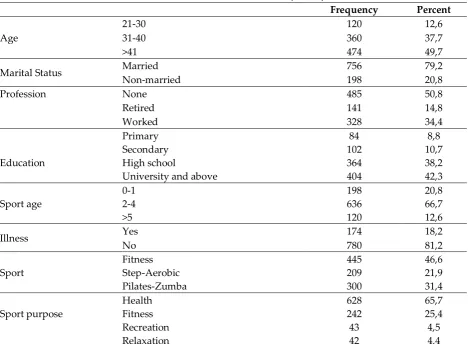
Table 1: Personal information (n=954)
Frequency Percent
Age
21-30 120 12,6
31-40 360 37,7
>41 474 49,7
Marital Status Married 756 79,2
Non-married 198 20,8
Profession None 485 50,8
Retired 141 14,8
Worked 328 34,4
Primary 84 8,8
Secondary 102 10,7
Education High school 364 38,2
University and above 404 42,3
0-1 198 20,8
Sport age 2-4 636 66,7
>5 120 12,6
Illness Yes 174 18,2
No 780 81,2
Fitness 445 46,6
Sport Step-Aerobic 209 21,9
Pilates-Zumba 300 31,4
Health 628 65,7
Sport purpose Fitness 242 25,4
Recreation 43 4,5
Relaxation 42 4,4
Table 1 shows that the majority of female members of healthy living and sports centers are 474 people (49.7%), married 756 people (79.2%), housewives 485 people (50.8%), 41 years and older 404 people (42.3%) graduated, 636 people (66.7%) who have been doing sports for 2-4 years, 780 people (81.2%) without any discomfort, 445 people (46.6%) with the aim of doing fitness 628 people (65.7%).
Table 2: Marital status and service expectations analysis
Marital status Freq. Mean Std. Dev. t p
Officer Married 756 4,515 0,449 3,94 0.00*
None 198 4,364 0,589
Programme Married 756 4,539 0,455 3,81 0.00*
None 198 4,394 0,555
Dressing room Married 756 4,575 0,476 5,61 0.00*
None 198 4,352 0,574
Physical facility Married 756 4,533 0,464 6,59 0.00*
Training facility Married 756 4,558 0,467 4,99 0.00*
None 198 4,354 0,660
Total scale Married 756 4,540 0,416 5,47 0.03*
None 198 4,359 0,542
When examining Table 2, service expectations, marital status variable and scale were
found to be significantly different with the sub-dimensions and total scale. As a result, the members of the wellness and sports center who are married are single members of the wellness and sports center. According to this result, it can be said that married customers have higher expectations than single customers (p <0.05).
Table 3: Illness and service expectations analysis
Illness Freq. Mean Std. Dev. t p
Officer Yes 174 4,2759 ,42970
-6,833
No 780 4,5299 ,48454 0,00*
Programme Yes 174 4,3522 ,46078
-4,929
No 780 4,5440 ,47810 0,00*
Dressing room Yes 174 4,3793 ,47215
-4,539
No 780 4,5615 ,50756 0,00*
Physical facility Yes 174 4,3317 ,40357
-4,921
No 780 4,5099 ,54098 0,00*
Training facility Yes 174 4,3966 ,43101
-3,362
No 780 4,5423 ,53436 0,00*
Total scale Yes 174 4,3397 ,40505
-5,636
No 780 4,5355 ,45416 0,00*
When examining Table 3, is seen that any discomfort state variable and the expectation scale were significantly different with the sub-dimensions and the total scale. As a result, it is seen that healthy living and sports center members who have any discomfort get more points than healthy living and sports center members without any discomfort. According to this result, it can be said that customers with any discomfort have higher expectations than customers without any discomfort (p <0.05).
Table 4: Age and service expectations analysis
Age Freq. Mean Std. Dev. F p Difference
Officer 21 -30 (x) 120 4,250 0,623
16,67 0,00* x<y,z 31-40 (y) 360 4,529 0,449
>41 (z) 474 4,507 0,454 Programme 21 -30 (x) 120 4,285 0,572
15,32 0,00* x<y,z 31-40 (y) 360 4,547 0,467
>41 (z) 474 4,536 0,450 Dressing room 21 -30 (x) 120 4,310 0,562
13,11 0,00* x<y,z 31-40 (y) 360 4,556 0,527
>41 (z) 474 4,562 0,459 Physical facility 21 -30 (x) 120 4,300 0,644
Training facility 21 -30 (x) 120 4,383 0,718
7,00 0,00* x<z 31-40 (y) 360 4,488 0,518
>41 (z) 474 4,569 0,450 Total scale 21 -30 (x) 120 4,300 0,588
14,05 0,00* x<z 31-40 (y) 360 4,515 0,425
>41 (z) 474 4,538 0,417
When examining Table 4, there is a significant difference between age variable and all sub-dimensions of the expectation scale and total expectation scale. According to these results, the satisfaction level of staff, program, dressing room, physical facility sub-dimensions increased as age increased, the training facility sub-dimension and total scale increased the satisfaction level of those aged 41 years and over compared to those aged 21-30 years. According to these results, it can be said that as the age of healthy living and sports center members increases, their satisfaction levels increase.
4. Discussion
The aim of this study was to determine the expectation and satisfaction levels of female individuals going to sports centers. For this purpose, a total of 499 women who visited the sports centers in Gaziantep were reached and a questionnaire was applied. According to the results of the study, it was found that the expectations and satisfaction levels of the female individuals showed significant differences in terms of various variables.
According to the results obtained from this variable, the personnel status of the sports facilities, the level of the programs implemented, the changing rooms and the sports areas could not meet the expectations of the married female individuals. it was found that the expectations of the sports facilities were significantly higher than that of the female individuals without any discomfort.
According to the results of a study conducted in the literature, a significant difference was found between the perceived sports service according to the disease status as a result of the evaluation of the problems related to the sports services perceived by the sports centers from late and adult women participating in the study according to the presence of any disease (Yaman, 2016).
In order to be successful according to the participant views of the sportive and recreational activities offered by local governments, it is important that the services provided are sufficient to meet the expectations of the participants (Ağılönü and Mengütay, 2009). In some studies in the literature, it has been found that sports centers cannot adequately meet the expectations and needs of members (Aslan and Koçak, 2011).
private sports centers and their sporfan expectations have significant effect on the age variable (Akça, 2012).
In a study conducted by Fischer, satisfaction of sports participants from sports centers was analyzed. As a result of the examination, a significant relationship was found between satisfaction levels and age groups (Fischer, 2002; Peatke, 2003). In a similar study, parallel results were obtained with our study. Expectations of the participants from sports centers showed significant differences between the ages. Expectation rates in sports centers have been found to increase as age increases (Bingöl, 2010).
In our study, the degree to which marital status affects expectations and satisfaction from sports centers was examined. As a result of the analysis, it was seen that married women had significantly higher expectations than individuals who were single. When a similar study in the literature is examined the expectation and satisfaction levels of individuals are examined according to their marital status, it is revealed that married individuals are more satisfied than single individuals (Rieger, 2000).
As a result, it can be said that the expectations of female individuals going to sports centers increased significantly according to the expectations of sports centers marital status, disease status and age variables.
References
Ağılönü, A., & Mengütay, S. (2009). Yerel yönetimlerde rekreasyon hizmetleri ve model belirleme. Uluslararası İnsan Bilimleri Dergisi, 6(2), 160-176.
Akça N. Ş. (2012). Reasons of Direction of Sports and Expectations of Individuals Member of Private Sports Centers, Department of Physical Education and Sports, Ankara University, Institute of Health Sciences and Sport, Ankara, p.34.
Amman T. (2000). Spor Sosyolojisi, Sporda Sosyal Bilimler, (Ed.:C.İkizler), Alfa Yayınları, s.54, İstanbul.
Aslan, M., & Koçak, M. S. (2011). Determination of the service quality among sport and fitness centers of the selected universities. Journal of Human Sciences, 8(2), 817-833.
Bayraktar C. (2003). Sosyal Yapı Özelliklerinin Spora Etkisi. Uludağ Üniversitesi Eğitim Fakültesi Dergisi. 17;(1), Bursa.
Bingöl A. (2010). Expectation Levels of Sports and Sports Centers of Individuals Attending Sports Centers, Physical Education and Sports Department Karadeniz Technical University, Institute of Social Sciences, Trabzon.
Dolaşir, S. (2005). Değişim Yönetimi ve Spor Örgütleri. Spormetre Beden Eğitimi ve Spor Bilimleri Dergisi, 1: 11-15.
Gürbüz, B., Koçak, S., & Lam, E. T. (2005). Hizmet Kalitesi Değerlendirme Ölçeği’nin Türkçe Versiyonunun Güvenirliği ve Geçerliği. Eğitim ve Bilim, 30(138).
İkizler H. C. (1994) Sporda Basarının Psikolojisi. Alfa Basım Yayın Dağıtım, 2 Baskı, İstanbul.
Kale, R. (1994). Toplum ve Olimpik Başarı, Türkiye ve Olimpiyat Sempozyumu, İstanbul, 249.
Karaküçük S. (1995). Rekreasyon; Bos Zamanları Değerlendirme , Ankara.
Lam, E. T., Zhang, J. J., & Jensen, B. E. (2005). Service Quality Assessment Scale (SQAS): An instrument for evaluating service quality of health-fitness clubs. Measurement in physical education and exercise science, 9(2), 79-111.
Paetke V., (2003). Fit und Schlank Durch Fitnesstrainnig?, Diplomarbeit, Bielefeld Universitat, Deutschland.
Rieger T., (2000)., Die Analyze der Kundenzufriedenheit in Der Fitnessbranche., Diplomarbeit, Fachhochschule Bielefeld, University of Applied Sciences Deutschland.
Rowe, D. (1996). Popüler Kültürler: Rock ve Sporda Haz Politikaları. İstanbul: Ayrıntı Yayınları, s.:184- 185.
Seraslan Z. (1990). Spor Pazarlaması, Spor Topluma Yaygınlastırılmasında Pazarlama Tekniklerinden Yararlanma. İstanbul Üniversitesi Sosyal Bilimler Enstitüsü Pazarlama Anabilim Dalı, İstanbul.
Sunay, H. (2000). Türkiye’de Sporun Yaygınlaştırılması. Milli Eğitim Dergisi, 147: 64-66. Yaman M. S. 2016. Genç ve Yetişkin Kadınların Düzenli Spor Yapmalarına İlişkin
Creative Commons licensing terms