SYNTHESIS OF SOME NEW
4-(BENZOTHIAZOLYLAMINO)-PYRAN-2-ONE DERIVATIVES AND THEIR ANTIBACTERIAL
ACTIVITY
Ramiz Hoti,
[a]Hamit Ismaili,
[a]*Naser Troni,
[a]Idriz Vehapi,
[b]Malesore
Pllana,
[c]Veprim Thaci
[a]Keywords:Pyran-2-one, benzothiazole, condensation, antibacterial activity, zones of inhibition.
Novel 4-substituted pyran-one derivatives were synthesized by condensation of 6-methylpyran-ones and corresponding 2-aminobenzothiazoles. Condensation of 4-chloro-6-methyl-2H-pyran-2-one 2a and 2-aminobenzothiazoles 3(a-c) afforded corresponding 4-(2-benzothiazolylamino)-6-methyl-2H-pyran-2-one 4a, 4-(4-methyl-2-benzothiazolylamino)-6-methyl-2H-pyran-2-one 4b and 4-(5,6-dimethyl-2-benzothiazolylamino)-6-methyl-2H-pyran-2-one 4c. By condensation of 4-chloro-3-nitro-6-methyl-2H-pyran-2-one 2b and 2-aminobenzothiazoles 3(a-d), 4-(2-benzothiazolylamino)-3-nitro-6-methyl-2H[1]-pyran-2-one 4d and 4-(6-ethoxy-2-benzothiazolylamino)-3-nitro-6-methyl-2H[1]-pyran-2-one 4e were synthesized. The synthesized products were characterized on the basis of IR, 1H-NMR and 13C-NMR spectra. Compounds 4a-4e were screened for their antibacterial activity against S. Aureus, E. Coli and Klebsiella. Their
antibacterial activity is examined by measuring the zones of inhibition around the disks impregnated with the corresponding product solutions in N,N-DMF concentration 2 mg mL-1, 4 mg mL-1 and 6 mg mL-1 and results are reported.
* Corresponding Authors
E-Mail: [email protected]
[a] Department of Chemistry, Faculty of Nature Sciences, University of Prishtina, 10000 Prishtina, Kosovo [b] Institute of Public Health of Kosovo, 10000 Prishtina,
Kosovo
[c]
Faculty of Mining and Metallurgy, University of Mitrovica, 40000 Mitrovica, KosovoIntroduction
Pyran-2-ones and their derivatives are an important class of compounds and play an important role in many life processes. Many of such derivatives are reported for their synthesis1 and a wide range of biological activities.2-4 They
were shown to exhibit antimicrobial,5 antibacterial,6
antifungal,7 antimalarial,8 and anticonvulsant activity.9
3-Hydroxypyran-2-one was found to be present in kojic acid derivatives and reported for their significant antimicrobial activity. Some 4-hydroxypyran-2-one derivatives exhibited inhibitory activity in the enzymatic process of HIV protease.10 Some natural pyrone antibiotics containing
hydroxamate or catechole groups are used for lead complexiation in cases of poisoning.11 Some polycyclic
aromatic compounds have been shown to have antitumor activity as they may be inserted between DNA bases. Their selective activation in the tumor may be applied to anticancer chemotherapy with reduced side effects.12 It has
been reported that 3-bromo-6-(4-chlorophenyl)-4-methylthio-2H-pyran-2-one has shown protective action against hepatitis.13 The biological activity of these
derivatives is conditioned by their structure, so the presence of different substituents on the pyrone ring indicates their impact on the type and potency of biological activity.14
Unfortunately, the relationship between structure and biological activity of these derivatives so far has not yet been sufficiently clarified.
On the other hand, the extraordinary biologically importance of benzothiazole derivatives has generated a constant interest for their synthesis and research. In continuation of our previous studies and in an attempt to synthesize the new derivates15-17 in this paper we had
intended to synthesize some new heterocyclic derivatives by condensation of 4-chloro-6-methyl-2H-pyran-2-one and substituted 2-aminobenzothiazole which could serve as pro-pharmaceutical products.
Methods and materials
The compounds are synthesized under catalytic conditions using commercial reagents of Aldrich company. The reaction flow was monitored by thin layer chromatography using Merck Kieselgel-60 (F-254) as a stationary phase and a mixture of benzene:toluene:glacial acetic acid (v/v/v 85:10:5) as the mobile phase. The synthesized products are purified by crystallization from methanol and ethanol.
Melting points are determined used a paraffin oil bath with the open capillary tube. The IR spectra are recorded in KBr discs on Shimadzu 8400xFT-IR spectrometer with 4cm -1 resolution. The 1H-NMR and 13C-NMR spectra are
recorded in DMSO on UNITYplus-300“NMR 1” spectrometer. Chemical shifts were reported in ppm downfield fromTMS as internal standard (δ0.00).
Antibacterial activity of the synthesized compounds is examined using standard discs (d=5.0mm, maximum capacity10 pg) measuring the zones of inhibition. Standard discs were previously impregnated with 2 mg mL-1, 4 mg
mL-1 and 6 mg mL-1 solutions of respective compounds in
Synthesis of 4-heteroarylamino-6-methyl-2H-pyran-2-ones 4(a-c). General procedure
The reaction mixture containing 0.72 g (5 mmol) of 4-chloro-6-methyl-2H-pyran-2-one 2a, equimolar amounts of corresponding 2-aminobenzothiazole (3a-3d) and a catalytic amount of triethylamine were dissolved in 12 mL of acetonitrile. The reaction mixture was refluxed in a water bath for 8-12 hours, then was cooled and crude product was filtered off under vacuum, then was dried and crystallized from ethanol.
4-(-2-Benzothiazolylamino)-6-methyl-2H- pyran-2-one (4a)
White crystalline product, yield was 88 %, m.p. 220 oC,
FTIR (KBr, cm-1): 3420, 3250, 2978, 2923, 1705, 1685,
1680, 1618, 1160, 1130, 760. 1H NMR (300 MHz,
DMSO-d6, ppm) 1,90 (s, 1H), 4,10 (s, 1H), 5,80 (s, 1H), 6,20 (s, 1H), 7,60-8,20 (m, 4H). 13C-NMR (δ, ppm) 23,1, 93,8, 103,2,
123,0, 124,0, 125,4, 126,2, 127,3, 127,9, 145,6, 162,4, 167,8, 175,3.
4-(4-Methyl-2-benzothiazolylamino)-6-methyl-2H-pyran-2-one (4b)
White crystalline product, yield was 82 %, m.p. 228-230
oC. FTIR (KBr, cm-1): 3440, 3040, 2925, 1695, 1670, 1640,
1080, 770. 1H NMR (300 MHz, DMSO-d
6, ppm; 2,05(s, 3H), 2,40 (s, 3H), 4,35(s, 1H), 5,95(s, 1H), 6,30(s, 1H), 7,40-7,90(m, 3H).
4-(5,6-Dimethyl-2-benzothiazolylamino)-6-methyl-2H-pyran-2-one (4c)
Brown crystalline product, yield was 79 %, m.p. 175-176
oC.FTIR (KBr, cm-1): 3446, 2975-2925, 1685, 1670, 1140,
1100, 765.
Synthesis of 4-heteroarylamino-6-methyl-3-nitro-2H-pyran-2-ones (4d-4e). General procedure
The reaction mixture containing 0.85 g (5 mmol) of 4-chloro-6-methyl-3-nitro-2H-pyran-2-one 2b equimolar amounts of 2-aminobenzothiazoles (3a, 3d) and a small amount of triethylamine were dissolved in 20 mL of acetonitrile, and the reaction mixture was refluxed in aqueous baths for 6-10 hours. Then the mixture was cooled and crystalline product was filtered off under vacuum, and dried in air, then purified by crystallization from ethanol.
4-(2-Benzothiazolylamino)-3-nitro-6-methyl-2H-pyran-2-one (6a)
Yellow crystalline product, yield was 67.5 %, m.p.=124-126oC.FTIR (KBr, cm-1): 3400, 3050, 2940, 1690, 1630,
1585, 1515, 1340, 1300, 750, 720.
4-(2-Benzothiazolylamino)-3-nitro-6-methyl-2H-pyran-2-one (6d)
Yellow crystalline product, yield was 72.5 %, m.p. 152-154 oC. FTIR (KBr, cm-1): 3450, 3170, 2930, 1695, 1605cm -1, 1540, 1480, 1290, 1070, 790. 1H NMR (300 MHz,
DMSO-d6, ppm;1,33 (t, 3H), 1,95 (s, 3H), 4,05 (q, 2H), 4,40(s, 1H), 6,28 (s, 1H),7,61-7,92 (m, 3H). 13C-NMR; (δ,
ppm):14,8, 22,9, 66,2, 103,2, 108,8, 111,0, 113,3, 123,0, 124,1, 140,2, 144,6, 156,5, 161,9, 167,2, 174,8.
Results and discussion
On the basis of previous research it has been established that 4-chloro-6-methyl-2H-pyran-2-one (2) in the reaction with 2-aminobenzothiazoles (3) forms corresponding 4-benzothiazolylamino-6-methyl-2H-pyran-2-ones (4). Also, 4-chloro-3-nitro-6-methyl-2H-pyran-2-one in reaction with 2-aminobenzothiazoles forms the corresponding nitro derivatives 4d-4e.
By reaction of 4-hydroxy-6-methyl-2H-pyran-2-one 1 and equimolar amount of phosphorous oxychloride, 4-chloro-6-methyl-2H-pyran-2-one 2a is synthesized in 85 % yield. The obtained product is condensed with 2-aminobenzothiazoles (3a-3c) in acetonitrile, giving the corresponding benzothiazolylamino-6-methyl-2H-pyran-2-ones (4a-4c). (Scheme 1). Also by condensation of 4-chloro-3-nitro-6-methyl-2H-pyran-2-one 2b with 2-aminobenzothiazoles 3a and 3d, corresponding nitro derivatives 4d and 4e were synthesized.
.
Scheme 1. Synthetic procedures
O OH
O
S N N H2
R1
R2
R3
O Cl
O
S N
R1 R2 R3
O N
O H
S N N H2
R1
R2
R3
O OH
O NO2
O Cl
O NO2
S N
R1 R2 R3
O N
O H
NO2 POCl3
POCl3 HONO2
1a
3a-3c
2a
4a-4c
1b 2b
3 a, 3d
4d, 4e 4a (R1, R2, R3=H;
4b (R1=Me, R2, R3=H) 4c (R1=H, R2, R3=Me)
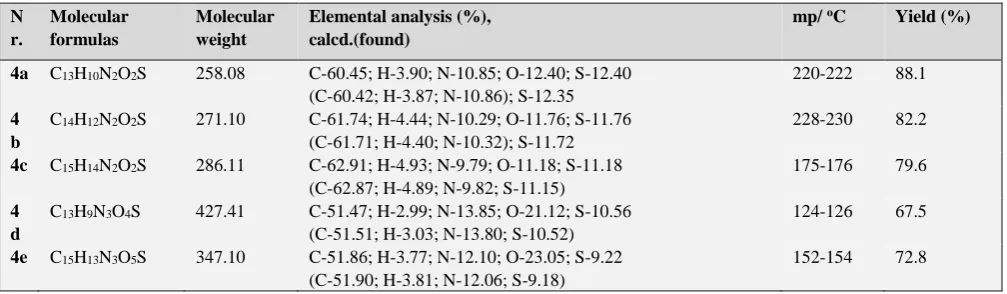
Table 1. Physical properties of compounds 4a-4e and their elemental analysis
Structural elucidation of the synthesized products is based on spectrometric IR and NMR data. In the IR spectrum of the compound, 4a appeared an absorption signal absorption at 3420 cm-1 which is responsible for ν(NH
2) stretching
vibrations. The characteristic signal at 3250 cm-1 appeared
due to aromatic ν(CH) stretching vibrations while the absorption signal at 2978 resulted from methyl ν(CH) stretching vibrations. The sharp peak at 1695 cm-1 is
responsible for ν(C=O) stretching vibrations, while the absorption modes at 1680 and 1618 cm-1 result from ν(C=N)
and ν(C=C) stretching vibrations. On the other hand, the absorption signal at 1130 cm-1 is characteristic for lactonic
ν(C-O-C) stretching vibrations while the sharp peak at 750 cm-1 resulted from aromatic δ(C-H) oop bending vibrations.
In the 1H-NMR spectrum of compound 4a, a three proton
singlet is appeared at δ1.90 ppm corresponding to the methyl protons, while the singlets at δ5.80 ppm and 6.00 ppm correspond to the pyronic protons. A singlet displayed at δ4.10 ppm results from amine proton, while benzothiazole protons are displayed as multiplets at δ7.60-8.20 ppm. In the
13C-NMR spectrum, the respective signals for 13 carbon
atoms are displayed.
In the IR spectrum of compound 4b, an absorption signal at 3422 cm-1, which results from υ(NH) stretching vibrations
is displayed. Also characteristic peaks at 3040 cm-1 and
2925 cm-1 which respond to the aromatic υ(CH) and methyl
υ(CH) stretching vibrations were assigned. The lactone carbonyl vibrations appeared at 1696 cm-1 while those
υ(C=N) and υ(C=C) of the aromatic system assigned at 1670 cm-1 and 1640 cm-1. The sharp peak at 770 cm-1 is
characteristic for aromatic bending δ(C-H) oop vibrations. The 1H-NMR spectrum of compound 4b, displayed two
singlets at δ2.05 ppm and δ2.40 ppm characteristic for methyl protons, whereas two singlets at δ5.95 ppm and δ6.30 ppm are responsible to the pyronic ring proton and the singlet at δ4.35 ppm results from the amine proton. Benzothiazole protons have been shown as a multiplet at δ7.40-7.90 ppm.
In the IR spectrum of compound 4c, the absorption signal appeared at 3446 cm-1 which is responsible for ν(NH)
stretching vibrations of secondary amines.
The absorption band at 2975-2925 cm-1 is attributed to
υ(CH) stretching vibrations of aromatic and methyl group. The characteristic peak for unsaturated six-membered lactones has appeared in 1705 cm-1. Signals at 1685 cm-1
and 1670 cm-1 correspond to υ(C=N) and υ(C=C) stretching,
while the signal at 765 cm-1 responsible for aromatic
bending δ(CH) vibrations also is appeared.
The IR spectrum of compound 4d showed an absorption peak at 3400 cm-1 which result from the υ(NH) stretching
vibrations. The absorption peaks at 3050 cm-1 and 2940 cm-1
are responsible for aromatic and methyl υ(CH) stretching vibrations. The intense absorption at 1690 cm-1 resulted
from υ(C=O) stretching vibrations while aromatic υ(C=N) and υ(C=C) modes are displayed at 1630 cm-1 and 1585 cm-1.
Two signals at 1515 cm-1 and 1340 cm-1 are assigned for
asymmetric and symmetric υ(NO2)vibrations while the
lactone υ(C-O-C) mode appeared at 1300 cm-1. The Peak at
750 cm-1 resulted from aromatic δ(CH) bending mode.
In the IR spectrum of the compound 4e is observed the absorption peak at 3450 cm-1 which is responsible for υ(NH)
stretching vibrations. The aromatic υ(CH) vibrations are displayed at 3170 cm-1 while those of the methyl group at
2930 cm-1. A sharp peak at 1695 cm-1 and the peaks at 1605
cm-1 and 1540 cm-1 are responsible for υ(CO) stretching and
aromatic υ(C=N) and υ(C=C) stretching modes. The peaks at 1480 cm-1 and 1290 cm-1 respond to asymmetric and
symmetric υ(NO2) vibrations. Also in the spectrum is shown
the bending absorption δ(CH) (oop) at 790 cm-1.
In the 1H-NMR spectrum of the compound 4e appeared a
three-proton triplet at δ1.40 ppm which corresponds to the methyl group protons, while the singlet at δ1.95 has resulted from the methyl group of the pyronic ring. The two-proton quartet at δ4.05 ppm results from ethylene protons, whereas the signal at δ4.40 ppm is displayed due to amine proton. A singlet at δ1.95 ppm corresponds to the pyronic proton, while the benzothiazole protons are displayed as a multiplet at δ7.61-7.92 ppm. In the 13C-NMR spectrum of 4e, the
respective signals for 15 carbon atoms are displayed. N
r.
Molecular formulas
Molecular weight
Elemental analysis (%), calcd.(found)
mp/ oC Yield (%)
4a C13H10N2O2S 258.08 C-60.45; H-3.90; N-10.85; O-12.40; S-12.40
(C-60.42; H-3.87; N-10.86); S-12.35
220-222 88.1
4 b
C14H12N2O2S 271.10 C-61.74; H-4.44; N-10.29; O-11.76; S-11.76
(C-61.71; H-4.40; N-10.32); S-11.72
228-230 82.2
4c C15H14N2O2S 286.11 C-62.91; H-4.93; N-9.79; O-11.18; S-11.18
(C-62.87; H-4.89; N-9.82; S-11.15)
175-176 79.6
4 d
C13H9N3O4S 427.41 C-51.47; H-2.99; N-13.85; O-21.12; S-10.56
(C-51.51; H-3.03; N-13.80; S-10.52)
124-126 67.5
4e C15H13N3O5S 347.10 C-51.86; H-3.77; N-12.10; O-23.05; S-9.22
(C-51.90; H-3.81; N-12.06; S-9.18)
Table 2. The zones of inhibition (mm) of the discs impregnated with solutions of the synthesized compounds
Antibacterial activity of the products 4a-e
Following this study compounds 4a-4e are investigated for their antibacterial activity. Our research has been conducted in terms of testing their activity against bacteria S. aureus, E. coli, and Klebsiella, on the basis of Standard disc method.18 The discs have previously been impregnated with
solutions of the compounds in N,N-DMF with concentrations of 2 mg/mL, 4 mg/mL and 6 mg/mL. After 48 h incubatoin, the zones of inhibition around the standard discs were measured and reported. Results are summarized in table 2.
Compounds of series 4a-4e showed significant antimicrobial activity against E. Coli and Klebsiella, while
their activity against S. Aureus was moderate. Compounds 4e and 4c were most active against S. aureus, compounds 4b and 4e showed the most activity against E. Coli whereas 4a and 4e were more active against Klebsiella.
Antibacterial activity against E. Coli and Klebsiella
displayed in a large-scale. On the other hand, these products expressed both bactericidal and bacteriostatic activity against S. Aureus. While bactericidal activity was low, bacteriostatic activity is shown in a large range (+3.0 mm). Compound 4e expressed considerable activity against these microorganisms. It has been observed that the nitro group of pyronic residue had a significant impact on antibacterial activity. Also, the impact of the methyl and ethoxy group of the benzothiazole moiety was considerable.
Figure 1. The graphical presentation of zones of inhibition (mm) against S. aureus
Figure 3. The graphical presentation of zones of inhibition (mm) against Klebsiella
We my consider that the antibacterial activity may result as a consequence of the involvement of these products in enzymatic reactions. In any way these products can cause enzymatic inhibition of cell wall construction of the microorganisms, however, mechanism of enzymatic inhibition is not yet fully studied. It was observed that by increasing the concentration of solvents, their antimicrobial activity increased.
Conclusions
Novel 6-methyl-2H-pyran-2-one derivatives 4(a-e) have
S. aureus, dose in mg mL-1 E. coli, dose in mg mL-1 Klebsiella, dose in mg mL-1
dose in mg mL-1 dose in mg mL-1 dose in mg mL-1
2 4 6 2 4 6 2 4 6
4a 8.0 10.0 11.5 20.0 22.5 23.0 24.5 24.0 25.0
4b 10.0 10.5 12.0 21.0 23.0 25.0 16.5 18.5 19.5
4c 10.0 11.0 13.0 18.0 20.0 23.0 16.0 18.0 22.5
4d 9.5 10.0 10.5 22.0 24.0 24.5 20.0 23.0 25.5
expressed more antibacterial activity against E. coli, while compounds 4a and 4e have been more active against
Klebsiella. The impact of nitro, methyl and ethoxy groups in antibacterial activity was significant. In general, antibacterial activity is shown to be proportional to the concentration of these compounds.
Acknowledgement
We are grateful to Prof. Dr. Hrvoj Vancik, Department of Organic Chemistry and Biochemistry, University of Zagreb, Croatia, for their support and facilities.
References
1Kepe, V., Kocevar, M., Polanc, S., J. Heterocycl. Chem.,1996,
33(6),1996, 1707–1710.
http://onlinelibrary.wiley.com/doi/10.1002/jhet.5570330626/ abstract
2Parker, S. R., Cutler, H. G., Jacyno, J. M., Hill, R. A., J. Agric.
Food Chem.,1997,45(7), 2774–2776.
http://pubs.acs.org/doi/abs/10.1021/jf960681a
3Dong, Y., Nakagawa-Goto, K., Lai C. Y., Morris-Natschke, S. L.,
Bastow, K. F., Lee, K. H., , Bioorg. Med. Chem. Lett., 2011, 21(8), 2341–2344.
https://www.ncbi.nlm.nih.gov/pmc/articles/PMC3072684/
4Defant, A., Mancini, I., Tomazolli, R., Balzarini, J.,
Arch.Pharm.Chem.LifeSci.,2015,348, 23-33.
doi/10.1002/ardp.201400235/epdf
5Aytemir, M. D., Demirerol, D., Hider, C., Ozalp, M., Turk J
Chem., 200327, 757–764.
http://journals.tubitak.gov.tr/chem/issues/kim-03-27-6/kim-27-6-12-0303-15.pdf
6Li, H. H., Qi, F. M., Dong, L. L., Fan, G. X., Che, J. M., Guo, D.
D., Zhang, Z. X., Fei, D. Q., Phytochem. Letters, 2014, 10, 304–308.
http://www.sciencedirect.com/science/article/pii/S187439001 4001980
7Jelen, H., Blaszczyk, L., Chełkowski, J., Rogowicz, K.,
Strakowska, J.,2014, 13(3), 589–600.
https://link.springer.com/article/10.1007/s11557-013-0942-2
8McCracken, S. T., Kaiser, M.,Boshoff, H. I.,Peter D. W. Boyd, P.
D. W., Copp, B. R., Bioorg. Med. Chem.,2012, 20(4), 1482– 1493.
https://www.ncbi.nlm.nih.gov/pmc/articles/PMC3276683/
9Aytemir, M. D., Calis, U., Ozalp, M., Arch. Pharm. (Weinheim),
2004, 337, 281–288.
https://www.ncbi.nlm.nih.gov/pubmed/15095421?dopt=Abst ract
10Vara Parsad, J. V. N., Tummino, P. J., Ferguson, D., Saunders, J.,
Roest, S. V., McQuade, T. J., Heldsinger, A., Reyner, E. L., Steward, B. H., Guttendorf, R. J., Para, K. S.,Biochem. Biophysm. Res. Commun.,1996, 221(3), 815-820.
http://www.sciencedirect.com/science/article/pii/S0006291X 96906798
11Brtko, J., Rondahl, L., Fickova, M., Hudecov, D., Eybl, V., Uher,
M., Cent. Eur. J. Public Health, 2004, 12, 16–18.
https://www.researchgate.net/profile/Julius_Brtko/publicatio n/8564052_Kojic_acid_and_its_derivatives_History_and_pre sent_state_of_art/links/0912f510c021fbb7c6000000.pdf
12Dong, Y.,Nakagawa-Goto, K., Lai, C. Y., Morris-Natschke, S.
L., Kenneth F. Bastow, K. F., Lee, K. H., Bioorg. Med. Chem. Lett., 201121(8), 2341–2344.
https://www.ncbi.nlm.nih.gov/pmc/articles/PMC3072684/
13Konreddy, A., K., Toyama, M., Ito, W., Bal, C., Baba, M.,
Sharon, A., ACS Med. Chem. Lett., 2014, 5(3), 259–263.
https://www.ncbi.nlm.nih.gov/pmc/articles/PMC4027742/
14Parker, S. R., Cutler, H. G., Jacyno, J. M., Hill, R. A., J. Agric.
Food Chem.,1997,45(7), 2774–2776.
http://pubs.acs.org/doi/abs/10.1021/jf960681a
15Hoti, R., Nura-Lama, A., Mulliqi-Osmani, G., Troni, N., Gashi,
F., Ismaili, H., Thaci, V., Orbital: E-J. Chem., 2014, 6(3),
184-190.
http://www.orbital.ufms.br/index.php/Chemistry/article/view/ 564
16Hoti, R., Troni, N., Nura-Lama, A., Mulliqi-Osmani, G., Ismaili,
H., Thaci, V., Eur. Chem. Bull.,2017, 6(2), 83-88. DOI: 10.17628/ecb.2017.6.83-88
17Hoti R., Kalaj V., Vehapi I., Ismaili H., Thaçi V., Bicaj M.,
FASEB J. Exp. Biol., 2010, lb487,
http://www.fasebj.org/content/24/1_Supplement/lb487.short
18Bauer, A. W., Kirby, W. M., Sherris, J. C., Turuck M., Am. J.
Clin. Pathol.,1966, 45(4), 493-496.
https://www.ncbi.nlm.nih.gov/pubmed/5325707