CORROSION PROTECTION OF CARBON STEEL IN
SEAWATER BY ALUMINA NANOPARTICLES WITH
POLY(ACRYLIC ACID) AS CHARGING AGENT
Haider Abdulkareem Yousif Almashhdani
[a]*and Khulood Abid Al-Saadie
[b]Keywords: Alumina, carbon steel, AFM, nanoparticle, polyacrylic acid, corrosion.
Nanostructured Al2O3 in 60-80 nm diameter has been deposited on carbon steel substrates, by cathodic electrophoretic deposition (EPD), in
ethanol with poly(acrylic acid) (PAA) as charging agent, as a protective coating against corrosion for carbon steel (C.S.) in seawater environment. Potentiodynamic polarization measurements performed on the Al2O3 coated carbon steel coated by Al2O3in 3.5 % NaCl at
temperature range 298-328 K and the result showed that using PAA charging agent lead to increase the corrosion resistance.
*Corresponding Authors
Email: [email protected]
[a] Al-Rasheed University College, Department of Dentistry, Baghdad, Iraq
[b] University of Baghdad, College of Science, Department of Chemistry, Baghdad, Iraq
Introduction
Corrosion is a natural phenomenon and is accompanied by the flow of electrical current involving the reversion from metallic to compound state. So it becomes clear that corrosion cannot be fully prevented instead it can be controlled to a greater extent. Many researchers have used various methods in corrosion prevention investigations, such as coated metal surfaces by nanoparticles.
The use of particles in nano scale could also change the microstructure of the electrodeposits leading to a more compact structure and thus to improved corrosion
resistance.1,2 Nanoparticle coatings possess good thermal and
electrical properties and they are resistant to oxidation, corrosion, erosion and wear in high temperature
environments.3 These properties are very important factors in
the applications such as pipelines, castings and automotive industry.
Electrophoretic deposition (EPD) is one of the liquid
coating methods,4–6 which elaborates stable suspensions of
Al2O3 particles in an appropriate liquid. Both sparse Al2O3
particles and dense particle coating layers on metal surface have been invented. Generally, EPD consists of two processes, i.e. the movement of charged particles in suspension in an electric field between two electrodes and the particle deposition on one of the electrodes to be protected. The mechanism of the formation of a deposit during EPD is reviewed and discussed in several theoretical papers and
reviews.7-9
The insufficiency of surface charge and excessive weight potentially can be overcome through the use of polymeric charging agents, EPD with ethanol as suspension medium and poly(acrylic acid) (PAA) as polymeric charging agent give
good protection. Further, these polymeric charging agents play an important role as binders to improve adhesion
between deposited particles and substrate.9,10
The aim of the present work was to examine the efficiency
of Al2O3 nanoparticles (NPs) to protection of carbon steel
(C.S.) using absolute ethanol as suspension medium and a PAA polymeric charging agent.
Experimental
Materials
The steel used in this study is a carbon steel (C45) with a chemical composition (in wt %) of 0.42 % C, 0.40 % Si, 0.50 % Mn, 0.045 % S, 0.40 % Cr, 0.045 % P, 0.40 % Ni, 0.0.1 % Mo and the remainder is iron (Fe).The carbon steel samples were pre-treated prior to the experiments by grinding with emery paper SiC (120, 600 and 1200); rinse with distilled water, degreased in acetone, washed again with distilled water and then dried at room temperature before used synthesized seawater. The seawater solution was prepared by
dissolved 35 g NaCl in 1L distilled water. Al2O3
Nanoparticles were used in diameter range (20-30nm, Hongwu nanometer, purity 99.9%) and iodine was used in 99.8% purity (Aldrich).
Preparation of emulsion solution
Emulsion solution was prepared by adding 1 % Al2O3 NPs
powder to ethanol as solvent 16 (adding 1.5 g NPs to 150 mL
ethanol). To study the effect of adding different percentages of PAA (0.1, 0.25, 0.5 and 1%) in emulsion solution (0.1, 0.25, 0.5 and 1g) of PAA was added to 100 mL ethanol respectively.
To homogenize the solution, an ultrasonic (50 W) stirrer was used to mixed the solution for 30 min. The solutions were applied for coating C.S. pieces by using EPD technique
method. Sometime few iodine crystalswere added to increase
Electrophoresis deposition of emulsion solution (coating samples)
To deposit emulsion solution on a piece of C.S.. surfaces, deposition cell device was used. The electrodes were connected to a D.C power supply, it can be used in anodic or cathodic deposition by reversing electrodes of the power
supply.12 The deposition cell device composed of the
following components: A beaker of 250 mL capacity and the cover contains two slit with distance between then equal to 1 cm. Power supply used to supply constant direct current D.C voltage was varied between 0 and 20 V. An electrical circuit was connected by ammeter, respectively, to measure the current generated between the poles. Stainless steel rode used
as inert electrode in deposition process cell.13 A piece of
carbon steel catch by tong made of stainless steel fixed with 1cm distance between it and inert electrode.
The deposition on C.S. specimens were carried for 3, 4, 5 and 6 minutes, then all specimens thermally dried at 150 C for 2 min.
Electrochemical measurements
The electrochemical measurements were carried out using Mlab (Germany, 2000) potentiostate and controlled by a computer and MLabSci software which were used for data acquisition and analysis under static condition. The corrosion cell used had three electrodes, the reference electrode was a silver- silver chloride, platinum electrode was used as
auxiliary electrode with 1 cm2 surface area and the working
electrode was carbon steel. All potentials given in this study were referred to this reference electrode. The working electrode was immersed in test solution for 15 min to a
establish steady state open circuit potential (Eocp), then
electrochemical measurements were performed in potential range (±200) mV. All electrochemical tests have been performed in aerated solutions at 208-328 K.
Results and discussion
Effect of time
The deposition on C.S. specimens were carried for (3, 4, 5 and 6) minutes, to study the effect of time on the deposition on C.S. specimens and chose the optimization time for deposition to get high protection efficiency. The perfect time
for coated C.S. by Al2O3 NPs using EPD technique was 6 min,
which gave percentage of protection efficiency (PE %) as 83.9 % at 298 K as shown in Figure 1.
Polarization curve
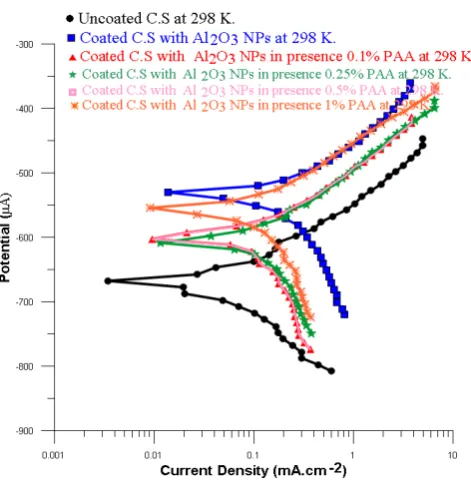
Figure 2 shows the polarization curves for the corrosion of
carbon steel coated with Al2O3 NPs in absence and presence
of various amounts of PAA. It could be observed that both the cathodic and anodic reactions were suppressed with the addition of different amounts of PAA, which suggests that
coating by Al2O3 in the absence PAA lead the polarization
curve shifting to more positive value (less active) reach to -730.0 mV at 328 K but when PAA was added in different
concentration, the value of corrosion potential shifted to more active value but don’t reach to the corrosion potentials of uncoated C.S.
Figure 1. Relationship between PE% and coating time for coated C.S. by Al2O3 NPs at 298K.
PE % of all types of coating estimated by comparison with the measurements of the uncoated surface of carbon steel alloy using Eqn. (1).
% i 100
(1)
where icorr uncoated and icorr coated are corrosion current densities
for uncoated and coated specimen, respectively.
Effect of PAA
The thickness of coat layer on C.S. surface can be measured using eqn. (2)
(2)
where is the density of NPs, Wt is weight of the coat and V
is volume of the coat.
3.14
(3)
where r is the radius of C.S. piece and d is thickness of the
coat.
The effect of adding different PAA concentration in the
Al2O3 NPs suspension solution, were investigated. PAA lead
to decrease the thickness of Al2O3 layers from 14.424 µm in
the absence PAA to thickness ranging between 11.1 and 11.8 µm in presence of different concentration of PAA, as shown in Figure 3.
Figure 3. Relation between thickness and PPA % after 6 min coating time with Al2O3.
Figure 4. Effect of adding different PAA % to Al2O3 NPs coating
suspension on icorr.
Adding 0.5 % of PAA for the suspension of Al2O3 coating
lead to the lowest icorr value in temperature range of 298- 328
K, as shown in Figure 4. So the best PE % was obtained in presence of 0.5 % PAA at 298 K. So 0.5 % PAA is the right concentration for addition to suspension solution of coating which give PE % ranging between 87–85 % in the temperatures range of 298- 328 K, as shown in Figure 5.
Figure 5. Effect of adding different PAA % to Al2O3 NPs coating
suspension on PE %.
Surface Morphology
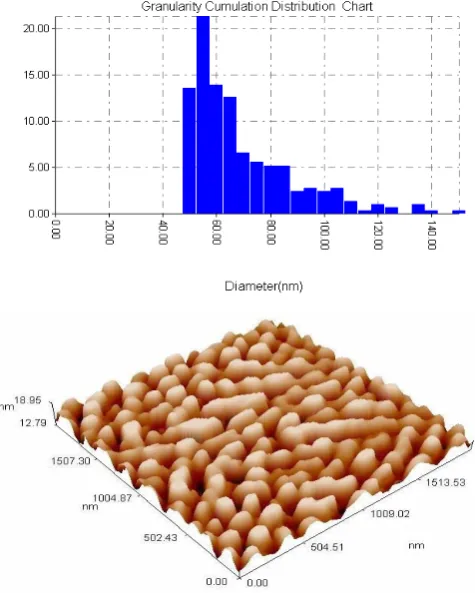
The morphologic analysis by AFM for layers of Al2O3 NPs
without PAA and for Al2O3 NPs with 0.5 % PAA was done.
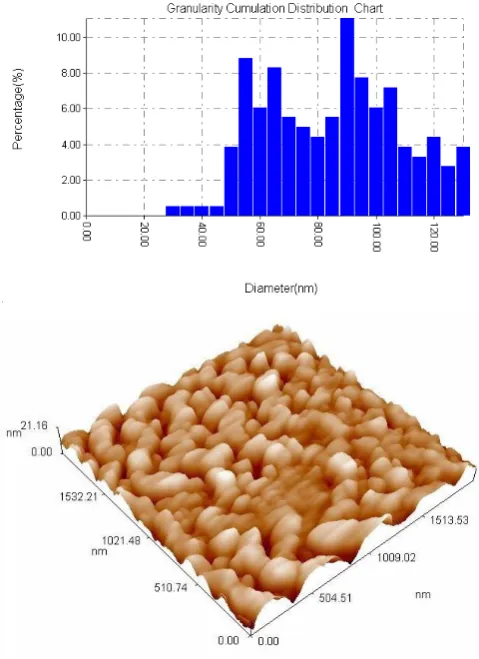
Figure 7. Granularity Cumulation Distribution and 3D views of AFM image of Al2O3 with PAA applied on carbon steel.
Since we started with alumina particles of 20-30 nm in diameter, AFM images shows little largest average particles
sizes for the Al2O3 NPs without PAA and Al2O3 NPs with
0.5 % PAA, as shown Figures 6 and 7 respectively, and it reached around 66 nm and 82 nm respectively.
FT-IR Spectroscopy
Fourier transformation infrared spectra for Al2O3 NPs
deposition on C.S. in presence PAA and the pure PAA show
a multi peak band at 3304-3350 cm-1 which indicates the
presence of the OH group or N-H, which was not shown in the spectrum of pure PAA, also it shows a peak at 1735-1793
cm-1 due to the presence of the carbonyl group for ketone. In
this spectrum, there are bands at 1176 and 1172 cm-1
indicating the presence of C=H groups.
Table 1. Wave number of FT-IR adsorption for pure PAA. and PAA/Al2O3 coat in C.S..
Al2O3 NPs deposition in presence PAA Pure PAA
Assignment Wave number (cm-1)
Wave number, cm-1
OH stretch 3401,13
-
OH strech 3350
3143
C-O stretch 1458
1436
C=N stretch 1172
1176
C=O strech 1739
1735
Surface porosity
Surface porosity percentage fraction was estimated by potentiostatic polarization. In this case, the porosity
percentage (P %) can be calculated using the following
equation:
% ,
, 10
∆
10
(4)
where RP,ucoated and RP,coated are the polarization resistances of
the uncoated C.S. and the coating C.S. by NPs, respectively,
ΔEcorr is the corrosion potential difference between them, and
βa is the anodic Tafel coefficient of the uncoated C.S..
In general, adding PAA increase surface porosity
percentage (P %) for coated C.S. by Al2O3 NPs at all
concentration of PAA, 1 % PAA lead to higher P% which reach to 32.5 % at 328 K, as shown in Figure 8.
Figure 8. Variation of porosity percentage P% with PAA % at different temperatures.
Kinetic studies
The corrosion reaction can be regarded as an Arrhenius
modified Arrhenius equation.17
log icorr = log A – Ea/2.303RT (5)
where icorr is the corrosion current density, Ea is the apparent
activation energy of the corrosion reaction, R is the gas
constant, T is the absolute temperature and A is the Arrhenius
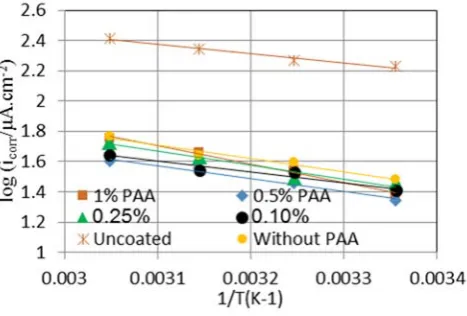
pre-exponential factor. Figure 9presents the Arrhenius plots
of the natural logarithm of the current density vs.1/T, for C.S.
samples uncoated and coated C.S. by Al2O3 in presence and
absence of different concentrations of PAA, in artificial seawater.
Values Ea and A for the corrosion reaction in the absence
Figure 9. logicorr vs 1/T for coated C.S. with Al2O3 NPs in absence
and presence of different PAA % in 3.5 % NaCl.
It is found that the activation energy is increased after
coating C.S. by Al2O3 in absence and presence PAA, and a
higher value was obtained when C.S. coated with Al2O3 in
presence 1 % PAA which reach to 23.54 kJ mol-1. But Value
of A increase slightly when C.S. is coated.
Table 2. Kinetic parametera for C.S. coated with Al2O3 in absence
and presence of different PAA % in 3.5 % NaCl.
Conc. Ea kJ mol -1
A Molecules cm-2 s-1 Uncoated 12.33 1.32 x 1028
Coated
by
Al2 O3
Without PAA 20.10 3.271 x 1028
(0.1%) PAA 12.33 3.79 x 1028
(0.25%) PAA 17.69 2.02 x 1028
(0.5%) PAA 16.30 9.9 x 1027
(1%) PAA 23.54 1.9 x 1029
Ea increases with coated C.S. by Al2O3 in absence and
presence PAA, it is obvious that thin layer of coat is playing a role in increasing the activation energy value, thereby indicating a more efficient inhibiting effect. According to eqn.
(5) low values of A and high values Ea lead to lower corrosion
rates. For the present study, there is some lower in the Ea
values in presence of (0.1-0.5 %) PAA. Therefore, the decrease in the carbon steel corrosion rate is controlled by the
pre-exponential factor A.
Thermodynamic studies
The values of thermodynamic parameters are presented in
table 3 where the value of ΔG calculated from its dependence
on corrosion potential (Eqn. 6).
∆
(6)
The entropy (ΔS) and enthalpy (ΔH) are obtained from the
slope and intercept respectively, of the plot of ΔG vs TΔS
(Figure 10). The value of ΔG indicates that the coated C.S.
functions by a chemical process on the surface of the metal.
Generally, the values of ΔG up to -20 kJ mol-1 are consistent
with electrostatic interaction between charged molecules and a charged metal (physical process), while those more negative
than -40 kJ mol-1 involve charge sharing or transfer from the
inhibitor molecules to the metal surface, to from a co-ordinate
type of bond (chemical process).14
Figure 10. Plot of -∆G vs T for coated C.S. with Al2O3 NPs in
absence and presence of different PAA % in 3.5 % NaCl.
Table 3. Thermodynamic parameter for the coated C.S..
Conc. -ΔGavg
kJ mol-1
-ΔHavg kJ mol-1
-ΔS J K-1 mol-1 Uncoated 110.86 304.55 618.6
Coated
by Al
2
O3 Without PAA 136.66 257.06 390.8
(0.1%) PAA 122.17 254.22 421.9 (0.25%) PAA 124.52 262.61 441.2 (0.5%) PAA 129.24 389.53 831.6 (1%) PAA 118.40 323.26 654.5
The negative sign of the ΔG obtained indicates that the
process is spontaneous, while the negative sign of ΔS indicates that a process is accompanied by a decrease in
entropy.15
Conclusion
Coating C.S. with alumina nanoparticles act as a good protecting thin layer to save it from corrosion, which give PE% reach to 82 %. The rate of corrosion increased with increasing temperatures ranged from 298 to 328 K. Adding PAA in suspension solution of coating act as stabilizer agent, which were adsorbed onto the surfaces of ceramic particles which, could generate steric and electrostatic stabilization and prevent particles agglomeration. PAA additives increase the PE % which reaches up to 87 % with 0.5 % of PAA. The surface porosity percentage, P %, generally increase with increasing temperature, and adding increasing amounts PAA
increase the P % as P % depended on RP and Ecorr. The
activation energy for the corrosion of coated C.S. is increased.
The corrosion is a spontaneous and exothermic reaction
(values of both ΔG and ΔH are negative). The AFM images
References
1Arman, S. R., Compos. Sci. Technol., 2011, 471, 203.
2Vaezi, M. R., Sadrnezhaad, S. K., Nikzad, L., Colloids Surf., A,
2008, 315, 176.
3Saji, V. S., Joice T., Curr. Sci., 2007, 92, 51-55.
4Ishihara, T., Sato, K., Takita, Y., J. Am. Ceram. Soc., 1996, 79,
913–919.
5Xu, Z., Rajaram, G., Sankar, J., Pai, D., Surf. Coat. Technol., 2006,
201, 4484–4488.
6Vander, B. O., and Vandeperre, L. J., Ann. Rev. Mater. Sci., 1999,
29, 327–352.
7Sarkar, P., Nicholson, P. S., J. Am. Ceram. Soc., 1996, 79, 1987–
2002.
8Corni, I., Ryan, M. P., Boccaccini, A. R., J. Eur. Ceram. Soc., 2008,
28, 1353–1367.
9Besra, L., Liu, M., Prog. Mater. Sci., 2007, 52, 1-61.
10Zhitomirsky, I., Adv. Colloid Interface Sci., 2002, 97, 277-315.
11Dor, S., Ruhle, S., Ofir, A., Adler, M., Grinis, L., Zaban, A., J.
Phys. Chem., 1999, 113, 3895-3898.
12Lessing,P., Erickson, A., Kunerth D., J. Mater. Sci., 2000, 35,
2913-2925.
13Kok-Te, L., Sorrell, C., J. Aust. Ceram. Soc., 2013, 49(2), 104-
112.
14Srimati, M., Rajalakshmi, R., Subhashini, S., Arab. J. Chem., 2010,
1.
15Vashi R., Champaneri, V., Trans. SAEST, 1997, 32, 5-14.
16Fredric, B., Alain, F., J. Am. Ceram. Soc., 1999, 82, 2001-2010. 17Mugulescu, I., Radovici, O., 2nd International Congress on
Metallic Corrosion, London, 10-15, April,
Butterwirths,London, 1961, 202-205.