Recent Advances in Multi-paradigm Modeling
(MPM 2011)
How to reach a usable DSL? Moving toward a Systematic Evaluation
Ankica Bariˇsi´c , Vasco Amaral, Miguel Goul˜ao and Bruno Barroca
12 pages
Guest Editors: Vasco Amaral, C ´ecile Hardebolle, Hans Vangheluwe, L ´aszl ´o Lengyel, Peter Bunus
Managing Editors: Tiziana Margaria, Julia Padberg, Gabriele Taentzer
How to reach a usable DSL? Moving toward a Systematic
Evaluation
Ankica Bariˇsi´c1, Vasco Amaral2, Miguel Goul˜ao3and Bruno Barroca4
1[email protected] 2[email protected] 3[email protected] 4[email protected]
CITI, Departamento de Inform´atica, Faculdade de Ciˆencias e Tecnologia Universidade Nova de Lisboa
Campus de Caparica, 2829-516 Caparica, Portugal
Abstract: Domain-Specific Languages (DSLs) are claimed to increase productiv-ity, while reducing the required maintenance and programming expertise. In this context, DSL usability by domain experts is a key factor for its successful adoption.
Evidence that support those improvement claims is mostly anecdotal. Our system-atic literature review showed that a usability evaluation was often skipped, relaxed, or at least omitted from papers reporting the development of DSLs. The few excep-tions mostly take place at the end of the development process where fixing problems identified is too expensive.
We argue that a systematic approach based on User Interface experimental validation techniques should be used to assess the impact of the new DSLs. The rationale is that assessing important and specially tailored usability attributes for DSLs early in language construction will ultimately foster a higher productivity of the DSL users. This paper, besides discussing the quality criteria, proposes a development and evaluation process that can be used to achieve usable DSLs in a better way.
Keywords:Domain-Specific Languages Evaluation, Quality in Use, Software Lan-guages Engineering
1
Introduction
Software Languages Engineering (SLE) is becoming a mature and systematic activity, build-ing upon the collective experience of a growbuild-ing community, and the increasbuild-ing availability of supporting tools [Kle09]. A typical SLE process starts with the Domain Engineering phase, in order to elicit the domain concepts. The following step is to design the language, capturing the referred concepts and their relationships. Then, the language is implemented, typically using workbench tools, and documented. A development process goes on to the testing, deployment, evolution, recovery, and retirement of languages. However streamlined the process is becom-ing, it still presents a serious gap in what should be a crucial phase: evaluation, which includes acceptance testing.
If DSLs are meant to close that gap, between the Domain Experts and the Solution computation-platforms, then, from this perspective, they can be regarded as similar toHuman/Computer
(H/C)Interaction. The interaction should favor an increase in efficiency of people performing their duties without this having to cause extra organizational costs, inconveniences, dangers and dissatisfaction for the user, undesirable impacts on the context of use and/or the environment, long periods of learning, assistance and maintenance[Cat00]. Following this line of thought, most of the requirements concerning evaluation of User Interface (UI) are actually associated with a qualitative software characteristic calledUsability; which is defined by quality standards in terms of achieving theQuality in Use[ISO04].
A good DSL is hard to build because, as noted by Merniket al. [MHS05], it requires both domain knowledge and language development expertise, and few people have both. We should assert claims like that ’the newly designed language brings efficiency to the process’, or that
’it is usable and effective’, with an unbiased evaluation process. The closer we get to fill the gap between domain experts and the solution platforms, the closer we are to increase the user’s productivity.
This paper is organized as follows.Section2provides an evaluation approach and background definitions. Section3 presents usability evaluation in general. Section4 gives us an overview on how usability evaluation of programming languages is done. Section5discusses what DSL evaluation process should look like. Finally,Section6concludes.
2
Background
We will now include some essential definitions that we will use through the remainder of the paper, namely on the descriptions of existing methodologies for usability evaluation.
2.1 Domain-Specific Language Definition
Intuitively, a language is a means for communication between peers. For instance, two persons can communicate with each other by exchanging sentences. These sentences are composed by signs in a particular order. According to the context of a conversation, these sentences can have different interpretations. If the context is not clear, we call these different interpretations
ambiguous.
in-terfaces between humans and machines — i.e. UIs. Therefore human-human languages (e.g. natural languages) and machine-machine languages (e.g. communication protocols) are not rele-vant for the purposes of the work described in this paper. Examples of user interfaces range from compilers to command-shell and graphical applications. In each of those examples we can de-duce the (H/C) language that is being used to perform that communication: in compilers we may have a programming language; in a graphical application we may have an application specific language, and so on. Moreover, we argue that any user interface is a realization of a language. A language is a theoretical object (a.k.a. model) that describes the allowed terms and how to compose them into the sentences involved in a particular human-machine communication.
The Contexts of Use i.e. ’the users, tasks, equipment (hardware, software and materials), and the physical and social environments in which a product is used’ [ISO04] is one of the characteristics that we can use to evaluate its usability. In fact, we can use this characteristic to pragmatically distinguish between different products: in our case different languages may have differentContexts of Use. Moreover, if they have differentContexts of Use, then we can infer that the users of those languages (the humans) most likely will have different knowledge sets, each one with a minimum amount ofontological concepts[AK03] required in order to actually be able to use each language.
If we say thatContext of Usehas some ontological purpose, then we can see it asa problem to be solved in the language user’s mind. One example of this is the set of general purpose languages(GPL) where each user has to know aboutprogrammingconcepts(variables, cycles, clauses, component, events), plus the domain concepts from a givenContext of Use. Moreover, languages that reduce the use ofcomputation domain conceptsand focus on thedomain concepts
of thecontexts of use’sproblem, are calleddomain-specific languages.
2.2 Usability definition
As previously mentioned, Usability is a key characteristic for evaluating the Quality of UIs, and, since we defined H/C languages as UIs, in our perspective, we should also use it for eval-uating the Quality of this kind of languages. The difference between usability and the other software qualities is that to achieve it, one has to concentrate not on system features but specifi-cally on user-system interaction characteristics. There are several interpretations of usability e.g. [Bev09], [PB09], [Bev95]. However, if we look at the standards, such as ISO 9241-11Usability
is defined as: ’the extent to which a product can be used by specified users to achieve speci-fied goals with effectiveness, efficiency and satisfaction in a specispeci-fied context of use’ [Bev09]. Moreover ISO 9126 estimated this definition with the notion of ’Goal Quality’, that has to be evaluated through the already mentioned Quality in Use that is perceived by the user during actual utilization of a product in realContext of Use[ISO04].
Similarly to the other software qualities, usability evaluation cannot be simply added at the end of the development process. Instead, it has to be included in the development process from the beginning by taking into consideration internal and external quality attributes.
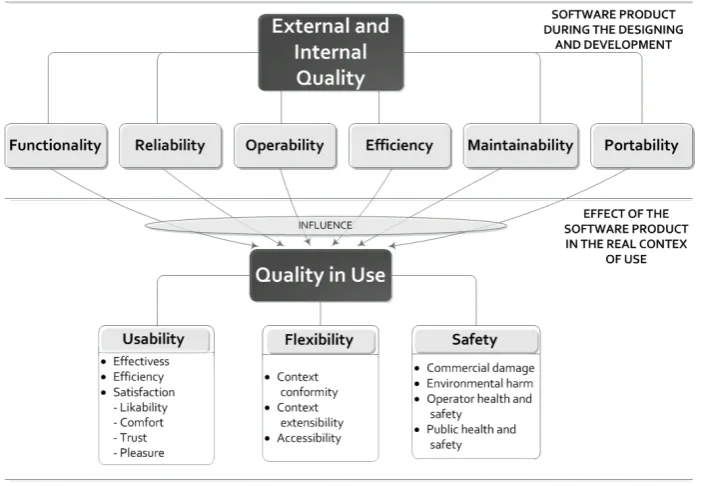
Figure 1: Quality model for achieving Quality in Use based on ISO IEC CD 25010.3
designing and coding. Internal metrics provide users, evaluators, testers, and developers with the benefit that they are able to evaluate software product quality and address quality issues early before the software product becomes executable [ISO04].
External quality is the ’totality of characteristics of the software product from an external view’that provide us with metrics that use measures of a software product derived from mea-sures of the behavior of the system of which it is a part, by testing, operating and observing the executable software or system. Before acquiring or using a software product it should be evalu-ated using metrics based on business objectives relevalu-ated to the use, exploitation and management of the product in a real Context of Use. External metrics provide users, evaluators, testers, and developers with the benefit that they are able to evaluate software product quality during testing or operation [ISO04].
EvaluatingQuality in Usevalidates software quality in specific user-task scenarios. Quality in Useis the user’s view of the quality of a system containing software, and is measured in terms of the result of using the software, rather than properties of the software itself. AchievingQuality in Useis dependent on achieving the necessaryExternal quality, which in turn is dependent on achieving the necessaryInternal quality. Measures are normally required at all three levels, as meeting criteria for internal measures is not usually sufficient to ensure achievement of criteria for external measures, and meeting criteria for external measures is not usually sufficient to ensure achieving criteria forQuality in Use. The most complete Quality model for achieving
Usabilitywas given by ISO IEC CD 25010.3 [PB09] in the terms of achievingQuality in Useas presented inFig.1.
user, quality in use is mainly a result of Functionality, Reliability, Operability and Efficiency; for the person maintaining the software, quality in use is a result of Maintainability; for the person portingthe software, quality in use is a result of Portability. The new model for achieving
Quality in Useprovides a framework for a more comprehensive approach to specifying usability requirements and measuring usability with taking in account the stakeholder perspective.
To evaluate the achieved Quality in Use of DSLs in real context of use we find it most relevant to evaluate the following attributes of Usability and Flexibility (Fig.1):
• Effectivenessshould determine the accuracy and completion of the implementation of the sentences,
• Efficiency tells us what level of effectiveness is achieved at the expense of various re-sources, such as mental and physical effort, time or financial cost, and is commonly mea-sured in the sense of time spent to complete a sentence,
• Satisfactioncaptures freedom from inconveniences and positive attitude towards the use of the language and
• Accessibilitywith an emphasys on learnability and memorability of the language terms.
We need to find suitable quantitative and qualitative measures that will be reliable to capture the achieved goals. These attributes should contribute, in most cases, to the claimed productivity improvements of DSLs and can be evaluated as in [BAGB11a].
3
Usability Evaluation
3.1 General approach to Usability evaluation
Nielsen and Molich proposed evaluating usability in four ways [NM90];
Formallyby some analysis techniques.Evaluations using models and simulationscan predict measures such as time to complete a task or the difficulty of learning to use a product. Some models have the potential advantage that they can be used without the need for any prototype to be developed.
Automaticallyby a computerized procedure. This can be done byAutomated checking of con-formance to guidelines and standardsor byEvaluation of data collected during system usage. This kind of evaluation is possible when initial prototypes or initial versions of full implementa-tion are available.
Heuristically by simply looking at the product and passing judgment according to an own opinion. It is usually considered as Evaluation conducted by expert and it can be used when initial prototypes are available. Expert methods that do not use task scenarios are referred to as reviews or inspections, while task-based evaluations are referred to as walkthroughs. Conducting expert evaluation is recommended to identify as many usability issues as possible in order to eliminate them before conducting user-based evaluations.
Empiric and Heuristic approaches have been used to assess the usability of DSLs [MPGB00], [KMB+96], [HPD09], [BAGB11a], [KMC11]. The lessons learned from those works can be use-ful for establishing guidelines and devising tool support for DSL evaluation. These should then be combined with formal and automatic approaches, in a proposal for a cost-effective approach to usability assessment.
3.2 Software Engineering with Usability concerns
By allowing significant changes to correct deficiencies along the development process instead of just evaluating at the end of it (when it might be too late),User Centered Designcan reduce development and support costs, increase sales, and reduce staff cost for employers. The essential activities required to implementUser Centered Designare described in ISO 13407 [Bev05]:
• Plan and manage the human centered design process
• Understand and specify the context of use
• Specify the stakeholder and organizational requirements
• Produce design solutions
• Evaluate designs against requirements
has reached acceptable levels, integration of components and final implementation of the inter-active system may be required. Finally, once the system is released to users, an evaluation of its use in real contexts may be highly beneficial [PB09]. This kind of iterative evaluation ap-proach should be merged with DSL development cycle, so we can avoid unnecessary coasts of developing inadequate DSLs for its end users.
4
Evaluation of Programming Languages
Usability of GPLs is mostly indirectly measured by the size of the community that uses GPL. The rationale is that, if so many people are using this GPL, that says something about its usabil-ity. But there are also other sorts of evaluations on GPLs, namely benchmarks, feature-based comparisons and heuristic-based evaluations [Pre00]. Comparisons are done on different ver-sions of the same language or on the different languages focusing on some characteristic that indicate suitability of language to its intended Context of Use. There are also Heuristic-based evaluations that provide guidelines for evaluating syntax of visual languages based on the studies of cognitive effectiveness [Moo09].
When usability problems are only identified too late a common approach to mitigate them is to build tool support that minimizes their effect on users’ productivity [BJRT10], [PFHS09].
There is an increasing awareness to the usability of languages, fostered by the competition of language providers. Better usability is a competitive advantage, although evaluating it remains challenging, because it is hard to interpret existing metrics in a fair, unbiased way, which resists to external validity threats concerning the broad user groups, or internal ones - it is very easy to end up comparing apples with oranges, when evaluating competing languages.
In general, the software industry does not invest much on the evaluation of the usability of DSLs [GGA10]. It is unclear whether this results from an insufficient understanding of the SLE process which, in our opinion, must include the evaluation of the DSLs. Language engineers may perceive the investment in evaluation as an unnecessary cost and prefer to risk providing a solution which has not been validated, w.r.t. its usability, by end users. With anecdotal re-ports of 3-10 times productivity improvements, [KT00],[WL99],[Met07b], or “clearly boosted development speeds” [Met07a] in industrial settings, why bother with validation?
The problem, of course, is that anecdotal reports on improvements lack external validity. Other reports, such as [BJMH02], present maintainability and extensibility improvements brought by a combination of DSLs and Software Product Lines (SPL), but it is unclear which share of the merit belongs to DSLs and which should be credited to SPLs. The usage of DSLs has been favorably compared to the usage of templates in code generation, with respect to flexibility, reliability and usability [KMB+96]. Other work evaluates a visual language against a GPL for which it is a front-end [MPGB00]. Another success story can be found in [HPD09], where a survey conducted with users of a particular DSL clearly reports on noticeable improvements in terms of reliability, development costs, and time-to-market. The usability of that particular DSL and its toolset are among the most important success factors of DSL introduction in that context. But are these improvements typical, or exceptional? The honest answer can only be one: we do not know.
and how they are evaluated [GGA10]. Our review analyzed 15 of the most important scientific venues covering Software Languages Engineering, from 2001 to 2008. Out of over 640 papers published in those venues, we finally selected 36 which reported either on the process developing at least one DSL (33) or on experimental validation of DSLs (3). Only 3 of the inspected papers reported on using quantitative data in their DSL evaluation, while 2 papers reported the usage of qualitative data in DSL evaluation. 21 papers did not provide any information concerning how evaluation was performed. Finally, 10 papers do not report any kind of evaluation of the produced DSLs. Only 2 of the papers claim to have used industrial level validation, against 21 papers which report on toy examples. No details are available concerning the remaining 3 papers which may have performed some sort of evaluation. Only 3 papers report having used industrial, or specialized subjects in their DSL evaluation, while this information is unknown in the remaining cases where some sort of evaluation was conducted. Only 1 paper reports the usage of specific usability techniques, borrowed from the evaluation of GPLs. 6 other papers report on ad-hoc usability evaluation.
Overall, the level of DSL evaluation found in our survey can be considered low, and the details on the few performed evaluations are clearly insufficient. For instance it is often the case where information concerning who participated in the evaluation is missing. We do not know whether the final users participated in the evaluation at all, in most situations. We were not able to find compelling evidence supporting the improvement claims on DSL usage. Although this does not necessarily mean no usability evaluation is being performed, it sends the wrong message to practitioners who should be concerned with systematically evaluating the DSLs they produce. It should be noted that this kind of evaluation, comparing the impact of different languages in the software development process has some tradition, in the context of GPLs (e.g. [Pre00]) and their impact on developer productivity. Why should this be different with DSLs?
5
Discussion on DSL Usability Evaluation proposal
In order to propose a process for performing Usability evaluation on DSLs, we first must ask what are the main goals of a software language engineer when devise a new DSL. The main design objectives for building a new DSL are:
• To build a comprehensive language that captures domain expressivity.
• To achieve compliance with existing standards in a given domain.
• To overcome previously identified problems in the domain.
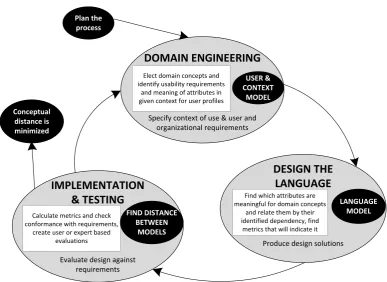
As in other usability evaluation methodologies, Usability evaluation should be embedded in the DSL development pocess itself, and considered from the beginning of its development to-gether with User Centered Design activities fromSection3.2as we propose inFig.2. According to our proposal, Usability requirements should be identified during domain engineering phase
DOMAIN ENGINEERING
Specify context of use & user and organizational requirements Elect domain concepts and identify usability requirements
and meaning of attributes in given context for user profiles
USER & CONTEXT
MODEL
DESIGN THE LANGUAGE
Produce design solutions Find which attributes are meaningful for domain concepts
and relate them by their identified dependency, find
metrics that will indicate it
LANGUAGE MODEL
IMPLEMENTATION & TESTING
Evaluate design against requirements Calculate metrics and check conformance with requirements,
create user or expert based evaluations FIND DISTANCE BETWEEN MODELS Plan the process Conceptual distance is minimized
Figure 2: Evaluation Process for DSLs’ Usability.
about their working environment and the products that are already used within the domain. It is necessary to identify characteristics that the users find useful, frustrating or lacking while using the existing approach to solve the problem, and group them in the usability requirements. Con-necting usability requirements to conceptual dimensions we can identify what quality means in a specific context of use for the end user.
In the language design phase, the language engineer should elect which quality attributes fromFig. 1are connected to the domain concepts according to requirements. For each domain concept, he should identify or predict both its frequency and relevance within the domain, that should be obtained from the precisely defined questionnaire. He can do it by assigning weights between quality attributes and domain concepts according to their influence on final Usability of the language [BAGB11b]. To produce pertinent usability metrics and tests from collected information it is important to know which attributes will contribute to achieve Quality in Use .
real problems to solve in order to cover the most important tasks identified in the domain. Data about satisfaction and cognitive workload should also be evaluated subjectively through ques-tionnaires. It is especially important in this phase to measure all the learnability issues, since DSLs should be (in principle) easy to learn and remember. Of course, in order to certify that we are creating a good DSL we should conduct a comparative analysis with previous products that are already used in the domain and also were built to achieve the same goals. Examples of the user based evaluations of DSLs, that presents examples of tasks and questions that are constructed to measure achieved Quality in Use can be seen in [BAGB11a] and [KMC11].
The main idea is that we can measure the distance between the language model and the user-context model during language development through defined Internal and External quality met-rics that influence Usability. The smaller the conceptual distance, higher the level of achieved Quality in Use.
6
Conclusions and Future Work
The software industry, in general, does not seem to invest much on the evaluation of DSLs. However, since DSLs are built for a specific domain of use in order to close the gap between domain experts and software engineers, we find that it is essential to evaluate their usability.
Usability is the main quality attribute while performing UI evaluation. If we consider DSLs as a kind of UIs, then we find that evaluating DSL’s Usability can bring a positive influence on their users’ productivity. Moreover, unlike other software products, DSL’s Usability evaluation can be an accurate activity, since precisely defined DSLs can target specific Contexts of Use, inside a particular set of user profiles.
The main contribution of this paper is the proposal of an evaluation process for DSLs’ Us-ability that is to be applied during DSLs’ life-cycle. With this evaluation process we are able to evaluate Usability of a DSL in early stages of its development in order to predict its outcome w.r.t. Usability and prevent user-interaction mistakes, hence achieving a usable DSL by construction.
As future work, we will instantiate our proposed DSL evaluation process in the construction of new DSLs which will take into account the Usability aspect from the very beginning of their development. From this instantiation, we expect to devise languages and tools that can effectively and automatically measure the identified Usability factors early and during DSLs’ development.
Bibliography
[AK03] C. Atkinson, T. K¨uhne. Model-Driven Development: A Metamodeling Foundation.
IEEE Softw.20:36–41, September 2003.
doi:10.1109/MS.2003.1231149
http://portal.acm.org/citation.cfm?id=942589.942704
http://ecs.victoria.ac.nz/twiki/pub/Events/PLATEAU/Program/ plateau2011-barisic.pdf
[BAGB11b] A. Bariˇsi´c, V. Amaral, M. Goul˜ao, B. Barroca. Quality in Use of DSLs: Current Evaluation Methods. Proceedings of the 3rd INForum - Simp´osio de Inform´atica (INForum2011), September 2011.
[Bev95] N. Bevan. Measuring usability as quality of use. Software Quality Journal
4(2):115–130, 1995.
[Bev05] N. Bevan. Cost benefits framework and case studies.Cost-Justifying Usability: An Update for the Internet Age. Morgan Kaufmann, 2005.
[Bev09] N. Bevan. Extending quality in use to provide a framework for usability measure-ment.Human Centered Design, pp. 13–22, 2009.
[BJMH02] D. Batory, C. Johnson, B. MacDonald, D. v. Heeder. Achieving extensibility through product-lines and domain-specific languages: a case study.ACM Trans-actions on Software Engineering and Methodology11(2):191–214, 2002.
[BJRT10] R. Bellamy, B. John, J. Richards, J. Thomas. Using CogTool to model program-ming tasks.Evaluation and Usability of Programming Languages and Tools, p. 1, 2010.
[Cat00] T. Catarci. What happened when database researchers met usability.Information Systems25(3):177–212, 2000.
[DK98] A. V. Deursen, P. Klint. Little Languages: Little Maintenance?Journal of Software Maintenance: Research and Practice10(2):75–92, 1998.
[GGA10] P. Gabriel, M. Goul˜ao, V. Amaral. Do Software Languages Engineers Evaluate their Languages?Proceedings of the XIII Congreso Iberoamericano en” Software Engineering”(CIbSE’2010), Universidad del Azuay, Cuenca, Ecuador, pp. 149– 162, April 2010.
[GRT04] J. Gray, M. Rossi, J.-P. Tolvanen. Preface.Journal of Visual Languages and Com-puting, Elsevier15:207–209, 2004.
[HPD09] F. Hermans, M. Pinzger, A. V. Deursen. Domain-Specific Languages in Practice: A User Study on the Success Factors. In12th International Conference on Model Driven Engineering Languages and Systems. Volume 5795/2009, pp. 423–437. Lecture Notes in Computer Science, Denver, Colorado, USA, 2009.
[Kle09] A. Kleppe. Software language engineering: creating domain-specific languages using metamodels. Addison-Wesley, 2009.
[KMC11] T. Kosar, M. Mernik, J. Carver. Program comprehension of domain-specific and general-purpose languages: comparison using a family of experiments.Empirical Software Engineering, pp. 1–29, 2011.
doi:10.1109/MS.2003.1231149
[KT00] S. Kelly, J.-P. Tolvanen. Visual domain-specific modelling: benefits and experi-ences of using metaCASE tools. In B´ezivin and Ernst (eds.),International Work-shop on Model Engineering, at ECOOP’2000. 2000.
[Met07a] MetaCase. EADS Case Study, http://www.metacase.com/papers/MetaEdit in EADS.pdf. Technical report, MetaCase, 2007.
[Met07b] MetaCase. Nokia Case Study, http://www.metacase.com/papers/MetaEdit in Nokia.pdf. Technical report, MetaCase, 2007.
[MHS05] M. Mernik, J. Heering, A. M. Sloane. When and How to Develop Domain-Specific Languages.ACM Computing Surveys37(4):316–344, 2005.
[Moo09] D. Moody. The physics of notations: Toward a scientific basis for constructing vi-sual notations in software engineering.IEEE Transactions on Software Engineer-ing, pp. 756–779, 2009.
[MPGB00] N. Murray, N. Paton, C. Goble, J. Bryce. Kaleidoquery–a flow-based visual lan-guage and its evaluation.Journal of Visual Languages & Computing 11(2):151– 189, 2000.
[NM90] J. Nielsen, R. Molich. Heuristic evaluation of user interfaces.Proceedings of the SIGCHI conference on Human factors in computing systems: Empowering people, pp. 249–256, 1990.
[ISO04] International Standard Organization. ISO/IEC 9126 Quality Standards. 2004.
http://www.iso.org/iso/
[PB09] H. Petrie, N. Bevan. The evaluation of accessibility, usability and user experience.
The Universal Access Handbook, 2009.
[PFHS09] K. Phang, J. Foster, M. Hicks, V. Sazawal. Triaging Checklists: a Substitute for a PhD in Static Analysis.Evaluation and Usability of Programming Languages and Tools (PLATEAU) PLATEAU 2009, 2009.
[Pre00] L. Prechelt. An Empirical Comparison of Seven Programming Languages.IEEE Computer33(10):23–29, 2000.