© 2020 by the Serbian Biological Society How to cite this article: Mishra M, Sharma A, Dagar VS, Kumar S. Effects of 271 β-sitosterol on growth, development and midgut enzymes of Helicoverpa armigera Hübner. Arch Biol Sci. 2020;72(2):271-8.
Effects of β-sitosterol on growth, development and midgut enzymes of
Helicoverpa
armigera
Hübner
Monika Mishra, Aarti Sharma, Vinay Singh Dagar and Sarita Kumar*
Department of Zoology, Acharya Narendra Dev College (University of Delhi), Kalkaji, New Delhi 110019, India
*Corresponding author: [email protected]; [email protected]
Received: March 8, 2020; Revised: April 28, 2020; Accepted: May 8, 2020; Published online: May 12, 2020
Abstract: Helicoverpa armigera is a global agricultural pest of serious concern. Continued use of chemical insecticides as
control measures has raised grave health and environment concerns, necessitating a search for botanicals as safe alternatives. The current study investigates the effects of β-sitosterol, a bioactive phytocomponent in Thevetia neriifolia, on the growth and development, as well as on midgut enzymes of H. armigera. Dietary β-sitosterol produced dose-dependent systemic toxicity and growth inhibitory effects in H. armigera; the most significant effects were obtained with 10 µg/mL dietary β-sitosterol. Higher prepupal and pupal mortality in comparison to larval mortality and a comparatively greater reduction in average weight gained by later instars point to cumulative effects of β-sitosterol. The delayed effects were ascertained by the 82.05%-57.89% reduction in adult emergence in comparison to 95.02% emergence in controls. Dose-dependent effects of β-sitosterol were observed as significantly decreased enzyme activities of alanine aminotransaminase (ALT), aspartate aminotransaminase (AST) and alkaline phosphatase (ALP) in the larval midgut. Suppression of enzyme activity was obtained in the order ALT>AST>ALP. Impaired activity of gut enzymes possibly lowered the energy reserves and affected nutrient transport through the gut epithelium, affecting the growth and development of H. armigera. Our study points to a promising use of β-sitosterol against H. armigera, although further examination and field studies are needed to ascertain its possible use in control programs.
Keywords: Helicoverpa armigera; β-sitosterol; alanine aminotransaminase; aspartate aminotransaminase; alkaline phosphatase
INTRODUCTION
Helicoverpa armigera is a widely spread destructive pest of many important agricultural crops in Asia, Africa, Australia and Europe [1]. Commonly known as cot-ton bollworm, the pest feeds on a wide geographical range of host plants, possesses the ability to adapt to new ecosystem and causes great economic losses to cultivated crops [2]. In India alone, this highly poly-phagous insect feeds on about 181 plant species spread across 68 botanical families [3]. So far, the major tool applied to keep this pest under check was spraying of crop fields with chemical insecticides. However, this has resulted in the persistent occurrence of residual insecticides in foodstuff and drinking water, raising grave health concerns. The adverse effects of insecticides in the environment has resulted in ecological imbal-ance, emergence of more aggressive and resistant pests and the elimination of valuable non-target organisms [4]. Several studies have reported the development of
resistance in H. armigera against almost every group of chemical insecticides [5-10]. All this has raised the necessity to explore and develop novel and eco-safe strategies for H. armigera control.
in order to devise novel eco-friendly molecules with practical application in the field.
Our previous studies have shown the significant effects of the dietary stem extract of Thevetia neriifolia on larval growth, development and midgut enzymes of H. armigera [4,13-15]. The extract of T. neriifolia could diminish the levels of phosphatases and transaminases in H. armigera. These enzymes play several functions in the insect body and display an important growth diagnostic potential [16]. Alkaline phosphatase (ALP), a brush border membrane marker enzyme [17], is ac-countable for tissue cytolysis during insect development [18] while transaminases are key enzymes in the for-mation of non-essential amino acids, gluconeogenesis, and the metabolism of nitrogenous compounds and protein [19]. Involvement of midgut transaminases in the Krebs cycle and energy production affects insect growth and development considerably [20]. Thus, any deviation in these enzymes indicates the adverse ef-fects on gut physiology and growth and development of the target insect.
Gas chromatography-mass spectrometry (GC-MS) analysis of T. neriifolia stem extract has revealed the presence of a number of components, with β-sitosterol as one of the important bioactive constituents [15,21]. β-sitosterol is a dominant phytosterol widespread in plants, animals as well as fungi [22]. It is structurally similar to cholesterol and is converted to cholesterol by phytophagous insects for their growth and repro-duction [23-25]. It has also been observed as a feeding incitant in silkworms, Bombyx mori [26].
Various reports, however, have suggested that a few insects are incapable of converting β-sitosterol to cholesterol, which may affect their growth and devel-opment [27-29]. Incorporation of β-sitosterol in the diet of Dermestes maculatus inhibited its larval devel-opment and transformation into the pupal stage [27]. Treatment of Pieris rapae 5th instars with β-sitosterol
affected their biochemical profile by reducing the protein and glycogen contents of hemolymph [28]. β-sitosterol, isolated from the petroleum ether extract of Abutilon indicum, has been found to be toxic against Culex quinquefasciatus [29].
According to available reports, the efficacy and potential use of β-sitosterol as a possible control agent of H. armigera has not been investigated. As a continuation
of our previous work, in the present study we explored the effects of dietary stress caused by β-sitosterol on the growth and development, as well as on three mid-gut enzymes, alanine aminotransaminase, aspartate aminotransaminase and alkaline phosphatase, of H. armigera. The outcome of the study may help in devis-ing a novel and eco-friendly control strategy.
MATERIALS AND METHODS
Rearing and maintenance of H. armigera under controlled conditions
The culture of H. armigera was maintained in a Bio-logical Oxygen Demand (BOD) incubator under controlled conditions of 27±1°C temperature and 80±5% relative humidity, with a photoperiod of 12 h daylight/12 h dark [13].
Experimental diet
β-sitosterol was obtained from Sigma Aldrich, US (<99% purity). Dilutions were made in ethanol and stored at 4°C. An artificial diet for H. armigera was prepared using chickpea flour [15]. A preliminary toxicity and antifeedant bioassay was conducted with β-sitosterol against H. armigera on the basis of which three concentrations of β-sitosterol, 10, 1 and 0.1 µg/ mL, which exhibited insignificant toxic and antifeedant activity, were selected to evaluate their impact on the growth parameters of H. armigera. The experimental diets possessing final concentrations of 10, 1 and 0.1 µg/mL β-sitosterol were prepared by replacing one part of the 200 mL of dry diets with the required concentra-tion of β-sitosterol. The diet was solidified using agar after evaporation of the solvent. The diet containing only the solvent served as the control.
Examination of the effects of dietary stress of β-sitosterol on H. armigera growth parameters
emergence were recorded. Morphological aberrations in the developmental stages and hormone-mimetic effects exerted by dietary stress of β-sitosterol were also noted. Controls were run simultaneously.
Effect of dietary stress of β-sitosterol on gut enzymes of H. armigera
The effect of dietary β-sitosterol was investigated on three midgut enzymes of H. armigera, alanine aminotransaminase (ALT), aspartate aminotransami-nase (AST) and alkaline phosphatase (ALP). Fourth instars of H. armigera were randomly selected from the experimental linesreared on 0.1, 1 and 10 µg/mL of β-sitosterol and killed at -20°C. The midgut was carefully excised, homogenized in ice-cold phosphate buffer (pH 7.0) for 5 min and centrifuged at 13226×g for 30 min at 4°C. The supernatant was used for esti-mation of enzyme activity. Each assay was conducted in 5 replicates, each containing 10 larvae. Respective control sets were reared simultaneously. The protein content of the samples was quantified using bovine serum albumin (BSA) as standard according to the Bradford protocol [30]. A volume of 800 µL of each standard and sample solution was separately mixed with 200 µL of Bradford reagent followed by incubation in the dark at 37°C. The absorbance was read at 595 nm.
Estimation of ALT activity
The activity of alanine aminotransaminase (ALT) and aspartate aminotransaminase (AST) was determined based on the method of Reitman and Frankle [31]. A volume of 500 µL of Reagent A (2.8 M L-alanine and 7 mM α-ketoglutarate in 0.1 M phosphate buffer, pH 7.4) was incubated at 37°Cfor 3 min in a water bath and added to 100 µL of larval tissue homogenate, incubated again at 37°Cfor 60 min, followed by the addition of 500 µL of Reagent B (1 mM 2,4 dinitrophenyl hydra-zine in 1N HCl). The mixture was kept at 25°C for 20 min after which 5.0 mL of 0.4 N NaOH solution was added to stop the reaction. The mixture was incubated at 25°C for 5 min and absorbance was measured at 505 nm. The pyruvate standard was used to prepare the calibration curve. ALT activity was expressed as moles of pyruvate formed from α-ketoglutarate per mg of total protein per h.
Estimation of AST activity
AST activity was estimated following a similar procedure to that described for ALT, but with minor modifica-tions. Reagent A was replaced by a mixture consisting of 75 mM L-aspartic acid and 17 mM α-ketoglutarate in 0.1 M phosphate buffer (pH 7.4). AST activity was expressed as moles of oxaloacetate formed from α-ketoglutarate per mg of total protein per h.
Estimation of ALP activity
The activity of alkaline phosphatase (ALP) was deter-mined based on the method described in [32] but with modifications. One mL of bicarbonate and carbonate buffer (0.1 M, pH 10.4) each was mixed with 1.0 mL of 0.02 M disodium phenyl phosphate and incubated at 37°C for 3 min. One hundred µL of tissue homogenate was added to the mixture which was incubated for 15 min at 37°C. The volumes of 800 µL of 0.5 M NaOH, 1.2 mL of 0.5 M NaHCO3, 1.0 mL of 4-aminoantipyrine and 1.0 mL of potassium ferricyanide were added, mixed and the absorbance was recorded at 510 nm. ALP activity was expressed as moles of phenol formed from phenyl phosphate per mg of total protein per h.
Statistical analysis
Data obtained from growth and development bioassays and estimation of enzyme activities were subjected to analysis of variance (ANOVA). The means were separated using Tukey’s post hoc honestly significant difference (HSD) test for statistical significance con-sidered for P≤0.05.
RESULTS
Effect of β-sitosterol on the growth parameters of H. armigera
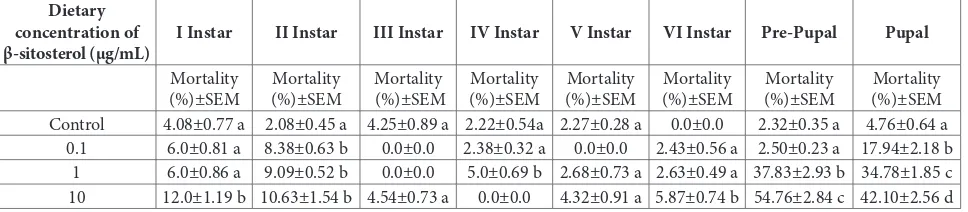
A pronounced lethal and dose-dependent effect of 0.1, 1.0 and 10.0 µg/mL dietary β-sitosterol was recorded on the 2nd larval instars and pupal stages of H. armigera
β-sitosterol did not result in any mortality in 4th instars
although a significant mortality was recorded with 1.0 µg/mL dietary β-sitosterol (P<0.05). Results showed a direct correlation between the dietary concentration of β-sitosterol and its systemic toxicity on H. armigera developmental stages (Table 1).
The growth inhibitory effects of dietary β-sitosterol in H. armigera were shown by reduced average weight gain in the larvae during development (Table 2). Most significant effects (P<0.05) were revealed by the rearing of H. armigera neonates on the 10.0 µg/ mL β-sitosterol-containing diet, which reduced the mean weight of 6th instars and prepupae by 56.04%
and 59.93%, respectively, in comparison to the weight gained by control larvae (P<0.05). Less pronounced adverse effects were observed with 1.0 µg/mL dietary β-sitosterol, which caused a 39.74% reduction in weight gain in 6th instars (Table 2). The 0.56- and 0.37-fold
decreases in pupal weight with dietary 1.0 and 10.0 µg/mL β-sitosterol, respectively (P<0.05), further confirmed its growth inhibitory effects (Table 3). Di-etary β-sitosterol also reduced adult emergence in H. armigera, resulting in 82.05-57.89% adult emergence as compared to 95.02% emergence observed in con-trols (P<0.05) (Fig. 1). However, β-sitosterol could not
induce any hormone-mimetic effects specified by the absence of larval-pupal or pupal-adult intermediates, and deformed adults during development.
Effect of β-sitosterol on the midgut enzymes of H. armigera
Among the three midgut enzymes investigated, the control set of H. armigera showed maximum activ-ity for ALP, followed by ALT and AST. A significant decrease in all three midgut enzymes of H. armigera
Table 1. Mortality (%) at different developmental stages of Helicoverpa armigera when reared on a β-sitosterol-containing diet. Dietary
concentration of
β-sitosterol (µg/mL) I Instar II Instar III Instar IV Instar V Instar VI Instar Pre-Pupal Pupal
Mortality
(%)±SEM (%)±SEMMortality (%)±SEMMortality (%)±SEMMortality (%)±SEMMortality (%)±SEMMortality (%)±SEMMortality (%)±SEMMortality
Control 4.08±0.77 a 2.08±0.45 a 4.25±0.89 a 2.22±0.54a 2.27±0.28 a 0.0±0.0 2.32±0.35 a 4.76±0.64 a
0.1 6.0±0.81 a 8.38±0.63 b 0.0±0.0 2.38±0.32 a 0.0±0.0 2.43±0.56 a 2.50±0.23 a 17.94±2.18 b
1 6.0±0.86 a 9.09±0.52 b 0.0±0.0 5.0±0.69 b 2.68±0.73 a 2.63±0.49 a 37.83±2.93 b 34.78±1.85 c
10 12.0±1.19 b 10.63±1.54 b 4.54±0.73 a 0.0±0.0 4.32±0.91 a 5.87±0.74 b 54.76±2.84 c 42.10±2.56 d
Mean±SEM, calculated for five replicates, each replicate contains 10 larvae; means in each column followed by the same letters are not significantly different (P<0.05, one-way ANOVA followed by Tukey’s all pair wise multiple comparison test)
Table 2: Effect of dietary β-sitosterol on Helicoverpa armigera larval and prepupal weight.
Dietary concentration of β-sitosterol (µg/mL)
Mean weight of III instars (g) ± SEM
Mean weight of IV instars (g)
± SEM
% Change in weight
Mean weight of V instars (g)
± SEM
% Change
in weight Mean weight of VI instars (g) ± SEM
% Change in weight
Mean weight of pre-pupae (g) ± SEM
% Change in weight
Control 0.0391 ± 0.0013 a 0.1282 ± 0.0062 a 227.87 (+) 0.3014 ± 0.0199 a 135.10 (+) 0.4926 ± 0.0141 a 63.43 (+) 0.4641 ± 0.0131 a 5.80 (-) 0.1 0.0447 ± 0.0034 a 0.1333 ± 0.0076 a 198.21 (+) 0.2995 ± 0.0142 a 124.68 (+) 0.4231 ± 0.0173 b 41.26 (+) 0.3916 ± 0.0165 b 7.44 (-) 1 0.0392 ± 0.0062 a 0.1026 ± 0.0162 a 161.73 (+) 0.2168 ± 0.0152 b 111.3 (+) 0.2968 ± 0.0281 c 36.91 (+) 0.2763 ± 0.0130 c 6.90 (-) 10 0.0442 ± 0.0014 a 0.0911 ± 0.0081 b 106.81 (+) 0.1721 ± 0.0103 b 89.12 (+) 0.2165 ± 0.0101 c 25.79 (+) 0.1906 ± 0.0056 d 11.96(-) Mean±SEM, calculated for five replicates, each replicate contains 10 larvae; (+)indicates weight gain, (-)indicates a decrease in the weight of larvae and pupae; means in each column followed by the same letters are not significantly different (P<0.05, one-way ANOVA followed by Tukey’s all pair wise multiple comparison test)
Table 3: Effect of dietary β-sitosterol on Helicoverpa armigera
pupal weight. Dietary concentration of β-sitosterol (µg/mL)
Mean weight of pre-pupa
(g) ±SEM
Mean weight of pupae (g) ±
SEM
% Change in weight (-)
Control 0.4641±0.0131 a 0.4317±0.0112 a 6.98
0.1 0.3916±0.0161 b 0.3534±0.0171 b 9.75
1 0.2763±0.0130 c 0.2452±0.0115 c 11.25
10 0.1906±0.0056 d 0.162 ±0.0056 d 14.53
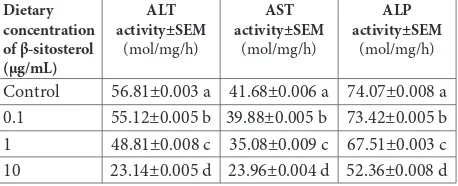
larvae was observed with dietary β-sitosterol (P<0.05). The suppression was dose-dependent, increasing with the rise in dietary concentration (Table 4, Fig. 2). The decrease in enzyme activity was recorded in the order of ALT>AST>ALP, indicating more pronounced ef-fects of β-sitosterol on the transaminases (P<0.05) in comparison to the phosphatase. In comparison to the control diet, 10.0 µg/mL dietary β-sitosterol reduced ALT activity by 59.17% (r=-0.9944), AST activity by 42.51% 0.9767), and ALP activity by 29.31% (r=-0.9812) (Table 4, Fig. 2).
DISCUSSION
Plants possess a pool of secondary metabolites, which have a defensive role against herbivores, such as repel-lency, feeding deterrence, insecticidal activity, growth regulation, and other effects. These bioactive molecules are continuously explored by researchers owing to their non-detrimental effects on non-target hosts and the environment [33]. Our earlier studies described the effective use of T. neriifolia extracts against H. ar-migera [13,14]. Among various bioactive constituents identified in the T. neriifolia extract, β-sitosterol was reported to possess insect growth regulatory activity [4]. Likewise, the leaf extract of Melochia corchorifolia, whichwas found to be an effective antifeedant against H. armigera, Spodoptera litura, Earias vittella and Leucinodes orbonalis,contained sterols as one of the bioactive constituents [34].
Development of H armigera larvae on the β-sitosterol-containing diet adversely impacted their growth and development. Substantial mortality was observed in prepupal and pupal stages as compared to the larval in-stars, which could be due to the accumulated β-sitosterol in the body leading to various physiological changes. The decline in the weights of later instars and pupal stages due to dietary β-sitosterol pointed to delayed growth inhibitory effects. These results are in agree-ment with the work carried out on other insect pests with β-sitosterol, where growth regulatory activities of sitosterol were reported against Spodoptera littoralis [35]. The sitosterol isolated from Anemone pavonina has been found to effectively control Pheidole pallidula ants [36]. Although not much study has been carried out on β-sitosterol, other components isolated from different plants have been investigated for their possible effects
Fig. 1. Percent adult emergence in Helicoverpa armigera larvae reared on the control diet and diet containing 0.1, 1 and 10 µg/mL β-sitosterol. Larvae were reared in five replicates, each replicate contained 10 larvae. Bars (±SEM) with different letters differ sig-nificantly (P<0.05, one-way ANOVA followed by Tukey’s all pair wise multiple comparison test).
Fig. 2. Correlation between the dietary concentration of β-sitosterol and activity of alanine aminotransaminase, aspartate aminotransami-nase and alkaline phosphatase in the midgut of Helicoverpa armigera
IV instars.
Table 4. Effect of dietary β-sitosterol on the activity of midgut enzymes (mol/mg/h) in Helicoverpa armigera early IV instars.
Dietary concentration of β-sitosterol (µg/mL)
ALT activity±SEM
(mol/mg/h)
AST activity±SEM
(mol/mg/h)
ALP activity±SEM
(mol/mg/h)
Control 56.81±0.003 a 41.68±0.006 a 74.07±0.008 a
0.1 55.12±0.005 b 39.88±0.005 b 73.42±0.005 b
1 48.81±0.008 c 35.08±0.009 c 67.51±0.003 c
10 23.14±0.005 d 23.96±0.004 d 52.36±0.008 d
on insect pests. β-amyrin isolated from the methanol extracts of Sarcostemma acidum possessed antifeedant and growth regulatory activity against S. litura [37]. β-sitosterol displayed higher efficacy than α-amyrin acetate isolated from Catharanthus roseus leaves that reduced larval growth in H. armigera by 35.71% [38]. Similarly, the α-tocopherol isolated from Ailanthus altissima inhibited 76% of larval growth in S. littoralis when reared on 25 μg/cm2 dietary α-tocopherol with
an ED50 value of 222 μg/cm2 [39]. Citronellol displayed
cidal potential against lepidopterans [40].
The dietary β-sitosterol also adversely affected percent adult emergence in H. armigera; the total emergence varying from 82.05% to 57.89% as compared to 95.02% emergence in the controls. Phytophagous insects convert β-sitosterol to cholesterol, using it for growth and reproduction [23-25]. In the present study, the adverse effects of β-sitosterol on growth and de-velopment of H. armigera may possibly be due to the non-conversion of β-sitosterol into cholesterol, leading to its accumulation in the body and causing adverse effects. In a comparable study, flavonoids were reported to negatively impact the growth and development of H. armigera, and also exerted dose-dependent effects on adult growth and emergence [41]. In contrast to our study, emergence of deformed adults was reported with flavonoids, with the number directly proportional to the concentration of the extract [41]. This suggests that β-sitosterol does not exert any negative effects on the endocrine system of H. armigera.
The effect of β-sitosterol on H. armigera estimated on AST, ALT and ALP, resulted in a significant reduc-tion of their activities in a dose-dependent manner. Higher dietary concentrations of β-sitosterol caused more suppression of the enzymatic activity, resulting in negative correlation coefficients. As transaminases are involved in energy production in the Krebs cycle, [20], and ALP plays an active role in membrane transport in intestinal epithelial cells [42, 43], Malpighian tubules [44] and hemolymph [45], any impairment in their activities will have a direct impact on the growth and development of insects. A significant 59.17% reduc-tion in ALT activity in β-sitosterol-fed H. armigera larvae indicates reduced energy levels, which may have hampered larval growth and development. Similar reduced midgut enzymatic activities of transaminases and phosphatases were reported in Cnaphalocrocis
medinalis, the rice leaf folder, fed on a diet containing Azadirachta indica and Vitex negundo extracts [46]. The effects of different categories of toxic compounds (pyriproxyfen, neemazal and spinetoram) were inves-tigated on the activities of acid phosphatase, alkaline phosphatase, glutamic oxaloacetic transaminase and glutamine pyruvic transaminase in both hemolymph and fat body of the red palm weevil, Rhynchophorus ferrugineus 5th instars [16]. Among all of the compounds,
spinetoram was found to be the most potent compound, inducing maximum reduction in transaminase and phosphatase activities [16]. In contrast to the present result showing reduced ALT and ASP activities in 4th instars of H. armigera after feeding on 10 µg/mL
β-sitosterol, increased activity of ALT and AST was demonstrated in 4th instar larvae of S. littoralis after
feeding with lufenuron [47].
The decreased activity in ALP was also induced in Bombyx mori and crickets when subjected to different stress conditions, diseases and toxic chemicals [48-49]. Six essential oils extracted from garlic (Allium sativum), mint (Mentha piperita), basil (Ocimum basilicum), thyme (Thymus vulgaris), sesame (Sesamum indicum) and chamomile (Chamaemelum nobile) decreased ALP activity in Tribolium confusum adults and last larval instar, with a maximum reduction of 18% observed with chamomile [50]. Our results are in accordance with the inhibition of ALP activity in Euprepocnemis plorans obtained after feeding on limonoids [51].
The presented results suggest that β-sitosterol has the potential to disrupt physiological process and activities that are essential for the survival, acceptable growth and development of H. armigera. Reduced lar-val growth and adult emergence may be attributed to inadequate metabolism of β-sitosterol resulting in its accumulation in the body. The diminished transami-nases in the midgut caused by β-sitosterol probably led to a reduction in energy reserves because of an inefficient Krebs cycle. On the other hand, reduced phosphatases likely affected nutrient transport through the gut. However, these assumptions need further study in order to ascertain the effects at the cellular level.
could help in devising a novel and eco-friendly strategy for Helicoverpa management.
Funding: The authors are grateful to the Council of Scientific and Industrial Research, New Delhi [Grant No. 08/529(0004)2017] for providing the research fellowship to carry out the investigations.
Acknowledgements: The authors would like to thank the Principal, Acharya Narendra Dev College for providing the laboratory and culture facilities to conduct the experimental work.
Author contributions: All the authors contributed to the study conception and design. Material preparation data collection and analysis were performed by Monika Mishra, Aarti Sharma, Vinay Singh Dagar and Sarita Kumar. The first draft of the manuscript was written by Monika Mishra and all authors contributed to the editing of the manuscript. All authors read and approved the final manuscript.
Conflict of interest disclosure: The authors report that there is no conflict of interest.
REFERENCES
1. Kriticos DJ, Ota N, Hutchison WD, Beddow J, Walsh T, Tay WT, Borchert DM, Silvana Paula-Moreas SV, Czepak C, Zalucki MP. The potential distribution of invading Helicov-erpa armigera in North America: Is it just a matter of time? Plos One. 2015;10(3):1-24.
2. Packiam SM, Baskar K, Ignacimuthu S. Ovicidal activity of botanical oil formulations against Helicoverpa armig-era Hübner (Lepidoptera: Noctuidae). Int J Agric Tech. 2013;9(3):553-63.
3. Cunningham JP, Zalucki MP. Understanding heliothine (Lepidoptera: Heliothinae) pests: what is a host plant? J Econ Entomol. 2014;107(3):881-96.
4. Mishra M, Gupta KK, Kumar S. Growth regulatory and growth inhibitory effects of Thevetia neriifolia stem extracts on Helicoverpa armigera (Lepidoptera: Noctuidae). Arch Phytopathol Plant Prot. 2018;51:895-914.
5. Armes NJ, Jadhav DR, De Souse KR. A survey of insecticide resistance in Helicoverpa armigera in the Indian subconti-nent. Bull Entomol Res. 1996;86(5):499-514.
6. Kranthi KR, Jadhav D, Wanjari R, Kranthi S, Russell D. Pyrethroid resistance and mechanisms of resistance in field strains of Helicoverpa armigera (Lepidoptera: Noctuidae). J Econ Entomol. 2001;94:253-63.
7. Vila TLM, Rodriguez MMC, Lacasa PA, Bielza LP. Insecti-cide resistance of Helicoverpa armigera to endosulfan, car-bamates and organophosphates: The Spanish case. J Crop Prot. 2002;21(10):1003-13.
8. Thibaud M, Ochou OG, Maurice V, Didier F. Organophos-phorus insecticides synergize pyrethroids in the resistant strain of cotton bollworm, Helicoverpa armigera (Hübner) (Lepidoptera: Noctuidae) from West Africa. J Econ Entomol. 2003;96(2):468-74.
9. Yang Y, Li Y, Wu Y. Current status of insecticide resistance in Helicoverpa armigera after 15 years of Bt cotton planting in China. J Econ Entomol. 2013;106(1):375-81.
10. Tossou E, Tepa-Yotto G, Kpindou OKD, Sandeu R, Datinon B, Zeukeng F, Akoton R, Tchigossou GM, Djègbè I, Vontas J, Martin T, Wondji C, Tamò M, Bokonon-Gant AH, Djouaka R. Susceptibility profiles of Helicoverpa armigera (Hübner) (Lepidoptera: Noctuidae) to deltamethrin reveal a contrast between the Northern and the Southern Benin. Int J Environ Res Publ Hlth. 2019;16:1-15.
11. Williams LAD. Rhizophora mangle (Rhizophoraceae) trit-erpenoids with insecticidal activity. Naturwissenschaften. 1999;86:450-2.
12. Hikal WM, Baeshen RS, Said-Al Ahl HAH. Botanical insec-ticide as simple extractives for pest control. Cogent Biol. 2017;3:1-16.
13. Mishra M, Gupta KK, Kumar S. Impact of the stem extract of Thevetia neriifolia (Apocynaceae) on food consumption and growth of early fourth instars of Helicoverpa armigera. Malaya J Biosci. 2015;2(1):26-35.
14. Mishra M, Gupta KK, Kumar S. Impact of the stem extract of
Thevetia neriifolia on the feeding potential and histological architecture of the midgut epithelial tissue of early fourth instars of Helicoverpa armigera Hübner. Int J Insect Sci. 2015;7:53-60.
15. Mishra M, Gupta KK, Kumar S. Diminished activity of lar-val midgut transaminases and phosphatases in Helicoverpa armigera Hübner (Lepidoptera) induced by dietary stem extracts of Thevetia neriifolia. J Lep Soc. 2019;73(1):23-33. 16. Hamadah KS. Disturbance of phosphatase and transaminase
activities in grubs of the red palm weevil Rhynchophorus fer-rugineus (Coleoptera: Curculionidae) by certain insecticidal compounds. J Basic Appl Zool. 2019;80:1-8.
17. Wolfersberger MG. Enzymology of plasma membranes of insect intestinal cells. Am Zool. 1984;24:187-97.
18. Dadd RH. Arthropoda nutrition. In: Florkin M, Scheer Bt, editors. Chemical Zoology. Vol 5, Arthropoda, Part A. New York: Academic Press;1970. p. 35-95.
19. Mordue W, Goldworthy GJ. Transaminase levels and uric acid production in adult locusts. Insect Biochem. 1973;3:419-27.
20. Adel MM, El-Hawary FM, Abdel-Aziz NF, Sammour EA. Some physiological, biochemical and histopathological effects of Artemisia monosperma against the cotton leaf-worm, Spodoptera littoralis. Arch Phytopathol Pflanzen-schutz. 2010;43(11):1098-110.
21. Salim AS. Identification of active pharmaceutical ingredi-ents in Thevetia neriifolia juss leaf callus using analysis of GC-MS. Indian J Public Health Res Dev. 2018;9(12):1019-23. 22. Saeidnia S, Manayi A, Gohari AR, Abdollahi M. The Story
of Beta-sitosterol-A Review. Eur J Med Plant. 2014;4(5):590-609.
23. Ritter FJ, Wientjens WHJM. Sterol metabolism in insects. TNO Nieuws. 1967; 22:381-92.
24. Robbins WE, Dutky RC, Monroe RE, Kaplanis JN. The metabolism of 3H-β-sitosterol by the German cockroach. Ann Entomol Soc Am. 1962; 55:102-4.
intermedi-ate in the conversion of stigmasterol to cholesterol in the tobacco hornworm, Manduca sexta (Johannson). Steroids. 1969;14:469-76.
26. Hamamura Y, Hayashiya K, Naito K. Food selection by silk-worm larvae, Bombyx mori: β-sitosterol as one of the biting factors. Nature. 1961;190:180-1.
27. Levinson ZH. The function of dietary sterols in phytopha-gous insects. J Ins Physiol. 1962;8(2):191-8.
28. Guozhou Z, Yawei W, Hanhong X, Shanhuan Z. Physio-bio-chemical effects on insects by beta-sitosterol, Daphnoritin and Chamechromone. J Hunan Agric Univ. 2000;26(5):366-7. 29. Rahuman AA, Gopalakrishnan G, Venkatesan P, Geetha
K. Isolation and identification of mosquito larvicidal com-pound from Abutilon indicum (Linn.) Sweet. Parasitol Res. 2008;102:981-8.
30. Bradford MA. Rapid and sensitive method for the quantita-tion of microgram quantities of protein utilizing the prin-ciple of protein-dye binding. Anal Biochem. 1976;72:248-54 . 31. Reitman S, Frankel S. A colorimetric method for the deter-mination of serum glutamic oxalacetic and glutamic pyruvic transaminases. Am J Clin Pathol. 1957;28:56-63.
32. King PRH, EJ King. Estimation of plasma phosphatase by determination of hydrolysed phenol with amino-antipyrine. J Clin Pathol. 1954;7:322-6.
33. Adeyemi MMH. The potential of secondary metabolites in plant material as deterrents against insect pests: A review. Afr J Pure Appl Chem. 2010;4(11):243-6.
34. Pavunraj M, Baskar K, Ignacimuthu S. Efficacy of Melochia corchorifolia L. (Sterculiaceae) on feeding behavior of four lepidopteran pests. Int J Agric Res. 2012;7:58-68.
35. Diaz M, Castillo L, Díaz CE, Álvarez RG, González-Coloma A, Rossini C. Differential deterrent activity of natural prod-ucts isolated from Allophylus edulis (Sapindaceae). Adv Biol Chem. 2014;4:168-79.
36. Varitimidis C, Petrakis PV, Vagias C, Roussis V. Secondary metabolites and insecticidal activity of Anemone pavonina. Zeitschrift für Naturforschung. 2006;61:521-6.
37. Kannan S, Vijayakumar B, Sureshkumar C, Mohankumar R, Narasimhan S. Insect antifeedant and growth regulating activities of β-amyrin from Sarcostemma acidum. Asian J Chem. 2013;25(2):1167-8.
38. Singh D, Mehta SS, Neoliya KN, Shukla NY, Mishra M. New possible insect growth regulators from Catharanthus roseus.
Curr Sci. 2003;84:1184-6.
39. Pavela R, Zabka M, Tylova T, Kresinova Z. Insecticidal activ-ity of compounds from Ailanthus altissima against Spodop-tera littoralis larvae. Pak J Agr Sci. 2014;51(1):101-12. 40. Loh FS, Awang RM, Omar D, Rahmani M. Insecticidal
prop-erties of Citrus hystrix DC leaves essential oil against Spodop-tera litura Fabricius. J Med Plant Res. 2011;5(16):3739-44. 41. Jadhav DR, Mallikarjuna N, Rathore A, Pokle D. Effect of
some flavonoids on survival and development of Helicoverpa armigera (Hübner) and Spodoptera litura (Fab) (Lepidoptera: Noctuidae). Asian J Agric Sci. 2012;4(4):298-307.
42. Eguchi M. Alkaline phosphatase isozymes in insects and comparison with mammalian enzyme. Comp Biochem Physiol B. 1995;111:151-62.
43. Yan Y, Peng L, Liu WX, Wan FH. Research progress in insect alkaline phosphatases. Acta Entomol Sin. 2009;1:95-105. 44. Etebari K, Matindoost L. Effects of hypervitaminosis of
vita-min B3 on silkworm biology. J Biosci. 2004;29:417-22. 45. Etebari K, Bizhannia AR, Sorati R, Matindoost L.
Biochemi-cal changes in haemolymph of silkworm larvae due to pyri-proxyfen residue. Pestic Biochem Phys. 2007;88:14-9. 46. Senthil-Nathan S, Chung PG, Murugan K. Effect of
botani-cal insecticides and bacterial toxins on the gut enzyme of the rice leaf folder Cnaphalocrocis medinalis. Phytoparasitica. 2004;32:433-43.
47. Abou-Taleb HK, Hossam El-Din ZM, Abir AG. Biochemical and physiological effects of lufenuron and chlorfluazuron on Spodoptera littoralis (Boisd.) (Lepidoptera: Noctuidae). J Entomol. 2015;12:77-86.
48. Miao Y. Studies on the activity of the alkaline phosphatase in the midgut of infected silkworm, Bombyx mori L. J Appl Entomol. 2002;126:138-42.
49. Zera A J, Zhao Z. Effect of a juvenile hormone analogue on lipid metabolism in a wing-polymorphic cricket: impli-cations for the endocrine biochemical bases of life-history trade-offs. Physiol Biochem Zool. 2004;77:255-66.
50. Abd El-Aziz MF, El-Sayed YYA. Toxicity and biochemical efficacy of six essential oils against Tribolium confusum (du val) (Coleoptera: Tenebrionidae). Egypt Acad J Biol Sci. 2009;2:1-11.