© 2020 by the Serbian Biological Society How to cite this article: Çelik E, Sak O. Effects of kinetin on biological parameters 181 and hemocytes of Achroia grisella (Lepidoptera: Pyralidae). Arch Biol Sci.
2020;72(2):181-92.
Effects of kinetin on biological parameters and hemocytes of Achroia grisella
(Lepidoptera: Pyralidae)
Erinç Çelik and Olga Sak*
Department of Biology, Faculty of Science-Literature, Balıkesir University, Balıkesir, 10145, Turkey
*Corresponding author: [email protected]; [email protected]
Received: January 7, 2020; Revised: March 20, 2020; Accepted: March 27, 2020; Published online: April 8, 2020
Abstract: The effects of the cytokinin hormone kinetin on the life history traits and hemocytes of the smaller wax moth
Achroia grisella F. (Lepidoptera: Pyralidae) were examined in order to better understand the physiological impacts of plant growth regulators on insects. Based on the obtained results, it was found that kinetin did not lead to significant changes in larval mortality, development time, morphological disorders and egg fertility. Female and male longevity were almost unchanged when early instars were fed with a kinetin-added diet, and it tended to be higher for males when kinetin was applied at the egg stage, especially at 5 mg/L. The weight of females decreased significantly with 25 and 3000 mg/L of kinetin and that of males with 5 mg/L. The most striking effect was a considerable decline in the number of progeny, particularly at 400 and 3000 mg/L, as compared to the control. The injection of kinetin caused noticeable decreases in the number of hemocytes in the circulation at 3 and 24 h. This work presents the first evidence that kinetin adversely affects the
develop-ment and the hemocyte counts of an economically-important host species, A. grisella.
Keywords: Achroia grisella; cytokinin; life history traits; morphological disorder; hemocyte number
INTRODUCTION
Over the years of developing pest control programs, scientists have started exploring eco-friendly methods. One of them is the application of plant growth regulators (PGRs), which were initially used only to contribute to the growth, differentiation and development of plants in limited agricultural areas. However, overuse of these natural and synthetic chemicals can have detrimental effects on environmental health as well as on plants. Hence, the availability of PGRs in nature has led re-searchers to investigate their neglected roles on other organisms. Kinetin, a member of the cytokinin class of plant hormones, is an amphoteric compound derived from adenine base [1,2]. The name was proposed be-cause of its cell division-promoting activity in tobacco tissues [1,3,4]. After its discovery about 60 years ago [3], kinetin was classified in the category of pesticides by the Environmental Protection Agency (EPA) [5]. Despite the fact that it was purified from DNA dur-ing initial studies, kinetin (N6-furfuryladenine) was
assumed to be an unnaturally-occurring synthetic cytokinin [1]. However, kinetin was also detected in
natural samples, including plants [6,7], human cell extracts and DNA [8] and human urine [9], with the help of recent technological developments using more sensitive techniques such as high-performance liquid chromatography with an electrochemical detector (HPLC/UV/EC) system, or mass-spectrometric analysis [8,9]. The data concerning the biological properties of kinetin are mostly related to plants. Kinetin in-duces tRNA synthesis, the cell cycle and the activity of cyclin-dependent kinases, and serves as an anti-stress molecule in plant cells [10,11]. Moreover, studies with both plants and animals showed its antioxidative and free radical scavenger characteristics and anti-aging properties [12-15]. Due to these three features, kinetin as the main component of cosmetic, pharmaceutical and cosmeceutical substances, was thought to be useable for human dermo-cosmetic research [2,10,11,16-18]. Because of the intriguing effects of kinetin, it is still the subject of much research including interactions in biological systems.
similar cytokinins that are applied to plants in nature, can cause the accumulation in both target and non-target species through direct chemical contact or by feeding, and can also have considerable impacts at third trophic levels, such as fitness changes of natural enemies. Therefore, it has become necessary to investigate the possible deleterious effects of kinetin on both harmful and beneficial insect species as part of integrated pest management (IPM) studies. Kinetin research about insects has shown that the data were mostly related to the orders of Orthoptera [19], Hemiptera [20-23], Lepidoptera [24], and especially Diptera [12,13,25-31]. Yeşilada et al. [25-28] investigated the effects of kinetin, abscisic acid (ABA), gibberellic acid (GA3) and indole acetic acid (IAA) on some biological features of Mei-gen and Oregon R strain of Drosophila melanogaster (Diptera: Drosophilidae). They found that kinetin added to the standard nutrient medium of Drosophila, especially at high doses (10-3 and 10-4 M), increased egg
fecundity and the number of pupae and adults, while it also decreased the percentage viability of this insect [25,26]. When adult morphology was examined, it was observed that 10-3 M kinetin caused the highest
rate of phenotypic abnormality [27] and decreased the mutant wing spots [28]. However, the detection of an increase in the number of wing spots at 10-4 M kinetin
may indicate a dose-dependent mutagenic effect of this hormone [28]. In another fruit fly, Zaprionus paravit-tiger (Godbole and Vaidya) (Diptera: Drosophilidae), low doses of kinetin slowed down growth and ageing, improved lifespan, reduced egg fecundity and increased catalase activity, while high doses had toxic effects by shortening the lifespan of insects [12,13]. Kaur and Rup [29,30] treated Bactrocera cucurbitae (Coquillett) (Diptera: Tephritidae) with four PGRs (kinetin, cou-marin, GA3 and IAA) and reported inhibitory effects on growth, development, adult emergence, longevity and reproductive potential of this fruit fly. Their results also revealed that the percentage of abnormal flies emerging increased [30] and quantitative changes in the biochemical profile (i.e. proteins, carbohydrates, hydrolytic enzymes) occurred [31] under exposure to these hormones. The most striking effect of PGRs on B. cucurbitae was with kinetin and coumarin, fol-lowed by GA3 and IAA [29,30]. Evidence from earlier studies [25,26,29,30] strongly supports that kinetin has an inestimable effect on insects. Despite this, the biological effects of kinetin on insects have not yet been
sufficiently investigated, so further studies on different types of insects are needed.
The smaller wax moth, Achroia grisella F. (Lepi-doptera: Pyralidae), is a serious pest in beehives be-cause its caterpillars feed on wax, honeycombs and pollen by leaving silk-lined tunnels or galleries in the combs. This holometabolic insect is frequently used as a model organism to evaluate the effects of toxic substances [32-38]. As summarized above, kinetin has adverse effects on some biological and biochemical properties of insects. However, we lack knowledge about its possible toxic effects on hemocytes, which are important elements of the insect immune system. Insects that encounter xenobiotics/toxic compounds or viruses respond effectively by means of innate immunity, which consists of cellular and humoral components. Hemocytes are more sensitive than other cells to different environmental factors [39-41] since they have multifunctional roles such as phagocytosis, nodulation, cell agglutination, and detoxification [42]. Hence, changes in the free hemocyte numbers in insect hemolymph are routinely used as an indicator when investigating the cytotoxic effects of chemicals such as PGRs [36,43,44]. To further increase our awareness of how insect biology and physiology can be influenced by PGRs, we studied the exposure response to differ-ent doses of kinetin in a lepidopteran wax moth, A. grisella. According to the literature, this is the first research that shows the kinetin-induced changes in the total hemocyte count (THC) and on some biological parameters (mortality, adult eclosion, total number of progeny, morphological disorders, weight, adult longevity and egg fecundity) of A. grisella.
MATERIALS AND METHODS
Insects
experimental groups were maintained on a diet described by Bronskill [47] and modified by Sak et al. [48].
Kinetin
Technical kinetin (CAS no. K3378-16,Sigma-Aldrich, St. Louis, MO) was used for experimental analysis. A stock solution of kinetin was prepared by first dis-solving this hormone in 0.1 NNaOH (Sigma) and the final volume was adjusted withphosphate buffer saline (PBS; Sigma, pH=7.4). The other kinetin solutions were obtained by dilution with PBS from this stock solution (3000 mg/L) kept at +4ºC in a refrigerator, and were used immediately in the experiments.
Treatment and bioassays
Three series of experiments were carried out to examine the effects of kinetin on this moth species. In the first one (toxicity test), different kinetin doses (5, 25, 50, 100 and 3000 mg/L) were prepared in distilled water and then added to the insect diet as the water source. For this purpose, five randomly selected early instars (1.8±0.6 mg) were removed from the stock culture and placed on a glass Petri dish (60x15 mm) containing 2.5 g of the kinetin-applied diet or a distilled water control (25 larvae for each tested group in the five replicates). All Petri dishes were held in another rearing room under the same conditions as mentioned for the stock cultures. Dead larvae and emerged adults were removed from the Petri dishes, after which larval mortality, larva-to-adult developmental time, adult weight and adult longevity for each dose were observed for 60 days. The inert larvae that did not respond to a me-chanical stimulus were designated as dead. The time required for completion of development from the day when early instars were placed in the Petri dishes to the adult emergence was recorded as the larva-to-adult developmental time. To examine the effects of kinetin on adult weight and longevity of A. grisella, newly emerged individuals were collected from the Petri dishes and fresh-weighed. Female and male adults were placed in the same rearing room, but in separate 80-mL cups, and observed daily until their death. The time between adult emergence and death was recorded as the longevity of virgin adults. The dead individuals were kept in an incubator set to 50±1ºC for 24 h to determine their dry weights [49].
The 2nd round of experiments
In the 2nd series of experiments, the adverse effects of
kinetin on A. grisella were investigated in more detail with only three selected doses (5, 400 and 3000 mg/L) because of kinetin-independent deaths in toxicity tests. For this, two newly-emerged females and males (0- to 1-day-old) were removed from the stock cultures and placed in 1-L jars containing 20 g of kinetin-treated diets or 20 g of three different control diets supple-mented with distilled water, 0.1 N NaOH or PBS. The jars were maintained in the same rearing room under the same conditions as the Petri dishes. Adults were removed from the jars on the 5th day after mating and
laying eggs. When F1 larvae were observed in the jars, 20 g more of the kinetin-treated diet or NaOH- and PBS-treated control diets were added. Thus, this moth species was exposed to the chemicals by the diet two times after the egg stage. Moreover, 20-40 g of distilled water control diet were also added to all tested groups from time to time to prevent the larvae from starving. All jars were observed daily until the first adult eclosion and then checked for daily 10 days to determine the egg-to-adult developmental time, the total number of progeny, morphological disorders, adult weight, adult longevity and egg fecundity of A. grisella. For the egg-to-adult developmental time, the day after two parent adults were placed into the jars was recorded as the 1st
day. Then, the time elapsed from this day until the 1st
F1 female or male emergence was determined. After the 1st adult eclosion, the jars were checked for 10 days
of newly emerged F1females was assessed by placing individual mating pairs in another 80-mL cup covered with gauze. A piece of paper was placed on the gauze and females were allowed to lay eggs on the surface of the paper through the gauze. The papers on the gauze were changed daily until the females died, while the eggs on the papers were counted under a microscope (Olympus CX21, Japan). The total number of eggs obtained from all of the papers was recorded as the egg fecundity of F1females.
The 3rd round of experiments
In the 3rd series of experiments, the influence of
kine-tin on THC, as an indicator of immunity, was studied with 4 different doses (5, 25, 400 and 3000 mg/L). Last instars (30±20 mg), obtained from the stock culture, were injected with 2 μL of kinetin solution on the 2nd hind leg by using a 5-μL Hamilton microsyringe
(Hamilton, 75 N). Kinetin-applied larvae were held in plastic Petri dishes (60x15 mm) for 3 h or 24 h under the same laboratory conditions as for the toxicity tests. Controls consisted of untreated larvae, null-injected, 0.1 N NaOH-injected, PBS-injected, and larvae injected with a mixture of 0.1 N NaOH and PBS (NaOH-PBS-injected). THC was determined [50] as follows: briefly, 3 and 24 h post-injection, the hemolymph was taken from the 1st hind leg by a sterile 19-gauge needle.
Then, 4 µL of obtained hemolymph were immediately mixed with an anticoagulant buffer to prevent clotting and the THC was detected under an Olympus CX21 (Olympus, Japan) microscope. The experiments were repeated four times for F1 offspring to determine the egg-to-adult developmental time, the total number of progeny, morphological disorders and egg fecundity (10 pairs in each replicate). Also, the experiments were repeated three times with specimens chosen randomly from different populations at different intervals to analyze adult weight and longevity (10 pairs in each replicate), as well as the THC (10 larvae in each replicate).
Statistical analysis
One-way analysis of variance (ANOVA) was used to compare the means of the noted biological param-eters (mortality, developmental time, total number of progeny, morphological disorders, weight, longevity,
and fecundity) or the THC as the assumptions for the parametric tests were met. Tukey’s post hoc (HSD) test was used to compare the means according to the homogeneity of variances. Dunnett’s procedure was also used to determine if the means of the treatment groups differed from the control group. The THC at 3 and 24 h was compared by using the independent-samples t-test. SPSS software program (version 18.0 for Windows, SPSS Science, Chicago, IL) was used for data analysis. The results were considered statistically significant when P<0.05.
RESULTS
Toxicity of kinetin
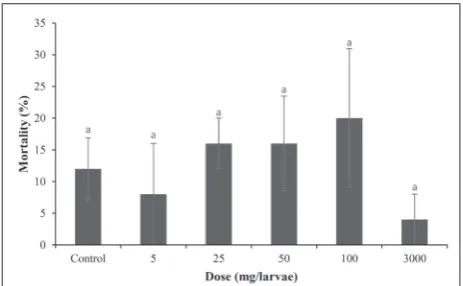
The mortality percentage of A. grisella larvae after exposure to different doses of kinetin-supplemented diet is shown in Fig. 1. The mortality reached the highest value at 100 mg/L of kinetin and the lowest value at 3000 mg/L; however, the chemical concen-tration did not affect mortality according to one-way ANOVA (F=0.703; df=5, 24; P=0.627). In support of ANOVA, Dunnett’s test showed that the mortality of the experimental groups did not differ significantly (P>0.05) from the controls. Therefore, the toxicity results showed that the deaths occurred independ-ent of kinetin doses, and probit analysis could not be performed due to insufficient mortality ratios (Fig. 1). Similarly, the kinetin-related changes in some bio-logical properties (larva-to-adult developmental time, adult longevity and adult weight) of A. grisella could be determined for the larvae reaching adult stage in
toxicity tests that also showed an insignificant influence of kinetin (Table 1). The developmental time (F=0.424; df=5, 57; P=0.830) and longevity of adult females (F=0.645; df=5, 57; P=0.667) slightly decreased at all doses when compared to the control groups (Dunnett’s test; P>0.05), while for the same parameters we found increases for males (developmental time: F=0.272; df=5, 62; P=0.927, longevity: F=0.577, df=5, 62; P=0.718). However, kinetin-dependent changes were not statisti-cally significant (Dunnett’s test; P>0.05). Insignificant decreases were also observed in the wet (F=2.712; df=5, 57; P=0.029) (except for 25 mg/L; Dunnett’s test; P= 0.004) and dry weights of females (F=1.471; df=5, 57; P=0.214) at all tested doses when compared to the controls, while the wet (F=0.844, df=5, 62, P=0.524) and dry weights of males (F=0.194, df=5, 62, P=0.964) were almost constant (Table 1).
Effects of kinetin on F1 offspring
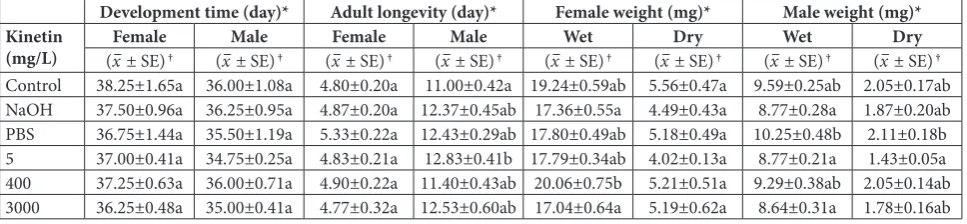
Kinetin-related changes in F1 A. grisella based on ten daily observations are shown in Tables 2-4. The devel-opmental times of females (F=0.431; df=5, 18; P=0.821) and males (F=0.523; df=5, 18; P=0.756) were almost
unchanged after exposure to kinetin. The longevity of females (F=0.821; df=5, 174; P=0.536) was also constant in all tested groups when compared to the control (Dunnett’s test; P>0.05), while the longevity of males (F=2.650; df=5, 174; P=0.025) tended to be higher (significantly higher than the control longevity at 5 mg/L, Dunnett’s test; P=0.017). Table 2 also shows that kinetin application decreased slightly the weights of female and male individuals. The reduction in the dry weight of females (F=1.485; df=5, 174; P=0.197) was not statistically significant when compared to the controls (Dunnett’s test; P>0.05), however, Dunnett’s test showed a significant decrease in wet weight only at 3000 mg/L (P=0.032). When the wet weights of females (F=4.198; df= 5, 174; P=0.001) were compared between different treatments, significantly lower values were observed for the NaOH-treated (Tukey test; P=0.013) and 3000 mg/L groups (Tukey test; P=0.004) than for 400 mg/L. Moreover, considerable decreases in the wet weights of males (F=3.482; df=5, 174; P=0.005) for NaOH-treated (Tukey test; P= 0.024), 5 mg/L (Tukey test; P= 0.025) and 3000 mg/L groups (Tukey test; P= 0.010) were observed, whereas for the dry weight (F=2.595; df=5, 174; P=0.027) a decrease was detected
Table 1. Kinetin-related changes in larva-to-adult developmental time, adult longevity and weight of A. grisella.
Development time (day)* Adult longevity (day)* Female weight (mg)* Male weight (mg)*
Kinetin
(mg/L) (Femalex– ± SE) † (x– Male± SE) † (x– Female± SE) † (x– Male± SE) † (x– Wet± SE) † (x– Dry± SE) † (x– Wet± SE) † (x– Dry± SE) †
Control 29.33±1.56a 24.30±2.57a 8.50±0.58a 15.50±0.50a 23.37±1.25a 4.64±0.28a 8.10±0.53a 1.35±0.09a
5 27.90±1.45a 25.85±1.57a 7.20±0.63a 16.69±0.92a 19.99±1.12a 3.71±0.30a 8.89±0.38a 1.38±0.07a
25 27.00±0.59a 25.40±0.99a 8.27±1.34a 16.70±0.54a 17.37±1.44a 3.55±0.31a 8.88±0.53a 1.34±0.09a
50 29.20±1.03a 26.82±1.38a 7.20±0.68a 17.00±0.74a 20.61±1.55a 3.95±0.35a 7.99±0.45a 1.29±0.09a
100 28.00±0.78a 25.64±1.36a 7.11±0.46a 15.45±1.18a 20.98±1.32a 4.50±0.66a 8.72±0.39a 1.36±0.09a
3000 29.36±2.54a 26.00±0.97a 7.82±0.33a 15.62±1.16a 19.32±1.16a 3.88±0.27a 8.65±0.30a 1.42±0.12a
*Means in each column followed by the same letter are not significantly different (P>0.05; Tukey’s HSD test).
†Data are average of 25 individual in five replicates.
Table 2. Kinetin-related changes in the egg-to-adult developmental time, adult longevity and weight of F1A. grisella.
Development time (day)* Adult longevity (day)* Female weight (mg)* Male weight (mg)*
Kinetin
(mg/L) (Femalex– ± SE) † (x– Male± SE) † (x– Female± SE) † (x– Male± SE) † (x– Wet± SE) † (x– Dry± SE) † (x– Wet± SE) † (x– Dry± SE) †
Control 38.25±1.65a 36.00±1.08a 4.80±0.20a 11.00±0.42a 19.24±0.59ab 5.56±0.47a 9.59±0.25ab 2.05±0.17ab
NaOH 37.50±0.96a 36.25±0.95a 4.87±0.20a 12.37±0.45ab 17.36±0.55a 4.49±0.43a 8.77±0.28a 1.87±0.20ab
PBS 36.75±1.44a 35.50±1.19a 5.33±0.22a 12.43±0.29ab 17.80±0.49ab 5.18±0.49a 10.25±0.48b 2.11±0.18b
5 37.00±0.41a 34.75±0.25a 4.83±0.21a 12.83±0.41b 17.79±0.34ab 4.02±0.13a 8.77±0.21a 1.43±0.05a
400 37.25±0.63a 36.00±0.71a 4.90±0.22a 11.40±0.43ab 20.06±0.75b 5.21±0.51a 9.29±0.38ab 2.05±0.14ab
3000 36.25±0.48a 35.00±0.41a 4.77±0.32a 12.53±0.60ab 17.04±0.64a 5.19±0.62a 8.64±0.31a 1.78±0.16ab
*Means in each column followed by the same letter are not significantly different (P>0.05; Tukey’s HSD test).
only for 5 mg/L (Tukey test; P= 0.032) when compared to the PBS-treated group. However, the differences were not statistically significant for the wet and dry weights of males (except for 5 mg/L; Dunnett’s test; P=0.025) when compared to the controls (Table 2).
The effects of kinetin on the morphological dis-orders of F1 individuals are presented in Table 3. The total number of females with curved wings (F=2.122; df=5, 18; P=0.110), shortened wings and fully disrupted individuals did not significantly change in all tested groups when compared to the control (Dunnett’s test; P>0.05). However, the application of PBS considerably increased the number of females with shortened wings (F=4.497; df=5, 18; P=0.008) compared to NaOH-treated (Tukey test; P= 0.028) and 400 mg/L (Tukey test; P=0.004) groups, as well as the number of fully disrupted females (F=4.078; df=5, 18; P=0.012) as compared to the 3000 mg/L group (Tukey test; P=0.026). When the percentages of the total morphological disorders were evaluated, the increase in the PBS-treated group was significant when compared to both control (Dunnett’s
test; P=0.018) and other test groups (F=5.807; df=5, 18; P=0.002). The total number of males with curved wings (F=1.978; df=5, 18; P=0.131), shortened wings (F=1.418; df=5, 18; P=0.265), fully disrupted individu-als (F=0.508; df=5, 18; P=0.767) and the percentage of total morphological disorders (F=2.623; df=5, 18; P=0.060) fluctuated among the test groups, but the differences were not significant when compared to the controls (Dunnett’s test; P>0.05) (Table 3).
Kinetin application caused a noticeable decline in the total number of F1 progeny produced by two female parents during a period of 10 days (F=6.125; df=5, 18; P=0.002) (Table 4). The reduction in F1 progeny was significant at 400 mg/L (Dunnett’s test; P=0.001) and 3000 mg/L (Dunnett’s test; P=0.005) when compared to the control. The decrease in the number of progeny at 400 mg/L was also significant when compared to 5 mg/L (Tukey test; P=0.048) and the PBS-treated control (Tukey test; P=0.027). The total numbers of females (F=4.266; df=5, 18; P=0.010) and males (F=3.825; df=5, 18; P=0.015) were prominently
Table 3. Kinetin-related changes in morphological disorders of F1A. grisella.
Female* Male*
Kinetin (mg/L)
Curved
wings Shortened wings disruptedFully disorders (%)Morpholog. Curved wings Shortened wings disruptedFully disorders (%)Morpholog. (x– ± SE) † (x– ± SE) † (x– ± SE) † (x– ± SE) † (x– ± SE) † (x– ± SE) † (x– ± SE) † (x– ± SE) †
Control 4.25±1.03a 5.50±0.96ab 3.75±1.03ab 12.45±0.85a 2.25±0.25a 1.00±0.41a 1.25±0.63a 2.90±0.32a
NaOH 2.50±0.87a 3.00±0.58a 1.00±1.00ab 10.63±2.03a 1.50±0.29a 0.75±0.48a 0.50±0.29a 2.03±0.37a
PBS 8.50±3.66a 9.50±1.56b 5.25±1.70b 21.98±1.84b 1.50±0.65a 0.25±0.25a 1.25±0.48a 2.19±0.79a
5 2.00±0.00a 3.75±1.55ab 1.00±0.71ab 7.76±0.69a 1.75±0.48a 1.25±0.63a 1.25±0.95a 3.00±0.64a
400 2.00±0.41a 1.25±0.63a 1.00±0.00ab 9.44±1.30a 1.75±0.63a 0.00±0.00a 1.75±0.25a 4.04±1.17a
3000 2.75±1.55a 4.25±2.02ab 0.50±0.29a 12.29±3.93a 3.75±1.03a 0.75±0.25a 1.25±0.48a 5.38±0.99a
*Means in each column followed by the same letter are not significantly different (P>0.05; Tukey’s HSD test).
†Data are average of four replicates.
Morpholog. – Morphological
Table 4. Kinetin-related changes in the number of offspring, sex ratio, and egg fecundity of F1A. grisella.
No. of offspring and sex ratio* Egg Fecundity*
Kinetin
(mg/L) Female Male Total no. of progeny
Female sex
ratio (%) Total no. of eggs/female % Fecundity
(x– ± SE) † (x– ± SE) † (x– ± SE) † (x– ± SE) † (x– ± SE) † (x– ± SE) †
Control 107.75±11.67a 155.00±13.05a 262.50±12.82a 41.07±3.98a 134.65±18.26a 100.00±0.00a
NaOH 59.00±11.11ab 136.00±8.54ab 194.75±10.87abc 29.86±4.77a 164.80±17.66a 122.39±13.11a
PBS 102.25±14.50ab 134.75±15.44ab 237.00±28.06ab 42.93±1.98a 181.03±20.89a 134.44±15.51a
5 85.75±17.16ab 144.00±4.55ab 229.75±18.38ab 36.30±4.48a 126.13±15.23a 93.67±11.31a
400 48.75±9.74b 98.75±14.29b 147.50±23.66c 32.59±1.97a 143.38±13.70a 106.48±10.18a
3000 54.00±8.44ab 108.75±4.17ab 162.75±4.33bc 32.84±4.23a 174.98±16.19a 129.95±12.03a
*Means in each column followed by the same letter are not significantly different (P>0.05; Tukey’s HSD test).
lowered in all test groups. Dunnett’s test showed that the reduction in the number of females was significant for the NaOH-treated (P=0.049), 400 mg/L (P=0.015) and 3000 mg/L groups (P=0.028), and for males in the 400 mg/L (P=0.008) and 3000 mg/L groups (P=0.032) when compared to the controls. Kinetin treatment also caused an insignificant decrease in the female sex ratios (F=1.893; df=5, 18; P=0.146) (Dunnett’s test; P>0.05). The sex ratio of adults was male-biased in all test groups. When the total number of eggs laid by newly emerged F1females was examined until their death, it was found that the fecundity fluctuated between doses (F=1.736; df=5, 234; P=0.127), but these differences were not statistically significantly different from the control group (Dunnett’s test; P>0.05). The relative fecundity percentage of the experimental groups was also variable when the percentage fecundity of the control group was assumed to be 100% (F=2.141; df=5, 234; P= 0.061). However, the fluctuations among the tested groups were not significant when compared to the control (Dunnett’s test; P>0.05) (Table 4).
Effects of kinetin on the THC
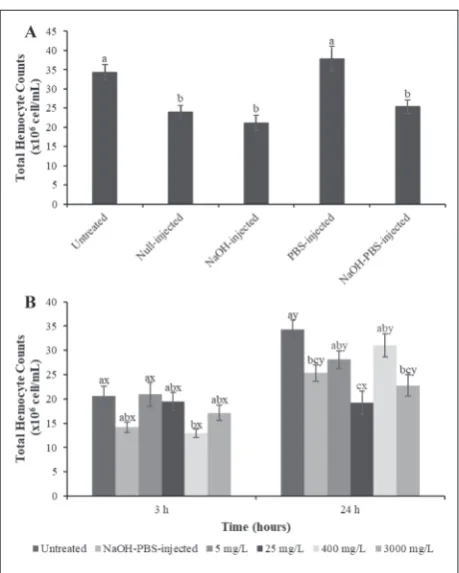
Comparisons of the THC among the control groups (untreated, null-injected, NaOH-injected, PBS-injected, and NaOH-PBS-injected) are shown in Fig. 2A. The THC decreased significantly (F= 10.509; df=4, 145; P=0.000) in all control groups except for the PBS-injected group when compared to the untreated ones (Dunnett’s test; P<0.05). As the mixture of NaOH and PBS solutions included the effects of other controls on the THC, the results of kinetin-treated groups at 3 h and 24 h were statistically compared only with the untreated and NaOH-PBS-injected controls (Fig. 2B). Hemolymph samples from the untreated last instars normally displayed 20.64±2.04 and 34.33±1.93 x10⁶
cells/mL at 3 h and 24 h, respectively. The minimum count of 12.95±0.93 x10⁶ cells/mL was observed at
3 h after the 400-mg/L kinetin injection, whereas a maximum count of 31.02±2.42 x10⁶ cells/mL was
re-corded for the same dose at 24 h. Kinetin application caused prominent decreases in all test groups except for 5 mg/L at 3 h (F=3.752; df=5, 174; P= 0.003), but the differences were only significant for the NaOH-PBS-injected (Dunnett’s test; P=0.041) and 400 mg/L groups (Dunnett’s test; P= 0.010) when compared to the untreated controls. There was also a significant
decrease at 400 mg/L compared to 5 mg/L at 3 h (Tukey test; P=0.048) when the THC was compared between treatments. At 24 h post-kinetin injection, the THC declined noticeably in all tested groups when com-pared to the untreated control (F=6.863; df=5, 174; P<0.0001), but the differences were only significant for the NaOH-PBS-injected (Dunnett’s test; P=0.013), 25 mg/L (Dunnett’s test; P=0.000) and 3000 mg/L groups (Dunnett’s test; P=0.001). When the kinetin-injected groups were compared with each other at 24 h, there was a significant decrease at 25 mg/L compared to the 5 mg/L (Tukey test; P=0.039) and 400 mg/L (Tukey test; P=0.002) groups. THC considerably increased at 24 h compared to 3 h for both controls and kinetin-injected larvae, except for 25 mg/L (untreated: t=-4.872; df= 58; P=0.000; NaOH-PBS-injected: t=-5.439; df=48.059; P=0.000; 5 mg/L: t=-2.347; df=58; P=0.022, 25 mg/L: t=0.071; df=58; P=0.943; 400 mg/L: t=-6.972; df=37.343; P=0.000; 3000 mg/L: t=-2.070; df=58; P=0.043).
DISCUSSION
Pesticides and PGRs accumulate in both living and non-living systems through chemical cycles whereby their harmful effects manifest after an extended time [51,52]. Even the unknown effects of chemicals such as PGRs should be investigated carefully for different insect species. According to the literature, this is the first detailed evaluation of the potential impact of a cytokinin hormone, kinetin, on some biological aspects and the immune system of the wax moth, A. grisella. The insects from the early instars were initially fed a kinetin diet and the percentage of larval mortality was determined. Mortality values in the experimental groups showed insignificant decreases (5 and 3000 mg/L) or increases (25, 50 and 100 mg/L) when compared to the controls, but the presence of a similar number of dead larvae in untreated groups clearly revealed that this situation was independent of kinetin dose. In a study using different insect species, kinetin, coumarin and GA3 were shown to cause 100% mortality in the first instars of B. cucurbitae at higher doses (125, 625 and 3125 µg/mL) [30]. Studies have also demonstrated that kinetin can cause unexpected effects by changing metabolic pathways [13,22,23,31], though it has no lethal effect on insects and is considered to be safer, biodegradable and environmentally friendly. Namely, the activity of some detoxification enzymes involved in the metabolism of xenobiotics can be increased (catalase, esterase, NADH dehydrogenase, glutathione peroxidase, superoxide dismutase and acid phosphatase) or decreased (alkaline phosphatase, esterase, ATPase and O-demethylase) with the influence of kinetin in the aphid Lipaphis erysimi (Kaltenbach) (Hemiptera: Aphididae) [22,23] and fruit flies Z. paravittiger [13] and B. cucurbitae [31]. This type of metabolic regula-tion aimed at compensating for the negative effects of foreign materials may not always have positive effects on living organisms over the long term. For example, Sharma et al. [13] found that the maximum catalase activity at a 100 ppm kinetin dose, reduced the lifespan of Z. paravittiger. In the current study, adult longevity was almost unchanged in the toxicity test, while kinetin applied from the egg stage significantly prolonged the longevity of males at 5 mg/L compared to the control. Because of the decreased trend in F1 progeny and the male-biased sex ratio in all tested groups, in the current study, male larvae were influenced more by kinetin than female larvae. Another explanation for
this situation may be differences in the physiology of males and females. The sexes could also respond differently to xenobiotics/toxic compounds and could differ in resistance to oxidative stress, hormone levels, immune traits, etc. Current results about longevity are in agreement with those showing the prolongation of adult life in insects depending on exposure to low kinetin doses [12,13], which was assumed to be related to the anti-aging properties of kinetin. Namely, kinetin delays the onset of several cellular and biochemical charac-teristics associated with cellular aging by maintaining the efficiency of various repair and defense systems or by reducing the accumulation of metabolic defects and debris that can have harmful effects on cellular physiology and biochemistry [2,12,13]. On the other hand, high doses of kinetin were also shown to cause toxic effects in fruit flies by shortening the life span [12,13,29], which once again reveals the importance of the dose of application.
The developmental time for A. grisella was almost unchanged after exposure to different kinetin doses for both the 1st and 2nd series of experiments. Therefore,
groups. Due to the reduced number of progeny in the 400-mg/L kinetin group, the amount of nutrients per individual could be increased, which led to weight gain due to the ingestion of more food. Another result linked to female weight was an insignificant decrease in the dry weight in both series of experiments when compared to the control. However, the wet weight of females showed significant decreases, especially at 25 mg/L for the toxicity test, and at 3000 mg/L in the 2nd series of experiments. In contrast to the present
study, larval, pupal, cocoon and shell weights in B. mori increased significantly after the topical applica-tion of kinetin and GA3 to the 4th and 5th instars [24].
In a study conducted with another PGR, the effects of IAA added to the host diet were examined within the host-parasitoid interactions. Researchers found that neither the host Galleria mellonella L. (Lepidoptera: Pyralidae) nor the endoparasitoid Pimpla turionellae L. (Hymenoptera: Ichneumonidae) displayed significant changes in adult size and weight upon IAA treatment [54]. The reason for the differences between our result and others’ findings may be attributed in part to the use of different insect species.
Examining the effects of kinetin on the morpho-logical disorders of F1 individuals revealed that the total number of female and male moths with curved wings, shortened wings and fully disrupted individuals did not considerably change in the test groups when compared to the control. In a study of D. melanogaster, the effects of different concentrations of kinetin and ABA (10-3 and 10-4 M) on adult morphology were
in-vestigated by adding kinetin or ABA to the standard nutrient medium for different developmental stages (egg, larva and pupa) [27]. In contrast to our results, 10-3 M kinetin caused the highest rate of phenotypic
abnormalities such as wings or thorax disorders, blackened body color and black-pigmented eye [27]. Because a significant effect of the mutation was not shown, these phenotypic abnormalities were attributed to the teratogenic effect of the PGRs. The fact that our data on morphological disorders do not overlap with those of D. melanogaster could be attributed to the differences in the duration of kinetin exposure and the insect species used. At the same time, analysis of the data for the percentage of total morphologi-cal disorders in the present study revealed that PBS treatment caused significant increases in females un-like males when compared to both control and other
tested groups. These PBS-induced disorders in females apparently disappeared after kinetin treatment. In a previous study of the antimutagenic effect of PGRs in D. melanogaster [28], it was found that 10-3 and 10-4
M GA3 reduced all types of ethyl methane sulfonate (EMS)-induced mutant wing spots, whereas 10-3 M
kinetin reduced only twin spots, and 10-4 M IAA
de-creased only large single spots. These results [28] and our data indicate that PGRs may have healing power against stress factors. However, in the same article it was also found that kinetin and IAA caused mutagenic effects in D. melanogaster since they increased the number of EMS-induced mutant wing spots at 10-4 and
10-3 M, respectively. Thus, the effects of a chemical on
an organism vary greatly depending on the type and dose of the substance.
of newly-emerged F1females revealed that hormone treatment caused insignificant changes. On the other hand, the total number of eggs and the fecundity per-centage tended to increase parallel to the increment in kinetin doses. A study with Aulocara elliotti females (Thomas) (Orthoptera: Acrididae) fed with kinetin also demonstrated an increment in the mean number of eggs and in the number of viable eggs at 10 and 20 mg/L doses [19]. Similarly, it was found that kinetin added to the nutrient medium of D. melanogaster, es-pecially at high doses (10-3 and 10-4 M), increased egg
fecundity [25,26]. Moreover, the maximum egg number was observed at 100 ng/mL kinetin and 300 ng/mL GA3 when applied to the silkworm B. mori topically [24]. In contrast, other studies showed that kinetin reduced the egg-laying capacity and the reproductive potential of fruit flies [13,29]. It can be concluded that kinetin influences various insect species differently in terms of egg fecundity, thus further studies should be conducted with different insect species to explore its effects in more detail.
Stress factors such as wounding, infection and chemical substances can cause some alterations in hemocyte counts in the circulation [36,43,44,61]. The THC of A. grisella decreased significantly in all control groups (null-injected, NaOH-injected and NaOH-PBS-injected) except for the PBS-injected group, when compared to untreated individuals. This result clearly showed stress association with the in-jection injury and the NaOH-induced effect. As the NaOH-PBS-injected group included the effects of all the other controls, the THC of kinetin-treated groups was statistically compared with only untreated and NaOH-PBS-injected controls. Comparing the counts for the two time periods, THC declined noticeably in all tested groups except for 5 mg/L at 3 h post-kinetin injection. However, the differences were only significant for 3 h in the NaOH-PBS-injected and 400 mg/L groups and for 24 h in the NaOH-PBS-injected, 25 and 3000 mg/L groups when compared to the untreated control. This reduction in the THC is thought to stem from the injection injury or NaOH-induced effect. Although the THC were markedly affected by the injection of the mixture of PBS and NaOH, the high rate of decline at 400 mg/L after 3 h (37%), and at 25 mg/L and 3000 mg/L doses after 24 h (34-44%) showed that kinetin also has a role in the decline in THC. Besides, THC considerably increased at 24 h compared to 3 h in all
tested larvae, except for 25 mg/L. Kinetin is not likely to cause such differences between the two time points since the THC of the control groups also increased at 24 h compared to 3 h, similar to kinetin-injected larvae. It is known that insects exposed to different PGRs exhibit changes in hemocyte counts as a result of detoxification and immune responses [36,43,44]. The role played by hemocytes in the first line of the defense system against the toxicity of kinetin could be responsible for the observed decrease in THC in A. grisella. Consistent with our data, ABA was reported to cause a remarkable decrease in the number of circulat-ing hemocytes in G. mellonella larvae at 4, 24 and 48 h post injection [44]. Unlike our results, an increase in the THC was shown in G. mellonella and A. grisella larvae when they were fed with GA3- and IAA-treated diets, respectively [36, 43]. Thus, studies have shown that the extent to which PGRs affect hemocyte counts varies greatly depending on the type of hormone and insect species.
Extensive use of pesticides has led researchers to look for natural compounds, such as PGRs, to com-pensate for the harmful effects of these chemicals. However, the increasing usage of PGRs in agriculture has shown that over time these substances can be harmful. It is clear from the current study that one of the cytokinin hormones, kinetin, can interfere with normal developmental and immune processes of A. grisella by reducing the weight, the total number of progeny and the THC. Evidence from earlier studies mentioned here and our findings strongly indicate that kinetin can be unpredictably toxic to insects, affect-ing future generations. Therefore, further research is needed to reveal the long-term effects of kinetin and other PGRs on both host species and natural enemies used in IPM. It should be kept in mind that even natural compounds such as PGRs can have adverse effects on all living organisms and ultimately disrupt the ecological balance.
Funding: We did not receive financial support, we used the facilities available in our laboratory.
REFERENCES
1. Miller CO, Skoog F, Okumura FS, Von Saltza MH, Strong FM. Isolation, structure and synthesis of kinetin, a substance promoting cell division. J Am Chem Soc. 1956;78(7):1375-80. 2. Rattan SIS. N6-furfuryladenine (kinetin) as a potential
anti-aging molecule. J Anti-Aging Med. 2002;5(1):113-6. 3. Miller CO, Skoog F, Von Saltza MH, Strong FM. Kinetin, a
cell division factor from deoxyribonucleic acid. J Am Chem Soc. 1955;77:1392.
4 Amasino R. 1955: Kinetin arrives. The 50th anniversary of a new plant hormone. Plant Physiol. 2005;138:1177-84. 5. US-EPA: US Environmental Protection Agency Office of
Pesticide Programs Biopesticides and Pollution Prevention Division [Internet]. Washington (PA): Kinetin technical. 2016 - [cited 2016 Jul 25]. Available from: https://www3.epa.gov/ pesticides/chem_search/ppls/091620-00002-20160725.pdf. 6. Raman N, Elumalai S. Presence of cytokinin in the root
nod-ules of Casuarina equisetifolia. Ind J Exp Biol. 1996;34:577-80. 7. Ratti N, Janardhanan KK. Effect on growth, phosphorus and cytokinin contents of palmarosa (Cymbopogon martini var.
motia) by Glomus inoculation. Ind J Exp Biol. 1996;34:1126-28.
8. Barciszewski J, Siboska GE, Pedersen BO, Clark BFC, Rattan SIS. Evidence for the presence of kinetin in DNA and cell extracts. FEBS Lett. 1996;393:197-200.
9. Barciszewski J, Mielcarek M, Stobiecki M, Siboska G, Clark BFC. Identification of 6-furfuryladenine (kinetin) in human urine. Biochem Bioph Res Co. 2000;279(1):69-73.
10. Barciszewski J, Rattan SIS, Siboska G, Clark BFC. Kinetin-45 years on. Plant Sci. 1999;148(1):37-45.
11. Barciszewski J, Massino F, Clark BFC. Kinetin-A multiactive molecule. Int J Biol Macromol. 2007;40(3):182-92.
12. Sharma SP, Kaur P, Rattan SIS. Plant growth hormone kinetin delays aging, prolongs the lifespan, and slows down develop-ment of the fruitfly Zaprionus paravittiger. Biochem Bioph Res Co. 1995;216(3):1067-71.
13. Sharma SP, Kaur J, Rattan SIS. Increased longevity of kine-tin-fed Zaprionus fruitflies is accompanied by their reduced fecundity and enhanced catalase activity. Biochem Mol Biol Int. 1997;41(5):869-75.
14. Olsen A, Siboska GE, Clark BFC, Rattan SIS. N6-furfury-ladenine, kinetin, protects against Fenton reaction-medi-ated oxidative damage to DNA. Biochem Bioph Res Co. 1999;265(2):499-502.
15. Ahanger MA, Alyemeni MN, Wijaya L, Alamri SA, Alam P, Ashraf M, Ahmad P. Potential of exogenously sourced kinetin in protecting Solanum lycopersicum from NaCl-induced oxi-dative stress through up-regulation of the antioxidant system, ascorbate-glutathione cycle and glyoxalase system. PloS ONE. 2018;13(9):1-21.
16. Mccullough JL, Weinstein GD. Clinical study of safety and efficacy of using topical kinetin 0.1% (Kinerase®) to treat pho-todamaged skin. Cosmet Dermatol. 2002;15(9):29-32. 17. Wu JJ, Weinstein GD, Kricorian GJ, Kormeili T, McCullough
JL. Topical kinetin 0.1% lotion for improving the signs and symptoms of Rosacea. Clin Exp Dermatol. 2007;32(6):693-5. 18. Miastkowska M, Sikora E. Anti-aging properties of plant stem
cell extracts. Cosmetics. 2018;5(4):55.
19. Visscher SN. Plant growth hormones affect grasshopper growth and reproduction. In: Visser JH, Minks AK, editors. Proceedings of the 5th International Symposium of Insect-Plant Relationships. Wageningen: Pudoc, 1982. p. 57-62. 20. Chawla SS, Perron JM, Cloutier M. Effects of different growth
factors on the potato aphid, Macrosiphum euphorbiae (Aphi-didae: Homoptera), fed on an artificial diet. Can Entomol. 1974;106(3):273-80.
21. Rup PJ, Sohal SK, Kaur P, Kaur S, Dhillon MK, Kumari J, Dhingra P. Population studies on the mustard aphid, Lipaphis erysimi (Kalt.) in response to 14 plant growth regulators. J Aphidol. 1998;12:67-73.
22. Rup PJ, Sohal SK, Kaur G, Sharma R. The possible role of five enzymes in the metabolism of kinetin in mustard aphid,
Lipaphis erysimi (Kaltenbach). J Aphidol. 2002;16:1-8. 23. Rup PJ, Sohal SK, Kaur H. Studies on the role of six enzymes
in the metabolism of kinetin in mustard aphid, Lipaphis
erysimi (Kalt.). J Environ Biol. 2006;27(3):579-84.
24. Sepperumal U, Sukumar S. Impact of kinetin and gibberellic acid on the commercial characteristics of the silkworm, Bom-byx mori L. (Lepidoptera: Bombycidae). J Microbiol Biotech Res. 2014;4(1):11-20.
25. Yeşilada E, Bozcuk AN. The effects of ABA and kinetin on the fecundity of Drosophila melangaster. Turk J Biol. 1995;19:37-44. 26. Yeşilada E, Bozcuk AN. The effects of ABA and kinetin on
the developmental period of Drosophila melanogaster. Turk J Biol. 1996;20:29-35.
27. Yeşilada E,Bozcuk AN, Bozcuk S, Topcuoğlu F. The effects of abscisic acid (ABA) and kinetin on sex-ratio and adult mor-phology of D. melanogaster. Turk J Biol. 1996;20:171-8. 28. Yeşilada E. The effect of kinetin, gibberellic acid and
indole acetic acid on EMS-induced somatic mutation and
recombination in Drosophila melanogaster. Turk J Biol.
2000;24(2):279-84.
29. Kaur R, Rup PJ. Evaluation of regulatory influence of four plant growth regulators on the reproductive potential and longevity of melon fruit fly (Bactrocera cucurbitae). Phyto-parasitica. 2002;30(3):224-30.
30. Kaur R, Rup PJ. Influence of four plant growth regulators on development of the melon fruit fly, Bactrocera cucurbitae
(Coquillett). Insect Sci Appl. 2003a;23(2):121-5.
31. Kaur R, Rup PJ. Influence of some plant growth regulators (PGR) on biochemical profile in the larvae of melon fruit fly Bactrocera cucurbitae (Coquillett) (Diptera: Trypetidae). Entomon. 2003b;28(2):89-95.
32. Uçkan F, Hepçorman Şengül Ş, Sak O, Korkmaz M. Effects of 5-Aza-2΄-deoxycytidine on biological parameters of larval endoparasitoid Apanteles galleriae (Hymenoptera: Braconi-dae) and on its host Achoria grisella (Lepidoptera: PyraliBraconi-dae). Ann Entomol Soc Am. 2007;100(2):265-69.
33. Ergin E, Er A, Uçkan F, Rivers DB. Effect of cypermethrin exposed hosts on egg-adult development time, number of offspring, sex ratio, longevity, and size of Apanteles gal-leriae Wilkinson (Hymenoptera: Braconidae). Belg J Zool. 2007;137(1):27-31.
35. Uçkan F, Haftacı İ, Ergin E. Effects of indol-3-acetic acid on biological parameters of the larval endoparasitoid Apanteles galleriae (Hymenoptera: Braconidae). Ann Entomol Soc Am. 2011a;104(1):77-82.
36. Çelik D, Özbek R, Uçkan F. Effects of indole-3-acetic acid on hemocytes of Achoria grisella Fabr. (Lepidoptera: Pyralidae). J Entomol Res Soc. 2017;19(2):83-93.
37. Sak O. The effects of 5-Aza-2´-deoxycytidine on total lipid and fatty acid composition of Apanteles galleriae Wilkinson (Hymenoptera: Braconidae) and on its parasitized host. J Entomol Res Soc. 2017;19(1), 105-20.
38. Sak O. Effects of 5-aza-2´-deoxycytidine on Biological Param-eters of Achroia grisella F. (Lepidoptera: Pyralidae). Arch Biol Sci. 2018;70(1):149-58.
39. Zibaee A. Botanical Insecticides and Their Effects on Insect Biochemistry and Immunity. In: Stoytcheva M, editor. Pes-ticides in the modern world - pests control and pesPes-ticides exposure and toxicity assessment. Rijeka: InTech; 2011. p. 55-68.
40. Venier P, Maron S, Canova S. Detection of micronuclei in gill cells and haemocytes of mussels exposed to benzo[a]pyrene. Mutat Res. 1997;390:33-44.
41. James RR, Xu J. Mechanisms by which pesticides affect insect immunity. J Invertebr Pathol. 2012;109(2):175-82.
42. Gupta AP. Cellular Elements in the Hemolymph. In: Kerkut GA, Gilbert LI, editors. Comprehensive insect physiology biochemistry and pharmacology, Vol 3. New York: Pergamon Press; 1985. p. 401-51.
43. Altuntaş H, Kılıç AY, Uçkan F, Ergin E. Effects of gibberel-lic acid on hemocytes of Galleria mellonella L. (Lepidoptera: Pyralidae). Environ Entomol. 2012;41(3):688-96.
44. Er A, Keskin M. Influence of abscisic acid on the biology and hemocytes of the model insect Galleria mellonella (Lepidop-tera: Pyralidae). Ann Entomol Soc Am. 2016;109(2):244-51. 45. Uçkan F, Gülel A. Effects of host species on some biological
characteristics of Apanteles galleriae Wilkinson (Hymenop-tera; Braconidae). Turk J Zool. 2000;24:105-13.
46. Uçkan F, Ergin E. Temperature and food source effects on adult longevity of Apanteles galleriae Wilkinson (Hymenop-tera: Braconidae). Environ Entomol. 2003;32(3):441-6. 47. Bronskill JF. A cage to simplify the rearing of the greater
wax moth, Galleria mellonella (Pyralidae). J Lep Soc.
1961;15(2):102-4.
48. Sak O, Uçkan F, Ergin E. Effects of cypermethrin on total body weight, glycogen, protein, and lipid contents of Pimpla turionellae (L.) (Hymenoptera: Ichneumonidae).Belg J Zool. 2006;136(1):53-8.
49. Lincoln DE, Couvet D, Sionit N. Response of an insect herbi-vore to host plants grown in carbon dioxide enriched atmo-spheres. Oecologia. 1986;69(4):556-60.
50. Er A, Uçkan F, Rivers DB, Ergin E, Sak O. Effects of parasit-ization and envenomation by the endoparasitic wasp Pimpla turionellae (Hymenoptera: Ichneumonidae) on hemocyte numbers, morphology, and viability of its host Galleria mel-lonella (Lepidoptera: Pyralidae). Ann Entomol Soc Am. 2010;103(2):273-82.
51. World Health Organization (WHO): 2,4-Dichlorophenoxy-acetic acid (2,4-D). Geneva: World Health Organization; 1984. 151 p. (Environmental health criteria; 29).
52. Guedes RNC, Smagghe G, Stark JD, Desneux N. Pesticide-induced stress in arthropod pests for optimized integrated pest management programs. Ann Rev Entomol. 2016;61:43-62. 53. Pijpe J, Fischer K, Brakefield PM, Zwaan BJ. Consequences of
artificial selection on pre-adult development for adult lifespan under benign conditions in the butterfly Bicyclus anynana, Mech Ageing Dev. 2006;127(10):802-7.
54. Uçkan F, Özbek R, Ergin E. Effects of indol-3-Acetic Acid on the biology of Galleria mellonella and its endoparasitoid
Pimpla turionellae. Belg J Zool. 2015;145(1):49-58.
55. Uçkan F, Öztürk Z, Altuntaş H, Ergin E. Effects of gibberellic acid (GA3) on biological parameters and hemolymph metabo-lites of the pupal endoparasitoid Pimpla turionellae (Hyme-noptera: Ichneumonidae) and its host Galleria mellonella
(Lepidoptera: Pyralidae). J Entomol Res Soc. 2011b;13(3):1-14. 56. Kaur M, Kaur S. Tritrophic interactions among coumarin, the herbivore Spodoptera litura and a gregarious ectoparasitoid
Bracon hebetor. Biol Control. 2013;58:755-63.
57. Prado SG, Frank SD. Tritrophic effects of plant growth regula-tors in an aphid-parasitoid system. Biol Control. 2013;66:72-6. 58. Altuntaş H, Uçkan F, Kılıç AY, Ergin E. Effects of gibberellic
acid on hemolymph-free amino acids of Galleria mellonella
(Lepidoptera: Pyralidae) and endoparasitoid Pimpla
turionel-lae (Hymenoptera: Ichneumonidae). Ann Entomol Soc Am.
2014;107(5):1000-9.
59. Uçkan F, Soydabaş HK, Özbek R. Effect of indol-3 acetic acid on the biochemical parameters of Achoria grisella hemolymph and
Apanteles galleriae larva. Pak J Biotechnol. 2014;11(2):63-71. 60. Özcan Ö, Gündüz EA. Influence of gibberellic acid on some
biological parameters of ectoparasitoid, Bracon hebetor (Say, 1836) (Hymenoptera: Braconidae). Acta Biologica Turcica. 2018;31(1):13-7.