ISSN-L: 2501 - 1235 Available on-line at: www.oapub.org/edu
doi: 10.5281/zenodo.1256250 Volume 4 │ Issue 7 │ 2018
EXAMINATION OF THE FINGER TAPPING TEST AND
MENTAL ROTATION ACHIEVEMENT LEVEL OF
THE ORIENTEERING ATHLETES
Canan Bastık1, Şenay Sahin2,
Ersin Şahin3, Serkan Pancar4i,
Engin Sağdilek5, Erhan Kızıltan6
1Bursa Technical University, Turkey 2Uludag University Sports Science Faculty, Turkey 3Uludag University Faculty of Educational Sciences, Turkey
4Uludağ University, Sport Sciences Faculty, Turkey 5Uludağ University, Faculty of Medicine, Turkey 6Başkent University, Faculty of Medicine, Turkey
Abstract:
The purpose of this study is to assess the cognitive skills and the audio visual perceptions of orienteering athletes and to research the relationship between these two. 17 male athletes, who have been playing orienteering sport for at least 2 years, whose average age is 16.3 ± 1.6 years, participated voluntarily in our study. Reaction time test, mental rotation tests were implemented to the participants on successive days, during the same time zone, and in a quiet environment favorable for testing. The "Finger Tapping Test” (FTT), in which the speed of consecutive motor movements was evaluated was implemented via a computer program and the athletes were asked to press the specified key consecutively for 20 seconds. The obtained data was recorded. In conclusion, it was determined that the random-interval audio visual reaction times are longer than the Fix-interval audio visual reaction times. It was concluded that each question was answered in 8.7 seconds on average during the mental rotation test implemented in the study; whereas it was discovered that the correct answer average was 9.8 in the MR test, which consists of 16 questions. When the answers given by the athletes to the test questions were examined, it was determined that 4 athletes, who answered each question approximately in 3 seconds and completed the test in under 1 minute, are not successful in terms of accuracy and duration. These results indicate that the mental rotation performances of the orienteering athletes are not at a good level.
Keywords: cognitive skill, audio visual perception, orienteering, reaction time
1. Introduction
Orienteering is a sport that requires matching of map reading skills with actual location and reaching the specified targets as soon as possible. This concept, which is used as Orienteering in English and Orienteering in Sweden, is the name of a sport that aims to find checkpoints, marked on a special topographic map, using a map and a compass, and requires mental attention, effort and motivation. The athlete is supposed to complete the map, which he/she starts reading at the beginning of the competition, making the right decisions despite his/her exhaustion and without getting distracted until the end. In order to follow the route on the map properly, he/she must react quickly to the visual stimuli. In this context, the situation of the orienteering athlete is constant action-reaction to visual stimuli and he/she needs to keep the visual reaction level at its best. Therefore, the orienteering athlete is expected to have a good reaction time (Akcan, 2016). Because the reaction is the ability to react quickly, instantly and consciously to various situations that cannot be predicted. The "reaction time" defined as the time elapsed between the beginning of the stimulus and the beginning of the reaction is one of the determinants of athletic performance and is closely related to the quick decision ability of the athlete, who is under the pressure of field, time and competitor (Achtman, 2008; Jansen, 2013).
which one learns analytical thinking, 3-dimensional perception, creating a solution to the problems and pushing their own limits.
The purpose of this study is to assess the cognitive skills and the audiovisual perceptions of orienteering athletes and to research the relationship between these two.
2. Material and method
2.1 Participants
17 male athletes, who have been playing orienteering sport for at least 2 years, whose average age is 16.3 ± 1.6 years, participated voluntarily in our study.
2.2 Method
Reaction time test, mental rotation tests were implemented to the participants on successive days, during the same time zone, and in a quiet environment favorable for testing. Before the test, brief information was given about the implementation of the test to each participant, and then a short trial was made. The study was carried out based solely on voluntariness and no incentive or prize was given to the participants.
The "Finger Tapping Test” (FTT), in which the speed of consecutive motor movements was evaluated, was implemented via a computer program and the athletes were asked to press the specified key consecutively for 20 seconds. The obtained data was recorded.
and in the other half "z-axis" was chosen. For both groups of axes, the "angle of rotation" was selected as a 30o increase between 0-180o.
The participant was asked to find out which of the three images other than the reference image was the same as the "reference" image as soon as possible. The "response time" of the questions was determined in millisecond (ms) resolution with the "true", "false" and "error" record and stored on the computer for later analysis (Moreau, et al., 2011).
Figure 1: A set of questions prepared with images selected from the library
"Mental Rotation Stimuli Library ©" prepared by Peters and Battista. Participants are asked to find out which of the three images on the right with the numbers 1, 2 and 3 is the same as the
object shown in the reference image on the left
Statistical evaluations were performed in the SPSS "20.00" package program. Results are given as average ± standard deviation and minimum-maximum values. Comparisons of intra-group dependent variables, were made with paired t test for those which show normal distribution, and with Wilcoxon rank sum tests for those which does not show normal distribution. The Spearman test was implemented for the connections between the tests. p<0.05 was accepted as the significance level.
3. Results
Findings obtained in the research are presented in tabular form.
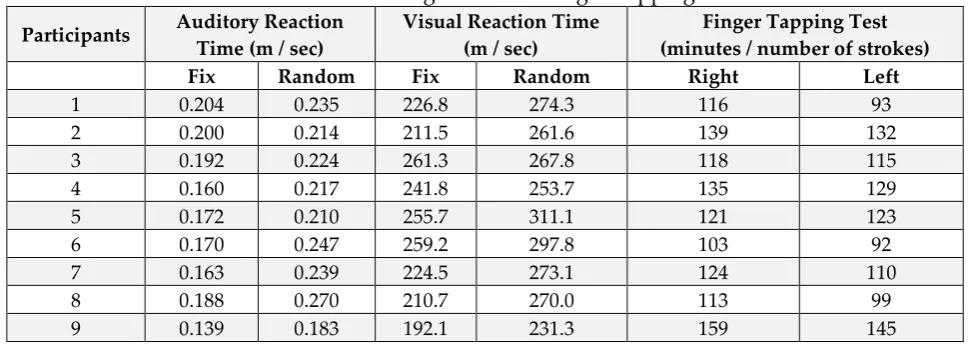
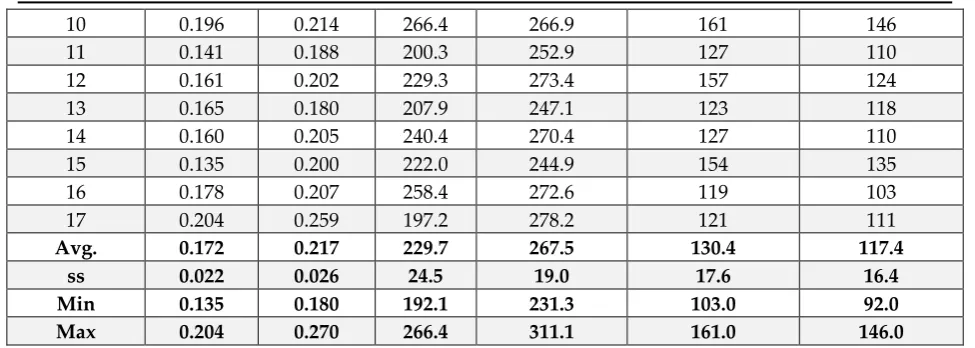
Table 1: Auditory visual Fix Random Reaction Times of the participants and the arithmetic average values of Finger Tapping Test
Participants Auditory Reaction Time (m / sec)
Visual Reaction Time (m / sec)
Finger Tapping Test (minutes / number of strokes) Fix Random Fix Random Right Left
1 0.204 0.235 226.8 274.3 116 93
2 0.200 0.214 211.5 261.6 139 132
3 0.192 0.224 261.3 267.8 118 115
4 0.160 0.217 241.8 253.7 135 129
5 0.172 0.210 255.7 311.1 121 123
6 0.170 0.247 259.2 297.8 103 92
7 0.163 0.239 224.5 273.1 124 110
10 0.196 0.214 266.4 266.9 161 146
11 0.141 0.188 200.3 252.9 127 110
12 0.161 0.202 229.3 273.4 157 124
13 0.165 0.180 207.9 247.1 123 118
14 0.160 0.205 240.4 270.4 127 110
15 0.135 0.200 222.0 244.9 154 135
16 0.178 0.207 258.4 272.6 119 103
17 0.204 0.259 197.2 278.2 121 111
Avg. 0.172 0.217 229.7 267.5 130.4 117.4 ss 0.022 0.026 24.5 19.0 17.6 16.4 Min 0.135 0.180 192.1 231.3 103.0 92.0 Max 0.204 0.270 266.4 311.1 161.0 146.0
Participants' dominant hand fix reaction time arithmetic average value was determined as 172 (m / sec), while the random reaction time as 217 (m / sec), the visual reaction time as 229.7 (m / sec), 267.5 (m / sec) respectively and finger tapping test result was determined as 130.4 for the right hand and 117.4 (minutes / strokes) for the left hand.
Table 2: Arithmetic average values of participants' Mental Rotation levels
Participants True False Fault T T A T T T A T
1 7 9 0 53721.7 3357.6 53.7 3.4
2 11 4 1 148855.5 9303.5 148.9 9.3
3 6 10 0 55634.4 3477.1 55.6 3.5
4 12 4 0 153429.2 9589.3 153.4 9.6
5 9 7 0 139582.3 8723.9 139.6 8.7
6 12 4 0 204858.5 12803.7 204.9 12.8
7 14 2 0 183972.5 11498.3 184.0 11.5
8 9 6 1 97257.8 6078.6 97.3 6.1
9 14 1 0 252034.0 16802.3 252.0 16.8
10 6 10 0 97464.1 6091.5 97.5 6.1
11 9 7 0 207508.2 12969.3 207.5 13.0
12 7 9 0 141039.7 8815.0 141.0 8.8
13 11 5 0 58801.5 3675.1 58.8 3.7
14 6 10 0 59807.3 3738.0 59.8 3.7
15 11 5 0 219788.4 13736.8 219.8 13.7
16 9 7 0 207218.0 12951.1 207.2 13.0
17 13 3 0 77241.1 4827.6 77.2 4.8
Avg. 9.8 6.1 138.7 8.7
ss 2.8 2.9 65.9 4.2
Min 6.0 1.0 53.7 3.4
Max 14.0 10.0 252.0 16.8
4. Discussion and Conclusion
Audio and visual reaction time test was implemented to measure how fast orienteering athletes perceive the information coming from the environment; mental rotation test was implemented to measure cognitive functions; finger tapping test was implemented to measure the motor output. Orienteering athlete is expected to achieve high level ability to envision 3-dimensional space coordinates, relocations and the inter-objects relations of the symbolic information. Hence, the implemented mental rotation test requires the athlete concentrate, to be careful and to be able to give fast and correct decisions. It was concluded that each question was answered in 8.7 seconds on average during the mental rotation test implemented in the study; whereas it was discovered that the correct answer average was 9.8’ in the MR test, which consists of 16 questions. When the answers given by the athletes to the test questions were examined, it was determined that 4 athletes, who answered each question approximately in 3 seconds and completed the test in under 1 minute, are not successful in terms of accuracy and duration. These results indicate that the mental rotation performances of the orienteering athletes are not at a good level.
Schmidt et al., (2016) showed in their research that gymnasts and orienteers displayed better mental rotation performance than non-athletes, people actively doing sports out performed athletes; orienteers and gymnasts out performed non-athletes; on contrary to expectations, gymnasts did not differ from orienteers. The mental rotation performances of both group athletes were determined to be higher when compared with the orienteers in our study. Moreau et al., (2011) stated that to-date only two cross- sectional studies have compared two sports groups with different mental rotation demands with each other and revealed that elite combat athletes display better mental rotation performance than elite runners or Jansen and Lehmann (2013) showed in their study that soccer players did not differ from gymnasts.
The results of the study by Kızıltan et al., (2015) on the relation between visual-spatial skills and academic achievement show that the average values were higher than the orienteering athletes in terms of mental rotation response time and accuracy rates obtained. It is stated that the students with high mental rotation performance, also have high test success and the abilities of thinking and processing in three dimensions is also positively affected. In this context, the fact that the athletes gave the maximum number of wrong answers supports the view that they performed the tests without concentrating.
it was determined that the random-interval audio visual reaction times are longer than the Fix-interval audio visual reaction times. In a similar way, visual reaction time is longer than the auditory reaction time. Participants, who have faster fix- interval auditory reaction times, complete the MR test in a longer time.
It has been observed that the participants, whose audio visual random-interval reaction times are fast, also have higher number of consecutive motor movements. The study reveals that those who have fast fix interval audio visual reaction time, completed the mental rotation test in the longest duration and achieve higher number of correct answers. These athletes are thought to be able to concentrate better on both tests with regular and effective exercise.
The finger tapping test is a different motoric test that gives information about upper extremity motor skills and is implemented for 20 seconds. In this test, the level of fatigue also causes changes to the performance. The result that the participants who had fast visual/auditory random interval reaction time in the study, had pointedly more finger tapping counts, shows that the motoric component also contributes to time in the response to the unforeseen warning.
As a result, the relationship between audio visual perception and motor and mental functions, planned based on the perception is interesting. The answers given by the orienteering athletes to different tests were examined and the result is also interesting: The mental rotation skills of the orienteering athletes, are related to the auditory reaction time. It is suggested that orienteering athletes should do exercises that will develop the mental rotation values (time and correct action) which enable them to follow the route, correlating the signs with the objects on the route until the end of the race.
Acknowledgements
This study was presented as a oral presentation in the 14th International Sport Sciences Congress, 01-04, 2016, 14th International Sport Sciences Congress, Antalya Turkey.
References
1. Achtman, R. L., Green, C. S., & Bavelier, D. (2008). Video Games As a Tool to Train Visual Skills. Restorative Neurology and Neuroscience, 26 (4, 5), 435-446. 2. Akcan İ.O. (2016). Elit Oryantiring Sporcularının Görsel Reaksiyon Süreleri ile
Karar Verme Stilleri Arasındaki İlişki. Beden Eğitimi ve Spor Anabilim Dalı Antrenman ve Hareket Bilimleri Programı Sağlık Bilimleri Enstitüsü, Gazi Üniversitesi
3. Ateş A., 2007. Türkiye’deki Oryantiring Sporcularının Karşılaştığı Temel
4. Castel, A. D., Pratt, J., & Drummond, E. (2005). The Effects of Action Video Game Experience on the Time Course of Inhibition of Return and the Efficiency of Visual Search. Acta Psychologica, 119 (2), 217-230.
5. Catelli, R., & Manaham, R. (1990). Reaction Time and Movement Time. Medicine
and Science in Sport and Exercise, 22 (1), 75-77.
6. Ferdjallah, M., Harris, G. F., Smith, P., & Wertsch, J. J. (2002). Analysis of Postural Control Synergies during Quiet Standing in Healthy Children and Children with Cerebral Palsy. Clinical Biomechanics, 17 (3), 203-210.
7. Green, C. S., & Bavelier, D. (2006). Effect of Action Video Games on the Spatial
Distribution of Visuospatial Attention. Journal of Experimental Psychology: Human Perception and Performance, 32 (6), 1465.
8. Griffith, J. L., Voloschin, P., Gibb, G. D., & Bailey, J. R. (1983). Differences in Eye-Hand Motor Coordination of Video-Game Users and Non-Users. Perceptual and Motor Skills, 57 (1), 155-158.
9.
http://docplayer.biz.tr/42400466-Klinik-oncesi-tip-egitiminde-ogrencilerin-mental-rotasyon-becerilerinin-donemsel-karsilastirilmasi.html (Erişim tarihi:
01.05.2018)
10. Jansen, P., & Lehmann, J. (2013). Mental Rotation Performance in Soccer Players and Gymnasts in an Object-Based Mental Rotation Task. Advances in Cognitive Psychology, 9 (2), 92.
11. Karaca, F. (2008). Oryantiring Uygulamalarının İlköğretim Programlarındaki Fonksiyonelliği. Beden Eğitimi ve Spor Anabilim Dalı Yüksek Lisans Tezi, Sağlık Bilimleri Enstitüsü, Gazi Üniversitesi, Ankara.
12. Kızıltan, E., Yazıcı, A. C., Toyran, N., Bodur, B., Çelik, F. P., Erdem, İ., ... & Özbaş, G. (2015). Görsel-Uzaysal Beceriler ile Akademik Başarı İlişkisi: Başkent Üniversitesi Tıp Fakültesi Tecrübesi. Türkiye Klinikleri Journal Of Medical Sciences, 35 (3), 138-145.
13. Moreau, L. et al., 2011. The Open Provenance Model Core Specification (V1.1). in: Future Generation Computer Systems, 27 (6), Pp.743–756.
14. Özaslan, B. R., Biçer, M., Özdal, M., Vural, M., Şan, G. (2017). Investigation of visual and auditory simple reaction time of individuals with mental retardation. European Journal of Special Education Research. 2(3), 68-76.
15. Özcan, F. (2007). Orienteering Sporunun İlköğretim Öğrencilerinin Sosyal Bireysel Davranışları ile Matematik-Mantıksal Zekâ Gelişimleri Üzerindeki Etkisinin İncelenmesi. Yüksek Lisans Tezi. Dumlupınar Üniversitesi, Sosyal Bilimler Enstitüsü, Kütahya.
16. Pancar, Z., Özdal, M., Pancar, S., & Biçer, M. (2016). Investigation of visual and auditory simple reaction time of 11-18 aged youth. European Journal of Physical Education and Sport Science. 2(4), 145-152.
18. Schmidt, M., Egger, F., Kieliger, M., Rubeli, B., & Schüler, J. (2016). Gymnasts and
Orienteers Display Better Mental Rotation Performance than
Nonathletes. Journal of Individual Differences.
19. Sims, V. K., & Mayer, R. E. (2002). Domain Specificity Of Spatial Expertise: The Case Of Video Game Players. Applied Cognitive Psychology, 16 (1), 97-115.
20.Sperdin, H. F., Cappe, C., Foxe, J. J., & Murray, M. M. (2009). Early, Low-Level
Auditory-Somatosensory Multisensory İnteractions İmpact Reaction Time Speed. Frontiers in İntegrative Neuroscience, 3, 2.
21. Subrahmanyam, K., & Greenfield, P. M. (1994). Effect of Video Game Practice on Spatial Skills in Girls and Boys. Journal of Applied Developmental Psychology, 15 (1), 13-32.
Creative Commons licensing terms