Proceedings of the
Seventh International Workshop on
Graph Transformation and Visual Modeling Techniques
(GT-VMT 2008)
A Graph-Based Type Representation for Objects
Cong-Cong Xing16 pages
Guest Editors: Claudia Ermel, Reiko Heckel, Juan de Lara
Managing Editors: Tiziana Margaria, Julia Padberg, Gabriele Taentzer
A Graph-Based Type Representation for Objects
Cong-Cong Xing1
Department of Mathematics and Computer Science Nicholls State University
Thibodaux, LA, USA
Abstract: Subtyping and inheritance are two major issues in the research and devel-opment of object-oriented languages, which have been traditionally studied along the lines of typed calculi where types are represented as a combination texts and symbols. Two aspects that are closely related to subtyping and inheritance – method interdependency, and self type and recursive object type – have either been over-looked or not received sufficient/satisfactory treatments. In this paper, we propose a graph-based notation for object types and investigate the subtyping and inheritance issues under this new framework. Specifically, we (1) identity the problems that have motivated this paper; (2) propose an extension to Abadi-Cardelli’s ς-calculus towards fixing the problems; (3) present definitions of object type graphs followed by examples; (4) define subtyping and inheritance using object type graphs; (5) show how the problems can be easily resolved under object type graphs; and (6) summarize the contributions of this paper.
Keywords: Object type, graph transformation
1
Introduction
As pointed out by Markku Sakkinen in [Sak05], although in recent years the emphasis of the re-search and development in object-oriented programming (OOP) has shifted from programming languages (themselves) to larger entities such as components, environments, and manipulating tools, it does not mean that the existing object-oriented languages are perfect and no improve-ment is needed. In particular, typing is still a critical issue and a problem-prone area in the formal study of object-oriented languages, especially when type-related subjects, such as subtyping and inheritance, are considered.
2
Motivations
We present two problems that have motivated the writing of this paper.
2.1 Method Interdependency
We call a rectangle free if its two sides (height and width) are independent, constrained other-wise. In conventional type systems, the type of a free rectangle and the type of a constrained rectangle are not distinguished. We show, in this subsection, that this type confusion opens the door to let the different semantics of free rectangles and constrained rectangles be mixed, which is serious enough to be able to cause a program not to perform to its specification and thus weakens its reliability.
Using Abadi-Cardelli’s first-orderς-calculus notation [AC96], we can construct a free rectan-gle fRect, a constrained rectanrectan-gle cRect, and their types FR, CR as follows:
FR=defµ(Self)
h : int w : int
mvh : int→Self mvw : int→Self geth : int getw : int
, fRect=defς(s : FR)
h=1
w=2
mvh=λ(i : int)(s.h⇐s.h+i) mvw=λ(i : int)(s.w⇐s.w+i) geth=s.h
getw=s.w
,
CR=defµ(Self)
h : int w : int
mvh : int→Self mvw : int→Self geth : int getw : int
, cRect=defς(s : CR)
h=1
w=2(s.h)
mvh=λ(i : int)(s.h⇐s.h+i) mvw=λ(i : int)(s.w⇐s.w+i) geth=s.h
getw=s.w
.
Informally, FR denotes the (data) type of the object fRect (explained below) which contains the following fields/methods: h,w,mvh,mvw,geth,getw. Also, the types of h,w,geth,getw are all int, signifying that when these fields/methods are called, they will return an integer. The types of mvh,mvw are both int→Self , where the variable Self is bound by the standard recursion binder
µ. In other words, we can understand the types of mvh and mvw as int→FR, meaning that
these methods take an integer and returns an object of type FR. The type CR can be understood similarly. (Actually, we can see that FR and CR specify the same type here.)
fRect denotes an object which consists of fields/methods h,w,mvh,mvw,geth,getw. The values
of h and w are 1 and 2 respectively. Method geth, when being called, returns the value of h. (The symbol s in s.h represents the hosting object in such a way that we can regard s.h as this.h in
Java.) getw is similar to geth. Method mvh is a function that takes an integer i, adds it to the current value of h, updates/overrides the current value of h by the sum, and returns the newly updated object. Method mvw is similarly to mvh.
height (w=2(s.h)). Also note that FR=CR, that is, the types of these two rectangles are
confused (in conventional type systems).
Now, suppose we would like to have a function with the following specification (contract):
This function takes a rectangle and then doubles both its height and its width.
With little effort, such a function can be written as:
ds def= λ(r : FR)(r.mvh(r.geth)).mvw(r.getw).
It is easy to check that ds will double its argument’s both sides when taking a free rectangle as argument. However, when ds takes a constrained rectangle as argument, for example ds(cRect)
(due to the fact CR=FR, cRect will type-check), it will fail to do so, as it is supposed to (by the
specification). In detail,
ds(cRect) = (cRect.mvh(cRect.geth)).mvw(cRect.getw)
=ς(s : CR)
h=2
w=6
. . .no change. . .
.
Clearly, the height of cRect is doubled, but its width is tripled (not doubled)! The reason for this is the interdependency between the height and the width in cRect: when the height of cRect is changed to 2, its width is implicitly changed to 4 due to the width’s dependence on the height.
Considering that the widely-agreed notion of program reliability refers to (e.g. [Seb07]) “pro-gram performs to its specification under all circumstances” and that the fact that ds does not live up to its specification when taking cRect as its argument, we argue that the reliability of ds, in the environment of conventional type systems, is substantially low. Furthermore, such elusive com-putation fault may be hard-to-detect when ds is embedded in large software systems. To resolve this problem effectively, ds should be written in such a way that it only takes free rectangles, that is, ds(cRect)should be caught by the type checker. This observation calls for the separation of the type of free rectangles from that of constrained ones.
2.2 Self Type and Recursive Object Type
The notion of self type is coined to describe the type of the self variable in an object, especially when the object contains a self returning method. Then the question is: What is the (semantics of) self type? Is it just the (recursive) object type or something else? For example, using the notation ofς-calculus again, an object which consists of two methods, one returning the constant 1 and one returning the hosting object itself can be coded as a= [def l1 =1, l2=ς(s : X)s], where s is
the self variable and X is the type of s – the self type. How do we interpret X ? One “natural” way is that X is just the object type itself (recursively defined), that is, X=µ(Y)[l1: int,l2: Y].
self type. This setup, combined with inheritance and dynamic dispatch of methods, leads to the well-known “method-not-found” error as illustrated below (adapted from [Bru94]).
PT def= Ob jectType(MyType){x : int,eq : MyType→Bool}
CPT =def Ob jectType(MyType){x : int,c : color, eq : MyType→Bool}
pt0 def
= ob ject(self : MyType){x=0,eq= f un(p : MyType)(p.x=self.x)} pt =def ob ject(self : MyType){x=1,eq= f un(p : MyType)(p.x=sel f.x)}
cpt =def inherited f rom pt with{c=red,eq=f un(p : MyType)[(p.x=sel f.x)∧(p.c=sel f.c)]} F =def f un(p : PT)(p.eq(pt0))
Given these definitions, it is easy to check that pt0: PT , pt : PT , and cpt : CPT . Note that
in the definition of F, we actually have assumed (as [Bru94] does) that the type of pt0, PT ,
is a subtype of the self type associated with PT , MyType in this case, so that p.eq(pt0)
type-checks. Now, if inheritance implies subtyping (as we have been practicing in C++ and Java), then cpt : CPT <: PT and F(cpt)will type check. However, F(cpt) will crash and produce a
“method-not-found” error because cpt.eq(pt0)expects its argument,pt0, to have a color field and
uses that color field in the body of eq of cpt, but pt0does not have the color field.
Traditionally, it is this kind of problem that has prompted us to claim that “inheritance is not subtyping” [CHC90]. However, “inheritance implies subtyping” is a strongly desirable property in OOP. Without it, the software hierarchy build through inheritance will be much less useful since in this case a subobject (object from a subclass) cannot be regarded as having the same type with its superobject (object from the superclass), and cannot use any existing programs that have been written for superobjects. Program reusability will thus be greatly reduced. Towards keeping this hierarchy useful and resolving the method-not-found problem at the same time, we propose that an object type should not only be treated differently from its associated self type, but not be regarded as a subtype of its associated self type either.
3
Enhancing Object Types
In order to address the problems outlined in the previous section, we extend Abadi-Cardelli’s
ς-calculus by adding a mechanism called links that capture the method interdependencies in objects, and by distinguishing (recursive) object types from their associated self types. The terms (M) and types (σ) of this extended calculus are as follows.
M ::= x|λ(x :σ).M|M1M2|M.l|M.l⇐ς(x :S(A))M′|[li=ς(x :S(A))Mi]ni=1
σ ::= κ|t|σ1→σ2|µ(t)σ|A|S(A)
A ::= ι(t)[li(Li):σi]ni=1 Li⊆ {l1, . . . ,ln}for each i
x,λ(x :σ).M, and M1M2are the standardλ-terms, where x is a variable,λ(x :σ).M stands for
(M1is applied to M2).[li=ς(x :S(A))Mi]ni=1represents an object consisting of n methods, with
names li and bodies Mi for each i. ς is the self-binder. M.l means the invocation of method l
in M. M.l⇐ς(x :S(A))M′ is the updating operation which evaluates to an object obtained by replacing method l in M by M′. (See section 2.1 for more detailed explanations.)
κ, t,σ1→σ2, andµ(t)σ are ground types, type variables, function types, and recursive types
respectively. Object types are represented byι(t)[li(Li):σi]ni=1where each method lihas typeσi,
and Li is the set of links of li (defined below). ι is the self-type binder. An alternative way to
represent self type isS(A) which denotes the self type associated with the object type A. The two notations are related by A=ι(t)[li(Li):σi(t)]ni=1= [li(Li):σi(S(A))]ni=1. Terms that can
be of a self type are restricted to self (variable) or a modified self (for the sake of self variable specialization during inheritance).
Definition 1 Given an object[li=ς(s:S(A))Mi]ni=1. The only terms that are of typeS(A)are s or s.li⇐ς(s :S(A))M for some M.
The set of links, which is a part of the newly proposed object types, is defined as follows.
Definition 2 (Links) Given an object a= [li=ς(s :S(A))Mi]ni=1, (1) liis said to be dependent
on lj(i6=j)if there exists a M such that a.liand(a.lj⇐ς(s:S(A))M).lievaluate to different
val-ues. (2)The set of links of li in object a (or equivalently, of Miwith respect to object a), denoted
by La(li)(or equivalently, by La(Mi)), contains exactly all such lj on which liis dependent.
Remarks: The idea behind “method liis dependent on method ljin object a” is the following:
if we can make some change to the body of lj, and that change affects the evaluation of li
(compared with the evaluation of li before the change is made to lj), then we say that “li is
dependent on lj”. Taking the collection of all such lj’s on which liis dependent forms the set of
links of liin object a — La(li).
4
Object Type Graphs
The notion of links introduces new structures into object types. Object types are thus enriched but also become more complicated. To effectively analyze and reason about the structure of the new object types, we present a graph-based representation for object types – object type graphs (OTG).
4.1 Definitions
Definition 3 (Directed Colored Graph) A directed colored graph G is a 6-tuple(GN,GA,C,sr,tg,c)
consisting of: (1) a set of nodes GN, and a set of arcs GA; (2) a color alphabet C; (3) a source
map sr : GA→GN, and a target map tg : GA →GN, which return the source node and target
node of an arc, respectively; and (4) a color map c : GN∪GA→C, which returns the color of a
Definition 4 (Ground Type Graph) A ground type graph is a single-node colored directed
graph which is colored by a ground type.
Definition 5 (Function Type Graph) A function type graph (s,G1,G2)(GN,GA,C,sr,tg,c) is a
di-rected colored graph consisting exactly of a starting node s∈GN, and two type graphs G1and
G2, such that, (1) c(s) =→; (2) there are two arcs associated with the starting node s, left arc
l∈GA and right arc r∈GA, such that c(l) =in, c(r) =out; l connects G1 to s by sr(l) =sG1,
tg(l) =s, and r connects s to G2 by sr(r) =s, tg(r) =sG2, where sG1 and sG2 are the starting
nodes of G1and G2, respectively; (3) G1and G2are disjoint; (4) if there is an arc a∈GAwith c(a) =rec, then sr(a) =sGi, tg(a) =s, c(sGi) =→, i=1,2.
Definition 6 (Object Type Graph) An object type graph(s,A,R,L,S)(GN,GA,C,sr,tg,c)is a directed
colored graph consisting exactly of a starting node s∈GN, a set of method arcs A⊆GA, a set of
rec-colored arcs R⊆GA, a set of link arcs L⊆GA, and a set of type graphs S, such that (1) c(s) = self. (2)∀a∈A, sr(a) =s, tg(a) =sF for some type graph F∈S, and c(a) =m for some method
label m; c(a)6=c(b) for a,b∈A, a6=b. (3)∀r∈R, c(r) =rec, tg(r) =s, sr(r) =sF for some F∈S, and c(sF) =self. (4)∀l∈L, sr(l) =sF, tg(l) =sGfor some F,G∈S, and c(l) =bym for
some method label m.
Remarks: Directed colored graph is the foundation of graph grammar theory [EPS73,Ehr78,
Roz97]. Object type graphs are adapted from directed colored graphs. Ground type graphs are trivial. Function type graphs are straightforward. They need to be defined because an object type graph may include them as subgraphs. The basic idea of object type graphs can be described as follows: For object typeι(t)[li(Li):σi]ni=1, we use a designated node — the starting node s which
is colored by self — to represent the self type; for each method liof typeσi, we represent it by
a li-colored arc that starts from s and ends at a node which (1) is colored byσiifσiis a ground
type, or (2) is the starting node of a (sub-) type graph otherwise; for each link l∈Li of li, we
represent it by an arc which is colored by byl and goes from the end node of the arc representing
l to the end node of the arc representing li.
For the sake of brevity, we drop the subscripts in (s,G1,G2)(GN,GA,C,sr,tg,c) and
(s,A,R,L,S)(GN,GA,C,sr,tg,c)whenever possible throughout the paper.
4.2 Examples of OTG
We now provide some examples to illustrate the definitions introduced in the last section. Through-out this section, if the type of an object a is represented by a graph A, we will say the type of a is
A, and vice versa.
Example 1 In Figure1, A, B, and C are the type graphs for the three ground types int, real, and
bool respectively. They are just a node colored by the appropriate ground types. D is the type graph for function type int→int. E is the type graph for(int→B)→int, where B is the object type in Figure2(a)which will be explained in the next example.
int int in out in out D E x y self int int byx int in int out int int in out in out C E x y self int int byx int in int out real bool int B A
Figure 1: Examples of Ground Type Graphs and Function Type Graphs.
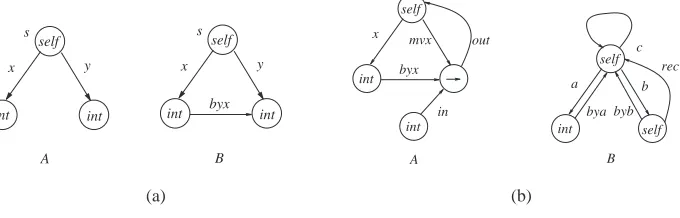
x y self s int int x y self s int int byx A B (a) a b self self int x mvx self int byx A B c rec int in out bya byb (b)
Figure 2: Example of Object Type Graphs
yare independent of each other. Graph B denotes the type[x : int,y({x}): int]where y depends on x. Note that the direction of the link arc in B is from x to y (not from y to x), and that the link is colored by byx, signifying that changes made to method x will affect method y. For instance, an object of type A may be[x=1, y=2](which is actually a record), and an object of type B may be[x=1,y=ς(s :S(B))(s.x+2)].
Note also that although the presence of the link in B or the absence of the link in A serves as an extra condition (compared to conventional type systems) for selecting objects to be typed as A or B respectively, there are still infinitely many objects that are of type A or type B. For example, objects [x=m,y=n]with m,n∈Nare all of type A; objects[x=n,y=ς(s : B)(a(s.x) +b)]
with n,a,b∈Nare all of type B. In this sense, OTG is (still) an abstract specification of object behaviors.
Example 3 In Figure2(b), A is the type graph forι(t)[x : int,mvx({x}): int →t]which is the
type of a simplified 1-d movable point[x=1,mvx=ς(s : B)λ(i : int)(s.x⇐s.x+i)]. The facts that mvx depends on x and returns a modified self object are indicated by the byx-colored arc and the out-colored arc respectively. Note the direction of the out-colored arc goes to the starting node of the type graph directly, indicating that this is a self type (as opposed to recursive objet type). Graph B represents the type of the object[a=1,b=p, c({a,b}) =ς(s :S(B))s]where
to the starting node of the graph. The difference between recursive object type and self type is clearly represented in object type graphs.
5
Subtyping under OTG
Given the definition of OTG, we now investigate the issue of subtyping under OTG. Throughout the paper, we write Aσ <: Bτ iffσ <:τ whereσ andτ are types and Aσ and Bτ are their type
graphs. We first present the necessary definitions and then provide some subtyping examples.
5.1 Definitions
Definition 7 (Type Graph Premorphism) Let Φ be the set of ground types. Given two type graphs G= (GN,GA,C,sr,tg,c) and G′ = (G′N,G′A,C′,sr′,tg′,c′), a type graph premorphism f : G→G′is a pair of maps(fN: GN→G′N,fA: GA→G′A), such that (1)∀a∈GA, fN(sr(a)) = sr′(fA(a)), fN(tg(a)) =tg′(fA(a)), and c(a) =c′(fA(a)); (2)∀v∈GN, if c(v)∈Φ, then c′(fN(v))∈ Φ; otherwise c(v) =c′(fN(v)).
Definition 8 (Base, Subbase) Given an object type graph G= (s,A,R,L,S). The base of G, denoted by Ba(G), is the graph(s,A,t(A),L), where t(A) ={tg(a)|a∈A}. A subbase of G is a
subgraph(s,A′,t(A′),L′)of Ba(G), where A′⊆A, L′⊆L, t(A′) ={tg(a)|a∈A′}, and for each
l∈L′there exist a1,a2∈A′such that sr(l) =tg(a1)and tg(l) =tg(a2).
Definition 9 (Closure, Closed) The closure of a subbase D= (s,A′,t(A′),L′)of an object type graph G= (s,A,R,L,S), denoted by Cl(D), is the union D∪E1∪E2, where (1) E1={l∈L|
∃a1,a2∈A′with tg(a1) =sr(l), tg(a2) =tg(l)}, and (2) E2={l,h,a,t(l)|l,h∈L, a∈A, a6∈
A′,tg(l) =sr(h) =tg(a), and∃a1,a2∈A′such that tg(a1) =sr(l),tg(a2) =tg(h)}. A subbase
D is said to be closed if D=Cl(D).
Definition 10 (Covariant, Invariant) Given an object type graph (s,A,R,L,S). Let t(A) =
{tg(a)|a∈A}. For each v∈t(A), if v is not incident with any links, or if v is the target node of some links but not the source node of any links, then v is said to be covariant; otherwise, v is said to be invariant.
Definition 11 (Object Subtyping) Given two object type graphs G= (sG,AG,/0,LG,SG) and F= (sF,AF,/0,LF,SF). F <: G if and only if the following conditions are satisfied: (1) There
exists a premorphism f from Ba(G) to Ba(F) such that f(Ba(G)) =Cl(f(Ba(G))). That is,
f(Ba(G))is closed. (2) For each node v in f(Ba(G)), let u be its preimage in Ba(G)under f ,
Fv∈SF be the type graph with v as its starting node, and Gu∈SGbe the type graph with u as its
starting node. (i) If v is invariant, then Fvis isomorphic to Gu. (ii) If v is covariant, then Fv<: Gu.
x y self
int int
x y
self
real int byx
A B
byx
v
(a)
x y
self
int int
x y
self
real pos byx
A B
byx
v u
u'
(b)
Figure 3: Examples of Object Subtyping
information out of the entire object type graph so that the structure of the method interdependen-cies can be better studied. A subbase of a base is a subgraph of the base and this subgraph by itself forms a base (of another object type graph). The closure of a subbase captures the com-plete behavior of the subbase by including, in addition to all methods and links in the subbase, all necessary methods and associated links outside of the subbase. A subbase is closed if it coin-cides with its closure. The notions of covariance and invariance are used to characterize whether the change of a method can affect another method by checking the directions of links that are incident with the method. The subtyping relation of two object types is given by first checking the structures of the two object type graphs to ensure that they have the same kind of behaviors, and then checking the subtyping relations for their sub- type graphs.
5.2 Examples
We now present some simple subtyping examples.
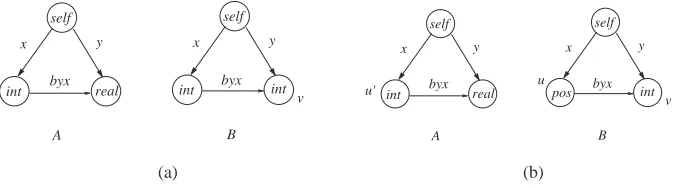
Example 4 Given the two type graphs in Figure3(a), clearly we can find a premorphism f from base of A to base of B such that f(Ba(A))is closed; note also that node v in B is covariant. Thus,
B<: A. As an example, we can regard the object[x=1, y=ς(s :S(B))(s.x+1)]of type B as
having type A.
Example 5 For the two type graphs in Figure3(b), we can also find a premorphism from the
base of A to the base of B, and node v in B is also covariant. But, node u in B is invariant which requires the corresponding node u′in A have the same color – pos (standing for positive integer) in order to have B<: A. But u′is colored by int, hence, B6<: A.
As an example to justify that B6<: A, let b= [x=1, y=ς(s :S(B))(log(s.x) +1)], it is easy to check b : B. If B<: A, then b : A, and in this case we can update the x field in b to a negative integer, say, -1, resulting an object like b= [x=−1, y=ς(s :S(B))(log(s.x) +1)]. In this
object, the invocation of method y will crash since log is not defined over negative integers.
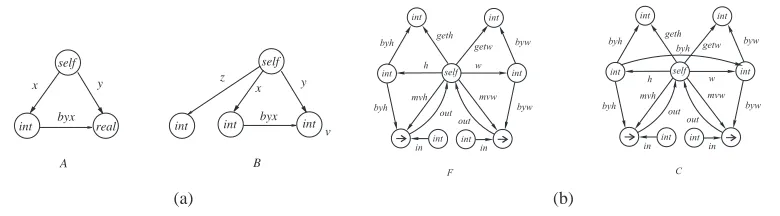
Example 6 Considering the graphs A and B in Figure4(a), it is easy to check (similar to the case of example 4) that B<: A. As an example for this subtyping, an object[x=1, y=ς(s :
S(B))(s.x+1), z=1]which is of type B, can clearly be regarded as having type A.
x y self
int int
x y
self
real byx
A B
byx
v z
int int
(a)
h w
mvh mvw byw getw geth
int self int
int int byh byw
in out in
out byh
F int int
h w mvh mvw
byw getw geth
int self int
int int byh byw
in out in
out byh
C int int
byh
(b)
Figure 4: Examples of Object Subtyping
find a premorphism f from Ba(A)to Ba(B)such that f(Ba(A))is closed. Similarly, there exists no such a premorphism g from Ba(B)to Ba(A)such that g(Ba(B))is closed, so A6<: B.
One may wonder what kind of type (graph) can be of a subtype of A or B respectively. Any subtype of A must not have a link between methods x and y; and any subtype of B must have a link going from x to y. This is the structural requirement in Definition11. As a result, object
[x =1, y =1] cannot be regarded as having the same type with the object [x=1, y=ς(s :
S(B))(s.x+1)], and vice versa. One may contend that this subtyping is too restrictive so that some “good” subtyping instances are not allowed by it; we argue that this is the trade-off in the sense that the strictness of this subtyping can block and prevent potential programming errors, as shown in the next example.
Example 8 As the last example, we show how the “free or constrained rectangles problem”
described in section 2.1. The (new) types of the free rectangle fRect and the constrained rectangle
cRectare depicted as F and C in Figure4(b). Note that the independence between the height and the width in the free rectangle fRect and their dependency in the constrained rectangle cRect are faithfully shown by the absence and presence of a byh-colored link between methods h and w in
Fand C, respectively. It is easy to check that C6<: F. So if we modify the function ds of section 2.1 by replacing its parameter type FR by the new type F in Figure4(b), then the call ds(cRect)
will be rejected under OTG by the compiler since it does not type-check.
6
Inheritance under OTG
We now turn to the issue of inheritance. Some basic notions in graph grammar are needed before we can define inheritance formally.
6.1 Definitions
Definition 12 (Type Graph Production) A type graph production p is a pair of type graph
premorphisms f : K→A1and g : K→A2, where A1is called the left side, A2the right side, and
K the interface. This is denoted as p= (A1 f
P B
A f K
PO g
f'
g'
P' i
j h
(a) Graph gluing definition
P D H
S f K g T
k PO1 PO2
(b) Direct derivation definition
Figure 5: Definitions of Graph Gluing and Direct Derivation
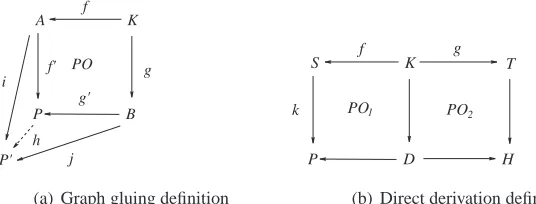
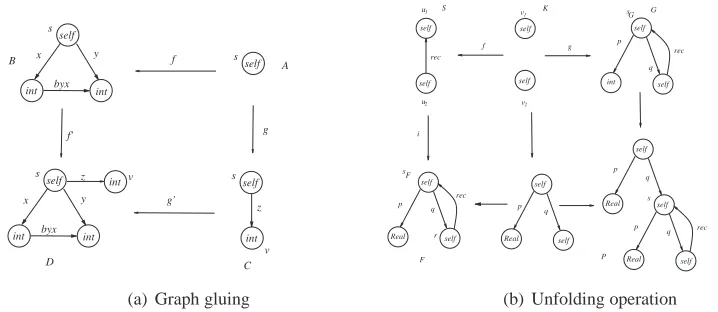
Definition 13 (Type Graph Gluing) Given two type graph premorphisms f : K→A and g :
K→B. The gluing of A and B along K is the pushout of K→f A and K→g B in the category
formed by type graphs together with type graph premorphisms (Figure5(a)).
Definition 14 (Direct Derivation) Given type graphs P, D, H, a type graph production p= (S←f K→g T), and a premorphism k : S→P (called a context map). We say that H is directly
derived from P via p by k, denoted by P(=p,k⇒)H, if P is the result of gluing S and D along K and H is the result of gluing D and T along K (Figure5(b)).
Definition 15 (Unfolding Production and Operation) A graph production u= (S←−f K−→g G)
is called an unfolding production if (1) K is a graph consisting of two nodes v1 and v2, and
c(v1) =c(v2) =sel f ; (2) S is a graph consisting of two nodes u1and u2and an arc t such that
c(u1) =c(u2) =sel f,c(t) =rec,sr(t) =u2, and tg(t) =u1; (3) f(vi) =ui,i=1,2; g is a partial
morphism with g(v2) =sGwhere sGis the starting node of G. Given an unfolding production
u= (S←−f K−→g G), an object graph F, and a premorphism i : S→F, we say F unfolds to P if F=(u,i⇒) P.
Definition 16 (Addition Production and Operation) A graph production a= (S←−f K−→g G)is called an addition production, if (1) K consists of only one node v, and c(v) =sel f ; (2) S consists
of only one node u, and c(u) =sel f ; (3) f(v) =u and g(v) =sGwhere sGis the starting node of
G. Given an addition production a= (S←−f K−→g G), an object graph F, and a premorphism
j : S→F, we say that P is the result of adding G into F if F=(a,⇒j)P.
Definition 17 (Link Production and Operation) A graph production l= (S←−f K−→g G) is called a link production, if (1) G is a graph consisting of two nodes v1, v2and an arc a connecting
these two nodes. c(vi) (i=1,2)is either a ground type or a→or a sel f , and c(a) =bym, where m is the color of one of the methods in G; (2) K is a graph consisting of two nodes u1 and u2
with c(ui)is either a ground type or a→or a sel f , i=1,2; (3) S is isomorphic to K, that is, f is
an isomorphism from K to S; g is an injection with g(ui) =vi, i=1,2; Given a link production
x y self s int int byx B z self s C int v self s x y self s int int byx D int A f f' g' z v g
(a) Graph gluing
self self self self self self int rec rec p q f g u
u1 s
2 v1 v2 self self Real p q G K S i self self Real rec p q s F self Real p q self self Real rec p q s P r G F
(b) Unfolding operation
Figure 6: Examples of Graph Gluing and Unfolding Operation
of embedding G into F if F=(l,k⇒) P.
Definition 18 (Inheritance Construction of Object Type Graphs) Given object type graphs F
and G. F is said to be inherited from G if G can be transformed into F through a finite sequence of unfolding operations, addition operations, and link operations.
Definition 19 (Inheritance) Given object type graphs S and T , an object of type T can be
constructed by inheritance from an object of type S if T is inherited from S.
Remarks: The central idea here is that inheritance of objects should be guided and guarded by object types. We devise, through some basic graph transformation techniques, an “inheritance” notion on object types, and then use this notion to judge whether an object can be built through inheritance from another object. Specifically, type graph production, type graph gluing, and direct derivation are the standard graph grammar notions in the context of object type graphs. An object type graph can be inherited from another object type graph, if the second object type graph can be transformed into the first one through a sequence of combinations of three special productions: unfolding production, addition production, and link production. An object can be constructed from another object via inheritance if and only if the type of the first object can be inherited from the type of the second object.
6.2 Examples
We now give some examples to demonstrate the graph operation definitions in the last section.
Example 9 A graph gluing example is shown in Figure6(a), where f and g map the only node
in A to the sel f -colored node in B and C respectively, and D is the result of gluing B and C along
int x out eq P byx in bool self int x out eq byx in bool self color c self self self color c int x out eq byx in bool self int x out eq CP byx in bool self color byc c int x out eq byx in bool self color c
color color color
int x out eq byx in bool self color c byc P' P'
Figure 7: CP is Inherited from P.
Example 10 Figure6(b)shows an unfolding operation. F =(u,i⇒) P, where u= (S←−f K−→g G),
f(vi) =ui, i=1,2, g(v2) =sG, i(u1) =sF, i(u2) =r. As we can see, P can be understood as
constructed by deleting the rec-colored arc from F, and then glue the result with a copy of the original F by identifying the starting node of the former with the source node of the rec-arc of the latter.
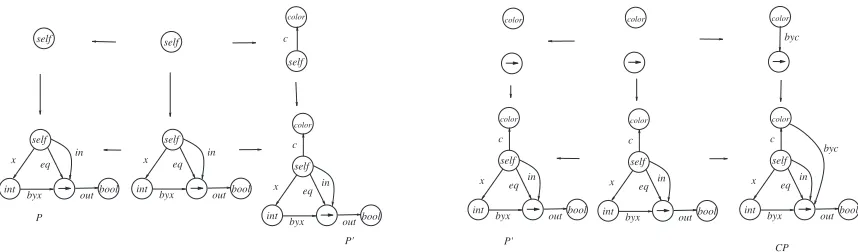
Example 11 We finally show how the “colored point problem” addressed in section 2.2 can be
resolved under OTG inheritance and subtyping. The type of points pt and pt0 and the type of
color point cpt are depicted as P and CP in Figure7respectively. We can see that CP is inherited from P (through one addition operation and one link operation), which means that cpt can be constructed by inheritance from pt (or pt0). Moreover, it is easy to check that CP<: Punder
OTG subtyping, which indicates that inheritance and subtyping are congruent in this case. (Note that this contrast with the “inheritance is not subtyping” slogan in the literature which is mainly motivated by this colored point example.) Finally, the crash of F(cpt) is prevented since the function F, as defined in section 2.2 and in the literature, does not type-check under OTG typing. Note in its definition, F=f un(p : PT)(p.eq(pt0)), with PT=Ob jectType(MyType){x : int,eq :
MyType→Bool}, p.eqrequires an argument of the self type associated with PT ,S(PT), but pt0has type PT , and PT is neither the same as nor the subtype ofS(PT)under OTG.
7
Resolution of the Problems
As examples of OTG subtyping and inheritance, we have demonstrated in the last section that the two problems outlined in section 2 can be successfully resolved under OTG subtyping and inheritance mechanisms. Here, we just summarize some major points.
Conse-quently, these two kinds of rectangles have different types.
• OTG inheritance replies on basic graph derivations. The fundamental idea in this respect is that inheritance on objects should be regulated using type information of the relevant objects. An “inheritance” relation over object types is first defined using graph derivations and then used to determine whether an object can be constructed by inheritance from another one.
• “Inheritance is not subtyping” has been advocated in the literature for quite a while. De-spite that, the mainstream OOP still adheres to the practice that “inheritance indicates subtyping”. One of the reasons for this is that without this practice, the software hierar-chy built by inheritance would be almost useless. Thus this practice is highly desirable. The“colored point problem” described in section 2.2 is one of the motivating examples that has prompted “inheritance is not subtyping”, because otherwise we will face some “method-not-found” error. Under OTG, we give this problem a new solution in the sense that “inheritance indicates subtyping” is retained and ”method-not-found” error is avoided.
8
Related Work
Representing object types as directed colored graphs and subsequently addressing the subtyping and inheritance issues by graph transformations is our original idea. It uniquely connects the type theory of object-oriented languages to algebraic graph transformation theory. The founda-tions of type theory can be found in [Bar92,AC96,Pie02], and the recent results and directions in type theory research are reflected in, for example, [PRB07, Che07, DHC07]. The origin of algebraic graph grammar and graph transformation can be traced back to [EPS73, Ehr78], and [Roz97,EEPT06] present a comprehensive coverage of this research area. For current trends and developments in graph transformation, see for example, the proceedings of GT-VMT and ICGT [EG07,CEM+06].
Incidentally, it is interesting to note that the phrase “type graph” has been used inconsistently in the literature. For example, it is used to denote the disjunctive rational trees in Prolog type analysis and database query algebra [HCC93,Sch01], to facilitate the investigation of quantifi-cation in Type Logical Grammar [BS06], and to give types for (some other) graphs in graph transformation study [GL07, EEPT06]. None of these is the same as the (object) type graphs introduced in this paper. In particular, the notion of type graphs which is used frequently in the domain of graph transformations refers to the directed graphs which are designated to abstract the properties of other (more complex) graphs and thereby to render the type of those graphs; whereas the notion of the type graphs addressed in this paper refers to a graphical representation of the usual data types (e.g., primitive types, function types, object types, etc.). Nevertheless, both notions are the abstraction of certain entities: the former is the abstraction of graphs and the latter is the abstraction of values.
9
Final Remarks
“inheritance is not subtyping”, are identified and subsequently addressed by a graph-computing (OTG) approach in this paper. It is demonstrated that both problems can be resolved effectively under OTG subtyping and inheritance mechanisms.
Bibliography
[AC96] M. Abadi, L. Cardelli. A Theory of Objects. Springer-Verlag, New York, 1996.
[Bar92] H. Barendregt. Lambda Calculi with Types. In S. Abramsky (ed.), Handbook of
Logic in Computer Science. Volume 2, pp. 117–309. Clarendon Press, Oxford, 1992.
[BL95] V. Bono, L. Liquori. A Subtyping for the Fisher-Honsell-Mitchell Lambda Calcu-lus of Objects. In Proc. of International Conference of Computer Science Logic. LNCS 933, pp. 16–30. 1995.
[Bru94] K. Bruce. A paradigmatic Object-Oriented Programming Language: Design, Static Typing and Semantics. Journal of Functional Programming 4(2):127–206, 1994.
[BS06] C. Barker, C. chieh Shan. Types as Graphs: Continuations in Type Logical Grammar.
J. of Logic, Language and Information 15(4), 2006.
[CEM+06] A. Corradini, H. Ehrig, U. Montanari, L. Ribeiro, G. Rozenberg (eds.). Proc. of
ICGT’06. LNCS 4178, Springer, 2006.
[CHC90] W. Cook, W. Hill, P. Canning. Inheritance is not Subtyping. In Proc. of POPL. Pp. 125–135. 1990.
[Che07] J. Chen. A typed intermediate language for compiling multiple inheritance. In Proc.
of POPL’07. Pp. 25–30. 2007.
[DHC07] D. Dreyer, R. Harper, M. Chakravarty. Modular type classes. In Proc. of POPL’07. Pp. 63–70. 2007.
[EEPT06] H. Ehrig, K. Ehrig, U. Prange, G. Taentzer. Fundamentals of Algebraic Graph
Trans-formation. Springer, 2006.
[EG07] K. Ehrig, H. Giese (eds.). Proc. of GT-VMT’07. http://eceasst.cs.tu-berlin.de/, 2007.
[Ehr78] H. Ehrig. Introduction to the algebraic theory of graph grammars. In
Graph-Grammars and Their Applications to Computer Science and Biology. LNCS 73,
pp. 1–69. Springer-Verlag, 1978.
[EPS73] H. Ehrig, M. Pfender, H. J. Schneider. Graph grammars: An algebraic approach. In
IEEE Conference of Automata and Switching Theory. Pp. 167–180. 1973.
[GL07] E. Guerra, J. de Lara. Adding Recursion to Graph Transformation. In Proc. of
GT-VMT’07. 2007.
[HCC93] P. V. Hentenrck, A. Cortesi, B. L. Charlier. Type Analysis of Prolog Using Type Graphs. Technical report, Brown University, Technical Report CS-93-52, 1993.
[LC96] L. Liquori, G. Castagna. A Typed Lambda Calculus of Objects. LNCS 1179, pp. 129–141. Sringer–Verlag, 1996.
[Liq98] L. Liquori. On Object Extension. In ECOOP’98 Object-oriented Programming. Lecture Notes in Computer Science 1445, pp. 498–522. Sringer–Verlag, 1998.
[Pie02] B. Pierce. Types and Programming Languages. MIT Press, 2002.
[PRB07] P. Permandla, M. Roberson, C. Boyapati. A type system for preventing data races and deadlocks in the java virtual machine language. In Proc. of LCTES’07. Pp. 1–10. 2007.
[Roz97] G. Rozenberg (ed.). Handbook of Graph Grammars and Computing by Graph
Transformation. Volume 1. World Scientific, 1997.
[Sak05] M. Sakkinen. Wishes for Object-oriented Languages. In Proc. of Langages et
Mod-eles a Objets (LMO 2005, invited talk). 2005.
[Sch01] K.-D. Schewe. On the Unification of Query Algebras and Their Extension to Ratio-nal Tree Structures. In Proc. of 12th Australasian Database Conference. Pp. 52–59. 2001.