257
IdentIfIcatIon and partIal characterIzatIon of a novel cIrcular
transcrIpt of the
Tc2n
gene from rat mammary gland
ShiQi Zhu, YanHong Wang, YuLong Zhao, Jia Chen, Chen Chen, YaMei Jiang, Jing Pang, XingTang Fang, Hong Chen and ChunLei Zhang*
Institute of Cellular and Molecular Biology, School of Life Science, Jiangsu Normal University, Xuzhou, Jiangsu, China 221116
*corresponding author: [email protected]
received: October 15, 2015; revised: December 14, 2015; accepted: December 21, 2015; published online: February 24, 2016
abstract: The regulatory mechanism of mammary gland development and lactation is important, as lactation not only provides healthy milk for infants, but also provides health benefits to mothers. Circular RNAs (circRNAs) have recently received much attention, but only a few have been functionally characterized. In the present study, the structure and expres-sion profile of a rat Tc2n-derived circular RNA (cTc2n) was investigated by several protocols. The cTc2n comprised exons 10 and 11 of the Tc2n gene and had no poly(A) structure. The expression of cTc2n was significantly higher in the mam-mary gland of rat than in other tissues, including the heart, liver, spleen, lung, kidney, uterus and ovary. The abundance of cTc2n was the highest on day 1, and significantly declined on day 7, slightly increasing on day 21 postpartum. This finding indicates that cTc2n might play an important role in lactation.
Key words:circular RNA; Tc2n; mammary gland; lactation; expression profile
IntroductIon
Mammary gland development and lactation are regulated by hormones and related metabolic path-ways, the detailed mechanisms of which are still not fully investigated. The gene regulatory networks in lactation have been preliminarily revealed by high throughput sequencing techniques and bioinformat-ics methods in the past decade [1-2]. Interestingly, noncoding RNAs, such as microRNA and long non-coding RNA, have been recently reported to play key roles in mammary gland function [3].
Circular RNAs (circRNAs), a novel class of non-coding RNAs, have recently received much attention from molecular biologists as they are very abundant and are differentially expressed [4-5]. More than 10000 circRNAs have been predicted in human H19 cells [6], nearly 2000 circRNAs have been predicted in mouse sequences and over 700 in Caenorhab-ditis elegans [7]. Drosophila has RNA sequencing
evidence for over 800 scrambled exon spliced junc-tions [8]. Additionally, circRNAs have been recently reported in plants, yeast and protists [9]. Although two circRNAs (CDR1as/ciRS-7 and Sry) have been evidenced as functioning as miRNA sponges [8,10], the function of most of the newly identified circRNAs remains unknown [8-11]. Thus, the current work on circular RNA is focused on elucidating their function.
materIals and methods rna extraction from tissues
Sprague-Dawley rats (Rattus norvegicus) at the fifth gestation were obtained from Vital River Laborato-ries (Beijing, China). Lactating mammary glands were harvested at days 1, 7 and 21 postpartum. Other tis-sues, including heart, liver, spleen, kidney, ovary and uterus, were also collected from the rats on day 21 postpartum. Five rats, designated as biological rep-licates, were used per time point. The tissues were rinsed with sterilized saline and frozen in liquid nitro-gen within 30 s after tissue dissection. Frozen samples were stored at -80°C until further analysis. The Review Committee for the Use of Animal Subjects of Jiangsu Normal University approved all the animal protocols. Total RNA was extracted from samples using RNAiso Plus (Takara) according to the standard procedures. Purity and concentration were detected by NanoDrop 2000 (Thermo, USA) before being stored at -80°C.
rnase r digestion treatment
RNA (5 μg) was incubated with or without 20 U of RNase R (Epicentre Biotechnologies) for 0.5 h at 37ºC. The resulting RNA was purified by ethanol precipitation and quantified. Equal amounts of RNA with or without RNase R treatment were subjected to reverse transcription using random primers.
reverse transcription by random primers or oligo(dt) primer
RNA (1 μg) was reverse-transcribed in vitro into cDNA with a PrimeScriptTM RT reagent Kit with a
gDNA Eraser (Takara) using random primers (Pro-mega, Madison, MI, USA) and an oligo(dT) primer (Takara, Dalian, China), respectively.
real time pcr
Expression of the transcript was detected using SYBR Green-based real-time PCR, which was performed us-ing the Step One plus Real-Time PCR System (Applied
Biosystems, USA) with SYBR Green I PCR premix (Takara, Dalian, China). The optimized reaction was performed in a 20-μL final reaction volume containing 10 μL of kit-supplied SYBR® Premix Ex TaqTM II, 1 μL
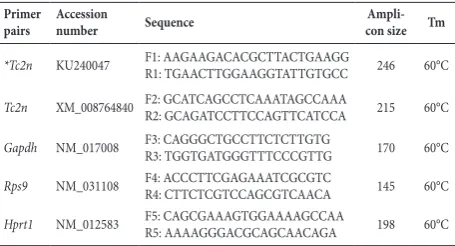
ROX Reference Dye (50×), 0.5 μL of both the forward and reverse primers (each 10 μM), 1 μL cDNA tem-plate and 7 μL distilled water, giving a final volume of 20 μL. The outward-facing primers were used for cTc2n quantification, and inward-facing primers were used for canonical Tc2n quantification (Table 1). The equation 2-∆Ct was used to measure the change of the
novel transcript expression after RNase R digestion.
sequencing of back-splice site
PCR was performed with outward-facing primers (Table 1). Amplification conditions were as follows: denaturation at 94°C for 4 min; 40 cycles of dena-turation at 94°C for 30 s, annealing at 60°C for 30 s, and extension at 72°C for 1 min, with a final ex-tension step at 72°C for 10 min. Each 20 μL of PCR reaction contained 1 μL cDNA template, 10 μL of 2× Taq PCR MasterMix (Tiangen, Beijing, China), 1 μL forward primer and 1 μL reverse primer. Ali-quots (140 μL) of the amplified PCR products were loaded onto 2% agarose gels for electrophoresis and visualization with ethidium bromide. The band was cut from the gel and purified using the Gel Extraction Kit (Sangon Biotech, Shanghai, China). The purified DNA fragment was subcloned to a pMD 19-T Vec-tor and transformed into JM109 cells (Takara, Dalian, China) according to the manufacturer’s instructions. table 1. The primer pairs for reverse transcription-PCR and real time-PCR.
primer
pairs accession number sequence con sizeampli- tm
*Tc2n KU240047 F1: AAGAAGACACGCTTACTGAAGGR1: TGAACTTGGAAGGTATTGTGCC 246 60°C
Tc2n XM_008764840 F2: GCATCAGCCTCAAATAGCCAAAR2: GCAGATCCTTCCAGTTCATCCA 215 60°C
Gapdh NM_017008 F3: CAGGGCTGCCTTCTCTTGTGR3: TGGTGATGGGTTTCCCGTTG 170 60°C
Rps9 NM_031108 F4: ACCCTTCGAGAAATCGCGTCR4: CTTCTCGTCCAGCGTCAACA 145 60°C
Hprt1 NM_012583 F5: CAGCGAAAGTGGAAAAGCCAAR5: AAAAGGGACGCAGCAACAGA 198 60°C
Plasmid DNA was extracted using a Plasmid DNA Extract kit and sequenced by Sanger sequencing (San-gon Biotech, Shanghai, China). The sequences were aligned with the rat Tc2n mRNA sequence by BLAST. The RNA secondary structures were predicted by RNAfold software [12,20].
statistical analysis
Values were presented as means±SD. Statistical analy-sis was done using SPSS 19.0 with one-way analyanaly-sis of variance (ANOVA) followed by Student-Newman-Keuls post hoc test. P <0.05 was considered statisti-cally significant.
results and dIscussIon Identification and validation of ctc2n
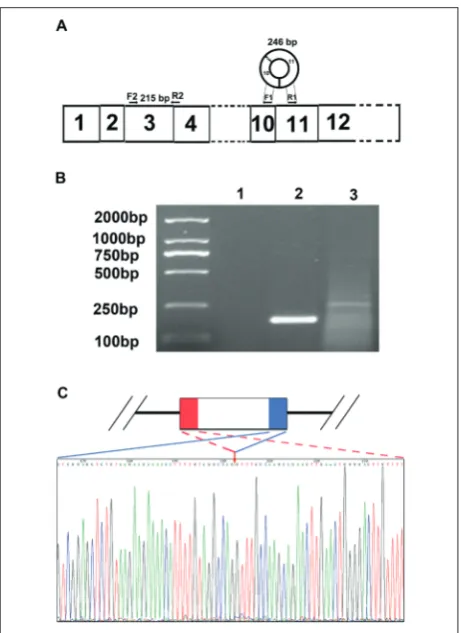
RNA-seq analysis indicated that rat cTc2n is com-prised of the exons 10 and 11 of the Tc2n gene. If this transcript is circular, a junction (back-splice site) be-tween the 5’ end of exon 10 and 3’ end of exon 11 of Tc2n should exist in the cTc2n. We performed PCR with total RNA from rat mammary glands us-ing a pair of outward-facus-ing primers from Tc2n exon 11 (Fig. 1A). The PCR products were subcloned and sequenced. Fragments were observed in all samples at 246 bp (Fig. 1B). The sequence (KU240047) was aligned with Tc2n canonical mRNA (XM_008764840), and the back-splice site was detected. The back-splice site linked the 5’ end of exon 10 and 3’ end of exon 11 of Tc2n (Fig. 1C). The cTc2n was derived from the back-spliced exons 10 and 11 of Tc2n.
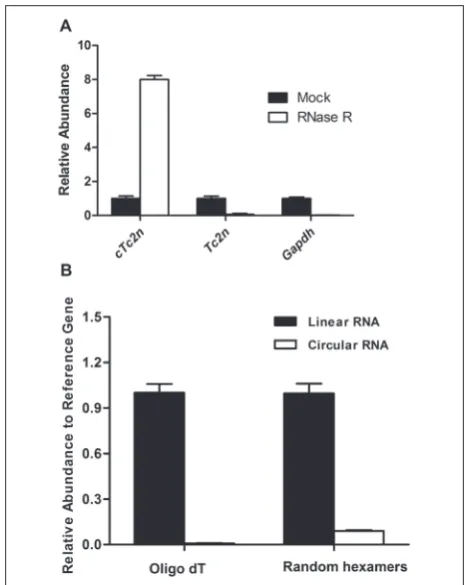
To further verify the circularization of the non-canonical transcript, we determined its resistance to RNA exonuclease R (RNase R). RNase R specifi-cally digests linear RNA, both structured and non-structured, but does not digest circular or lariat RNA [13-14]. Real-time PCR was performed to detect the change in its expression after RNase R digestion us-ing cDNAs of five rat mammary glands. The results showed a significant enrichment in the circular tran-script (Fig. 2A). The result of calculation using the
equation 2-∆Ct showed there was on average an 8-fold increase in cTc2n, but a 16-fold decrease in canonical Tc2n, which confirmed that cTc2n was circular.
Circular RNAs lack a polyadenylated tail [15]. To investigate whether cTc2n is without a polyadenylated tail, total RNA was reverse-transcribed with either random primers or oligo(dT) primers into cDNAs. Canonical transcripts were amplified from both kinds of cDNAs; cTc2n was only amplified from random priming cDNAs (Fig. 2B). This further confirmed the circularization of cTc2n. The results also indi-cated that cTc2n is abundant, when compared with canonical Tc2n.
putative second structure of ctc2n
Circular RNAs do not in general act by encoding a protein [7,9], and a handful studies have indicated that they may belong to a new class of regulatory RNAs [7,11]. We compared the putative second struc-ture of cTc2n with that of the corresponding region of Tc2n mRNA. The cTc2n had more stem-loop struc-ture with higher minimum free energy than that of the corresponding region of Tc2n mRNA (Fig. 3).
expression profile of ctc2n
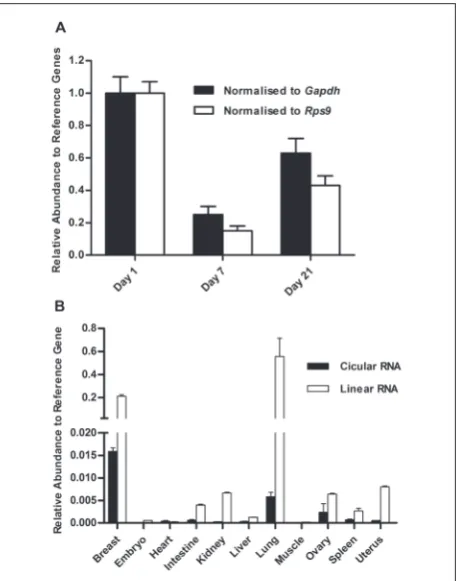
Our previous study found that cTc2n was one of the most highly expressed circular RNAs in lactating mammary glands [16]. Therefore, we investigated the expression profile of cTc2n during lactation. The abundance of cTc2n was highest on day 1,
signifi-cantly declined on day 7, and then slightly increased in day 21 postpartum (Fig. 4A). As the triacylglycerol concentration in rat milk decreased significantly dur-ing the first 5 days postpartum and then remained constant for the remaining lactation stages [17], cTc2n might be involved in milk lipid synthesis. To further confirm the importance of cTc2n in the mam-mary gland, we analyzed its expression in different tissues, including the heart, liver, spleen, lung, kidney, uterus and ovary in five rats on lactation day 21. Re-sults show that the expression of cTc2n was signifi-cantly higher in the mammary gland than in the other seven tissues (Fig. 4B). Thus, the results indicated that cTc2n might play an important role in the mammary gland, which needs further study.
We browsed the circBase (http://www.circbase. org) for circular RNAs in mouse and human Tc2n, but we could not find a homolog of rat circular Tc2n, which suggested it was species-specific.
function of ctc2n
The function of most circRNAs remains largely un-clear. Two circRNA, ciRS-7/CDR1as and Sry, have been demonstrated to function as miRNA sponges fig. 3. Putative secondary structure of cTc2n and correspond-ing linear region of Tc2n. A – cTc2n; B – linear cTc2n. The left structure was predicted by RNAfold, and the right structure was predicted by mfold software.
[8,11]. We analyzed the putative miRNA target sites in cTc2n by BLAST software. No specific miRNA tar-get sites were predicted to be densely distributed in cTc2n, which indicated that cTc2n does not function to modulate miRNA activity. This is in agreement with a previous report that the enrichment of mi-croRNA binding sites was not a global feature under selection [9].
A recent work showed that circRNA biogenesis per se can regulate mRNA production; for example, circRNAs could compete with the linear splicing of pre-mRNA [18] and that circularization of exons cor-related with exon skipping [19]. Interestingly, in the present study the expression level of Tc2n mRNA in rat mammary glands increased from lactation day 1
to day 7. Conversely, the expression level of cTc2n de-clined significantly from lactation day 1 to day 7. Fur-thermore, cTc2n comprised exons 10 and 11 of Tc2n. one of two conserved domains in the Tc2n protein, suggesting that cTc2n might suppress Tc2n splicing. However, this needs further confirmation.
acknowledgements: This work was funded in part by the National Natural Science Foundation of China (31472077, 31101703), Innovation and Entrepreneurship Training Program for the Jiangsu College Students (201410320027Z), Natural Sci-ence Foundation of Jiangsu Province (BK2011206), Jiangsu Over-seas Research and Training Program for University Prominent Young and Middle-aged Teachers and Presidents Project, and a Project Funded by the Priority Academic Program Development of Jiangsu Higher Education Institutions.
authors’ contributions: ShiQi Zhu, YanHong Wang, YuLong Zhao, Jia Chen, Chen Chen, YaMei Jiang and Jing Pang performed the experiments; XingTang Fang and Hong Chen analyzed the results; ChunLei Zhang designed the experiment.
conflict of interest: The authors declare that they have no com-peting interests.
references
1. Bionaz M, Loor JJ. Gene networks driving bovine milk fat synthesis during the lactation cycle. BMC Genomics. 2008; 9:366.
2. Maningat PD, Sen P, Rijnkels M, Sunehag AL, Hadsell DL, Bray M, Haymond MW. Gene expression in the human mam-mary epithelium during lactation: the milk fat globule tran-scriptome. Physiol Genomics. 2009;37(1):12-22.
3. Piao H, Ma L. Non-coding RNAs as regulators of mammary development and breast cancer. Mammary Gland Biol Neo-plasia. 2012;17(1):33-42.
4. Jeck WR, Sharpless NE. Detecting and characterizing circular RNAs. Nat Biotechnol. 2014;32(5):453-461.
5. Lasda E, Parker R. Circular RNAs: diversity of form and func-tion. RNA. 2014;20(12):1829-1842.
6. Zhang XO, Wang HB, Zhang Y, Lu X, Chen LL, Yang L. Complementary sequence-mediated exon circularization. Cell. 2014;159(1):134-147.
7. Memczak S, Jens M, Elefsinioti A, Torti F, Krueger J, Rybak A, Maier L, Mackowiak SD, Gregersen LH, Munschauer M, Loewer A, Ziebold U, Landthaler M, Kocks C, le Noble F, Rajewsky N. Circular RNAs are a large class of animal RNAs with regulatory potency. Nature. 2013;495(7441):333-338. 8. Salzman J, Chen RE, Olsen MN, Wang PL, Brown PO.
Cell-type specific features of circular RNA expression. PLoS Genet. 2013;9(9):e1003777.
9. Wang PL, Bao Y, Yee MC, Barrett SP, Hogan GJ, Olsen MN, Dinneny JR, Brown PO, Salzman J. Circular RNA is expressed across the eukaryotic tree of life. PLoS One. 2014;9(6):e90859. 10. Hansen TB, Jensen TI, Clausen BH, Bramsen JB, Finsen B,
Damgaard CK, Kjems J: Natural RNA circles function as effi-cient microRNA sponges. Nature. 2013;495(7441):384-388. 11. Salzman J, Gawad C, Wang PL, Lacayo N, Brown PO.
Cir-cular RNAs are the predominant transcript isoform from hundreds of human genes in diverse cell types. PLoS One. 2012;7(2):e30733.
12. Hofacker IL, Stadler PF. Memory Efficient Folding Algo-rithms for Circular RNA Secondary Structures. Bioinformat-ics. 2006;22(10):1172-1176.
13. Burd CE, Jeck WR, Liu Y, Sanoff HK, Wang Z, Sharpless NE. Expression of linear and novel circular forms of an INK4/ ARF-Associated Non-Coding RNA correlates with athero-sclerosis risk. PLoS Genet. 2010;6(12):e1001233.
14. Suzuki H, Zuo Y, Wang J, Zhang MQ, Malhotra A, Mayeda A. Characterization of RNase R-digested cellular RNA source that consists of lariat and circular RNAs from pre-mRNA splicing. Nucleic Acids Res. 2006;34(8):e63.
15. Jeck WR, Sorrentino JA, Wang K, Slevin MK, Burd CE, Liu J, Marzluff WF, Sharpless NE. Circular RNAs are abun-dant, conserved, and associated with ALU repeats. RNA. 2013;19(2):141-157.
16. Zhang C, Wu H, Wang Y, Zhao Y, Fang X, Chen C, Chen H. Expression Patterns of Circular RNAs from Primary Kinase Transcripts in the Mammary Glands of Lactating Rats. J Breast Cancer. 2015;18(3):235-41.
17. Nicholas KR, Hartmann PE. Milk secretion in the rat: pro-gressive changes in milk composition during lactation and weaning and the effect of diet. Comp Biochem Physiol A Comp Physiol. 1991; 98(3-4):535-542.
18. Ashwal-Fluss R, Meyer M, Pamudurti NR, Ivanov A, Bartok O, Hanan M, Evantal N, Memczak S, Rajewsky N, Kadener S. CircRNA biogenesis competes with pre-mRNA splicing. Mol Cell. 2014;56(1):55-66.
19. Kelly S, Greenman C, Cook PR, Papantonis A. Exon Skip-ping Is Correlated with Exon Circularization. J Mol Biol. 2015;427(15):2414-2417.