Available online throug
ISSN 2229 – 5046
International Journal of Mathematical Archive- 9(2), Feb. – 2018 52
RADIATION AND CHEMICAL REACTION EFFECTS
ON MHD MIXED CONVECTIVE FLOW OF A VERTICAL SURFACE
WITH OHMIC HEATING AND VISCOUS DISSIPATION
V. NAGARAJU
1, K. HEMALATHA
21
Research Scholar, Department of Mathematics,
Krishna University, Machalipatnam, India-521001.
2
Department of Mathematics,
V R Siddhartha Engineering College, Vijayawada, India-520007.
(Received On: 26-12-17; Revised & Accepted On: 18-01-18)
ABSTRACT
W
e consider the radiation and chemical reaction effects on MHD mixed convective heat and mass transfer flow past a vertical surface under the influence of Ohmic and viscous dissipation. The governing system of partial differential equations is transformed to dimensionless equations using dimensionless variables. The dimensionless equations are then solved analytically using perturbation technique. The various parameters entering into the problem on the dimensionless velocity, temperature and concentration fields within the boundary layer are discussed and the skin-friction coefficient, the Nusselt number and Sherwood number are presented numerically in tabular form also explained qualitatively.Keywords: Mixed convective flow; MHD; Ohmic heating; viscous dissipation; Radiation; Chemical reaction.
1. INTRODUCTION
The study of boundary layer flow heat and mass transfer over an inclined plate has generated much interest from astrophysical, renewable energy systems and also hypersonic aerodynamics researchers for a number of decades. In recent years, MHD flow problems have come in view of its significant applications in industrial manufacturing processes such as plasma studies, petroleum industries, Magneto hydrodynamics, power generator cooling of clear reactors and boundary layer control in aerodynamics. Many authors have studied the effects of magnetic fields on mixed, natural and force convection, heat and mass transfer problems. Heat transfer considerations arise due to chemical reactions and often due to the very nature of the process. MHD free convection fluid-flows frequently occur in natural world. Fluid passing through porous medium is of great interest nowadays and many researchers are attracted towards the applications in the fields of science and technology, namely in the area of agriculture engineering to know about ground water resources, in technology to study the moment of natural gas, oil, and water through the oil reservoirs. The effects of mixed convection unsteady stagnation point flow of a viscous fluid, with a variable free stream velocity. The mass transfer effects on unsteady flow past an accelerated vertical porous plate have been noticed by Das et al. [1]. Sattar [2] has investigated the free convection and mass transfer flow, past an infinite vertical porous plate with time dependent temperature and concentration. Chen et al. [3] examined heat and mass transfer in MHD flow by natural convection from a permeable, inclined surface with variable wall temperature and concentration. Masood et al. [4] used HAM to formulate the MHD mixed convection Falkner–Skan flow with convective boundary conditions. The MHD conjugative heat transfer problem from vertical surfaces embedded in saturated porous media was discussed by Duwairi and Al-Kablawi [5]. Nasir Uddin et al. [6] discovered the effect of conjugate heat and mass transfer on magneto hydrodynamic mixed convective flow past inclined plate in a porous medium. The skin friction in the MHD mixed convection stagnation point with mass transfer was studied by Abdelkhalek [7].The number of investigations of natural convection flow with thermal radiation has increased greatly during the past few decades due to its importance in many practical situations. When natural convection flows occur at high temperature, radiation effects on the fluid flow become significant. Radiation effects on the natural convection flow are important in the context of furnace design, electric power generation, thermo-nuclear fusion, glass production, casting and levitation,
Corresponding Author: V. Nagaraju
1,
1Research Scholar, Department of Mathematics,
plasma physics, cosmic flights, propulsion systems, solar power technology, spacecraft re-entry, aerothermodynamics, etc., It is worth noting that unlike convection/conduction, the governing equations taking into account the effects of radiation become quite complicated. Hence, many difficulties arise while solving such equations. However, some reasonable approximations are proposed to solve the governing equations with radiative heat transfer.
The influence of magnetic field on the flow of an electrically conducting viscous fluid with mass transfer and radiation absorption is also useful in planetary atmosphere research. Kinyanjui et al. [8] investigated simultaneous heat and mass transfer in unsteady free convection flow with radiation absorption past an impulsively started infinite vertical porous plate subjected to a strong magnetic field. Suneetha [9] noticed the problem of radiation and mass transfer effects on MHD free convection flow past an impulsively started isothermal vertical plate with dissipation. Aydin and Kaya [10] proposed the MHD mixed convective heat transfer about a semi-infinite inclined plate in the presence of magneto and thermal radiation effects. Israel Cookey et al. [11] noticed the influence of viscous dissipation and radiation on unsteady MHD free convection flow past an infinite heated vertical plate in a porous medium with time dependent suction. Ogulu [12] examined the influence of radiation absorption on unsteady free convection and mass transfer flow of a polar fluid in the presence of uniform magnetic field. Rajesh [13] has investigated radiation effects on MHD free convection flow near a vertical plate with ramped wall temperature. Sivaiah et al. [14] noticed that the heat and mass transfer effects on MHD free convective flow past a vertical porous plate. Radiation effects on mixed convection along anisothermal vertical plate were investigated by Hossain and Takhar [15]. Raptis and Perdiki [16] discovered the effects of thermal radiation and free convection flow past a moving vertical plate.
In many chemical engineering processes, chemical reaction occurs between a foreign mass and the fluid in which the plate is moving. These processes take place in numerous industrial applications viz., polymer production, manufacturing of ceramics or glassware and food processing. The effect of chemical reaction on unsteady MHD flow through an impulsively started semi-infinite vertical plate was examined by Muthucumaraswamy et al. [17]. Sudhir Babu et al. [18] studied radiation and chemical reaction effects on an unsteady MHD convection flow past a vertical moving porous plate embedded in a porous medium with viscous dissipation. Dulal Pal et al. [19] analyzed Perturbation Analysis of unsteady magnetohydrodynamic convective heat and mass transfer in a boundary layer slip, flow past a vertical permeable plate with thermal radiation and chemical reaction. The effect of radiation and chemical reaction on transient MHD free convective flow over a vertical plate through porous media was formulated by Sandeep et al. [20]. Recently, Kumar et al. [21] investigated effects of chemical reaction and radiation on MHD free convection flow past an exponentially accelerated vertical plate. Anjali Devi and Kandasamy [22] have discovered the effects of chemical reaction, heat and mass transfer on MHD flow past a semi-infinite plate. Ibrahim et al. [23] have examined the effects of the chemical reaction and radiation absorption on the unsteady MHD free convection flow past a semi-infinite vertical permeable moving plate with heat source and suction. Effects of chemical reaction and radiation absorption on MHD flow of dusty viscoelastic fluid are analyzed by Prakash et al. [24]. The chemical and radiation absorption effects on MHD convective heat and mass transfer flow past a semi-infinite vertical moving porous plate with time dependent suction was proposed by Ramana Reddy et al. [25]. Sudheer Babu et al. [26] investigated the effects of thermal radiation and chemical reaction on MHD convective flow of a polar fluid past a moving vertical plate with viscous dissipation. Saritha and Satya Narayana [27] investigated thermal diffusion and chemical reaction effects on unsteady MHD free convection flow past a semi-infinite vertical permeable moving plate. For the problem of coupled heat and mass transfer in MHD free convection, the effect of Ohmic heating has not been considered in the above investigations. However, it is more realistic to include this effect to explore the impact of the magnetic field on the thermal transport in the boundary layer. With this awareness, the effect of Ohmic heating on the MHD free convection heat transfer has been examined on a Newtonian fluid by Hossain [28]. Chaudhary et al. [29] have discovered the radiation effect with simultaneous thermal and mass diffusion in MHD mixed convection flow from a vertical surface with Ohmic heating. The effect of Ohmic heating on the MHD free convection heat transfer has been studied on a Newtonian fluid by Hossain [30]. The problem of combined heat and mass transfer of an electrically conducting fluid in MHD natural convection, adjacent to a vertical surface with Ohmic heating was analyzed by Chen [31]. The effect of Ohmic heating and viscous dissipation on MHD mixed convection heat and mass transfer about a vertical plate are analyzed by Aydin and Kaya [32]. Babu and Reddy [33] have discovered the mass transfer effects on MHD mixed convective flow from a vertical surface with ohmic heating and viscous dissipation. Sibanda and Makinde [34] proposed the effects of magnetic fields on heat transfer on a rotating disk in a porous medium with Ohmic heating and viscous dissipation.
© 2018, IJMA. All Rights Reserved 54
2. FORMATION OF THE PROBLEM
We consider the mixed convection flow of an incompressible, electrically conducting viscous fluid such that
x
*- axis which is taken along the plate in upward direction andy
*- axis is normal to it. A transverse constant magnetic field isapplied in the direction
y
*-axis. Since the motion is two dimensional and length of the plate is large therefore all the physical variables are independent ofx
*. Letu
*andv
* be the components of velocity inx
*andy
* directions respectively, taken along and perpendicular to the plate. The governing equations of continuity, momentum and energy for a flow of an electrically conducting radiation is given by0
v
y
∗ ∗∂
=
∂
⇒
*v
= -v
0(constant) (1)*
0
p
P
y
∗ ∗∂
= ⇒
∂
is independent ofy
* (2)(
)
(
)
2
2
* 2
0 *
u
u
u
v
g
T
T
g
C
C
B u
y
y
K
ϑ
ρ
∗ ∗µ
∗ρ β
∗ ∗ρ β
∗ ∗σ
∗ ∗∞ ∞
∗ ∗
∂
=
∂
+
−
+
−
−
−
∂
∂
(3)2 2 * 2 2 2 0 r p
q
T
T
u
C v
k
B u
y
y
y
y
ρ
∗ ∗ ∗µ
∗σ
∗∗ ∗ ∗ ∗
∂
∂
=
∂
+
∂
−
+
∂
∂
∂
∂
(4)(
)
2
2
*
C
C
v
D
R C
C
y
y
∗ ∗ ∗ ∗ ∗ ∞ ∗ ∗∂
=
∂
−
−
∂
∂
(5)Here, g is the due to gravity,
T
* the temperature of the fluid near the plate,T
∞∗ the free stream temperature,c
*-the concentration,β
-the coefficient of thermal expansion, k the thermal conductivity,P
*the pressure,C
p the specific heat of constant pressure,B
0the magnetic field coefficient,µ
the viscosity of the fluid,q
r* the radiative heat flux,ρ
the density,σ
the magnetic Permeability of the fluid,v
0-the constant suction velocity,v
the kinematic viscosity and D molecular diffusivity.The radiative heat flux is given by
(
)
4
rq
T
T
I
y
∗ ∗ ∞ ∗∂
′
=
−
∂
(6)where 0
,
b w wde
K
d
dT
λ λλ
∞ ∗
∫
K w
λ
is the absorption coefficient at wall ande
bλ is Planck’s function.The boundary conditions are
0
u
∗=
,T
∗=
T
w,C
∗=
C
wy
∗=
0
(7)
0
u
∗→
,T
∗→
T
∞,
C
C
∗ ∞
→
y
∗→ ∞
Introducing the following non–dimensional quantities are
0
,
u
u
v
∗=
0,
v y
y
ϑ
∗=
,
wT
T
T
T
θ
∗ ∞∗ ∞−
=
−
w,
C
C
C
C
C
∗ ∗ ∞ ∞−
=
−
Pr
,
p
c
k
µ
=
Sc
,
D
ϑ
=
3 0(
)
,
wg
T
T
Gr
v
βϑ
−
∞=
* 30
(
)
,
wg
C
C
Gm
v
β ϑ
−
∞=
022 0
,
B
M
v
σ ϑ
ρ
=
2 * 0 2,
v K
K
ρ
ϑ
=
(
)
2 0,
p wv
E
C T
T
α=
−
2 04
,
pI
F
c v
ϑ
ρ
′
=
2*The non-dimensional form of the governing Eqs. (3) - (5) reduce to
[
]
1
u
u
M
u
GrT
GmC
K
′′
+ −
′
+
= −
+
(9)2 2
Pr
Pr
Pr ( )
Pr
0
T
′′
+
T
′
−
F
T
+
E u
′
+
EMu
=
(10)
0
C
′′
+
ScC
′
−
ScKrC
=
(11)where Gr is the Grashof number, Gm – the modified Grashof number, Pr - the Prandtl number, F- the radiation parameter, Sc- the Schmidt number, E-the Eckert number, M-the magnetic parameter, Kr-the chemical reaction.
The corresponding boundary conditions in dimension less form are reduced to
0,
1,
1
at
0
0,
0,
0,
as
u
T
C
y
u
T
C
y
=
=
=
=
→
→
→
→ ∞
(12)The physical variable u, T and C can expand in the power of Eckert number €. This can be possible physically as E for the flow of an incompressible fluid is always less than unity. It can be interpreted physically due to the Ohmic dissipation which is improved on the main flow.
3. SOLUTION OF THE PROBLEM
To reduce the above system of partial differential equations to the system of ordinary differential equations in a dimension less from, we may represent the translational velocity, temperature and concentration as
2
0 1
( )
( )
( )
(
)
u y
=
u y
+
Eu y
+
O E
2
0 1
( )
( )
( )
(
)
T y
=
T y
+
ET y
+
O E
2
0 1
( )
( )
( )
(
)
C y
=
C y
+
EC y
+
O E
(13)Using equation (13) in equation (9) - (11) and equating the Coefficient of like power of E, we have
0 0 1 0 0 0
u
′′
+ −
u
′
n u
= −
GrT
−
GmC
(14)0
Pr
0Pr
00
T
′′
+
T
′
−
F
T
=
(15)
0 0 0
0
C
′′ +
ScC
′
−
ScKrC
=
(16)
1 1 1 1 1 1
u
′′
+ −
u
′
n u
= −
GrT
−
GmC
(17)
( )
2 21
Pr
1Pr
1Pr
0Pr
00
T
′′
+
T
′
−
E
T
+
u
′
+
Mu
=
(18)
1 1 1
0
C
′′+
ScC
′
−
ScKrC
=
(19)The corresponding boundary conditions are
0 1 0 1 0 1
0 1 0 1 0 1
0,
0,
1,
0,
1,
0 at
0
0,
0,
0,
0,
0,
0 as
u
u
T
T
C
C
y
u
u
T
T
C
C
y
=
=
=
=
=
=
=
→
→
→
→
→
→
→ ∞
(20)Solving equations (15)-(19) with the help of (20), we get
3
4 1
0
( )
3 1 2m y
m y m y
u y
=
A e
−−
A e
−−
A e
−(21)
( 4 3) ( 1 3) ( 1 4)
6 5 2 4 2 3 2 1
1
( )
18 11 12 13 14 15 16 17m m y m m y m m y
m y m y m y m y m y
u y
=
A e
−−
A e
−+
A e
−+
A e
−+
A e
−−
A e
− ++
A e
− +−
A e
− +(22)
3
0
m y
T
=
e
−(23)
( 3 4) ( 1 3) ( 1 4)
5 2 4 2 3 2 1
1 10 4 5 6 7 8 9
m m y m m y m m y
m y m y m y m y
T
=
A e
−−
A e
−−
A e
−−
A e
−+
A e
− +−
A e
− ++
A e
− +(24)
1
0
m y
C
=
e
−(25)
1
0
C
=
© 2018, IJMA. All Rights Reserved 56
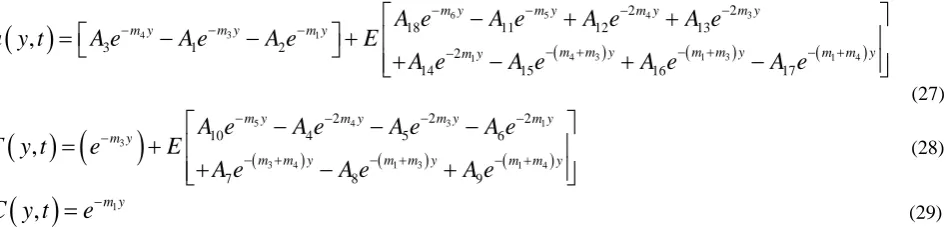
Substituting equations (21)-(26) in Equation (13), we obtain the velocity, Temperature and concentration distribution in the boundary layer as follows:
( )
6 5( ) 4 ( ) 3 ( )3
4 1
4 3 1 3 1 4
1
2 2
18 11 12 13
3 1 2 2
14 15 16 17
,
m y m y m y m y
m y
m y m y
m m y m m y m m y
m y
A e
A e
A e
A e
u y t
A e
A e
A e
E
A e
A e
A e
A e
− − − −
−
− −
− + − + − +
−
−
+
+
=
−
−
+
+
−
+
−
(27)
( )
(
)
(5 ) 4 ( ) 3 ( 1) 33 4 1 3 1 4
2
2 2
10 4 5 6
7 8 9
,
m y m y m y m y
m y
m m y m m y m m y
A e
A e
A e
A e
T y t
e
E
A e
A e
A e
− − − −
−
− + − + − +
−
−
−
=
+
+
−
+
(28)
( )
,
m y1C y t
=
e
− (29)The skin-friction, Nusselt number and Sherwood number are important physical parameters for this type of boundary layer flow.
Skin Friction:
The non-dimensional skin friction at the plate is given by:
0
y
u
y
τ
=
∂
=
∂
(
)
6 18 11 5 4 12 3 13 14 14 3 1 3 1 2
3 4 15 1 3 16 4 1 17
2
2
2
(
)
(
)
(
)
m A
A m
m A
m A
A m
m A
A m
m A
E
m
m A
m
m A
m
m A
τ
= −
+
+
+
−
+
−
−
−
+
+
−
+
+
+
(30)Nusselt Number:
The non- dimensional form of the rate of heat transfer in terms of Nusselt number at the plate is given by:
0
y
T
Nu
y
=
∂
= −
∂
(
5 10)
4 4(
3 5)
1(
6)
33 4 7 1 3 8 4 1 9
2
2
2
m A
A m
m A
m A
Nu
m
E
m
m
A
m
m
A
m
m A
−
+
+
+
=
−
−
+
+
+
−
+
(31)Sherwood Number:
The non- dimensional form of the rate of heat transfer in terms of Sherwood number at the plate is given by:
0
y
C
Sh
y
=
∂
= −
∂
1
Sh
=
m
(32)
RESULTS AND DISCUSSION
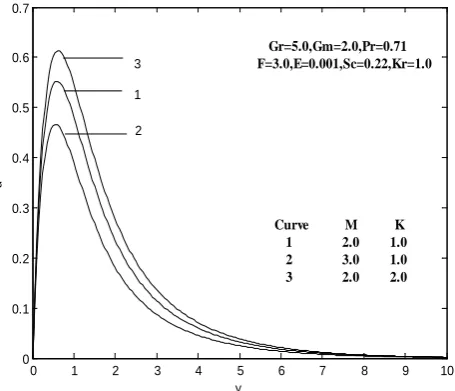
The system of ordinary differential equations (14) - (19) with boundary conditions (20) is solved analytically by employing the perturbation technique. The solutions are obtained for the velocity fields from (21) - (22), temperature fields from (23) - (24), and concentration fields are given by (25) - (26). To assess the physical depth of the problem the effects of various parameters like Grashof number Gr, modified Grashof number Gm, magnetic parameter M, porosity parameter K, Prandtl number Pr, Eckert number E, Schmidt number Sc, Chemical reaction Kr, Radiation parameter F,on velocity distribution, temperature distribution and concentration distribution are studied in figures 1-8, while keeping the other parameters as constants. The variation in Skin friction, the rate of mass transfer in the form of Sherwood number studied through the following default parameter values are adopted Gr=5.0, Gm=2.0, M=2.0, K=1.0, Pr=0.71, E=0.001, Sc = 0.22, Kr=1.0, F=3.0.
Figure. 1 depicts the velocity profile u against y for different values of Grashof number Gr and modified Grashof number Gm. From this, we observe that as Grashof number Gr increases, velocity field u increases, modified Grashof number Gm increases and velocity field u increases.
Figure 3&6 show the dimensionless velocity and temperature profiles for different values of Prandtl number Pr. It can be seen that both velocity and the temperature profiles decrease with the increase of Prandtl number Pr.
In figure 4, it exhibits the velocity profiles for various value of chemical reaction parameter Kr, Schmidt number Sc. From this figure, it is observed that velocity decreases with increases in chemical reaction Kr, and the velocity increases with a decrease in Schmidt number Sc. Figure 8 illustrates the effects of chemical reaction Kr, Schmidt number Sc on the concentration profile. It is seen from these figures that there is a steady decrease in the concentration with the increase in chemical reaction Kr, and there is a decrease in the velocity with the increase in Schmidt number Sc.
Effects of Eckert number E and Radiation parameter F on velocity and temperature profiles are studied from figure 5&7. From these figures, it is observed that velocity and temperature profiles decrease as Radiation parameter F increases and it can be seen that both velocity and the temperature profiles increase with the increase of Eckert number E.
Figure-1: Velocity profiles for different values of Gr and Gm.
Figure-2: Velocity profiles for different values of K and M
0 1 2 3 4 5 6 7 8 9 10
0 0.1 0.2 0.3 0.4 0.5 0.6 0.7
y
u
3
1 2
M=2.0,K=1.0,Pr=0.71,F=3.0, E=0.001,Sc=0.22,Kr=1.0
Curve Gr Gm 1 5.0 2.0 2 6.0 2.0 3 5.0 3.0
0 1 2 3 4 5 6 7 8 9 10
0 0.1 0.2 0.3 0.4 0.5 0.6 0.7
y
u
3 1 2
Gr=5.0,Gm=2.0,Pr=0.71 F=3.0,E=0.001,Sc=0.22,Kr=1.0
© 2018, IJMA. All Rights Reserved 58
Figure-3: Velocity profiles for different values of Scand Kr
Figure-4: Velocity profile for different values of Pr
Figure-5: Velocity profiles for different values of F and E
0 1 2 3 4 5 6 7 8 9 10
0 0.1 0.2 0.3 0.4 0.5 0.6 0.7
y
u
1 3
2
Gr=5.0,Gm=2.0,M=2.0,K=1.0, Pr=0.71,F=3.0,E=0.001
Curve Sc Kr 1 0.22 1.0 2 1.0 1.0 3 0.22 2.0
0 1 2 3 4 5 6 7 8 9 10
0 0.1 0.2 0.3 0.4 0.5 0.6 0.7 0.8
y
u
1
2
3
Curve Pr 1 0.25 2 0.50 3 0.71 Gr=5.0,Gm=2.0M=2.0,K=1.0, F=3.0,E=0.001,Sc=0.22,Kr=1.0
0 1 2 3 4 5 6 7 8 9 10
-0.1 0 0.1 0.2 0.3 0.4 0.5 0.6
y
u
3 1 2
Gr=5.0,Gm=2.0,M=2.0,K=1.0, Pr=0.71,Sc=0.22,Kr=1.0
Figure-6: Temperature profile for different values of Pr
Figure-7: Temperature profiles for different values of F and E
Figure-8: Concentration profiles for different values of Scand Kr
0 1 2 3 4 5 6 7 8 9 10
0 0.1 0.2 0.3 0.4 0.5 0.6 0.7 0.8 0.9 1
y
T
1
3 2
Gr=5.0,Gm=2.0,M=2.0,K=1.0, F=3.0,E=0.001,Sc=0.22,Kr=1.0
Curve Pr 1 0.25 2 0.50 3 0.71
0 1 2 3 4 5 6 7 8 9 10
0 0.1 0.2 0.3 0.4 0.5 0.6 0.7 0.8 0.9 1
y
T
3 1 2
Gr=5.0,Gm=2.0,M=2.0,K=1.0, Pr=0.71,Sc=0.22,Kr=1.0
Curve F E 1 3.0 0.001 2 5.0 0.001 3 3.0 0.05
0 1 2 3 4 5 6 7 8 9 10
0 0.1 0.2 0.3 0.4 0.5 0.6 0.7 0.8 0.9 1
y
C
3 1
2
© 2018, IJMA. All Rights Reserved 60
Table-1: Numerical values of the Skin-friction (Cf), Nusselt number (Nu) and Sherwood number (Sh) for Gr, Gc, M, K.
Table-2: Numerical values of the Skin-friction (Cf), Nusselt number (Nu) and Sherwood number (Sh) for Pr, F, E.
Table-3: Numerical values of the Skin-friction (Cf), Nusselt number (Nu) and Sherwood number (Sh) for Sc, Kr.
Tables (1), (2) and (3) show the numerical values of the skin friction (Cf), Nusselt number (Nu) and Shear wood number (Sh). The effects of where Grashof number Gr, modified Grashof number Gm, magnetic parameter M, porosity parameter K, Prandtl number Pr, Radiation parameter F, Eckert number E Schmidt number Sc and Chemical reaction Kr on the skin-friction(Cf), Nusselt number(Nu), Sherwood number (Sh)are shown in Tables 1 to 3.
From Table 1, it is noticed that as the skin-friction increases as Grashof number Gr, modified Grashof number Gc, porosity parameter K increases. Magnetic parameter M increases the skin-friction decreases. The Nusselt number decreases as Grashof number Gr, modified Grashof number Gc, porosity parameter K increases. Magnetic parameter M increases the Nusselt number also increases.
Gr Gc M K Cf Nu Sh
5.0 2.0 2.0 1.0 2.6422 1.8493 0.5918
1.0 2.0 2.0 1.0 1.3724 1.8548 0.5918
3.0 2.0 2.0 1.0 2.0067 1.8521 0.5918 5.0
1.0 2.0 1.0 2.1122 1.8532 0.5918 5.0
1.5 2.0 1.0 2.3772 1.8513 0.5918 5.0
2.0 1.0 1.0 3.0238 1.8299 0.5918 5.0
2.0 1.5 1.0 2.8080 1.8450 0.5918 5.0
2.0 2.0 0.3 2.1597 1.8548 0.5918 5.0
2.0 2.0 0.5 2.3932 1.8531 0.5918
Pr F E Cf Nu Sh
0.71 3.0 0.001 2.6422 1.8493 0.5918
0.25 3.0 0.001 3.2304 0.9961 0.5918
0.50 3.0 0.001 2.8430 1.4950 0.5918
0.71 1.0 0.001 3.0033 1.2639 0.5918
0.71 2.0 0.001 2.7827 1.5924 0.5918
0.71 3.0 0.01 2.6790 1.7800 0.5918
0.71 3.0 0.05 2.8363 1.4765 0.5918
Sc Kr Cf Nu Sh
0.22 1.0 2.6422 1.8493 0.5918
0.6 1.0 2.4084 1.8488 1.1307
0.5 1.0 2.4549 1.8491 1
0.22 0.3 2.7688 1.8489 0.3895
From the table 2 presents, it is observed that the Prandtl number Pr, Radiation parameter F increases skin-friction decreases, Nusselt number increases .Eckert number E increases and the skin-friction increase, Nusselt number decreases.
From the table 3 presents it is observed that the Schmidt number Sc increases the skin-friction and the Sherwood number also increases. Chemical reaction Kr increases the skin-friction and Nusselt number decreases but Sherwood number increases.
CONCLUSION
In this paper, we discussed the radiation and chemical reaction effects on MHD flow of a vertical surface in presence of ohmic heating and viscous dissipation has been studied. The governing equations are solved for the velocity field, temperature and concentration by using perturbation technique in terms of dimensionless parameters. In the analysis of the flow the following conclusions are made:
• The velocity increases with an increase in Grashof number Gr and modified Grashof number Gc.
• The velocity decreases with an increase in the magnetic parameter M.
• The velocity increases with an increase in the porosity parameter K.
• Increase the Prandtl number Pr, decreases the velocity and the temperature field.
• Increase the Radiation parameter F, decreases the velocity and the temperature field.
• An increase in the Eckert number E leads to increase in the velocity and the temperature field.
• The velocity as well as concentration decreases with an increase in the Schmidt number Scand Chemical reaction Kr.
REFERENCES
1. S. S. Das, S. K. Sahoo and G. C. Dash, Numerical Solution of Mass Transfer Effects on Unsteady Flow Past an Accelerated Vertical Porous Plate with Suction, Bulletin of Malysie. Math.Sci. Soc. 29(1), 33-42, 2006. 2. M. A. Sattar, Free Convection and Mass Transfer Flow Through a Porous Medium Past and Infinite Porous
Plate with Time Dependent Temperature and Concentration, Int. J. Pure and Appl. Math, 23, 759-766, 1994. 3. C.H. Chen, Yunlin and Taiwan, “Heat and mass transfer in MHD flow by natural convection from a
permeable inclined surface with variable wall temperature and concentration”, Acta Mechanica, vol. 172, 2004, pp. 219-235.
4. Masood K, Ali R, Shahzad A. MHD Falkner-skan flow with mixed convection and convective boundary conditions. Walaiak J SciTechnol 2013; 10:517-29.
5. Chen, C.H. (2004) “Heat and mass transfer in MHD flow by natural convection from a permeable inclined surface with variable wall temperature and concentration”, Acta Mechanica,Vol.172, p219-235.
6. Md. Nasiruddin, M. A. Alim and M. M. K. Chowdhury, “Effect of Conjugate Heat and Mass Transfer on MHD Mixed Convective Flow past Inclined Porous Plate in Porous Medium”, International Journal of Mechanical, Industrial Science and Engineering, vol. 08, no. 03, 2014, pp. 1870-1875.
7. Abdelkhalek MM (2006) The skin friction in the MHD mixed convection stagnation point with mass transfer. Int. Communications in Heat and Mass Transfer, 33: 249-258.
8. Kinyanjui M, Kwanza JK and Uppal SM, Energy Conversion and Management, 2010,42(8):917–931.
9. Suneetha S, Bhasker Reddy N and Ram Chandra Prasad V, Thermal Science, 2009, Vol.13, No.2, pp. 171-181.
10. O. Aydin and A.Kaya, “MHD mixed convective heat transfer flow about an inclined plate”, Heat Mass Transfer, vol. 46, 2009, pp. 129-136.
11. Israel – cookey, C. Ogulu, A. Omubo – Pepple V.M. (2003). The influence of viscous dissipation and radiation on unsteady MHD free convection flow past an infinite heated vertical plate in a porous medium with time dependent suction. Int. J. Heat Mass Transfer,46, 13, 2305 –2311.
12. A. Ogulu, “The influence of radiation absorption on unsteady free convection and mass transfer flow of a polar fluid in the presence of a uniform magnetic field”, International Journal of Heat and Mass Transfer, vol. 48, no. 23-24, pp. 5078–5080, 2005.
13. Rajesh, V., 2010. Radiation effects on MHD free convection flow near a vertical plate with ramped temperature mixed free-forced convection and mass transfer, Int. J. Appl. Math and Mech., 6 (21): 60-77. 14. Sivaiah M, Nagarajan A, Reddy PS. Heat and mass transfer effects on MHD free convective flow past a
vertical porous plate. The ICFAI University Journal of Computational Mathematics. 2009; 2(2):14-21.
15. Hossain M. A. and Takhar H.S. 1996. Radiation effects on mixed convection along a vertical plate with uniform surface temperature. Heat and MassTransfer. 31:243-248.
© 2018, IJMA. All Rights Reserved 62
17. Muthucumaraswamy. R, Maheswari. J and Pandurangan. J (2008): Unsteady MHD flow past an impulsively started semi-infinite vertical plate in the presence of chemical reaction, Mathematics, 4(1), p-119.
18. SudhirBabu M, Satyanarayana P V, Sankar Reddy and Uma Maheshwara Reddy D, Advances in Applied Science Research, 2011,2 (5):226-239.
19. Dulal Pal and BabulalTalukdar (2010). Perturbation analysis of unsteady magneto hydrodynamic convective heat and mass transfer in a boundary layer slip flow past a vertical permeable plate with thermal radiation and chemical reaction. Communications in Nonlinear Science and Numerical Simulation, pp.1813-1830.
20. N. Sandeep, A. Vijaya Bhaskar Reddy, and V. Sugunamma, “Effect of radiation and chemical reaction on Transient MHD free convective flow over a vertical plate through porous media”, Chemical and Process Engineering Research, vol. 2, pp. 1-9, 2012.
21. Kumar, A.G. V. Varma, S.V. K. and Rammohan. Chemical reaction and radiation effects on MHD free convective flow past an exponentially accelerated vertical plate with variable temperature and variable mass diffusion, Annals of Faculty Engineering Hunedoara, Tome X, Fascicule 2, 2012, pp: 195-202.
22. S. P. Anjali Devi and R. Kandasamy, “Effects of chemical reaction, heat and mass transfer on MHD flow past a semi-infinite plate,” Zeitschrift fur AngewandteMathematik und Mechanik, vol. 80, no. 10, pp.697–701, 2000.
23. F.S. Ibrahim, A.M. Elaiw and A. A. Bakr, Effects of chemical reaction and radiation absorption on the unsteady MHD free convection flow past a semi-infinite vertical permeable moving plate with heat source and suction, Communications in Nonlinear Science and Numerical Simulation, Vol. 13, no. 6, 2008, pp.1056-1066.
24. Prakash. J, Vijaya Kumar, A.G, Madhavi, M and Varma, S. V. K (2014). Effects of Chemical Reaction and Radiation Absorption on MHD Flow of Dusty Visco elastic Fluid, Applications and Applied Mathematics: An international Journal, Vol.9, No.1, pp.141-156.
25. G. V. Ramana Reddy, G. Sudershan Reddy and K. Jayarami Reddy: Chemical and radiation absorption effects on MHD convective heat and mass transfer flow past a semi-infinite vertical moving porous plate with time dependent suction, International Journal Of Mathematical Archive, 3(2012), pp.2974-2982.
26. SudheerBabu M, Satyanarayana P V, Sankar Reddy T and Umamaheswara Reddy D (2011): Effects of thermal radiation and chemical reaction on MHD convective flow of a polar fluid past a moving vertical plate with viscous dissipation, Elixir Appl. Math. 40:pp. 5168-5173.
27. Saritha S and Satya Narayana P V(2012): Thermal diffusion and chemical reaction effects on unsteady MHD free convection flow past a semi-infinite vertical permeable moving plate, Asian Journal of Current Engineering and Maths, 1: 3, pp. 131 –138.
28. M. A. Hossain, The effect of Ohmic heating on the MHD free convection heat transfer has been examined for a Newtonian fluid, Int. J. Heat and Mass transfer, 35, P3485, 1992.
29. R. C. Chaudhary, Bhupendra Kumar Sharma and Abhay Kumar Jha, “Radiation effect with simultaneous thermal and mass diffusion in MHD mixed convection flow from a vertical surface with Ohmic heating”, Rim. Journ.Phys. vol. 51, Nos.7-8, pp.715-727, 2006.
30. M. A. Hossain, (1992), Viscous and Ohmic heating effects on MHD free convection flow with variable plate temperature, Int. J. Heat and Mass transfer, 35, p. 3485.
31. Chien-Hsin-Chen, (2004), Combined heat and mass transfer in MHD free convection from a vertical surface with Ohmic heating and viscous dissipation, Int. J. Engineering Science, 42, p. 699.
32. O. Aydin and A. Kaya (2009), the effect of Ohmic heating and viscous dissipation on MHD mixed convection heat and mass transfer about a vertical plate, Appl. Math. Model.33 (11), pp. 4086-4096.
33. Babu V. S. H. and Reddy G. V. R. 2011.Mass transfer effects on MHD mixed convective flow from a vertical surface with ohmic heating and viscous dissipation. Advances in Appl. Sci. Res. 2 (2011) (4), 138-146.
34. P. Sibanda and O. D. Makinde, “On steady MHD flow and heat transfer past a rotating disk in a porous medium with ohmic heating and viscous dissipation,” International Journal of Numerical Methods for Heat and Fluid Flow, vol.20, no.3, pp.269–285, 2010.
35. Hossain M. A, “Viscous and Ohmic heating effects on MHD free convection flow with variable plate temperature”, Int. J. Heat and Mass transfer, 35 (1992),12, pp. 3485-3487
APPENDIX
2 1
4
2
Sc
Sc
KrSc
m
=
+
+
,2 2
4
2
Sc
Sc
KrSc
m
=
+
+
,2 3
Pr
Pr
4 Pr
2
F
m
=
+
+
41
1 4
12
n
m
=
+
+
,2 5
Pr
Pr
4 Pr
2
E
m
=
+
+
, 61
1 4
12
n
m
=
+
+
, 1 23 3 1
Gr
A
m
m
n
=
−
−
, 2 21 1 1
Gm
A
m
m
n
=
− −
,A
3= +
A
1A
2(
)
2 2 3 4 4 2 4 4Pr
,
4
2 Pr
Pr
A
m
M
A
m
m
E
+
=
−
−
11
,
n
M
K
=
+
(
)
2 2 1 3 5 2 3 3Pr
,
4
2 Pr
Pr
A
m
M
A
m
m
E
+
=
−
−
(
)
2 2 2 1 6 2 1 4Pr
,
4
2 Pr
Pr
A
m
M
A
m
m
E
+
=
(
)
(
3)
1 4(
3)
7 2
4 3 4 3
2
Pr
,
Pr
Pr
A A m m
M
A
m
m
m
m
E
+
=
+
−
+
−
(
)
(
2)
1 1(
3)
8 2
1 3 1 3
2
Pr
,
Pr
Pr
A A m m
M
A
m
m
m
m
E
+
=
+
−
+
−
(
)
(
)
(
)
3 2 4 1
9 2
4 1 4 1
2
Pr
,
Pr
Pr
A A m m
M
A
m
m
m
m
E
+
=
+
−
+
−
A
1=
A
0 4+
A
5+
A
6−
A
7+
A
8−
A
9,
10 11 2
5 5 1
,
A Gr
A
m
m
n
=
−
−
4 12 2
4 4 1
,
4
2
A Gr
A
m
m
n
=
−
−
5 13 2
3 3 1
,
4
2
A Gr
A
m
m
n
=
−
−
6 14 2
1 1 1
,
4
2
A Gr
A
m
m
n
=
−
−
(
) (
7)
15 2
3 4 3 4 1
,
A Gr
A
m
m
m
m
n
=
+
−
+
−
(
) (
)
8
16 2
3 1 3 1 1
,
A Gr
A
m
m
m
m
n
=
+
−
+
−
(
) (
9)
17 2
1 4 1 4 1
,
A Gr
A
m
m
m
m
n
=
+
−
+
−
A
18=
A
11−
A
12−
A
13−
A
14+
A
15−
A
16+
A
17,
Source of support: Nil, Conflict of interest: None Declared.