TEA1024/ TEA1124
Zero Voltage Switch with Fixed Ramp
Description
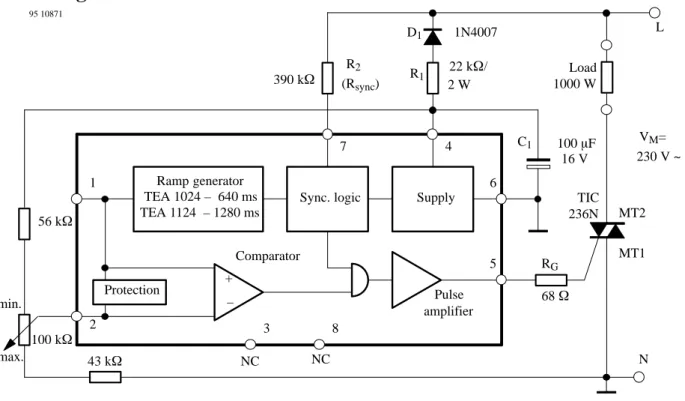
The monolithic integrated bipolar circuit, TEA1024/ TEA1124 is a zero voltage switch for triac control in domestic equipments. It offers not only the control of a triac in zero crossing mode but also the possibility of power control. This is why the IC contains a mains
synchronized ramp generator with 640 ms (1280 ms) duration (50 Hz). It is suitable for a typical load of 750 W (1000 W) meeting the Flicker Standard. (values in brackets relate to TEA1124.)
Features
D Direct supply from the mains D Definite IC switching characteristics D Very few external components
D Full wave drive – no dc component in the load circuit D Current consumption ≤ 1.5 mA
D Output short circuit protected
D Simple power control D Integrated ramp generator
D Reference voltage variable by external resistance D Pulse position optimization
Package: DIP8
Block Diagram
D1
Ramp generator TEA 1024 – 640 ms TEA 1124 – 1280 ms
Sync. logic Supply
+ – Protection
2 1
7 4
6
5 Pulse amplifier Comparator
3 8 NC NC
R1 2 W
1N4007
C1 100 mF
16 V Load 1000 W
L
56 kW
100 kW min.
max. 43 kW
TIC 236N
N VM=
230 V ~
95 10871
390 kW (R
sync)
R2
MT2 MT1 68 W
RG
22 kW/
TEA1024/ TEA1124
Power Supply and its Limitations
The voltage limitation contained in the IC allows it to be powered from mains via series resistance R1 and recti– fying diode D1 between Pin 6 (+ Pol/ă) and Pin 4 (–VS). The capacitor C1 smooths the supply voltage (see figure 1).An internal temperature-compensated limiting circuit protects the module from random peaks of voltage on the mains, and delivers a defined reference voltage during the negative half-cycle.
Synchronization
Figure 2. Pulse position optimization
The logic function is synchronized by means of a separate resistance R2 connected between Pin 7 and phase (voltage-synchronization). The width of the pulse can be varied between wide limits by choice of Rsync. The larger the value chosen, the wider the output pulse is on Pin 5. Automatic optimization of the phase of the pulse is necessary, since the latching current of the triac exceeds the steady current by a factor of 3.
The phase of the pulse is chosen so that ca. 1/3 of the pulse width appears before the transition through null and 2/3 after it (see electrical characteristics and figure 2). In order to avoid phase-clipping after the switch-on the first third of the first pulse is automatically suppressed.
Full-Wave Logic
The full-wave logic ensures that only pairs of pulses can be released, and that these always begin with the positive dv/dt. The load is thus switched on for a minimum of one complete mains cycle. This means that the triac receives a minimum of two driving pulses, so that the unwanted d.c. component in the load circuit is definitely eliminated.
Pulse Amplifier
The pulse amplifier connected to the output of the full-wave logic circuit, is proof against continuos short-circuits, and delivers negative output pulses of typ. 75 mA, via an integrated limiting resistance, to Pin 5.
Ramp Generator (Figures 3, 4)
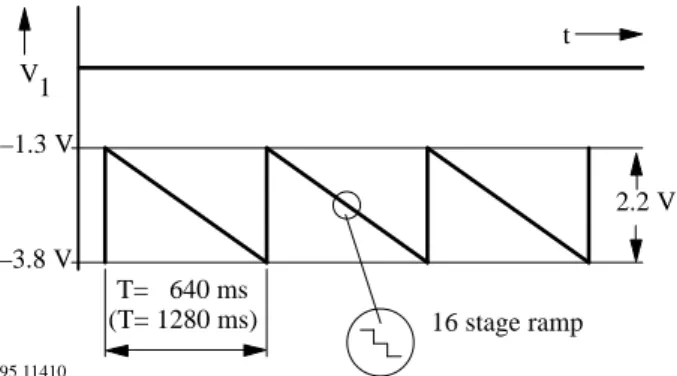
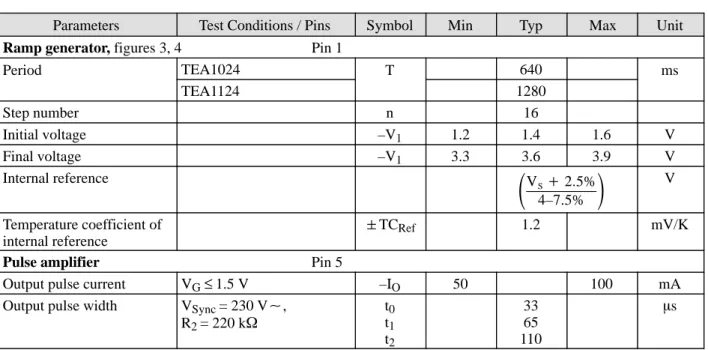
Ramp voltage which is generated in the IC is available not only at reference Pin 1, but also at the non-inverted input of the comparator.
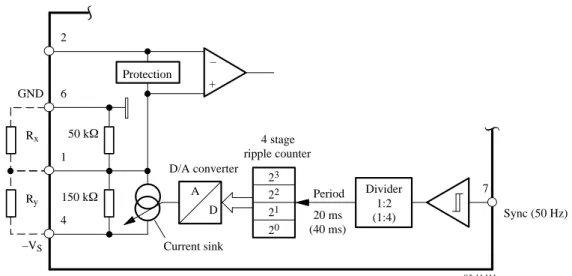
The current sink which is controlled by D/A converter influences the internal reference voltage at Pin 1 specified by voltage divider. The current sink is turned-off in the reset state of the D/A converter so that the voltage at Pin 1 is primarily specified via the internal voltage divider (ramp starting voltage).
In the maximum state of the 4 stage (5 stage – TEA1124) D/A converter, the current sink overtakes the maximum current, whereby the ramp’s final (end) voltage has reached. External resistance Rx, Ry shown in figure 4 are in position to influence the initial ramp voltage as well as the ramp amplitude. If the external resistances ratio Rx, Ry is the same as that of the internal ratio, the ramp voltage at the beginning remains maintained (constant), only the amplitude is compressed.
2.2 V T= 640 ms
(T= 1280 ms) V
1 –1.3 V
16 stage ramp –3.8 V
t
95 11410
TEA1024/ TEA1124
– + Protection
50 kW
150 kW A
D/A converter
D
20
Current sink
21
22
23
4 stage ripple counter
Divider 1:2 (1:4) Period
20 ms (40 ms) 2
6
1
4 –VS
Rx
Ry
GND
7
Sync (50 Hz)
95 11411
Figure 4. Principle diagram – Generation and evaluation of ramp
Period
1. The time required for one complete cycle of a regular. repeating signal, function, or series of emends. 2. The tune between two consecutive transients of the
pointer or indicating means of an electrical indicating instrument in the same disdain the rest position. Something called periodic fine.
Comparator
The comparison of set value and measured value is carried out via the two comparator inputs Pin 1 and Pin 2. Here Pin 2 is the inverting input and has a circuit pro-tecting it against interference spikes. Figure 5 shows the protective circuit of the comparator. Pin 1 is the non-inverting input.
Ramp generator
95 11412 +
– R
T Z
1
6
2 GND
Figure 5. Protective circuit of the comparator
Firing Pulse Width (Figures 6, 7)
It depends on the latching current as well as on the load current of the used triacs.whereas IL[A] = Latching current of the triac VM[V]= Mains voltage, effective P[W] = Power load
f[1/s] = Mains frequency tp[s]+ 3
4 p f arcsin
IL VM P 2Ǹ
Firing pulse width is specified through the zero cross over identification which can be influenced by the sync. resistance.
Rsync [W] +
VMǸ2 sin ǒ 2
3 w tpǓ – 0.6
2.5 10–5 –1.4 10 3
where
TEA1024/ TEA1124
0.01 0.10 1.00 10.00
10 100 1000 10000
t ( ms )
P ( W)
96 11939
p
IL ( mA)
100 200
50
Vmains = 230 V∼
Figure 6.
0 200 400 600 800
0 0.5 1 1.5 2 2.5
R ( M )2
tp ( ms )
1000
95 11
W
VMains=230VX
Figure 7.
Ignition (Firing) Current
The necessary ignition current depends on the specified triac. With the help of a resistance, it is possible to limit its value:
whereas VG[V]= Gate voltage of the triac IG[A]= Max. gate current
IP[A]= Average gate current requirement t [s] = Ignition pulse width
RGmax[W] [
5.7 V – VGmax IGmax
–25 W Ip[A]+
IGmax T tp
Supply Voltage
Due to higher trigger sensitivity of the triac it is supplied with negative signal. It can be supplied via diode and series resistance from the negative half wave of the mains. An internal parallel controller limits the voltage between Pin 5 and 7 to a typical value of 6.55 V.
Dimensioning of the Series Resistance
R
1(Figures 8, 9)
VM = Mains supply
VS = Limiting voltage of the IC Itot = Total current requirement
Ix = Current requirement for external circuit R1max+ 0.85
VMmin – VSmax 2 Itot
–65 W Itot+ IS) IP) IX P(R1)+
(VM– VS)2 2 R1
0 3 6 9 12
0 10 20 30 40 50
R ( k )1
Itot ( mA )
15
95 10114
VMains=230VX
W
Figure 8.
0 3 6 9 12
0
Itot ( mA )
15
95 10116
VMains=230VX
1 2 3 4 6
P
(
W
)
5
TEA1024/ TEA1124
Absolute Maximum Ratings
Reference point Pin 6
Parameters Symbol Value Unit
Current consumption Pin 4
t≤ 10 ms
–IS is
30 150
mA
Sync. current Pin 7
t≤ 10 ms
ISync iSync
5 40
mA
Comparator input current Pin 2 "II 1 mA
Input voltages Pin 1,4,5
Pin 5
–VI +VI
≤VS
≤ 0.5
V Power dissipation
Tamb = 45°C Tamb = 100°C
Ptot 400
125
mW
Junction temperature Tj 125 °C
Ambient temperature range Tamb 0 to 100 °C
Storage temperature range Tstg –40 to + 125 °C
Thermal Resistance
Parameters Symbol Maximum Unit
Junction ambient RthJA 200 K/W
Electrical Characteristics
Supply voltage –VS = 5.6 V, Tamb = 25°C, f = 50 Hz, reference point Pin 6, unless otherwise specified
Parameters Test Conditions / Pins Symbol Min Typ Max Unit
Supply voltage limitation –I4 = 1 mA Pin 4 –VS 5.7 7.4 V
Current consumption Pos. half, cycle Pin 4 Zero cross over
(Pin 5 open) Pin 4 neg. half cycle Pin 4
–IS –IS –IS
1 1 1.8
mA
Synchronization Pin 7
Voltage limitation ±I7 = 1 mA "VI 1.0 1.8 V
Synchronization current "ISync 0.15 mA
Zero cross detection "ISync 25 mA
Comparator, figure 5
Input zero voltage Pin 1, 2 V10 10 mV
Input quiescent current Pin 2 IB 1 mA
Common mode input range
TEA1024/ TEA1124
Unit Max
Typ Min
Symbol Test Conditions / Pins
Parameters
Ramp generator, figures 3, 4 Pin 1
Period TEA1024 T 640 ms
TEA1124 1280
Step number n 16
Initial voltage –V1 1.2 1.4 1.6 V
Final voltage –V1 3.3 3.6 3.9 V
Internal reference
ǒ
VS) 2.5% 4–7.5%
Ǔ
V
Temperature coefficient of internal reference
"TCRef 1.2 mV/K
Pulse amplifier Pin 5
Output pulse current VG≤1.5 V –IO 50 100 mA
Output pulse width VSync = 230 VX, R2 = 220 kW
t0 t1 t2
33 65 110
ms
Applications
MT1 Ramp generator
TEA 1024 – 640 ms TEA 1124 –1280 ms
Sync. logic Supply
+ – Protection
2 1
7 4
6
5 Pulse amplifier Comparator
3 8
NC NC
R1 22 kW/
2 W D1 1N4007
C1 100 mF
16 V Load 0.7...1.5 kW
L
TIC 236N
N VM =
230 V ~
95 11416
390 kW/
(Rsync)
R2
0.5 W
MT2
68 W RG
R(25) = 10 kW
R(30) = 8 kW
R(10) = 20 kW
NTC / M87 B value = 3474
TEA1024/ TEA1124
MT1 Ramp generator
TEA1024 – 640 ms TEA1124 –1280 ms
Sync. logic Supply
Protection 2
1
7 4
6
5 Pulse amplifier Comparator
3 8
NC NC
R1 22 kW/
2 W D1 1N4007
C1 100 mF
16 V Load 0.7...1.5 kW
L
2.2 kW
TIC 236N
N VM=
230 V ~
95 11417
390 kW/
(Rsync)
R2
0.5 W
MT2
68 W RG
R(25) = 10 kW
R(30) = 8 kW
R(10) = 20 kW
NTC / M87 B value = 3474
R12
10 kW R6
33 kW R4
50 kW Rp
+ –
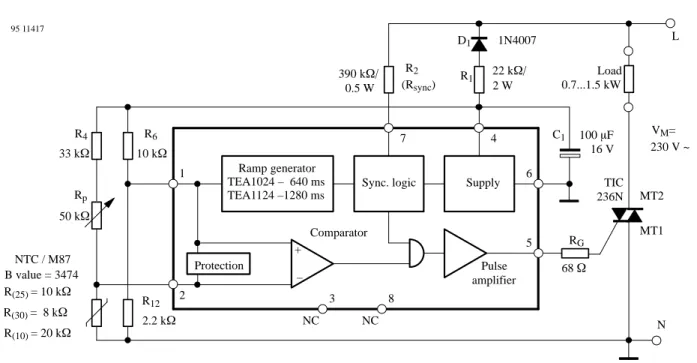
Figure 11. Temperature regulation with proportional range, 10 to 30 °C/ 640 ms ramp cycle
Dimensions in mm
Package: DIP8TEA1024/ TEA1124
Ozone Depleting Substances Policy Statement
It is the policy of TEMIC TELEFUNKEN microelectronic GmbH to1. Meet all present and future national and international statutory requirements.
2. Regularly and continuously improve the performance of our products, processes, distribution and operating systems with respect to their impact on the health and safety of our employees and the public, as well as their impact on the environment.
It is particular concern to control or eliminate releases of those substances into the atmosphere which are known as ozone depleting substances ( ODSs ).
The Montreal Protocol ( 1987 ) and its London Amendments ( 1990 ) intend to severely restrict the use of ODSs and forbid their use within the next ten years. Various national and international initiatives are pressing for an earlier ban on these substances.
TEMIC TELEFUNKEN microelectronic GmbH semiconductor division has been able to use its policy of continuous improvements to eliminate the use of ODSs listed in the following documents.
1. Annex A, B and list of transitional substances of the Montreal Protocol and the London Amendments respectively 2 . Class I and II ozone depleting substances in the Clean Air Act Amendments of 1990 by the Environmental
Protection Agency ( EPA ) in the USA
3. Council Decision 88/540/EEC and 91/690/EEC Annex A, B and C ( transitional substances ) respectively.
TEMIC can certify that our semiconductors are not manufactured with ozone depleting substances and do not contain such substances.
We reserve the right to make changes to improve technical design and may do so without further notice. Parameters can vary in different applications. All operating parameters must be validated for each customer
application by the customer. Should the buyer use TEMIC products for any unintended or unauthorized application, the buyer shall indemnify TEMIC against all claims, costs, damages, and expenses, arising out of,
directly or indirectly, any claim of personal damage, injury or death associated with such unintended or unauthorized use.