| 1 |
INDIAN INSTITUTE OF TECHNOLOGY MADRAS
Annual Report
2012–13
IIT Madras
Annual Report
2012–2013
INDIAN INSTITUTE OF TECHNOLOGY MADRAS
CHENNAI – 600 036
THE VISITOR
Shri Pranab MukherjeePresident of India
THE BOARD OF GOVERNORS
Chairman
Director of the Institute
Prof. M.M. Sharma
3, Jaswant Baug (Runwal Park) Behind Akbarallys
Chembur Naka Chembur 40071
Prof. Bhaskar Ramamurthi
Indian Institute of Technology Madras Chennai 60036
Members
Nominees of the IIT Council
Prof. Dipankar BanerjeeDepartment of Materials Engineering Indian Institute of Science
Bangalore 560012
Dr. P Anandan
Managing Director
Microsoft Research Lab India Private Limited 1026, 1st Floor, “Vigyan”, 9, Lavelle Road Bangalore 560025
Prof. Sibaji Raha
Director Bose Institute
Acharya Prafulla Chandra Road Kolkata 70009
Dr. B.N. Suresh
Vikram Sarabhai Distinguished Professor Indian Space Research Organisation Department of Space, GoI
Anteriksh Bhavan, New BEL Road Bangalore 580231
Nominees of the Senate
Prof. M.S. ShunmugamDepartment of Mechanical Engineering Indian Institute of Technology Madras Chennai 60036
Prof. G. Muthuveerappan
Department of Mechanical Engineering Indian Institute of Technology Madras Chennai 60036
Nominees of State Governments
Dr. J. LethaDirector
Directorate of Technical Education
Government of Kerala, Padmavilasom, Fort Thiruvananthapuram 695023
Prof. P.M. Kavimani
Commissioner i/c
Directorate of Technical Education Government of Tamil Nadu Chennai 60025
Dr. N. Vasanthakumar, IAS
Collector & Development Commissioner Administration of the UT of Lakshadweep Kavaratti 682555
Mr. Ragesh Chandra, IAS
Secretary to Government (Education) Chief Secretariat (Education)
Government of Puducherry Puducherry 605001
Mr. Mohamed Hashim Jadwet
Jadwet Trading Company Tower House, Aberdeen Bazar Port Blair 744101
Secretary
Invitee
Ms. V.G. Bhooma, IRPS
Registrar
Indian Institute of Technology Madras Chennai 60036
Prof. P. Sriram
Dean (Administration)
Indian Institute of Technology Madras Chennai 60036
CONTENTS
1. Director’s
Report
1
2. Administration
22
3.
Academic Programmes and Award of Degrees
33
4. Departments
46
4.1. Department of Aerospace Engineering
47
4.2. Department of Applied Mechanics
56
4.3. Department of Biotechnology
66
4.4. Department of Chemical Engineering
90
4.5. Department of Chemistry
110
4.6. Department of Civil Engineering
136
4.7. Department of Computer Science and Engineering
169
4.8. Department of Electrical Engineering
183
4.9. Department of Engineering Design
212
4.10. Department of Humanities and Social Sciences
226
4.11. Department of Management Studies
236
4.12. Department of Mathematics
247
4.13. Department of Mechanical Engineering
266
4.14. Department of Metallurgical and Materials Engineering
289
4.15. Department of Ocean Engineering
310
4.16. Department of Physics
328
5.
Sophisticated Analytical Instrument Facility
344
6.
Centres of Special Facilities
346
6.1. Centre for Continuing Education
347
6.2. Centre for Industrial Consultancy and Sponsored Research
360
6.3. Central Electronics Centre
387
7. Central
Facilities
390
8. Central
Library
392
9.
Students Amenities and Activities
397
10. Students
Placement
409
11. Financial Assistance to Students
410
12. Weaker Section & Foreign National Students
414
13. Campus
Amenities
416
14. Finance
and
Accounts
421
15. Appendices
423
1. The
Senate
424
2.
Board of Academic Courses
426
3.
Board of Academic Research
427
4.
Board of Students
428
5.
Board of Industrial Consultancy & Sponsored Research
429
6. Library
Advisory
Committee
430
7.
The Finance Committee
431
1. DIRECTOR’S
REPORT
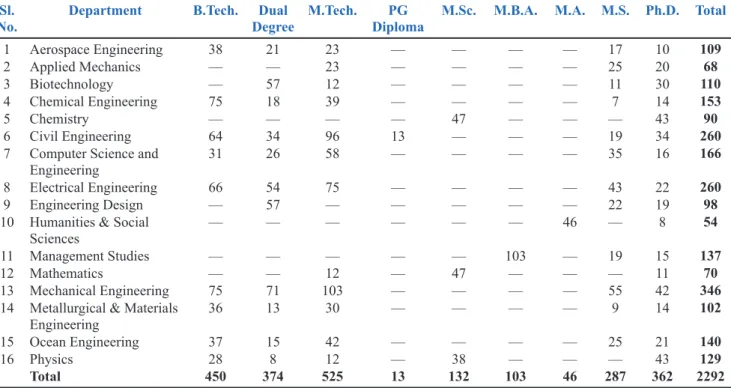
The Indian Institute of Technology Madras (IITM) was established in 1959 and declared an institute of national impor-tance by an Act of Parliament in 1961. In the forty-ninth convocation, there were a total of 1464 graduands—141 Ph.D., 127 M.S., 468 M.Tech., 69 M.B.A., 29 M.A., 123 M.Sc., 225 Dual Degree (B.Tech. and M.Tech.) and 273 B.Tech., and the fi rst batch of 9 of the PG Diploma in Metro Rail Technology and Management.These degrees cover a wide range of disciplines and specializations offered by the eleven engineering departments, three science departments, the Department of Management Studies and the Department of Humanities and Social Sciences.
The faculty and students undertake basic and applied research across a wide swathe of areas. The institute attracts research funding from science ministries as well as a wide spectrum of industries and collaborates extensively with the space, nuclear and defence research organizations. The IIT Madras Research Park is a fi rst-of-its-kind university-based research park in the country and is growing from strength to strength. IIT Madras has active linkages with more than 150 leading universities world-wide, resulting in a substantial two-way fl ow of students and faculty.
IIT Madras has been recruiting world-class faculty members in emerging areas for several years now. In 2012-2013, the institute added 37 new faculty members (of whom 3 are women), taking the total number to 526. We bade farewell to 11 faculty members and 29 staff members who retired after a lifetime of dedicated service to the institute.
This report provides a summary of our activities, achievements and accomplishments during the year 2012-2013.
1.1. Course-Based
Programmes
In addition to the slew of undergraduate and postgraduate degrees offered by the sixteen departments, the institute offers several specialized degrees as well. These include a unique Clinical Engineering Programme, offered jointly with the Christian Medical College, Vellore and Sree Chitra Tirunal Institute for Medical Science and Technology, Tiruvananthapuram; a Visionary Leaders in Manufacturing PG diploma programme offered jointly with IIT Kanpur and IIM Kolkata; a PG diploma programme in metro rail technology and management; and interdisciplinary PG programmes in catalysis technology, petroleum engineering and nuclear engineering. The institute also offers special-ized PG programmes for specifi c industries in civil, mechanical and ocean engineering.
In an effort to broaden the palette for UG students, two minor streams have been introduced: Sustainable Infrastructure & Environment Management, and Structural Mechanics. More such minor streams are on the anvil as the curriculum moves decisively towards increasing inter-disciplinarity.
IIT Madras has a Joint Doctoral Degree Programme with the National University of Singapore, and more such programmes are expected in the coming years as our trans-national research collaborations intensify and fructify.
1.2. Academic
Research
Research at IIT Madras continued to fl ourish during the year under review. Around 360 new Ph.D. students enrolled in 2012-2013, in keeping with the national goal of increasing the availability of the highest-quality researchers and teachers to industry and academia. In 2012-2013, our faculty and research scholars published 1014 papers in refereed international journals and 54 in refereed national journals. They also presented 371 research papers in international conferences and 80 in national conferences. IIT Madras is thus a signifi cant contributor to the national research output.
1.2.1. Snapshots of Research in 2012–2013
Around 250 research scholars, assisted by their faculty supervisors, submitted theses and papers that have been published this year. I shall now give you a glimpse of the research work carried out in various departments by describing one interesting piece of work from each department. I do this to expose the breadth and scope of research at IIT Madras and thereby hope to attract more of our bright young minds to the fascinating world of research.
Mr. Sumit Verma, from Aerospace Engineering, suggested new techniques to enhance the burn rate of an aluminized composite solid propellant.
Mr. B.S. Suresh Anand, of Applied Mechanics, investigated factors affecting quantifi cation of biomarkers using optical spectroscopy of turbid media.
Ms. P. Vidya, Department of Biotechnology, studied biotransformation with ionic liquids as reaction media. Ms. R. Anandalakshmi, of Chemical Engineering, investigated natural convection in rhombic enclosures using
heat-line and entropy generation.
Mr. K. Kumar, from the Department of Chemistry, synthesized various metal—boron cluster compounds and studied their properties that are specifi cally relevant to electronics, ceramic materials and boron—neutron-capture therapy.
Mr. P. Balasubramanian, of Civil Engineering, has proposed the treatment of volatile organic compounds using biotrickling fi lters.
Mr. R. Padmanabhan, Department of Computer Science and Engineering, carried out investigations on voice activity detection and feature diversity for speaker recognition.
Mr. Sivakumar Ganjikunta, from Electrical Engineering, has shown a strategy to mitigate voltage sags with phase jumps using custom power devices.
Mr. S. Saravana Kumar, Department of Engineering Design, investigated obstacle avoidance and dynamic path plan-ning of an autonomous underwater vehicle in 3D space.
Ms. Shweta Kushal, from the Humanities and Social Sciences Department, studied women’s narratives of the Punjabi diaspora and concluded that female protagonists construct their selves irrespective of the social construction of womanhood and that in doing so they debunk the meta-narratives of femininity, ethnicity, sexuality, race and gender by means of which they may be controlled.
Mr. P.A. Job, of Management Studies, studied organizational design for excellence in the backdrop of Indian organizations.
Mr. G. Krishna Kumar, Department of Mathematics, studied the pseudo spectrum and condition spectrum of an element in a Banach algebra.
Mr. K. Ravi Kumar, of Mechanical Engineering, investigated energy-effi cient receivers for line-focus-concentrating solar power systems.
Mr. Puli Ramesh, from the Department of Metallurgical and Materials Engineering, studied microstructures and properties of friction-surfaced stainless steel coatings.
Mr. Harender, of Ocean Engineering, presented a design for harnessing wave energy by converting the linear heave oscillation of a buoy to rotary motion and generating power with an electric generator. He also presented a failure-and-risk analysis for this power-generating system.
Mr. B.P. Vinayan, from the Department of Physics, studied chemically modifi ed carbon nanostructures for hydrogen storage, fuel cell and lithium-ion battery applications.
1.2.2. New Research Centres
Several new research centres have been created in 2012–2013 with multi-disciplinary research programmes of great national importance.
In recognition of the importance of the work initiated at IIT Madras on decentralized solar photovoltaic power systems, the Centre of Excellence for Decentralized Power Systems has been sanctioned by MHRD with an initial funding of Rs.20 crores. The centre will develop systems with smart DC microgrids for deployment at homes, farms, offi ces, schools and commercial and industrial buildings. The goal is to develop affordable and viable solutions to ameliorate India’s energy shortage and at the same time improve sustainability and increase the use of renewable energy.
IIT Madras has been an important resource to the Archeological Survey of India (ASI) in the restoration of heritage structures. Most notable among the contributions of our faculty is the complete reconstruction of the Ta Prohm temple of the Angkor Wat group of monuments, in Cambodia, and the Kailasanathar temple in Uttiramerur, in Kancheepuram District, in India. When the institute was engaging in this work, it became apparent that there is a pressing need for sustained research towards ensuring the safety of our heritage structures, many of which are more than a thousand years old and located in seismically active zones. The National Centre for Safety of Heritage Structures (NCSHS) has there-fore been created and funded to the tune of Rs.12 crores by the MHRD. This centre will bring together faculty members from multiple disciplines and draw on the knowledge of traditional sculptors and artisans. An MoU is also being signed with the ASI for collaborative work to be taken up by this centre.
IIT Madras has signed an MoU with Hindustan Aeronautics Ltd. to set up the Centre for Aerospace Transmission System (CATS) for undertaking joint research on software and design solutions for different types of gears, bearings, lubrication systems, vibration monitoring systems and production technologies in helicopter transmission systems.
The Thematic Unit of Excellence (TUE) is an advanced research laboratory funded by the DST for water purifi ca-tion using nano-technology. This year, the passive water purifi cation technology developed by the centre for removing arsenic contamination is being deployed in 2000 communities in the affected districts of West Bengal.
The Healthcare Technology Innovation Centre (HTIC), a joint initiative of IIT Madras and the DBT, launched Eye-PAC, an intelligent image computing technology for extracting clinically important information from images of the eye. This enables screening for eye diseases in remote areas even when an expert is not available locally. The HTIC has partnered with Forus Health, an Indian med-tech start-up that has indigenously developed a revolutionary eye examina-tion device, to take Eye-PAC to the public. The device has now reached around 200 installaexamina-tions across 10 countries.
The National Centre for Combustion Research & Development (NCCRD), set up last year at IIT Madras with funding from the DST, is progressing well. A number of sophisticated instruments such as a high-speed tomographic PIV, PDPA and high-pressure TGA have been procured, and many versatile test set-ups are being developed. A 24000 sq. ft 5-storey building is being constructed to house the centre. The centre will focus on three application sectors in which combustion plays a central role, namely the automotive, aerospace and thermal power sectors. In addition, research on fi re safety and microgravity combustion will be carried out. An industry consortium consisting of leading automotive OEMs and ancillary parts manufacturers has been constituted to work together with NCCRD on gasoline direct injection (GDI) engine technology development optimized for different duty cycles under Indian conditions. On the thermal power front, distributed power generation through gasifi cation of combinations of high-ash coal, biomass and other waste is being explored. On the aerospace front, advanced technologies related to combustion instability, micro-sprays, lean direct injection, supersonic combustion and solid propellants are being investigated.
The Department of Civil Engineering has been carrying out research and development activities, since 2003, in the area of rapid, affordable mass housing using glass fi bre reinforced gypsum (GFRG) panels. These panels, originally developed by RBS Australia, were intended to be used in rapid erection of walls in buildings to carry gravity loads. The IIT Madras research team extended the application of this product to the entire building system—including fl oors, roofs and staircases. This system has the advantages of facilitating rapid construction, being cost-effective and sustainable. The consumption of energy-intensive materials such as cement and steel, and increasingly scarce materials such as river sand and water, are drastically reduced. In order to demonstrate this technology, a two-storeyed demonstration GFRG building was built on our campus, all in one month’s time. The work has received widespread acclaim. The R&D work and technology transfer are supported by the Department of Science & Technology, and the design and construction methodology has been approved by the Building Materials & Technology Promotion Council, Government of India. This technology will hopefully serve as a game-changer for affordable mass housing in India.
The Centre for Non-Destructive Evaluation has developed a high-temperature magnetostriction-based ultrasonic sensor for monitoring the health of pipes in process industries, an acoustic emission sensor and associated electronics and software for online monitoring of marine, power plant and automobile engines using a novel r-Wavelet algorithm, and a new method for measuring the elastic moduli of materials as a function of temperature up to 1500°C using an ultrasonic waveguide technique.
The Centre for NanoElectroMechanical Systems and Nanophotonics (CNNP) is a multi-disciplinary centre set up to carry out application-oriented research in the material science, health, food safety and communication sectors and trans-lating these into commercial products. Characterization equipment such as a spectroscopic ellipsometer, surface profi ler, Doppler vibrometer, and probe stations have been commissioned, while processing equipment such as an ICP PECVD, DRIE and e-beam lithography system are being installed in a Class 1000 clean room. Lamellar gratings have been devel-oped for compact FTS systems, and RF switches and silicon-ridge and single-mode waveguides have been fabricated. Silicon nanoporous membranes developed at the centre have been effective in size-based fi ltration of several biomolecules.
A fi bre optics spectrophotometer that is capable of measuring both absorbance and fl uorescence spectra has been designed in the Chemistry Department. An optical fi bre-based dynamic interrogator for elastic wave sensing has been developed for IGCAR, Kalpakkam by the Electrical Engineering Department.
1.2.3. New Research and Fabrication Facilities
Research at the highest levels requires constant upgradation of instruments and facilities. It is our constant endeavor to equip the faculty and students of IIT Madras with the best possible facilities to take on the most challenging research problems in the years ahead.
A low-noise, low-speed wind tunnel facility for studying hydrodynamic stability, transition and fl ow control has been built in the Aerospace Engineering Department, while localized surface plasmon resonance (LSPR) and surface enhanced Raman Scattering (SERS) facilities have been created in the Applied Mechanics Department.
IIT Madras and the Glazing Society of India (GSI) have developed the Structural Glass Research and Testing Facility (SGRT) in the Civil Engineering Department. It is a fi rst-of-its-kind facility in India for safety testing of and research in structural glass.
Under the FIST project (Rs.4.6 crores) sanctioned to the Department of Civil Engineering by the Department of Science and Technology, a unique facility to determine the behaviour of practically all materials used in the construc-tion of infrastructure, housing and other essential services is being set up. This facility has servo-controlled systems having digital closed-loop controllers and data acquisition systems. This new set-up will promote, for the fi rst time in a single Indian facility, characterization of material response ranging from elastic to post-cracking regimes, from dynamic to static to nonlinear creep loading rates, over a range of temperatures, under both monotonic and cyclic loading and under atmospheric and hydrostatic confi ning pressures. The materials that could be studied range from
highly deformable polymer fi bres, geotextiles and bitumens to quasi-brittle concretes, rocks and ceramics and to high-strength steels and fi bre reinforced composites.
The Industrial Automation Laboratory has been established with support from the Automation Industries Association of India in the Department of Engineering Design.
A 3D printer received by the Centre for Social Innovation and Entrepreneurship has been installed at the CFI lab to enable students to develop quick prototypes.
The 4096-node IBM iDataPlex HPC cluster installed last year has been ranked 224th amongst the fastest computing clusters in the world and the 5th in India. It is the fastest cluster in an Indian academic institution. In terms of energy effi ciency, this is the best in India and is ranked 5th globally.
Specialized equipment such as spectrometers, aerodynamic particle size sensors, a vacuum brazing furnace and an Nd3+ YAG laser have been installed in different departments. The cryogenic nitrogen and helium plants of the institute
have also been commissioned.
1.3. Academic Distinctions Secured by Our Faculty Members and Students
Several academic distinctions, honours and awards, fellowships of professional societies, and memberships of editorial boards of journals, have been bestowed on our faculty, staff and students in recognition of their academic achievements during the current year. Prof. Y. Shanthi Pavan of the Electrical Engineering Department was selected for the prestigious Shanti Swarup Bhatnagar Award in Engineering Sciences for 2012. Prof. Krishnan Balasubramanian has been awarded the Roy Sharpe Prize 2012 (lifetime achievement) by the British Institute for Non-Destructive Testing for his outstanding contributions to the fi eld of NDT. He is only the second non-European and the fi rst Indian to receive this award.
Dr. Satyanarayana Gummadi has won the NASI Scopus Young Scientist Award for 2012. Five of our young faculty members, Drs. Ashwin Mahalingam, Edamana Prasad, Deepa Venkitesh, Andrew Thangaraj and N.V. Ravikumar, have won the Young Faculty Recognition Award of the Institute for 2012. Prof. C. Balaji has won the award for Excellence in Teaching for the year 2012–2013.
Our faculty have also been prolifi c during the past year, writing books and monographs and fi ling patents for their inventions. An exhaustive list of laurels won by our faculty and students is given as an annexure to this report.
1.4. Industrial Consultancy and Sponsored Research
IIT Madras is pro-active in seeking out industry collaborations with a view to raising the technology bar in industry and making Indian industry globally competitive. Our faculty and students gain tremendously from the interaction as well. In 2012–2013, the Institute received sanctions for Rs.46 crores from industry for carrying out new projects, nearly 50% of the amount being for research-based consultancy.
Public funding for research in the form of sponsored projects from science ministries and government departments is critical for the high research intensity of IIT Madras. The faculty secured sanctions for projects worth Rs.105 crores in 2012–2013. The total value of ongoing sponsored projects in the Institute is Rs.460 crores, which constitutes a sizable part of the Institute’s total budget.
The Institute has earned Rs.173 lakhs from technology transfer fees and royalties during the year 2012–2013. The details are provided in the annexure. An intellectual property management cell has been created in the Centre for Industrial Consultancy and Sponsored Research. This cell assists the faculty and students to protect their intellectual property by fi ling patents and pro-actively commercializes the products and processes developed at the institute.
In order to enable students and new faculty members to initiate and establish their research activities, the institute has supported seven new innovative student projects to the tune of Rs.8.5 lakhs and 30 new faculty proposals to the tune of Rs.369 lakhs.
We have signed 22 MoUs during the year with industries such as ITC Limited, Automation Industry Association of India, MRF Limited, Saint-Gobain Research India Ltd., Anant Udyog, LG Soft India Pvt. Ltd., Gopalpur Ports Ltd., Mahindra & Mahindra Ltd., AT&T Services Inc. and New Jersey etc. A new initiative called ReachIITM has been initiated for reaching out to the various stakeholders of IIT Madras via Facebook, Twitter and YouTube. A fortnightly e-newsletter has also been launched.
1.5. Research Park and Incubation
IIT Madras Research Park, three years after its inception, continues to attract new companies. Such sustained interest exemplifi es the confi dence that industry has placed in our ability to provide at the Research Park an environment condu-cive to foster technological collaboration and nurture innovation. During 2012–2013, the last couple of spaces meant for R&D clients were taken.
Despite constraints in space availability, there is no dearth of applicants, re-inforcing the value proposition that industry perceives in being located at the Research Park and collaborating with IIT Madras. In this context, IITMRP has taken a giant leap forward by starting to build another 8 lakh sq. ft, which will be ready for fi tment by January 2015. Saint-Gobain Research has signed up as an anchor client to set up their India Research Centre. The next phase will have specialized spaces for sophisticated-materials, biological and machine laboratories and will make IIT Madras Research Park a very powerful platform for industry–academia collaboration.
The institute has set up an incubation cell to implement the incubation policy of the institute. This cell provides over-arching governance to the specialized incubators operating in the institute, as well as support services to incubatees. While the cell will assist the faculty and students to launch start-ups, it will also support external start-ups that can benefi t from association with the institute and its faculty. A key objective of the cell is to leverage the intellectual capital of the faculty and students, the research infrastructure of the institute and the ecosystem of the Research Park to unlock value and create a large number of new enterprises.
The alumni-funded Center for Social Innovation and Entrepreneurship (CSIE) initiated ‘Entrepreneurship Week’ during 3–9 March 2013, an event dedicated to celebrating and fostering entrepreneurship on campus. IIT Madras’ Rural Technology and Business Incubator (RTBI), housed in the Research Park, has incubated 12 new companies in the last year in diverse areas ranging from education to development of cloud- and mobile-based technology and solutions for the dairy sector.
I am heartened to report that 25% of the graduating class of the Engineering Design Department have started compa-nies this year. The department was started in 2006 with a distinct curriculum to encourage product development and design. We are glad that our efforts are beginning to yield fruit.
Two companies, one focusing on providing appropriate and cost effective environmental engineering solutions based on sustainability principles and another specializing in drafting and implementing social media and branding strategies for businesses and events, have also been incubated.
1.6. Continuing
Education
IIT Madras has an extensive outreach programme catering to teachers, practising engineers and researchers. The Centre for Continuing Education (CCE) has been very active, with our faculty members organizing 13 AICTE-funded Short-Term Training Programmes (QIP) for the benefi t of engineering college faculty members, as well as 84 Continuing Education Programmes (CEP) for the benefi t of industrial personnel, through the Curriculum Development Cell. These programmes have benefi tted about 3000 participants in 2012–2013 and resulted in revenue of around Rs.3.5 crores.
Under the Book Writing Scheme, designed to encourage textbook writing by our faculty members, 74 books have so far been published, and 7 books are under publication in the current year.
1.7. Our Contributions to the National S&T Educational System
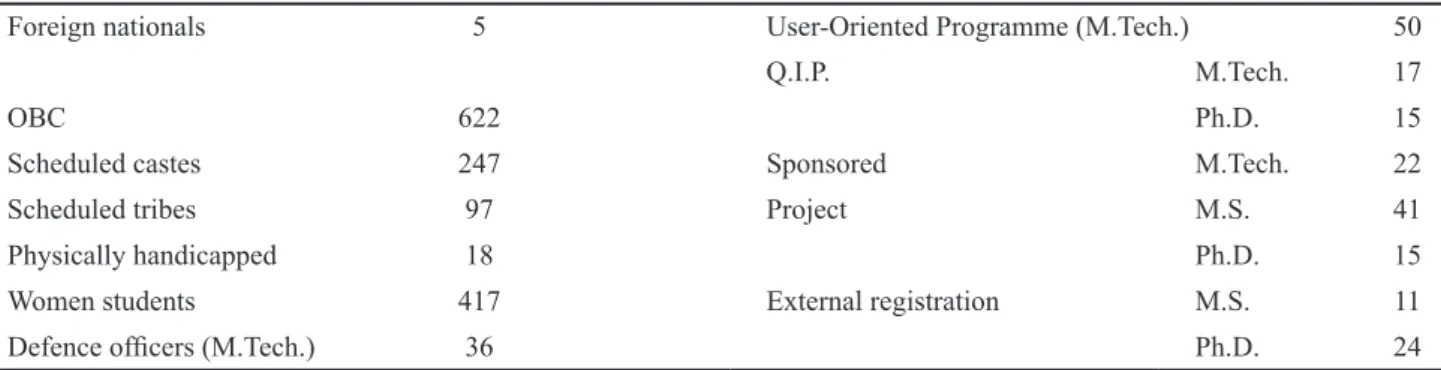
IIT Madras plays an important role in assisting other engineering institutions in the country with their curriculum, laboratory upgradation and faculty career development. Under the Quality Improvement Programme (QIP), 604 faculty members from other institutions have obtained their Ph.D. degrees, and 567 faculty members from other insti-tutions have obtained their M.Tech degrees. from IIT Madras since its inception. Currently we have a total of 96 QIP scholars—68 pursuing Ph.D. and 28 M.Tech., including 20 and 9 women, respectively. The institute is also assisting engineering colleges in Tamil Nadu and the neighbouring states to implement their TEQIP-II programmes.
The National Programme on Technology Enhanced Learning (NPTEL) is India’s largest ICT-based technical course dissemination programme in the higher-education sector. Its main objective is to increase the reach of high-quality engineering and sciences education across our country. A total of 575 (web/video) courses in engineering, science and technology developed under NPTEL are freely available on our NPTEL website (http://nptel.iitm.ac.in) and through YouTube at http://www.youtube.com/iit. The courses are also telecast through the Eklavya channel, made available by the MHRD exclusively for this purpose. The NPTEL channel in YouTube has received more than 88 million upload views, and the NPTEL site has recorded more than 22 million visits since inception.
The NPTEL at IIT Madras has also started conducting online courses. Two live online courses, ‘Digital System Design’ and ‘Basic Electrical Circuits’, were offered in 2013. Several institutions and some individuals participated in these courses. A large Massive Open Online Course on computer science, with a proctored examination and certifi ca-tion in collaboraca-tion with NASSCOM, is planned for engineering college students across the country. This will enable them to be better qualifi ed for employment in the IT industry. With the experience gained from this exercise, NPTEL will thereafter launch online courses in various engineering disciplines as well.
In the area of renewable energy, the Central Electronics Centre has been playing a key role by conducting several training programmes related to solar photo-Voltaics (SPV). Forty SPV training programmes have been conducted,
and more than 860 personnel have been trained. The project was sponsored by IREDA (Indian Renewable Energy Development Agency), New Delhi. SPV Laboratory (indoor and outdoor) facilities have been established to promote the developmental activities in this area.
IIT Madras’ Summer Fellowship Scheme, initiated a few years ago, provides opportunities for summer research internship to top-ranking engineering and science students all over the country, and 167 students participated in the programme this year.
1.8. International
Collaboration
IIT Madras has been interacting with several globally reputed universities and organizations for collaborative research, exchange of faculty and students, etc. The Offi ce of I&AR, set up last year, promotes research collaborations and student exchanges with leading academic institutions and organizations around the world. More than 150 MoUs are in effect, and one joint doctorate programme has been launched in partnership with NUS, Singapore. During the academic year 2012-2013, more than 100 foreign students were hosted on campus, and an equal number of IIT Madras students travelled abroad for study and research purposes. About a hundred university delegations visited the campus, and in each case, faculty–faculty interactions were facilitated.
The fi rst ever ‘International Day’ was celebrated in November last year and was attended with great enthusiasm by Indian and foreign students alike. Both groups collaborated, planned and executed a great event.
The Indo-German Centre for Sustainability (IGCS) is a collaborative venture with German universities, established in our Golden Jubilee year to discover sustainable pathways for development in the 21st century. IIT Madras and RWTH Aachen University signed an MoU when the Prime Minister’s delegation visited Germany in April 2013, which is expected to give a fi llip to collaborative research between the two countries. The centre will receive Rs.53.37 million during 2013–2016 from the Department of Science and Technology, Government of India to carry out research projects in four thematic areas—energy, land-use, waste and water—around sustainability challenges that will be exacerbated by climate change. The German Academic Exchange Service (DAAD) has committed up to €2.8 Mio from the New Passage to India programme to RWTH Aachen during 2013–2016. This will enable German scientists from partnering universities in the fi eld of sustainability science to travel to IIT Madras and spend 1–2 years each to carry out this research jointly with faculty and researchers at IIT Madras.
IIT Madras signed 5 MoUs with international companies and research laboratories for collaborative R&D last year. During the summer, as many as 200 faculty members from the Institute visited universities and research laboratories abroad for collaborative research, participation in conferences, visiting assignments, etc.
Over the past few years, the institute has created several opportunities for international student exchange. Under the Indo-German agreement between the seven IITs and seven technical universities in Indo-Germany, we deputed 7 M.Tech. students to undertake their project/thesis work in these German universities last year. We also received 56 students from Germany so that they could undertake their projects in our research laboratories. Under the DAAD-sponsored IITM–Bremen Student Exchange Programme, 3 M.A. students will visit the University of Bremen for a semester. Under the MoU with EPFL, 4 students visited last year, and under the student exchange programme, 4 B.Tech./DD students visited NTU.
1.9. Human Resources Training
Systematic programmes are conducted throughout the year to train our technical and administrative staff and help them upgrade and acquire new knowledge, skills and professional orientation through a variety of learning experiences. In the year under review, about 121 staff members benefi tted from 16 in-service and 22 offsite training programmes. Apart from this, as many as 25 offi cers/staff members were provided Hindi training.
The Teaching Learning Centre (TLC), the fi rst of its kind among higher technical institutions in the country, established to create human resources with the highest professional and personal qualities, organized many faculty development programmes, workshops and lectures in the last year, and several faculty members benefi tted from it.
1.10. Quality and Process Improvement Initiatives
IIT Madras has been awarded ISO 9001:2000 certifi cation for academic support processes since 1999 and for admin-istrative support processes since 2001. In 2011, all the units of IIT Madras were recertifi ed as per the ISO standard ISO 9001:2008. The certifi cate is valid until August 2014 for academic support processes and till January 2014 for administrative support processes. In addition to ISO 9001:2008 certifi cation, the Central Electronic Centre has been NABL-accredited for its Testing and Calibration Laboratories since 2004.
With the increased student intake in recent years and the faculty recruitment, the implementation of an enterprise resource planning (ERP) software system, internally referred to as Workfl ow, was initiated to enhance the effi ciency
and quality of the processes at IIT Madras. A suite of electronic data services (e-services) have been provided to the students, faculty and staff via Workfl ow processes in the different sections, such as Academics, Administration, Accounts, Stores & Purchase and ICSR.
The benefi ts of an institute-wide effort to adopt an ERP solution are beginning to bear fruit, and the benefi ts are now tangible. Each of the administrative and academic processes has been mapped and optimized. The ERP platform is fl ex-ible and can connect to third-party packages such as Tally for accounting and payrolls and to open-source software such as Moodle for academics. While our operations are being streamlined, the staff are also being trained in the use of Workfl ow.
1.11. Infrastructure
Development
The Engineering Unit plays a vital role in overseeing all construction activities and facilities management on the campus. The major infrastructure projects completed during the academic year 2012–2013 include a new shopping centre, a campus community hall, additional rooms in the men’s hostels, G-type quarters (one tower, 30 units), a new bus shed and an auto workshop and diesel refueling facility. The construction projects currently under progress include new hostels (one hostel for women and two hostels for men (creating approximately 1351 additional rooms, thereby meeting the needs of the growing student population), the new Academic Complex and Canteen, a new block for the Chemistry Department, the DST Thematic Unit of Excellence—Water Purifi cation Using Nanotechnology, the National Centre for Combustion R&D (NCCRD) and a fully rebuilt swimming pool.
One of the major green initiatives taken up by IIT Madras is the generation of power using solar photo-voltaic systems. A 1 MW roof-top solar PV plant is being installed. We have also initiated innovative R&D efforts to adaptively match the load to the power being generated, adoption of energy-effi cient DC appliances and modifi cations of appli-ances for higher effi ciency when operating on power generated using solar PV.
The institute ensures that all new buildings meet the green building and GRIHA norms and are provided with energy-effi cient light fi ttings. The IIT Madras Campus Master Plan, which was updated in 2010, serves as the blueprint for planned growth to meet future infrastructure needs of IIT Madras in a sustainable way while preserving the natural beauty, fl ora and fauna of the campus.
The Zero Waste Zone (OWZone) project continues to render commendable service to the cause of keeping the campus clean. It employs fi ve self-help groups to collect the solid waste on campus on a daily basis for segregation, recycling and composting.
1.12. Student Co-curricular and Extra-curricular Activities
The academic year 2012–2013 has been yet another remarkable one for the students. The co- and extra-curricular activ-ities continued with great enthusiasm and scaled new heights. Eminent personalactiv-ities from all walks of life addressed our students in different forums. Several new initiatives were launched for the welfare of the students.
The IIT Madras sports contingent came second in the overall Men’s General Championship in the 48th Inter-IIT Sports Meet, held at IIT Roorkee. Considering the biting cold in mid-December, it was a commendable performance by our sportspersons.
IIT Madras coordinated the fourth edition of the Terry Fox Run, which surpassed the previous editions in terms of both participation (12000) and sponsorship funds collected (Rs.12 lakhs).
The Gerhard Fischer and Kokila Rajaiah basketball tournaments were successfully conducted in the OAT after a long gap of almost a decade.
On the occasion of Holi, the Gymkhana organized for the fi rst time the Great Indian Sports Mela. Thirteen traditional games were organized for the students, faculty and residents of IIT Madras, and the entire event was a super hit. It helped increase interactions among the students, faculty and staff and family members.
A 24-hour snacketeria has been created in the Hostel Zone. After a gap of 3 years, the community laundry service has been restarted at Brahmaputra Hostel. Two cycle repair shops—one in the men’s hostel zone and the other in the women’s hostel zone—have been approved. A music room, equipped with high-quality amplifi ers and a professional drum kit, is available for use by student-musicians.
Shaastra, the annual technical festival of IIT Madras, received the ISO 2001:9000 certifi cation for three more years. Envisage, the fi rst ever techno-entertainment show, conceived and performed by our students, was a huge success. More than 60 exhibits featured this year. With a total of 14 workshops, Shaastra 2013 offered the highest number of workshops, compared with any other technical festival in India. Shaastra Junior Quiz witnessed the fi rst-ever interna-tional participation this year.
Saarang, the annual cultural festival of IIT Madras, was held in the second week of January this year. The opening Classical Night presented a perfect blend of Hindustani and Carnatic music performed by the Gundecha and Malladi
brothers, respectively. It was followed by a splendid Kathak performance by the maestro Pt. Birju Maharaj. The 5-day festival concluded with the Popular Night performance by the hugely popular Shankar—Ehsaan—Loy trio.
Two major new initiatives launched this year are Saarang Milan—the fi rst-ever outreach organized by any college cultural festival, which involved the conduct of selected Saarang events in other cities and Saarang Eunoia—an umbrella for Saarang’s various social cause activities.
The extramural lecture series saw a plethora of speakers from diverse backgrounds presenting their talks. This series had the most number of lectures in an academic year. The invited speakers included Dr. Alan R. Chambers, Mr. Anand Teltumbde, Mr. Prabir Purkayastha, Mr. Ramachandra Sundaralingam, Mr. Sam Pitroda, Mr. Siddharth Varadarajan, Mr. Narendra Nayak, Mrs. Amala Akkineni, Mr. R. Gopalakrishnan and Mr. V.S. Sampath.
As always, the students of IIT Madras have made a sincere attempt to give back their due share to society. The students partnered with Teach for India, Make A Difference, Milaap, Eureka Child, etc., to render service to the less fortunate. Volunteers from the speaking skills, dramatics and Western music clubs taught underprivileged children at two centres. The computer vision group of the Center for Innovation developed an alternative to the Optical Mark Reader machine. This was launched during Shaastra 2013 and was implemented in collaboration with an NGO, Pravinya. In association with Sankara Netralaya and the Elite School of Optometry (ESO), a two-day vision screening camp was conducted in the village of Natham, Kancheepuram district, Tamil Nadu. The IViL team conducted weekly English classes for the students in this village with the objective of opening up newer avenues for interaction with the villagers.
The quiz team from IIT Madras stood 3rd overall and 1st among the IITs at Nihilanth, the Inter-IIT/IIM Quiz Fest, held at IIT Bombay. For the fi rst time, students from IIT Madras participated in two major international competitions, namely, FSAE 2012 and Mirosot, held by FIRA (Federation of International Robot-soccer Association). We were the only Indian team to participate in Mirosot 2012. We also won the award for the Best Idea in Robocon 2013.
A contingent of 10 students represented IIT Madras in the New York Global Young Leaders’ Summit 2013, International Model United Nations programme, held in New York from 26 to 29 March this year, and received the Outstanding Delegation award from among the delegations from various countries that participated in the programme. Additionally, two of our students received individual Best Delegate awards.
1.13. Student
Welfare
MITr has been proactive this year, with a wide range of activities organized with the objective of nurturing a physically, socially, emotionally and intellectually balanced life among our students.
Freshmen Forum was hosted on the website offi cially for the fi rst time and was publicized well. It received a massive response from the freshers, who shared their doubts/concerns, which were answered by the MITr team.
IIT Madras has set up a one-of-its-kind dedicated student-driven Disaster Management Committee. Three emer-gency medical care workshops were conducted, with ALERT as a knowledge partner, to offer training to more than 300 students and staff members of the institute. Training was imparted in fi re safety and handling of fi res by the institute’s Fire Offi cer and his team.
The event titled CONNECT 12–13, held between 5 and 7 October 2012, consisted of panel discussions in prepara-tion for the civil services admissions, CAT, etc.
1.14. Placement
As a result of reaching out to a total of 1200 core and non-core companies—500 from the previous year and 700 new ones—we had 313 companies registering this year. The focus was on contacting various Fortune 500 companies and leading companies in the automobile sectors, such as Rolls Royce, Mahindra and Renault and semiconductor industries. A total of 814 students were placed through the Placement Offi ce, of whom a large fraction joined core engineering companies. To enhance student interaction with the companies, the Research Park co-ordinated the Summer Internship 2013 drive, placing about 611 3rd year students into internships.
1.15. Alumni
Matters
The alumni of our Institute make us proud by distinguishing themselves in various professions and walks of life. Many occupy leadership positions in India and abroad in industry, government organizations and educational institutions, fulfi lling the original intent of the creators of the IIT system. A position of Dean (International and Alumni Relations) was created in 2012–2013 to leverage the institute’s excellent relations with its alumni and to catalyse increased engagement with academic institutions, industry and enterprises across the world. Till now, nearly 40,000 students have been awarded degrees. Since 1997, we have been honouring select alumni for their distinguished contributions to society, through Distinguished Alumnus Awards, every year. The names of the awardees for the year 2013 were announced on Republic Day.
They are:
● Dr. S. Gopalakrishnan, Professor, Department of Aerospace Engineering, Indian Institute of Science, Bangalore; M.Tech. in Applied Mechanics, 1987
● Dr. Hari Balakrishnan, Professor, Department of Computer Science, Massachussetts Institute of Technology, Cambridge, MA, USA; B.Tech. in Computer Science, 1993
● Dr. Shankar Ramamurti, Professor, Department of Physics, Yale University, New Haven, CT, USA; B.Tech. in Electrical Engineering, 1969
● Dr. Ramanathan V. Guha, Google Inc., Los Altos Hills, CA, USA; B.Tech. in Mechanical Engineering, 1986 ● Dr. Kumar N. Sivarajan, Chief Technology Offi cer, Tejas Networks, Bangalore; B.Tech. in Electrical Engineering,
1987
● Dr. Venky Harinarayanan, Senior VP, Walmart Global eCommerce and Head of @walmartLabs, Saratoga, CA, USA; B.Tech. in Computer Science, 1988
● Dr. Anand Rajaraman, Founding Partner, Cambrian Ventures, Palo Alto, CA, USA; B.Tech. in Computer Science, 1993
● Dr. Sailesh Krishna Rao, Founder and Executive Director, Climate Healers, Danville, CA, USA; B.Tech. in Electrical Engineering, 1981
with this, the number of Distinguished Alumni of IIT Madras now exceeds 100.
Alumni continue to contribute generously towards the development of the institute and to the welfare of our students. In 2012, for the fi rst time ever, alumni donations to IIT Madras exceeded Rs.12 crores in a calendar year. Contributions were directed towards research infrastructure, socially relevant projects, chair professorships, student and faculty awards and students’ fee waivers. Endowments were created to support entrepreneurship initiatives and to facilitate discretionary expenditure by the institute on worthy causes.
Many events were held on campus to strengthen and celebrate alumni and international relations—PG Confl uence Day; Alumni Day; and Re-Union Days of the 1997, 1992, 1987, 1988 and 1972 batches. The Leadership Lecture Series, featuring alumni, has been received very well by the campus community, and nearly 30 lectures have been delivered so far in this series.
1.16. Acknowledgements
An endeavour on the scale of this institute and its entire gamut of activities takes place with the whole-hearted partici-pation and support of all stakeholders—our faculty, students and staff; agencies and industries sponsoring R&D and consultancy projects; professionals from other organizations who assist us in various capacities; and our alumni. In particular, I would like to thank offi ce-bearers such as heads of departments, deans, wardens, advisors and profes-sors-in-charge of various cells and centres for the selfl ess work they put in to keep the institute ticking. The institute is grateful to the Ministry of Human Resources Development, Government of India for its continued and sustained encouragement and support.
Annexure
Faculty Awards
Dr. Athi N. Naganathan (BT) – Innovative Young Biotechnologist Award, Department of Biotechnology, New Delhi
Dr. Mukesh Doble(BT) – The Dow Professor M.M. Sharma Distinguished Visiting Professorship, Institute of Chemical Technology, Mumbai
Dr. Satyanarayana N. Gummadi (BT) – NASI Scopus Young Scientist Award
Dr. Smita Srivastava (BT) – Rashtriya Gaurav Award, India International Friendship Society Dr. Ashwin Mahalingam (CE) – Young Faculty Recognition Award, IIT Madras
Dr. Balaji Narasimhan (CE) – Distinguished Achievement Award, International SWAT Conference Dr. Koshy Varghese (CE) – Distinguished Scholar Award, Project Management Institute (PMI), India Dr. Lelitha Devi V. (CE) – Volvo Sustainable Mobility Award, Volvo Buses India Pvt. Ltd., Karnataka Dr. Mathews M.S. (CE) – Vishwakarma Award, Construction Industry Development Council
Dr. Rajagopal K. (CE) – Achievement Award, International Geosynthetics Society, USA Dr. Raghuram Chetty (CH) – Top Cited Article Certifi cate, Elsevier
Dr. Hema A. Murthy (CS) – Prof. Rais Ahmed Memorial Lecture Award, Acoustical Society of India Dr. Balasubramanian K.K. (CY) – Gold Medal, Chemical Research Society of India
Dr. Dhamodharan R. (CY) – INSA Teachers Award, Indian National Science Academy Dr. Edamana Prasad (CY) – Young Faculty Recognition Award, IIT Madras
Dr. Pazhamalai Anbarasan (CY) – Thieme Chemistry Journals Award
Dr. Pradeep T. (CY) – India Nanotech Innovation Award
Dr. Santosh J. Gharpure (CY) – B.M. Birla Science Prize in Chemistry
Dr. Sundargopal Ghosh (CY) – Bronze Medal, Chemical Research Society of India
Dr. Shankar Ram C.S. (ED) – INAE Young Engineer Award, Indian National Academy of Engineering Dr. Andrew Thangaraj (EE) – Young Faculty Recognition Award, IIT Madras
Dr. Ashok Jhunjhunwala (EE) – A.V. Rama Rao Technology Award, Indian Institute of Chemical Technology, Hyderabad
Dr. Deepa Venkitesh (EE) – Young Faculty Recognition Award, IIT Madras
Dr. Shanthi Pavan Y. (EE) – Shanti Swarup Bhatnagar Prize, Council of Scientifi c and Industrial Research Dr. Ajit Kumar Kolar (ME) – Distinguished Service to the Institute Award, IIT Madras Alumni Association Dr. Chakravarthy Balaji (ME) – Srimathi Marti Annapurna Gurunath Award for Excellence in Teaching, IIT
Madras
Dr. Krishnan Balasubramanian (ME) – Roy Sharpe Prize, a lifetime achievement award, British Institute for Non-destructive Testing
Dr. Sarit Kumar Das (ME) – India Citation Award 2012, Thomson Reuters (Web of Science) Dr. Murty B.S. (MM) – Distinguished Visiting Professorship, PSG College of Technology Dr. Ravikumar N.V. (MM) – Young Faculty Recognition Award, IIT Madras
Dr. Sundar (OE) – Distinguished Membership Award, International Association of Hydro-Environment Engineering and Research
Dr. Natarajan T.S. (PY) – National Award for Technology Innovation in Petrochemicals (runner-up), Ministry of Chemicals and Fertilizers
Fellowships
Dr. Michael Gromiha M. (BT) – Senior Scientist S&T Visiting Fellowship, INSA Dr. Arun K. Tangirala (CH) – IAS Visiting Fellowship, TUM, Germany Dr. Shankar Narasimhan (CH) – Fellow, Indian National Academy of Engineering Dr. Murty C.V.R. (CE) – Fellow, Institution of Engineers (India)
Dr. Ravindra Gettu (CE) – Fellow, RILEM International Union of Laboratories and Experts in Materials, Structures & Systems, France
Dr. Sudheer K.P. (CE) – Visiting Research Scientist Fellowship, Purdue, USA Dr. Siva Ram Murthy(CS) – Fellow, Indian National Science Academy
Dr. Baskaran S. (CY) – Fellow, Indian Academy of Sciences
Dr. Asokan T. (ED) – Indo-Australian Senior Scientist Visiting Fellowship, INSA Dr. Chakravarthy Balaji (ME) – Fellow, Indian National Academy of Engineering
Alexander Von Humboldt Fellowship
Dr. Sitaram N. (ME) – Associate Fellow, American Institute of Aeronautics and Astronautics Dr. Prem B. Bisht (PY) – Fellow, Optical Society of India
Best Thesis Awards
Ramsatish Kaluri (CH)—guided by Dr. Tanmay Basak
– Dr. A.V. Rama Rao Foundation’s Best Ph.D. Thesis and Research Award Arun Srikanth S. (CH)—guided by
Dr. Shankar Narasimhan and Dr. Sridharakumar Narasimhan
Jagadeesh Chandra Prasad (CY) —guided by Dr. Sekar G.
– 2nd Prize, Lilly Outstanding Thesis Award Murali A (CY)—guided by
Dr. S. Baskaran
– 2nd Prize, Lilly Outstanding Thesis Award Siva Kumar G. (EE) and Srinivas
Bhaskar Karanki—guided by Dr. Kalyan Kumar B. and Dr. Mahesh Kumar
– POSOCO Power System Award
Scholarships
Maya Raman (BT) – Woman Scientists Scheme (WOS-A), DST
Mayank N. K. Choudhary (BT) – Honda Young Engineer and Scientist Award Nishita Mohan P V (BT) – Honda Young Engineer and Scientist Award Siddharth Dialani (BT) – Nissan Foundation Scholarship
Venkata Santhosh Kumar (CE) – Fulbright–Nehru Scholarship Satya Nunna Mounika (CS) – Aditya Birla Scholar
Naveen Nikamanth A B (ME) – Nissan Foundation Scholarship
Books/Monographs
Dr. Bhaskar K. (AE) – Plates: Theories and Applications, Ane Books, 2013 Dr. Gummadi S.N. (BT),
Dr. Mukesh Doble et al.
– Cyclic -Glucans from Microorganisms: Production, Properties and
Applications, Springer Briefs in Microbiology
Dr. Michael Gromiha M. (BT) – Advanced Intelligent Computing: Theories and Applications, Lecture Notes in Artifi cial Intelligence, Springer
Dr. Srinivasa Chakravarthy V. (BT) – Demystifying the Brain, e-book, NPTEL Dr. Ligy Philip (CE),
Dr. Murty B.S. et al.
– Guidelines for Decentralized Waste-Water Management, Ministry of Urban
Development Dr. Murty C.V.R. (CE),
Dr. Goswami R. et al.
– Some Concepts in Earthquake Behaviour of Buildings, Gujarat State
Disaster Management Authority, Gandhinagar Dr. Murty C.V.R. (CE),
Dr. Goswami R. et al.
– Introduction to Earthquake Protection of Non-structural Elements in
Buildings, Gujarat State Disaster Management Authority, Gandhinagar Dr. Murty C.V.R. (CE),
Dr. Goswami R. et al.
– Build a Safe House with Confi ned Masonry, Gujarat State Disaster
Management Authority, Gandhinagar Dr. Kamala Krithivasan (CS) and
Dr. Rama R. (MA)
– Introduction to Formal Languages, Automata and Computation, Pearson
Education
Dr. Kamala Krithivasan (CS) – Discrete Mathematics and Its Applications, McGraw-Hill
Dr. Ravindran B. (CS) – Relativized Hierarchical Decomposition of Markov Decision Processes, Progress in Brain Research, Elsevier
Dr. Pradeep T. (CY) – Nanoscience in India: A Perspective. Volume 1, Nanostructures Through Chemistry, Paul O’Brien (Ed.), Royal Society of Chemistry, London
– A Textbook on Nanoscience and Nanotechnology, McGraw-Hill Education,
New Delhi Dr. Bhaskar Ramamurthi (EE) and
Dr. Ashok Jhunjhunwala
– Powering Cellular Base Stations: A Quantitative Analysis of Energy
Options (Solar PV, Diesel Generators, Batteries and Electrical Grid), Telecom Centre of Excellence (RiTCOE), IIT Madras
Dr. Aysha Iqbal (HS) – Politics of Global Reception and Awards, Anthem Press Dr. Raghu Prakash (ME) – ICoRD’13—Global Product Development, Springer-Verlag
– Infrared Thermography, In-Tech Publishers
Dr. Narasimhan A. (ME) – Essentials of Heat and Fluid Flow in Porous Media, Ane Books (Indian edition) and CRC Press, Taylor and Francis Group, NY Dr. Sampath Kumar T.S. (MM) – Characterization of Biomaterials, Elsevier Science & Technology Dr. Ramaprabhu S. (PY) – Graphene: The Wonder Material, SAMS Publishers
Membership of Editorial Boards
Dr. Michael Gromiha M. (BT) – Guest Editor, Protein and Peptide Letters
Dr. Rama S. Verma (BT) – Member, International Advanced Biotechnology and Bioinformatics Dr. Sanjib Senapati (BT) – Member, Journal of Theoretical Chemistry
Dr. Vignesh Muthuvijayan (BT) – Associate Editor, World Research Journal of Biomaterials
Dr. Raghuram Chetty (CH) – Member, Nano Hybrids
Dr. Rajagopal K. (CE) – Member, Journal of Geotextiles and Geomembranes
– Member, Journal of Ground Improvement and Geosynthetics Dr. Janakiram D. (CS) – Associate Editor, IEEE Transactions on Cloud Computing
Dr. Kamala Krithivasan (CS) – Editor, International Journal of Communication Networks and Distributed Systems
Dr. Krishna Moorthy Sivalingam (CS) – Editor-in-Chief, Photonic Network Communications – Member, Wireless Networks
Dr. Sukhendu Das (CS) – Editor, CSI Journal of Computing
Dr. Baskaran S. (CY) – National Representative, International Union of Pure and Applied Chemistry
Dr. Pradeep T. (CY) – Member, Surface Innovations
Dr. Sankararaman S. (CY) – Associate Editor, Journal of Chemical Sciences
Dr. Shankar Ram C.S. (ED) – Associate Editor, Journal of Dynamic Systems, Measurement, and Control Dr. Bijoy Krishna Das (EE) – Associate Editor, Journal of Optical Engineering
Dr. Enakshi Bhattacharya (EE) – Member, Journal of Institute of Smart Structures and Systems Dr. Karmalkar S. (EE) – Associate Editor, IEEE Transactions on Education
Dr. Shanti Bhattacharya (EE) – Member, Optik Dr. Sonika Gupta (HS) and
Dr. Mugur Zlotea
– Co-editors, China: An International Journal Dr. Parthasarathy R.P. (MA) – Member, Advances in Operations Research
Dr. Satyajit Roy (MA) – Member, Advisory Committee, Journal of the Indian Academy of Mathematics
Dr. Sivakumar K.C. (MA) – Editor, Journal of Applied Mathematics – Member, Algebra
Dr. Sundar S. (MA) – Member, Advisory Committee, Journal of the Indian Academy of Mathematics
Dr. Thamban Nair (MA) – Associate Editor, Inverse Problems in Science and Engineering Dr. Chakravarthy Balaji (ME) – Member, International Journal of Thermal Sciences
Dr. Prakash Maiya M. (ME) – Member, International Journal of Sustainable Built Environment Dr. Shunmugam M.S. (ME) – Member, International Journal of Machine Tools and Manufacturing Dr. Sampath Kumar T.S. (MM) – Regional Editor (Asia—India), Journal of Biomaterials and Tissue
Engineering
– Member, The Indonesian Journal of Dental Research – Member, Trends in Biomaterials & Artifi cial Organs
Dr. Rajiv Sharma (OE) – Member, Journal of Engineering for the Maritime Environment Dr. Sundar V. (OE) – Member, Journal of Applied Water Engineering and Research
Dr. Nandigana Krishna Mohan (PY) – Associate Editor, Optics and Lasers in Engineering
Dr. Ramaprabhu S. (PY) – Editor-in-Chief, Graphene
Dr. Subrahmanyam A. (PY) – Member, Editorial Board, Solar Energy Materials and Solar Cells Journal
Student Prizes/Awards
Saida Naik Bhukya (AE), Vinay Kottapalli and Venkata Ramana MakkapatiSelected for Round 2, Fly Your Ideas Global Student Competition, for their Arble Wings: Adjustable Wings for Parking
Boeing Singh L. (CE) Young Research Scholar Award, Project Management Institute (PMI), India Mothukuri Snigda (CE) and
Nandita Vadali
Runner-up, Bentley Design Competition for innovation in bridge/road design, Bentley Systems
Suyog Sawala (CH)—guided by Dr. Basavaraja Gurappa and Dr. Sridharakumar Narasimhan
Best Project Award (Mechanical Division), Joy of Engineering, Design and Innovation (JED-I) Project Challenge for their robust method for feature extraction for applications in colloidal science and biology
Biswabandan Panda (CS) and Krithika R.
Selected for the TCS Research Scholar Program, TATA Consultancy Services
Binesh Babu (ED), Harsit Agarwal and Nagendar V.
Invention award, Intellectual Ventures, USA Mukul Mohan (EE),
Jairaj M.V. (ME) et al.—guided by Dr. Sujatha Srinivasan (ME), Dr. Shanti Bhattacharya (EE) and Dr. Nitin Chandrachoodan (EE)
Overall Best Project Award and Best Project Award (Electrical Division), Joy of Engineering, Design and Innovation (JED-I) Project Challenge for the development of a low vision telescope
Pramitha V. (EE) Innovative Student Project Award, INAE
Vishwanath R.V. (EE), Sushant Veer and Rohith Mittapally (ME)—guided by Dr. Nitin Chandrachoodan (EE), Dr. Anil Prabhakar (EE) and Dr. Sujatha Srinivasan (ME)
Third Prize, IEEE All India Young Engineers Humanitarian Challenge 2012 for their TactoGraph, a low-cost assistive device for tactiling simple images in pre-literacy and early literacy books for visually impaired children
Jobin Jacob Kavalam (EE) and Sudarshan V.—guided by
Dr. Shankar Balachandran (CS) and Dr. Nitin Chandrachoodan (EE)
First Prize, TAU Workshop, Ridge Tahoe Resort, NV, USA for their ‘IITiMer: A Parallel Variation Aware-Timing Analyser’
Sahil Mathur (HS), Prateek
Vijayavargia and Kavin Aadithiyan C.
Winner, Chennai leg, the Sweden India Nobel Memorial Quiz
Tarun Kumar Mishra (ME) Top 10 Innovators in India, Lockheed Martin–DST for development of DeTecT, a high-temperature magnetostriction-based ultrasonic sensor for monitoring the health of pipes in process industries
Sushant Veer (ME)—guided by Dr. Sujatha Srinivasan
Yeongchi Wu International Education Award for his presentation on the ‘Standing Wheelchair’ at the International Society of Prosthetics and Orthotics (ISPO) World Congress
Gokul B. (ME)—guided by Dr. Somashekhar S. Hiremath
Innovative Student Project Award, INAE
Chirag Jain (MS) Nissan Student Brand Manager Award, Nissan Motor Corporation
Ravinder Reddy (MS) Second runner-up, ICICI Stockmind Competition
IIT Madras Team, led by Dr. Hema A. Murthy (CS)
GE India Innovation Award and First Prize, Research Expo, SHASTRA 2013, IIT Madras for their ‘Text to Speech Converter’, a software that promises to be a boon for the visually challenged
Best Paper Awards
Dr. Boominathan A (CE) and Krishna Kumar R.
– Prof. C.S. Desai Biannual Prize, Indian Geotechnical Society Dr. Ravindra Gettu (CE) – Best Paper Award, Indian Concrete Institute
Dr. Robinson R.G. (CE) and Bushra I. – IGS–ONGC Biannual Prize, Indian Geotechnical Society Keerthiga G. (CH)—guided by
Dr. Raghuram Chetty
– Best Paper Award, National Symposium on Electrochemical Science and Technology
Mirnalinee T.T. (CS), Dr. Sukhendu Das and Dr. Koshy Varghese (CE)
– Best Paper Award, Journal of Indian Society of Remote Sensing
Dr. Sukhendu Das (CS) – Best Paper Award, National Symposium on Space Technology for Food and Environment Security
Amutha N. (EE)—guided by Dr. Kalyan Kumar B.
– Best Paper Award, 1st National Conference on Power Electronics Systems and Applications
Ankesh Jain (EE)—guided by Dr. Shanthi Pavan
– Best Student Paper Award, International Symposium on Circuits and Systems
Aravind P.A. (EE)—guided by Dr. Deepa Venkitesh
– Best Paper Award, International Symposium on Nonlinear Optics Lakshma Naik P. (EE)—guided by
Dr. Krishna Jagannathan
– Best Paper Award, 11th International Symposium on Modeling and Optimization in Mobile, Ad Hoc, and Wireless Networks
Nizar M. (EE) and Haseen R. —guided by Dr. Gaurav Raina
– Zhang Si-Ying Outstanding Youth Paper Award, 25th Chinese Control and Decision Conference
Suman Kumar (EE)—guided by Dr. Giridhar K.
– Best Paper Award, International Academy, Research and Industry Association
Suman Kumar (EE) and Sheetal Kalyani—guided by Dr. Giridhar K.
– Best Paper Award, 8th International Conference on Wireless and Mobile Communications
Vaibhav P. Singh (EE)—guided by Dr. Anil Prabhakar and Dr. Nitin Chandrachoodan
– Best Paper Presentation Award, International Conference on Wireless and Optical Communications
Dr. Shankar Ram C.S. (ED) – IET Electrical Systems in Transportation Premium Award, the Institution of Engineering and Technology, UK
Padmaja M. (HS)—guided by Dr. Subash S.
– Best Paper Award, 6th Doctoral Theses Conference, Indian Business School
Dr. Chandramouli P. (ME) and Bhanuprakash Ila P.
– C.V. Raman Award, Acoustical Society of India Harshavardhan B. (ME)—guided by
Mallikarjuna J.N.
– Best Paper Presentation and Best Content Award, International Conference on Mechanical and Industrial Engineering
Hanumantray Baluragi (ME)— guided by Dr. Ramesh Babu N.
– IIM–Binani Gold Medal for Best Paper, Indian Institute of Metals Shivaprasad S. (ME)—guided by
Dr. Krishnan Balasubramaniam
– Best Paper Award, National Conference of Non-destructive Evaluation Rayudu R.K. (MM)—guided by
Dr. Bhattacharya S.S.
– Best Paper Award (materials processing session), International Symposium for Research Scholars
Bharathi R. (MS)—guided by Dr. Rupashree Baral
– Best Paper Award, 3rd National Conference on Human Resource Management
Ranjitha Ajay (MS)—guided by Dr. Madhumathi R.
– Highly Commendable Paper Award, Conference on Global Strategies for an Emergent India
Sumathi G.N. (MS)—guided by Dr. Kamalanabhan T.J. and Dr. Thenmozhi M.
– Best Paper Award, 16th International Conference of the Indian Academy of Applied Psychology
Sowmya K. (MS)—guided by Dr. Sundarraj R.P.
– Best Paper Award, International Symposium on Cloud and Service Computing
Best Paper Award, International Simulation Conference of India
– Best Paper Award, International Simulation Conference of India Venkata Prasad Palakiti (MS)—
guided by Dr. Usha Mohan and Dr. Sundarraj R.P.
– Best Paper Award, 16th Annual International Conference of the Society of Operations Management
Venkataraghavan K. (MS)—guided by Dr. Sundarraj R.P.
– Best Paper Award, 16th Annual International Conference of the Society of Operations Management
Vijayalakshmi Rangarajan (MS) – First Prize, ELIXIR, 3rd International Conference on Challenges and Strategies in the Global Scenario for Business and Societal Excellence Yamini Srinivasan(MS)—guided by
Dr. Rahul Marathe
– Best Paper Award, 16th Annual International Conference of the Society of Operations Management
Ratheesh Kumar R.T. (OE)—guided by Dr. Rajesh R. Nair
– Best Paper Award, 25th Kerala Science Congress
Best Poster Awards
Pramal Biswa (BT)—guided by Dr. Doble Mukesh
– Second Prize for Best Poster, International Conference on Regulatory Network Architecture in Bacteria
Dr. Aswathy E.V. (CE)—guided by Dr. Sachin S. Gunthe
– Best Poster Award, Conference of Indian Aerosol Science and Technology Association
Abhishankar Kumar (CH)—guided by Dr. Sridharakumar Narasimhan
– Best Oral Presentation Award, Chemference
Amala M. Mathai (CH) – Best Poster Award, International Workshop on Mathematics in Chemical Kinetics and Engineering
Fazil A. (CH) – Best Poster Award, Indo-US Workshop on Electrocatalytic Materials for Fuel Cells and Biofuel Cells
Keerthiga G. (CH)—guided by Dr. Raghuram Chetty
– Best Digital Presentation, 10th International Oil and Gas Conference and Exhibition
Rajamohan K.S. (CH)—guided by Raghuram Chetty
– Best Poster Award, 4th International Conference on Advanced Nanomaterials
Sriram S. (CH)—guided by Dr. Tanmay Basak and Dr. Madhuchhanda Bhattacharya
– Best Poster Presentation, Chemference
Sudhakar M. (CH)—guided by Dr. Sridharakumar Narasimhan
– Best Poster Award, International Symposium on Process Systems Engineering
Bijan Mondal (CY)—guided by Dr. Sundargopal Ghosh
– Best Poster Presentation Award, National Symposium on Recent Advances in Chemistry
Debajyoti Basak (CY)—guided by Dr. Nandita Madhavan
– First Special Poster Award, 4th Indian Peptides Symposium Dipak Kumar Roy (CY)—guided by
Dr. Sundargopal Ghosh
– Best Poster Presentation Award, Chemistry In-House Symposium, IIT Madras
Dr. Karthikeyan I. (CY)—guided by Dr. Sekar G.
– Best Poster Presentation Award, Chennai Chemistry Conference Sharmila D. (CY)—guided by
Dr. Sundargopal Ghosh
– Best Poster Presentation Award, Chennai Chemistry Conference Anish Bekal (EE)—guided by
Dr. Kovendhan Vijayan and Dr. Balaji Srinivasan
– Best Poster Award, Photonics
Gerald Tennyson P. (MM)—guided by Dr. Phani Kumar G. and Dr. Harikumar K.C.
– Best Poster Award, 5th International Conference on Solidifi cation Science and Processing
Mitun Das (MM)—guided by Dr. Sampathkumar T.S.
– 2nd Best Poster Award, International Conference on Design of Biomaterials Muthuchamy A. (MM)—guided by
Dr. Janakiram G.D. and Dr. Phanikumar G.
– Best Poster Award, National Conference on Advances in Naval Materials
Niraj Chawake (MM)—guided by Dr. Ravi Sankar Kottada
– Best Poster Award, International Symposium for Research Scholars Praveen S. (MM)—guided by
Dr. Ravi Sankar Kottada
– Best Poster Award, National Conference on Advances in Naval Materials Paresh Hader (OE)—guided by
Abdus Samad
– Best Poster Award, ANSYS Convergence Conference Shri Prashant Dabas (PY)—guided
by Dr. Hariharan K.
– Best Poster Award, 57th DAE Solid State Physics Symposium Rajib Mondal R. Nirmala (PY),
Arout Chelvane and Nigam A.K.
– Best Poster Award, AGM of Materials Research Society of India
Patents Filed
Dr. Srinivasa Chakravarthy V. (BT) – Bharati: A Universal Script for Indian Languages with Applications in Online Handwritten Character Recognition
Dr. Rajagopal K. (CE) – A Novel Method for Making Gabion Box-Mediated Reinforcement System Dr. Raghuram Chetty (CH) et al. – A Universal Approach to the Synthesis of Palladium Dendrites on
Carbon-Based Substrates
Dr. Raghuram Chetty (CH) – A Method of Preparing Palladium Dendrites on Carbon Paper – A Method of Preparing Palladium Dendrites on Carbon Nanotubes – A Method of Preparing Palladium Dendrite
Dr. Muraleedharan K.M. (CY) et al. – Synthesis of Quinolone Antibiotics from Baylis-Hillman Adducts Dr. Pradeep T. (CY) et al. – Methods for Selective Visual Detection of TNT
– Visible Detection of Quantity of Water Flow Using Quantum Clusters – A Method for the Preparation of Graphenic Material from Asphalt and Its
Application in Water Purifi cation
Dr. Asokan T. (ED) – A Non-destructive Method to Identify Used Syringes and Thus Prevent Their Re-use
Dr. Sandipan Bandyopadhyay (ED) – Mapaman: A Reconfi gurable Parallel Manipulator Dr. Sandipan Bandyopadhyay (ED)
and Dr. Saravana Kumar G. (ED)
– A Human-Powered Device – Design and Assembly of a Clutch Dr. Sankara J. Subramanian (ED) – Forceps
Dr. Sankara J. Subramanian (ED) and Dr. Murthy H.S.N. (AE)
– Invention Disclosure: Non-destructive Structural Health Monitoring Using On-board Device
Dr. Reddy K.S. (ME) – Solar Parabolic Trough Collector with Integrated Torque Tube–Box Support Structure
– Passive Cooling-Based Secondary Concentrator for Solar Concentrating Photovoltaic (CPV) System for Uniform Flux Distribution and Effective Cooling
Dr. Soundarapandian S. (ME) – Laser-Assisted Machining (LAM) of Hard Tissues and Bones Dr. Sujatha Srinivasan (ME) – Standing/Reclining Wheel Chair
Dr. Murty B.S. (MM) et al. – A Process for Coating Refractories in Steel Plant