Table of Contents
GENERAL INFORMATION
ABOUT THIS HANDBOOK ... 3
PROGRAM MISSION AND OVERVIEW ... 3
MISSION AND STRENGTHS ... 3
PROGRAM OVERVIEW ... 3
ADMISSION TO THE PROGRAM ... 4
GENERAL PROCEDURES ... 4
TRANSFER STUDENTS ... 4
FINANCIAL AID ... 5
PROGRAM TIME CONSTRAINTS ... 5
TIMELY PROGRESS IN THE PROGRAM ... 5
LEAVE OF ABSENCE ... 5
MAXIMUM TENURE ... 5
EVALUATION OF STUDENT PERFORMANCE ... 5
GRADING POLICY ... 5
INCOMPLETES ... 5
ACADEMIC GOOD STANDING AND DISMISSAL ... 6
ADMINISTRATION OF THE PROGRAM ... 7
THE DOCTORAL PROGRAM COMMITTEE ... 7
ADVISING ... 7
LEARNING CONTRACT ... 7
EDUCATIONAL PLANNING CONFERENCE (EPC) ... 7
DOCTORAL STUDENT ORGANIZATION ... 8
COMPONENTS OF THE CURRICULUM PURPOSE AND EXPECTIONS ... 9
REQUIRED CORE COURSES ... 9
SEQUENCE OF COURSES ... 9
ELECTIVE COURSES ... 10
OVERVIEW ... 10
ELECTIVES TAKEN AT SIMMONS ... 10
ELECTIVES TAKEN OUTSIDE SIMMONS ... 10
TEACHING ... 11
RESEARCH PRACTICUM ... 11
INDEPENDENT STUDY ... 13
2
THE DOCTORAL COMMITTEE AND DISSERTAION ... 14
DISSERTATION COMMITTEE ... 14
DOCTORAL DISSERTATION ... 15
OBJECTIVES OF THE DISSERTATION ... 15
OPTIONS FOR DISSERTATION FORMAT ... 15
DISSERTATION TOPIC AND CONTENT ... 17
ORAL DEFENSE OF THE DISSERTATION ... 21
TIME FRAME FOR DISSERTATION DEFENSE AND GRADUATION ... 21
COMPONENTS AND FORMAT OF THE DISSERTATION ... 22
GENERAL TYPING GUIDELINES ... 23
DISSERTATION MANUSCRIPT SIGN OFF ... 23
PROCEDURES FOR PROCESSING FINAL MANUSCRIPT ... 23
PUBLICATION AND COPYRIGHT ... 24
AUTHORSHIP OF RELATED SUBSEQUENT PUBLICATIONS ... 25
OTHER SIMMONS SCHOOL OF SOCIAL WORK AND COLLEGE POLICIES OTHER SIMMONS COLLEGE SCHOOL OF SOCIAL WORK POLICIES ... 25
OTHER SIMMONS COLLEGE POLICIES ... 26
APPENDICES APPENDIX A: PHD PROGRAM LEARNING CONTRACT ... 28
APPENDIX B: PHD PROGRAM EPC FORMAT ... 32
APPENDIX C: SUGGESTED GUIDELINES FOR DOCTORAL DISSERTATION ORAL DEFENSE ... 33
APPENDIX D: THESIS AND DISSERTATION GUIDELINES SIMMONS COLLEGE LIBRARY AND COLLEGE ARCHIVES ... 34
APPENDIX E: SOCIAL WORK ABSTRACT GUIDELINES FOR DISSERTATION ABSTRACTS……….. 36
APPENDIX F: PERMISSION FORM FOR SOCIAL WORK ABSTRACTS ... 37
3
General Information
ABOUT THIS HANDBOOK
This handbook describes the general guidelines, practices, and procedures that pertain to the Doctor of Philosophy in Social Work Program. We hope it will be a useful resource during your time in the Doctoral Program. Please take a few minutes to familiarize yourself with its contents.
This handbook is not a contract, but rather an informational guide for students and faculty alike. Simmons College in general, and the Graduate School of Social Work, specifically, retain the unilateral right to modify or change the guidelines, practices, and procedures reflected in this handbook, or to tailor those guidelines, practices and procedures for the particular situation in the interest of the College and the School.
Changes to specific policies and procedures may be introduced during the academic year, and can be found in the online version of this Handbook posted on the School website. Please check the online Handbook if you have questions about the currency of particular policies and
procedures.
PROGRAM MISSION AND OVERVIEW
MISSION
The Graduate School of Social Work at Simmons College has offered a Ph.D. degree in Social Work since 1983. The Doctoral Program prepares students to assume a variety of leadership roles within the profession as advanced clinical scholars and practitioners. The core curriculum is organized around courses on the philosophy of science and practice of clinical social work, advanced research methods, analysis of major policy and practice trends and issues, and the conceptualization of advanced levels of clinical competence. Grounded in direct practice and scholarly inquiry, the Simmons Ph.D. in social work prepares practice scholars for careers in social work education and leadership in social work practice. In addition to the focus on clinical practice, the program’s faculty will provide students with extensive research training and experience.
OVERVIEW
The Doctoral Program is offered on a full-‐time basis, with all required courses offered on Thursdays during the regular academic semesters. No clinical practicum is required. A total of 45 credits (15 courses) are required for graduation. Other requirements include the teaching practicum, research practicum, and the successful completion of the dissertation. Students take three courses each semester with an option for a summer course over the first three years of the Program. A comprehensive exam in both written and oral format, and the submission of an empirical paper to a peer reviewed scientific journal in the substantive area of a student’s expertise must be completed before a student can progress into the dissertation proposal seminar. The comprehensive exam and paper submission usually occur before the end of summer between the second and third years of study. Students are expected to complete the Program, including defense of the dissertation, in 4 -‐ 6 years.
4
ADMISSION TO THE PROGRAM
GENERAL PROCEDURES
The Program commences in the fall semester only. Therefore, it is preferred that completed applications be received by February 1 in order for the Doctoral Committee to make admissions decisions.
All applicants must have experience as social workers in clinical, supervisory, or administrative roles, and in most cases must hold a master’s degree from a social work program accredited by the Council on Social Work Education. Applicants must submit a personal statement, a written case presentation, and the results of the GRE exam. An interview is part of the admissions process. An applicant for whom English is not the native language must achieve a satisfactory score on the Test of English as a Foreign Language (TOEFL).
In order to hold a place in the Program for the following Fall, a tuition deposit must be received by June 1. Deferrals are permitted at the discretion of the School. If an applicant is admitted to the Program but requests a deferral, any deferral that is granted would extend until the following Fall only.
TRANSFER STUDENTS
If a person wishes to transfer into the SSW PhD Program from another doctoral Program, she or he must complete the regular admission application, which involves an interview. The applicant must submit to the Doctoral Director evidence of courses taken within the last five years— including, but not limited to, official transcript, syllabi for those courses and assignments completed – in order for the School to determine if material covered is equivalent to that covered in courses in our Program.
If the applicant is accepted, the entire committee will make a determination of the number of credits that can be transferred. The Doctoral Director will inform the applicant in writing of the committee’s determination.
In all instances, the student is expected to take a total of 24 credits (8 courses) at the School of Social Work. The transfer student is also required to complete the comprehensive exam, and required submission of an empirical paper for peer review to a scientific journal in her or his substantive area of expertise.
5
FINANCIAL AID
The Doctoral Program offers limited financial aid. Awards may be offered to students who demonstrate exceptional promise.
PROGRAM TIME CONSTRAINTS
TIMELY PROGRESS IN THE PROGRAM
The program is structured for completion within 4-‐6 years, except in unusual circumstances.
LEAVE OF ABSENCE
A student may request a leave of absence from the Program for unanticipated personal
circumstances. Generally, a leave of absence may be granted for one semester with a maximum of two semesters cumulatively during the program. If granted a leave of absence, the student does not pay tuition or have access to school resources. The student will not be penalized for time elapsed. Requests for leave of absence should be submitted in writing to the Doctoral Program Director and include a reason for the request and a revised learning contract (see below) developed with his/her advisor. If a student requires leaves of absence totaling more than two semesters, an EPC (Educational Planning Conference) will be convened to review the student’s status in the Program.
MAXIMUM TENURE
The dissertation should ordinarily be completed within 4-‐6 years of the student's beginning the Program. However, the student must graduate from the program within 10 years of
matriculation. If the student does not meet this requirement, it will be grounds for dismissal.
EVALUATION OF STUDENT PERFORMANCE
GRADING POLICY
Students are evaluated in each course based on the criteria outlined in the course syllabus. All students are expected to perform according to the NASW code of ethics and the SSW Standards for Professional Practice.
Grading Scale for classes: A: Excellent Performance A-‐: Very good Performance B+: Good Performance B: Satisfactory Performance B-‐: Marginal Performance C/D: Unsatisfactory Performance F: Failing Performance
INCOMPLETES
A request for an Incomplete is made by the student to the instructor. The request must be made before the end of the course. An incomplete is assigned only at the discretion of the instructor. Incompletes will only be granted when coursework cannot be completed for a serious and
6
compelling reason, such as family crisis or illness. Incompletes are assigned only at the end of the semester for an entire course, not for a specific written assignment within a semester. Students must resolve an incomplete on their transcript by the deadlines listed below. There will be NO exceptions. These deadlines are all PRIOR to the beginning of the next semester with the exception of the spring final deadline. Students are responsible to make certain that course obligations have been completed.
• Fall semester-‐ Incompletes must be completed a full week before the start of spring
classes.
• Spring semester-‐ Incompletes must be completed by June 30.
• Summer semester-‐ Incompletes must be completed by the Tuesday before Labor Day.
Neither a faculty member nor a student can negotiate an extension of the Incomplete deadline beyond the above dates. Under extenuating circumstances, this can be done through an EPC with an Assistant Dean. Failure to resolve Incompletes by the deadlines will result in students’ need to substitute an additional course at their own expense. When the Incomplete is in a required course, the student must take the same course or a course that fulfills the
requirement. Students with an Incomplete at the end of the spring semester or first summer session will require the approval of an advisor to attend the next session with an outstanding Incomplete. Students must remain in clear communication with faculty. Students should view their grades on AARC periodically. If an unexpected incomplete is received on their transcript, students should be in touch with the faculty immediately to determine the reason. Only the student is accountable for timely completion of Incompletes.
An Incomplete can be resolved in the following ways:
• Finish the coursework by the appropriate deadline
• Convert the incomplete to a Withdrawal in writing by the appropriate deadline. In this
case, the student will be held responsible for the added expense of taking another course.
A student who does not complete requirements by the deadline or make a request for withdrawal in writing will have to take an additional course. If a student receives a second Incomplete and, again, does not resolve this Incomplete by the deadline, the student will receive an automatic “F” and the grading policy consequences will apply.
ACADEMIC STANDING AND DISMISSAL
Dismissal for academic and misconduct reasons:
A student who earns a grade of “F” in one class will be dismissed from the program. A student who cumulatively earns three grades of B-‐ or below will be dismissed from the program. If a student fails the comprehensive exam, he/she will have only one additional opportunity to retake it. Failure to pass the exam after the second attempt will result in dismissal from the program. If dismissed from the program, the student will be notified of the decision orally and in writing by the Director of the Doctoral Program. In most cases, prior to receiving a marginal pass grade or failing grade, the student will have met with his/her instructor, advisor and participated in an EPC meeting to address poor performance issues through performance improvement plans and additional academic supports.
7
generally accepted standards of professional conduct, ethics, personal integrity, and/or emotional stability requisite for professional practice. Additionally, inappropriate or disruptive behavior towards colleagues, faculty, staff or students may also constitute grounds for a hearing by the can lead to a sanction or dismissal. Sanctions include but are not limited to: additional course work, mandatory leave, probation or dismissal.
The dismissal of a student from the program may be appealed to the Dean in writing seven days after receipt of the dismissal letter from the Director of the Doctoral Program. The Dean will only consider an appeal when new evidence is presented regarding the circumstances that led to the dismissal. When the Dean does consider an appeal, the student will receive a decision in writing within two weeks after the Dean receives the appeal.
Students must maintain passing grades in all courses throughout the Program. One grade of B-‐ or below results in an EPC (Educational Planning Conference) to review the student’s academic status.
ADMINISTRATION OF THE PROGRAM
THE DOCTORAL PROGRAM COMMITTEE
The faculty delegates the Doctoral Program Committee to set policy and implement procedures for the Doctoral Program. The Committee consists of all faculty teaching in the Doctoral
Program, the Doctoral Program Director (members of the Committee serve a term as Director by appointment of the Dean), and the Dean, ex-‐officio. Qualifications for doctoral faculty include active participation in science via externally funded research and/or scholarly peer-‐reviewed publications.
ADVISING
A faculty advisor is assigned to each student when he or she enters the Program. Students are free to change advisors after the first semester. When the student chooses his/her dissertation committee, the chairperson of the dissertation committee becomes the student’s advisor. The advisee is expected to meet with the advisor at least once each semester.
LEARNING CONTRACT
To facilitate timely progress through the program, student progress is reviewed yearly in writing with a Learning Contract. All students enrolled in the doctoral program are required to
complete an annual Learning Contract during the second semester of the academic year (see Appendix A). All students complete objectives for the coming year and detail achievements of the past year. Permission to continue to register in the program depends on a satisfactory report.
Educational Planning Conference (EPC)
When a student is having academic difficulty, an Educational Planning Meeting is convened to help explore the nature of the difficulties and determine an educational plan for the individual student that will address the difficulties and suggest remedies in the context of the School’s standards and expectations. The goal of an EPC is to make recommendations to address
8
identified issues and work with the student to develop an educational plan.
The EPC is an “ad hoc” group made up of those who are knowledgeable about the student’s performance in classes. This will include some or all of the following, depending on the nature of the issues to be discussed: a student’s faculty (past or present), advisor, and the director of the Doctoral Program. An EPC can be called by a student, advisor, faculty member, director of the Doctoral Program or under the following circumstances:
1. When the student or classroom faculty have been unable to resolve an issue and/or when issues merit the participation of the director of the Doctoral Program—such as students with disabilities, health issues, persistent academic difficulties, repeated absences.
2. When a student receives a Marginal Pass (MP), B-‐, or C putting her/his future in the program at risk.
Procedures for an EPC
1. When a faculty person identifies a concern, the student should be informed as soon as possible in a meeting and/or in writing from the appropriate person. When the student identifies the concerns s/he may initiate the EPC process through his or her advisor or the director of the Doctoral Program.
2. Prior to an EPC meeting the student and relevant faculty should be notified by the student’s advisor as to the purpose of the meeting along with a request for their input. 3. To schedule an EPC meeting with the director of the Doctoral Program, the advisor
should inform the administrative assistant for the Doctoral Program of the following:
• Dates and times when the advisor and the student are available to meet • The urgency of the meeting (i.e. within one week, two weeks, etc.)
• The names of any faculty whose attendance at the meeting is essential or of high
importance
• The names of any additional faculty who should be invited once the date and time
have been determined
4. When the EPC has been scheduled, the administrative assistant for the Doctoral
Program will confirm the date, time, and place with the advisor and faculty. The advisor should then notify the student.
5. If a faculty member is unable to be in attendance, he/she should reply in writing or by phone to the advisor regarding the student’s status in their courses. The EPC can proceed with the minimal membership described above once all the notified parties have responded. The advisor should make every effort to obtain current information about the student’s performance in all courses.
6. In most instances, the EPC will review the issues at the beginning of the meeting without the student present and then the student will join the meeting where their participation and input will be critical to the determination of outcomes and recommendations for the EPC.
7. Following an EPC, the advisor will write a memo summarizing the outcome. This memo will be sent to the administrative assistant of the Doctoral Program. The EPC is reviewed by the director of the Doctoral Program and revised as needed or approved. The final copy will be sent to the aforementioned, one copy will be placed in the student’s
mailbox, and a copy will be placed in the student’s folder to keep record of the meetings throughout the student’s tenure at the school. A record of the EPC will also be filed electronically.
9
DOCTORAL STUDENT ORGANIZATION
The Simmons College School of Social Work Doctoral Student Organization (DSO) is a student group that was created in 2004 and is designed to provide mutual support among doctoral students at all phases of the program. The DSO’s primary goals are to assist students through the normal challenges of the program, to provide support during transitions and adjustments, and to provide a forum for information sharing among students and with faculty.
Components of the Curriculum
PURPOSE AND EXPECTATIONS
Coursework, practicum, the comprehensive paper and the dissertation prepare students to become knowledgeable about relevant concepts, methods, traditions and intellectual skills necessary for a successful career as a scholar in social work.
REQUIRED CORE COURSES
All students are required to take the following courses:
• SW 650 Quantitative Scientific Methods
• SW 651 Introduction to Statistics, Data Analysis and STATA • SW 623 Philosophy of Science
• SW 625 Social and Behavioral Theory
• SW 652 Introduction to Multivariate Statistics • SW 626 Critical Analysis of Clinical Practice • SW 654Qualitative Scientific Methods
• SW 670 Integrating Public Policy Issues and Outcomes Into Social Work Research • SW 633 Survey Research Methods
• SW 635 Qualitative Data Analysis
• SW 634 Comparative Social Work Macro Practice Models • SW 624 Intervention research
• SW 671 Teaching and Learning. • SW 653 Dissertation Proposal Seminar
• Elective such as SW 638 Advanced Methods, SW 636 Logistic Regression, or SW 628
Secondary Analysis of Data
Sequence of courses
Year 1
Total credits = 18
Fall
1. Quantitative Scientific Methods
2. Introduction to Statistics, Data Analysis and STATA 3. Philosophy of Science
10
Spring
1. Social and Behavioral Theory
2. Introduction to Multivariate Statistics 3. Critical Analysis of Clinical Practice
Year 2
Total Semester Credits = 18 Total cumulative credits = 36
Fall
1. Qualitative Scientific Methods
2. Integrating Public Policy Issues and Outcomes Into Social Work Research 3. Survey Research Methods
Spring
1. Qualitative Data Analysis
2. Comparative Social Work Macro Practice Models* 3. Intervention Research
Summer
1. Teaching Practicum/Independent Study ** (no credit)
Comprehensive Exam and paper submission requirement*** (no credit) Research Practicum**
*Prerequisite online module required: Introduction to Social Work Policies and Policy Analysis **May be scheduled for Fall, Spring, Summer semesters of second year, upon approval of work agreement with faculty (note that most faculty are off contract during summer months making Fall/Spring more likely)
*** Written and Oral occur in May/June, article submission must occur before August 31.
Year 3
Total Credits = 9 Total cumulative credits = 45
Fall
1. Dissertation Seminar (1.5 credits) 2. Teaching and Learning
3. Elective Course such as Advanced Methods, Logistic regression, or secondary analysis of data
Spring
1. Dissertation Seminar (1.5 Credits)
***All courses are three credits unless noted
At the end of the third year all required coursework is completed. Students are expected to have an approved proposal by the end of the fourth year. All Dissertating Students (year four and beyond) register each semester for SW690, Doctoral Advising. SW690 offers no credit and is charged comparable to the cost for a one-‐credit course.
ELECTIVE COURSES
OVERVIEW
11
Students may choose to take elective courses, and may also take additional courses in excess of the required coursework. Any elective courses should focus on areas of interest and knowledge that fall outside the scope of required courses. Elective courses can be taken during summers, and/or in the third year, or even during the dissertation phase.
ELECTIVES TAKEN AT SIMMONS
Simmons SSW and programs within the larger Simmons community, such as the School of Health Studies regularly offers elective courses. Specific course offerings will vary from year to year.
ELECTIVES TAKEN OUTSIDE SIMMONS
Elective courses may be taken at schools other than Simmons with prior approval of the Director of the Doctoral Program. An outside elective course must fulfill the requirements of a three credit Simmons course (at least 28 hours of instruction) and be deemed to be at the doctoral level academically. When students select a course outside Simmons the student must discuss the selection with their advisor and submit a written proposal to the Director describing the course, appending a catalog description of the course, the course syllabus, number of credits offered and course assignments. Sometimes course assignments will need to be “upgraded” in order to meet doctoral level learning goals. When the class is complete, the student should order an official transcript and submit it to the social work registrar along with the transfer of credit form (available on SSW website) signed by the student and Director.
TEACHING
The doctoral program seeks to advance student competence in teaching in a variety of ways. SW671, “Learning and Teaching in Higher Education” is offered on at least alternate years, and taken by students after they have completed their Comprehensive Paper. This course is required of all students entering the program starting in Fall 2008.
In addition, a teaching practicum will be a graduation requirement starting with the class entering Fall 2009. The practicum should build on the teaching experience/knowledge with which a student enters the program and could take many forms from teaching two or three classes as a module within an on-‐going course to teaching a full-‐semester course as an adjunct instructor to prior teaching experience for those who come to Simmons as experienced teachers. In every case it should involve a supervised and mentored teaching experience with some written reflection and documentation.
The practicum would be a non-‐credit experience taken by most students in the third year. Because SW671 is offered only late in the student’s progress through the program, it is not realistic to require completion of the course prior to a practicum experience. The practicum can be concurrent with SW671.
As early as the first year of the program, students should begin to plan for the practicum by discussing their teaching experience with their adviser as part of developing their Learning Contract. They should also meet with the Teaching Practicum Coordinator, a doctoral faculty member who will develop a range of teaching opportunities in conjunction with SSW faculty and make a list of opportunities available for student application. The Coordinator will assist the
12
student in finding the practicum experience best to match learning needs and available opportunities.
RESEARCH PRACTICUM
In addition to course work, PhD students are required to complete a mentored research
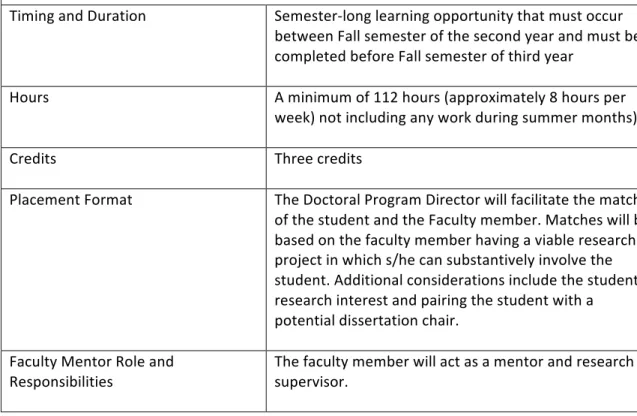
practicum. The overall goal of the practicum is to help prepare students to become independent scholars by providing them with the opportunity to apply, and thereby deepen, the research knowledge they have gained in the classroom. The practicum is specifically designed to cultivate the research skills necessary to successfully fulfill the requirements for the doctoral degree and participation in the community of scholars. To this end, students undertake the practicum during their second year in the program and must be finished before the beginning of the third year. A detailed description of the research practicum can be found in table 1.
Table 1: Description of Research Practicum for Simmons SSW Ph.D. Program
Timing and Duration Semester-‐long learning opportunity that must occur between Fall semester of the second year and must be completed before Fall semester of third year
Hours A minimum of 112 hours (approximately 8 hours per week) not including any work during summer months)
Credits Three credits
Placement Format The Doctoral Program Director will facilitate the match of the student and the Faculty member. Matches will be based on the faculty member having a viable research project in which s/he can substantively involve the student. Additional considerations include the student’s research interest and pairing the student with a
potential dissertation chair.
Faculty Mentor Role and
Responsibilities The faculty member will act as a mentor and research supervisor.
13
Student Responsibilities Students responsibilities will vary according to project; however, it is anticipated that students will be involved in any of the following research-‐related tasks:
• Writing literature reviews
• Developing conceptual frameworks • Conceptualizing study designs • Choosing study measures
• Collecting, cleaning, and analyzing data • Interpreting findings
• Co-‐authoring and/or authoring IRB applications,
grant applications, reports, manuscripts, presentations, and posters
Evaluation system At the start of the practicum, the faculty member and the student will develop a contract with goals and objectives intended to enhance the student’s research experience and skills. The Doctoral Program Director will review the contract after the student and faculty member come to agreement. Upon her or his approval, the practicum will commence.
Faculty member and student will periodically assess progress on those goals and objectives and augment as needed. The research practicum will be included in the learning contract.
As the student nears 112 hours, the faculty supervisor, student, and Doctoral Program Director will assess progress and consult to determine whether the student successfully completed practicum. At the end of the practicum, the faculty mentor will assign a grade in accordance with the SSW grading policy for coursework.
Practicum can be coordinated with the work done to fulfill the manuscript submission necessary for candidacy.
INDEPENDENT STUDY
An Independent Study provides an opportunity for doctoral students to pursue knowledge and research in fields related to professional interests or objectives not represented in regular
14 course offerings.
Students may earn three elective credits by successfully completing an Independent Study. No more than two Independent Studies can be undertaken during a student’s progress through the Program.
To complete an Independent Study, the student must discuss the proposed project with a member of the Simmons faculty who might be interested in directing the project. Students can consult with the Director of the Doctoral Program to learn about faculty interests if necessary. The identified faculty member and student will submit a proposal to the Director of the Doctoral Program for approval. The proposal should include the following:
• a description of the work, including learn objectives;
• the scope and subject of the final outcomes which the faculty member will evaluate
including a timeline to meet each outcome;
• regular meeting times to discuss the student’s progress towards learning objectives
The proposal should be indicative of the intellectual rigor and appropriate for doctoral level work.
THE COMPREHENSIVE EXAM AND QUALIFICATION INTO PhD CANDIDACY
March Date TBD: Each required course instructor will submit two (2) exam questions that capture key concepts from the class. The questions will be peer reviewed by the entire Doc Com during its March meeting (first Thursday). In the event of the Doc Com does not meet that month, the questions will be circulated on that day for peer review via email.
May Date TBD: Two-‐week exam period begins. Examinees receive exams via email no later than 12 pm. Each examinee chooses one of two questions from each course, completing a total of five questions. The concise, focused, and scholarly response for each question should be written in APA style in five (5) pages or less, excluding a cover page and references.
May Date TBD: Written exam due. Two week reading period for faculty begins. The entire PhD faculty will read each exam and provide comment.
May or June Date TBD: Oral Examination/Grade Day. The entire Doctoral Committee will meet with each examinee for one hour. Students will be scheduled sequentially, with 15 minutes for deliberation between each exam. The examinee will be invited back into the examination room. The student’s advisor or the director of the doctoral program will report the deliberations and final conclusion to the student at that time.
August 30: Deadline for submission of empirical manuscript to a scientific peer review journal approved by the examinee’s adviser and doctoral program director. Students are encouraged— but not required—to recruit one or more faculty members to work on the manuscript as co-‐ authors—with the provision that faculty members contribute, and that the student will be listed as first author. The manuscript must be submitted in accordance the journal’s instructions.
Upon meeting the requirements listed above, the student will move into candidacy, and be eligible to participate in the dissertation seminar.
15
THE DISSERTATION COMMITTEE
The doctoral candidate will select members of the dissertation committee in consultation with his/her advisor and the Director of the PhD Program. The objective in selecting a committee is to ensure that the areas of substantive, theoretical, and methodological expertise related to the topic are adequately represented on the committee and that persons serve the committee are academically and professionally qualified and willing to. Faulty who are asked to chair or serve on a dissertation committee are free to accept or decline the candidate’s request. The
chairperson must be a member of the PhD-‐level School of Social Work faculty. The responsibilities of the chairperson are to1
• be a voting member;
• hold an Endorsement to Chair a doctoral supervisory committee;
• be able and willing to assume principal responsibility for advising the student; • have adequate time available for this work and be accessible to the student; • attend both Proposal and Full Dissertation Defenses and additional committee
meetings, as necessary;
• sign the dissertation signature page acknowledging approval of the dissertation and completion of the degree
Each dissertation committee will be made up of no fewer than three committee members with at least two members of the Simmons faculty. At least one member of the three-‐person committee should be selected from outside the School. At least two members of the
committees should have doctoral degrees. One member of the committee is expected to be knowledgeable regarding the research methodology to be used.
Upon approving the composition of the committee, the chair will forward her or his
recommendation to the Director. The Director will defer to the dissertation committee chair unless she or he has serious concerns about the qualifications of the committee members. Upon approval, a letter will be sent to the third reader confirming appointments and informing them of the expectation that s/he attend the proposal hearing and defense in-‐person or
remotely. In addition, the chair will advise the Director of specific expectations to be included in the letter to the external reader(s).
The candidate is responsible for timely production of material for periodic committee review. Chairpersons and readers will make their own arrangements with students when they are on sabbatical.
THE DOCTORAL DISSERTATION
The dissertation seminar provides a forum for development of a position paper with which to approach potential committee members. The course prepares candidates to develop a strategy for recruiting committee members and thinking beyond the PhD degree to the career trajectory
1 Language taken from The University of Washington
16
that the degree will afford the successful graduate. The dissertation seminar also serves as a quality assurance measure for the rigor and quality of dissertation proposals. The Dissertation Seminar Instructor will be a faculty member actively involved in science through external funding and/or peer reviewed empirical publication).
THE OBJECTIVES OF THE DISSERTATION
The production of a dissertation and its oral defense are major components in doctoral education. They are the final and most complete demonstration of the student's suitability to receive the PhD. The dissertation has three basic objectives:
1. To extend empirical and conceptual knowledge in a substantive area of concern to society.
2. To demonstrate the application of rigorous scientific methodology to the substantive area of study.
3. To articulate the relevance of the scholarship and science resulting from the execution of the society, other disciplines, and social work practice, policy and research.
OPTIONS FOR DOCTORAL DISSERTATION FORMAT
The doctoral candidate has two options for the format of their dissertation: Standard Dissertation (Option A), or three paper dissertation (Option B).
The sample dissertation proposal outlines below are provided as examples.
Candidates should follow one of these outlines and consult with their dissertation committee chair about specific content within the format selected.
Option A: Standard Dissertation
I. Introduction
A. Background (background to the problem)
B. The Study (briefly introducing the study and research questions) C. Significance (briefly explaining who your study will be of value to and why)
II. Conceptual Framework (situates your work within a conceptual framework, explains key constructs, introduces or clarifies any theoretical models involves, and situations your work within prior theory and research on the question; begin with an introductory paragraph introducing the elements of the conceptual framework and conclude with a summation that helps review the need for your study and thus transitions to the methodology)
III. Methodology
17
A. Overall Research Approach (with justification and citations of other research using that approach or to theorists of that approach) [usually needed for qualitative, possibly for quantitative]
B. Research Sites/Population/Sampling/Subjects/Participants C. Instruments/Measures/Sources of Data
D. Procedures [usually needed for quantitative; less often used in qualitative] E. Data Analysis
F. Trustworthiness and Credibility [usually needed for qualitative, not quantitative]
IV. Timeline (for proposal defense, completion of the dissertation, and dissertation defense)
V. Outline of Dissertation Chapters [optional] (usually Introduction, Conceptual Framework, Methodology, Findings, and Conclusion)
VI. Dissemination [optional] (plans for journal articles, conference presentations, or other forms of dissemination)
VII. References
Option B: Three-‐Article Dissertation
I. Introduction
A. Background (background to the problem)
B. The Studies (briefly introducing the collection of studies and overall research questions) C. Significance (briefly explaining who your dissertation will be of value to and why)
II. Conceptual Framework (situates your work within a conceptual framework, explains key constructs, introduces or clarifies any theoretical models involves, and situates your work within prior theory and research on the question; begin with an introductory paragraph introducing the elements of the conceptual framework and conclude with a summation that helps review the need for your study and thus transitions to the methodology)
III. Methodology
A. Overall Research Approach (with justification and citations of other research using that approach or to theorists of that approach) [optional]
B. Overall Research Site or Population (if this is consistent across the three studies) [optional]
C. Study A
i. Research Approach
ii. Research Sites/Population/Sampling/Subjects/Participants iii. Instruments/Measures/Sources of Data
iv. Procedures [usually needed for quantitative; less often used in qualitative] v. Data Analysis
vi. Trustworthiness and Credibility [usually needed for qualitative, not quantitative]
18
i. Research Approach
ii. Research Sites/Population/Sampling/Subjects/Participants iii. Instruments/Measures/Sources of Data
iv. Procedures [usually needed for quantitative; less often used in qualitative] v. Data Analysis
vi. Trustworthiness and Credibility [usually needed for qualitative, not quantitative]
E. Study C
i. Research Approach
ii. Research Sites/Population/Sampling/Subjects/Participants iii. Instruments/Measures/Sources of Data
iv. Procedures [usually needed for quantitative; less often used in qualitative] v. Data Analysis
vi. Trustworthiness and Credibility [usually needed for qualitative, not quantitative]
IV. Timeline (for proposal defense, completion of the dissertation, and dissertation defense)
V. Outline of Dissertation Chapters [optional] (Usually Introduction, Conceptual
Framework, Study A, Study B, Study, C, and Conclusion) (Methodology will be integrated into each of the three Study chapters; umbrella information about Methodology can be integrated into the Introduction or the Conceptual Framework or included in an additional chapter inserted after the Conceptual
Framework)
VI. Dissemination [optional] (plans for journal articles, conference presentations, or other forms of dissemination)
VII. References
THE TOPIC AND CONTENT OF THE DISSERTATION
Within the context of the previously stated basic objectives the specific topic area of the dissertation should develop out of and foster the intellectual and professional interests of the student. In selecting a topic and developing a methodological plan the student should be attentive to the following criteria:
1. The topic must be in an area of significance to social work practice and the social work profession.
2. The dissertation must be aimed at the development of new knowledge and address issues that have not been adequately explored. Therefore it should not merely replicate an existing study without adequate justification of how such a replication would add to existing knowledge.
3. The dissertation must be a creative and independent project. Secondary analysis of data collected by another investigator will be accepted under certain conditions. The proposed research must be within an area of interest and competence of the student. It should
19
include an independent conceptualization, literature review, and procedure for data analysis. The selected area of study should be one not carried out in the analysis by the other investigator(s).
In addition to advantages, use of secondary data creates some risks, for which the student needs adequate safeguards. In the case of data from an investigator outside the School, careful consultations each step of the way with relevant persons will be necessary. The people likely to be involved will include, but not be limited to, the dissertation seminar instructor, the Director of the Doctoral Program, the dissertation chair, and, in some instances, the Dean. A written agreement between the School and the outside investigator will ordinarily be wise. In the case of in-‐School data, the risks are less great, but it is still important to insure that the student's interests are protected. Thus, in-‐house investigators would ordinarily be limited to a maximum of two votes of the five at a proposal hearing, with replacements appointed by the Director. They should also represent a minority of the votes at the Human Subjects Committee.
4. The dissertation must use a research design appropriate to the formulation of the problem
and developed in accordance with the canons of sound research principles.
5. The dissertation problem and research design should be formulated in such a way that they can be feasibly carried out by a single investigator within the time frame required by the School's policies.
THE DISSERTATION PROPOSAL AND PROPOSAL HEARING
Each student must submit a dissertation proposal that: states the problem for study;
summarizes relevant theoretical and empirical literature; specifies the expected contribution of the study; provides detailed methodology of the study including plans for data analysis and states its relationship to social welfare. The proposal may also include a completed IRB (Institutional Review Board) proposal and should identify any expected difficulties and explicit plans for solving them in the course of carrying out the dissertation research.
The proposal should include the following elements:
1. Student’s Name.
2. Preliminary Title. (A Proposal for a Dissertation Tentatively Titled: ________________)
3. Committee Members. Dissertation Committee members and other external or agency personnel involved with the proposed study.
4. Specific Aims. What is the problem that you are investigating? What question(s) do you wish to answer with this study? What is the theoretical framework and/or conceptual model underlying the proposed research? How are you advancing knowledge? Why is the topic worthy of investigation? The question(s) or problem should be clearly stated in about one-‐half page. Then, as appropriate, and varying with
20
the particular research design, state the major hypotheses and their sources and operationally define the main concepts. Include a statement of its relevance to social welfare.
5. Background and Significance. What does the literature reveal? The literature review should be about 5-‐7 pages in length. It should focus on the relationship between extant knowledge and the research question(s), including gaps in knowledge in the field. At the proposal hearing, students should be prepared to justify their choice of literature in the context of the broader body of relevant scholarship and explain how the proposed research is derived from this body of literature.
6. Research Design and Methods. Describe in detail the research design. Discuss the theoretical framework and/or conceptual model underlying the proposed research. Justify its relationship to the research question(s). Discuss its strengths and limitations for answering the research question(s). The proposal must discuss the choice and rationale for the method selected.
Specifically:
If the proposed study employs quantitative methods, the description should include the sampling strategy (including strengths and weaknesses); issues of researcher’s role; measurement approach (including sources of data,
descriptions of major variables, instrumentation, reliability and validity); issues of internal and external validity; specific procedures for conducting each stage of the research and preliminary plans for data analysis that includes anticipated statistical procedures based on the types of measures used to collect data.
Proposals for qualitative studies should discuss the research setting; sampling strategy or selection of informants (including strengths and weaknesses); issues of researcher role management; data collection techniques (e.g., interviews, observation, document analysis); strategies for recording, managing, and assuring the quality of data; trustworthiness and credibility, and a specific plan for data analysis.
If you are proposing a mixed methods design, justify the utility of qualitative and quantitative measures to answer your question(s). Address appropriate issues from the preceding description of qualitative and quantitative proposals.
7. Information about Available Resources, Sources of Data, Cooperation, Project Feasibility, Staff. Discuss anticipated problems and plans to overcome them. The proposal should report on: relationships to larger projects, status of gaining permission to use data sources and of IRB application, if required. If the dissertation is part of a larger project, specify the extent to which and how the design, methodology, collection of data and interpretation of findings will be your responsibility. Also indicate your responsibility to the larger project to make data available and restrictions, if any, on publication, including agreements about authorship.