Audit Report on the Small
Procurement Practices of the Board
of Elections
MD03-066A
THE CITY OF NEW YORK OFFICE OF THE COMPTROLLER
1 CENTRE STREET NEW YORK, N.Y. 10007-2341
---WILLIAM C. THOMPSON, JR.
COMPTROLLER
To the Citizens of the City of New York
Ladies and Gentlemen:
In accordance with the Comptroller’s responsibilities contained in Chapter 5, § 93, of the New York City Charter, my office has examined the operating practices of the Board of Elections (Board).
The results of our audit, which are presented in this report, have been discussed with Board and OMB officials, and their comments have been considered in the preparation of this report.
Audits such as this provide a means of ensuring that the Board demonstrates effective internal controls over its small procurement practices.
I trust that this report contains information that is of interest to you. If you have any questions concerning this report, please e-mail my audit bureau at [email protected] or telephone my office at 212-669-3747.
Very truly yours,
William C. Thompson, Jr.
Report: MD03-066A Filed: June 12, 2003
Table of Contents
AUDIT REPORT IN BRIEF 1
INTRODUCTION 3
Background 3
Objectives 3
Scope and Methodology 3
Discussion of Audit Results 5
FINDINGS AND RECOMMENDATIONS 6
Bids Not Solicited 6
Inadequate Maintenance of Required Documents 7 Purchase Orders Were Prepared and Approved
After the Invoice Dates 8 Purchase Orders Missing the Necessary Certification 9 Invoices Are Not Clocked In when Received 10 Late Vendor Payments 11 The Board Overpaid Vendors 12 Invoices Were Not All Marked “Vouchered” 13 The Board Used Incorrect Object Codes 13 Miscellaneous Payment Vouchers are not Used Correctly 14 ADDENDUM I – Board Response
The City of New York
Office of the Comptroller
Bureau of Management Audit
Audit Report on the Small Procurement
Practices of the Board of Elections
MD03-066A
AUDIT REPORT IN BRIEF
This audit determined whether the Board of Elections (Board) complied with applicable purchasing procedures regarding its small procurements, including PPB Rules, Comptroller’s Directives #1, #6, #24, and #25, and its own formal procedures.
Audit Findings and Conclusions
The Board generally complied with applicable PPB Rules, Comptroller’s directives, and its own formal procedures, when processing small procurements. Specifically, most purchases were appropriately prepared and authorized. In general, purchases were supported by vendor invoices; invoices were checked for clerical accuracy; and payments matched invoice amounts. In addition, we found no evidence of split purchasing in violation of § 3-08 of the PPB Rules.
However, during Fiscal Year 2001, there were problems with some of the Board’s small procurement purchasing practices. The Board’s small procurement purchasing practices have improved during Fiscal Year 2003, although the problems still existed to a lesser degree.
Audit Recommendations
To address these issues, we make 11 recommendations that include the following:
• The Board should ensure that bids are solicited in accordance with PPB rules.
• Board officials should ensure that they maintain all the required documents in the procurement files to support purchases and payments.
• Board and OMB officials should find a workable solution to avoid late vendor payments.
• Board officials should ensure that the Board uses Miscellaneous Payment Vouchers according to the circumstances specified in Comptroller’s Directive #25.
Discussion of Audit Results
The matters covered in this report were discussed with officials from the Board during and at the conclusion of this audit. A preliminary draft report was sent to Board officials and discussed at an exit conference held on April 21, 2003. On April 29, 2003, we submitted a draft report to Board officials with a request for comments. On May 28, 2003, we submitted a draft to OMB officials with a request for comments. We received a written response from the Board on May 13, 2003 and from OMB on June 6, 2003. Board officials generally agreed with the audit’s findings and recommendations, stating:
“The Board wishes to make a global reply to all the recommendations . . . .
“The Board accepts, and will implement TO THE EXTENT POSSIBLE all the recommendations contained in this draft audit, dated April 29, 2003. We are gratified to note the recurrent theme in this audit of steady improvement from FY01 to FY03, and pledge to continue said improvements in FY04 and all succeeding years.”
In addition, OMB officials stated that they recognize the need for additional appropriations and have increased funding to the Board for Fiscal Year 2004.
Auditor Comments: Since the Board replied globally and agreed to implement all of the recommendations, we will not respond to individual recommendations.
The full text of the Board’s and OMB’s comments are included as an addendum to this report.
INTRODUCTION
Background
The Board of Elections (Board) administers elections and voter registration activities within the City of New York. In adherence to § 3-200 of the New York State Election Law, a Board of Elections has been established in each of the City’s five counties. In addition to its five borough offices, the Board has a general administrative office located in Manhattan.
During Fiscal Year 2001, the Board encumbered funds for small procurements totaling $705,958. Rules governing an agency’s handling of small procurements are included in § 3-08 of the City’s Procurement Policy Board (PPB) Rules. For Fiscal Year 2001, small procurements were defined as the purchase of goods and services totaling $25,000 or less, construction and construction-related services totaling $50,000 or less, and information technology totaling $100,000 or less.
Objectives
The objectives of the audit were to determine whether the Board complied with applicable purchasing procedures regarding its small procurements, including PPB Rules, Comptroller’s Directives #1, #6, #24, and #25, and its own formal procedures.
Scope and Methodology
The initial scope of our audit was small procurement purchases for Fiscal Year 2001.1 However, during the audit Board officials stated that as a result of staff changes and updated procurement procedures, operations at the Board have recently improved. Therefore, we expanded our scope to include small procurement purchases for the first six months of Fiscal year 2003 (July 2002 through December 2002) to determine whether operations had improved.
To obtain an understanding of the Board’s purchasing procedures, we interviewed the agency’s Chief Contracting Officer, Finance Officer and Assistant Finance Officer, Budget Analyst, Director of Equipment, and Administrative Manager. We also reviewed the Board’s
Fiscal Unit Procedures Manual and Agency Procurement Procedures, and applicable Comptroller’s directives and PPB Rules.
To determine the total encumbrances and payments made by the Board during Fiscal Year 2001 for small procurements, we obtained a list of all Board encumbrances and payments
1 Board officials requested that we use Fiscal Year 2001 as our audit scope, as opposed to Fiscal Year 2002. Board officials stated that, due to events during Fiscal Year 2002 (the September 11, 2001 attack, the Mayoral and run-off elections) the Board did not always have the resources to ensure it complied with all small procurement purchasing procedures. Therefore, the purchasing practices that year were not indicative of the Board’s normal procedures.
from the City Financial Management System (FMS); we also obtained a list of the same information from Board officials. We compared both lists for completeness.
To determine whether the Board complied with PPB Rules and Comptroller’s directives, we selected two random samples for Fiscal Year 2001: a sample of 40 purchase orders (that represented 127 invoices and 48 payment vouchers), totaling $154,234, from 156 purchase orders issued in Fiscal Year 20012; and a sample of 25 miscellaneous vouchers, totaling $549,433, from 568 miscellaneous vouchers paid during Fiscal Year 2001. In addition, we selected a random sample of 15 purchase orders (that represented 46 invoices and 23 payment vouchers), totaling $115,591, from 64 purchase orders issued during the first six months of Fiscal Year 2003.
We reviewed the supporting documentation for each of our sampled transactions for both fiscal years to determine whether:
• Bids were solicited in accordance with PPB Rules.
• Purchases and payments were supported by requisitions, purchase orders, invoices, receiving reports, and vouchers.
• Purchases were appropriately prepared and reviewed.
• Purchase orders were certified for final payment.
• Invoices were clocked in at the time that they were received.
• Payments were made to vendors within the 30-day time period mandated by § 4-06 of the PPB Rules.
• Payments matched the invoices and vendors were paid the correct amounts.
• Invoices were checked for clerical accuracy and were canceled to prevent duplicate payment.
• Object codes were correctly charged.
• Miscellaneous vouchers were used correctly.
In addition, to determine whether there was evidence of split purchasing in violation of § 3-08 of the PPB Rules, which applies to small procurements, we sorted all purchase orders issued by the Board for Fiscal Year 2001 by vendor name, purchase order date, and dollar amount. We reviewed the purchase orders to determine whether the same or similar goods or services were purchased from the same vendor within a short time period (1-week) using
2
different purchase orders. We determined whether any of these purchase orders for the same vendor, although individually below the small purchase limits set by § 3-08 of the PPB Rules for bidding, exceeded these limits when added together. To illustrate, for a $3,000 purchase, an agency might attempt to forgo the competitive bidding required under § 3-08 by issuing three $1,000 purchase orders at intervals a few days apart.
This audit was conducted in accordance with Generally Accepted Government Auditing Standards (GAGAS), and included tests of the records and other auditing procedures we considered necessary. This audit was performed in accordance with the audit responsibility of the City Comptroller as set forth in Chapter 5, § 93, of the New York City Charter.
Discussion of Audit Results
The matters covered in this report were discussed with officials from the Board during and at the conclusion of this audit. A preliminary draft report was sent to Board officials and discussed at an exit conference held on April 21, 2003. On April 29, 2003, we submitted a draft report to Board officials with a request for comments.On May 28, 2003, we submitted a draft to OMB officials with a request for comments. We received a written response from the Board on May 13, 2003 and from OMB on June 6, 2003. Board officials generally agreed with the audit’s findings and recommendations, stating:
“The Board wishes to make a global reply to all the recommendations . . . .
“The Board accepts, and will implement TO THE EXTENT POSSIBLE all the recommendations contained in this draft audit, dated April 29, 2003. We are gratified to note the recurrent theme in this audit of steady improvement from FY01 to FY03, and pledge to continue said improvements in FY04 and all succeeding years.”
In addition, OMB officials stated that they recognize the need for additional appropriations and have increased funding to the Board for Fiscal Year 2004.
Auditor Comments: Since the Board replied globally and agreed to implement all of the recommendations, we will not respond to individual recommendations.
The full text of the Board’s and OMB’s comments are included as an addendum to this report.
OFFICE OF THE COMPTROLLER
NEW YORK CITY
FINDINGS AND RECOMMENDATIONS
The Board generally complied with applicable PPB Rules, Comptroller’s directives, and its own formal procedures, when processing small procurements. Specifically, most purchases were appropriately prepared and authorized. In general, purchases were supported by vendor invoices; invoices were checked for clerical accuracy; and payments matched invoice amounts. In addition, we found no evidence of split purchasing in violation of § 3-08 of the PPB Rules.
However, during Fiscal Year 2001, there were problems with some of the Board’s small procurement purchasing practices. The Board’s small procurement purchasing practices have improved during Fiscal Year 2003, although the problems still existed to a lesser degree. These issues are discussed in the following sections of this report.
Bids Not Solicited
During Fiscal Year 2001, the Board failed to solicit the required bids for each of the 13 purchase orders that required competitive bidding in our sample. Those 13 purchases totaled $82,142.
Table I, below, summarizes the purchases in our sample that lacked the required bid documentation on file.
TABLE I
Purchases Not Bid
Vendor Purchase Amount
Mutual Central Alarm Serv Inc. $2,794 Visual Word Systems, Inc. 3,067 C.S. Plumbing Inc. 3,298 New Horizons Computer 3,675 Office Works, Inc. 3,720 CS S Trucking 5,221 Liberty Moving and Storage 5,934 All Purpose Advertising 6,764 Blue Chip Office Automation 8,608 Positive Promotions 9,507 Rand Associates 9,554 Lucent Technologies 10,000 Avaya Incorporated 10,000
Total $82,142
Section 3-08 of the PPB Rules states that five suppliers are to be solicited for procurements costing more than $2,500 but equal to or less than the small purchases limits.
To determine whether the Board’s bidding practices had improved during Fiscal Year 2003, we reviewed a sample of purchases from that period. The Board did solicit the required bids for four (50%) of the eight purchase orders in our sample that required competitive bidding. Nevertheless, it failed to solicit required bids for the remaining four purchase orders. These four purchases totaled $20,641.
The Board must ensure that the required number of vendors are solicited and that the required number of bids are obtained for its purchases.
Recommendation
1. The Board should ensure that bids are solicited in accordance with PPB Rules.
Inadequate Maintenance of Required Documents
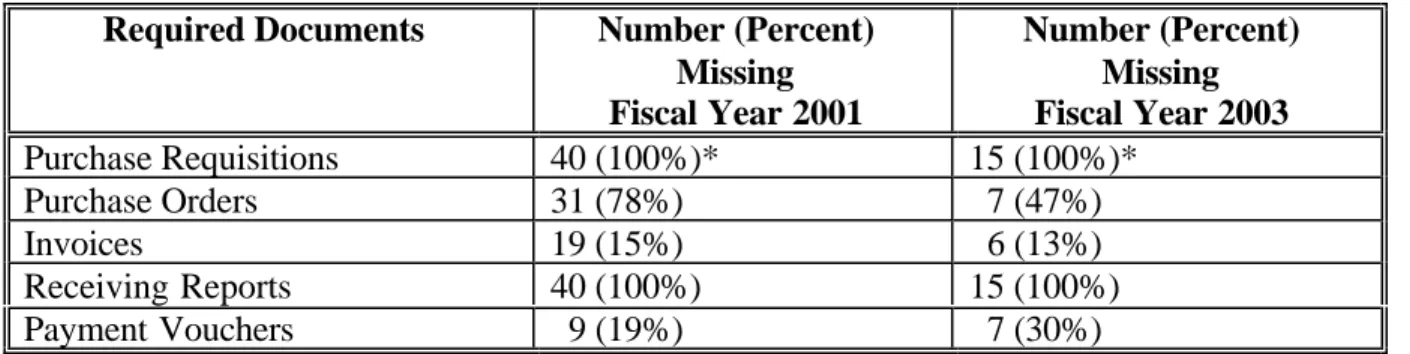
The Board failed to maintain purchase requisitions, purchase orders, invoices, receiving reports, and payment vouchers in its procurement files to support purchases, as required by Comptroller’s Directive #24. Although the Board’s maintenance of purchasing documents has improved in Fiscal Year 2003, the problem still persists. Table II, below, details the various documents missing for both fiscal years:
TABLE II
Missing Purchasing Documents
Required Documents Number (Percent) Missing Fiscal Year 2001
Number (Percent) Missing Fiscal Year 2003
Purchase Requisitions 40 (100%)* 15 (100%)* Purchase Orders 31 (78%) 7 (47%) Invoices 19 (15%) 6 (13%) Receiving Reports 40 (100%) 15 (100%) Payment Vouchers 9 (19%) 7 (30%)
* Board officials stated that it was their policy not to prepare requisitions.
According to Comptroller’s Directive #24, procurement files should contain documentation indicating the quantity and description of the goods and services received, the signature of the individual verifying the receipt of the goods and services, the date that the goods and services were delivered, and the invoices. This documentation is necessary to indicate before payment is made that goods and services received meet purchase order and invoice specifications.
Each of the documents cited in the above table are an integral part of the purchasing process. They ensure before a payment is issued that purchases are needed, budgeted for, received and approved, as detailed below:
• Purchase Requisitions: Document the need for the goods requested.
• Purchase Orders: Allow for the encumbrance of funds. This allows the agency to appropriately assess its budget by setting aside funds before expenditures are made.
• Invoices: Arecompared to receiving reports, checked for clerical accuracy, and cancelled to avoid duplicate payment.
• Receiving Reports: Confirm that the goods and services ordered were actually received.
• Vouchers: Are the written authorization for payments. The lack of vouchers can lead to unauthorized payments being made.
To maintain internal controls over agency purchases and ensure that purchases are needed, approved, budgeted for, received and accurately paid, the Board should document all aspects of its purchasing cycle.
Recommendation
2. Board officials should ensure that they maintain all the required documents in the procurement files to support purchases and payments.
Purchase Orders Were Prepared And Approved After the Invoice Dates
Purchase orders for 19 (48%) of the sampled 40 purchases were prepared and approved after the date on the invoices3. For example, the purchase order for Visual Word Systems, Inc., for the leasing of recording equipment was dated January 31, 2001, and the invoice was dated August 7, 2000. This means that the agency ordered and received the goods and services before preparing a purchase order and voucher. This is in violation of Comptroller’s Directive #24, which requires the pre-encumbrance of funds prior to making a purchase.
Board officials stated that in emergency situations, they prepare and approve purchase orders after the invoice dates. Section 3-06 of the PPB Rules states that an agency can make an emergency purchase, permitting the agency not to follow the normal procurement method, but
3
The Board provided us with only nine purchase orders; therefore, we had to obtain dates for the
only in the event of an unforeseen danger to life, safety, property, or a necessary service. An emergency purchase must be documented in writing and must be approved by the Comptroller’s Office and the Law Department. In the 19 cases cited above, we saw no documentation stating that these were emergency purchases.
During Fiscal Year 2003, 14 of the 15 sampled purchase orders were prepared and approved prior to the invoice dates4, as required by PPB rules. However, one purchase order for A-Art Locksmith, Inc., was prepared after the invoice date. Officials of the Board stated that this was an emergency situation. However, we saw no evidence of this in the closed payment file.
A purchase order is used by agencies to encumber funds. Encumbering funds before payments are made allows agencies to properly authorize and monitor expenses. Purchase orders are also used to document the approval to purchase items and to clearly state to the vendor the items ordered and terms of the sale. Preparing a purchase order after an item has been received defeats this purpose.
Recommendation
3. The Board should ensure that purchase orders are prepared before purchases are made.
Purchase Orders Missing the Necessary Certifications
As noted in the prior section, the Board could only provide us with the purchase orders for nine (23%) of our 40 sampled purchases. Purchase orders for each of these nine documents were missing a certification signature to indicate proper review of the purchase orders. Since we did not see purchase orders for the remaining 31 sampled purchases we cannot determine if they were properly certified as well.
Comptroller’s Directive #24, § 8.4, requires that the payment voucher contain a preparer’s certification, a pre-audit certification, and a departmental certification. Furthermore, § 8.2 states that “to prevent errors and to safeguard assets, individuals performing the purchasing, receiving, and vouchering function should be independent of each other.”
Purchase orders should contain the necessary certification signatures indicating that the purchase has been reviewed for accuracy and completeness. By certifying the purchase order, the reviewer ensures that the purchases are correctly coded and that there is enough money in the budget to cover the purchase.
The Board’s practice for certifying purchase orders did improve during Fiscal Year 2003. The Board certified each of the eight purchase orders that they had given us.
4
The Board provided us with only eight purchase orders; therefore, we had to obtain dates for the
It is important that the Board continues to ensure that purchase orders are properly authorized so that there is proof that the purchase orders have been sufficiently reviewed and that all duties have been segregated.
Recommendation
4. The Board should certify all purchase orders to ensure adequate controls over its procurement process.
Invoices Are Not Clocked In when Received
The Board did not have clock-in or receiving dates on any of the 108 invoices in our sample. The clock-in and receiving dates are important when determining whether late fees are due to vendors. The PPB Prompt Payment Guidelines state:
“When an agency receives an invoice, the first thing that should be done is to immediately clock it in, either by a date stamp or simply noting when it was received.
“In the event the invoice is not date stamped, the date of the invoice or, if later, the postmark on the envelope, plus five days, will serve as the clock-in date.”
FMS uses the clock-in date to determine an agency’s adherence to § 4-06 of the PPB Rules regarding timeliness of payments. If the Board does not clock in invoices when they are received, FMS uses an earlier date (the date of the invoice, or the fifth day after the postmark date on the envelope containing the invoice). This affords the agency less time to pay the invoice and remain in compliance with the prompt payment procedures outlined in PPB Rules, and may result in late fees that would not accrue if the Board clocked in all invoices.
During Fiscal Year 2003, the Board had clock-in or receiving dates on 31 (78%) out of the 40 invoices in our sample. Though this is an improvement over the practice during Fiscal Year 2001, the Board still did not clock-in or have receiving dates, as required by PPB rules, on nine (22%) of the 40 invoices.
Recommendation
Late Vendor Payments
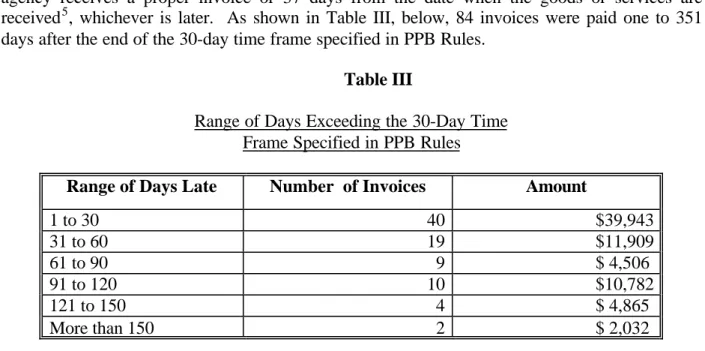
The Board did not pay 84 (78%) of the 108 invoices in the sample, totaling $74,037 within the time frames specified by PPB Rules. Section 4-06 of PPB Rules, Prompt Payment,
states that agencies are required to pay all vendors within 30 calendar days from the date the agency receives a proper invoice or 37 days from the date when the goods or services are received5, whichever is later. As shown in Table III, below, 84 invoices were paid one to 351 days after the end of the 30-day time frame specified in PPB Rules.
Table III
Range of Days Exceeding the 30-Day Time Frame Specified in PPB Rules
Range of Days Late Number of Invoices Amount
1 to 30 40 $39,943
31 to 60 19 $11,909
61 to 90 9 $ 4,506
91 to 120 10 $10,782
121 to 150 4 $ 4,865 More than 150 2 $ 2,032
Board officials stated that late payments occur because of under-funding by OMB. The Board, they said, must request additional funding from OMB during the year to pay bills. Board and OMB officials need to discuss this problem and find a workable solution to it.
During Fiscal Year 2003, the Board did improve on its payment practices. However, it did not pay 14 (35%) of the 40 invoices in the sample, totaling $33,846, within the time frames specified by PPB Rules. Those 14 invoices were paid one to 60 days after the end of the 30-day time frame specified in PPB Rules.
Recommendations
6. Board and OMB officials should find a workable solution to avoid late vendors payments.
Board Response: “This recommendation places an onus on the Board that really should be placed on OMB. Board managerial and budgetary personnel basically know up front the cost of any given fiscal year. It is the practice of the Board to make this figure known
5
We were unable to use the time frame of 37 days from the date the goods or services are received because the Board had no receiving report to indicate the date that the goods or services were received.
to OMB and the City Council at the earliest appropriate moment. What happens next is beyond the Board’s control.”
Auditor Comments: The recommendation places an equal onus on the Board and on OMB. As stated previously, the Board and OMB should both work together to find a way to avoid late vendor payments.
OMB Response: “Recognizing the need for increased appropriations, the Executive Budget for Fiscal Year 2004, includes an addition to the baseline funding for the Board of Elections in the amount of $8,007,837. We believe that this additional funding amount will be sufficient to enable the Board of Elections to carry out its responsibilities.” 7. The Board should ensure that invoices are paid within the time frames specified in PPB
Rules.
The Board Overpaid Vendors
Our review of the sample of 40 purchases made during Fiscal Year 2001 revealed that the Board overpaid four of the companies by a total of $2,440, as shown in Table IV, below.
Table IV
Overpayment of Vendors
Vendor Name Goods or Service Invoice Amount Amount Paid by Board Overpayment Mutual Central Alarm Service Inc.
Security Alarm
$1,956 $3,341 $1,385 Rand Associates Data Entry 8,959 9,554 595 Metro Parking
Systems LTD
Parking 1,195 1,585 390 Great Spring Waters
of America
Water 3,297 3,367 70
Total $2,440
Comptroller’s Directive #24 states that:
“The individual signing the pre-audit certification acknowledges that a detailed review of the voucher and all its supporting documentation has been made in verification of the payment request.”
In none of the above instances did the employee who performed the pre-audit review take the necessary steps to ensure that only appropriate payments were made. However, during Fiscal Year 2003 the Board improved its practices and did not make any overpayments.
Recommendation
8. The Board should ensure that an individual reviews the invoices prior to payment so that the correct amounts are paid.
Invoices Were Not All Marked “Vouchered”
Not all parts, especially the invoices, were marked “vouchered” in any of the 40 voucher files reviewed in our sample for Fiscal Year 2001, or in any of the 15 voucher files reviewed in our sample for Fiscal Year 2003. Comptroller’s Directive #24, § 8.5, states that all documents in the vouchering package should be stamped with the word “vouchered.” By not stamping all parts of the voucher file as “vouchered,” especially all copies of the invoices, the Board increases the chance of duplicate payments.
Recommendation
9. The Board should ensure that all parts of the voucher package, especially the invoices, are marked “vouchered” to avoid any duplicate payments.
The Board Used Incorrect Object Codes
A total of seven (78%) of the nine purchase orders provided to us by the Board, totaling $19,063, were charged to incorrect object codes. (As noted in the prior section the Board only had purchase orders for nine of the 40 purchases in our sample.) For example, the Board charged $1,516 for a Crystal Report Developer from Software Solutions to object code 100 (Supplies and Materials) rather than to object code 684 (Professional Services-Computer Services). The City’s Chart of Accounts states that all payments for professional computer-related services performed by other than City employees should be charged to object code 684.
Comptroller’s Directive #24, § 8.4, states that “the reviewer should . . . examine the accounting and budget codes used and determine that they are correct—the proper fund should be charged.”
Table V, below, summarizes the Board’s Fiscal Year 2001 purchases charged to the incorrect object codes.
TABLE V
Summary of Purchases Charged to Incorrect Object Codes
Description of Purchase Dollar Amount of Purchase Object Code Charged
Object Code that Should Have Been Charged Petitions Printing $1,144 100 – Supplies and Materials
General
101– Printing Supplies Camera Equipment 1,169 100 – Supplies and Materials
General
300 – Equipment-General Crystal Report
Developer
1,516 100 – Supplies and Materials General
684 – Professional Services
Computer Services – Contractual Application
Development Time
1,750 400 – Contractual Expenditures General
684 – Professional Services
Computer Services – Contractual Computer System 2,231 400– Contractual Expenditures
General
332 – Purchases of Data Processing Equipment
Printing of Various Forms
1,746 100 – Supplies and Materials General
101– Printing Supplies Printing of Booklet 9,507 100 – Supplies and Materials
General
101– Printing Supplies
Total $19,063
The Board’s practices for charging purchases to the correct object code did improve during Fiscal Year 2003. The Board correctly coded 14 (93%) of our sample of 15 Fiscal Year 2003purchase orders.
The use of the correct object code enables an agency to categorize the type and amount of a particular expense item within a fiscal year. This information is used to generate the year-end reports that identify expenditure patterns. Expenditures by object code are also reported in the
Financial Report of the Comptroller. The use of incorrect object codes can compromise management’s ability to properly plan future budgets.
Recommendation
10.The Board should ensure that purchases are charged to the correct object codes.
Miscellaneous Payment
Vouchers are not Used Correctly
The Board inappropriately used miscellaneous payment vouchers totaling $467,586 in 18
(72%) of the 25 Fiscal Year 2001 payment vouchers that we reviewed.
Directive #25 states that Miscellaneous Payment Vouchers are to be used when the estimated or actual future liability is not determinable for expenses such as payments for utility
and postmaster, establishment of and increases to imprest funds, and reimbursements for out-of pocket expenses such as carfare, tolls, telephones, mileage. They should not be used for the purchase of supplies, equipment, materials, and services; for monthly rent payable on leases; or for license agreements of other uses of real property. Neither should they be used when the actual or future use is determinable, as in a contract.
The Board did not properly use 18 Miscellaneous Payment Vouchers in the following ways:
• Five (20%) of 25 Miscellaneous Payment Vouchers, totaling $190,349, were used to pay vendors who already had existing contracts.
• Six (24%) of 25 Miscellaneous Payment Vouchers, totaling $17,260, were used to pay re-occurring expenses that were on an annual basis. These expenses should be encumbered at the beginning of the year by preparing a blank purchase order.
• Seven (28%) of 25 Miscellaneous Payment Vouchers, totaling $259,977, were used for the payment of rent or lease of property.
According to Comptroller’s Directive #25 “the inappropriate use of Miscellaneous Vouchers contributes to the distortion of the City’s books of accounts by understaffing the City’s outstanding obligations.” Board officials should issue Miscellaneous Payment Vouchers in accordance with Comptroller’s Directive #25.
Recommendation
11.Board officials should ensure that the Board uses Miscellaneous Payment Vouchers according to the circumstances specified in Comptroller’s Directive #25.