ETSI EN 301 487-2
V1.1.1
(2000-09)
European Standard (Telecommunications series)Broadband Integrated Services Digital Network (B-ISDN);
Digital Subscriber Signalling System No. two (DSS2) protocol;
B-ISDN user-network interface layer 3 specification
for switched virtual path capability;
Part 2: Protocol Implementation Conformance
Statement (PICS) proforma specification
Reference
DEN/SPAN-05175-2
Keywords
B-ISDN, DSS2, UNI, layer 3, PICS, broadband
ETSI
650 Route des Lucioles
F-06921 Sophia Antipolis Cedex - FRANCE Tel.: +33 4 92 94 42 00 Fax: +33 4 93 65 47 16
Siret N° 348 623 562 00017 - NAF 742 C Association à but non lucratif enregistrée à la
Sous-Préfecture de Grasse (06) N° 7803/88
Important notice
Individual copies of the present document can be downloaded from:
http://www.etsi.org
The present document may be made available in more than one electronic version or in print. In any case of existing or perceived difference in contents between such versions, the reference version is the Portable Document Format (PDF). In case of dispute, the reference shall be the printing on ETSI printers of the PDF version kept on a specific network drive
within ETSI Secretariat.
Users of the present document should be aware that the document may be subject to revision or change of status. Information on the current status of this and other ETSI documents is available athttp://www.etsi.org/tb/status/
If you find errors in the present document, send your comment to: [email protected]
Contents
Intellectual Property Rights ...6
Foreword...6
Introduction ...7
1
Scope ...8
2
References ...8
3
Definitions and abbreviations...9
3.1 Definitions ...9
3.2 Abbreviations ...10
4
Conformance ...10
Annex A (normative):
PICS proforma for EN 301 487-1 ...11
A.1
Guidance for completing the PICS proforma...11
A.1.1 Purpose and structure ...11
A.1.2 Abbreviations and conventions ...11
A.1.3 Instructions for completing the PICS proforma...12
A.2
Identification of the implementation ...12
A.2.1 Date of the statement ...12
A.2.2 Implementation Under Test (IUT) identification ...13
A.2.3 System Under Test (SUT) identification ...13
A.2.4 Product supplier...13
A.2.5 Client ...14
A.2.6 PICS contact person ...14
A.3
Identification of the protocol to which this PICS proforma applies...15
A.4
PICS proforma tables ...15
A.4.1 Correspondence to a physical interface ...15
A.4.2 Structure of the tables...15
A.4.3 Complexity of conditions in Protocol Data Unit (PDU) parameter tables ...15
A.4.4 Support for received PDU parameters...15
A.5
Global statement of conformance...16
A.6
Roles...16
A.7
User ...16
A.7.1 Major capabilities ...17
A.7.2 Subsidiary capabilities...18
A.7.3 PDUs ...18
A.7.3.1 Messages received by the user ...19
A.7.3.2 Messages transmitted by the user ...20
A.7.4 PDU parameters ...20
A.7.4.1 Information elements in messages received by the user ...21
A.7.4.2 Information elements in messages transmitted by the user...24
A.7.5 Timers ...28
A.7.6 Structure of information elements received...28
A.7.6.1 Broadband locking shift...29
A.7.6.2 Broadband non-locking shift...29
A.7.6.3 Void ...29
A.7.6.4 ATM traffic descriptor...29
A.7.6.9 Called party number...32
A.7.6.10 Called party subaddress ...33
A.7.6.11 Calling party number ...33
A.7.6.12 Calling party subaddress ...34
A.7.6.13 Connection identifier ...34
A.7.6.14 End-to-end transit delay...34
A.7.6.15 Quality of service parameter ...35
A.7.6.16 Restart indicator...35
A.7.6.17 OAM traffic descriptor ...36
A.7.7 Structure of information elements transmitted ...36
A.7.7.1 Broadband locking shift...36
A.7.7.2 Broadband non-locking shift...37
A.7.7.3 Void ...37
A.7.7.4 ATM traffic descriptor...37
A.7.7.5 Broadband bearer capability ...38
A.7.7.6 Broadband high layer information ...38
A.7.7.7 Broadband low layer information ...39
A.7.7.8 Call state ...40
A.7.7.9 Called party number...40
A.7.7.10 Called party subaddress ...41
A.7.7.11 Calling party number ...41
A.7.7.12 Calling party subaddress ...42
A.7.7.13 Connection identifier ...42
A.7.7.14 End-to-end transit delay...42
A.7.7.15 Quality of service parameter ...43
A.7.7.16 Restart indicator...43
A.7.7.17 Transit network selection...43
A.7.7.18 OAM traffic descriptor ...44
A.8
Network...44
A.8.1 Major capabilities ...44
A.8.2 Subsidiary capabilities...45
A.8.3 PDUs ...45
A.8.3.1 Messages received by the network ...46
A.8.3.2 Messages transmitted by the network ...46
A.8.4 PDU parameters ...47
A.8.4.1 Information elements in messages received by the network...48
A.8.4.2 Information elements in messages transmitted by the network ...51
A.8.5 Timers ...55
A.8.6 Structure of information elements received...55
A.8.6.1 Broadband locking shift...56
A.8.6.2 Broadband non-locking shift...56
A.8.6.3 Void ...56
A.8.6.4 ATM traffic descriptor...56
A.8.6.5 Broadband bearer capability ...57
A.8.6.6 Broadband high layer information ...57
A.8.6.7 Broadband low layer information ...58
A.8.6.8 Call state ...59
A.8.6.9 Called party number...59
A.8.6.10 Called party subaddress ...60
A.8.6.11 Calling party number ...60
A.8.6.12 Calling party subaddress ...61
A.8.6.13 Connection identifier ...61
A.8.6.14 End-to-end transit delay...61
A.8.7.4 ATM traffic descriptor...64
A.8.7.5 Broadband bearer capability ...65
A.8.7.6 Broadband high layer information ...65
A.8.7.7 Broadband low layer information ...66
A.8.7.8 Call state ...66
A.8.7.9 Called party number...67
A.8.7.10 Called party subaddress ...67
A.8.7.11 Calling party number ...68
A.8.7.12 Calling party subaddress ...68
A.8.7.13 Connection identifier ...69
A.8.7.14 End-to-end transit delay...69
A.8.7.15 Quality of service parameter ...69
A.8.7.16 Restart indicator...70
A.8.7.17 OAM traffic descriptor ...70
Intellectual Property Rights
IPRs essential or potentially essential to the present document may have been declared to ETSI. The information pertaining to these essential IPRs, if any, is publicly available for ETSI members and non-members, and can be found in ETSI SR 000 314: "Intellectual Property Rights (IPRs); Essential, or potentially Essential, IPRs notified to ETSI in respect of ETSI standards", which is available from the ETSI Secretariat. Latest updates are available on the ETSI Web server (http://www.etsi.org/ipr).
Pursuant to the ETSI IPR Policy, no investigation, including IPR searches, has been carried out by ETSI. No guarantee can be given as to the existence of other IPRs not referenced in ETSI SR 000 314 (or the updates on the ETSI Web server) which are, or may be, or may become, essential to the present document.
Foreword
This European Standard (Telecommunications series) has been produced by ETSI Technical Committee Services and Protocols for Advanced Networks (SPAN).
The present document is part 2 of a multi-part EN covering the Broadband Integrated Services Digital Network (B-ISDN); Digital Subscriber Signalling System No two (DSS2) protocol; B-ISDN user-network interface layer 3 specification for switched virtual path capability, as described below:
Part 1: "Protocol specification [ITU-T Recommendation Q.2934 [5] (1998), modified]";
Part 2: "Protocol Implementation Conformance Statement (PICS) proforma specification"; Part 3: "Test Suite Structure and Test Purposes (TSS&TP) specifications for the user";
Part 4: "Abstract test Suite (ATS) and partial Protocol Implementation eXtra Information for the Testing (PIXIT) proforma specification for the user";
Part 5: "Test Suite Structure and Test Purpose (TSS&TP) specification for the network";
Part 6: "Abstract Test Suite (ATS) and partial Protocol Implementation eXtra Information for Testing (PIXIT) proforma specification for the network".
National transposition dates
Date of adoption of this EN: 25 August 2000
Date of latest announcement of this EN (doa): 30 November 2000 Date of latest publication of new National Standard
or endorsement of this EN (dop/e): 31 May 2001
Introduction
To evaluate conformance of a particular implementation, it is necessary to have a statement of which capabilities and options have been implemented for a given protocol. Such a statement is called an Implementation Conformance Statement (ICS). An ICS stating what capabilities and options have been implemented for a particular protocol is called a protocol ICS. This is commonly abbreviated to "PICS".
EN 301 487-1 [1] is derived from ITU-T Recommendation Q.2934 [5] (1998). However, no PICS proforma exists for this Recommendation. Therefore, ETSI has created a PICS proforma that is specific to the European environment. This PICS proforma reflects the requirements contained in ITU-T Recommendation Q.2934 [5] with the modifications applied by EN 301 487-1 [1]. This has been done to assist understanding of how the European requirements relate to the requirements contained within ITU-T Recommendation Q.2934 [5] (and in particular, to the options specified in that recommendation that are selected by the ETS). In practical terms, this means that a number of capabilities specified by ITU-T Recommendation Q.2934 [5] appear as items in this PICS proforma with a status more akin to the status that would be expected in a profile ICS (i.e. out-of-scope (I), prohibited (X)).
1
Scope
This second part of EN 301 487 provides the Protocol Implementation Conformance Statement (PICS) proforma for the Broadband Integrated Services Digital Network (B-ISDN) Digital Subscriber Signalling System No. two (DSS2) protocol user-network interface layer 3 specification for switched virtual path capability defined in EN 301 487-1 [1] in compliance with the relevant requirements and in accordance with the relevant guidance given in ISO/IEC 9646-7 [4]. The supplier of a protocol implementation which is claimed to conform to EN 301 487-1 [1] is required to complete a copy of the PICS proforma provided in annex A of the present document and is required to provide the information necessary to identify both the supplier and the implementation.
2
References
The following documents contain provisions which, through reference in this text, constitute provisions of the present document.
• References are either specific (identified by date of publication, edition number, version number, etc.) or non-specific.
• For a specific reference, subsequent revisions do not apply. • For a non-specific reference, the latest version applies.
[1] ETSI EN 301 487-1: "Broadband Integrated Services Digital Network (B-ISDN); Digital
Subscriber Signalling No. two (DSS2) protocol; Switched virtual path capability; Part 1: Protocol Specification [ITU-T Recommendation Q.2934 (1999), modified]".
[2] ETSI ETS 300 443-1 (1996): "Broadband Integrated Services Digital Network (B-ISDN); Digital Subscriber Signalling System No. two (DSS2) protocol; B-ISDN user-network interface layer 3 specification for basic call/bearer control; Part 1: Protocol specification [ITU-T Recommendation Q.2931 (1995), modified]".
[3] ISO/IEC 9646-1: "Information technology - Open Systems Interconnection - Conformance testing methodology and framework - Part 1: General concepts".
[4] ISO/IEC 9646-7: "Information technology - Open Systems Interconnection - Conformance testing methodology and framework - Part 7: Implementation Conformance Statements".
[5] ITU-T Recommendation Q.2934: "Digital subscriber Signalling System No. 2 - Switched virtual path capability".
[6] ITU-T Recommendation Q.921: "ISDN user-network interface - Data link layer specification". [7] ITU-T Recommendation X.25: "Interface between Data Terminal Equipment (DTE) and Data
Circuit-terminating Equipment (DCE) for terminals operating in the packet mode and connected to public data networks by dedicated circuit".
[8] ISO/IEC 8802-2: "Information technology - Telecommunications and information exchange between systems - Local and metropolitan area networks - Specific requirements - Part 2: Logical link control".
[9] ITU-T Recommendation X.75: "Packet-switched signalling system between public networks providing data transmission services".
[12] ISO 1745: "Information processing - Basic mode control procedures for data communication systems".
[13] ITU-T Recommendation I.441: "ISDN user-network interface - Data link layer specification". [14] ISO/IEC 7776: "Information technology - Telecommunications and information exchange between
systems - High-level data link control procedures - Description of the X.25 LAPB-compatible DTE data link procedures".
[15] ISO/IEC 8208: "Information technology - Data communications - X.25 Packet Layer Protocol for Data Terminal Equipment".
[16] ITU-T Recommendation X.223: "Use of X.25 to provide the OSI connection-mode network service for ITU-T applications".
[17] ISO/IEC 8878: "Information technology - Telecommunications and information exchange between systems - Use of X.25 to provide the OSI connection-mode Network service".
[18] ITU-T Recommendation X.233: "Information technology - Protocol for providing the connectionless-mode network service: Protocol specification".
[19] ISO/IEC 8473 (all parts): "Information technology - Protocol for providing the connectionless-mode network service".
[20] ITU-T Recommendation T.70: "Network-independent basic transport service for the telematic services".
[21] ISO/IEC 9577: "Information technology - Protocol identification in the network layer".
[22] ITU-T Recommendation Q.33: "Protection against the effects of faulty transmission on groups of circuits".
3
Definitions and abbreviations
3.1
Definitions
For the purposes of the present document, the definitions in EN 301 487-1 [1], ISO/IEC 9646-1 [3], and ISO/IEC 9646-7 [4] apply. In particular, the following terms defined in ISO/IEC 9646-1 [3] apply:
Implementation Conformance Statement (ICS): statement made by the supplier of an implementation or system claimed to conform to a given specification, stating which capabilities have been implemented. The ICS can take several forms: protocol ICS, profile ICS, profile specific ICS, and information object ICS
Protocol Implementation Conformance Statement (PICS): ICS for an implementation or system claimed to conform to a given protocol specification
PICS proforma: document, in the form of a questionnaire, which when completed for an implementation or system becomes a PICS
The following terms and definitions also apply:
network: DSS2 protocol entity at the network side of the user-network interface user: DSS2 protocol entity at the user side of the user-network interface
3.2
Abbreviations
For the purposes of the present document, the following abbreviations apply: ATM Asynchronous Transfer Mode
BCOB Broadband Class Of Bearer B-ISDN Broadband ISDN
CLP Cell Loss Priority
DSS2 Digital Subscriber Signalling System No. two DTE Data Terminal Equipment
ICS Implementation Conformance Statement IUT Implementation Under Test
LAN Local Area Network
NSAP Network layer Service Access Point OAM Operations And Maintenance
PDU Protocol Data Unit
PICS Protocol Implementation Conformance Statement PIXIT Protocol Implementation eXtra Information for Testing
QOS Quality Of Service
SLP Single Link Procedure
SUT System Under Test
SVP Switched Virtual Path
VC Virtual Connection
VCI VC Identifier
VP Virtual Path
VPC VP Connection
VPCI VPC Identifier
4
Conformance
A PICS proforma that conforms to this PICS proforma specification shall be technically equivalent to annex A, and shall preserve the numbering and ordering of the items in annex A.
A PICS that conforms to this PICS proforma specification shall:
a) describe an implementation which conforms to EN 301 487-1 [1];
b) be a conforming PICS proforma, which has been completed in accordance with the instructions for completion given in clause A.1;
Annex A (normative):
PICS proforma for EN 301 487-1
Notwithstanding the provisions of the copyright clause related to the text of the present document, ETSI grants that users of the present document may freely reproduce the PICS proforma in this annex so that it can be used for its intended purposes and may further publish the completed PICS.
A.1
Guidance for completing the PICS proforma
A.1.1
Purpose and structure
The purpose of this PICS proforma is to provide a mechanism whereby a supplier of an implementation of the requirements defined in EN 301 487-1 [1] may provide information in a standardized manner.
The PICS proforma is subdivided into clauses as follows:
A.1: guidance for completing the various parts of the PICS proforma; A.2: identification of the implementation;
A.3: identification of the protocol to which this PICS proforma applies; A.4: explanation of the PICS proforma tables;
A.5: global statement of conformance; A.6: questions to determine roles; A.7: questions for the user role; A.8: questions for the network role.
A.1.2
Abbreviations and conventions
The PICS proforma contained in this annex is comprised of information in tabular form in accordance with the guidelines presented in ISO/IEC 9646-7 [4].
Item column
The item column contains a unique reference (a mnemonic plus a number) for each item within the PICS proforma. Items are not always numbered sequentially.
Item description column
The item description contains a brief summary of the static requirement for which a support answer is required. Conditions for status column
The conditions for status column contains a specification, if appropriate, of the predicate upon which a conditional status is based.
Status column
N/A Not Applicable - in the given context, it is impossible to use the capability. No answer in the support column is required.
O Optional - the capability may be supported or not.
O.i qualified Optional - for mutually exclusive or selectable options from a set. "i" is an integer that identifies an unique group of related optional items and the logic of their selection, defined below the table.
X eXcluded or prohibited - there is a requirement not to use this capability in a given context. Reference column
Except where explicitly stated, the reference column refers to the appropriate text of
ITU-T Recommendation Q.2934 [5] as modified by EN 301 487-1 [1] describing the particular item.
NOTE: A reference indicates only the location of the most essential information about an item. All additional requirements contained in EN 301 487-1 [1] have also to be taken into account when making a statement about the conformance of that particular item.
Support column
The following notation, defined in ISO/IEC 9646-7 [4], is used for the support column: [ ] Yes Tick "Yes" if item is supported;
[ ] No Tick "No" if item is not supported; [ ] N/A Tick "N/A" if the item is "not applicable". Prerequisite line
A prerequisite line takes the form: Prerequisite: <predicate>.
A prerequisite line after a subclause heading or table title indicates that the whole subclause or the whole table is not required to be completed if the predicate is FALSE.
A.1.3
Instructions for completing the PICS proforma
The supplier of the implementation shall complete the PICS proforma. For each row in each PICS proforma table the supplier shall enter an explicit answer (i.e. by ticking the appropriate "Yes", "No", or "N/A" in each of the support column boxes provided). Where a support column box is left blank, or where it is marked "N/A" without any tickbox, no answer is required.
If necessary, the supplier may enter additional comments at the end of each table, or separately. More detailed instructions may be found at the beginning of each subclause of the proforma.
A.2
Identification of the implementation
Identification of the Implementation Under Test (IUT) and the system in which it resides (the System Under Test (SUT)) should be filled in to provide as much detail as possible regarding version numbers and configuration options. The product supplier and client information should both be filled in if they are different.
A.2.2
Implementation Under Test (IUT) identification
IUT name:... ... IUT version:
...
A.2.3
System Under Test (SUT) identification
SUT name:
... ... Hardware configuration:
... ... ... Operating system:
...
A.2.4
Product supplier
Name:
... Address:
... ... ... Telephone number:
... Facsimile number:
... E-mail address:
... Additional information:
A.2.5
Client
Name:... Address:
... ... ... Telephone number:
... Facsimile number:
... E-mail address:
... Additional information:
... ... ...
A.2.6
PICS contact person
Name:
... Telephone number:
... Facsimile number:
... E-mail address:
... Additional information:
... ... ...
A.3
Identification of the protocol to which this PICS
proforma applies
This PICS proforma applies to the following standard:
EN 301 487-1 [1]: "Broadband Integrated Services Digital Network (B-ISDN); Digital Subscriber Signalling No. two (DSS2) protocol; Switched virtual path capability; Part 1: Protocol Specification [ITU-T Recommendation Q.2934 [5] (1999), modified]".
A.4
PICS proforma tables
A.4.1
Correspondence to a physical interface
The "implementation" (IUT) about which this PICS proforma asks questions corresponds to a layer 3 implementation on top of ONE physical interface. If the SUT implements more than one configuration, then a layer 3 PICS shall be created for each type of interface (and for each configuration of each interface) provided by the SUT.
A.4.2
Structure of the tables
The supplier shall provide answers to the questions concerning the major roles of the IUT (see table A.1). The supplier shall then provide answers to the questions relating to the capabilities of the IUT in one of the major roles as
appropriate. Apart from the initial questions to determine roles, the major roles of the IUT (the user role (R 1) and the network role (R 2)) are treated completely separately in the PICS proforma. It is only necessary to complete the questions for the supported role. Clause A.7 concerns the capabilities of the IUT whilst in the user role. Clause A.8 concerns the capabilities of the IUT whilst in the network role.
A.4.3
Complexity of conditions in Protocol Data Unit (PDU)
parameter tables
The conditions governing when an individual information element has to be supported in a specific message are quite complex. To make the conditions for status easier to understand questions about these information elements have been split into several sub-items.
A.4.4
Support for received PDU parameters
In the PDU parameter tables (see subclauses A.7.5 and A.8.5), the PICS proforma asks questions about the information elements (parameters) supported in messages (PDUs) received by the IUT. This subclause explains, in the context of EN 301 487-1 [1], what means.
The requirement that an IUT is able to parse an information element in a received message is already implied by claiming support for the receipt of that received message. This means that "to support a received PDU parameter" implies more.
Information elements in received messages are regarded as either transparent or non-transparent.
A non-transparent information element is one that causes the protocol control entity to vary its behaviour in accordance with the content of the information element. To support a non-transparent information element means an IUT can process the received parameter and behave according to the procedures described in EN 301 487-1 [1].
An information element is transparent if the actions taken according to its contents are not detectable in the subsequent behaviour of the protocol (i.e. EN 301 487-1 [1] does not specify the protocol behaviour). To support a transparent
This PICS proforma considers the Cause information element to be transparent in all circumstances where it is possible to be received. Other information elements may be transparent in some circumstances.
A.5
Global statement of conformance
Does the implementation described in this PICS meet all the mandatory requirements of the referenced standard? [ ] Yes
[ ] No
NOTE: Answering "No" to this question indicates non-conformance to the protocol specification. Non-supported mandatory capabilities are to be identified in the PICS, with an explanation of why the implementation is non-conforming. Explanations may be entered in the comment field at the bottom of each table or on attached pages.
A.6
Roles
Table A.1: Roles
Item Role:
Does the implementation support...
Conditions for status
Status Reference Support
R 1 the user role? O.1 [ ]Yes [ ]No
R 2 the network role? O.1 [ ]Yes [ ]No O.1 Support of one, and only one, of these options is required.
Comments:
A.7
User
The tables provided in this clause need only to be completed for user implementations: Prerequisite: R 1.
A.7.1
Major capabilities
Each question in table A.2 refers to a major function of the protocol. Answering "Yes" to a particular question states that the implementation supports all the mandatory procedures for that function defined in the referenced clauses and subclauses of ITU-T Recommendation Q.2934 [5] as modified by EN 301 487-1 [1]. Answering "Broadband Integrated Services Digital Network (B-ISDN); Digital Subscriber Signalling No. two (DSS2) protocol; Switched virtual path capability; Part 1: Protocol Specification [ITU-T Recommendation Q.2934 [5] (1999), modified]" to a particular question states that the implementation does not support that function of the protocol.
Table A.2: Major capabilities of the user role
Item Major capability:
Does the implementation support...
Conditions for status
Status Reference Support Call establishment at the originating interface
MCu 1 outgoing calls O.2 9.1 [ ]Yes [ ]No
Call establishment at the destination interface
MCu 2 incoming calls O.2 9.2 [ ]Yes [ ]No
Others
MCu 3 initiation of call clearing M 5.4 [Q.2931 [11]] [ ]Yes [ ]No MCu 4 restart procedure M 9.3 [ ]Yes [ ]No MCu 5 handling of error conditions M 5.6 [Q.2931 [11]] [ ]Yes [ ]No MCu 5.1 invocation of the status enquiry procedure on
receipt of an AAL-ESTABLISH.indication in the call establishment phase
O 5.6.9 b) [Q.2931 [11]]
[ ]Yes [ ]No
MCu 6 error procedures with explicit action indication
M 5.7 [Q.2931 [11]] [ ]Yes [ ]No MCu 7 handling of messages with insufficient
information
M 5.8 [Q.2931 [11]] [ ]Yes [ ]No MCu 8 notification procedures M 5.9 [Q.2931 [11]] [ ]Yes [ ]No MCu 10 broadband low layer information negotiation O annex C
[Q.2931 [11]]
[ ]Yes [ ]No MCu 11 transit network selection procedures O clause D.2
[Q.2931]
[ ]Yes [ ]No
MCu 13 handling of the OAM traffic descriptor O 8.4 [ ]Yes [ ]No MCu 14 handling of the End-to-end transit delay
information element
O annex K [Q.2931 [11]]
[ ]Yes [ ]No O.2 Support of at least one of these options is required.
A.7.2
Subsidiary capabilities
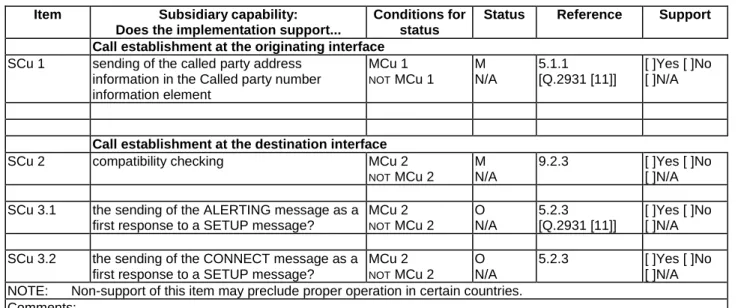
Indicating support for an item in table A.3 states that the implementation supports special cases or options within a major capability.
Table A.3: Subsidiary capabilities of the user role
Item Subsidiary capability: Does the implementation support...
Conditions for status
Status Reference Support Call establishment at the originating interface
SCu 1 sending of the called party address information in the Called party number information element
MCu 1
NOTMCu 1
M N/A
5.1.1 [Q.2931 [11]]
[ ]Yes [ ]No [ ]N/A
Call establishment at the destination interface
SCu 2 compatibility checking MCu 2
NOTMCu 2
M N/A
9.2.3 [ ]Yes [ ]No [ ]N/A SCu 3.1 the sending of the ALERTING message as a
first response to a SETUP message?
MCu 2
NOTMCu 2
O N/A
5.2.3 [Q.2931 [11]]
[ ]Yes [ ]No [ ]N/A SCu 3.2 the sending of the CONNECT message as a
first response to a SETUP message?
MCu 2
NOTMCu 2
O N/A
5.2.3 [ ]Yes [ ]No [ ]N/A NOTE: Non-support of this item may preclude proper operation in certain countries.
Comments:
A.7.3
PDUs
The tables in this subclause ask questions related to the supported PDUs in the user role. In the DSS2 protocol, PDUs are known by the term "messages".
A.7.3.1 Messages received by the user
Indicating support for an item in table A.4 states that the implementation has the ability to recognize the message listed in that item. Support for the receipt of a particular type of PDU means support for recognizing and acting upon all valid instances of that PDU type, including all valid PDU parameters, to the extent required by EN 301 487-1 [1].
Table A.4: Messages received by the user
Item Message: Does the implementation support the receipt of...
Conditions for status
Status Reference Support
MRu 1 ALERTING MCu 1
NOTMCu 1
M N/A
3.1.1, 5.1.6 [Q.2931 [11]]
[ ]Yes [ ]No [ ]N/A MRu 2 CALL PROCEEDING MCu 1
NOTMCu 1
M N/A
3.1.2, 5.1.5 [Q.2931 [11]]
[ ]Yes [ ]No [ ]N/A
MRu 3 CONNECT MCu 1
NOTMCu 1
M N/A
3.1.3, 5.1.7 [Q.2931 [11]]
[ ]Yes [ ]No [ ]N/A MRu 4 CONNECT ACKNOWLEDGE MCu 2
NOTMCu 2
M N/A
3.1.4, 5.2.7 [Q.2931 [11]]
[ ]Yes [ ]No [ ]N/A
MRu 5 NOTIFY M 3.1.10, 5.9
[Q.2931 [11]]
[ ]Yes [ ]No MRu 6 RELEASE M 3.1.5, 5.4.4, 5.4.5
[Q.2931 [11]]
[ ]Yes [ ]No MRu 7 RELEASE COMPLETE M 3.1.6, 5.1.2, 5.1.3,
5.2.5.3, 5.4.3, 5.6.3.2, 5.6.7, 5.6.8.1, 5.7.2 [Q.2931 [11]]
[ ]Yes [ ]No
MRu 8 RESTART M 3.3.1, 5.5.2
[Q.2931 [11]]
[ ]Yes [ ]No MRu 9 RESTART ACKNOWLEDGE M 3.3.2, 5.5.1
[Q.2931 [11]]
[ ]Yes [ ]No
MRu 10 SETUP MCu 2
NOTMCu 2
M N/A
3.1.7, 5.2 [Q.2931 [11]]
[ ]Yes [ ]No [ ]N/A
MRu 11 STATUS M 3.1.8, 5.6.3.2,
5.6.12 [Q.2931 [11]]
[ ]Yes [ ]No
MRu 12 STATUS ENQUIRY M 3.1.9, 5.6.3.2, 5.6.11 [Q.2931 [11]]
[ ]Yes [ ]No
A.7.3.2 Messages transmitted by the user
Indicating support for an item in table A.5 states that the implementation has the ability to transmit the message listed in that item.
Table A.5: Messages transmitted by the user
Item Message: Does the implementation support the receipt of...
Conditions for status
Status Reference Support
MTu 1 ALERTING MCu 2
NOTMCu 2
M N/A
3.1.1, 5.2.5.1 [Q.2931 [11]]
[ ]Yes [ ]No [ ]N/A MTu 2 CALL PROCEEDING MCu 2
NOTMCu 2
M N/A
3.1.2, 5.2.5.1 [Q.2931 [11]]
[ ]Yes [ ]No [ ]N/A
MTu 3 CONNECT MCu 2
NOTMCu 2
M N/A
3.1.3, 5.2.6 [Q.2931 [11]]
[ ]Yes [ ]No [ ]N/A MTu 4 CONNECT ACKNOWLEDGE MCu 1
NOTMCu 1
M N/A
3.1.4, 5.1.7 [Q.2931 [11]]
[ ]Yes [ ]No [ ]N/A
MTu 5 NOTIFY M 3.1.10, 5.9
[Q.2931 [11]]
[ ]Yes [ ]No
MTu 6 RELEASE M 3.1.5, 5.4.3
[Q.2931 [11]]
[ ]Yes [ ]No MTu 7 RELEASE COMPLETE M 3.1.6, 5.2.2.2.2,
5.2.3, 5.2.4, 5.2.5, 5.4.4 [Q.2931 [11]]
[ ]Yes [ ]No
MTu 8 RESTART M 3.3.1, 5.5.1
[Q.2931 [11]]
[ ]Yes [ ]No MTu 9 RESTART ACKNOWLEDGE M 3.3.2, 5.5.2
[Q.2931 [11]]
[ ]Yes [ ]No
MTu 10 SETUP MCu 1
NOTMCu 1
M N/A
3.1.7, 5.1 [Q.2931 [11]]
[ ]Yes [ ]No [ ]N/A
MTu 11 STATUS M 3.1.8, 5.5.2.1,
5.6.3.2, 5.6.4, 5.6.7, 5.6.8, 5.6.11, 5.7 [Q.2931 [11]]
[ ]Yes [ ]No
MTu 12 STATUS ENQUIRY M 3.1.9, 5.6.3.2, 5.6.11 [Q.2931 [11]]
[ ]Yes [ ]No
Comments:
A.7.4
PDU parameters
The tables in this subclause ask questions related to the support of PDU parameters in messages received and transmitted by the IUT in the user role. In the DSS2, protocol PDU parameters are known by the term "information elements".
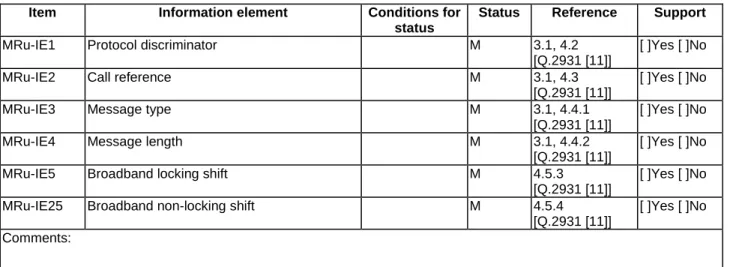
Tables A.6 and A.7 deal with the four information elements that appear in all messages that are either received or transmitted (respectively) by the IUT in the user role (Protocol discriminator, Call reference, Message type and Message length) and two information elements which may appear in a message for which it is mandatory for the receiver to interpret (shift information elements).
Table A.6: Information elements in all messages received by the user
Item Information element Conditions for status
Status Reference Support
MRu-IE1 Protocol discriminator M 3.1, 4.2 [Q.2931 [11]]
[ ]Yes [ ]No MRu-IE2 Call reference M 3.1, 4.3
[Q.2931 [11]]
[ ]Yes [ ]No MRu-IE3 Message type M 3.1, 4.4.1
[Q.2931 [11]]
[ ]Yes [ ]No MRu-IE4 Message length M 3.1, 4.4.2
[Q.2931 [11]]
[ ]Yes [ ]No MRu-IE5 Broadband locking shift M 4.5.3
[Q.2931 [11]]
[ ]Yes [ ]No MRu-IE25 Broadband non-locking shift M 4.5.4
[Q.2931 [11]]
[ ]Yes [ ]No Comments:
Table A.7: Information elements in all messages transmitted by the user
Item Information element Conditions for status
Status Reference Support
MTu-IE1 Protocol discriminator M 3.1, 3.2, 4.2 [Q.2931 [11]]
[ ]Yes [ ]No MTu-IE2 Call reference M 3.1, 3.2, 4.3
[Q.2931 [11]]
[ ]Yes [ ]No MTu-IE3 Message type M 3.1, 3.2, 4.4.1
[Q.2931 [11]]
[ ]Yes [ ]No MTu-IE4 Message length M 3.1, 3.2, 4.4.2
[Q.2931 [11]]
[ ]Yes [ ]No MTu-IE5 Broadband locking shift O 4.5.3
[Q.2931 [11]]
[ ]Yes [ ]No MTu-IE25 Broadband non-locking shift O 4.5.4
[Q.2931 [11]]
[ ]Yes [ ]No Comments:
A.7.4.1 Information elements in messages received by the user
Indicating support for an item in the tables in this subclause states that the implementation has the ability to process the information elements listed in the specified received messages.
Table A.8: Information elements in ALERTING received by the user
Item Information element Conditions for status
Status Reference Support
MRu1-IE13 Connection identifier MRu 1
NOTMRu 1
M N/A
8.2 [ ]Yes [ ]No [ ]N/A MRu1-IE20 Notification indicator MRu 1
NOTMRu 1
M N/A
3.1.1 [Q.2931 [11]]
[ ]Yes [ ]No [ ]N/A Comments:
Table A.9: Information elements in CALL PROCEEDING received by the user
Item Information element Conditions for status
Status Reference Support
MRu2-IE13 Connection identifier MRu 2
NOTMRu 2
M N/A
8.2 [ ]Yes [ ]No [ ]N/A MRu2-IE20 Notification indicator MRu 2
NOTMRu 2
M N/A
3.1.2 [Q.2931 [11]]
[ ]Yes [ ]No [ ]N/A Comments:
Table A.10: Information elements in CONNECT received by the user
Item Information element Conditions for status
Status Reference Support
MRu3-IE17 Broadband low layer information MRu 3 O 3.1.3 [Q.2931 [11]]
[ ]Yes [ ]No MRu3-IE13 Connection identifier MRu 3
NOTMRu 3
M N/A
8.2 [ ]Yes [ ]No [ ]N/A MRu3-IE19 End-to-end transit delay MRu 3
NOTMRu 3
M N/A
3.1.3 [Q.2931 [11]]
[ ]Yes [ ]No [ ]N/A MRu3-IE20 Notification indicator MRu 3
NOTMRu 3
M N/A
3.1.3 [Q.2931 [11]]
[ ]Yes [ ]No [ ]N/A MRu3-IE14 OAM traffic descriptor MRu 3
NOTMRu 3
M N/A
8.4 [ ]Yes [ ]No [ ]N/A Comments:
Table A.11: Information elements in CONNECT ACKNOWLEDGE received by the user
Item Information element Conditions for status
Status Reference Support
MRu4-IE20 Notification indicator MRu 4
NOTMRu 4
M N/A
3.1.4 [Q.2931 [11]]
[ ]Yes [ ]No [ ]N/A Comments:
Table A.12: Information elements in NOTIFY received by the user
Item Information element Conditions for status
Status Reference Support
MRu6-IE20 Notification indicator M 3.1.10 [Q.2931 [11]]
[ ]Yes [ ]No Comments:
Table A.13: Information elements in RELEASE received by the user
Item Information element Conditions for status
Status Reference Support
MRu8-IE24 Cause M 3.1.5
[Q.2931 [11]]
[ ]Yes [ ]No MRu8-IE20 Notification indicator M 3.1.5
[Q.2931 [11]]
[ ]Yes [ ]No Comments:
Table A.14: Information elements in RELEASE COMPLETE received by the user
Item Information element Conditions for status
Status Reference Support
MRu9-IE24 Cause M 3.1.6
[Q.2931 [11]]
[ ]Yes [ ]No Comments:
Table A.15: Information elements in RESTART received by the user
Item Information element Conditions for status
Status Reference Support
MRu10-IE13 Connection identifier M 8.2 [ ]Yes [ ]No MRu10-IE4 Restart indicator M 8.3 [ ]Yes [ ]No Comments:
Table A.16: Information elements in RESTART ACKNOWLEDGE received by the user
Item Information element Conditions for status
Status Reference Support
MRu11-IE13 Connection identifier M 8.2 [ ]Yes [ ]No MRu11-IE4 Restart indicator M 8.3 [ ]Yes [ ]No Comments:
Table A.17: Information elements in SETUP received by the user
Item Information element Conditions for status Status Reference Support
MRu12-IE12 ATM traffic descriptor MRu 12
NOTMRu 12
M N/A
3.1.7 [Q.2931 [11]]
[ ]Yes [ ]No [ ]N/A MRu12-IE16 Broadband bearer capability MRu 12
NOTMRu 12
M N/A
3.1.7 [Q.2931 [11]]
[ ]Yes [ ]No [ ]N/A MRu12-IE18 Broadband high layer information MRu 12
NOTMRu 12
M N/A
3.1.7 [Q.2931 [11]]
[ ]Yes [ ]No [ ]N/A MRu12-IE8 Broadband repeat indicator MCu 10ANDMRU12
NOT(MCu 10AND
MRU12)
M N/A
3.1.7, annex C [Q.2931 [11]]
[ ]Yes [ ]No [ ]N/A MRu12-IE17 Broadband low layer information MRu 12
NOTMRu 12
M N/A
3.1.7 [Q.2931 [11]]
[ ]Yes [ ]No [ ]N/A MRu12-IE1 Called party number MRu 12
NOTMRu 12
M N/A
3.1.7 [Q.2931 [11]]
[ ]Yes [ ]No [ ]N/A MRu12-IE2 Called party subaddress MRu 12
NOTMRu 12
M N/A
3.1.7 [Q.2931 [11]]
[ ]Yes [ ]No [ ]N/A MRu12-IE9 Calling party number I 3.1.7
[Q.2931 [11]]
[ ]Yes [ ]No MRu12-IE10 Calling party subaddress I 3.1.7
[Q.2931 [11]]
[ ]Yes [ ]No MRu12-IE13 Connection identifier MRu 12
NOTMRu 12
M N/A
8.2 [ ]Yes [ ]No [ ]N/A MRu12-IE19 End-to-end transit delay MRu 12
NOTMRu 12
M N/A
3.1.7 [Q.2931 [11]]
[ ]Yes [ ]No [ ]N/A MRu12-IE20 Notification indicator MRu 12
NOTMRu 12
M N/A
3.1.7 [Q.2931 [11]]
[ ]Yes [ ]No [ ]N/A MRu12-IE14 OAM traffic descriptor MRu 12
NOTMRu 12
M N/A
8.4 [ ]Yes [ ]No [ ]N/A MRu12-IE15 QOS parameter MRu 12
NOTMRu 12
M N/A
3.1.7 [Q.2931 [11]]
[ ]Yes [ ]No [ ]N/A MRu12-IE7 Broadband sending complete MRu 12
NOTMRu 12
O N/A
3.1.7 [Q.2931 [11]]
[ ]Yes [ ]No [ ]N/A MRu12-IE3 Transit network selection X [ ]Yes [ ]No Comments:
Table A.18: Information elements in STATUS received by the user
Item Information element Conditions for status
Status Reference Support
MRu14-IE21 Call state M 3.1.8 [Q.2931 [11]]
[ ]Yes [ ]No
MRu14-IE24 Cause M 8.3 [ ]Yes [ ]No
Comments:
Table A.19: Information elements in ALERTING transmitted by the user
Item Information element Conditions for status
Status Reference Support
MTu1-IE13 Connection identifier SCu 5.1
NOTSCu 5.1 M N/A
8.2 [ ]Yes [ ]No [ ]N/A MTu1-IE20 Notification indicator MTu 1
NOTMTu 1
O N/A
3.1.1 [Q.2931 [11]]
[ ]Yes [ ]No [ ]N/A Comments:
Table A.20: Information elements in CALL PROCEEDING transmitted by the user
Item Information element Conditions for status
Status Reference Support
MTu2-IE13 Connection identifier SCu 5.2
NOTSCu 5.2 M O
8.3 [ ]Yes [ ]No
MTu2-IE20 Notification indicator MTu2
NOTMTu2
O N/A
3.1.2 [Q.2931 [11]]
[ ]Yes [ ]No [ ]N/A Comments:
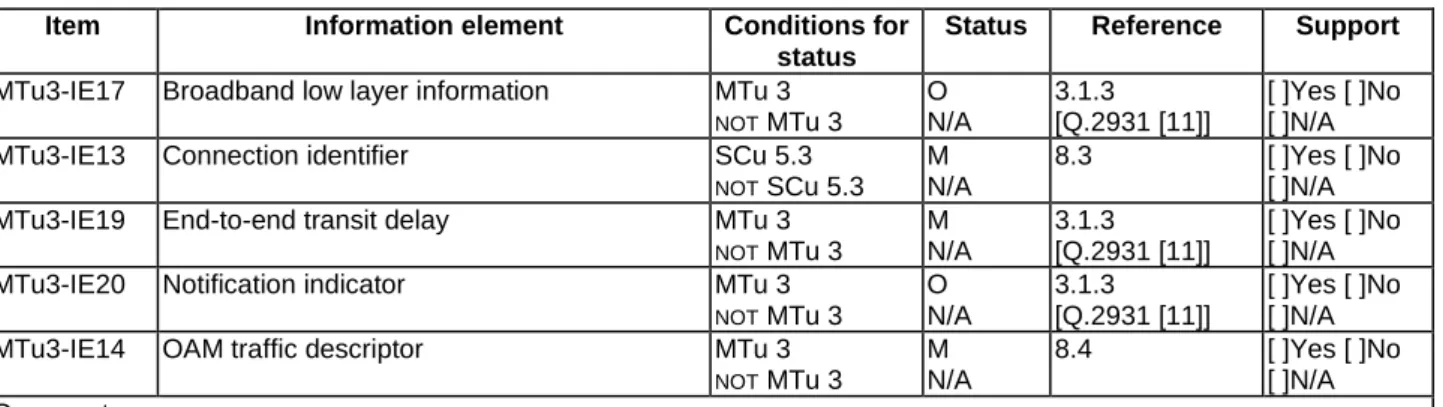
Table A.21: Information elements in CONNECT transmitted by the user
Item Information element Conditions for status
Status Reference Support
MTu3-IE17 Broadband low layer information MTu 3
NOTMTu 3
O N/A
3.1.3 [Q.2931 [11]]
[ ]Yes [ ]No [ ]N/A MTu3-IE13 Connection identifier SCu 5.3
NOTSCu 5.3 M N/A
8.3 [ ]Yes [ ]No [ ]N/A MTu3-IE19 End-to-end transit delay MTu 3
NOTMTu 3
M N/A
3.1.3 [Q.2931 [11]]
[ ]Yes [ ]No [ ]N/A MTu3-IE20 Notification indicator MTu 3
NOTMTu 3
O N/A
3.1.3 [Q.2931 [11]]
[ ]Yes [ ]No [ ]N/A MTu3-IE14 OAM traffic descriptor MTu 3
NOTMTu 3
M N/A
8.4 [ ]Yes [ ]No [ ]N/A Comments:
Table A.22: Information elements in CONNECT ACKNOWLEDGE transmitted by the user
Item Information element Conditions for status
Status Reference Support
MTu4-IE20 Notification indicator MTu 4
NOTMTu 4
O N/A
3.1.4 [Q.2931 [11]]
[ ]Yes [ ]No [ ]N/A Comments:
Table A.23: Information elements in NOTIFY transmitted by the user
Item Information element Conditions for status
Status Reference Support
MTu6-IE20 Notification indicator M 3.1.10 [Q.2931 [11]]
[ ]Yes [ ]No Comments:
Table A.24: Information elements in RELEASE transmitted by the user
Item Information element Conditions for status
Status Reference Support
MTu8-IE24 Cause M 3.1.5
[Q.2931 [11]]
[ ]Yes [ ]No MTu8-IE20 Notification indicator O 3.1.5
[Q.2931 [11]]
[ ]Yes [ ]No Comments:
Table A.25: Information elements in RELEASE COMPLETE transmitted by the user
Item Information element Conditions for status
Status Reference Support
MTu9-IE24 Cause M 3.1.6
[Q.2931 [11]]
[ ]Yes [ ]No Comments:
Table A.26: Information elements in RESTART transmitted by the user
Item Information element Conditions for status
Status Reference Support
MTu10-IE13 Connection identifier M 8.3 [ ]Yes [ ]No MTu10-IE4 Restart indicator M 3.3.1
[Q.2931 [11]]
[ ]Yes [ ]No Comments:
Table A.27: Information elements in RESTART ACKNOWLEDGE transmitted by the user
Item Information element Conditions for status
Status Reference Support
MTu11-IE13 Connection identifier M 8.3 [ ]Yes [ ]No MTu11-IE4 Restart indicator M 3.3.2
[Q.2931 [11]]
[ ]Yes [ ]No Comments:
Table A.28: Information elements in SETUP transmitted by the user
Item Information element Conditions for status
Status Reference Support
MTu12-IE12 ATM traffic descriptor MTu 12
NOTMTu 12 M N/A
3.1.7 [Q.2931 [11]]
[ ]Yes [ ]No [ ]N/A MTu12-IE16 Broadband bearer capability MTu 12
NOTMTu 12 M N/A
3.1.7 [Q.2931 [11]]
[ ]Yes [ ]No [ ]N/A MTu12-IE18 Broadband high layer information MTu 12
NOTMTu 12 O N/A
8.1 [ ]Yes [ ]No [ ]N/A MTu12-IE8 Broadband repeat indicator MCu 10AND
MTU12
NOT(MCu 10
ANDMTU12) O N/A
3.1.7, annex C [Q.2931 [11]]
[ ]Yes [ ]No [ ]N/A
MTu12-IE17 Broadband low layer information MTu 12
NOTMTu 12
O N/A
3.1.7 [Q.2931 [11]]
[ ]Yes [ ]No [ ]N/A MTu12-IE1 Called party number SCu2
NOTSCu2
O M
3.1.7 [Q.2931 [11]]
[ ]Yes [ ]No MTu12-IE2 Called party subaddress MTu 12
NOTMTu 12 O N/A
3.1.7 [Q.2931 [11]]
[ ]Yes [ ]No [ ]N/A MTu12-IE9 Calling party number MTu 12
NOTMTu 12 O N/A
3.1.7 [Q.2931 [11]]
[ ]Yes [ ]No [ ]N/A MTu12-IE10 Calling party subaddress MTu 12
NOTMTu 12 O N/A
3.1.7 [Q.2931 [11]]
[ ]Yes [ ]No [ ]N/A MTu12-IE13 Connection identifier MCu1.1
NOTMCu1.1 M O
8.2 [ ]Yes [ ]No MTu12-IE19 End-to-end transit delay MTu 12
NOTMTu 12 O N/A
3.1.7 [Q.2931 [11]]
[ ]Yes [ ]No [ ]N/A MTu12-IE20 Notification indicator MTu 12
NOTMTu 12
O N/A
3.1.7 [Q.2931 [11]]
[ ]Yes [ ]No [ ]N/A MTu12-IE14 OAM traffic descriptor MTu 12
NOTMTu 12 O N/A
8.4 [ ]Yes [ ]No [ ]N/A MTu12-IE15 QOS parameter MTu 12
NOTMTu 12 M N/A
3.1.7 [Q.2931 [11]]
[ ]Yes [ ]No [ ]N/A MTu12-IE3 Transit network selection MTu 12
NOTMTu 12 O N/A
3.1.7 [Q.2931 [11]]
[ ]Yes [ ]No [ ]N/A Comments:
Table A.29: Information elements in STATUS transmitted by the user
Item Information element Conditions for status
Status Reference Support
MTu14-IE21 Call state M 3.1.8 [Q.2931 [11]]
[ ]Yes [ ]No
MTu14-IE24 Cause M 3.1.8
[Q.2931 [11]]
[ ]Yes [ ]No Comments:
A.7.5
Timers
Indicating support for an item in table A.36 states that the implementation has a timer that operates in accordance with the description in clause 7 and with the relevant behaviour specified in clauses 5 and 6 of ITU-T
Recommendation Q.2934 [5] as modified by EN 301 487-1 [1].
The table indicates the permitted range of values for each timer. The supplier shall state the values supported by their implementation.
Table A.30: Timers in the user role
Item Timer: Does the implementation
support...
Conditions for status
Status Reference Support Values Allowed
Value Supported
TMu 1 T301 MCu 1
NOTMCu 1
O N/A
table 7-3 [Q.2931 [11]]
[ ]Yes [ ]No [ ]N/A
minim. 3 min TMu 2 T302 SCu 4
NOTSCu 4
M N/A
table 7-4 [Q.2931 [11]]
[ ]Yes [ ]No [ ]N/A
10 - 15 s TMu 3 T303 MCu 1
NOTMCu 1
M N/A
table 7-3 [Q.2931 [11]]
[ ]Yes [ ]No [ ]N/A
4 s
TMu 5 T308 M table 7-3 [Q.2931 [11]]
[ ]Yes [ ]No 30 s TMu 6 T309 M table 7-3
[Q.2931 [11]]
[ ]Yes [ ]No 10 s TMu 7 T310 MCu 1
NOTMCu 1
M N/A
table 7-3 [Q.2931 [11]]
[ ]Yes [ ]No [ ]N/A
30 - 120 s TMu 8 T313 MCu 2
NOTMCu 2
M N/A
table 7-3 [Q.2931 [11]]
[ ]Yes [ ]No [ ]N/A
4 s TMu 9 T316 M table 7-3
[Q.2931 [11]]
[ ]Yes [ ]No 120 s TMu 10 T317 M table 7-3
[Q.2931 [11]]
[ ]Yes [ ]No < T316 TMu 11 T322 M table 7-3
[Q.2931 [11]]
[ ]Yes [ ]No 4 s Comments:
A.7.6.1 Broadband locking shift
Table A.31: Broadband locking shift information element contents
Item Does the implementation support the information element field:
Status Value Support
IERu 25.1 New codeset identification M [ ]Yes [ ]No 1. Codeset 4
2. Codeset 5 3. Codeset 6 4. Codeset 7
M M M M
4 5 6 7
[ ]Yes [ ]No [ ]Yes [ ]No [ ]Yes [ ]No [ ]Yes [ ]No Comments:
A.7.6.2 Broadband non-locking shift
Table A.32: Broadband non-locking shift information element contents
Item Does the implementation support the information element field:
Status Value Support
IERu 26.1 Temporary codeset identification M [ ]Yes [ ]No 1. Codeset 0
2. Codeset 4 3. Codeset 5 4. Codeset 6 5. Codeset 7
M M M M M
0 4 5 6 7
[ ]Yes [ ]No [ ]Yes [ ]No [ ]Yes [ ]No [ ]Yes [ ]No [ ]Yes [ ]No Comments:
A.7.6.3 Void
A.7.6.4 ATM traffic descriptor
Table A.33: ATM traffic descriptor information element contents
Item Does the implementation support the information element field:
Status Value Support
IERu 12.1 Forward peak cell rate (CLP=0) Backward peak cell rate (CLP=0) Forward peak cell rate (CLP=0+1) Backward peak cell rate (CLP=0+1)
O O M M
N/A N/A N/A N/A
[ ]Yes [ ]No [ ]Yes [ ]No [ ]Yes [ ]No [ ]Yes [ ]No Comments:
A.7.6.5 Broadband bearer capability
Table A.34: Broadband bearer capability information element contents
Item Does the implementation support the information element field:
Status Value Support
IERu 16.1 Bearer class M [ ]Yes [ ]No 1. BCOB-A
2. BCOB-C 3. BCOB-X 4. Transparent VP
O O O O
1 3 16 24
[ ]Yes [ ]No [ ]Yes [ ]No [ ]Yes [ ]No [ ]Yes [ ]No IERu 16.2 Traffic type O [ ]Yes [ ]No
1. No indication 2. Constant bit rate 3. Variable bit rate
O O O
0 1 2
[ ]Yes [ ]No [ ]Yes [ ]No [ ]Yes [ ]No IERu 16.3 Timing requirements O [ ]Yes [ ]No
1. No indication
2. End-to-end timing required 3. End-to-end timing not required
O O O
0 1 2
[ ]Yes [ ]No [ ]Yes [ ]No [ ]Yes [ ]No IERu 16.4 Susceptibility to clipping M [ ]Yes [ ]No
1. Not susceptible to clipping 2. Susceptible to clipping
O O
0 1
[ ]Yes [ ]No [ ]Yes [ ]No IERu 16.5 User plane connection configuration
1. Point-to-point M 0 [ ]Yes [ ]No Comments:
A.7.6.6 Broadband high layer information
Table A.35: Broadband high layer information element contents
Item Does the implementation support the information element field:
Status Value Support
IERu 18.1 High layer information type M [ ]Yes [ ]No 1. ISO/IEC
2. User specific
3. Vendor specific application identifier
4. Reference to ITU-T SG 1 B-ISDN teleservice recommendation
O O O O
0 1 3 4
[ ]Yes [ ]No [ ]Yes [ ]No [ ]Yes [ ]No [ ]Yes [ ]No Comments:
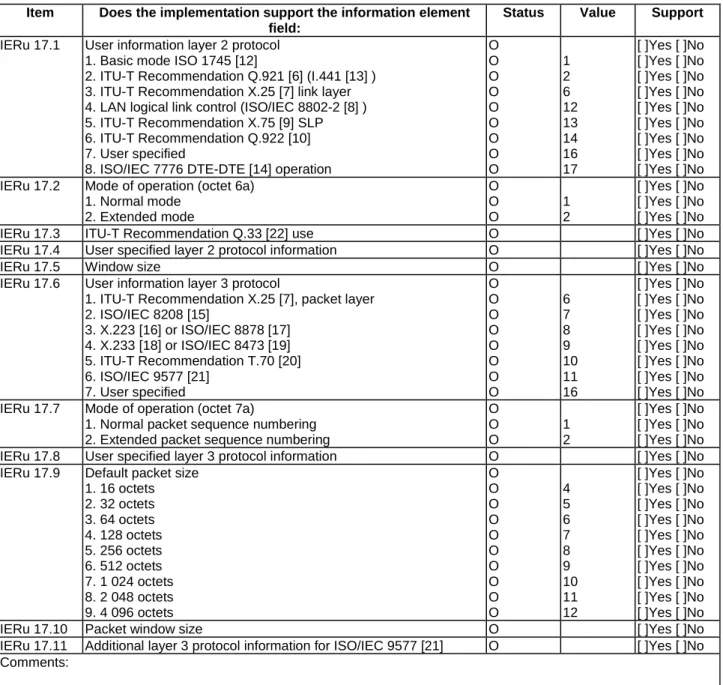
A.7.6.7 Broadband low layer information
Table A.36: Broadband low layer information element contents
Item Does the implementation support the information element field:
Status Value Support
IERu 17.1 User information layer 2 protocol O [ ]Yes [ ]No 1. Basic mode ISO 1745 [12]
2. ITU-T Recommendation Q.921 [6] (I.441 [13] ) 3. ITU-T Recommendation X.25 [7] link layer 4. LAN logical link control (ISO/IEC 8802-2 [8] ) 5. ITU-T Recommendation X.75 [9] SLP 6. ITU-T Recommendation Q.922 [10] 7. User specified
8. ISO/IEC 7776 DTE-DTE [14] operation
O O O O O O O O 1 2 6 12 13 14 16 17
[ ]Yes [ ]No [ ]Yes [ ]No [ ]Yes [ ]No [ ]Yes [ ]No [ ]Yes [ ]No [ ]Yes [ ]No [ ]Yes [ ]No [ ]Yes [ ]No IERu 17.2 Mode of operation (octet 6a) O [ ]Yes [ ]No
1. Normal mode 2. Extended mode
O O
1 2
[ ]Yes [ ]No [ ]Yes [ ]No IERu 17.3 ITU-T Recommendation Q.33 [22] use O [ ]Yes [ ]No IERu 17.4 User specified layer 2 protocol information O [ ]Yes [ ]No IERu 17.5 Window size O [ ]Yes [ ]No IERu 17.6 User information layer 3 protocol O [ ]Yes [ ]No
1. ITU-T Recommendation X.25 [7], packet layer 2. ISO/IEC 8208 [15]
3. X.223 [16] or ISO/IEC 8878 [17] 4. X.233 [18] or ISO/IEC 8473 [19] 5. ITU-T Recommendation T.70 [20] 6. ISO/IEC 9577 [21]
7. User specified
O O O O O O O 6 7 8 9 10 11 16
[ ]Yes [ ]No [ ]Yes [ ]No [ ]Yes [ ]No [ ]Yes [ ]No [ ]Yes [ ]No [ ]Yes [ ]No [ ]Yes [ ]No IERu 17.7 Mode of operation (octet 7a) O [ ]Yes [ ]No
1. Normal packet sequence numbering 2. Extended packet sequence numbering
O O
1 2
[ ]Yes [ ]No [ ]Yes [ ]No IERu 17.8 User specified layer 3 protocol information O [ ]Yes [ ]No IERu 17.9 Default packet size O [ ]Yes [ ]No
1. 16 octets 2. 32 octets 3. 64 octets 4. 128 octets 5. 256 octets 6. 512 octets 7. 1 024 octets 8. 2 048 octets 9. 4 096 octets
O O O O O O O O O 4 5 6 7 8 9 10 11 12
[ ]Yes [ ]No [ ]Yes [ ]No [ ]Yes [ ]No [ ]Yes [ ]No [ ]Yes [ ]No [ ]Yes [ ]No [ ]Yes [ ]No [ ]Yes [ ]No [ ]Yes [ ]No IERu 17.10 Packet window size O [ ]Yes [ ]No IERu 17.11 Additional layer 3 protocol information for ISO/IEC 9577 [21] O [ ]Yes [ ]No Comments:
A.7.6.8 Call state
Table A.37: Call state information element contents
Item Does the implementation support the information element field: Status Value Support
IERu 21.1 Call state value M [ ]Yes [ ]No 1. Null
2. Call initiated
3. Outgoing call proceeding 4. Call delivered
5. Call present 6. Call received 7. Connect request 8. Incoming call proceeding 9. Active
10. Release request 11. Release indication 12. Restart null 13. Restart request 14. Restart M M M M M M M M M M M M M M 0 1 3 4 6 7 8 9 10 11 12 0 61 62
[ ]Yes [ ]No [ ]Yes [ ]No [ ]Yes [ ]No [ ]Yes [ ]No [ ]Yes [ ]No [ ]Yes [ ]No [ ]Yes [ ]No [ ]Yes [ ]No [ ]Yes [ ]No [ ]Yes [ ]No [ ]Yes [ ]No [ ]Yes [ ]No [ ]Yes [ ]No [ ]Yes [ ]No Comments:
A.7.6.9 Called party number
Table A.38: Called party number information element contents
Item Does the implementation support the information element field: Status Value Support
IERu 1.1 Type of number M [ ]Yes [ ]No 1. Unknown
2. International 3. National 4. Network specific 5. Subscriber 6. Abbreviated O O O O O O 0 1 2 3 4 6
[ ]Yes [ ]No [ ]Yes [ ]No [ ]Yes [ ]No [ ]Yes [ ]No [ ]Yes [ ]No [ ]Yes [ ]No IERu 1.2 Addressing/numbering plan identification M [ ]Yes [ ]No
1. Unknown
2. ISDN numbering plan 3. NSAP addressing 4. Private numbering plan
O O O O 0 1 2 9
[ ]Yes [ ]No [ ]Yes [ ]No [ ]Yes [ ]No [ ]Yes [ ]No Comments:
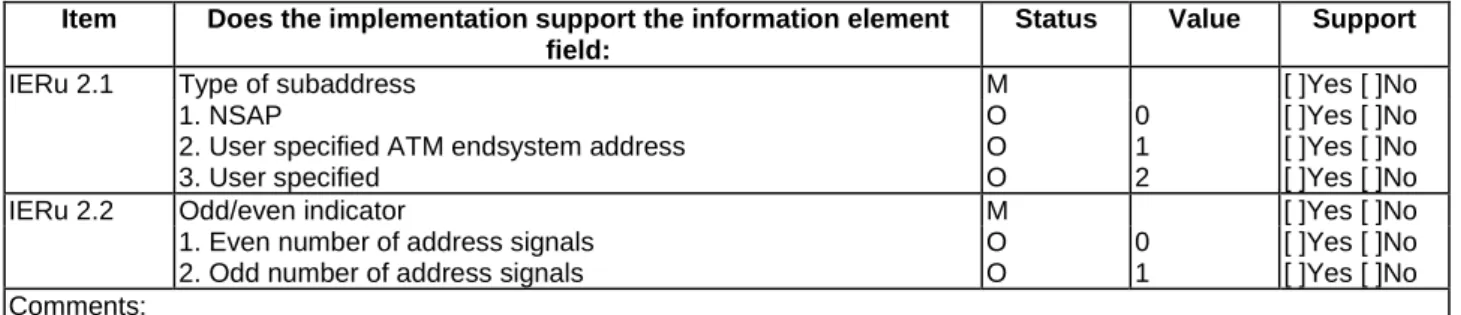
A.7.6.10 Called party subaddress
Table A.39: Called party subaddress information element contents
Item Does the implementation support the information element field:
Status Value Support
IERu 2.1 Type of subaddress M [ ]Yes [ ]No 1. NSAP
2. User specified ATM endsystem address 3. User specified
O O O 0 1 2
[ ]Yes [ ]No [ ]Yes [ ]No [ ]Yes [ ]No IERu 2.2 Odd/even indicator M [ ]Yes [ ]No
1. Even number of address signals 2. Odd number of address signals
O O
0 1
[ ]Yes [ ]No [ ]Yes [ ]No Comments:
A.7.6.11 Calling party number
Table A.40: Calling party number information element contents
Item Does the implementation support the information element field:
Status Value Support
IERu 9.1 Type of number M [ ]Yes [ ]No 1. Unknown
2. International 3. National 4. Network specific 5. Subscriber 6. Abbreviated O O O O O O 0 1 2 3 4 6
[ ]Yes [ ]No [ ]Yes [ ]No [ ]Yes [ ]No [ ]Yes [ ]No [ ]Yes [ ]No [ ]Yes [ ]No IERu 9.2 Addressing/numbering plan identification M [ ]Yes [ ]No
1. Unknown
2. ISDN numbering plan 3. NSAP addressing 4. Private numbering plan
O O O O 0 1 2 9
[ ]Yes [ ]No [ ]Yes [ ]No [ ]Yes [ ]No [ ]Yes [ ]No IERu 9.3 Presentation indicator O [ ]Yes [ ]No
1. Presentation allowed 2. Presentation restricted 3. Number not available
O O O 0 1 2
[ ]Yes [ ]No [ ]Yes [ ]No [ ]Yes [ ]No IERu 9.4 Screening indicator O [ ]Yes [ ]No
1. User provided, not screened 2. User provided, verified and passed 3. User provided, verified and failed 4. Network provided
O O O O 0 1 2 3
[ ]Yes [ ]No [ ]Yes [ ]No [ ]Yes [ ]No [ ]Yes [ ]No Comments:
A.7.6.12 Calling party subaddress
Table A.41: Calling party subaddress information element contents
Item Does the implementation support the information element field:
Status Value Support
IERu 10.1 Type of subaddress M [ ]Yes [ ]No 1. NSAP
2. User specified ATM endsystem address 3. User specified
O O O
0 1 2
[ ]Yes [ ]No [ ]Yes [ ]No [ ]Yes [ ]No IERu 10.2 Odd/even indicator M [ ]Yes [ ]No
1. Even number of address signals 2. Odd number of address signals
O O
0 1
[ ]Yes [ ]No [ ]Yes [ ]No Comments:
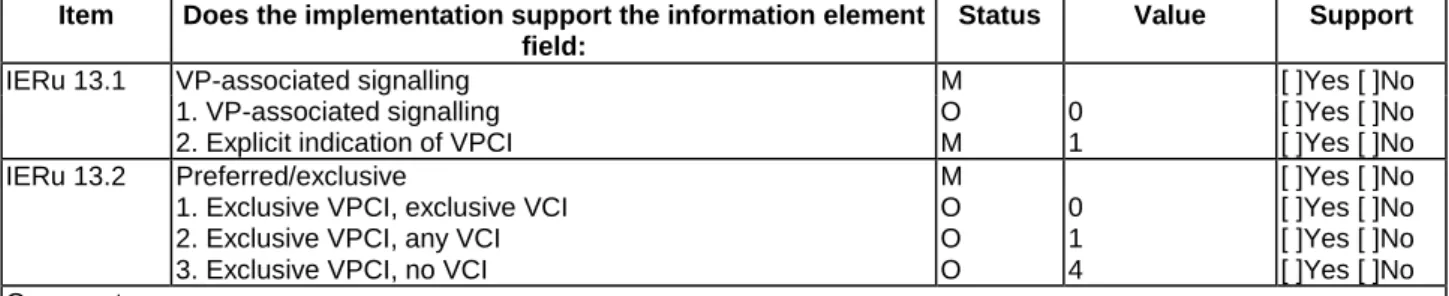
A.7.6.13 Connection identifier
Table A.42: Connection identifier information element contents
Item Does the implementation support the information element field:
Status Value Support
IERu 13.1 VP-associated signalling M [ ]Yes [ ]No 1. VP-associated signalling
2. Explicit indication of VPCI
O M
0 1
[ ]Yes [ ]No [ ]Yes [ ]No IERu 13.2 Preferred/exclusive M [ ]Yes [ ]No
1. Exclusive VPCI, exclusive VCI 2. Exclusive VPCI, any VCI 3. Exclusive VPCI, no VCI
O O O
0 1 4
[ ]Yes [ ]No [ ]Yes [ ]No [ ]Yes [ ]No Comments:
A.7.6.14 End-to-end transit delay
Table A.43: End-to-end transit delay information element contents
Item Does the implementation support the information element field:
Status Value Support
IERu 19.1 Maximum end-to-end transit delay O [ ]Yes [ ]No Comments:
A.7.6.15 Quality of service parameter
Table A.44: Quality of service parameter information element contents
Item Does the implementation support the information element field:
Status Value Support
IERu 15.1 QOS class forward M [ ]Yes [ ]No 1. Unspecified QOS class
2. Parameterized QOS
O O
0 255
[ ]Yes [ ]No [ ]Yes [ ]No IERu 15.2 QOS class backward M [ ]Yes [ ]No
1. Unspecified QOS class 2. Parameterized QOS
O O
0 255
[ ]Yes [ ]No [ ]Yes [ ]No Comments:
A.7.6.16 Restart indicator
Table A.45: Restart indicator information element contents
Item Does the implementation support the information element field:
Status Value Support
IERu 4.1 Class M [ ]Yes [ ]No
1. Indicated virtual channel O 0 [ ]Yes [ ]No 2. VP or all VCs in indicated VP controlled by the signalling VC O 1 [ ]Yes [ ]No 3. All VPs controlled by the layer 3 entity O 2 [ ]Yes [ ]No Comments:
A.7.6.17 OAM traffic descriptor
Table A.46: OAM traffic descriptor information element contents
Item Does the implementation support the information element field:
Status Value Support
IERu 14.1 Shaping indicator M [ ]Yes [ ]No 1. No user requirement
2. Aggregate shaping not allowed
O O
0 1
[ ]Yes [ ]No [ ]Yes [ ]No IERu 14.2 Compliance indicator M [ ]Yes [ ]No
1. Optional end-to-end OAM F4 flow 2. Mandatory end-to-end OAM F4 flow
O O
0 1
[ ]Yes [ ]No [ ]Yes [ ]No IERu 14.3 User-network fault management indicator M [ ]Yes [ ]No
1. No user-originated indications 2. Use of user-originated indications
O O
0 1
[ ]Yes [ ]No [ ]Yes [ ]No IERu 14.4 Forward end-to-end OAM F4 flow indicator M [ ]Yes [ ]No
1. 0 % 2. 0,1 % 3. 1 %
O O O
0 1 4
[ ]Yes [ ]No [ ]Yes [ ]No [ ]Yes [ ]No IERu 14.5 Backward end-to-end OAM F4 flow indicator M [ ]Yes [ ]No
1. 0 % 2. 0,1 % 3. 1 %
O O O
0 1 4
[ ]Yes [ ]No [ ]Yes [ ]No [ ]Yes [ ]No Comments:
A.7.7
Structure of information elements transmitted
These tables are to be completed in order to evaluate the likelihood of successful interoperation of two implementations. The answers supplied are not used for conformance testing.
A.7.7.1 Broadband locking shift
Table A.47: Broadband locking shift information element contents
Item Does the implementation support the information element field:
Status Value Support
IETu 25.1 New codeset identification [ ]Yes [ ]No 1. Codeset 4
2. Codeset 5 3. Codeset 6 4. Codeset 7
M M M M
4 5 6 7
[ ]Yes [ ]No [ ]Yes [ ]No [ ]Yes [ ]No [ ]Yes [ ]No Comments:
A.7.7.2 Broadband non-locking shift
Table A.48: Broadband non-locking shift information element contents
Item Does the implementation support the information element field:
Status Value Support
IETu 26.1 Temporary codeset identification [ ]Yes [ ]No 1. Codeset 0
2. Codeset 4 3. Codeset 5 4. Codeset 6 5. Codeset 7
M M M M M
0 4 5 6 7
[ ]Yes [ ]No [ ]Yes [ ]No [ ]Yes [ ]No [ ]Yes [ ]No [ ]Yes [ ]No Comments:
A.7.7.3 Void
A.7.7.4 ATM traffic descriptor
Table A.49: ATM traffic descriptor information element contents
Item Does the implementation support the information element field:
Status Value Support
IETu 12.1 Forward peak cell rate (CLP=0) Backward peak cell rate (CLP=0) Forward peak cell rate (CLP=0+1) Backward peak cell rate (CLP=0+1)
O O M M
N/A N/A N/A N/A
[ ]Yes [ ]No [ ]Yes [ ]No [ ]Yes [ ]No [ ]Yes [ ]No Comments:
A.7.7.5 Broadband bearer capability
Table A.50: Broadband bearer capability information element contents
Item Does the implementation support the information element field:
Status Value Support
IETu 16.1 Bearer class M [ ]Yes [ ]No 1. BCOB-A
2. BCOB-C 3. BCOB-X 4. Transparent VP
O O O O
1 3 16 24
[ ]Yes [ ]No [ ]Yes [ ]No [ ]Yes [ ]No [ ]Yes [ ]No IETu 16.2 Traffic type O [ ]Yes [ ]No
1. No indication 2. Constant bit rate 3. Variable bit rate
O O O
0 1 2
[ ]Yes [ ]No [ ]Yes [ ]No [ ]Yes [ ]No IETu 16.3 Timing requirements O [ ]Yes [ ]No
1. No indication
2. End-to-end timing required 3. End-to-end timing not required
O O O
0 1 2
[ ]Yes [ ]No [ ]Yes [ ]No [ ]Yes [ ]No IETu 16.4 Susceptibility to clipping M [ ]Yes [ ]No
1. Not susceptible to clipping 2. Susceptible to clipping
O O
0 1
[ ]Yes [ ]No [ ]Yes [ ]No IETu 16.5 User plane connection configuration M [ ]Yes [ ]No 1. Point-to-point O 0 [ ]Yes [ ]No Comments:
A.7.7.6 Broadband high layer information
Table A.51: Broadband high layer information element contents
Item Does the implementation support the information element field:
Status Value Support
IETu 18.1 High layer information type M [ ]Yes [ ]No 1. ISO/IEC
2. User specific
3. Vendor specific application identifier
4. Reference to ITU-T SG 1 B-ISDN teleservice recommendation
O O O O
0 1 3 4
[ ]Yes [ ]No [ ]Yes [ ]No [ ]Yes [ ]No [ ]Yes [ ]No Comments:
A.7.7.7 Broadband low layer information
Table A.52: Broadband low layer information element contents
Item Does the implementation support the information element field: Status Value Support
IETu 17.1 User information layer 2 protocol O [ ]Yes [ ]No 1. Basic mode ISO 1745 [12]
2. ITU-T Recommendation Q.921 [6] (I.441 [13] ) 3. ITU-T Recommendation X.25 [7] link layer 4. LAN logical link control (ISO/IEC 8802-2 [8] ) 5. ITU-T Recommendation X.75 [9] SLP 6. ITU-T Recommendation Q.922 [10] 7. User specified
8. ISO/IEC 7776 DTE-DTE [14] operation
O O O O O O O O 1 2 6 12 13 14 16 17
[ ]Yes [ ]No [ ]Yes [ ]No [ ]Yes [ ]No [ ]Yes [ ]No [ ]Yes [ ]No [ ]Yes [ ]No [ ]Yes [ ]No IETu 17.2 Mode of operation (octet 6a) O [ ]Yes [ ]No
1. Normal mode 2. Extended mode
O O
1 2
[ ]Yes [ ]No [ ]Yes [ ]No IETu 17.3 ITU-T Recommendation Q.33 [22] use O [ ]Yes [ ]No IETu 17.4 User specified layer 2 protocol information O [ ]Yes [ ]No IETu 17.5 Window size O [ ]Yes [ ]No IETu 17.6 User information layer 3 protocol O [ ]Yes [ ]No
1. ITU-T Recommendation X.25 [7], packet layer 2. ISO/IEC 8208 [15]
3. X.223 [16] or ISO/IEC 8878 [17] 4. X.233 [18] or ISO/IEC 8473 [19] 5. ITU-T Recommendation T.70 [20] 6. ISO/IEC 9577 [21]
7. User specified
O O O O O O O 6 7 8 9 10 11 16
[ ]Yes [ ]No [ ]Yes [ ]No [ ]Yes [ ]No [ ]Yes [ ]No [ ]Yes [ ]No [ ]Yes [ ]No [ ]Yes [ ]No IETu 17.7 Mode of operation (octet 7a) O [ ]Yes [ ]No
1. Normal packet sequence numbering 2. Extended packet sequence numbering
O O
1 2
[ ]Yes [ ]No [ ]Yes [ ]No IETu 17.8 User specified layer 3 protocol information O [ ]Yes [ ]No IETu 17.9 Default packet size O [ ]Yes [ ]No
1. 16 octets 2. 32 octets 3. 64 octets 4. 128 octets 5. 256 octets 6. 512 octets 7. 1 024 octets 8. 2 048 octets 9. 4 096 octets
O O O O O O O O O 4 5 6 7 8 9 10 11 12
[ ]Yes [ ]No [ ]Yes [ ]No [ ]Yes [ ]No [ ]Yes [ ]No [ ]Yes [ ]No [ ]Yes [ ]No [ ]Yes [ ]No [ ]Yes [ ]No [ ]Yes [ ]No IETu 17.10 Packet window size O [ ]Yes [ ]No IETu 17.11 Additional layer 3 protocol information for ISO/IEC 9577 [21] O [ ]Yes [ ]No Comments:
A.7.7.8 Call state
Table A.53: Call state information element contents
Item Does the implementation support the information element field:
Status Value Support
IETu 21.1 Call state value M [ ]Yes [ ]No 1. Null
2. Call initiated
3. Outgoing call proceeding 4. Call delivered
5. Call present 6. Call received 7. Connect request 8. Incoming call proceeding 9. Active
10. Release request 11. Release indication 12. Restart null 13. Restart request 14. Restart M M M M M M M M M M M M M M 0 1 3 4 6 7 8 9 10 11 12 0 61 62
[ ]Yes [ ]No [ ]Yes [ ]No [ ]Yes [ ]No [ ]Yes [ ]No [ ]Yes [ ]No [ ]Yes [ ]No [ ]Yes [ ]No [ ]Yes [ ]No [ ]Yes [ ]No [ ]Yes [ ]No [ ]Yes [ ]No [ ]Yes [ ]No [ ]Yes [ ]No [ ]Yes [ ]No Comments:
A.7.7.9 Called party number
Table A.54: Called party number information element contents
Item Does the implementation support the information element field:
Status Value Support
IETu 1.1 Type of number M [ ]Yes [ ]No 1. Unknown
2. International 3. National 4. Network specific 5. Subscriber 6. Abbreviated O O O O O O 0 1 2 3 4 6
[ ]Yes [ ]No [ ]Yes [ ]No [ ]Yes [ ]No [ ]Yes [ ]No [ ]Yes [ ]No [ ]Yes [ ]No IETu 1.2 Addressing/numbering plan identification M [ ]Yes [ ]No
1. Unknown
2. ISDN numbering plan 3. NSAP addressing 4. Private numbering plan
O O O O 0 1 2 9
[ ]Yes [ ]No [ ]Yes [ ]No [ ]Yes [ ]No [ ]Yes [ ]No Comments:
A.7.7.10 Called party subaddress
Table A.55: Called party subaddress information element contents
Item Does the implementation support the information element field:
Status Value Support
IETu 2.1 Type of subaddress M [ ]Yes [ ]No 1. NSAP
2. User specified ATM endsystem address 3. User specified
O O O 0 1 2
[ ]Yes [ ]No [ ]Yes [ ]No [ ]Yes [ ]No
Comments:
A.7.7.11 Calling party number
Table A.56: Calling party number information element contents
Item Does the implementation support the information element field:
Status Value Support
IETu 9.1 Type of number M [ ]Yes [ ]No 1. Unknown
2. International 3. National 4. Network specific 5. Subscriber 6. Abbreviated O O O O O O 0 1 2 3 4 6
[ ]Yes [ ]No [ ]Yes [ ]No [ ]Yes [ ]No [ ]Yes [ ]No [ ]Yes [ ]No [ ]Yes [ ]No IETu 9.2 Addressing/numbering plan identification M [ ]Yes [ ]No
1. Unknown
2. ISDN numbering plan 3. NSAP addressing 4. Private numbering plan
O O O O 0 1 2 9
[ ]Yes [ ]No [ ]Yes [ ]No [ ]Yes [ ]No [ ]Yes [ ]No IETu 9.3 Presentation indicator O [ ]Yes [ ]No
1. Presentation allowed 2. Presentation restricted 3. Number not available
O O O 0 1 2
[ ]Yes [ ]No [ ]Yes [ ]No [ ]Yes [ ]No IETu 9.4 Screening indicator O [ ]Yes [ ]No
1. User provided, not screened 2. User provided, verified and passed 3. User provided, verified and failed 4. Network provided
O O O O 0 1 2 3
[ ]Yes [ ]No [ ]Yes [ ]No [ ]Yes [ ]No [ ]Yes [ ]No Comments: