A Performance Analysis of Face Recognition Based on
Artificial Neural Network
Abrham Debasu Mengistu*
Dr.Vuda Sreenivasarao**
M.Sc. (Computer Science) Professor
School of Computing and Electrical Engineering School of Computing and Electrical Engineering
IOT, Bahir Dar University IOT, Bahir Dar University
Ethiopia Ethiopia, INDIA
Abstract: Face recognition is bearing in mind and recognizing a face of individual, like a visual pattern recognition that enables the system to verify or identify individual faces that is taken from imaging system. In this paper we tried to show that a face recognition that uses a tanh activation function would have a better or lower mean squared error instead of using the Logistic Sigmoid activation function. The network was trained several times on different ideal input and noisy images that are taken from imaging devices like camera. In this case training a network on different sets of noisy images forced the network to learn how to deal with noise image by using a tanh activation function.
Keywords: Face recognition, Logistic Sigmoid activation function and tanh function.
I.INTRODUCTION:
A. Face Recognition:
Human beings have recognition capabilities that are unparalleled in the modern computing area these are mainly due to high degree of interconnectivity, adaptive nature learning skill and generalization capacities of nervous system. The human brain has numerous highly interconnected biological neurons therefore the main idea is a system that can emulate what human beings can do. Face recognition is a part of visual pattern recognition technology which is used for identifying or verifying a person that is taken from a digital image or a video automatically. Face recognition has always been a very challenging task for the researches its applications may be very useful for personal verification and recognition. It is typically used in security systems like biometrics such as fingerprint, eye iris recognition systems, facial patterns and others although we can find many other identification and verification techniques, the main motivation for face recognition is because it is considered as a passive, no intrusive system to verify and identify people.
The way to carry out face recognition is to look at the major features of the face that is taken from digital image or video and compare these features to the same features on other faces. For example, the image that is taken from digital image or video then the face recognition system may analyze the relative position, size, and/or shape of the eyes, nose, lip, jaw and others
these features are used to search for other images with matching features.
Face recognition starts from the moment that machine started to become more and more intelligent or help the lack of human abilities and senses. Darwin includes analysis of the different facial expressions due to different emotional states for instance sadness or happiness of a person, where as Galton studied facial profiles. The first real attempts regarding to face recognition is to develop semi-automated facial recognition systems began in the late 1960’s and early 1970’s, based on geometrical information and the features were placed on photographs locating the major facial features, such as eyes, ears, noses, and mouth. After placing feature on photographs relative distances and angles were computed from the located features on the photograph to a common reference point and compared to reference data therefore the first stages of facial recognition focused on the automatic detection of individual facial features.
similar to those performed by the human brain for example recognizing some ones at the first sight.
II. ARTIFICIAL NEURAL NETWORKS:
Computer plays an important role in day to day’s life and in the society. With the enhancing technology, human being becomes more and more affected with computers as the leader of this technological age. Technological revolution has taken place all over the world based on this enhancement. Computer vision plays a vital role in our life for the purpose of security of the systems. The problem in face recognition is to find the best match of an unknown image against a database of face models or to determine whether it does not match any of them well. An artificial neural network is to be designed and trained to recognize the persons of the database that is taken from imaging system however, the imaging system is not perfect and the faces may suffer from noise i.e. if the imaging system is at a fixed distance the image is clear but when the distance is varied the image became more and more noise due to this problem it is difficult to recognize the image that is taken from the imaging system.
When the image is suffered from noise it is difficult to recognize the person.
In this paper is to design a system that is a capable of recognize and identify noisy individual faceswhich consisting of a large set of images of different people.
III. PRESENT SYSTEM:
The authors state that they used a back propagation with both adaptive learning rate and momentum.Back propagation, which is frequently used in Neural Network training, often takes a great deal of time to converge on an acceptable solution. Momentum is a standard technique that is used to speed up convergence and maintain generalization performance.
The back propagation technique is used as a means of reducing error in the network’s classification, by initially calculating this error and the propagating it back through the network for reduction. Inputs are propagated to the first layer of hidden units, whose output is calculated and propagated to the next hidden
reached. Each output layer unit calculates the activation, from the sum of weighted inputs from previous layers. The error on the initial output is computed and propagated back to the first hidden layer, where the weight matrix is updated. This process is repeated until the error is minimized as far as possible. The back propagation learning technique can use the Logistic Sigmoid activation function or the tanh activation function at each classification unit. The logistic sigmoid activation function is mathematically defined by the following function:
=1 +1
Where Y is activation function. It was decided that the Logistic Sigmoid would be a suitable activation function because of it is easier to implement and modify the logistic sigmoid function.
The aim is to train the network to achieve a balance between the ability to respond correctly to the input patterns that are used for training and the ability to provide good response to the input that are similar
IV. BACK PROPAGATION ALGORITHM:
As in the case with most neural networks, the aim
is to train the network to achieve a balance
between the network’s ability to respond and the
ability to give a reasonable response to the input
that is similar, but not identical to the one used in
the training.
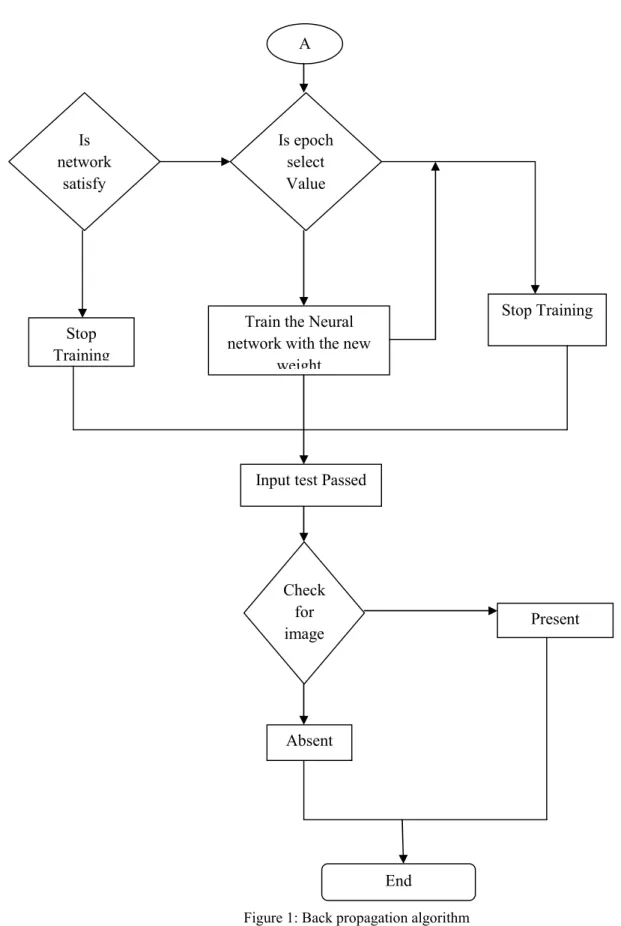
During feed forward, each input neuron receives an
input a signal and broad casts it to the each hidden
neuron, which in turn computes the activation and
passes it on to its output unit, which again
computes the activation to obtain the net output.
Start
Read an image
Select a parameter for the
neural network
Figure 1: Back propagation algorithm
A. Neuron Model:
A
Is epoch
select
Value
Is
network
satisfy
Stop
Training
Train the Neural
network with the new
weight
Stop Training
Input test Passed
Check
for
image
Present
Absent
∑
The neuron model that they applied is a three-layer
log sigmoid/log sigmoid network i.e. input layer,
hidden layer and output layer are used. The
log-sigmoid transfer function was picked because its
output range (0 to1) is perfect for learning to
outputBoolean values.The nodes of the input layer
are passive, meaning they do not modify the data.
They receive a single value on their input, and
duplicate the value totheir multiple outputs. On the
other hand, the nodes of the hidden and output
layer are active. This means they modify the data.
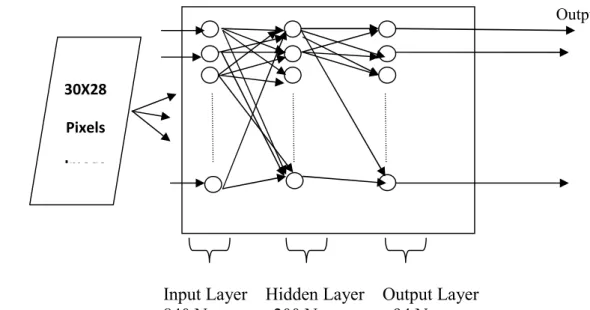
As shown in the figure below the image 32*30
passes to the input layer as it is to hidden and
output layer the node in the hidden and output
layer will process the data and produce either 0 or
1
Output
Input
Input Layer Hidden Layer Output Layer
840 Neurons 200 Neurons 94 Neurons
Figure 2: Neuron Model
The neural network needs 960 inputs and 94
neurons in its output layer to identify the faces. The
hidden layer has 200 neurons .This number was
picked by guesswork and experience. If the
network has trouble of learning capabilities, then
neurons can be added to this layer. Each value
from the input layer is duplicated and sent to all of
the hidden nodes. This is called a fully
interconnected structure. As shown in the above
figure, the values entering a hidden node are
multiplied by weights, a set of predetermined
numbers stored in the program. The weighted
inputs are then added to produce a single number.
Before leaving the node, this number is passed
through a nonlinear mathematical function called a
sigmoid. This is an "s" shaped curve that limits the
node's output. That is, the input to the sigmoid is a
value between -∞ and +∞, while its output can only
be between 0 and 1.
X1
Sum Sigmoid
X2
X3
X4
Figure 3: Sigmoid transfer function
V.
TRAINING:30X28
Pixels
Image
X1w4
X2w4
X3w4
After preparing all the things the network is ready
to be trained. To start this process the initial
weights are chosen randomly. Then, the training, or
learning, begins.To create a neural network thatcan
handle noisyinputimages itisbesttotrain the network
on both ideal and noisy images. In order todothis
the networkwill first be trained onideal images
until it has a low sum-squarederror. Thenthe
network will be trained on 10setsof idealand
noisyimages. The network is trained on two copies
of the noise free images at the sametime as
itistrained on noisyimages. The two copies of the
noise free images are usedtomaintainthe network’s
ability to classify ideal input images.Therefore, the
networkwill againbetrainedonjust ideal images.
This ensures that the network will respond
perfectly when presented with an ideal face.
Alltraining isdone using back propagation with
both adaptive learning rateand momentum.
A. Training without noise:
The networkwillinitially betrainedonjust ideal
images or without noisy image that is taken form
an imaging system for a maximum of 10,000
epochs or until the network sum-squared error
fallsbelow 0.1. Before the network has been trained
withnoise itmakes sense to train itwithoutnoise this
is
because
of
once
more
toensure
thatidealinputimages are always classified
correctly.
B. Training with noise:
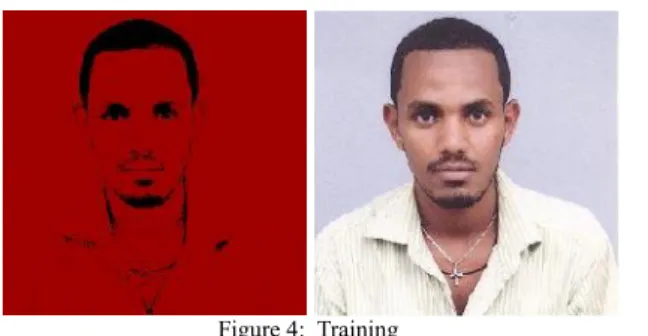
In order to train the network we tried to train with
two idealcopies and two noisycopies of the images.
Thisforces the neurons of network to learn how to
properly identify noisy faces
Figure 4: Training
VI.PROPOSED SYSTEM:
Back propagation with both adaptive learning rate and momentum uses gradient based methods and this method are one of the most widely used error minimization methods used to train back propagation networks. The back propagation algorithm has been the most popular and most widely implemented for training these types of neural network. even though the general success of back propagation network in the learning process. Several major deficiencies are still needed to be solved. The convergence rate of back propagation is very low. This is highly because the designer is required to arbitrarily select parameter such as the network topology, initial weights and biases, a learning rate value, the activation function, and a value for the gain in the activation function before the training. Improper selection of any of these parameters can result in slow convergence or even network paralysis where the training process comes to a virtual standstill. Another weakness is that the back propagation learning technique can use the Logistic Sigmoid activation function or the tanh activation function at each classification unit. It was decided that the Logistic Sigmoid would be a suitable activation function because of it is easier to implement and modify the logistic sigmoid function.The logistic sigmoid activation function is mathematically defined by the following function:
=
1
1 +
Where Y is the activation function.
The tanh function is an alternative for the activation function, and ismathematically defined by the following:
tanh( ) =
−
/ +
Where tanh(X) is the activation function.
The tanh function has a greater range than the Logistic Sigmoid. In terms of real numbers, this range is equivalent to double that of the Sigmoid, or [-1, +1]. The range of the Sigmoid function is [0, 1]. Therefore, the tanh function is far more sensitive to a change in
learning rate, which also ensures that weight changes have a greater range. The two functions are compared to one another.
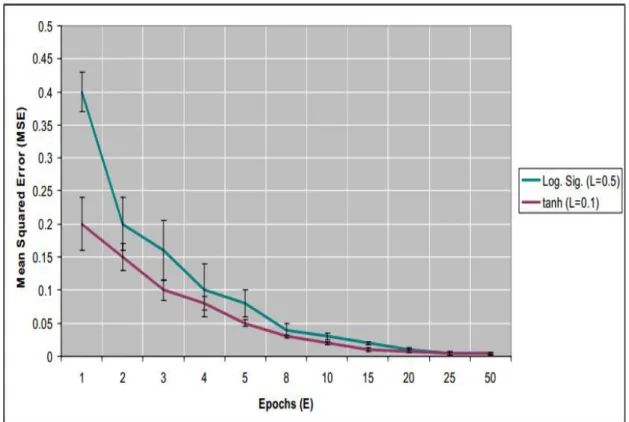
Figure 5: Logistic Sigmoid VS Tanh activation function
As shown in the graph above i.e. Figure 6 after approximately 20 epochs, the two functions converge and give similar results. But as epochs increased to 50 the tanh activation function is more accurate than the Logistic Sigmoid activation function. The activation functions that is used analyzing a neural network trained in back propagation as showed in fig 6 that the tanh
function would probably yield more accurate results than the Logistic Sigmoid function i.e. after 50 epochs the mean square error for the function tanh is 0.1 but when we see the Logistic Sigmoid it is 0.5 therefore if they used the tanh instead of using logistic sigmoid function they can achieve a better result.
Table 1: Recognition Rate for logistic sigmoid activation function and Tanh activation function.
VIII.CONCLUSION:
Face recognition is a technology just reaching sufficient maturity for it to experience a rapid growth in its practical applications. Much research effort around the world is being applied to expanding the accuracy and capabilities of this biometric domain, with a consequent broadening of it s application in the near future. we have
designed by artificial neural network with a low mean squared error. The network was trained several times on various input ideal and noisy images of faces. In this case training a network on different sets of noisy images forced the network to learn how to deal with noise a common problem in the real world.
IX.REFERENCES: Architecture of Neural
network
Training and
Testing trainingTime of
Recognition Rate Logistic Sigmoid activation
function Tanh activation function Image
without Noise
Image with
noise Image withoutnoise Image withnoise
Artificial Neural Network Web Faces 1 hr56 min
[1] Henry A. Rowley, ShumeetBaluja, and Takeo Kanade. Neural Network-Based Face Detection (PAMI, January 1998) [2] Omaima N. A. AL-Allaf, AbdelfatahArefTamimi, Mohammad A. Alia. “Face recognition System Based on Different Artificial Neural Networks Models and Training Algorithms , International Journal of Advanced Computer Science and Applications, Vol. 4, No. 6, 2013
[3] A. S. Tolba, A.H. El-Baz, and A.A. El-Harby. Face Recognition: A Literature Review, International Journal of Information and Communication Engineering 2:2 2006 [4] Face recognition home page:http://www.face-rec.org/
[5] Dr. Peter Tino. Analyzing a Neural network trained by back propagation. School of Computer Science. The University of Birmingham
[6] Md. Iqbal Quraishi, J Pal Choudhury , MallikaDe.Image Recognition and Processing Using Artificial Neural Network [7] AdjoudjRéda, DrBoukelifAoued. Artificial Neural Network-Based Face Recognition
X.AUTHORS BIBLIOGRAPHY:
Abrham Debasu Mengistureceived his B.Sc. Degree in Computer Science from Bahir Dar University.Currently perusing M.Sc. in Computer Science, School of Computing and Electrical Engineering, IOT, Bahir Dar University, Ethiopia. His main research interest is Image processing and robotics in ANN.
Dr. Vuda Sreenivasaraoreceived his M.Tech degree in computer science and engineering from Sathyabama University from 2007.He received PhD degree in computer science and engineering from Singhania University, Rajasthan, India from 2010. Currently working as Professor in School of Computing and Electrical Engineering, IOT, Bahir Dar University, Ethiopia. His main research interests are Data mining, Fuzzy logic, Mobile communication and Network Security. He has got 13 years of teaching experience. He has published 35 research papers in various international journals and one Springer international conference paper. He has 115 Editorial Board / Reviewers memberships in various international journals. He is a life member of various professional societies like IEEE, ACM, MAIRCC, MCSI, SMIACSIT, MIAENG, MCSTA, MAPSMS, MSDIWC, SMSCIEI, SNMUACEE and MISTE.
[1] Henry A. Rowley, ShumeetBaluja, and Takeo Kanade. Neural Network-Based Face Detection (PAMI, January 1998) [2] Omaima N. A. AL-Allaf, AbdelfatahArefTamimi, Mohammad A. Alia. “Face recognition System Based on Different Artificial Neural Networks Models and Training Algorithms , International Journal of Advanced Computer Science and Applications, Vol. 4, No. 6, 2013
[3] A. S. Tolba, A.H. El-Baz, and A.A. El-Harby. Face Recognition: A Literature Review, International Journal of Information and Communication Engineering 2:2 2006 [4] Face recognition home page:http://www.face-rec.org/
[5] Dr. Peter Tino. Analyzing a Neural network trained by back propagation. School of Computer Science. The University of Birmingham
[6] Md. Iqbal Quraishi, J Pal Choudhury , MallikaDe.Image Recognition and Processing Using Artificial Neural Network [7] AdjoudjRéda, DrBoukelifAoued. Artificial Neural Network-Based Face Recognition
X.AUTHORS BIBLIOGRAPHY:
Abrham Debasu Mengistureceived his B.Sc. Degree in Computer Science from Bahir Dar University.Currently perusing M.Sc. in Computer Science, School of Computing and Electrical Engineering, IOT, Bahir Dar University, Ethiopia. His main research interest is Image processing and robotics in ANN.
Dr. Vuda Sreenivasaraoreceived his M.Tech degree in computer science and engineering from Sathyabama University from 2007.He received PhD degree in computer science and engineering from Singhania University, Rajasthan, India from 2010. Currently working as Professor in School of Computing and Electrical Engineering, IOT, Bahir Dar University, Ethiopia. His main research interests are Data mining, Fuzzy logic, Mobile communication and Network Security. He has got 13 years of teaching experience. He has published 35 research papers in various international journals and one Springer international conference paper. He has 115 Editorial Board / Reviewers memberships in various international journals. He is a life member of various professional societies like IEEE, ACM, MAIRCC, MCSI, SMIACSIT, MIAENG, MCSTA, MAPSMS, MSDIWC, SMSCIEI, SNMUACEE and MISTE.
[1] Henry A. Rowley, ShumeetBaluja, and Takeo Kanade. Neural Network-Based Face Detection (PAMI, January 1998) [2] Omaima N. A. AL-Allaf, AbdelfatahArefTamimi, Mohammad A. Alia. “Face recognition System Based on Different Artificial Neural Networks Models and Training Algorithms , International Journal of Advanced Computer Science and Applications, Vol. 4, No. 6, 2013
[3] A. S. Tolba, A.H. El-Baz, and A.A. El-Harby. Face Recognition: A Literature Review, International Journal of Information and Communication Engineering 2:2 2006 [4] Face recognition home page:http://www.face-rec.org/
[5] Dr. Peter Tino. Analyzing a Neural network trained by back propagation. School of Computer Science. The University of Birmingham
[6] Md. Iqbal Quraishi, J Pal Choudhury , MallikaDe.Image Recognition and Processing Using Artificial Neural Network [7] AdjoudjRéda, DrBoukelifAoued. Artificial Neural Network-Based Face Recognition
X.AUTHORS BIBLIOGRAPHY:
Abrham Debasu Mengistu received his B.Sc. Degree in Computer Science from Bahir Dar University.Currently perusing M.Sc. in Computer Science, School of Computing and Electrical Engineering, IOT, Bahir Dar University, Ethiopia. His main research interest is Image processing and robotics in ANN.