118 International Journal of Communication Networks and Information Security (IJCNIS) Vol. 6, No. 2, August 2014
Overhead-controlled contention-based routing for
VANETs
Hooman Sadeghian
1, Ali Farahani
1and Maghsoud Abbaspour
11Dept. of Computer Engineering, Faculty of Electrical and Computer Engineering, Shahid Beheshti University, Tehran, Iran
Abstract: Routing of VANETs is a challenging issue that has
attracted many attentions of researchers recently. Contention based routing protocols have good congruity with high mobility of nodes in this kind of networks. Prevention from forwarding duplicate packets is an important challenge in such routing protocols. Indeed, such duplications can reduce scalability and efficiency of contention based routing protocols. On the other hand, the prevention method can affect advantages of such routing protocols. In this paper, we proposed 2 new routing protocols by adding 2 new methods to an existing contention based routing protocol to decrease overhead of duplications. Simulation results show that overhead decreases significantly while preserving end-to-end delay and delivery ratio in suitable values.
Keywords: VANET, routing, overhead-controlled,
contention-based, suppression mechanism.
1.
Introduction
Cheap, high-performance and reliable networks can supply human need for improving communication technology. Growth in population has been causing increasing vehicles’ mobility on the roads. This traffic on the roads can be a potential carrier for data packets. Nowadays, people expend a lot of time in heavy traffics in large cities in vehicles. This also indicates the importance of availability of a suitable and cheap or even free of charge network between vehicles. Such network can be used for many different applications like enhancing traffic safety [1], gamming or even providing some chargeable services like providing parking reservation [2] or needed information during intra-city transportation. Vehicular Ad hoc Networks (VANETs) are networks that can supply this need. In VANET, just like other kind of networks, routing is a major issue. In this paper, two routing protocols for this kind of networks have been proposed. Since contention based routing protocols have good congruity with high mobility in VANET [3], the proposed protocols are also from this type. In this type of protocols, duplicate forwarding is a challenge that must be controlled. Suppression mechanisms can be used to solve this problem. Three suppression mechanisms have been presented in [3] to prevent duplication, namely basic suppression, area-based suppression and active selection suppression.
In basic suppression, duplication can occur yet, because of longer distance than transmission range, between 2 neighbors of current forwarder, obstacle between them especially in city environment, or even too near timers of neighbors that causes neighbors haven’t enough time for preventing from duplicate forwarding. Wireless link failure is another reason of duplication in basic suppression. Duplication can cause more traffic and consequently more and more delay in data link layer. On the other hand duplication can help to find efficient and reliable route by means of redundancy
especially in sparse environment. In area-based suppression also duplications can occur because of obstacles between neighbors and too close timers of neighbors. Another problem of this mechanism in VANET comes from limitation of vehicles’ movements along the roads which can cause empty area of vehicles in some directions. Therefore, restriction on positions of candidates of next hop increases probability of forwarding failure. On the other hand, deceasing number of duplications in this mechanism can reduce congestion and therefore can decline delays.
Finally in active selection, duplication can occur in a few situations in which current forwarder doesn’t receive next hop’s forwarding packet and therefore it supposes that the packet was dropped and therefore resends it. Other kinds of duplication can be prevented by this mechanism. One of the problems of this mechanism is that two control messages (RTS and CTS) must be transmitted, before each data packet forwarding. This can increase delays and also intensifies the effects of wireless links’ failures on transmissions (RTS and CTS messages are also at risk of being affected by wireless links’ failures). In addition, since nodes in VANETs have high mobility and also because of wireless link failures, selected next hop may not receive the packet and therefore retransmission will be necessary in such situations.
Totally, CBF1 with basic suppression is a suitable routing for VANETs. It has suitable end-to-end delay [3] and delivery ratio [3], [4]. Main disadvantage of CBF with basic suppression is that it sends many duplicate packets which cause considerable overhead that can be a serious problem for CBF with basic suppression’s scalability. Because of limitation on positions of vehicles along the roads, usually distances between neighbor vehicles do not cause duplications in VANETs. In this type of networks, two important sources of duplications are close timers and vehicles in the junctions. Since timers have significant effect on the performance of routing, they must be selected as short as possible. Therefore, duplications caused by close timers must be managed. In addition, due to the fact that in the junctions, usually some neighbors of current forwarder cannot hear each other because of obstacles [5], duplications should somehow be prevented from.
In this paper, we propose two routing protocols by adding two mechanisms to contention-based routing protocol with basic suppression proposed in [3] to control duplicate messages. These mechanisms have as low effects on the advantages of CBF with basic suppression as possible. In the first one that we call it “CBF with ACK”, we use ACK and NACK messages to reduce duplications. ACK is used for preventing from creation of duplicate packets and NACK is used for suppressing more duplication propagation which
can cause more making of duplicate packets in next steps of transmissions. In spite of active selection, these ACK and NACK messages go after packets and therefore don’t affect the main forwarding steps. Indeed, forwarder doesn’t wait for ACK or NACK before forwarding the packet to the next hop. Therefore, they neither affect transmission failures (their transmission failures don’t affect data packet transmissions and such failures only cause not preventing from duplications) nor increase delays in the networking layer but they limitedly increase the data traffic.
In the second routing protocol, we extend the first one with a mechanism to ensure ACKs and NACKs can stop all duplicate packets ultimately in the nth hop, in the worse cases. We denominate this extended routing protocol “n-hop stop”. In this routing, some intermediate forwarders of a packet wait for receiving ACK before continuing transmission of the packet toward its destination.
These two routing protocols restrict to greedy forwarding phase of routing. Indeed, recovery strategy is not considered in them. In a real application, a recovery strategy such as what presented in [6] or perimeter forwarding of [7] should be added.
2.
Related work
There are many routing protocols that have been proposed for VANETs or even other networks like MANETs which can be applied to VANETs. Some of them are topology-based [8] which use established route from source to destination for transmitting packet, e.g. AODV [9] and LO-PPAOMDV [10]. As high mobility in VANETs can cause change in efficiency or even failure of routes, these routing protocols encounter many problems in such networks. Therefore, many other routing protocols (position-based [8]) use greedy forwarding (it is possible that a few hops ahead are considered in selecting next hop, i.e. recovery mode in [11]). In some of this kind of routing protocols, current forwarder explicitly determines which neighbor is next hop, i.e. GPSR [7]. Thus exchanging beacons is used to find neighbors’ positions that causes overhead and may lead use of inefficient or even broken links because of out of order information.
Hence, some position-based routing protocols omit beacon exchanging and use priority function for selecting next hop in a distributed manner [3], [11]-[17]. An important challenge in such routing protocols is duplication which should be controlled. Three suppression mechanisms have been proposed in [3] to control duplication as mentioned in section 1. In greedy mode of [16] hybrid of area-based and active selection are used. If the neighbor locates in Aggressive area (a 60 degree sector) it performs like area-based of [3] and if it is placed in other parts of contention area (named Non-Aggressive area in that paper) it performs like active selection. In [12] and [15] also area-based suppression mechanism is used for duplication control. In addition, in [12] a technique named “Avoidance of Simultaneous Forwarding” has been proposed for resolving a problem of duplicate packet forwarding.
These mechanisms of duplication control have a number of problems as mentioned in section 1. Thus a better mechanism is needed. In a number of papers [11], [14] “ACK forwarding” of current forwarder is used to reduce overhead of duplication. In [11] the routing protocol has been proposed for WSNs, although it is compatible with
VANETs’ properties. In [14] a cross layer protocol is proposed that selects next hop as a part of MAC layer’s function. Its MAC layer’s function doesn’t use control messages like RTS and CTS for collision avoidance such as IEEE 802.11 unicast. It means that in a real network with several simultaneous independent transmissions, collisions can occur more and more and probably decrease efficiency. Although this ACK sending mechanism can cause lower duplication and consequently lower overhead than basic suppression, it also has some preventable duplication occurrences growing with increasing in traffic density. In this paper, we proposed two methods for solving this problem as coming in the following section.
3.
Overhead-controlled
contention
based
routing
Reducing the high overhead of contention-based routing is very important. It is critical for scalability. Increasing the number of packets and vehicles and consequently raising the data traffic can cause much extra delay especially with regard to non-ideal MAC protocols. Heavy data traffic can even cause packet lost. On the other hand, mechanisms which are used for controlling overhead of contention-based routing should have as low effect on the advantages of it as possible.
It is worthy to mention that in our routing protocols, we suppose that all nodes know their positions (it can be achieved via GPS) and also a location service [18], [19] can help a sender node to know location of packet destination.
3.1 CBF with ACK
As in CBF with basic suppression mechanism [3], in our routing protocols, each node which has a packet to forward, sends it as single-hop broadcast. All neighbors of current forwarder which are closer than forwarder node to the destination of the packet set timers. Each neighbor, whose timer expires and hasn’t received the same packet by that time from any other neighbors, continues sending the packet by forwarding it as single-hop broadcast. Other neighbors which receive this single-hop broadcast, will turn off their timers.
Additionally, in CBF with ACK, when confirmed forwarder receives single-hop broadcast of its first neighbor, it sends an ACK as single-hop broadcast that confirms this neighbor. Therefore with high probability, all neighbors those are not in the transmission range of new confirmed forwarder, cancel their own timers for the packet if any exists, when they receive this ACK. Meanwhile, each neighbor which has sent that packet (except the confirmed neighbor by the ACK) sends a NACK to announce to its neighbors that packet has been sent by it, is duplicate. Each of its neighbors which receives this NACK also will cancel the timer or will send a NACK.
120 International Journal of Communication Networks and Information Security (IJCNIS) Vol. 6, No. 2, August 2014
Figure 1.Flowchart of CBF with ACK
Thus, by sending little ACK and NACK messages in CBF with ACK, overhead of duplicate packets can be controlled. It is noticeable that ACK is sent only by one node in each forwarding step of packet transmission from source to destination and NACKs are sent only by nodes which have sent duplicate packets. On the other hand, sending ACK occurs just after receiving first single-hop broadcast of neighbors, and NACK is sent just as a node knows that it has sent duplicate packet and there is no waiting for timer before
sending them. In addition, after receiving the first single-hop broadcast of neighbors, other neighbors which have tried to forward any packets, likely have some remained backoff time in the MAC layer. Hence, probability of successful transmission of ACK or NACK in the first try is considerably high. However, this probability can reduce dramatically with increasing network congestion. Figure 2 shows an example scenario which clarifies high probability of successful ACK sending in the first try.
Figure 2.ACK will be sent in first try with high probability. Little spaces before forwarding tasks present IFS of MAC protocol.
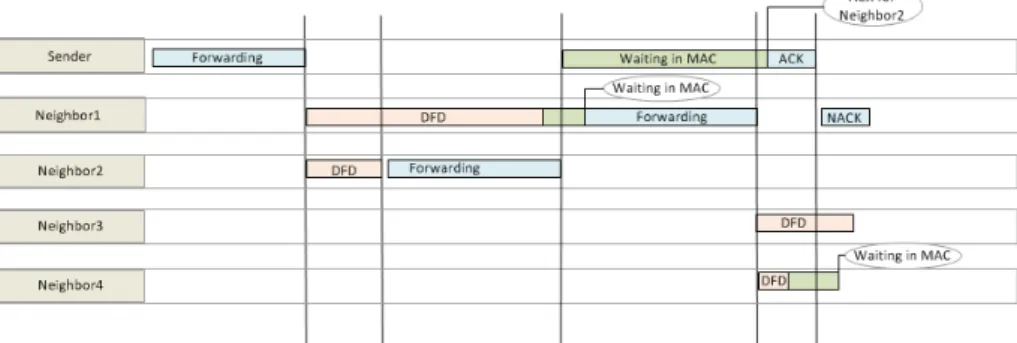
Figure 3 indicates a sample scenario which shows the reason of high probability of successful NACK sending in the first try. In this scenario, Neighbors 1 and 2 are neighbors of sender but they are not in the transmission range of each other. Neighbors 3 and 4 are neighbors of “Neighbor1”. Just
after receiving ACK of sender, Neighbor1 recognizes that its sent packet is duplicate. It is worth noting that the reason why Neighbor1 waits in MAC layer for Neighbor2’s transmissions while it doesn’t hear it, is that sender receives Neighbor2’s transmissions.
Therefore, with considerable probability ACK/NACK messages can stop duplications of each forwarding step of transmission in first try especially in non-dense traffic and because of ACK and NACK are sent by only those nodes that have forwarded the packet (main or duplicate) and these kinds of message have little sizes in comparison with data
packets, this mechanism can reduce the overhead of routing. For example of “CBF with ACK” routing protocols, in a scenario which is presented in Figure 4, sender has a packet for forwarding. It is supposed that destination is located at the end of the same street where sender is located on and sender moves toward destination.
Figure 4.Sample scenario of CBF with ACK
3.2 n-hop stop
In n-hop stop, routing is done similar to CBF with ACK except that all the neighbors of Mth forwarders in transmission sequence wait for an ACK from the corresponding Mth forwarders before starting competition for next hop selection where M is a multiples of n (n is a constant value. For example n can be 4 and consequently Mth forwarders are 4th, 8th and …). These ACKs that come from Mth forwarders for starting the next hop competitions don’t confirm any special nodes. With receiving this kind of ACK, neighbors who already have received the packet compete with each other to become next hop. With this mechanism in
network with heavy data traffic, we can be sure that duplicate packets which have propagated because of delayed ACK and delayed NACK will be stopped in utmost nth hop ahead. More precisely, if ACKs and NACKs have delay (e.g. wait in data link layer because of other transmissions in the same shared environment), with this mechanism in the worst case, in nth nodes ahead, data packet waits until receiving an ACK or a NACK and as a result duplicate or main packet becomes recognized. Of course, in some cases NACK can get duplicate packet before reaching stopping steps (before nth nodes). Figure 5 presents the flowchart of n-hop stop routing protocol.
122 International Journal of Communication Networks and Information Security (IJCNIS) Vol. 6, No. 2, August 2014
Figure 6 presents a sample scenario of n-hop stop routing. Suppose that n is 4 (stopping steps are 4th, 8th and …). It is also assumed that first node which originally creates and sends a packet, assigns 0 to hop count field (nodes which receive the packet with hop count 3, 7 and … should wait).
Figure 6. Sample scenario of n-hop stop
4.
Theoretical analysis
In this section, we theoretically analyze our proposed algorithms. For this purpose, we check that how our protocols treat in steps of transmitting a packet toward its destination. As we explained previously, the main reasons of duplication in VANETs are close timers and obstacles between vehicles especially in the junctions. We consider situation presented in figure 7 in which vehicle C doesn’t hear vehicle B, without losing generality. So, duplication can occur, if vehicle A cannot send ACK on time for example because of close timers of vehicles B and C or maybe since losing competition for sending in MAC layer due to other send behind of vehicle A.
Figure 7. duplication scenario
In this scenario, vehicle D sets DFD2 timer for competing to be selected as next hop in response to receiving duplicate packet sent by vehicle C. In such condition, using “CBF with ACK”, NACK packet should prevent from continuance of duplicate packet propagation sent by vehicle C. For successful prevention, needed time by NACK to reach vehicle D should be less than DFD timer of vehicle D. F
Delaymac(ACK, A, C) + Delayforwarding(ACK, A, C) + Delaymac(NACK, C, D)
+ Delayforwarding(NACK, C, D) < D
Where Delaymac is the delay which occurs in MAC layer e.g.
for backoff time, IFS before sendings and RTS and CTS sending, that can vary based on used MAC protocol. In addition, Delayforwarding is sum of transmission delay and
propagation delay. Moreover, in both Delaymac and
Delayforwarding first parameter is kind of sending packet and
two others are current forwarder and next receiver of the packet respectively. We call first and second Delaymac in the
2 Dynamic Forwarding Delay
inequality (1) as MAC_Delay1 and MAC_Delay2.
Furthermore, we consider first and second Delayforwarding in
that inequality as forwarding_Delay1 and forwarding_Delay2.
On the other hand, in this paper we calculate DFD timer like [3]. Therefore we have:
∑ MAC_Delay!" + ∑ forwarding_Delay!" <
#1 − &'()'*++,
&'()'*++-./0 × 2345
Now we can generalize inequality (2). If we have n forwarding steps so that ACK and NACKs can prevent from propagation of the duplicate packet, we have following inequality:
∑ MAC_Delay6!" + ∑ forwarding_Delay6!" <
#1 − &'()'*++,
&'()'*++-./0 × 2345
We suppose that all propagation delays (as a factor of forwarding_delay) are equal to their upper bound. It is noticeable that Since ACK and NACK in our protocols have the same size, there is no difference between transmission delays of ACK packets and NACK packets. Hence, inequality (3) can be written as:
∑ MAC_Delay6!" + 7 × (89:7;<=;;=>7_?@A:B(CDE/
GCDE) + H9>H:I:8=>7_?@A:B345) <
#1 − &'()'*++,
&'()'*++-./0 × 2345
In inequality (4), Tmax, progressmax, propagation_delaymax and
transmission delay of ACK or NACK
(transmission_delay(ACK/NACK)) are constant values. Therefore, “number of forwarding steps until NACK can suppress duplicate packet (‘n’ in inequality (4))”, “MAC delay in each of these forwarding steps” and “progress of neighbor(s) which sets DFD timer for current forwarding of duplicate packet” are variables of inequality (4). Now we estimate constant values:
∑ MAC_Delay6!" + 7 × (3.3 × 10MN O@P>7?;) <
#1 − &'()'*++,
QRR 3*S*'+0 × 0.045 O@P>7?;
Value of MAC_Delay depends on data traffic. In heavy data traffic, it can be too long to satisfy inequality (5). In such situation n-hop stop protocol can solve the problem by stopping duplicate packet propagation in some forwarding steps. On the other hand, in lower data traffic in which ACK and NACKs just encounter for example one backoff time, the inequality (5) can be estimated as following:
7 × (10MV O@P>7?) <
#1 − &'()'*++,
QRR 3*S*'+0 × 0.045 O@P>7?;
Where 10-3 roughly is upper bound of sum of “MAC_Delay and transmission delay”, considering our suppositions. Thus, if progress of vehicle D is even 90% of the maximum progress (500 meters), n should be less than 4.5. Hence, in such situation, with 4 forwarding steps or fewer distances between forwarder of ACK or NACK which tries to suppress duplicate packet and the neighbor of current duplicate packet forwarder who sets DFD timer, ACK or NACK can successfully stop propagation of duplicate packet. Therefore we can expect that our proposed protocols can suppress duplicate packets in few steps even with the existence of MAC layer delays. For more precise evaluation, we present simulation results in section 5 to consider various complex situations.
Now we should check our protocols’ overhead reductions. If our protocols cannot suppress duplicate packets’ propagations before reaching their destination, obviously (2)
(3)
(4)
(5)
(6)
their overheads will be worse than basic suppression, because of useless ACK/NACK sending. Hence, we should calculate that in which condition they reduce overhead. For this purpose, we suppose that in each forwarding step there are averagely ‘b’ number of next hop forwarders (i.e. “b-1” duplicate forwarders in each forwarding step averagely). Also we assume that distance between sender and destination of a packet is averagely ‘n’. If our protocols can stop duplicate packets in ‘mth’ hops averagely, our protocols’ overhead reductions can be calculated by formula (7). ∑ (W6M" × X)
!R − # Y36Z × ∑3M"!R (W× (X + C)) 0 , (< ≤ 7)
In formula (7), P and A are sizes of Packet and ACK respectively. First sigma calculates size of all forwarded packets (mains and duplicates in all steps). Since in our protocols, each node which sends main packet will send ACK and each node which sends duplicate packet will send NACK, second sigma can calculate sum of sizes of all packets and corresponding ACKs or NACKs sent in each suppression phase and Y6
3Z shows number of suppression
phases (we call forwarding steps from sending duplicate packet until its suppression as a suppression phase). For example, if we have b = 2 and m = 3, figure 8 shows a suppression phase with first forwarding step of its next suppression phase. Orange branch is main branch which transmits main packet and others are duplicate branches which transmit duplicate packets. After each suppression phase, all duplicate packets are suppressed (although in real situation, duplicate packets’ suppressions usually don’t occur in the same step but for simplicity we assume that all occur in an average step) and new duplicate will be forwarded from main branch of forwarding with factor ‘b’.
Figure 8. Suppression phase
In the last suppression phase, all branches usually will be suppressed by NACKs but main branch will be stopped at the destination of the packet which can be nearer to the beginning of the last suppression phase. In the worst case, we assume that destination also is located at mth step of the last suppression phase. For overhead reduction (which should be greater than zero) based on formula (7) and geometric progression, we have:
&×("M \])
"M\ − #Y 6 3Z ×
(&^_)×("M \-)
"M\ 0 > 0
X < X × W6− Y6
3Z × (X + C) × (W3− 1)
We assume that Packet size is 100 Bytes, ACK and NACK are 14 Bytes and n (distance between sender and destination of the packet) is averagely 7. Hence we have:
100 < 100 × Wa− Ya
3Z × (100 + 14) × (W3− 1)
For simplicity of calculation, we replace Ya
3Z with its upper
bound (7/m + 1) and rewrite inequality (10) as:
100 < 100 × Wa− (a
3+ 1) × (100 + 14) × (W3− 1)
As can be seen in inequality (11), with a specific value for b, our protocols should have ‘m’ with value less than a maximum value so that their overheads become reduced in comparison with basic suppression. For example, with 1.2, 1.3, 1.5 and 2 as values for b, mmax will be almost 2.65, 3.59,
4.67 and 5.66 (it is noticeable that in real world with different values for parameters of inequality (9), e.g. larger packet, and more precise value for Ya
3Z instead of its upper
bound, these mmax can be even higher). Hence, with even few
branching factors, our routing protocols can stop duplicate packets a few steps later while they still reduce the overhead. For evaluation more accurately, we use simulation in the next section.
5.
Simulation
For evaluation of presented routings, we use OMNeT++ version 4 [21]. Basic suppression and area-based mechanisms of [3] are chosen for comparison with our routings. Reuleaux triangle is selected as shape of suppression area. In all of routing protocols, “Avoidance of Simultaneous Forwarding” presented by [12] is used. End-to-end delay, reliability (Nnon-duplicate received packets in their destinations /
Ntotal sent packets), overhead (OH=Nbytes forwarded by all nodes in the network
/ Nnon-duplicate received bytes in their destination) and normalized overhead
(NOH) are metrics for comparison. NOH formula is:
NOH= Nbytes forwarded by all nodes in the network
∑ (Nhops visited
by i
× Nbytes
of i
) for eah non-duplicate
received packet 'i' in its destination
Where N presents the number of its subscript. Simulation parameters are presented in Table 1.
Table 1. Simulation parameters
parameter value
Vehicles’ transmission range 500 m
Data link layer protocol
extension of 802.11 broadcast with collision avoidance like extension proposed by [20] at 2 Mbps slot of data link layer’s
backoff times 20 microseconds
Tmax of DFD 45 ms
Packets’ payloads randomly chosen from 100 to 200 bytes
5.1 Using Random Model
For simulating random model, number of nodes is changed in a way to achieve averagely 5, 10 or 15 neighbors for each node in different simulations and packets are sent randomly by nodes with uniform probability that lead increasing data traffic with increasing network density. In some figures, clustered-column diagram is presented for illustration of values of corresponding metric for different routings more precisely in each network density. In clustered-column diagrams, the order of vertical rectangles for each network density from left to right is same as order of routings’ names beside the diagrams from top to bottom.
As seen in Figure 9, overhead (OH) of n-hop stop is totally better than other routing protocols. In the lowest simulated density of vehicles, CBF with ACK has lower overhead than n-hop stop. The reason is that in that density number of
(7)
(8) (9)
(10)
(11)
International Journal of Communication Networks and Information Security (IJCNIS)
duplicate packets reduces and therefore stopping steps cause even more overhead meanwhile it isn’t necessary in most of the cases. Furthermore, because of stopping steps, n
routing protocol suffers from carry and forward more than CBF with ACK in the lowest simulated density, because more delay in forwarding of packet to the next hop in low density when such forwarding is possible, can cause situation in which no potential next hop is available and therefore carry and forwarder occurs. More carry and forward occurrences cause more packets which aren’t received to their destinations before end of simulation (because of vehicles’ low speeds in comparison
forwarding). Consequently, ratio of sent bytes to non duplicate received bytes increases. In addition, more carry and forward occurrences cause more resends and consequently more overhead. The reason why overhead of CBF with ACK increases dramatically in network with averagely 15 neighbors for nodes, is the traffic of data transmissions and consequently increasing in waited and delayed ACKs and NACKs that causes more duplications and also more overhead of ACKs’ and NACKs’ transmissions, themselves. With managing these waited ACKs and NACKs by n-hop stop, this routing protocol has
(a) Fig
Normalized overheads (NOH) of different routing protocols have been shown in Figure 10. This figure totally confirms results presented in Figure 9 about overheads of routing protocols. However, difference between NOH of reuleaux area-based and other NOHs in network with averagely 5
(a) Figure 10 O v er h ea d [ R at io ]
Average number of neighbors
N o rm al iz ed O v e rh ea d [ R at io ]
Average number of neighbors
International Journal of Communication Networks and Information Security (IJCNIS)
duplicate packets reduces and therefore stopping steps cause even more overhead meanwhile it isn’t necessary in most of pping steps, n-hop stop routing protocol suffers from carry and forward more than CBF with ACK in the lowest simulated density, because more delay in forwarding of packet to the next hop in low density when such forwarding is possible, can cause situation in which no potential next hop is available and therefore carry and forwarder occurs. More carry and forward occurrences cause more packets which aren’t received to their destinations before end of simulation (because of vehicles’ low speeds in comparison with wireless forwarding). Consequently, ratio of sent bytes to non-duplicate received bytes increases. In addition, more carry and forward occurrences cause more resends and consequently more overhead. The reason why overhead of matically in network with averagely 15 neighbors for nodes, is the traffic of data transmissions and consequently increasing in waited and delayed ACKs and NACKs that causes more duplications and also more overhead of ACKs’ and NACKs’ lves. With managing these waited hop stop, this routing protocol has
good overhead in that traffic. In network with averagely 10 neighbors for nodes, CBF with ACK and n
roughly the same overhead. It is because that in that
density, neither carry and forward nor heavy data transmissions cause high overhead. Indeed, in that network density, ACKs and NACKs can reach on time and on the other hand because of existence of enough neighbors carry and forward occurs rarely. A little more overhead of n stop in comparison with CBF with ACK in that network density is for more useless overhead of multiple
sending extra ACKs. Also as seen in Figure 9 based suppression mechanism leads well overhead when density has increased but in lower density it causes more carry and forward and resend occurrences and consequently more overhead, because of its limitation on allowable neighbors that can participate in next hop selections’ competitions. In s
suppression mechanism has more overhead in denser networks. It occurs because with increasing in the number of neighbors, probability of forwarding duplicate packets increases in this routing much more in comparison with othe simulated routing protocols which have better suppression mechanisms.
(a) (b)
Figure 9.Overhead (OH) in Random Model
Normalized overheads (NOH) of different routing protocols . This figure totally confirms about overheads of routing , difference between NOH of reuleaux based and other NOHs in network with averagely 5
neighbors, proportionally, becomes higher in comparison with results of OHs in Figure 9
count (HC) of reuleaux area
considerably lower than HCs of other routings because of more carry and forward occurrences.
(a) (b)
Figure 10. Normalized Overhead (NOH) in Random Model
O v er h ea d [ R at io ]
Average number of neighbors Average number of neighbors
N o rm al iz ed O v e rh ea d [ R at io ]
Average number of neighbors Average number of neighbors
124 Vol. 6, No. 2, August 2014
good overhead in that traffic. In network with averagely 10 neighbors for nodes, CBF with ACK and n-hop stop have roughly the same overhead. It is because that in that network density, neither carry and forward nor heavy data transmissions cause high overhead. Indeed, in that network density, ACKs and NACKs can reach on time and on the other hand because of existence of enough neighbors carry A little more overhead of n-hop stop in comparison with CBF with ACK in that network density is for more useless overhead of multiple-nth steps for a ACKs. Also as seen in Figure 9, reuleaux area-based suppression mechanism leads well overhead control when density has increased but in lower density it causes more carry and forward and resend occurrences and consequently more overhead, because of its limitation on allowable neighbors that can participate in next hop selections’ competitions. In spite of it, routing with basic suppression mechanism has more overhead in denser networks. It occurs because with increasing in the number of neighbors, probability of forwarding duplicate packets increases in this routing much more in comparison with other simulated routing protocols which have better suppression
(b)
neighbors, proportionally, becomes higher in comparison with results of OHs in Figure 9. This is because that hop count (HC) of reuleaux area-based in that density is considerably lower than HCs of other routings because of more carry and forward occurrences.
Average number of neighbors
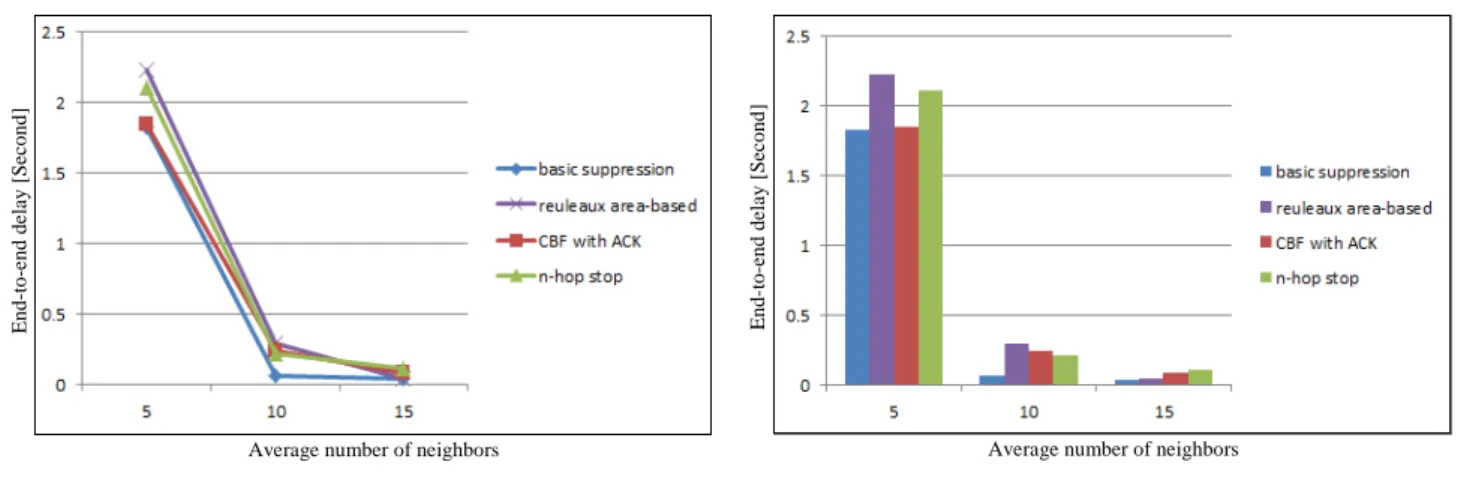
Figure 11 shows end-to-end delays of different routing protocols. As shown in the diagram, basic suppression has the least end-to-end delay among all. Although its overhead of duplications increases delay, its redundancy of forwarding through different routes decreases end-to-end delay by means of increasing chance of finding near optimum routes. Reuleaux area-based has the worst delay in networks with averagely 5 and 10 neighbors for nodes and the second best delay in network density of averagely 15 neighbors because of its higher occurrences of carry and forward and resends in lower density network that vanish in the highest density network. In more detail, in network with averagely 5 neighbors for nodes, its high carry and forward occurrences cause higher delay. In averagely-10-neighbor network, although its carry and forward occurs rarely but still it causes more delay in comparison with basic suppression and CBF with ACK. Also in spite of rare n-hop stop’s carry and forward occurrences and its almost the same overhead as reuleaux area-based in that network density, due to its multiple-nth hops’ stopping steps, n-hop stop has better end-to-end delay in comparison with reuleaux area-based. This is due to the fact that these steps’ delays cause same number of transmissions in the network take place in longer time of completion. This leads fewer collisions and consequently fewer backoff times in the MAC layer. As a result total end-to-end delay decreases. In the network with averagely 15 neighbors for nodes, reuleaux area-based has never encountered carry and forward due to existing enough neighbors. On the other hand, while it can control increment of duplications, because of limiting redundancy of forwarding to the neighbors with more suitable positions for forwarding, it has better delay in comparison with CBF with ACK in that network density. Indeed, although reuleaux
area-based’s OH is almost equal to 2/3 of overhead of CBF with ACK in averagely-15-neighbor network, in reuleaux area-based all redundant forwarding operations are transmitted by almost 1/3 of neighbors which have better positions. In addition, some part of overhead of CBF with ACK is for ACKs and NACKs especially in that network density that delayed ACKs and NACKs themselves cause more overhead, but in reuleaux area-based there is no such messages and overhead is only for duplicate data packets. In addition, some ACKs and NACKs in CBF with ACK can stop some neighbors that may even lead optimum or near optimum routes. Hence, reuleaux area-based has better chance to find near optimum routes. Moreover, less overhead of reuleaux area-based decreases MAC layer delays. Also as results indicate, n-hop stop has more delay in comparison with CBF with ACK in network densities of averagely 5 and 15 neighbors for nodes. In averagely-15-neighbor network density, this more delay is for multiple-nth hops’ stopping steps’ delays and more redundancy of CBF with ACK that causes more chance to find near optimum routes. These factors have even dominated the effect of higher CBF with ACK MAC layer delays. In 5 neighbors also because of less carry and forward occurrences of CBF with ACK, it has less delay. However, in network density of averagely 10 neighbors for nodes, n-hop stop has a little better delay. This is due to n-hop stop less collisions in MAC layer as previously described, which has even dominated the effect of a little more overhead on MAC delays and the multiple-nth steps’ stopping delays which are short in such traffic in which ACKs are received on time. It is worthy to mention that generally all these simulated routing protocols have very near end-to-end delays comparing with each other as can be seen in Figure 11.
(a) (b)
Figure 11.End-to-end delay in Random Model
Finally as can be seen in Figure 12, CBF with ACK has the best delivery ratio among all simulated routing protocols. In network density of averagely 5 neighbors for nodes, it has low overhead and low carry and forward occurrences. As a result, more sent packets reach their destinations by means of this routing protocol. After that, due to its duplications, basic suppression has the second best delivery ratio among all simulated routing protocols. Its extra overhead leads more carry and forward that causes less delivery ratio in comparison with CBF with ACK. N-hop stop’s multiple-nth stopping steps also causes high carry and forward and low
delivery ratio. Reuleaux area-based has the worst delivery ratio by reason of its high occurrences of carry and forward. In network density of averagely 10 neighbors for nodes, because of existence of enough potential next hops in most of the cases, delivery ratios have become very high. Basic suppression and CBF with ACK have 100% delivery ratio and two other routing protocols have almost 99% reliability. These percentages become 100% for all routing protocols with increasing in number of neighbors in the averagely-15-neighbor network.
E
n
d
-t
o
-e
n
d
d
el
ay
[
S
ec
o
n
d
]
E
n
d
-t
o
-e
n
d
d
el
ay
[
S
ec
o
n
d
]
126 International Journal of Communication Networks and Information Security (IJCNIS) Vol. 6, No. 2, August 2014
(a) (b)
Figure 12. Delivery ratio in Random Model
5.2 Using Map
We use sumo 0.12.3 [22] for simulating traffic flow in urban environment. Map and traffic flow exploited in our simulations are from [23]. We also use [23] for connecting sumo to OMNeT. In the following, the results of map-mode simulations are presented.
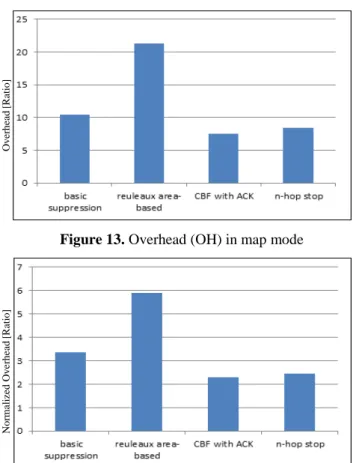
As can be seen in Figure 13, CBF with ACK has the least overhead among all simulated routing protocols. n-hop stop ranks second. The reason of better overhead of CBF with ACK in comparison with n-hop stop is that in traffics restricted along roads, in spite of what happens in Random model, neighbors can’t be located in all positions throughout the transmission range of forwarder. Therefore, concerning each position, environment is sparser along some directions and less duplication occurs. In addition, because of fewer nodes participating in competitions for next hop selections in sparser environments, ACK and NACK have more chance to be transmitted sooner. So the overhead of multiple-nth hops’ stopping steps isn’t useful in such traffics and only increases total overhead without usefully preventing from duplicate packets’ overhead. On the other hand, in such a sparse network, delay of forwarding in multiple-nth hops can increase probability of need for resending and for carry and forward without any advantages. As mentioned previously, more carry and forward occurrences can cause less reached packets in their destinations and consequently can increase overhead. Basic suppression has more overhead in comparison with CBF with ACK and n-hop stop, because the lack of suitable mechanism for controlling duplications. Finally reuleaux area-based has the worst overhead among all simulated routing protocols. This is because that it limits allowable neighbors which can participate in next hop selection’s competition as already mentioned. Hence, probability of forwarding in many cases declines considerably when straight directions of forwarding cases are along free areas of vehicles because of roads’ shapes. Thus in this routing protocol, carry and forward and resend increase and consequently overhead raises. Normalized overheads of routing protocols shown in Figure 14 also confirm overheads.
Figure 13. Overhead (OH) in map mode
Figure 14. Normalized Overhead (NOH) in map mode
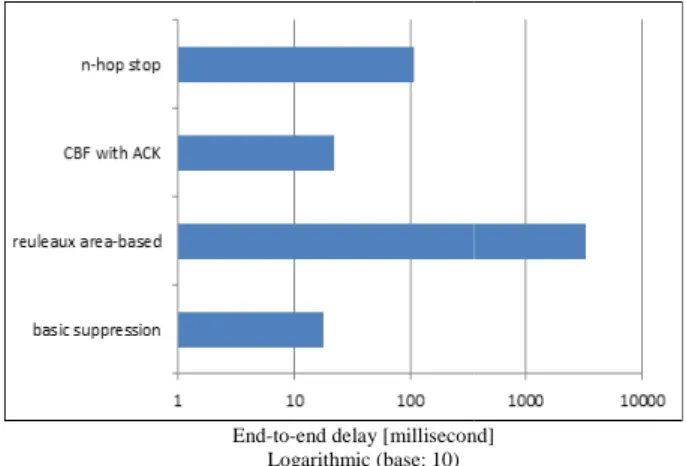
Figure 15 indicates end-to-end delays of simulated routing protocols. As can be seen, basic suppression has the least end-to-end delay. The reason is that it uses redundant routes toward destination that increases the chance of finding optimum or near optimum route. Although redundancy can increases overhead and consequently link layer delays, its finding optimum route has dominated to this extra link layer delay. CBF with ACK is placed second considering end-to-end delay in map mode. After that n-hop stop ranks third with little extra delay because of its multiple-nth stopping steps. Ultimately, reuleaux area-based has the worst end-to-end delay among simulated routing protocols, because its carry and forward occurrences especially in cases in which straight forward directions toward destinations of packets have considerable deviations from the roads’ directions as mentioned previously.
D
el
iv
er
y
r
at
io
D
el
iv
er
y
r
at
io
Average number of neighbors Average number of neighbors
O
v
er
h
ea
d
[R
at
io
]
N
o
rm
al
iz
ed
O
v
e
rh
ea
d
[R
at
io
Figure 15. End-to-end delay in map mode
Delivery ratios of different simulated routing protocols are presented in Figure 16. As can be seen, CBF with ACK has the highest delivery ratio among all. That is due to its low carry and forward occurrences that was previously explained for overhead results of map mode. Indeed, less number of carry and forward occurrences causes more number of reached packets and less number of carried packets until ends of simulations’ times. After that, basic suppression has the second highest delivery ratio. On the one hand, it more overhead than n-hop stop that can produce more link layer delay and consequently more carry and forward occurrences; on the other hand its redundancy increases chance of finding a route to deliver packet to its destination. As results indicate, its positive effect on delivery ratio has dominated. Finally reuleaux area-based ranks last in term of delivery ratio, because of its high carry and forward occurrences.
Figure 16.Delivery ratio in map mode
6.
Conclusions
In this paper, we try to propose suitable routing protocols for VANETs. We use contention-based routing protocol with basic suppression presented by [3] as basis of our own routing protocols. We use two mechanisms that control duplicate messages which cause considerable overhead that can be a serious problem for CBF with basic suppression’s scalability. In VANETs, two important sources of duplication are close timers and vehicles in junctions. As simulation results indicate, in random model of vehicles’ mobility, CBF with ACK (our first proposed routing protocol) has very well results totally in sparser networks. CBF with area-based suppression (reuleaux as suppression area) has generally very well results in denser network in that
End-to-end delay [millisecond] Logarithmic (base: 10)
D el iv er y r at io
end delay in map mode
ratios of different simulated routing protocols are . As can be seen, CBF with ACK has the highest delivery ratio among all. That is due to its low carry and forward occurrences that was previously explained p mode. Indeed, less number of carry and forward occurrences causes more number of reached packets and less number of carried packets until ends of simulations’ times. After that, basic suppression has the second highest delivery ratio. On the one hand, it has hop stop that can produce more link layer delay and consequently more carry and forward occurrences; on the other hand its redundancy increases chance of finding a route to deliver packet to its destination. ts positive effect on delivery ratio has based ranks last in term of delivery ratio, because of its high carry and forward
Delivery ratio in map mode
In this paper, we try to propose suitable routing protocols for based routing protocol with basic suppression presented by [3] as basis of our own routing protocols. We use two mechanisms that control e considerable overhead that can be a serious problem for CBF with basic suppression’s scalability. In VANETs, two important sources of duplication are close timers and vehicles in junctions. As simulation results indicate, in random model of vehicles’
bility, CBF with ACK (our first proposed routing protocol) has very well results totally in sparser networks. based suppression (reuleaux as suppression area) has generally very well results in denser network in that
model. In contrast, in the urban simulations (map mode) this area-based suppression mechanism totally has bad results because of its limitation on the place of candidate nodes for selecting as next hop. In this mode, CBF with ACK has generally very good results. It reduces overhea
comparison with CBF with basic suppression while roughly preserves end-to-end delay and delivery ratio of CBF with basic suppression (with a little more delay and even a little better delivery ratio).
As described in section 2, a number of
used ACK after forwarding step in other forms for preventing from duplications, but in this paper we only study our proposed routing protocols as samples of using ACK in this way in comparison with contention
with basic suppression and area
results show suitability of our methods, it is needed to do more study about the ways in which such using ACK can be exploited (as MAC layer function, in combination with NACK and etc.) and even new mec
overhead by using ACK in this way can be presented.
References
[1] T. Sukuvaara, C. Pomalaza Networking Pilot System for Vehicle
and Vehicle-to-Vehicle Communications,” International Journal of Communication Networks and Information Security (IJCNIS)
2009.
[2] R. Baumann, “Vehicular Ad hoc Networks (VANET),” Master’s Thesis in Computer Science, ETH Zurich, 2004.
[3] H. Füßler, J. Widmer, M. Käsemann, M. Mauve, H. Hartenstein, “Contention
ad hoc networks,” Ad Hoc Networks, vol. 1, no. 4, pp. 351–369, Nov. 2003.
[4] H. Füßler, H. Hartenstein, J. Widmer, M. Mauve, W. Effelsberg,
“Contention-Scenarios,” In Proceedings of the 1st Int
Workshop in Intelligent Transportation (WIT), pp. 155–159, 2004.
[5] C. Lochert, M. Mauve, H. Füßler, H. Hartenstein, “Geographic Routing in City Scenarios,” ACM SIGMOBILE Mobile Computing and Communications Review, vol. 9, no. 1, pp. 69
[6] H. Kalosha, A. Nayak, S. Rührup, I. Stojmenovic, “Select-and-Protest-Based Beaconless Georouting with Guaranteed Delivery in Wireless Sensor Networks,” In Proceedings of the 27th Conference on Computer Communications. IEEE (INFOCOM 2008.)
AZ, pp. 346-350, 2008.
[7] B. Karp, H. T. Kung, “GPSR: greedy perimeter stateless routing for wireless networks,” In Proceedings of the 6th annual international conference on Mobile computing and networking (MobiCom '00), pp. 243 254, 2000.
[8] J. Chennikara-Varghese, W.
“Survey of Routing Protocols for Inter
Communications,” In Proceedings of the Third Annual International Conference on Mobile and Ubiquitous Systems: Networking & Services,
5, 2006. [millisecond]
e urban simulations (map mode) this based suppression mechanism totally has bad results because of its limitation on the place of candidate nodes for selecting as next hop. In this mode, CBF with ACK has generally very good results. It reduces overhead of routing in comparison with CBF with basic suppression while roughly end delay and delivery ratio of CBF with basic suppression (with a little more delay and even a little
As described in section 2, a number of other works also have used ACK after forwarding step in other forms for preventing from duplications, but in this paper we only study our proposed routing protocols as samples of using ACK in this way in comparison with contention-based forwarding sic suppression and area-based suppression. Since our results show suitability of our methods, it is needed to do more study about the ways in which such using ACK can be exploited (as MAC layer function, in combination with NACK and etc.) and even new mechanism of controlling overhead by using ACK in this way can be presented.
C. Pomalaza-ráez, “Vehicular Networking Pilot System for Vehicle-to- Infrastructure Vehicle Communications,” Communication Networks and (IJCNIS), vol. 1, no. 3, pp. 1-11, R. Baumann, “Vehicular Ad hoc Networks (VANET),” Master’s Thesis in Computer Science, ETH Zurich, H. Füßler, J. Widmer, M. Käsemann, M. Mauve, H. ontention-based forwarding for mobile ad hoc networks,” Ad Hoc Networks, vol. 1, no. 4, pp. H. Füßler, H. Hartenstein, J. Widmer, M. Mauve, W. -Based Forwarding for Street Scenarios,” In Proceedings of the 1st International Workshop in Intelligent Transportation (WIT), pp. C. Lochert, M. Mauve, H. Füßler, H. Hartenstein, “Geographic Routing in City Scenarios,” ACM SIGMOBILE Mobile Computing and Communications Review, vol. 9, no. 1, pp. 69–72, 2005.
. Kalosha, A. Nayak, S. Rührup, I. Stojmenovic, Based Beaconless Georouting with Guaranteed Delivery in Wireless Sensor Networks,” In Proceedings of the 27th Conference on Computer Communications. IEEE (INFOCOM 2008.), Phoenix, B. Karp, H. T. Kung, “GPSR: greedy perimeter stateless routing for wireless networks,” In Proceedings of the 6th annual international conference on Mobile computing and networking (MobiCom '00), pp. 243–
1-128 International Journal of Communication Networks and Information Security (IJCNIS) Vol. 6, No. 2, August 2014
[9] C. E. Perkins, E. M. Royer, “Ad hoc on-demand distance-vector routing,” In Proceedings of the Mobile Computing Systems and Applications (WMCSA '99)- Second IEEE Workshop on, New Orleans, LA, USA, pp. 90-100, 1999.
[10] M. Ali Cherif, M. K. Feraoun, S. Boukli Hacene, “Link Quality and MAC-Overhead aware Predictive Preemptive Multipath Routing Protocol for Mobile Ad hoc Networks,” International Journal of Communication Networks and Information Security (IJCNIS), vol. 5, no. 3, pp. 210–218, 2013.
[11] I. Amadou, F. Valois, “Pizza Forwarding: A Beaconless Routing Protocol Designed for Realistic Radio Assumptions,” In Proceedings of the Fourth International Conference on Sensor Technologies and Applications (SENSORCOMM), Venice, pp. 495–500, 2010.
[12] M. Witt, V. Turau, “BGR: blind geographic routing for sensor networks,” In Proceedings of the Third International Workshop on Intelligent Solutions in Embedded Systems, pp. 51-61, 2005.
[13] J. A. Sanchez, R. Marin-Perez, P. M. Ruiz, “BOSS: Beacon-less On Demand Strategy for Geographic Routing in Wireless Sensor Networks,” In Proceedings of the IEEE international Conference on Mobile Ad hoc and Sensor Systems (MASS), Pisa, pp. 1-10, 2007. [14] I. Jang, W. Choi, H. Lim, “An opportunistic forwarding
protocol with relay acknowledgment for vehicular ad hoc networks,” Wireless Communications and Mobile Computing, vol. 11, no. 7, pp. 939–953, 2011.
[15] M. Heissenbüttel, T. Braun, T. Bernoulli, M. Wälchli, “BLR: beacon-less routing algorithm for mobile ad hoc networks,” Computer Communications, vol. 27, no. 11, pp. 1076-1086, 2004.
[16] T. Dinh, D. Nguyen, H. Thuan, “Hybrid contention-based geographic routing in wireless sensor networks,” In Proceedings of the Second Symposium on Information and Communication Technology (SoICT '11), pp. 86-91, 2011.
[17] X. Shi, K. Liu, “A contention-based beaconless geographic routing protocol for mobile ad hoc networks,” In Proceedings of the Third International Conference on Communications and Networking, pp. 840-843, 2008.
[18] T. Camp, J. Boleng, L. Wilcox, “Location information services in mobile ad hoc networks,” In Proceedings of the IEEE International Conference on Communications (ICC), pp. 3318–3324, 2002.
[19] H. Saleet, R. Langar, O. Basir, R. Boutaba, “Proposal and Analysis of Region-Based Location Service Management Protocol for VANETs,” In Proceedings of the Global Telecommunications Conference (IEEE GLOBECOM), pp. 1–6, 2008.
[20] K. Tang, M. Gerla, “MAC layer broadcast support in 802.11 wireless networks,” In Proceedings of the 21st Century Military Communications Conference Proceedings (MILCOM), vol. 1, Los Angeles, CA, USA, pp. 544-548, 2000.
[21] “OMNeT++4.” [Online]. Available:
http://www.omnetpp.org/. [Accessed: 27 Aug. 2011]. [22] “Sumo 0.12.3.” [Online]. Available:
http://sourceforge.net/projects/sumo/files/sumo/. [Accessed: 27 Aug. 2011].
[23] “Veins.” [Online]. Available: