SECTION 4
THEORETICAL FRAMEWORK
PROCESS STANDARDIZATION OVERVIEW
According to BWise (2013), a NASDAQ OMX company, complex organizations with
subsidiaries in different countries, or those that have merged and incorporated other companies over years, may find it difficult to set up a single business process that is appropriate for each office. Personnel may not understand the differences between how the departments works from one other. This can lead to inefficiencies and may also result in different conclusions on data across departments. Process standardization can enable an enterprise to become a more transparent and flexible organization, and can be the basis for realizing operational excellence.
Operational excellence in an organization means it has its business processes not only standardized, but also optimized to realize the company’s objectives as quickly and efficiently as possible. These business processes can be especially important in regards to the enterprise’s sustainable competitive advantage compared to the competition. To realize this advantage, companies need to standardize their processes and embed them across the entire organization, so that best practices and higher performance are created and replicated.
An additional value of process management is that it enables employees and managers to understand the way their personal processes work. Process management reduces the unpredictability that is inherent in business processes. When variability and unpredictability is recognized, better processes and frameworks can be created. Putting preparedness and proactive process management into practice, along with the creation of standardized processes, can raise operational and business efficiencies for the company.
Alp Performance organization (2010) specifies that standardization activities permit to seek for stability. In fact, it is not possible to improve methods without work organization of stabilization phase. The day-to-day operations have to follow a certain “standard” to be coherent with the company world-wide resources. Therefore, the new practices are well-defined and formalized, and the managers can train, help and assist employees, without always monitoring and calling them to order.
A standard can be defined by best practices:
• It defines the best and the easiest way to use a process and the most reliable
method to execute a process
• It should be simple, clear and evident to facilitate its application
• It preserves the know-how and exposes links between causes and effects
• It is the basic reference for training, audit and improvement
WHAT IS A STANDARD?
According to the International Organization for Standardization (ISO), a standard is a
“document established by consensus that provides, for common and repeated use, rules, guidelines or characteristics for activities or their results, aimed at the achievement of the optimum degree of order in a given context.”
Borraz, Olivier (2007) defines that “standards share four major characteristics: they result from the work carried out by interested parties, they are based on scientific and technical data, they rely on consensus, and their application remains voluntary.”
WHAT IS A PROCESS?
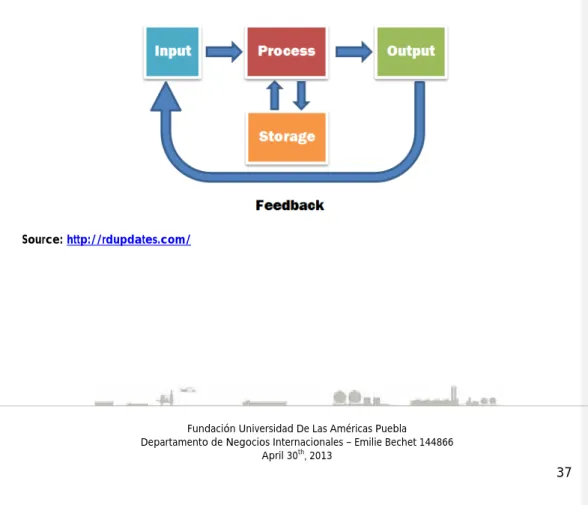
ISO defines a process as a “set of interrelated activities that transforms inputs into outputs".
Processes permit to understand and satisfy customer requirements, and to avoid unwanted elements.
According to Born, Cary (1994), “process cannot stand alone: it must have input or output
or both. This information will provide the necessary links between processes and also provide the flow of control which determines the order in which processes are carried out.
At the point of entry to a process, information is called input. At the point of exit from a
process, information is called output.
Processes include all the operations and are described or prescribed by procedures and work instructions. So processes are linked by information, or more correctly, by the flow of information.”
Illustration 4.1 Process Model
In addition, Krajewski, Lee J. & Ritzman, Larry P. (2005) remark that “every business is composed of a set of processes”. A process of an organization permits to understand its whole structure. Each department has its own “set of objectives, set of resources with capabilities to achieve this objectives, and managers and employees responsible for their performance”. However, the concept of process can have its own “set of objectives, involve a work flow that cuts across departmental boundaries, and require resources from several departments.” Indeed, we understand that a keen understanding of how their processes do work is the key to success.
Organizations can increase their efficiency by analyzing work methods and improving documentations for all employees:
“Each worker performs a standardized task or work method each day, so productivity tends to increase because, with increased repetition, workers learn to do the task more efficiently. Once a company has gone through the effort of making its processes capable, it must document its level of quality so as to better market its services or products. This is especially important in international trade.
To overcome this problem, the International Organization for Standardization devised a set of standards called ISO 9000. More especially, ISO 9001 is a standard that focuses on 20 aspects of a quality program for companies that design, produce, install, and service products. These aspects include management responsibilities, quality system documentation, purchasing, product design, inspection, training, and corrective action. It is the most comprehensive and difficult standard to attain”.
So, we realize that standard processes play a key part to understand the whole organization. To do so, companies should use ISO 9001 standard in order to ensure quality and to better sell its products.
THE PROCESS APPROACH
To implement processes, workers have to undertake a first approach to them.
According to Qualitadmin Conseil (2010), the process approach or approach to process
management refers to a systematic control of activities to results. It is based on the identification of key processes of the organization, their description, their measurement and continuous improvement.
Krajewski, Lee J. & Ritzman, Larry P. (2005) said that Continuous improvement is using a lean system approach: the Japanese term for this approach is Kaizen. Its key is the “understanding that excess capacity or inventory hides underlying problems with the processes that produce a service or a product. Lean systems provide the mechanism for management to reveal the problems by systematically lowering capacities or inventories until the problems are exposed”.
Using Lean systems employees and managers can identify problems and find ways to for overcoming those problems.
The process approach aims to be able to “implement the principle of continuous improvement independently with coherent grouping of activities, efficient with pilot with sufficient authority, and relevant regarding process objectives from the objectives general”.
LEAN OFFICE MANAGEMENT APPROACH
According to the Business Process Management Services (2013), there is another way to
improve best practices. For instance, Business Process Redesign (BPR) and Business Process Management (BPM) are very useful to improve quality, client orientation, and organization effectiveness. Despite all of these work techniques, projects, initiatives, or manual procedures, there are a lot of inefficiencies. Those inefficiencies can be controlled
Adopting the “Lean” approach involves transforming the organization and its practices looking for performance through continuous improvement. Its objective is to transform processes so that they become as “lean” as possible, so as to improve competitive position and added-value of the organization.
Its method is to detect and delete all wastes in each process (inventory, over production, useless operations, failure, waiting), simplifying the value-added activities. As a result, employees can spend more time on priority tasks.
There are 4 types of waste:
1. Waste of time by executing unnecessary tasks
2. Waste due to unknown or incorrectly applied processes
3. Waste due to a lack of information
4. Waste due to an insufficient use of tools
The Lean approach follows 3 major axes:
1. Operational system: the strategy is to focus on the rapidity of operations, delay
reduction, cost optimization, and quality improvement, in order to deliver products or services on time according to the initial order.
2. Management system: the organization has to promote the new approach, mobilize
and motivate operational teams, empower stakeholders, and communicate objectives and results.
3. Work culture: that is to say spirit and behavior of employees and leader
encouragement.
One of the Lean Management Office techniques is named Lean Six Sigma approach. It
focuses on the global quality improvement of services or products from manufacturing processes. Six Sigma is based on client needs, and measurable and reliable data of processes.
The Lean Six Sigma approach is composed of the following steps:
• Define: what are the different objectives of the required performance?
• Measure: what are we going to measure in order to follow these objectives?
• Analyze: what are the causes of the identified problem?
• Improve: what are the process improvement solutions?
• Control: how can we ensure improvement on a long term basis?
PROCESS STANDARDIZATION EXPLANATION
Nowadays, competition between companies is constantly increasing. Customers’ demand and technological innovation have been developing at great speed. That is why companies had to change their management system, to improve their processes, to lower
their costs and create new added-values. Process standardization plays a vital role in
improving growth and development of companies all over the world.
According to Tafolla (2000), the fundamental elements of standardization strategy are:
1. Establishment of missions, objectives, purposes and goals to respect organization
culture
2. Creation of an action plan on a long-term basis
3. Election of a leader to manage the project
4. Establish evaluation criteria of the results to facilitate decision making
5. Build a final report to oversee the accomplished activities and to maintain control
6. Develop a continued feedback and improvement of each department, by increasing
communication flow
The development of standardization processes can contribute to a form of “re-regulation”
Bolles, Dennis L. & Hubbard, Darrel G. (2006) mention that standardization means “establishing a project business management methodology (PBMM) model composed of a set of defined and integrated project management and business management processes”. These processes are aligned with the development processes of the enterprise’s products and services and are supported by associated written procedures.
Standardization requires the formal issuance, acceptance, and implementation of policies, processes, systems, plans, and procedures that are used consistently across the enterprise to authorize and manage all portfolios, programs, and projects.
Standardization is the best way to effectively spread the competencies and skills of project business management throughout an enterprise to achieve maximum benefits.
The goal is to “support inculcating project business management as a core capability and discipline that is part of the fabric of the enterprise’s work”.
According to Bolles, Dennis L. & Hubbard, Darrel G. (2006), standardized processes offer
the following benefits:
• “Improving efficiency and shortening the learning curve for new portfolio, program,
and project managers
• Supporting schedule improvement and cost reductions
• Enhancing planning and management skills
• Enabling consistent tracking of actual versus planned schedule and cost
• Facilitating regular management reviews of status
• Aiding in maturing the organization’s project business management methods
• Improving the effectiveness and capability of the enterprise to manage portfolios,
programs, and projects
• Providing standardized management models and tools that support profitability and
• Improving the ability to achieve strategic business objectives and obtain the related benefits
• Improving operational business processes
• Providing standardized material supporting project management career path
development”
Therefore Ebel, Kenneth E. (1991) emphasizes that process management should be
controlled. “This is a substantially more effective method for ensuring acceptable quality than that of product/service unit inspection. All activities performed in an organization are part of one or more processes. Many of the processes may be limited to one functional area or organizational unit; although most processes involve more than one functional or organizational unit”.
Process management is itself a process which can be subdivided into sub processes, for example, process definition, control, monitoring, corrective action, and improvement.
The Process Improvement is the single most effective approach to improving quality and reducing cost. Improvement in work processes should be pursued from two directions:
“Management directed – based on management monitoring of performance,
prioritizing improvement efforts, and initiating process improvement efforts (which is most effectively accomplished by forming a structured team to address each problem area.
Self-initiated – based on individual and group awareness of problems, investigation,
and correction proposal (most effectively accomplished by developing a culture of continuous improvement and through the use of self-directed structured teams)”. In each of these approaches, broad use of quality measuring/monitoring instruments and reporting systems is essential.
• “All processes can be improved to reduce variation in the resultant products/services, production time, and cost; and to increase productivity, effectiveness, and product/service quality
• Everyone should be involved in process improvement
• Data, quality, productivity, and statistical evaluation of this data are essential in
DIAGNOSTIC FORMULATION
The theoretical framework aided us in understanding that standardization of processes is the turnkey operation for companies to raise operational and business efficiency.
Process standardization can enable an enterprise to become a more transparent and flexible organization and permit better stability. Therefore making it easier to create best practices and ensure higher performance.
To reach their objectives as quickly and efficiently as possible, companies have to develop and control additional value of process management. Indeed, standardization is the best way to spread competency and skill of project business management throughout all the enterprise and to achieve maximum benefits.
Thanks to the cognitive map, we realized that AUGE does not sufficiently use the Lean Office Management techniques. Due to some obstacles and wastes in flow processes, we conclude that there is a lack of process standard control, communication flow and continuous improvement. All this affecting greatly process profitability.
In this project, we will explain “How standardization of process and best practices can
support the international growth of a fastener company?” trying to make all processes as lean as possible, in order to improve, on a long term basis, competitive position and added-value of the organization.